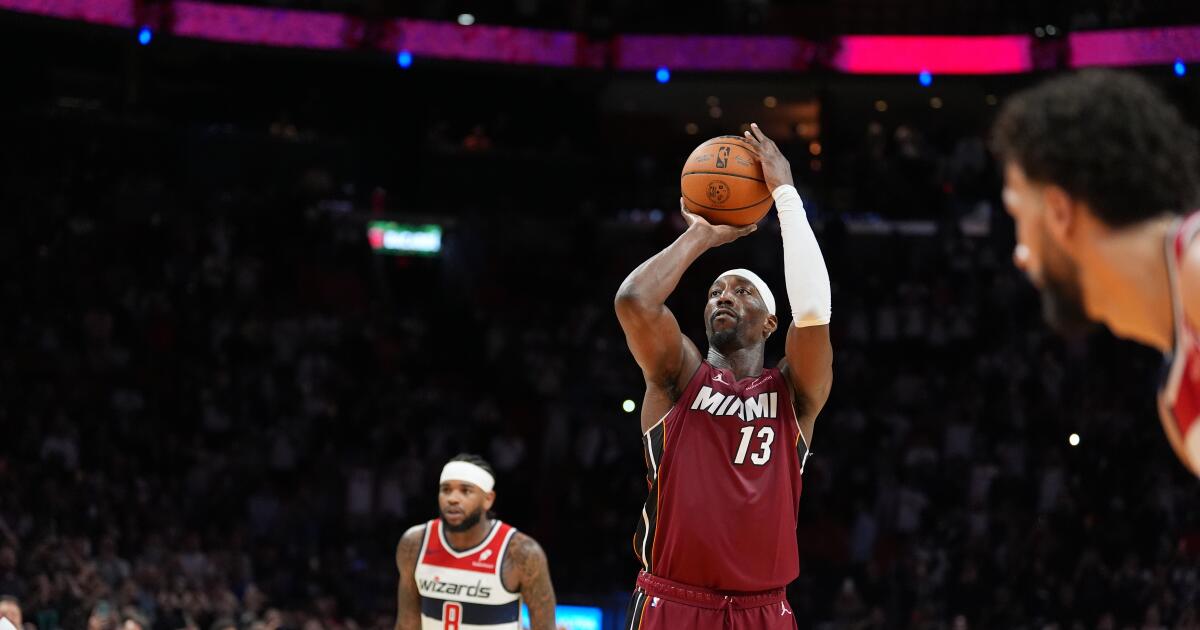
Bam Adebayo used a cheat code to score 83 points
From Mirjam Swanson: Wham, Bam, pfft.
Miami Heat center Bam Adebayo scored 83 points Tuesday night, the second most in an NBA game in history, surpassing Kobe Bryant’s iconic 81 points two decades ago.
Congrats to Adebayo, I guess.
The way it went down was highly questionable. Nothing romantic or real about it. We thought flopping and foul-baiting made for unethical hoops, but those are but basketball misdemeanors; Adebayo’s big night was felonious.
Tuesday’s game featured intentional clock-stopping, game-extending fouls by the Heat. And it was ripe with free-throw-abetting fouls by the Washington Wizards, an actively tanking team that got itself blown out, 150-129.
So, no. Bryant’s necessary, organic 81 this was not. The Lakers trailed that game against the Toronto Raptors on Jan. 22, 2006, at halftime and actually needed Kobe’s 55 second-half points to pull away for the win.
The Heat were up by as many as 28 points in the fourth quarter with Adebayo continuing to play pop-a-shot in the historic farce — which also moved him past LeBron James, whose 61 points in 2014 stood as Miami’s previous franchise record.
Now a Laker, LeBron cheered the effort on X, writing: “BAM BAM BAM” with a bunch of fire emojis.
Clippers run up big score in victory
Kawhi Leonard scored 45 points and the Clippers routed the Minnesota Timberwolves 153-128 on Wednesday night, moving above .500 with their third straight victory and sixth in seven games.
Eighth in the Western Conference at 33-32 after opening 6-21, the Clippers had their highest point total of the season. They blew out Minnesota after beating New York on Monday night to open a five-game homestand.
Leonard was 15 of 20 from the the field, six of nine on threes and made nine of 10 free throws. Los Angeles made 19 of 37 threes.
USC men’s basketball season ends with a thud
From Luke DeCock: The eventual end of the USC men’s basketball season came the same way that it fizzled out during the past month, with yet another second-half collapse that featured the added pain of overtime.
Tuesday’s 83-79 overtime loss to Washington in the Big Ten tournament, the Trojans’ eighth straight defeat, brought to a close what USC coach Eric Musselman called the toughest stretch of his coaching career. It included not only USC’s longest losing streak in a decade, but a pair of 19-point losses to UCLA and the dismissal of leading scorer Chad Baker-Mazara from the team in the past 10 days alone.
The Trojans led the Huskies by 13 in the second half and had chances to win at the end of regulation and overtime, only to miss all three potential game-winning or game-tying shots and go 2-for-5 from the free-throw line in overtime. For a team that was once in NCAA tournament consideration before stumbling, that failure to finish was a persistent flaw.
Iran won’t play in World Cup
From Kevin Baxter: Iran’s sports minister said his nation will not participate in this summer’s World Cup following the attacks on the country by the U.S., one of the tournament’s hosts.
The U.S. bombing campaign against Iran, which began two weeks ago, has triggered a region-wide conflict and killed more than 1,300 Iranians including Ayatollah Ali Khamenei, the country’s supreme leader, according to Iran’s U.N. ambassador Amir-Saeid Iravani.
“Considering that this corrupt regime has assassinated our leader, under no circumstances can we participate in the World Cup,” sports minister Ahmad Donyamali said on state television Wednesday.
“Our players do not have security, and fundamentally the conditions for participation do not exist.”
Donyamali’s statement came just hours after FIFA president Gianni Infantino said he had received assurances from President Trump that Iran would be allowed to participate in the tournament, which will be played in the U.S., Mexico and Canada.
This day in sports history
1937 — The first National Association of Intercollegiate Athletics (NAIA) men’s basketball tournament is won by Central Missouri State. Central Missouri wins the eight-team, single-elimination tournament by defeating Morningside College (Iowa) 35-24.
1966 — In the last race of his 40-year career, John Longden wins the San Juan Capistrano Handicap at Santa Anita, aboard George Royal. He retires with a then-record number of victories, 6,032.
1984 — Jayne Torvill and Christopher Dean of Britain become the first ice dancing team to record nine perfect marks of 6.0 during the world championships.
1985 — Larry Bird scores 60 points, including Boston’s last 16, to set a Celtics record and lead them to a 126-115 victory over Atlanta.
1994 — The Arkansas men’s track and field team wins its 11th straight NCAA Indoor Championship with a meet-record 94 points. The 54-point victory margin is the biggest in the meet’s 30-year history.
2002 — Siena (17-18), with an 81-77 victory over Alcorn State in the play-in game, becomes first team in 47 years to win an NCAA men’s basketball tournament game with a losing record.
2003 — Damian Costantino’s NCAA-record hitting streak ends at 60 games, one day after he broke Robin Ventura’s 16-year-old mark. Costantino, an outfielder for Division III Salve Regina of Newport, R.I., fails to get a hit in the first game of a doubleheader against Baldwin-Wallace. It’s the first time he finishes a game hitless since March 25, 2001.
2005 — Bode Miller becomes the first American in 22 years to win skiing’s overall World Cup title. He finishes ahead of his only remaining challenger, Benjamin Raich of Austria, in the season’s final giant slalom to capture the crown.
2008 — The Houston Rockets are the third team in NBA history to win 20 straight games and ties for the second-longest winning streak with an 83-75 victory over the Atlanta Hawks.
2009 — Syracuse outlasts Connecticut in the second-longest Division I game ever played, capping a Big East tournament quarterfinal doubleheader in which the second- and third-ranked teams in the nation both lose. Andy Rautins hits a three-pointer 10 seconds into the sixth overtime to give the Orange their first lead since regulation and they go on to a 127-117 victory over the third-ranked Huskies. Much earlier in the evening, West Virginia beats No. 2 Pittsburgh 74-60.
2011 — The No. 21 Connecticut Huskies win their seventh Big East championship by winning five games in as many days. Kemba Walker shatters the tournament scoring record, getting 19 points in the ninth-seeded Huskies’ 69-66 victory over No. 14 Louisville.
2017 — Joakim Jensen finally ends what is believed to be the longest game in hockey history, scoring in the eighth overtime in the Norwegian League playoffs. More than 8 1/2 hours after the game started — and after 217 minutes, 14 seconds of play — Jensen breaks through to give the Storhamar Dragons a 2-1 victory over the Sparta Warriors. Storhamar leads the best-of-seven quarterfinal series 3-2.
2018 — Alex Ovechkin scores twice to reach 600 goals as the Washington Capitals beat the Winnipeg Jets 3-2 in overtime. The Russian winger is the 20th player and fourth-fastest in NHL history to reach 600 goals.
2018 — Marc-Andre Fleury makes 38 saves to become the 13th goalie in NHL history with 400 wins, and Ryan Carpenter scores the winning goal with 2:40 left to lead the Vegas Golden Knights over the Philadelphia Flyers 3-2.
2020 — 2020 NCAA men’s basketball tournament is cancelled over concerns of the spread of COVID-19; first time ‘March Madness’ not held since it began in 1939; women’s tournament also cancelled.
2020 — NHL announces the pausing of the 2019-20 season due to the COVID-19 pandemic.
Compiled by the Associated Press
Until next time…
That concludes today’s newsletter. If you have any feedback, ideas for improvement or things you’d like to see, email me at houston.mitchell@latimes.com. To get this newsletter in your inbox, click here.