‘CoComelon’ turns to UCLA to prove its videos aren’t addictive
Beneath azure skies and fluffy white clouds, three giggling toddlers and their mothers arrive at a candy-colored water park in the town of CoComelon.
It’s the opening of “Fast Little Fishy Splash Water Park Adventure,” a three-minute episode of “CoComelon,” the popular children’s cartoon series that is perhaps as controversial as it is appealing to young children.
Moonbug Entertainment, the studio behind “CoComelon,” says the episode, which debuted on YouTube in May, is the result of a years-long collaboration with a UCLA think tank.
In an unconventional move for a privately held entertainment company, the studio released its child development guidelines on its website Tuesday. Moonbug’s head of communications Bao Nguyen said the company began to incorporate findings from the research into its creative process in late 2025.
“It’s a great example of what we’ve been trying to do,” said Rich Hickey, Moonbug’s chief creative officer, referring to the episode. “Inclusive storytelling and learning through play — they’re all evident within that episode.”
Nina and Cody, ecstatic about visiting their neighborhood splash pad, run through fountains and hop in kiddie pools, but protagonist JJ is a bit more skeptical.
With support from his friends and his mother, who offers him goggles and a pair of orange arm floaties, JJ decides to face his fears. He joins his friends under a tipping bucket, and — spoiler alert — realizes that he actually enjoys playing in water. (“I just love to swim, swim, swim,” he sings.)
The guidelines, called the “Moonbug Learning Principles Framework,” are informed by academic research and advise that Moonbug shows should help young viewers navigate “real life moments” and “model positive relationships among children and their friends and caregivers.”
Other priorities include creating shows that encourage kids to learn through play, as this helps them develop their imagination and creativity, and featuring characters from diverse backgrounds (“CoComelon’s” Nina is Mexican American, Cece is Korean American and Cody is Black) — and giving said characters depth — across all Moonbug shows.
“We’re a digital-first company and we realized that there may be some … hesitation to sharing online content with children,” Hickey said. “This is really to keep building on the trust we think we’ve built.”
“CoComelon” is Moonbug’s flagship preschool show, and the series’ origins date back to 2006 when commercial director Jay Jeon shared a YouTube video of an alphabet cartoon set to music. The videos began to revolve around toddler JJ in 2017.
By 2020, “CoComelon” was the most-watched YouTube channel in the world, averaging 3.5 billion monthly views. That year, the show made its streaming debut on Netflix — where it broke ratings records — and was bought by London-based entertainment company Moonbug.
Moonbug was then acquired by Candle Media, a firm led by ex-Disney execs Kevin Mayer and Tom Staggs, for a reported $3 billion. Disney+ has since obtained the exclusive streaming rights to “CoCoMelon.”
“CoComelon‘s” image woes aren’t new. The series has developed a reputation for keeping children glued to the screen, as seen in videos that have gone viral on social media of babies bolting to the television upon hearing the marimba theme song.
In 2020, a Guardian columnist wrote that “CoComelon” was “like crack” for a preschool child. A New York Times report in 2022 gave the public more insight into Moonbug’s audience development process, which included testing “CoComelon” videos on young children to make its shows as attention-grabbing as possible.
The program has been a hot topic on parenting forums. The exchange typically goes something like this: Someone asks if “CoComelon” is “bad” and a gaggle of parents weigh in. “Very overstimulating,” said a user in one Reddit thread. “It moves too fast for kids’ brains to process, which can cause a speech delay,” wrote another.
Asked to respond to the criticism, Hickey said he believes Moonbug makes “age-appropriate content” and produces a range of videos to cater to different moments throughout a child’s day, from slow bedtime videos to faster-paced ones meant to encourage movement, Hickey said.
In 2023, Moonbug recruited the Center for Scholars and Storytellers, a think tank at UCLA that bridges entertainment media and psychology research, to “create the best possible product” for its audience, Hickey said.
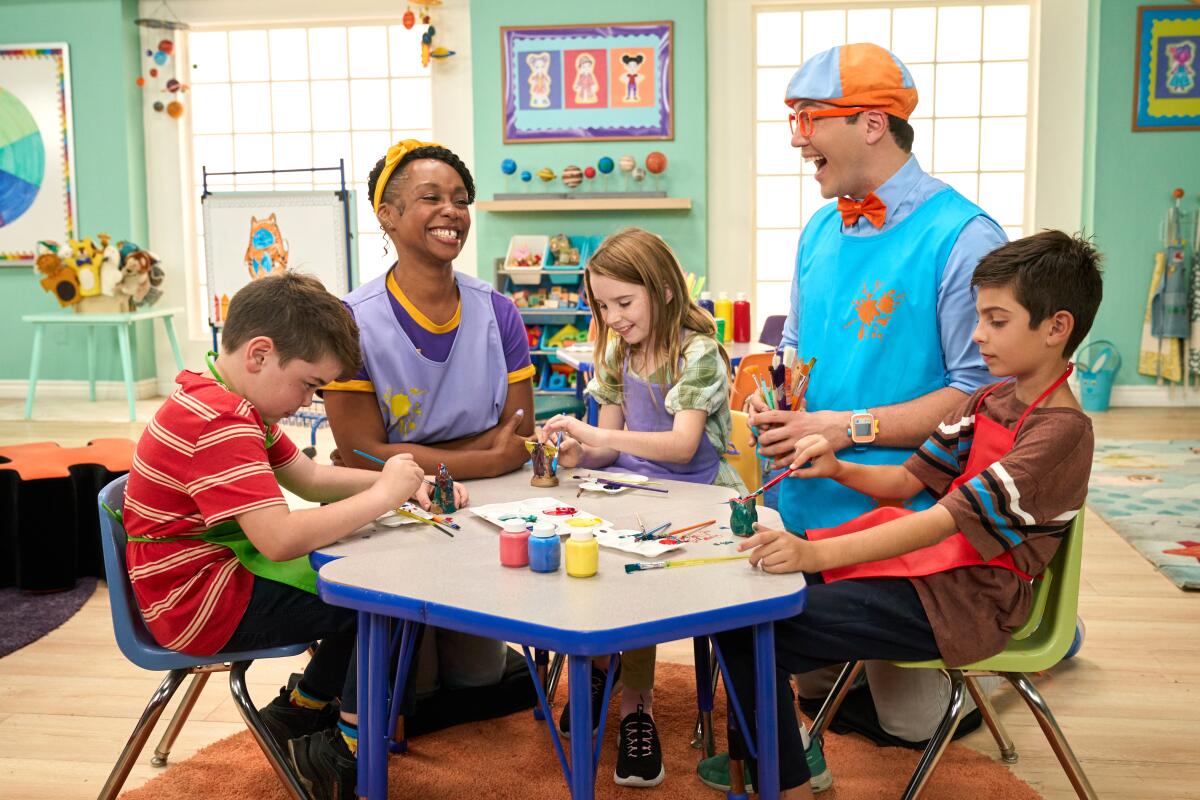
The center was tasked with analyzing Moonbug’s content and crafting the learning principles to guide the studio’s future preschool programming, which also includes the “Blippi” and “Little Angel” franchises.

A scene from Moonbug Entertainment’s “Blippi’s Job Show.”
(Jessica Perez / Moonbug)
Moonbug also asked the center to determine if there was research showing that audiovisual content could be addicting for preschoolers, said Yalda T. Uhls, an assistant adjunct professor of psychology at UCLA and executive director of the Center for Scholars and Storytellers. Uhls said the center’s review of existing peer-reviewed research found that there was no such evidence.
And despite oft-repeated claims that long-form content is better for kids than short-form content, “there isn’t really actually any evidence for that,” Uhls said. “It’s very inconclusive.”
The center found that preschool children struggle to learn as much from content with frequent cuts, though consuming it doesn’t impact their attention span negatively, Uhls said.
As such, the principles the center crafted recommend Moonbug “minimize distractions and tangential songs or storylines” when characters are navigating real-life situations to make sure it does not interfere with preschool children’s ability to learn lessons.
The center interviewed members of Moonbug’s creative teams and formed an advisory council of academic experts in child development to evaluate a selection of Moonbug’s episodes, assess the quality of socio-emotional learning and find areas for improvement, Uhls said.
“The content certainly had a lot of places where it could improve, but it wasn’t horrible,” Uhls said. “There was some learning within the episodes. … It wasn’t all good, it wasn’t all bad.”
Uhls said she recalled several instances of episodes modeling unsafe behavior, but declined to share specifics.
The center plans to continue to work with Moonbug to integrate child development research much earlier in the studio’s creative process and aid with the integration of the learning principles into its content slate, Uhls said.