After a bitter standoff, Paramount Skydance and California Atty. Gen. Rob Bonta have made progress in settlement talks that could push Hollywood’s massive merger over the finish line, people familiar with the matter said Friday.
The two sides have quietly been negotiating a truce to end the antitrust lawsuit brought by Bonta and 11 other Democratic state attorneys general — a legal volley that has threatened to derail Paramount’s $111-billion takeover of Warner Bros. Discovery.
It’s not clear how close to a resolution the two sides are, but talks in recent days have been constructive, one of the knowledgeable sources said.
Paramount Chief Executive David Ellison is highly motivated to end the court battle with Bonta before Oct. 1, when his company will be obligated to make a higher payout — an extra $7 million a day — to Warner Bros. Discovery shareholders on top of the $81 billion the company has already agreed to pay.
For weeks, Ellison and his team have been ratcheting up political heat on Bonta to abandon his lawsuit, including threatening to pull Paramount out of Hollywood — a scenario that has rattled state and local lawmakers who desperately want to bring film jobs back to Los Angeles, not lose thousands more.
Paramount declined to comment.
A spokesperson for Bonta’s office said in a statement: “Potential settlement talks are confidential. We cannot confirm or deny whether settlement talks are occurring or their alleged substance.”
Both sides have incentives to settle. Ellison, who has leaned on his family’s connections to President Trump and Washington Republicans, would like to avoid taking on more debt for the already highly leveraged deal. And he is eager to close the transaction and take the reins at Warner Bros. before the midterm elections.
Bonta has been on a winning streak with favorable rulings against the Trump administration and social media giant Meta, and he doesn’t want to overplay his hand or risk having his coalition of state attorneys fall apart.
WHEN it comes to girl groups going solo, there can only ever be one really successful member, while the others trail behind pretending to be happy for them.
Jade is enjoying huge success as a solo artist despite being the one member of Little Mix who didn’t want to take a breakCredit: ZUMA Press Wire/ShutterstockPerrie, Leigh-Anne and Jade went on hiatus in 2022 and have each spoken about the possibility of a reunionCredit: Getty Images for Warner Bros
In terms of their UK counterparts, Cheryl led the way for Girls Aloud and – although she’s not known for her music – Victoria Beckham will always be the standout Spice Girl.
As for Little Mix, it’s Jade Thirlwall who’s come out on top after her debut releases were met with huge critical and commercial success.
Sign up for the Showbiz newsletter
Thank you!
While her bandmates Leigh-Anne Pinnock and Perrie Edwards haven’t totally flopped – all three girls landed at number three with their solo albums – 33-year-old Jade’s highs have unfortunately highlighted their lows.
Leigh-Anne has turned her attention to reality TV after landed a stint on the upcoming series of Celebrity TraitorsCredit: WireImageThe Sun told last week how Perrie has split with her management company and record labelCredit: Getty Images
A well-placed insider told The Sun: “Perrie and Leigh are ready to come back now.
“They’ve done what they needed to do and would announce a Little Mix tour tomorrow if they could.
“It’s kind of ironic that Jade didn’t want the hiatus but she’s had the most success.
“But as much as she is, in her own words, Little Mix’s biggest fan, for Jade it’s just not the right time. She knows she’ll never get this chance again.”
Speaking of a possible Little Mix comeback, Perrie confessed recently she’s “ready and raring” while Leigh insisted she’s “a hundred per cent” behind getting back together.
Meanwhile, Jade has been a bit more coy in terms of timings. The Angel of My Dreams hitmaker said recently: “There will be a Little Mix reunion.”
But, suggesting her focus is elsewhere for now, she added to Capital: “It doesn’t matter how long that takes.”
We’re told Jade knows it’s not the right time for a break in her solo careerCredit: RedfernsBut Leigh and Perrie are waiting for the moment she’ll get back on stage with themCredit: JMEnternational for BRIT Awards/
We’re told that there is nothing but love between the three girls and they are as close as ever but Perrie and Leigh know that the more successful Jade becomes the longer they’ll have to wait to be back on stage with her.
Our source added: “Perrie and Leigh are super proud of Jade.
“They always knew she’d go on to do great things. They’ve each found the perfect balance as working mums but Jade doesn’t have kids so, for now at least, it’s all about her career.
“Perrie and Leigh just hope that it won’t be too much longer before Jade can clear some space in her schedule so they can be together again.”
Bitcoin (BTC-USD) is starting to consolidate above the $75,000 level after briefly reclaiming $80,000 for the first time since mid-May, underscoring persistent two-way order flow between aggressive buyers and sellers.
The timing of this resilience coincides with a striking historical
With the trade war with the US heating back up, Canada’s Prime minister Mark Carney has delivered another pledge to deepen his country’s economic and security partnership with the EU.
ADVERTISEMENT
ADVERTISEMENT
His statement came after trade talks between Ottawa and Washington collapsed last week, with Canada accusing the US of interfering in its sovereignty by demanding French-language concessions.
In retaliation, US President Donald Trump said on Truth Social that on 1 January 2027, tariffs on cars and trucks will be increased to 50%.
“WE DON’T NEED CANADA, THEY NEED US!” he wrote. “They do 95% of their business with the US, with us, the exact opposite!”
Canada announced later that, as of 8 September, it would enact tariffs ranging from 15% to 50% on over 700 American imports, worth about $20 billion (€17.2 billion).
Since Trump’s return to power in 2025 and his repeated attacks on US-Canada trade relations, Ottawa has been turning several times towards the EU, seeking a stable relationship with a “like-minded” partner.
“This fall we will begin intense discussions with the European Union, the world’s second-largest economy, to build a much stronger and deeper economic and security partnership,” Carney said on Monday.
The Canadian Prime minister has confirmed, according to Politico, that he will attend the State of the EU speech in Strasbourg on 16 September after European Commission President Ursula von der Leyen invited him before the trade war with the US broke out.
Since the start of the second Trump administration, Brussels and Ottawa have shared a common objective: diversifying their trade relations away from Washington. But since the EU and Canada are already bound by a trade agreement, how far could a deeper relationship go?
The truth is that both sides have their limits.
Intertwined Canadian and US markets
From critical raw materials to energy and defence, the last months have seen multiple areas of interest come to the fore, and they will likely set the agenda at the Canada-EU summit this fall.
Canada is planning to offer the EU better access to its critical raw materials. Brussels is desperate to move away from China, which holds the monopoly on the production and processing of rare earths. With strong domestic supplies of lithium, graphite and nickel, Ottawa has a lot to offer to integrate the EU into its metal value chain.
Canada might also make offers on energy, which it currently supplies principally to the US.
“We should be talking about a more viable Canada-EU corridor for energy, and not just in respect of oil and gas, but also of nuclear,” Mark Camilleri, President of the Canada-EU Trade and Investment Association, told Euronews. “The EU’s energy needs are increasing, and its energy supply is still very dependent on imports.”
On defence, Canada is already part of SAFE, the €150 billion defence instrument that supports EU member states that wish to invest in defence industrial production through common procurement. But defence cooperation is already set to go further, with Canada selecting German-Norwegian TKMS to build a new fleet of 12 submarines. Deepening the relationship on Arctic security could be another area of collaboration.
Canadian business, meanwhile, is increasingly interested in the European market, but the diversification will not come overnight. Geography, after all, matters.
“The Canadian economy is very much oriented and integrated to the US and North American economy,” Camilleri added. “We are not looking to untangle the relationship, despite the very distressing political issues taking place.”
The Europeans will also put limits on integration with Canada. The trade agreement struck in 2016 is proof enough that the EU market is not easy to access: the deal has not yet been ratified by all EU member states, and has only been provisionally applied since 2017.
Faint EU membership hopes
Geography matters not only for the Canadians, but also for the EU.
Article 49 of the Treaty on European Union opens membership to “any European State”. Morocco was not considered European enough in the past to become a member, so how could Canada, located much further away, be considered a “European state”?
Guntram Wolff, senior fellow at the Brussels-based think tank Bruegel, points out that there is a new openness in Brussels, and that a strategic alignment “could go far”, even if probably it has to fall short of full membership.
Liberalising trade further than what the current agreement involves could be an option. But how far could the integration of the Canadian market into the EU go?
“One can go to the point where Norway is, which is a single market membership,” Wolff told Euronews. “Whether that is where Canada wants to go and whether that’s where all the European countries want to go, we will see in the coming weeks.”
Norway, Iceland and Liechtenstein are members with EU member states of what is called the “European Economic Area”, membership of which involves the implementation of the EU’s four freedoms – free movement of goods, persons, services and capital. These freedoms form the basis of the single market.
But an EU official told Euronews that this option was not on the table yet, and remains a theoretical debate for now.
Bitkine, Chad – For Ache Kodo, seeing a doctor once meant saving money for the journey.
Living in Bitkine, in central Chad, she said a medical visit could mean paying for transport, the consultation and other costs of travelling to a larger town.
Now, she can consult a doctor remotely through a Telemedan kiosk closer to home.
“Telemedan changed how my family accessed healthcare services,” Ache told Al Jazeera. “It was difficult before, as it involved me saving money to travel just to see a doctor. Now I’m able to do it on time with fewer costs from where I am. It has also enhanced my economic status.”
For people in rural Chad, distance can be as much of a barrier to healthcare as the shortage of doctors themselves. Medical facilities and specialists are concentrated in larger towns and cities, leaving many communities far from basic services.
Abakar Mahamat grew up with that reality.
A patient uses a Telemedan kiosk in rural Chad to access healthcare remotely, with the solar-powered facility helping overcome distance and limited medical services [Yahuza Bawage/ Al Jazeera]
“The problem wasn’t only the lack of doctors,” he said. “It was also the distance between those doctors and the communities that needed them.”
In 2021, he launched Telemedan, a telemedicine initiative designed to bring consultations closer to communities where electricity, internet access and medical infrastructure are limited.
“Instead of asking people to travel hundreds of kilometres to find a doctor, I wanted to use technology to bring the doctor closer to them,” Abakar told Al Jazeera.
A clinic powered by the sun
The kiosks run on solar panels and batteries, allowing them to operate without reliable grid electricity.
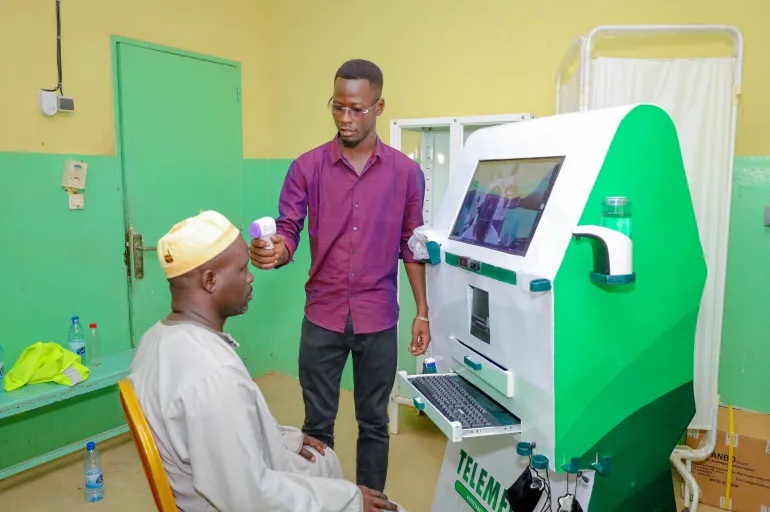
A local operator registers the patient and takes basic measurements using equipment including blood-pressure monitors, glucometers, thermometers, pulse oximeters and electrocardiogram (ECG) machines.
The doctor joins remotely, appearing on a screen as the operator assists with the examination.
Telemedan says its kiosks can also be equipped with diagnostic tools including stethoscopes, temperature sensors and, in some cases, ultrasound equipment. A trained local operator helps patients use them.
The system is designed for places where internet access may be unreliable. Patient information can be stored locally and synchronised when connectivity returns. An Unstructured Supplementary Service Data (USSD) service allows people without internet access to book appointments and access health information.
A Telemedan solar-powered kiosk helps patients in rural Chad access doctors remotely, reducing the need to travel long distances for medical care [Yahuza Bawage/Al Jazeera]
Depending on the location, the kiosks can connect through mobile networks or satellite links.
“We want to see that the absence of reliable electricity or the internet should not mean the absence of healthcare,” Abakar said.
The cost of getting to a doctor
Abakar said some journeys for medical care can cost $200 or more once transport, accommodation, logistics and medical consultations are included.
Telemedan consultations cost between $2 and $15, depending on the service.
For Abakar, the issue is also about what families can afford to give up to obtain care.
“A patient should not have to choose between seeking medical care and being able to feed their family,” he said.
From pilot to wider network
Telemedan began as a pilot and has expanded with support from grants and institutional partnerships, including Chad’s Ministry of Public Health and Prevention.
Abakar said the initiative now has 37 kiosks across 11 provinces and has reached an estimated 143,000 people.
A Telemedan kiosk in rural Chad is equipped with medical devices that allow local health workers to conduct examinations while doctors consult patients remotely [Yahuza Bawage/Al Jazeera]
Telemedan has also begun using artificial intelligence to help screen for diabetic retinopathy, a complication of diabetes that can damage vision. The initiative says the technology is intended to assist healthcare professionals rather than replace them.
But a remote consultation has limits.
A kiosk cannot provide emergency treatment or perform every examination. Patients who need specialist care, laboratory tests, medicines or hospital treatment still have to reach the next level of the health system.
Can the kiosks last?
Telemedan’s expansion comes as Chad develops its wider digital health system.
Youssouf Silay, an assistant to the coordinator of Chad’s National Digital Health Programme, told Al Jazeera that the country’s National Health Development Plan for 2022–2030 identifies digital health as a way to expand access to care.
Chad established the National Telemedicine Programme in 2021 and launched its National Digital Health Programme in 2023, Youssouf said. The Ministry of Health is also developing a legal and regulatory framework for digital health services.
“The objective is to promote innovative solutions that can improve access to healthcare, particularly in areas with limited medical and energy infrastructure,” Youssouf told Al Jazeera. “Solutions such as solar-powered telemedicine kiosks can contribute to this effort by bringing healthcare services closer to underserved populations.”
But putting a kiosk in a village is only the beginning.
The equipment has to keep working. Connectivity has to be available. Local operators need training. Doctors need to be there when patients call. And people who need care beyond the kiosk need a way to reach it.
In Chad, solar-powered Telemedan kiosks are designed to overcome two rural healthcare challenges at once: unreliable electricity and the long distances patients often travel to see a doctor [Yahuza Bawage/ Al Jazeera]
Each kiosk costs about $10,000, according to Abakar. Telemedan sells the units to governments, public health programmes and partner organisations, which then operate them. The model means patients are not paying for the infrastructure itself.
Telemedan says it wants to reach one million people in rural communities across sub-Saharan Africa.
A solar-powered kiosk cannot replace a hospital. It cannot replace a doctor in every circumstance.
But it can shorten the distance between a patient and the health system.
“We want Telemedan to become a sustainable layer of healthcare infrastructure, not simply a collection of technology projects,” Abakar told Al Jazeera.







![A Telemedan solar-powered kiosk helps patients in rural Chad access doctors remotely, reducing the need to travel long distances for medical care [Yahuza Bawage/ Al Jazeera]](https://i0.wp.com/www.aljazeera.com/wp-content/uploads/2026/08/IMG_2955-1787278824.jpg?w=640&ssl=1)

