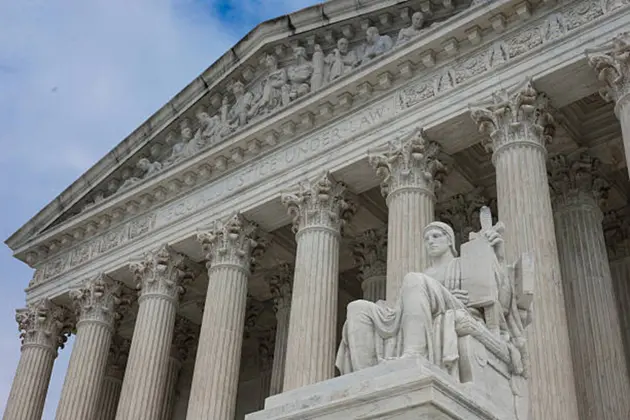
Supreme Court takes up Exxon, Suncor challenge to climate lawsuits
Supreme Court takes up Exxon, Suncor challenge to climate lawsuits
Source link
Supreme Court takes up Exxon, Suncor challenge to climate lawsuits
Source link
WASHINGTON — The Supreme Court will open its new term Monday by hearing arguments on whether the oil and gas industry may be forced to pay damages for the scorching heat waves, wildfires and droughts that are blamed on climate change.
It’s a momentous question the justices have put off deciding for nearly a decade — and may do so again.
California joined more than two dozen blue states and municipalities in 2023 when it sued the five largest oil companies, alleging “decades of deception” over the danger of a warming climate.
They have “privately known the truth for decades but have fed us lies and mistruths to further their record-breaking profits at the expense of our environment,” California Atty. Gen. Rob Bonta said.

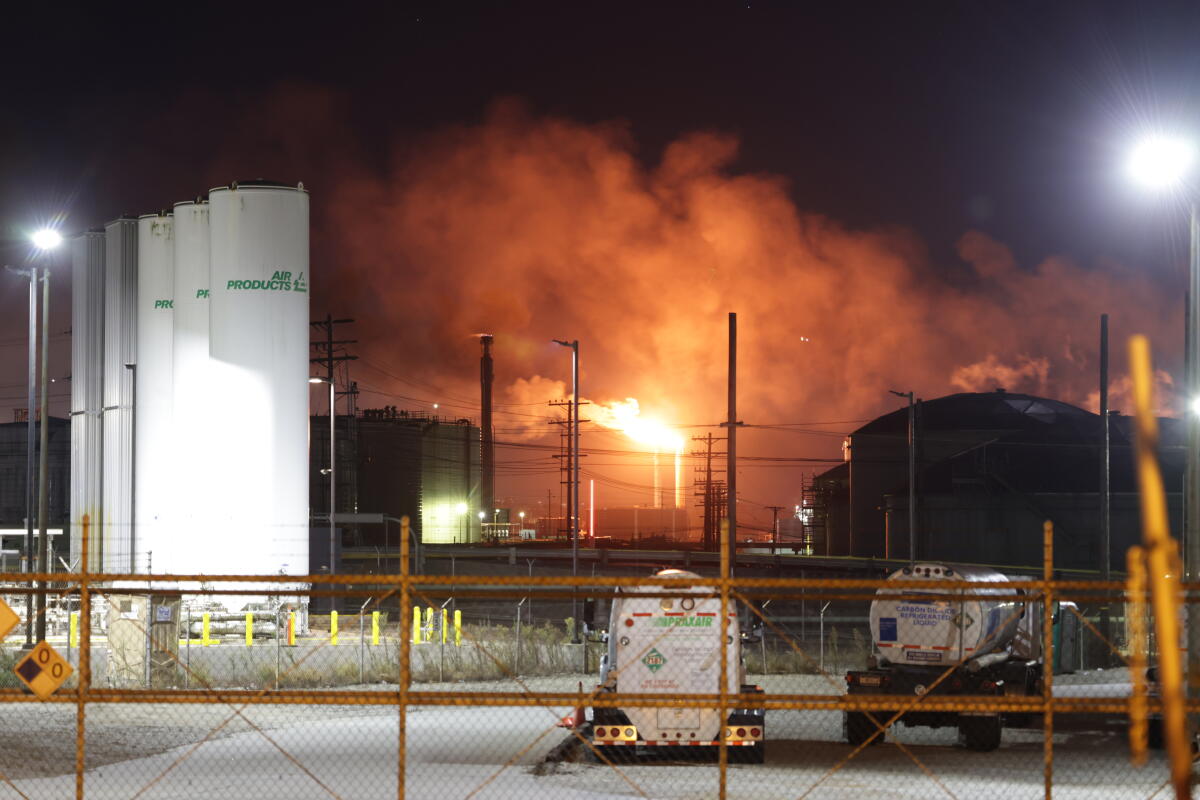
Fire and smoke rise at the Chevron Refinery in El Segundo in October 2025.
(Robbin Goddard/Los Angeles Times)
Such climate-change lawsuits were patterned after the mass claims against the tobacco and opioid industries. Both were accused of concealing the dangers of their very profitable products.
But the climate suits have stalled. Judges have been divided over whether these potentially huge claims should be decided in federal or state court, and if so, under what law.
Last year, Boulder County, Colo., won a 5-2 ruling in the state Supreme Court that allowed its 2018 suit to proceed as a claim of a public nuisance, an unjust enrichment or a civil conspiracy. These are referred to as “common law” claims that are long-standing and traditional but do not rely on a measure approved by the Legislature.
The Colorado judges also said the climate-change suits are not “preempted” or blocked by federal anti-pollution laws because the suit for damages did not regulate greenhouse gas emissions.
The dissenters said the state court was giving Boulder a “green light to act as its own republic” to punish the Exxon Mobil Corp. for the impact of “global climate change.”
Appealing to the Supreme Court, the oil companies sounded the same theme.
“Boulder, Colorado cannot make energy policy for the entire country,” they said. A ruling for the county would “authorize all 50 states and tens of thousands of municipalities” to ask their local juries to “impose ruinous liability” on the fossil fuel industry, they told the court.
The Trump administration joined in support of the industry’s appeal.
“Our federal system would disintegrate if each state could tackle inherently national or international problems by forcing its regulatory prescriptions on the other 49,” the administration’s lawyers wrote.
In February, the justices voted to hear the case and decide whether federal law blocks state law claims for the “effects of interstate and international greenhouse-gas emissions.”
The court scheduled the case of Suncor Energy and Exxon Mobil vs. Boulder County as the first of the new term.
Legal experts say the industry’s claim to be shielded by federal law is weak.
UCLA law professor Alejandro Camacho described the “preemption arguments as the latest and perhaps most ambitious effort to weaponize federal law to prevent polluters and fraudsters from paying for the harms they cause.”
Neither the Constitution nor the Clean Air Act provides such a shield, he said.
Legal experts on the other side question the notion that a public nuisance can be defined so broadly to include both the sale of a legal product and the impact on carbon pollution, much of it coming from China and India.
The outcome in the Supreme Court remains in doubt.

Supreme Court Justice Samuel Alito, left, shown with Justices Clarence Thomas and Brett Kavanaugh in 2025, withdrew from involvement in the climate case being argued Monday, when the court term begins.
(Chip Somodevilla / Getty Images)
Last week, Justice Samuel A. Alito, a reliable conservative, announced he was withdrawing from the case. He did not say why, but he owns stock in other oil companies that could be affected by the court’s decision.
A broad ruling for Boulder would send a shock through the fossil-fuel industry and clear the wave of climate-change suits to proceed in state courts.
The industry may turn to Congress. Republicans in the House and Senate have introduced bills that would shield energy companies from such liability claims.
Similarly, a broad ruling shielding the oil companies probably would block all of the climate change suits, including California’s.
The justices may opt out of ruling, however.
When they granted review of the case, they asked the lawyers on both sides to weigh in on whether the high court had “jurisdiction” to decide the Boulder case.
Usually the U.S. Supreme Court reviews only final judgments handed down by state courts, and the Boulder case did not result in a final ruling.
And without Alito, the court could split 4 to 4.
A decision based on a tie vote would affirm Boulder’s early stage victory but would not set a precedent that would govern other cases.
In its new term, the court also will hear major cases on immigration and guns.
Two of the cases test the Trump administration’s strict deportation policies. One denies bond hearings to people who entered the country illegally and may be deported.
In the past, the government usually offered bond hearings to those who could be held for months or even years while their claims were pending, so long as they could show they were not a flight risk or danger to the public.
But the Trump administration said it plans to detain tens of thousands of such persons indefinitely, even if they have no criminal record and pose no risk.
Government lawyers pointed to a provision of the 1996 immigration law that said people who entered the country illegally “shall be detained.” Previous administrations applied the mandatory-detention rule only to migrants who entered the U.S. illegally and were arrested near the border.

A refinery in Carson in 2024.
(Michael Blackshire/Los Angeles Times)
On Thursday, the court announced it will hear arguments on the mandatory detention policy, likely to be scheduled for January.
The other case involves so-called “third-country removals.”
The administration is determined to deport immigrants who have “final orders of removal,” many of whom have criminal records. But in some cases, they may not be sent back to their country of origin.
The policy of sending them to a third country has been condemned as harsh and cruel. Thousands of these people have been flown to impoverished countries that are dangerous and where they may be subjected to abuse.
The administration says it seeks assurances from those countries that the deported persons will not be not be abused or persecuted, but it refuses hearings for individuals.
U.S. District Judge Brian Murphy in Boston has ruled these deportees are entitled to a “meaningful notice” of where they are being sent and “meaningful opportunity” to contest this if they have a reasonable fear they will face persecution and torture.
Trump administration lawyers filed emergency appeals at the Supreme Court to set aside Murphy’s orders. They argued that the judge had gone beyond his authority, and the court’s conservatives agreed.
In December, however, the court will hear arguments from both sides on what the law calls for in such deportation cases.
Meanwhile, on Dec. 2, the court will hear a potential landmark on gun rights and and decide whether states may prohibit possession and sale of semiautomatic AR-15 rifles.
California and 11 other blue states have adopted such laws, often in response to mass shootings.
Gun rights advocates say these rapid-fire rifles are among the most popular weapons nationwide and should be protected as lawful under the 2nd Amendment’s right “to keep and bear arms.”
After turning away cases for a decade, the justices voted to hear 2nd Amendment challenges to the laws in Cook County, Ill., and the state of Connecticut.
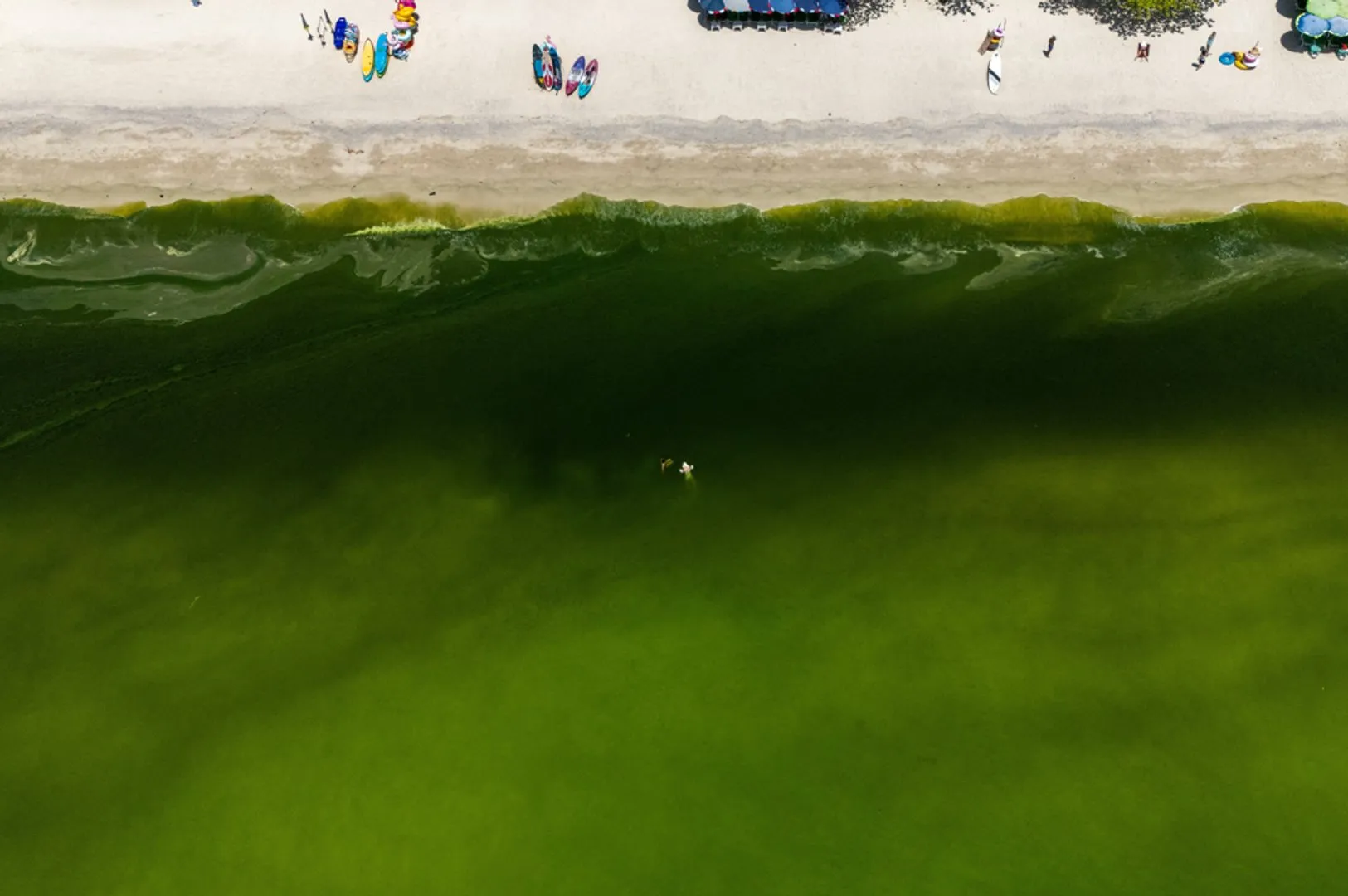
The water off Thailand’s Ko Lan island has turned a vibrant shade of green thanks to a plankton bloom, keeping many tourists out of the water. But scientists say the bigger concern may be what’s happening beneath the surface, where oxygen levels are falling.
Published On 2 Oct 20262 Oct 2026
Share
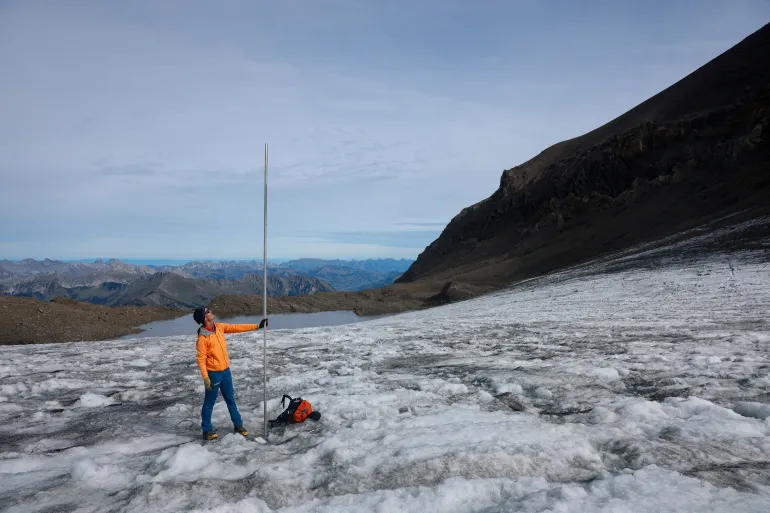
Switzerland’s glaciers are rapidly receding due to a combination of winters with too little snow and record-high temperatures across Europe this summer, scientists say. In all, one of the world’s top ski destinations has lost nearly one-fifth of its glacial ice in just five years.
In a report (PDF) published by the Swiss Glacier Monitoring Network (GLAMOS) and the Swiss Commission for Cryosphere Observation of the Swiss Academy of Sciences (SCNAT) on Thursday, researchers said Swiss glaciers lost 5.5 percent of their ice volume over the hydrologic year ending September 30, 2026, and nearly 20 percent since 2021.
list of 3 itemsend of list
Why is Switzerland, famed for its Alpine terrain and winter sports, losing its glaciers and what does this mean for the country?
Here’s what we know.
In September, a GLAMOS team visited 23 glaciers in Switzerland to record end-of-summer measurements of ice melt and snow accumulation.
Visiting one glacier named Scex Rouge in the Western Swiss Alps in early September, GLAMOS chief Matthias Huss, one of the report’s researchers, told the Reuters news agency that a measuring pole, about four metres (13 feet) high, was drilled into the ice in July to provide the team with a point of reference.
“Now when we have come back here, we saw the pole was out by three metres [10ft]. So just in August and September of this year, even excluding the heatwaves of June and July, we have lost three metres of ice at an elevation of almost 3,000 metres [9,843ft],” he explained.
“This clearly indicates these conditions that we had this summer, they are just inconsistent with the survival of these small glaciers in the Alps,” he added.

According to the report, the total mean thickness of individual glaciers in Switzerland has fallen by between 2.5 and four metres in 2026. At glacier tongues – narrow glacial extensions of a glacier which project from land into a body of water – it had decreased by as much as 10 metres in some places over the summer.
“We can clearly attribute the massive ice loss to the warming, and thus anthropogenic [caused by humans] climate change. The summer has been the hottest on record in Switzerland. In addition, there was little snow in winter, and therefore the glaciers were poorly protected when the heat started,” GLAMOS chief Huss told Al Jazeera.
He noted that while their measurements have indicated that the melting has affected all glaciers in Switzerland equally, the effects were most visible on smaller glaciers.
“Those shrink very quickly and sometimes even completely disappeared. Also, large glaciers lost an enormous quantity of ice, but they remain impressive,” he added.
The report’s scientists warned that the glaciers also lost a total of about 2.2 trillion litres of water (581 billion gallons) between July and September alone.
“This is more than four times the annual drinking water consumption of all Swiss households,” the report’s researchers said and warned this could impact the country’s future water supply.
Switzerland is a country known for winter sports and Alpine tourism, which depends on the glaciers. About 4 percent of the country’s entire workforce is employed in the tourism sector.
“This affects tourism and also how we perceive the mountains – they are no longer white but increasingly grey and black,” he told Al Jazeera.
He added that the water provided by glaciers is also important for the economy. “It is used to fill up hydropower lakes that produce clean energy, and supplies the biggest streams of Europe,” he said.
“We’re not yet seeing the full consequences as glaciers are still around and they contribute water when we need it. But this potential is soon being lost,” he added.
Harry Zekollari, a glaciologist and associate research professor at the Department of Water and Climate at the Vrije Universiteit Brussel, shared a similar view.
He stressed that glaciers are important natural water suppliers, as they provide water when people need it most – in summer, when it is hot and dry.
“With climate change, glaciers initially provide more water during summer as they rapidly melt. However, as glaciers become smaller, there is less ice to be melted, and as such the water supply in summer decreases. This peak in water supply has now been passed for glaciers in the European Alps, meaning that we expect glaciers to provide less and less water in the coming years,” he told Al Jazeera.
“Glacier changes can also cause natural hazards, and since most of the ice lost turns into water that reaches the oceans, the consequences of glacier loss [in Switzerland and elsewhere] will be felt for coastlines all around the globe,” he added.
Yes. According to Zekollari, in order to save as much glacier ice as possible in Switzerland, the world needs to stabilise rising temperatures as soon as possible.
“Projections for the European Alps and Swiss glaciers show that if we are able to rapidly stop emissions, we may still be able to save about one-third of their ice mass. However, in a case with strong warming, these glaciers are projected to lose more than 90 percent of their volume by 2100,” he said.
He noted that the situation is less grim globally as some glaciers in other regions are more persistent.
“However, even globally, future emissions play a big role and will decide whether we lose about 25 percent of glacier mass by 2100 – that’s the good case, with limited warming – or rather 50 percent – the bad case, with more warming,” he said.
“The losses in the longer term – past 2100 – are even larger due to the long response of glaciers, but also here it is the future warming that decides how much remains. Every 0.1 degree Celsius warming matters.”
Published On 1 Oct 20261 Oct 2026
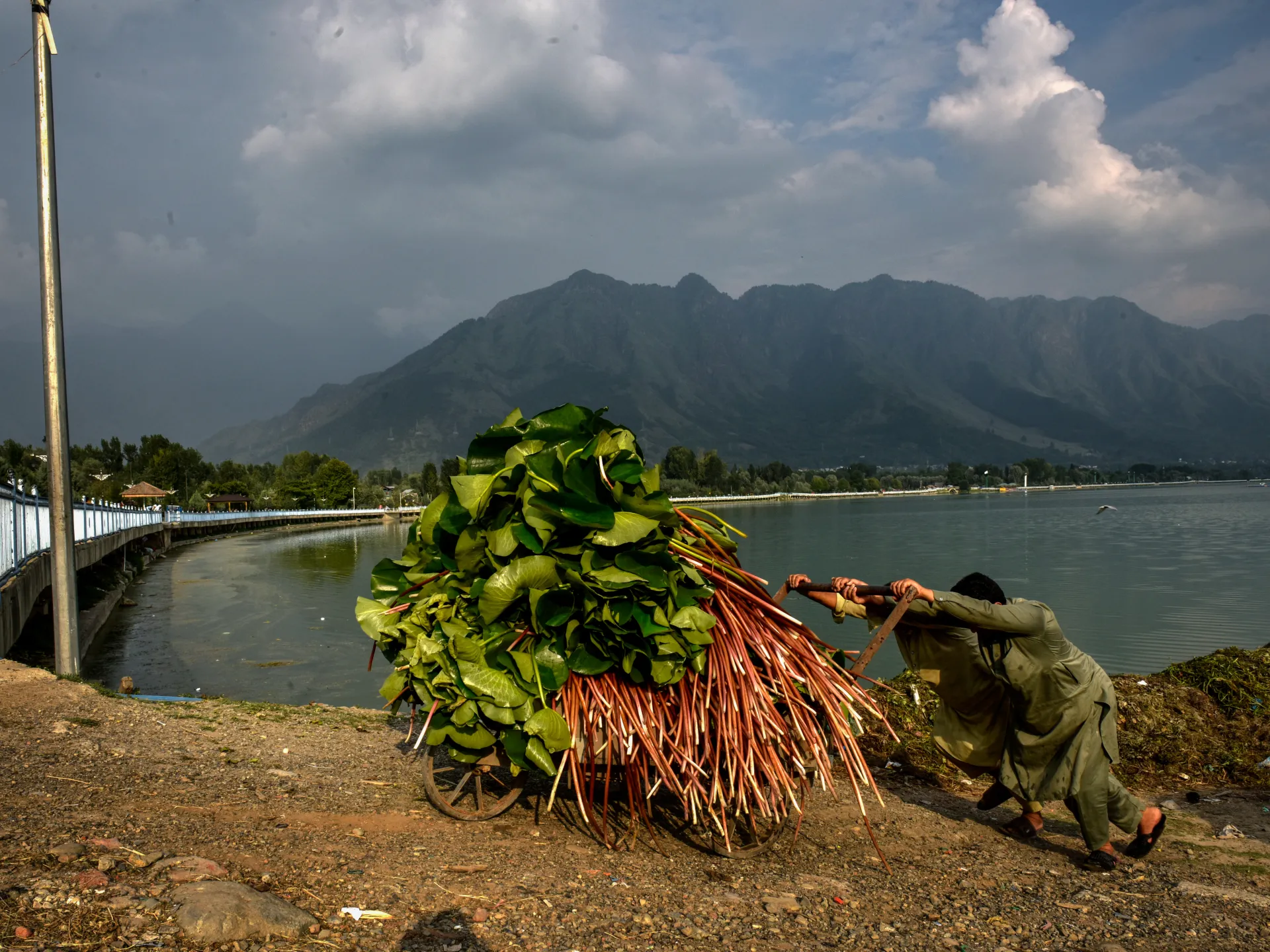
Dal Lake in Srinagar, the heart of tourism and cultural life in Indian-administered Kashmir, is slowly giving way under mounting population and environmental pressures.
Once renowned for its clear waters, floating gardens and houseboats, the lake is now clogged with untreated sewage, plastic waste and rampant weed growth, even as thousands of residents and businesses rely on it for transport and their livelihoods.
Unregulated construction along its shores, land encroachment and the expansion of nearby neighbourhoods have reduced its surface area and further damaged its fragile ecosystem.
The impact of climate change, including erratic rainfall and rising temperatures, is accelerating the lake’s decline.
Despite periodic clean-up campaigns and official conservation schemes, the future of Dal Lake remains uncertain, reflecting a wider environmental crisis across the Kashmir Valley.
Ugandan climate activist Vanessa Nakate says Africa is paying a high price for a crisis it did not create. She has taken her fight for climate justice from the streets of Kampala to the halls of power. She has been front and centre in the global climate movement, urging world leaders to act, taking part in protests and speaking at international conferences about the dangers of global warming.
However, Nakate admits progress has been slow. As a UNICEF goodwill ambassador, she has seen firsthand how communities are affected, and insists the major polluters should be held accountable. She is determined to raise awareness about how global warming is affecting African countries in particular. She says the continent is often left out of discussions.
Nakate admits she sometimes feels hopeless about the state of the world, but she is encouraged by grassroots initiatives that are bringing about change.
Published On 28 Sep 202628 Sep 2026
Share
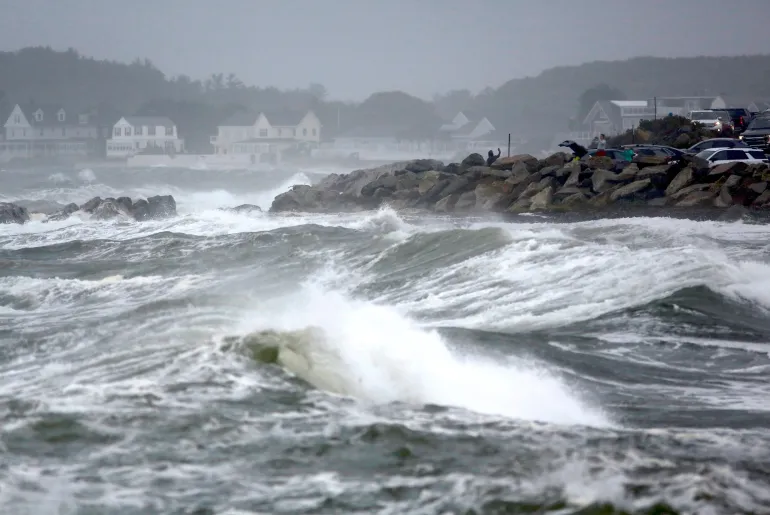
The nor’easter causes another round of flooding in low-lying areas in New Jersey and New York City and knocks out power to tens of thousands of homes into New England.
Published On 27 Sep 202627 Sep 2026
A powerful storm is pummelling the shoreline in the northeastern United States for a second day, causing another round of flooding in low-lying areas and knocking out power to tens of thousands of homes.
Tidal surges swamped low-lying neighbourhoods in New Jersey on Sunday, while wind gusts toppled trees on New York’s Long Island, damaging homes and bringing down utility poles.
list of 3 itemsend of list
In New York City, streets in the Howard Beach neighbourhood of Queens were inundated.
The slow-moving storm, which killed a New York City housing authority worker when a tree fell on Saturday, was expected to linger through Sunday, with heavy rain, strong winds and dangerous surf all the way to New England.
Extreme amounts of rain – more than 10cm (4 inches) since Friday in some spots in New Jersey – combined with a surging ocean led to flooding amounts not seen for close to a decade in places used to dealing with high water, residents said.
The storm, known as a nor’easter, triggered memories of Hurricane Sandy, which left behind more than $60bn in damage across the eastern US in 2012. While this storm’s impact has been nowhere near that, it could be the first of several along the East Coast this fall because of an El Nino climate pattern disrupting this year’s weather.
Images of waves crashing into sea walls and onto beaches raised concerns about coastal erosion.
More than 100,000 customers were without power across the Northeast and mid-Atlantic at times on Sunday, according to PowerOutage.us. The most widespread outages were in counties along the coast from New Jersey to Connecticut.
Numerous flights were cancelled or delayed up and down the coast. More than 250 flights had been cancelled at Boston Logan International airport by late Sunday morning as wind gusts reached 64km/hour (40 mph), according to the Massachusetts Port Authority.
The worst of the remaining rainfall was expected on Sunday from northern New Jersey into southern New England.
While the storm was gradually weakening, tidal flooding would stay through high-tide cycles Sunday night, said Bob Oravec, a lead forecaster with the National Weather Service in College Park, Maryland.
![People watch the ocean as a nor'easter storm hits Rye, New Hampshire, US on Sunday, September 27, 2026 [Caleb Jones/AP Photo]](https://i0.wp.com/occasionaldigest.com/wp-content/uploads/2026/09/AP26270677753401-1790545375.jpg?w=640&ssl=1)
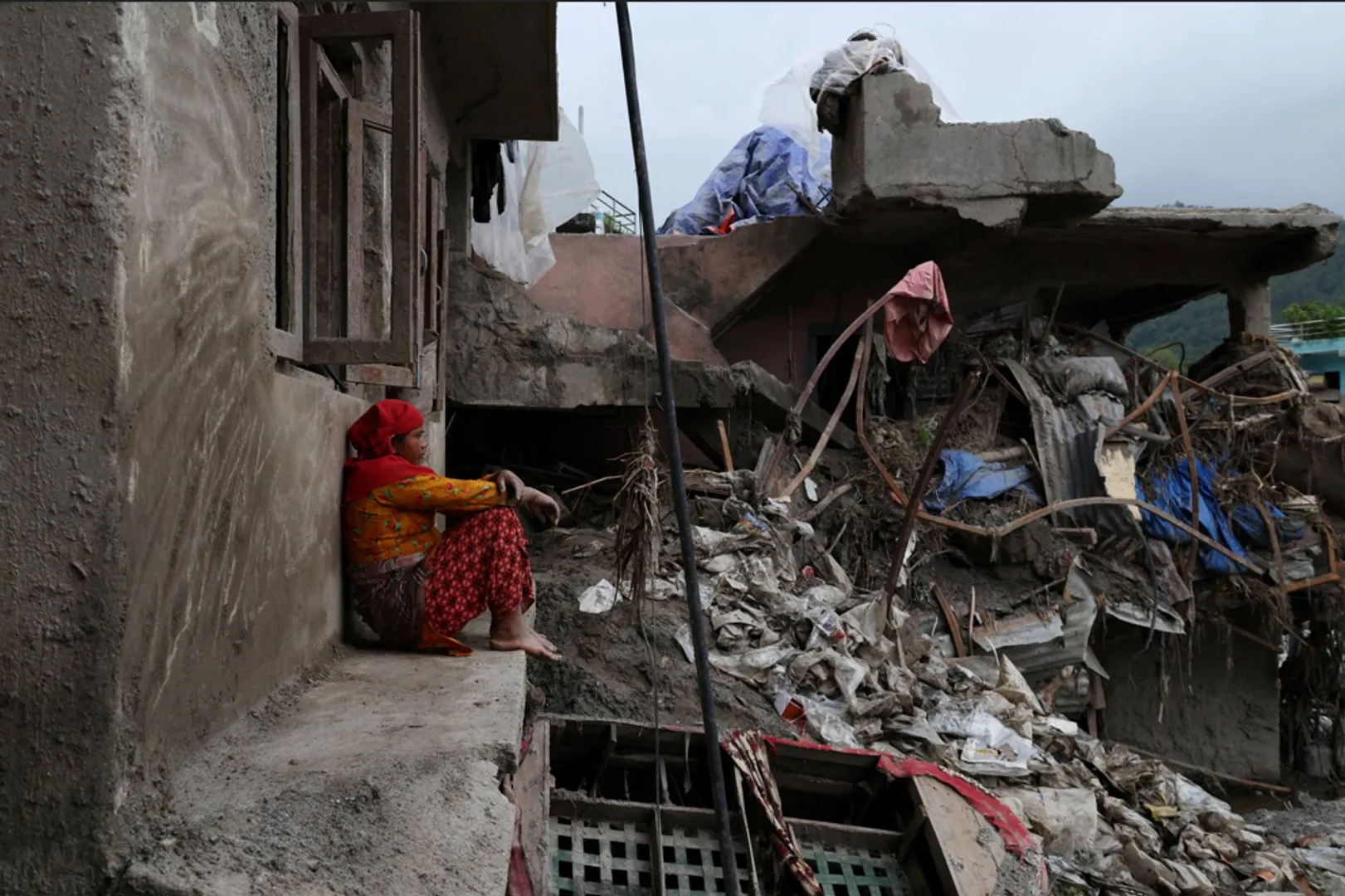
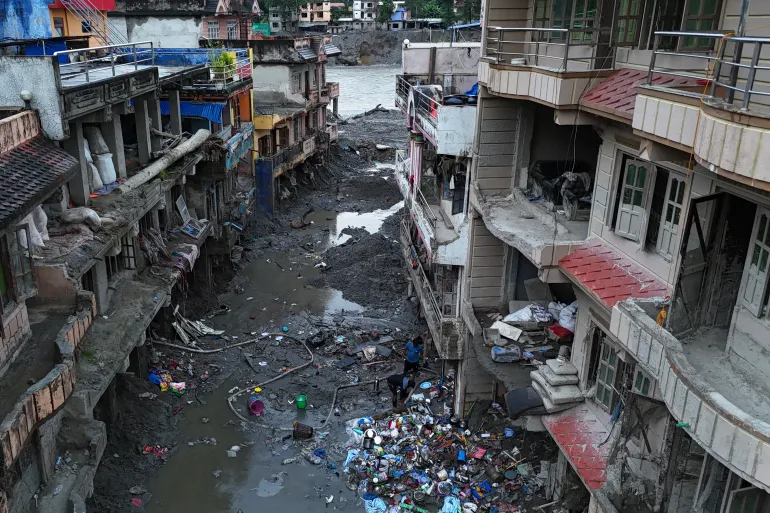
A month after catastrophic floods tore through Nepal, 5,285 people remain missing and more than 1,100 are still in holding centres. Fresh rains are now worsening conditions for displaced families living in temporary shelters, as the country faces a $4.78bn rebuilding bill.
Published On 27 Sep 202627 Sep 2026
Share
Authorities report increasing death toll over three days as rivers rise above danger levels across parts of neighbouring countries.
Published On 27 Sep 202627 Sep 2026
Heavy rainfall has triggered floods and landslides that have killed at least 56 people in the northern Indian state of Uttar Pradesh in recent days while 12 people have been reported dead in neighbouring Nepal.
Hrishikesh Bhaskar Yashod, Uttar Pradesh’s relief commissioner, said on Sunday that India’s most populous state had registered 66.5mm (2.6 inches) of rain from Friday to Sunday morning, compared with a normal 7.6mm (a quarter of an inch) for the period.
list of 3 itemsend of list
The deaths, in addition to 46 injuries, were reported during a spell of “exceptionally heavy rain that has affected much of Uttar Pradesh”, according to the commissioner’s office.
More than 1,000 houses were damaged after “a depression over the Bay of Bengal moved inland and intensified rainfall across the region,” it added.
Home to more than 240 million people, Uttar Pradesh is frequently hit by rain and thunderstorms during the annual monsoon season from June to September.
In India’s eastern state of Odisha, more than 70,000 people living in low-lying areas were evacuated after rivers rose due to heavy downpours, the NDTV news network reported. The rains have damaged bridges and culverts, forcing officials to shut down Devkund, a popular tourist spot in the state.
Separately, India’s Central Water Commission said 30 river-monitoring stations across seven states were in a “severe situation”. Major rivers that flow through India, including the Ganga, Gandak, Kosi, Bagmati and Narmada, had risen above danger levels.

In Nepal, where a devastating flood in late August killed more than 1,400 people and left thousands missing, a new wave of flooding and landslides has killed at least 12 people since Thursday, according to officials, with several others missing.
Authorities warned of possible flash floods in 49 of the country’s 77 districts, with more than half facing high flooding or flash-flooding risks as water levels in major rivers and tributaries continued to rise.
Power supplies have been disrupted in the Manang, Mustang, Myagdi and Baglung districts, with authorities working to restore electricity, officials at the Ministry of Energy, Water Resources and Irrigation said.
Flooding of the Rahuganga River damaged the structure and transmission-line towers of a 40-megawatt hydropower project, Water Resources and Energy Minister Biraj Bhakta Shrestha said.
Shanti Mahat, a spokesperson for the National Disaster Risk Reduction and Management Authority, said Rasuwa and Nuwakot, areas hit by last month’s deadly floods, should remain “alert” but were not currently considered high-risk areas.
Authorities warn residents that extreme conditions could pose risks and urge people to stay away from flooded areas.

Published On 26 Sep 202626 Sep 2026
Residents of the northeastern United States are facing a powerful storm known as a nor’easter that has knocked out power and caused flooding across the region.
The storm has led to the cancellation of more than 400 flights and power outages affecting more than 88,000 homes and businesses as of Saturday afternoon local time. That figure is down from a high of 119,000 earlier in the day.
list of 3 itemsend of list
Bob Oravec, lead forecaster with the National Weather Service in College Park, Maryland, said that the storm is likely to persist, with “a lot of high winds, a lot of high tides and heavy rain possibility over the next few days for the northeastern US”.
The governors of New York and New Jersey declared states of emergency in counties expected to see the worst of the storm, including New York City, on Friday.

Authorities have also warned residents about the risks of flooding and high tides, cautioning people to stay away from the beach and areas inundated with water.
“Anyone who goes in or near the water this weekend is literally gambling with their life,” New York Governor Kathy Hochul said.
Despite the warnings, people have been seen kayaking down flooded streets in Long Island, New York, while others took advantage of large swells in Hampton, New Hampshire.
“In all the canals, the water is up really high and coming into people’s back yards,” Jay Boyd, a resident of Ocean City, Maryland, told The Associated Press news agency.
Oravec said that nor’easters are not unusual as the region of New England enters the autumn season, but that “this might be a little earlier than average for a big storm”.

About 425 flights have been cancelled and 1,338 delayed so far on Saturday, according to data from the flight tracker FlightAware.
Concerts and sporting events have also been cancelled, including musician Ed Sheeran’s scheduled shows in the state of Massachusetts on Friday and Saturday.
Nonstop rain since Thursday has submerged Thai capital’s roads and canals, sending water into many homes and stores.
Published On 26 Sep 202626 Sep 2026
Bangkok authorities have declared a disaster zone across all 50 districts of Thailand’s capital after three consecutive days of rainfall caused heavy flooding.
The disaster designation, which gives local organisations authority to take action, came on Saturday after Governor Chadchart Sittipunt said almost 300mm (11.8 inches) of rain had fallen since Thursday afternoon.
list of 4 itemsend of list
The nonstop rain inundated roads and canals with water, sending water into many homes and stores alongside them, according to reports. Photos and videos showed major roads submerged and cars abandoned after drivers were unable to move through the rising water.
Chadchart said the east of the city was most impacted and warned that more rain was forecast again on Saturday. He added that flooding should recede once the rain subsides, as city officials work to drain floodwaters as quickly as possible.
“The rain keeps falling and we are doing our best. We are trying to pump the water out, but the water in canals are full,” he said on social media. “The risk areas are those who live near canals. Every canal is now filled.”
Later on Saturday, the government said the flooding situation had “stabilised” but added it would still take two or three days for the water to drain, as long as the rain held off. “If more rainwater doesn’t fall in the area, it will be solved,” he said.

Chadchart also advised residents to move their cars to higher ground, as Bangkok’s public transport authority offered free access to MRT train “park and ride” carparks to store their vehicles until October 2.
Reporting from a flooded street in Bangkok, Al Jazeera’s Tony Cheng said the Thai capital is no stranger to heavy rain during the monsoon season, but the continuous rainfall had locals worried.
“What usually happens is we get heavy downpours for a couple of hours, then you’ll see the street often flooded but it would flow away into the drains quickly, and it would only happen in isolated areas too,” he said.
“What’s happening here is … happening all across the city. This is not a flash flood; this is persistent heavy rain since Thursday evening, and it shows no sign of letting up.”
Somkid Pheuk-ngam, 67, a vendor who lives near a canal just north of central Bangkok, said she had to close her shop for two days.
“The water keeps coming in. It’s hard to go out now. It’s at my waist level,” she told the AFP news agency. “I cannot go anywhere,” she said, adding that this was “worse than the 2011 flood.”
Widespread flooding across Thailand in 2011 killed more than 500 people and damaged millions of homes.
The Department of Disaster Prevention and Mitigation has warned of low pressure across eastern, northeastern and central Thailand until Sunday, saying there was a risk of flash floods, forest runoff, mudslides and river overflow.
‘Hit by the climate we didn’t warm, hit by the wars we didn’t start.’
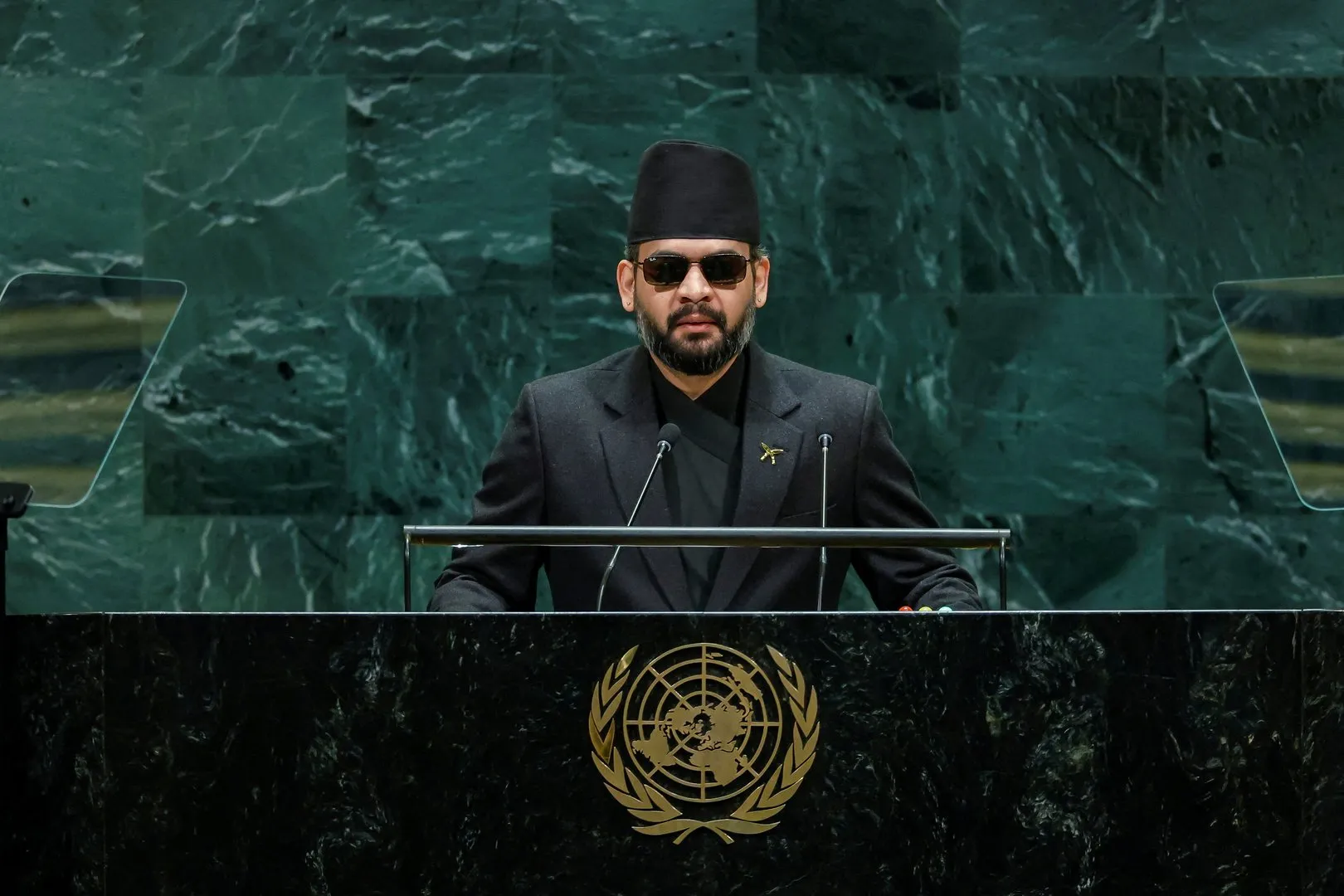
Nepal’s Prime Minister Balendra Shah was applauded at the UN General Assembly, as he highlighted how the world is failing countries on the frontline of the climate crisis.
Published On 25 Sep 202625 Sep 2026
Share
Prime Minister Balendra Shah told the UN that world leaders must act on climate change.
Published On 25 Sep 202625 Sep 2026
Nepal’s Prime Minister Balendra Shah has appealed for action to combat the rising threat of climate change, calling the flood that devastated his country last month “a warning to the world”.
Shah made the comments during his address to the 81st Session of the United Nations General Assembly in New York on Thursday night. He told the gathering that the August disaster “was not just a local tragedy”, asking them the question, “Have you really heard that warning?”
list of 3 itemsend of list
Political leaders “have been negligent to translate those warnings in action at the speed and scale that the vulnerable people require,” he said.
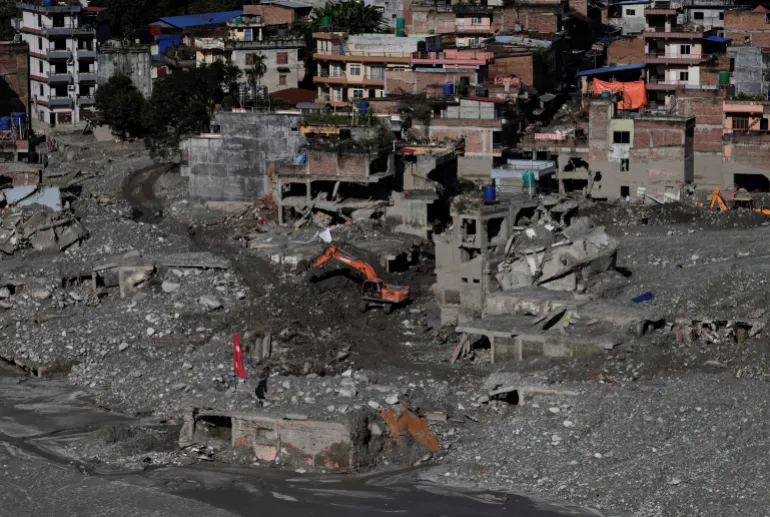
![An excavator clears mud from damaged houses following deadly flash floods and a mudslide, in Nuwakot district, Nepal, September 21, 2026 [Navesh Chitrakar/Reuters]](https://i0.wp.com/occasionaldigest.com/wp-content/uploads/2026/09/2026-09-25T021410Z_709369844_RC2ENNAUM1TN_RTRMADP_3_NEPAL-FLOODS-BALEN-UN-1790312192.jpg?w=640&ssl=1)
At least 1,453 people died when a torrent of mud, rock and water struck northern Nepal and the China-Tibet border on August 26, triggered by a glacial collapse.
According to Nepal’s National Disaster Risk Reduction and Management Authority, 5,500 people were still missing and 13,795 had been rescued.
Researchers from the World Weather Attribution (WWA) group said in a report released last week that the disaster was not caused by a single extreme weather event, but rather a “compound crisis” shaped by long-term warming, glacier retreat, permafrost thaw and geological instability.
Shah said climate change was hurting people not responsible for the crisis but who “are paying a colossal price for it”.
He said Nepal contributed less than one-tenth of 1 percent of the heat-trapping gases behind climate change. About 99 percent of the country’s electricity comes from hydropower, and many workers were trapped in tunnels by the flooding.
“Our glaciers are retreating, our mountain slopes are becoming unstable, our rivers are becoming less predictable, and every major disaster threatens to erase years of development,” Shah said.
![Nepal Prime Minister Balendra Shah addresses the 81st United Nations General Assembly at UN headquarters in New York City, US, September 24, 2026 [Eduardo Munoz/Reuters]](https://i0.wp.com/occasionaldigest.com/wp-content/uploads/2026/09/2026-09-25T002524Z_1559668133_RC20QNACRCWK_RTRMADP_3_UN-ASSEMBLY-1790312740.jpg?w=640&ssl=1)
Shah urged the international community to help bear the cost of helping Nepal adapt to climate change.
He proposed to create a ‘Himalaya Climate Resilience Mechanism’ which would include Nepal and neighbours India and China, and would allow them to share satellite data and expertise, monitor glacial lakes and strengthen joint early warning systems.
Nepal has asked the UN’s loss and damage fund for $20m in aid, the maximum allowed, but a tiny fraction of what it needs. A preliminary assessment by the government has placed the cost of the disaster at $5bn.
The fund, established in 2022 in the aftermath of catastrophic floods in Pakistan, has yet to make even its first disbursement, and observers see Nepal as a key test of its credibility.
Earlier this week, the United States pledged an additional $31m in new flood recovery support.
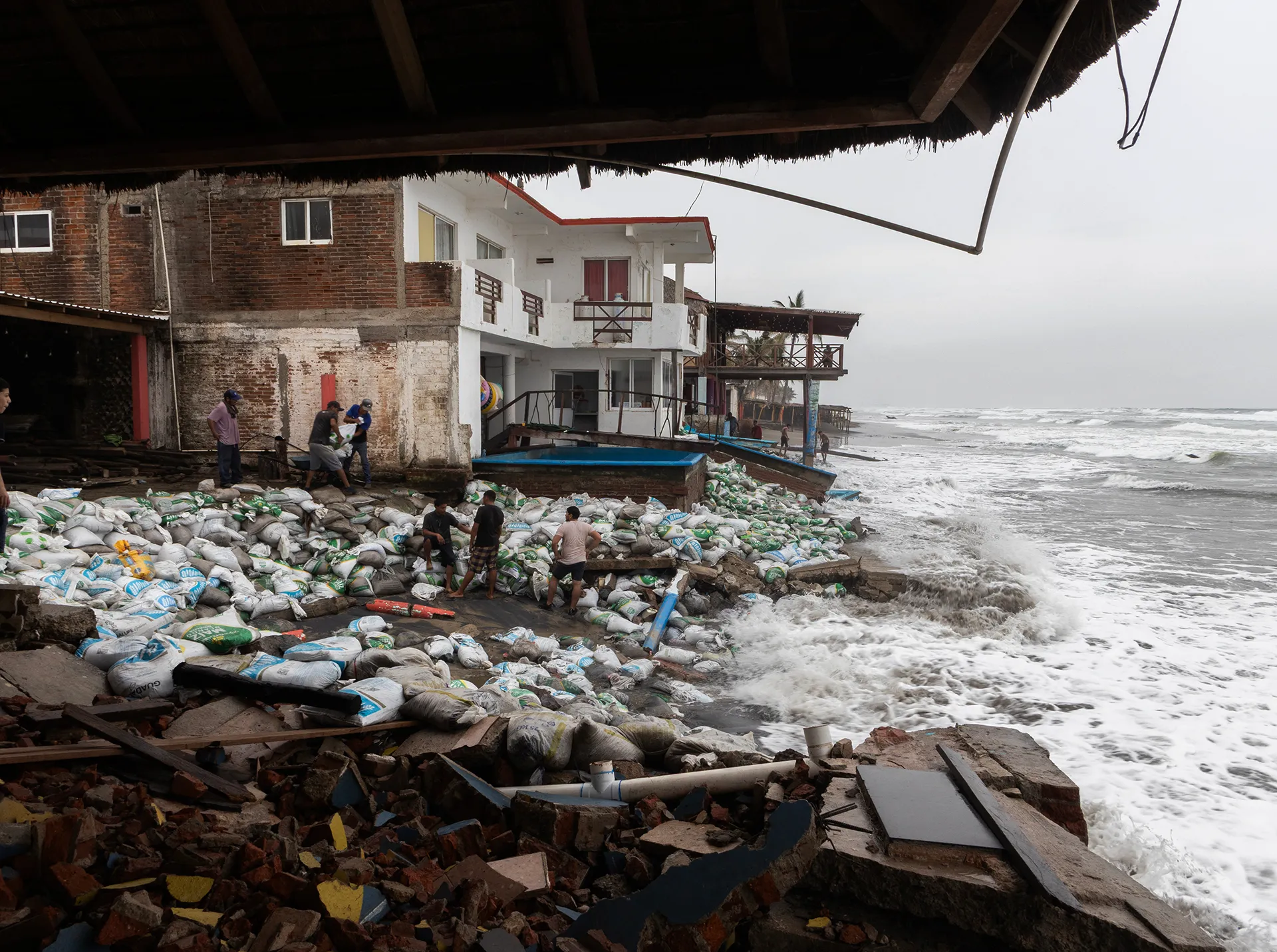
Heavy rains could cause life-threatening flooding and landslides on Mexico’s Pacific Coast, the US National Hurricane Center warned.
Published On 24 Sep 202624 Sep 2026
Hurricane Polo has sent heavy rain and strong waves across Mexico’s Pacific coast, while Tropical Storm Nolo is approaching Hawaii with the potential for catastrophic flooding.
Early on Thursday, the hurricane was swirling about 130 miles (209 kilometres) south-southwest of the Mexican city of Zihuatanejo. It was moving northwest at 7mph (11kph) and forecast to turn west-northwest later in the day, taking it further out to sea, before turning northwest on Saturday.
Polo was forecast to maintain Category 5 strength as it moves along Mexico’s coast over the next few days.
While the eye and the strongest winds were expected to remain at sea, the heavy rains could cause life-threatening flooding and landslides, warned the US National Hurricane Center in Miami.
A hurricane watch was issued for Hawaii county and disaster preparations are under way because Tropical Storm Nolo could hit the island on Friday or Saturday, warned the National Weather Service.
John Bravender, a weather service warning coordination meteorologist, said during a news conference on Wednesday afternoon that the tropical storm could develop into a major hurricane.
Hawaii County Mayor Kimo Alameda told residents in a video message that they should start preparing for the storm. He urged them to put together emergency kits with food, water and medications, as well as trim vegetation and clear drains.
“This is a very serious situation,” he said. “We do believe that the rain is going to come. It’s coming already.”
Governor Josh Green’s office said public schools and state and county offices across Hawaii’s Big Island will close on Thursday and Friday, while Maui County will shut them on Friday ahead of the threat of heavy rain, winds and flooding.
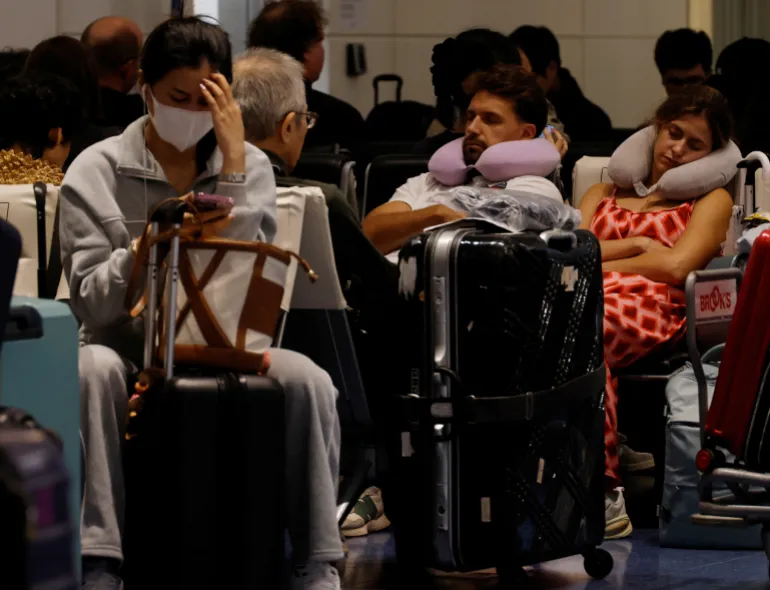
Storm is moving northeast of Japan’s eastern coast across the Pacific, leaving a path of destruction behind.
Published On 22 Sep 202622 Sep 2026
A powerful storm has triggered evacuation advisories for more than 1.6 million people, causing widespread travel chaos, flooding and landslides near Tokyo.
On Monday, Typhoon Dujuan packed wind speeds of about 144 kilometres (89 miles) per hour as it moved 130km (80 miles) south of Katsuura, near the Japanese capital, cutting power to thousands of households.
list of 3 itemsend of list
Two people have been confirmed dead, Kyodo News reported, citing local authorities.
By early Tuesday, the storm had shifted away from the coast and was heading northeast out to sea towards the Aleutian Islands, with slightly diminished winds, the Japan Meteorological Agency (JMA) said.
In areas where warnings have been issued, “there’s a risk the rain will continue as the typhoon moves north”, the JMA’s Takuya Hosomi said.

Passengers were stranded at airports after Japan Airlines cancelled 135 flights and All Nippon Airways scrapped 140 on Monday.
Some rail services were suspended, including bullet train services connecting Tokyo and Osaka, Japan Railways said.
The JMA warned on Sunday that rain and winds were expected to intensify even before the typhoon’s arrival.
“The total rainfall through Tuesday could exceed the average monthly rainfall for September, resulting in record-breaking heavy rain,” the agency said.
Social media posts showed images of flooded roads in front of Kamakura station, a popular sightseeing spot.
“There is flooding in various parts of the city, so travelling by car is dangerous,” Kamakura Mayor Takashi Matsuo said on X.
Floodwaters also inundated parts of Ichikawa, east of Tokyo.
Dujuan forced the early closure of the Tokyo Game Show, one of the world’s biggest video game trade fairs, on Monday, its final day.

A major outdoor music festival and a baseball match, both scheduled to be held in Chiba, were also cancelled.
Dujuan is Japan’s 25th typhoon this year. The country often sees strong typhoons in the late summer and early autumn.
The country has battled multiple wildfires amid record-breaking temperatures fueled by El Nino and intense drought conditions.
Published On 20 Sep 202620 Sep 2026
A massive wildfire has broken out in central Colombia, threatening the popular tourist town of Villa de Leyva, according to local officials.
The forest fire is near the Andean town in the Boyaca department, with flames engulfing the San Marcos hillside above the colonial architecture and cobblestone streets that attract more than a million visitors annually.
The blaze has already consumed 40 hectares of native forest, sending massive plumes of smoke that are visible from the town’s central square, according to Colombian authorities.
On Saturday night, Colombian President Abelardo de la Espriella posted on X that “Villa de Leyva is not alone”, pledging to mobilise all state resources to fight the fire and protect “this historical jewel” and “beautiful city that is the pride of Colombia”.
To combat the flames, the Boyaca department government said it is dispatching two aircraft. A military helicopter will also join the effort, along with firefighters from the capital, Bogota, Interior Minister Rodrigo Lara said.
The mayor of Bogota, Carlos Fernando Galan, will be sending a team of firefighters to join local crews from Tunja and Boyaca, reinforcing containment efforts and securing the urban centre, Lara said.
In the equatorial Andes, forest fires peak during the dry season, but this year they are fuelled by a severe El Nino weather pattern. Record high temperatures and lack of moisture have turned vast expanses of the Andean vegetation into tinderboxes. That has intensified a crisis that has already started 18 active wildfires across the country, according to the latest official data from Colombia’s National Unit for Disaster Risk Management (UNGRD).
The impacts of El Nino, a natural weather pattern, are felt globally and do not affect the entire South American continent in the same way, inducing extreme droughts in some regions and torrential flooding in others. This year, it comes supercharged by the effects of climate change, which is worrying many scientists, governments and aid workers.
The warming of the adjacent Pacific has triggered catastrophic flash floods and landslides in countries such as Peru and Ecuador.
Unlike in the southern part of the continent, where countries including Argentina, Chile and Uruguay have been expecting unseasonably heavy rainfall, El Nino has the opposite effect in the northern part of the continent. A significant reduction in rainfall leads to severe drought conditions which can suppress cloud formation and displace normal rain patterns, driving average temperatures well above normal.
The soaring heat rapidly evaporates moisture from the ground and water basins, leaving countries such as Colombia with extended periods of drought and critically low precipitation.
“El Nino can bring devastating climate extremes on its own, but it’s unfolding today on a much warmer planet, increasing the likelihood that heat, drought, floods and fires will push communities and ecosystems beyond anything they have experienced before,” said Stephanie Roe, lead climate scientist with the World Wildlife Fund.
You need a boost, right?
We’re living under a dark cloud, with a steady downpour of graft, thuggery and baloney.
There’s the raffling of presidential pardons and the attacks on reporters for doing their jobs, the clownish trade war with Canada, the bungled disaster in Iran, the petty obsessions with the ballroom and the Kennedy Center, the hogwash about a stolen election, the attacks on immigrants and the shameless presidential profiteering while working people suffer the cost of Trump’s countless broken promises.
I could go on, and I will. But rest assured, I have not forgotten about the boost I promised.
For all the affronts, nothing strikes me as more sinister than the Trump administration’s ambitious assault on the planet. Despite nearly daily headlines about the global calamity of overheated oceans, melting glaciers, stark weather transformations and species extinction, Trump keeps shoveling more coal onto a fire that will rage long after he’s dead and gone.
He’s gutted environmental protections and scientific research and dismantled clean energy initiatives. Now his administration is rolling back limits on power plant emissions, attempting to open the California coast to more oil drilling and sabotaging the state’s ambitious goals on emission controls and electric vehicle conversion.
We don’t need AI to threaten the future of humanity. We’ve got Trump.
It’s tempting to duck under the covers and wait for the nightmare to end, but the good news is that a lot of people are standing up rather than rolling over, rebelling against the ignorance and callous disregard that threatens our most precious and fragile shared inheritance.
In August, hundreds showed up to defend California’s authority to govern its own coast at a Santa Monica hearing of the National Oceanic and Atmospheric Agency, and 18,000 more people filed comments online.
The rollback of environmental safeguards is, for many, a call to arms.
“Yes, I am discouraged. … But I am not despairing,” said Bill McKibben, an author and environmental activist who is organizing a worldwide event called Sun Day for next year to promote clean energy. “We’re reacting to multiple crises, and we’re led by a pack of fools, so why would anybody not stand up?”
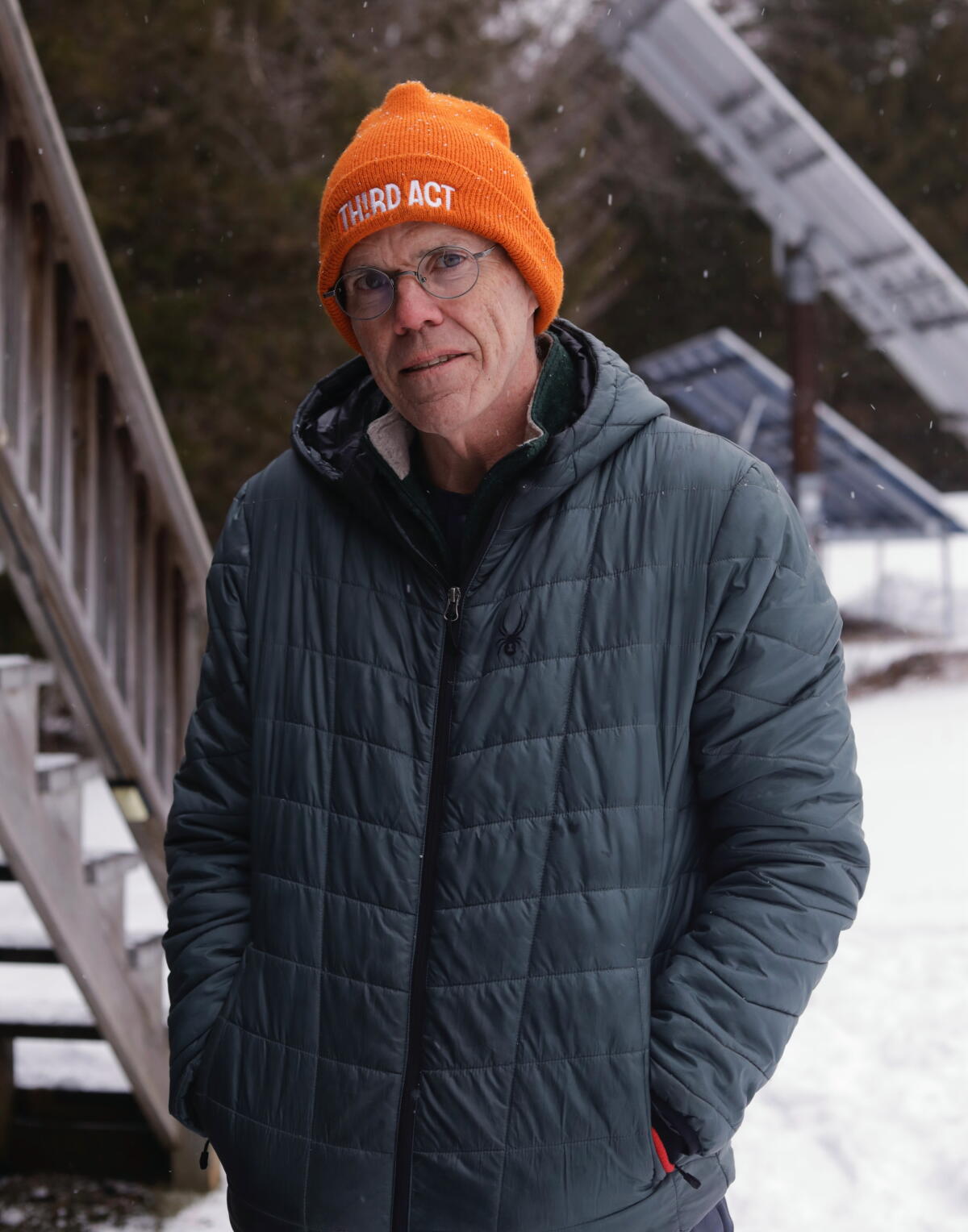
McKibben launched a national movement five years ago called Third Act, and tens of thousands of people 60 and older have signed on to advocate for climate action, voting rights and civic participation. Third Act now operates in about 30 states, with a robust chapter in Southern California.
Former Times reporter Zan Dubin has worked as both a volunteer and a paid communications consultant for Third Act, and I asked her what someone could expect to do if they became a member of Third Act/SoCal.

Environmentalist and author Bill McKibben is organizing a worldwide event called Sun Day next year to promote clean energy.
(Amanda Swinhart / Associated Press)
“We do it all,” Dubin said, from promoting climate-friendly candidates to running phone banks and testifying at public meetings. She said Third Act co-sponsors protests at Dodger Stadium, and she and others planned to meet at Vin Scully Avenue and Stadium Way for Sunday’s game against the San Francisco Giants. They want the Dodgers to stop doing business with Big Oil and bench their sponsorship deal with Phillips 66.
She also called out Disneyland for its exhaust-spewing Autopia attraction, along with former Times climate columnist Sammy Roth, and Disneyland responded by announcing in 2024 that it was switching to electric cars beginning in 2027.
Dubin, co-founder of National Drive Electric Week, said 170 volunteer-led events were being held nationwide over the next month to promote EVs, and she was leading one Friday in Irvine.
“Action is absolutely the antidote to despair,” Dubin said. “I find that despite the onslaught of these horrifying headlines … taking action invigorates me.”
Claremont resident Margaret Davis knows that feeling. She emailed me in 2023, prior to participating in a Third Act event, and said many retirees have time on their hands, which puts them in a powerful position.
“The climate crisis is the greatest existential threat humans have ever faced, hence we live in a time when we can make the greatest change for the better,” Davis wrote at the time.
When I called her a few days ago, Davis told me she’s now a member of Senior Stewards Acting for the Environment. She lives at Pilgrim Place — a senior community with a focus on justice, peace and environment — where residents meet regularly to study, discuss and advocate for sustainability, biodiversity and environmental causes.
“When I was in college in 1970, we had the antiwar movement and that was the first year of Earth Day,” Davis said. “At the time, I thought Earth Day was just a distraction from what was going on in the world.”
Later, she said, “I came to realize it was the biggest issue of all time.”

Climate activist Sim Bilal stands next to pumps at an oil field in Los Angeles in 2024.
(Allen J. Schaben/Los Angeles Times)
Like Davis, I went to college in the ‘70s, and there’s no denying that our aggressively consumptive generation played a key role in manufacturing a crisis for our children and grandchildren. We’ve got matches in our hands and smoke on the horizon, and if we’re honest with ourselves, we’d see atonement not as a hobby, but as a duty.
As for the next generation, climate activist Sim Bilal, 24, said he too shares the sense that this is both a wickedly frightening time and a moment of opportunity.
“In the last month, we’ve gotten more young people involved,” said Bilal, executive director of Youth Climate Stewards 4 Local Action. “We usually have to reach out to them, but so many people have been wanting to get involved, and they’re so eager, and that’s been affirming for me. The policies are depressing, but the fact that people are reenergized and want to fight back is really exciting.”
Bilal said faith in politics, government and corporations is not high among his peers, but he’s trying to grow a network of young people to cultivate and support future leaders.
“A mentor told me there are two kinds of power — organized people, and organized money,” said Bilal, whose activism began when his grandmother died and he began wondering if her cancer, and global warming, were connected to the oil drilling in his South L.A. neighborhood. “We don’t have the money, but a lot of the work we do is political and civic education, demystifying power, and making people understand they have agency.”
You needed a boost, right?
There you go.
Whatever your age, do not despair.
Get off the chair.
steve.lopez@latimes.com
New Delhi, India – On the morning of August 26, the Himalayan landscape above Nepal’s Rasuwa district changed in minutes.
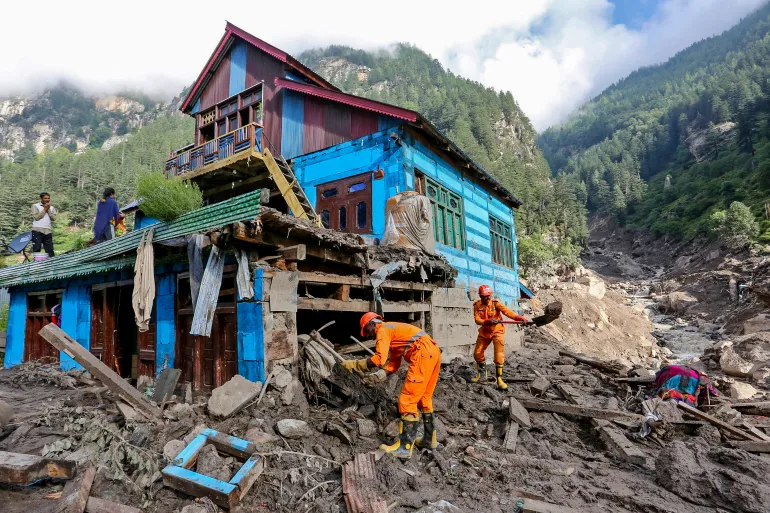
A mass of ice and rock broke loose high in the mountains and sent a violent surge of water, mud and debris down the Lhende Khola River. The torrent travelled through valleys, swept away settlements and infrastructure and eventually reached the Nepal-China border.
What followed was not simply a flood.
It was a chain reaction.
By mid-September, more than 1,400 people had been reported dead and at least 6,000 remained missing in Nepal and across the border in Tibet. Twelve hydropower plants were destroyed, while roads, bridges and homes were buried or washed away.
The scale of the destruction has left scientists and disaster managers confronting a difficult question: How do you warn communities about a disaster whose trigger may occur high above them, in terrain that is difficult to monitor and where there may be only minutes to react?
Basanta Raj Adhikari, director of the Centre for Disaster Studies at Tribhuvan University in Kathmandu, described the event to Al Jazeera as unprecedented in size, affected area and mechanism. His estimate suggested that the energy involved was greater than that released by the Hiroshima atomic bomb, a comparison intended to illustrate the scale of the physical forces involved rather than suggest that the event was equivalent to a nuclear explosion.
For scientists who study the Himalayas, the disaster demonstrated how quickly an event originating in a remote, high-altitude environment can become a regional catastrophe.
And Nepal is not alone.
A warming climate is altering glaciers, snow cover, permafrost and high-altitude lakes. At the same time, roads, hydropower projects, tourist facilities and settlements have pushed deeper into mountain valleys.
That combination is creating a new risk landscape in which one hazard can trigger another.
An avalanche can block a river. A blocked river can form a temporary lake. A sudden release can become a debris flow. That debris can destroy a road or bridge, block another river and create another flood downstream.
The August disaster in Nepal showed how quickly such a sequence can unfold. It also exposed a weakness in the way early-warning systems are often designed.
Many systems are built around a particular hazard: rainfall, river level or glacial lake outburst flood. But the Himalayas do not always respect those categories.
In July, the International Centre for Integrated Mountain Development, or ICIMOD, warned that a below-normal monsoon should not be interpreted as a safer one.
“The biggest misunderstanding is that less seasonal rainfall means lower flood risk,” said Saswata Sanyal, a disaster risk reduction specialist at ICIMOD.
“A drier monsoon can still be a dangerous monsoon,” he added, warning that seasonal averages cannot capture the cloudbursts capable of producing catastrophic flooding in mountain valleys.
The Nepal disaster went a step further.
The immediate trigger was not simply heavy rainfall.
Scientists have been examining an ice-rock avalanche and other possible processes that temporarily obstructed the river system before releasing a destructive surge. ICIMOD has described the event as an ice avalanche rather than a conventional glacial lake outburst flood, while other scientists have examined the role of local seismic activity and other high-altitude processes.
That distinction matters.
A warning system waiting for rainfall or a rising river may not provide enough time when the real trigger happens several kilometres upstream and above the line of sight of the communities below.
![Indian National Disaster Response Force (NDRF) personnel conduct a search and rescue operation at the site of a flash flood at a village in the Kishtwar district of Indian-administered Kashmir on August 16, 2025 [AFP]](https://i0.wp.com/occasionaldigest.com/wp-content/uploads/2026/09/afp_68aac36f5150-1756021615.jpg?w=640&ssl=1)
Thousands of kilometres away, scientists studying Kashmir’s Himalayas are seeing another part of the same problem.
A study published in the Journal of Glaciology this year mapped 155 glacial lakes above 2,500 metres (8,200ft) across the Himalayas in Indian-administered Kashmir.
The researchers found that the area of ice-contact proglacial lakes – bodies of water that form directly against the margin of a melting glacier, trapped by moraine ridges, bedrock basins, or ice dams – had increased by 26 percent between 1992 and 2024.
Five lakes were classified as having very high susceptibility to glacial lake outburst floods.
An outburst from those lakes, the researchers found, could threaten several thousand buildings, 15 major bridges, roads and a hydropower project.
More significantly, the study warned that hazards could occur in chains, with an upstream lake outburst potentially triggering secondary events downstream.
For Irfan Rashid, a glaciologist and associate professor at the University of Kashmir who co-authored the study, the implications extend beyond individual lakes.
Rashid recently told Al Jazeera that without action, the melting, thinning, and destabilisation of glaciers, seasonal snow cover, and permafrost along the Hindu Kush-Himalayas system would increase, and water shortages could become a major problem across the Upper Indus, Ganga and Brahmaputra basins by the end of the century.
That is why the Nepal disaster resonates in Kashmir.
The landscapes are different, the rivers are different and the individual hazards may differ. But the underlying problem is increasingly similar: Communities living downstream of a rapidly changing high-altitude environment may have little time to respond when something breaks loose above them.
The challenge is particularly acute in places where roads, bridges and hydropower projects occupy narrow valleys.
Once a mountain river begins carrying enormous quantities of rock, ice and mud, infrastructure designed for conventional floods can quickly become irrelevant.

The same concern runs across the western Himalayas and Karakoram ranges.
The Gilgit-Baltistan region in Pakistan-administered Kashmir contains hundreds of glaciers and glacial lakes, while communities and infrastructure sit along valleys exposed to sudden floods and landslides.
Pakistan has responded by expanding early-warning infrastructure.
Under a United Nations-supported programme, early-warning systems, evacuation shelters, disaster-management centres and other protective measures have been established in vulnerable valleys.
But technology alone cannot solve the problem. A sensor can detect a change. Someone still has to receive the message. Someone has to understand what it means. And people downstream have to have a route to safety.
That last part is often the weakest link. A siren is useful only if the people hearing it know where to go. An automatic warning is useful only if it arrives before the flood. A satellite image is useful only if the information can be converted into a decision quickly enough to save lives.
This is why disaster scientists increasingly talk about anticipatory action rather than simply disaster response.
“The era of preparing for a single, predictable hazard is over,” Sanyal said earlier this year. “Anticipatory action and early warning must now be the foundation.”

The Himalayas are also becoming more heavily engineered.
Hydropower is central to Nepal’s economy. Roads are being expanded. Border crossings are growing in importance. Tourism is pushing deeper into remote valleys.
The benefits are obvious. So are the risks.
The August disaster struck an area where hydropower infrastructure was concentrated along the river corridor. At least 900 workers were believed to have been inside tunnels and other facilities in the aftermath, making rescue operations extraordinarily difficult. Two workers were eventually pulled alive from a hydropower tunnel nine days after the disaster.
The question is no longer simply whether infrastructure can withstand a flood. It is whether planners have adequately considered what happens when a flood is carrying an enormous mass of rock and ice, when a river changes course, or when one mountain hazard triggers another.
For decades, engineering risk assessments have often relied on historical records. But history becomes a less reliable guide when the physical conditions producing disasters are changing.
A river that flooded once every several decades may no longer behave according to the same pattern. A glacier that appeared stable from satellite imagery may sit beneath an increasingly unstable slope. A lake that was considered remote may suddenly become a threat to a road, village or power plant hundreds of metres below.

There is another complication that no satellite can solve on its own.
Borders.
The Himalayas are divided among countries with different political systems, security concerns and approaches to sharing information. But rivers do not stop at international boundaries. Neither do floods.
The August disaster reached the Nepal-China border and damaged the Gyirong crossing, an important trade and pilgrimage route. The disaster also raised questions about how quickly information about hazards in high mountain areas can move between countries.
This is where regional cooperation becomes more than a diplomatic slogan, experts say. A sensor positioned in one country can provide warning to people in another. A satellite image collected over one mountain range can reveal a developing hazard that threatens a valley downstream. A river gauge can provide critical information before floodwaters reach a settlement.
The technical capability already exists in many cases. The missing piece is often the architecture connecting it.
A 2026 assessment of Himalayan disaster risks has argued for stronger monitoring, early-warning systems and regional coordination because hazards are increasingly interconnected.
The idea is simple: Information about a mountain hazard should not stop at the same line where a political boundary begins.

The August disaster in Nepal isn’t a tragedy belonging to one country, point out experts.
The Kashmir Himalayas study has already identified lakes capable of producing destructive outburst floods and has warned of cascading processes.
Northeast India’s Sikkim provides another example.
After the 2023 South Lhonak glacial lake outburst flood killed dozens and damaged major infrastructure, India expanded monitoring and mitigation efforts.
Today, 40 high-risk glacial lakes have been identified in Sikkim, including 16 placed in the highest-risk category, with authorities working on drainage, flood-retention and other protective measures.
But the lesson from each disaster is broadly the same: Waiting for a disaster to prove the risk is the most expensive form of preparedness.

The Himalayas are sometimes called the Third Pole because they contain one of the world’s largest concentrations of snow and ice outside the Arctic and Antarctic.
Major Asian rivers depend on water originating in these mountains. Hundreds of millions of people live downstream.
That makes the changing Himalayas not only an environmental issue but a security, infrastructure and humanitarian one.
The August disaster demonstrated the most frightening version of that future. A mountain can collapse without warning. A river can become a weapon of debris. A hydropower tunnel can become a trap. A border crossing can disappear in minutes. And by the time people downstream understand what is happening, the water may already be there.
It’s a future that a region stretching from northeast India, spanning Tibet, Nepal, Kashmir and Pakistan, can no longer ignore. Yet disaster management remains largely divided by national boundaries. That contradiction is becoming harder to navigate.
The next glacial collapse could begin in Kashmir. It could begin in Pakistan’s high mountains. It could begin in Sikkim, Nepal or Tibet.
Wherever it starts, the same question will follow the mountain downstream: Who knew, how early did they know, and did the warning reach the people in time?
For a region entering an era of increasingly complex mountain hazards, that may be the real measure of whether the Third Pole is prepared.
Magdalena Andersson will likely face several challenges as she tries to get Sweden’s other left-wing parties to unite.
Published On 18 Sep 202618 Sep 2026
Sweden’s opposition leader has officially begun talks to form a coalition government after the country’s left-wing bloc won a slim majority in last week’s election.
Magdalena Andersson, leader of the centre-left Social Democrats, was asked by Parliament Speaker Andreas Norlen on Friday to begin efforts to form a new government.
list of 3 itemsend of list
Norlen’s request follows the resignation of centre-right Prime Minister Ulf Kristersson, who stepped down on Thursday after the general election result was confirmed.
“I have now been tasked with exploring the possibility of forming a government. A task I undertake with great humility and will act constructively to put together a new government,” Andersson said in a statement posted on Instagram.
“My approach to the work that is now taking place is that all political forces now need to put party tactics aside and put Sweden and the Swedish people first.”
Andersson will likely face a series of challenges as she tries to persuade Sweden’s other left-wing parties to unite and form a new administration. The left-wing bloc won 176 of Parliament’s 349 seats in last week’s vote, securing a razor-thin majority of three seats.
Andersson is expected to seek the support of three other left-wing parties: the Greens, the Centre Party and the Left Party.
The socialist Left Party says Andersson will have to award some of its MPs cabinet posts to win their support. However, the liberal Centre Party insists it will not support such a government.
Andersson has until September 28 to form a government. If she fails, Kristersson, whose centre-right bloc won 173 seats, will try to form a coalition.
Coalition and minority governments are common in Sweden because the country has two major left- and right-wing blocs, both of which contain four parties.
The process of forming a government following the 2022 election took more than a month.
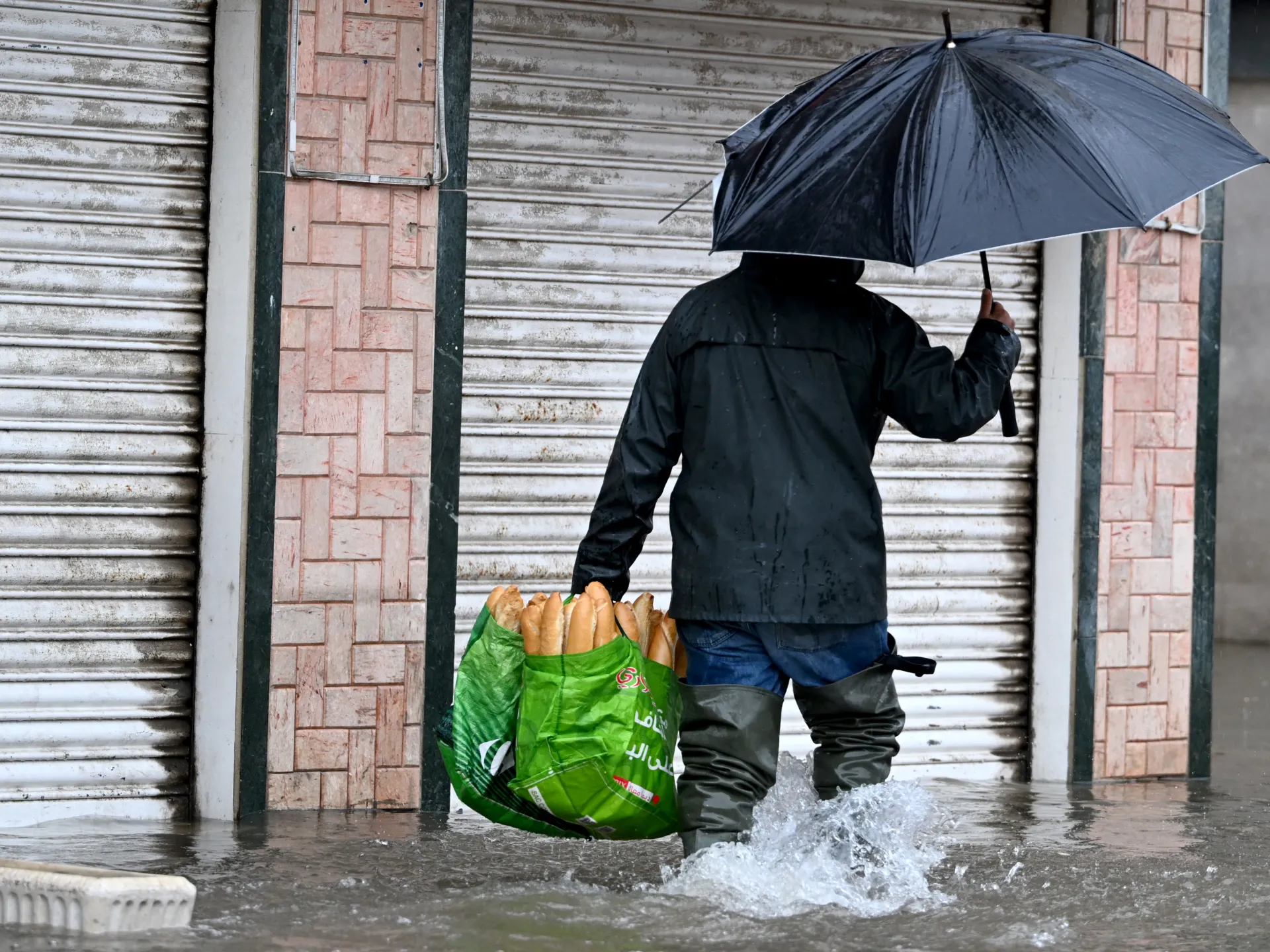
Recurring floods disrupt daily life in Tunis, raising questions about drainage, transport and flood preparedness.
Published On 18 Sep 202618 Sep 2026
Tunis, Tunisia – Heavy rain brought parts of Tunisia’s capital to a standstill on Thursday, flooding roads and homes, trapping people in cars and disrupting electricity and internet services.
Home to nearly three million people, the Greater Tunis region has faced repeated flooding in recent years. Thursday’s flooding came only months after severe January rains caused widespread disruption across the capital and other parts of the country, leaving several people dead and causing significant damage.
Weather warnings had been issued in advance, but the decision to suspend classes in Tunis was announced only shortly before it took effect. Parents rushed to schools to collect their children as the rain intensified and traffic backed up across the capital.
Videos shared online showed flooded streets, cars stranded in rising water and what appeared to be power lines catching fire. Residents also reported power and internet cuts and water entering homes.
Fatma, a 35-year-old employee in Tunis, said the situation deteriorated quickly as she struggled to get home safely.
“At about 4pm, the road became almost unrecognisable. The tunnel leading to Bab Saadoun was completely closed because of the rain,” she told Al Jazeera.
“Most people were stranded by the roadside for hours, waiting for public transport that never came. I saw three cars that filled with water and broke down, and people carrying their children on their shoulders.”
“Every season, the same thing happens. Roads close and traffic comes to a complete standstill. All the drains start overflowing with waste,” she said.
The National Institute of Meteorology had warned of locally heavy thunderstorms on Thursday, including heavy rain over short periods that could cause flooding, disrupt traffic and overwhelm drainage networks. It also warned of potential power cuts.
“Tunisia has become used to these disasters. Every year, we end up flooded even when there is little rain,” said Intissar, 33, from the Lafayette area of Tunis.
She blamed local authorities for failing to carry out preventive work before the rainy season.
“This is work that should have been done during the summer,” she said.
But she also acknowledged the role of residents.
“We cannot deny the responsibility of citizens who dump waste that blocks drainage channels,” she said.
At a government meeting in August, officials called for drainage networks and waterways to be cleaned and flood-protection work to be accelerated. The government said 29 flood-protection projects were under way across the country.
The flooding comes as Tunisia prepares for a national march in Tunis on Saturday, with organisers calling for the release of four activists detained in connection with the Al-Soumoud Flotilla. The march is scheduled for 5pm, as rain is forecast to continue through Saturday.
Fatma said the lack of reliable public transport, combined with repeated flooding, was making it increasingly difficult for people to manage without cars.
“The problem makes people look for their own solutions. That is why most people are trying to find a way to buy a car, because it has become difficult to live without one with these recurring problems,” she said.
The flooding also came as students returned to schools and universities this week, adding pressure to roads and public transport.
For Fatma, the disruption is becoming a familiar pattern.
“This shows that the state has no vision. It is caught off-guard just like citizens are,” she said.
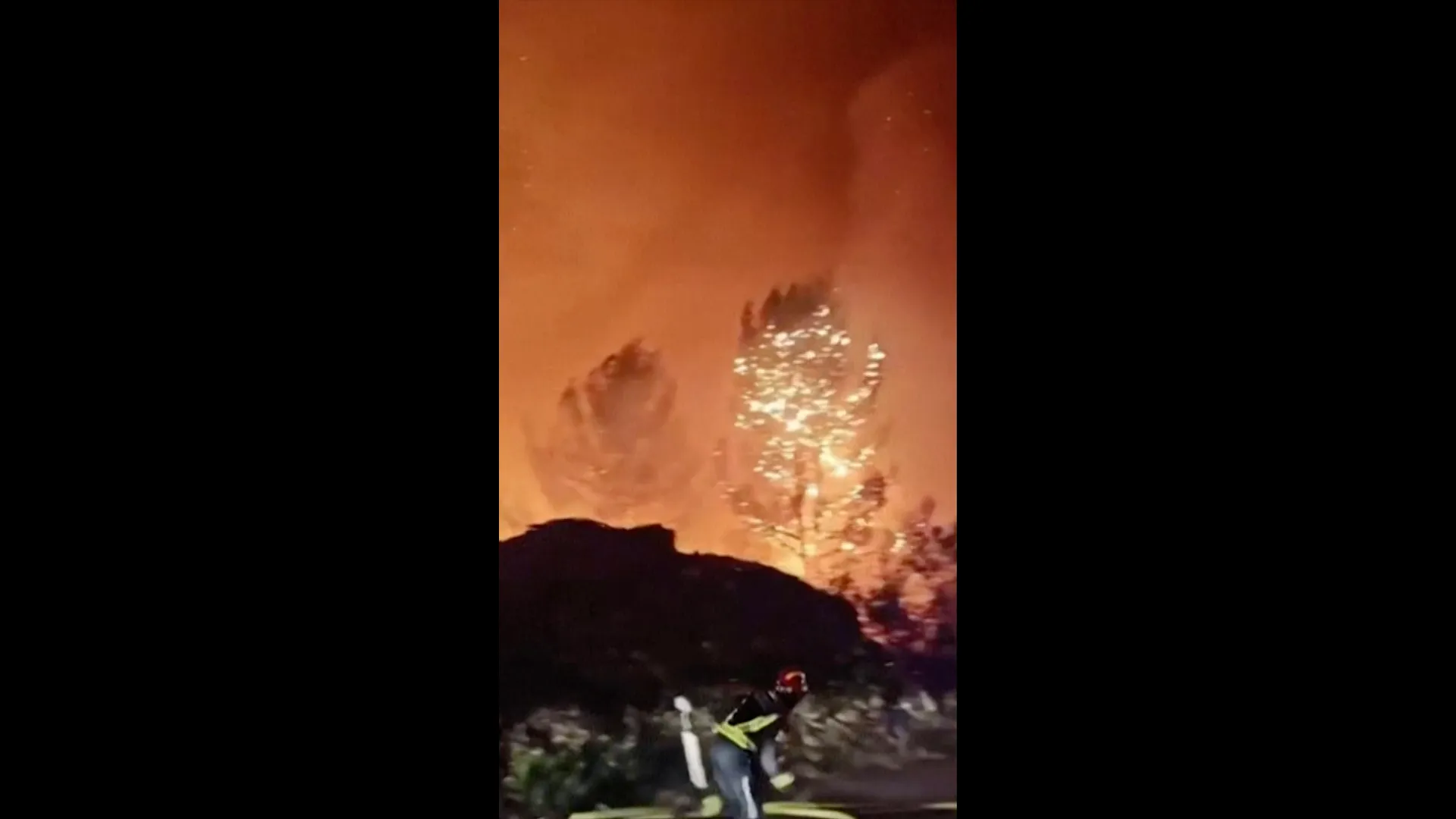
Croatian authorities have issued an emergency alert as a wildfire rages on Brac Island, off the Dalmatian coast. Strong winds have hampered efforts to stop the blaze near the island village of Milna.
Published On 13 Sep 202613 Sep 2026
Share
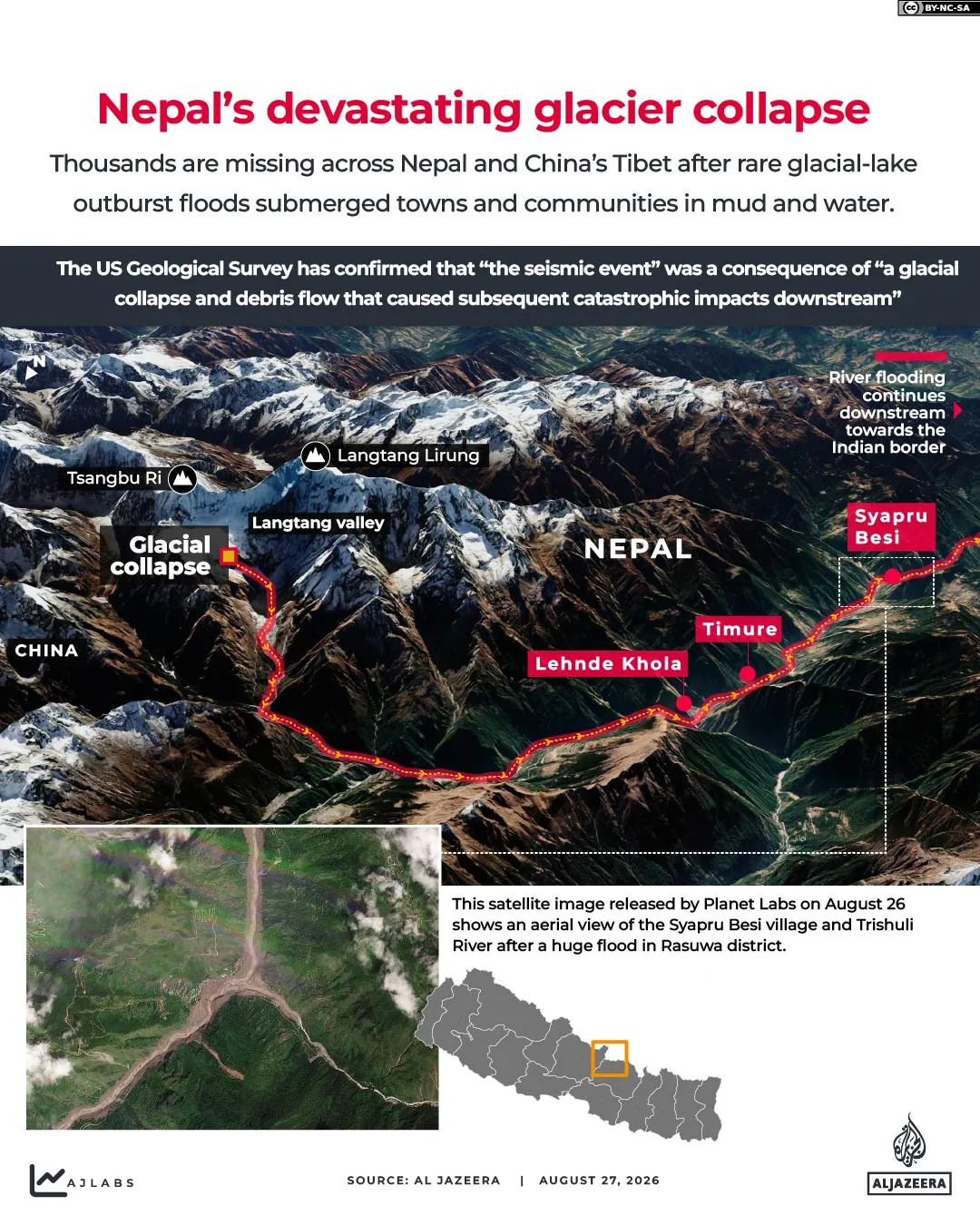
Nepal is demanding “climate justice” and $20m in compensation after the recent devastating floods in the country and China’s Tibet region, which led to the deaths and disappearances of thousands of people.
The catastrophe, which scientists say was caused by the effects of climate change, was triggered when part of a mountain glacier collapsed and a torrent of water and mud flooded down into Nepal’s Rasuwa and Nuwakot regions, as well as into China’s Tibet region on August 26. More than 1,300 people have been confirmed dead and more than 5,000 remain missing.
list of 3 itemsend of list
“We are paying the ultimate price for a global crisis we did not create,” Nepal’s Foreign Minister Shisir Khanal said last week.
“Support for Nepal should not be seen from an angle of aid or charity, but should be seen from the perspective of climate justice,” he told the AFP news agency.
On Monday, the country’s President Ramchandra Paudel made a similar demand during an address to the nation.
“I make a heartfelt appeal to the international community not only to listen to the voices of ecologically vulnerable countries, including Nepal, but also to take concrete and effective steps to ensure climate justice for them,” he said.
Nepal’s Ministry of Finance and Ministry of Environment have written a joint letter to the United Nations, which set up a fund to respond to loss and damage caused by climate change in 2022 in line with the 2015 Paris Agreement on climate, with a request for $20m in damages.
The UN’s Loss and Damage Fund is, however, facing a $2.8bn funding gap as it prepares to approve its first climate recovery projects.

Nepal’s leaders may have a point.
Nepal contributes less than 0.1 percent of global greenhouse gas emissions and generates most of its electricity from renewable sources of energy. Yet its geographical location in the Himalayas makes it particularly vulnerable to severe climate and weather events.
Last month’s catastrophic flooding in the country comes against a backdrop of rapid global warming and glacial loss across the Himalayas.
Glaciers across the Hindu Kush Himalaya mountain range – which spans Afghanistan, Bangladesh, Bhutan, China, India, Myanmar, Nepal and Pakistan – lost ice 65 percent faster between 2011 and 2020 than during the previous decade.
Nepal’s glaciers, which are sandwiched between two major carbon emitters – India and China – have lost close to one-third of their ice volume in roughly three decades due to global warming, the United Nations said in 2023.
Tanuja Pandey, a Nepal-based climate activist and lawyer, said there is collective frustration behind Nepal’s demand for climate justice.
“People here feel the world often pays attention to Nepal only when a climate disaster becomes impossible to ignore. It is deeply painful to people here that global attention intensifies when headlines report thousands of people dead or missing and in the end, their suffering does not generate any urgency to fight climate change,” she told Al Jazeera.
Shreya KC, a 28-year-old Nepali climate activist, said there is profound anger and sadness among people in Nepal who say that they must no longer continue to suffer the impact of climate change, which, as they see it, other countries are responsible for.
“My hometown is in Solukhumbu in eastern Nepal,” the activist told Al Jazeera. “It is a district of mountains and is also home to the world’s highest mountain, Mount Everest, and my home is also downstream. After the glacial collapse happened two weeks ago, people in my region have realised that this can now happen anywhere in Nepal since the Himalayas are warming and glaciers are melting faster.”
While Nepal has been actively fighting climate change, Shreya KC said she herself has been involved in projects in the country that focus on clean hydropower generation, forestry and other such climate advocacy programmes.
“Because of other countries,” she said, “today Nepalis are the ones most impacted by climate change. So people want justice.”

According to preliminary estimates from Nepal’s National Disaster Risk Reduction and Management Authority, the country’s property, housing and infrastructure losses in the floods amount to some $2.56bn.
But claiming compensation under a notion of “climate justice” won’t be straightforward, according to Joyeeta Gupta, a professor of Environment and Development in the Global South at the University of Amsterdam.
According to the United Nations, “‘climate justice’ is the moral and ethical principle that seeks to address the disproportionate impact of climate change on vulnerable communities and future generations”.
“I define it as a system of justice where others’ perspectives are taken into account, and no harm is caused to others,” Gupta told Al Jazeera.
Nepal is a country that has very low emissions, she said, but is facing the brunt of climate issues which it never created. “That is reason enough for Nepal to claim climate justice,” she noted.
But, practically speaking, can it? In the pre-1990 period, there was a lot of discussion among nations about the need for large emitters to compensate those that would be harmed, Gupta noted. But soon after that, the term “compensation” disappeared from the agenda of international climate treaties, which turned more to discussions about providing assistance to developing countries that need to tackle climate change instead.
In a July 2025 advisory opinion on climate change, the International Court of Justice (ICJ) declared that “all nations have binding legal duties under international law to prevent significant climate harm”.
The ICJ’s advisory opinion on climate change also says that states breaching their international climate obligations can be required to make full reparations, including financial compensation to “injured states” or countries impacted by climate change caused by the actions of other countries.
While the ICJ’s opinion is not legally binding, Gupta said, it is a statement in international law that could support Nepal’s government’s international appeal for climate justice and compensation.
Nepal’s rapper-turned-prime minister, Balendra Shah, is scheduled to travel to New York on September 22 to address the 81st session of the United Nations General Assembly (UNGA) on September 24. His country’s appeal for climate justice is expected to be a key part of his address.
For climate activist Shreya KC, while UN meetings and international conferences on climate change may hold some weight when it comes to discussing climate disasters, right now, what Nepal needs is money.
“So much of our money allotted for healthcare, education and to transition into a more developed nation is now being spent on fighting climate change. So countries who are causing emissions, especially from the global north, need to commit more money to the UN’s Loss and Damage Fund,” she said, adding that money from that fund should be disbursed to vulnerable communities in need, not as a loan but as compensation for bearing the brunt of climate change.
Pandey noted that this is not the first time a climate disaster has occurred in Nepal and said that the new government, which came into power in March this year on the back of Nepal’s Gen Z protests last year, has also failed to make climate a priority in its budget.
While it is a good sign that Nepali politicians are appealing for international climate justice, she said, they also need to address the country’s internal development model to fight climate change in the first place.
“There is no climate justice without internal justice within the country itself,” she said.
“I hope that even in our development, partners and investors stop treating climate resilience as an optional addition to development in Nepal just because we are economically vulnerable.
“Investing in Nepal without investing in sustainability is simply a bad investment.”
On Monday, Nepal declared a national day of mourning to remember the more than 1,300 people who are known to have died in last month’s catastrophic floods. Thousands more are still missing.
The country’s President Paudel used the opportunity to call on people to unite.
“This is not a time for division. Nor is it a time to blame one another or become entangled in political disputes and confrontation,” he said.
“This is a time to demonstrate national unity and solidarity. It is also a time for reconstruction, rehabilitation and economic recovery.”
But Gupta says Nepal’s biggest challenge right now is establishing a precedent for compensation for climate change-related disasters.
“It was recently a glacial collapse in the country, but soon, it will become a bigger issue as time goes on because the monsoon patterns will change, the sea level will rise,” she said.
As many other developing countries – notably island states that face being submerged altogether – are also likely facing similar climate change challenges, the damage could become huge.
“That is going to be a very big reason why many rich countries will probably be unwilling to pay compensation, because that would set a precedent for future issues,” Gupta said.
“But the issues countries like Nepal are facing are a very strong argument to try and convince the whole world to accelerate action to phase out fossil fuels and fight climate change.”