Sitting in a glacial valley surrounded by vast farmland is an area that offers tranquillity and a true sense of England’s countryside with historic villages and walking trails
It’s a paradise for walkers and cyclists (Image: Philip Silverman via Getty Images)
For those seeking a sense of peace and tranquillity, this glacial valley, encircled by expansive farmland, delivers precisely that – an authentic taste of England’s rural heartland.
Littondale is a small and peaceful dale in Yorkshire, nestled in a classic u-shape, with deep historical roots and a flavour of country living from a bygone era.
Visitors to the dale experience a feeling that time has stood still, as its hamlets and way of life remain quintessentially English in every respect.
Indeed, archaeologists have discovered numerous prehistoric and later settlements that once inhabited the length of the valley. Their extensive findings also showed that throughout the mediaeval period the dale was predominantly managed by several monastic houses.
The dale now consists of several settlements, including Hawkswick, Arncliffe and Litton. Each is characterised by farmhouses dating back to the 17th century.
Save on the best holiday cottages in Yorkshire
This article contains affiliate links, we will receive a commission on any sales we generate from it. Learn more
Famous for its dramatic landscapes, historic cities, hearty food, and rich cultural heritage Yorkshire is just waiting to be explored. Sykes Cottages has a large number of properties to choose from with prices from £31 per night.
Contributing to its peaceful atmosphere is the stunning river which famously winds through the valley before eventually merging with the larger River Wharfe.
Shallow yet flowing with remarkably clear waters, the River Skirfare meanders through the farmlands and valley floor, vanishing for portions of the year.
As seasonal conditions shift, the stream trickles away and disappears beneath the ground, near Litton, revealing an unusual limestone landscape below.
Arncliffe
Arncliffe stands as one of the principal villages in the region, and despite its compact size, it boasts considerable fame. Recognised by countless households across Britain, it served as the original backdrop and filming location for the much-loved soap Emmerdale Farm.
The village pub, called the Falcon, was even featured as the Woolpack Inn. The traditional inn, according to visitor feedback, has seen better days.
However, one guest commented on TripAdvisor: “We had read about this tiny pub. It had been featured on the TV soap Emmerdale many moons ago, and it did not disappoint! The landlord was straight out of central casting.”
The area still comprises the most enchanting stone cottages, alongside a delightful church, the Church of St Oswald. Constructed sometime between the 16th and 18th centuries, the building remains a listed structure, believed to have been developed from an original Saxon place of worship.
Positioned at the centre of the village, the church continues to attract curious visitors and was once a location regularly visited by the renowned poet and novelist Charles Kingsley.
His time there during the Victorian period was believed to have influenced his celebrated children’s story, The Water Babies, penned in 1873.
Walking
Many people choose to treat the area as a base for rambling, parking in one of its villages and tackling the Yorkshire Dales terrain. Most of these trails are circular, returning you directly to your starting point, whilst exploring the valleys and peaks en route.
The Littondale to Kettlewell walk is a well-loved route, starting in the village of Arncliffe, leading you across the shoulder of Birks in Kettlewell, where you can pause for refreshments, before returning into Littondale.
Alternatively, some choose the slightly over five-mile walk that takes you from Arncliffe to Litton and loops back round.
The two-hour ramble provides a leisurely countryside stroll as you soak up the picturesque beauty of Yorkshire, with the chance to make a stop, or two, at the charming village pubs.
From Gary Klein: The Rams’ remodeled secondary will have a heavy Kansas City Chiefs influence.
A week after trading for cornerback Trent McDuffie, the Rams on Monday agreed to terms with cornerback Jaylen Watson, a person with knowledge of the situation said. The person requested anonymity because deals cannot become official until Wednesday.
Watson’s deal with the Rams is for three years and includes $34 million in guarantees, NFL Media reported.
Watson and McDuffie, who on Sunday agreed to terms on an extension that reportedly includes $100 million in guarantees, won two Super Bowls with the Chiefs.
Watson, 27, has three career interceptions, including two last season. Watson, 6 feet 2 and 197 pounds, played at Ventura College for two seasons before transferring to Washington State. The Chiefs selected him in the seventh round of the 2022 draft.
The Rams have made several moves involving the secondary. In January, safety Quentin Lake received a three-year extension that includes $25 million in guarantees. They traded the 29th pick in this year’s draft and other picks this year and next for McDuffie, and also agreed to terms with safety Kam Curl on a three-year extension that includes about $24 million in guarantees.
Former Baltimore Ravens tight end Charlie Kolar agreed to a deal with the Chargers on Monday.
(Terrance Williams / Associated Press)
The Chargers aren’t hesitating when it comes to bolstering their run-blocking options for new offensive coordinator Mike McDaniel, reportedly agreeing to terms Monday with former Baltimore Ravens tight end Charlie Kolar.
Kolar and the Chargers agreed to a three-year, $24.3-million deal that includes $17 million in guarantees, NFL Media reported.
Widely considered the best run-blocking tight end available ahead of free agency, Kolar should help an uneven Chargers running attack that forced coach Jim Harbaugh to often rely too much on quarterback Justin Herbert — even when his running backs were healthy.
Ryan Ward hits for the Dodgers during a spring training game against the Arizona Diamondbacks on Feb. 25.
(Ross D. Franklin / Associated Press)
From Jack Vita: There comes a point in every big leaguer’s career when they graduate from their farm system, a time in which they’ve proven everything they can at the minor league level, and it’s time to see what they are made of in the big leagues.
For some, it’s a fast track. For others, it may come after a few seasons in the minors.
And then there’s players such as 28-year-old Dodgers prospect Ryan Ward. Drafted in the eighth round in 2019, Ward has played 402 games at triple-A Oklahoma City over the past three seasons. Last year, his 36 home runs, 122 RBIs, and .290/.380/.557 slash line made him the MVP of the Pacific Coast League. But after Sunday’s Cactus League game against the Athletics, the Dodgers optioned Ward and left-hander Ronan Kopp to Oklahoma City.
Fears of a broad flight of artists and agents prompted Wasserman to announce that he was selling his talent representation and sports marketing firm. Talks with prospective buyers have been ongoing, according to a person close to the agency but not authorized to speak publicly.
Clippers forward Kawhi Leonard, right, controls the ball in front of New York Knicks guard Josh Hart during the second half of the Clippers’ win Monday at Intuit Dome.
The Clippers are 32-32 and have won five of their first six games in March as they try to improve their potential position in the NBA play-in tournament. They began the season in a 6-21 tailspin.
It was Leonard’s 42nd straight game with 20-plus points, the second-longest active streak in the NBA and third-longest in team history.
The Fanatics Flag Football Classic, featuring Brady and a slew of other NFL stars and athletes, will take place March 21 at BMO Stadium, the venue that is also slated to host flag football during the 2028 Summer Olympics.
The event was originally scheduled to take place on the same date, but at a location more than 8,000 miles away at Kingdom Arena in Riyadh, Saudia Arabia.
Aaron Judge, center, celebrates in the dugout after hitting a two-run home run for the U.S. against Mexico in the World Baseball Classic on Monday.
(Ashley Landis / Associated Press)
From the Associated Press: Aaron Judge hit a two-run homer and Roman Anthony added a three-run blast in a big third inning to lead the United States to a 5-3 win over Mexico in the World Baseball Classic at Houston’s Daikin Park on Monday night.
The U.S. improved to 3-0 and will meet Italy (2-0) on Tuesday night, seeking to secure a spot in the quarterfinals in Houston this weekend.
Jarren Duran homered twice for Mexico (2-1), which will face Italy Wednesday night in the last game of Group B play.
1913 — The Quebec Bulldogs win the Stanley Cup in two games over Sydney.
1920 — Quebec’s Joe Malone scores six goals to lead the Bulldogs to a 10-4 rout of the Ottawa Senators.
1961 — Wilt Chamberlain of the Philadelphia Warriors becomes the first NBA player to score 3,000 points in a season. Chamberlain scores 32 points in a 120-103 loss to Detroit to bring his season total to 3,016.
1963 — Wilt Chamberlain of the San Francisco Warriors scores 70 points in a 163-148 loss to Syracuse.
1985 — Dick Motta becomes the fourth NBA coach to record 700 victories as Dallas beats New Jersey 126-113.
1991 — Eddie Sutton of Oklahoma State becomes the first coach to lead four schools into the NCAA tournament. Sutton also coached Creighton, Arkansas and Kentucky in the tournament.
1992 — New York Islanders coach Al Arbour becomes the second coach in NHL history to win 700 games with a 5-2 victory over Philadelphia.
2001 — With Swedish great Ingemar Stenmark looking on, Hermann Maier wins the giant slalom for his 13th victory this season, equaling one of the mightiest alpine skiing records. Maier, winner of the overall World Cup title three of the last four years, ties the record Stenmark set in 1979.
2002 — John Stockton, the NBA’s career assist leader, has 13 assists in Utah’s 95-92 loss at Houston to give him exactly 15,000 for his career.
2004 — Orlando’s Tracy McGrady scores a franchise record 62 points in a 108-99 win over Washington.
2011 — Veteran referees Jim Burr, Tim Higgins and Earl Walton, cited for two errors in the final seconds of the St. John’s-Rutgers game, withdraw from the rest of the Big East tournament. The three officials missed two calls — a travel and stepping out of bounds — in the final 1.7 seconds of St. John’s 65-63 win in the second-round of Big East tournament. The Big East acknowledged after the game the officials blew the calls.
2014 — The game between Dallas and the Columbus Blue Jackets is postponed by the NHL after Stars forward Rich Peverley collapses on the bench during the first period.
2018 — Texas Southern beats Arkansas-Pine Bluff 84-69 in the Southwestern Athletic Conference championship game. Texas Southern (15-19) earns an automatic bid into the NCAA Tournament after starting out 0-13 this season. The Tigers didn’t win a game until Jan. 1 and never beat a nonconference opponent.
2018 — The Vegas Golden Knights set a record for road wins by an expansion team with a 2-1 shootout victory at Buffalo. At 20-12-3, the Golden Knights break a tie with the 1993-94 Anaheim Ducks for most road wins by an NHL team in its first season.
2022 — After a 99-day lockout, Major League Baseball and MLB Players Assn. reach a new collective bargaining agreement; MLB teams set to play full 162 game season in 2022.
Compiled by the Associated Press
Until next time…
That concludes today’s newsletter. If you have any feedback, ideas for improvement or things you’d like to see, email me at houston.mitchell@latimes.com. To get this newsletter in your inbox, click here.
It was a new-look England as Wiegman is managing the return of several key players from injury, while rewarding those in form.
Manchester City’s Laura Blindkilde Brown was handed a rare start, while London City Lionesses defender Poppy Pattinson made her debut in the second half.
The back four in the starting XI had fewer than 100 caps combined – with captain Leah Williamson earning 65 of them – as Maya Le Tissier was at right-back over Lucy Bronze, while Taylor Hinds started her third game in four matches at left-back.
In-form Jess Park was playing out wide, as she has done for Manchester United so impressively this season, rather than in midfield where Wiegman has often used her.
It was uncharacteristically experimental from Wiegman considering this was their first competitive fixture since Euro 2025 and it took time to take shape.
England had 40 touches in the opposition box and 85% of the possession in the first half, but failed to score from their 15 efforts on goal.
The tempo had dropped, Ukraine were defending well and England’s hopes of flying out of the blocks had not materialised.
“They didn’t quite figure it out in the first half. They were a little bit stunned about what to do,” ex-England midfielder Fran Kirby told BBC Radio 5 Live Extra.
“Ukraine defended really well. They were really tight between the lines and they made it very difficult for England.
“They needed to have a little bit more composure in the box instead of crossing it for the sake of crossing it.
“The second half showed that they learned from the first half in terms of what wasn’t working.”
With a side stacked full of quality, the two-time European champions responded in the second half.
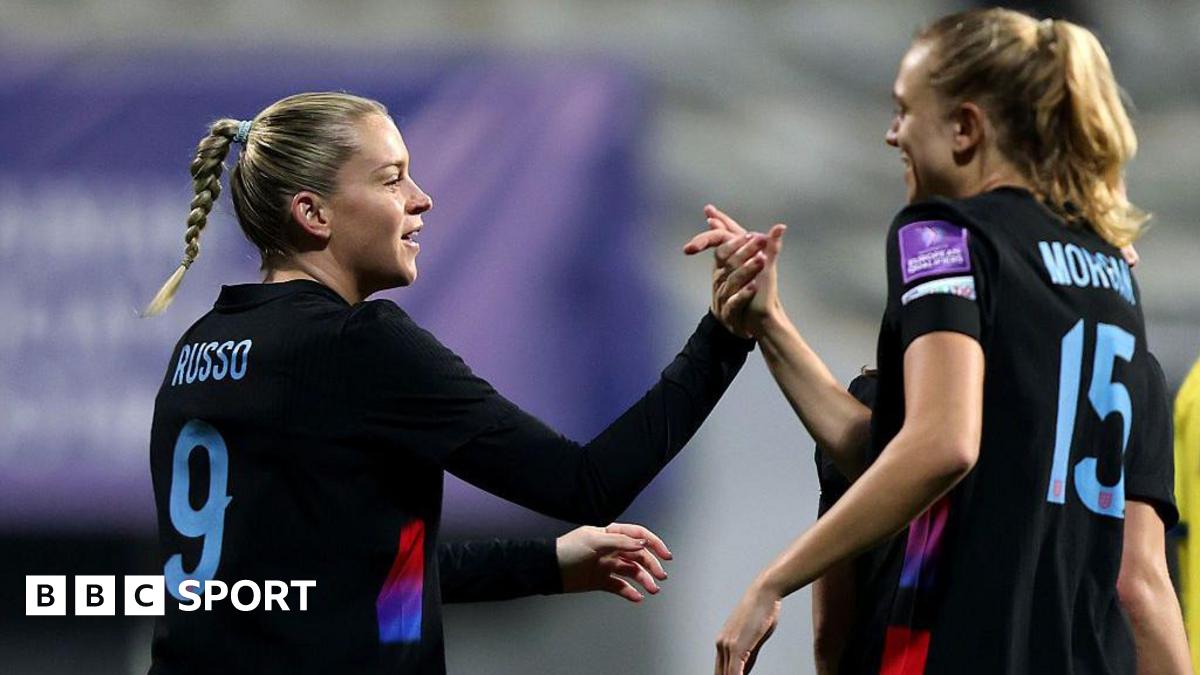
Arsenal striker Alessia Russo netted two goals in four minutes to put England in control, before a double from Georgia Stanway took them out of Ukraine’s reach.
Wiegman’s “clear win” was confirmed when Park also scored twice later on.
“I think it took us the first half to break them down. We were still very good in the first half. They were defensively solid,” said Russo afterwards.
“When the spaces opened, we took our chances. I wouldn’t say it was relief [when we scored]. We knew we had the quality in us and it was just executing it.
“It was finding the final moment, the final pass and the final shot. You saw that in the second half.”