MINI bars at your seat, fancy amenity kits and the ‘world’s biggest business class’ – British Airways’ latest announcement is transforming the way Brits will fly with the flag carrier.
The airline’s huge new upgrades are part of the A380 retrofit programme.
First look at British Airways’ huge new A380 retrofitCredit: British Airways
Set to cost millions, it will see new seats in every single cabin, including in World Traveller – economy – and its premium economy, World Traveller Plus.
It will also have what they are calling the world’s biggest business class as well, with 106 Club Suite seats which will be on the upper deck.
Sign up for the Travel newsletter
Thank you!
This is alongside 12 seats in First, 84 in World Traveller Plus and 215 in World Traveller.
The new amenity kits have been rolled out as well – First Class passengers will get bags designed by Swaine with Wildsmith toiletries, and Business Class will get unique patterned bags with anatome products.
First passengers will be getting a few other upgrades as well.
This includes new pyjamas with a bespoke tartan pattern design, along with slippers and blankets.
A built in mini bar will also mean First passengers can get their own snacks without having to go to the galley, with chocolates, mints and even electrolytes.
A new dining experience will include onboard Bollinger, and a wide cocktail menu. Even racks of lamb and grilled salmon will be on the menu.
A new food and snack menu is being rolled outCredit: British AirwaysIt will have the world’s biggest business class with the most seats onboardCredit: British AirwaysNew seats are being rolled out across all classesCredit: British AirwaysThere’s new amenity kits tooCredit: British Airways
British Airways boss Sean Doyle said: “This is a major milestone for British Airways and the future of our A380 fleet, marking one of the most significant transformations we’ve ever undertaken on any aircraft.
‘We’ve completely reimagined the customer experience, introducing new and updated seats in every cabin, all carefully considered to deliver greater comfort and an elevated customer experience.
“From redesigned interiors and upgraded dining to new amenities and service delivery, every detail has been thoughtfully designed with our customers front and centre, helping them to have a more seamless and memorable experience when they fly with us.”
Off the plane, new airport lounges are also being introduced.
First class passengers get an in-seat mini barThe airline has teamed up with Swaine and Wildsmith for First Class amenity kits
A new lounge at Heathrow Terminal 5 C will open by the end of 2028, while the Heathrow Arrivals lounge is being redesigned.
Lounges across the US including Boston, Newark and San Francisco are being updated, along with Geneva.
Fincantieri Marine Group, which developed the cancelled Constellation class frigate for the U.S. Navy, says it sees a possible new opportunity in the service’s latest small surface combatant plans. At least three foreign frigate designs are already under review for possible Navy service, as is the prospect of having them built overseas, as part of a study expected to wrap up next month. Fincantieri wants to once again add the FREMM design, which the Constellation was based on, to the Navy’s options. The shipyard, which is a subsidiary of its Italian namesake, made significant investments in shipyard infrastructure in the United States and supply chains as part of the Constellation debacle, but it is not clear if that will be enough to make a new pitch attractive.
USNI News first reported on the possibility of a new Fincantieri frigate pitch to the Navy yesterday after an interview with CEO George Moutafis. TWZ also spoke at length with Moutafis about the failure of the Constellation class program earlier this year, and we have reached back out to the company for more information about new prospects now.
“Right now the Navy and the [Trump] administration could find the right type of dialog with us to set [development] up in a way that enables quick setup and swift construction without letting design spirals get in the way,” Moutafis told USNI News. “Accept the design that is and works well, and start work on it to get units out there for the fleet.”
This is FREMM, this is Fincantieri | Fincantieri
In addition, “Moutafis said the supply chain the shipyard built during the Constellation could be applied to Fincantieri’s FREMM EVO design with few modifications to avoid the design churn that led to the cancellation of the Constellation,” according to USNI News.
The Constellation class was derived from the Franco-Italian FREMM, a multi-purpose frigate designed to offer a mix of anti-air, anti-submarine, and anti-surface warfare capabilities. The explicit intent of the program had been to acquire a frigate based on an established, in-production ‘parent’ design, to which only relatively minor changes would have to be made, helping to reduce cost and risk. In the end, Constellationonly had 15 percent design commonality with FREMM, causing delays and other issues that directly contributed to its cancellation. However, the Navy’s demand for smaller surface combatants has not gone away. We will come back to this all in a moment.
As designed, the FREMM EVO is close to 472.5 feet (144 meters) long, is some 64.6 feet (19.7 meters) at its widest, and displaces 6,500 tons with a full combat load, according to Fincantieri’s website. Its hull dimensions and displacement are essentially unchanged from the Italian subvariant of the baseline FREMM. The EVO will have a new superstructure configuration and a host of new capabilities.
Renderings of the FREMM-EVO. FincantieriAn Italian Navy FREMM frigate, or Bergamini class, in front, sails together with a US Navy Arleigh Burke class destroyer. USN
The most notable new feature on the EVO version is set to be a new Leonardo Kronos Dual-Band Radar (DBR). The Kronos DBR combines the C-band Kronos Quad and the X-band Kronos StarFire into a single system with four paired sets of active electronically scanned arrays (AESA) positioned around the superstructure. In general, combining radars in this way can offer advantages for performing a variety of different tasks and doing so simultaneously. The ability to fuse data from both arrays together can help produce high-fidelity target tracks and other benefits. At the same time, DBRs have historically presented complexities that can cause serious difficulties with both integration and operation.
Among other things, the DBR is set to give the FREMM EVO expanded capability to knock down incoming ballistic missiles in the terminal phase of flight using Aster 30 surface-to-air missiles. Anti-ship ballistic missiles have become a threat that navies globally could realistically encounter in future conflicts, even against smaller nation states or non-state actors. There is a trend emerging worldwide now in the development of new anti-ballistic missile defenses to protect individual warships, as well as help defend other naval assets and interests ashore. Baseline FREMM frigates can already fire Aster 30 missiles, as well as Aster 16s, from any of their 16 Sylver vertical launch system cells at the bow end of the ship. EVO has space allotted for the integration of additional VLS cells, but it is unclear whether any current customers are pursuing that option.
Lancio Aster 30
In terms of armament, like the baseline FREMM, the EVO configuration will also have deck-mounted launchers for eight anti-ship cruise missiles, two triple torpedo tubes, two turreted 76mm guns, and various smaller automatic cannons and machine guns.
FREMM EVO is to feature improvements to other parts of its sensor package, as well as electronic warfare and communications suites, compared to the baseline design. This will all be tied into a SADOC 4 combat management system (CMS) from Leonardo.
On top of all this, this new FREMM configuration will have a new dedicated suite of counter-drone capabilities, another threat category that is very real now, and that only continues to expand in scale and scope.
“FREMM EVO represents a milestone both in confirming the ability to combine maturity and innovation in its EW systems that will be on board, and for the first naval supply of an advanced anti-drone counter capability,” ELT Group, which is supplying components for the counter-drone suite, said in a statement back in 2024, according to Naval News. “The latter will allow both the detection, recognition and identification of drones and their soft-kill counter. The project of a naval CUAS arises from the expertise acquired by Elettronica in this capacity for several years now, which have led to the development of sophisticated Artificial Intelligence algorithms developed specifically for countering the threat posed by drones.”
When it comes to a new pitch to the U.S. Navy, FREMM EVO does have the benefit of being an in-production design. As mentioned, Fincantieri had also been working to expand its facilities at the Marinette Marine shipyard in Wisconsin to build similarly-sized Constellation class frigates before that program was cancelled. The shipbuilder has relevant established supply chains to feed into that yard, as well, as Moutafis highlighted to USNI News.
A Naval Sea Systems Command (NAVSEA) briefing slide from 2022 detailing work Fincantieri had been doing to expand its physical infrastructure to support the production of the Constellation class. USN
In speaking to us earlier this year, Moutafis also talked about important lessons learned from the Constellation program, which he felt were already having a positive impact the U.S. Navy way of doing business.
“Some of those lessons learned out of Constellation are being manifested in the things that the Navy has been rolling out the past few months – a new approach that empowers PAEs [Navy Portfolio Acquisition Executives] to make decisions, to minimize change, to embrace innovation and new technologies,” he said. “All these elements that we see now being rolled out, I think to a certain degree, connect back to lessons that have been learned out of the Constellation class journey.”
“Figure out what you want to prioritize, to what extent you want to prioritize schedule, and what’s the best way to say this,” he added when asked for specific examples of what he was talking about. “When you know when you need something delivered and at what pace, then enable the right level of decision-making. Because otherwise – I don’t want to sound this the wrong way – but perfection sometimes is the enemy of more than good enough.”
“Going beyond the Constellation class, now the needs are for vessels to be out there for the warfighter as soon as possible. For sure, we will see many cases where it will be considered that a vessel with these capabilities – even though potentially, in some areas, it may not have enough tons of steel on its sides, or whatever – it will be good enough to assist the warfighter as they head into harm’s way,” he also added at that time. “Those trade-offs are now being placed at the PAE level, allowing Navy leaders at that level to make the right decisions – figuring out whether to continue going down a design spiral versus just moving out with production and enabling us to have the right capabilities on time for the warfighter.”
When Moutafis spoke with us, the Navy had already unveiled a new FF(X) frigate program and announced plans to buy examples of a design derived from the Huntington Ingalls Industries’ (HII) Legend class National Security Cutter for the U.S. Coast Guard. Those frigates will notably lack a VLS array, at least initially, along with other features that were seen as critical to Constellation class. The Navy has outlined plans to offset the more limited baked-in capabilities of the FF(X)s with add-on containerized weapon systems and companion fleets of uncrewed surface vessels. All of this has already prompted significant debate about the operational utility of these small surface combatants, as TWZ has previously explored in detail.
A rendering of the FF(X) frigate. USN
In August, President Trump put out a memo that, in part, directed then-Acting Secretary of the Navy Hung Cao to “submit a plan … that includes timelines and resourcing requirements, for a new competitive acquisition approach for surface combatants with sufficient inherent capabilities to perform anti‑submarine warfare, surface warfare, and convoy escort duties.” The memo also outlined an acquisition strategy referred to as the “Finland Model,” in which foreign shipbuilders would have to make major investments in U.S. enterprises and hire American workers as part of any future contract, even if an initial tranche of vessels is built overseas. This, in turn, has led to the aforementioned foreign warship study ongoing now, which is reportedly exploring the merits of Japan’s Mogami class, the South Korean Chungnam class, and the Istanbul class from Turkey, in-depth profiles of which you can find here.
Examples of the Japanese Mogami class (at bottom), the South Korean Chungnam class (at top left), and the Turkish Istanbul class (at top right). Yuichi Yamazaki-Pool/Getty Images/HD Hyundai Heavy Industries/Anadolu Shipyard
Whether or not the U.S. Navy will pursue the acquisition of any of the ships it is studying now, or whether it might be willing to consider additional pitches from Fincantieri or other shipbuilders, remains to be seen. If it is to be successful, any new attempt to leverage an in-production foreign frigate design will have to take concrete steps to avoid falling into the same design change pitfalls as the Constellation class. The Navy’s struggles with solidifying designs early and keeping changes to a minimum during development and initial production have impacted several domestic naval shipbuilding efforts, too.
For Fincantieri, while the Navy played a central role in the failure of the Constellation program, there is the additional matter of whether the service is interested in any way in the optics of not only going back to the same shipbuilder, but the same underlying parent design (FREMM).
A rendering of Dutch shipbuilder Damen’s LST-100 landing ship, the basis for the Navy’s new LSMs. Damen
It’s also unclear what any additional frigate procurement program might mean for the existing FF(X) frigate program, and what level of additional competition there might be for shipbuilding resources, as a result.
“In terms of which path we go – I’m not going to get ahead of that process – but [studying all options is] essentially what we’re doing,” Navy Rear Adm. Casey Moton, head of the Portfolio Acquisition Executive Maritime (PAE-M) office, also said at the American Society of Naval Engineers Fleet Maintenance and Modernization Symposium last week, according to USNI News. “I am not going to get ahead of what we are doing in response to the presidential memo.”
“We just went through CDR [the critical design review] on the Flight I [of FF(X)], and so we’re doing some pre-production activities with HII to help prepare for that material,” Moton also noted. The Navy has said in the past that it is aiming to have the first FF(X) frigate in the water by 2028.
The Navy’s fleet of Arleigh Burke class destroyers “gets used with a very high demand signal combatant commanders. The Navy can’t operate with only one size of ship,” Rear Adm. Brian Metcalf, Deputy PAE-M, also said in an official video in June, further underscoring the general demand for these new smaller surface combatants. “The [FF(X)] frigate will fill that gap. They can be used in less contentious waters. They can be used as high-value escorts. There are all kinds of things the frigate can fill the gap for and allow destroyers to execute the high-end mission set.”
Signs that a new foreign-designed frigate could be in the Navy’s future have already been growing. The service may have a clearer vision for how to proceed, and whether there might be room for additional pitches from Fincanterai and others, after the review it is working through now is complete.
“A Different World,” a multicamera comic collegiate soap opera spun off from “The Cosby Show,” has been updated and reborn as a single camera sequel a mere 39 years after the original series welcomed its freshman class and 33 after it packed them off into adulthood. It’s a different “A Different World,” times being what they are, but in many respects the same, set over a school year at the same fictional Hillman College, “the preeminent HBCU in the country.”
As before, we begin with the arrival of new students, sorting themselves out, meeting roommates, finding friends. Many members of the original cast have returned, including Jada Pinkett-Smith, Cree Summer, Charnele Brown, Jenifer Lewis, Dawnn Lewis, Glynn Turman and Joe Morton, as parents or teachers or counselors, three decades older though not necessarily wiser. In a way I can’t exactly articulate — and which has nothing to do with the earlier series, which I know hardly at all — the new “A Different World” made me happy, especially in the early episodes, before the characters are entangled in plot and everything is new, infused with sweetness and energy. (A climactic talent show is just as corny and unpersuasive as every other climactic talent show in television history.)
At the center of a large and sometimes confusing Gen Z cast is Deborah Wayne (Maleah Joi Moon), the daughter of Dwayne Wayne (Kadeem Hardison), who is now the provost, and Whitley Gilbert-Wayne (Jasmine Guy), who in the intervening years founded and sold a beauty empire, which is to say that Deborah, accent on the “bo,” is a rich girl — not at all mean and not especially spoiled, though she doesn’t know how to operate a washing machine. (It also means she is not afraid to raise a ruckus.) She thinks of herself as an artist, but her admission to NYU’s Tisch School of the Arts was rescinded after “a horrible misstep.” And at Hillman, she is required to keep a B average and not get into any trouble, both of which will prove difficult.
Shaquille Johnson (Cornell Young IV), a football star who arrives a week late to practice in a Lamborghini accompanied by his domineering father — it’s Ron Johnson (Darryl M. Bell) from the original cast — who thinks it’s a shame that his son is at tiny Hillman when he could be making a pot of money elsewhere. (Shaquille promised his late mother he’d go there.) “Not everything is about money,” he says. Shaquille also has a gone-wrong romantic past with Deborah, but they are glad to see one another again.
While the show features members of the original cast, the younger generation sorts itself into trios, including Kojo (Chibuikem Uche), left, Shaquille (Cornell Young IV) and Amir (Jordan Aaron Hall).
(Quantrell Colbert/Netflix)
Deborah wants to show her parents, who have been separated for six months but are rarely apart, that she can “enter my full studious season.” This will lead to her engaging a tutor, Ellington (Vincent Jamal Hooper), introduced for some light romantic tension vis a vis Shaquille. Athletic RA Candace (Renee Harrison), who likes Shaquille, provides a counterweight.
The younger generation sorts itself into two entwined trios. For a roommate Deborah draws Rashida (Alijah Kai), who’s from Compton and supposedly a champion gymnast, a characteristic that seems to exist simply to support a joke about Deborah’s “most improved” trophies for Choate women’s pickleball, since it’s never mentioned again. (Some storylines do just melt away.) She’s majoring in criminal justice “to get my cousins out of prison” and thinks Deborah is an unserious student. They’re joined by Hazel (Kennedi Reece), a nice Christian girl looking for a nice Christian guy.
On the boys’ team, alongside Shaquille, are Amir (Jordan Aaron Hall), a gay Harlemite whose deferred admission was because of a year in what they seemingly still call juvie and whose dream is to design clothing; and Ghanian Nigerian “by way of the U.K.” Kojo (Chibuikem Uche), an aspiring influencer bootlegging T-shirts of Shaquille; he, too, has marriage on his mind. They will learn as much in the dorms as they do in the classroom, but the classroom scenes are more on point than they often are in school-set shows.
Shaquille has a rival on the team, Andre (Joshua Suiter), whose wrist he fractures in a locker room fight — but this never really turns into anything. There aren’t any villains here, just young people making young people mistakes and older people making older people mistakes. No one is evil, but people do stupid things, which accords with my own memories of college.
Created by Felicia Pride, who has writing credits on “Queen Sugar,”“Bel-Air” and “Grey’s Anatomy,” it also includes plenty of scenes in which the young folks just have fun, dancing and singing. Big scenes are very well staged, which might have something to do with having choreographer Debbie Allen, director of the premiere episode (and 83 episodes of the original series), as an executive producer. (She also reprises her role as academic counselor Dr. Langhorne, whose motto is “Relax, relate, release,” as if anyone could.)
Over the course of 10 episodes, we’ll encounter many issues relevant to student life and beyond — dyslexia, ADHD (this was my introduction to the parking lot and pomodoro techniques), how lockdown “wreaked havoc” on a generation’s ability to read social cues, STDs, adultification bias, federal cuts to education (Hillman is in the red, and students are losing their grants). bell hooks is quoted on socializing men toward love instead of sex, and, indeed, the series is refreshingly modest on that account.
Welcoming the incoming freshmen, Deborah’s father says, “This is a watershed moment where this country that we built is trying to erase our Black history. Our gains, our culture. They wanna demoralize us. They wanna deport us, they wanna jail us, they wanna shoot us down in the street. But you, you all are their greatest threat. You future leaders who are about justice and community and each other. I know you will stand up. I know you will fight, build and change the world.” It’s a bit speechy — well, it’s in an actual speech — but it’s nice to have that laid out so cleanly in a Netflix sitcom in these difficult days.
And in the wake of a bomb threat, Deborah will declare to the world, “We are not going anywhere. We are studying, we are partying, and we are living our best young, gifted, Black, talented lives right here in our space.” Which sums it up nicely.
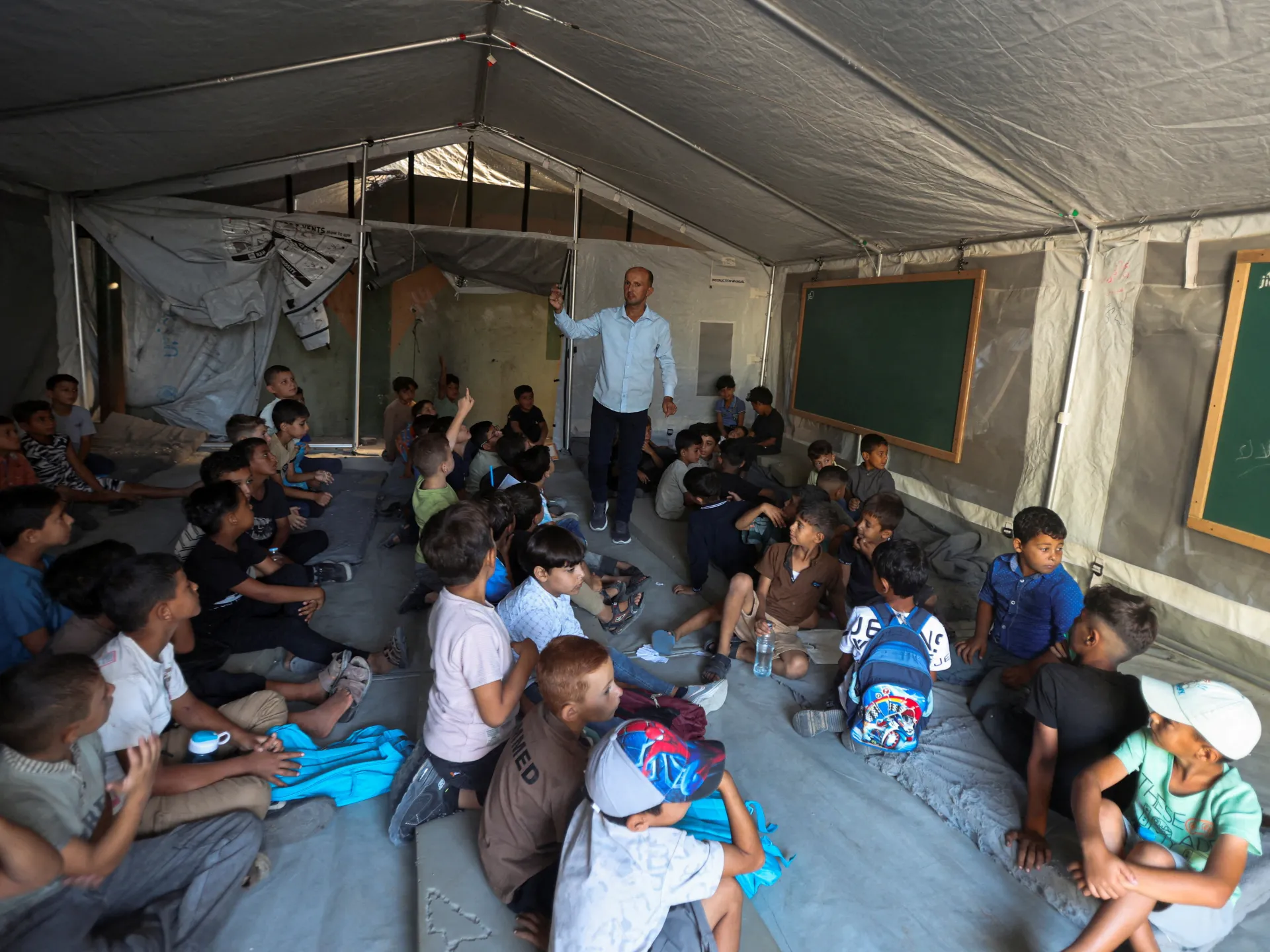
Hundreds of thousands of children returned to in-person classes in Gaza on Saturday for the first time in nearly three years, filing into damaged school buildings, makeshift classrooms and tents amid a severe shortage of basic supplies.
The United Nations Children’s Fund (UNICEF) says 98 percent of schools in the Gaza Strip were destroyed or damaged during Israel’s genocidal war on the enclave, while local education officials estimate about 660,000 students have been deprived of regular, in-person learning.
The reopening is a fragile milestone in a territory where about 22,000 students and more than 770 education workers, including 532 teachers, have been killed, according to Ibrahim Ramadan, director of education for eastern Khan Younis.
“The last time I have been to school was three years ago,” said student Moayed Abu Mustafa in Khan Younis. “Now, we are starting the school year; it is year of joy, happiness and success. Despite all of this, we will learn, we will learn even in a tent.”
Moayed has no proper shoes, notebook or pen, and will sit on the floor in a sweltering tent.
Across Gaza, the Ministry of Education, backed by aid agencies, has set up dozens of temporary schools from tarpaulins, sheet metal and wood. Some classrooms consist of a few mattresses and a blackboard; others still shelter displaced families.
“We studied on phones, and we haven’t seen our teachers. Now, we are back pursuing our dream … from one tent to another,” said 15-year-old Samar Abu Salmi, who lives in a tent with her family and can no longer afford school supplies that were cheap before the war.
Stationery trader Khaled Aliyan said Israeli import restrictions have driven prices up fivefold. “All stationery items are expensive,” he said.
Israeli forces still control more than 60 percent of Gaza despite an October 2025 “ceasefire” that halted large-scale fighting but left the underlying conflict unresolved.
YOU don’t need a fancy First Class plane ticket to enjoy a luxurious airport lounge with a free buffet.
In fact, there’s a far easier way you could be chilling in a classy airport lounge on your next trip, without forking out thousands. Click here to find out how.
This travel hack costs less than £5 a month and will get you into glamorous airport loungesCredit: Getty
Save 20% on Priority Pass across 1,900+ airport lounges
We’ve all been there – sitting in a hard plastic chair at the airport gate with a packet of crisps and a bottle of water that cost you an arm and a leg.
Or worse, stressing out that your family meal is taking too long to arrive and you might need to leg it to the boarding gate.
Sign up for the Travel newsletter
Thank you!
Instead, with a Priority Pass you could be snuggling into a cosy sleep pod, kicking back on a comfy sofa or tucking into a complimentary meal.
The best part? Sun readers can bag 20% off a Priority Pass right now by clicking here.
Priority Pass members get access to over 1,900 airport lounges across the world. The lounges cover over 85% of the world’s top 100 airports, so you’re basically travelling like a First Class passenger on the cheap (before you reach the plane and turn right).
There’s complimentary food and drink across ALL lounges, which will already save you on having to fork out for an expensive airport meal.
Plus there’s comfy sofas, charging points and free Wi-Fi, making that wait before your flight all the more comfortable.
Some lounges even have showers, sleep pods, desks and quiet spaces – so if you want to squeeze in a nap after your early wake-up, no problem.
A standard membership usually costs £69 per year, but you can now bag 20% off and pay only £55 for the whole year.
This gives you access to nearly 2,000 airports across the world, for a £24 fee each visit.
All Priority Pass member benefits
Priority Pass members get access to the following:
Complimentary food and drinks
Sleep pods to rest at certain airport locations
Be Relax spa treatments (at select lounges)
Bring along a guest (£24 Guest visit fee)
Discounts on more airport dining and spa treatments
The option to re-book selected lounges for a supplementary fee
Free membership to the WithU Fitness app (worth £79.99 per year)
All of the airport lounges offer complimentary food and drinkCredit: Getty
Save 20% on Priority Pass across 1,900+ airport lounges
Members also get extra perks like access to Be Relax spa treatments, including massages, manicures and more at participating airports.
Plus if you want to stretch or get a workout in before or after your journey, members also get access to a fitness app worth £79.99 completely for free.
The WithU Fitness app creates you a personalised training program which can be used in the gym or at home.
It’s also full of audio workouts where you are coached by professional trainers.
Priority Pass lets you into more than 1,900 lounges globallyCredit: Getty
Priority Pass plan options
Standard Plan is on a pay-as-you-go basis – all lounge visits are charged £24 at the time of usage to your payment card.
£69 £55 for first year (20% discount) / £4.60 per month
Standard Plus includes 10 free visits during your membership year, visits after this will be charged £24 to your payment card.
£229 £206 for first year (10% discount) / £17.17 per month
The Prestige Plan is unlimited free member lounge visits. Under all three plans members can take accompanied guests into the lounges for the visit fee stated which is charged to your payment card.
£419 per year / £34.92 per month
Save 20% on Priority Pass across 1,900+ airport lounges
It’s never too late to go back to school. But after years of deferred admission, can a new generation of students at Hillman College score high at delivering a compelling, modern take on the groundbreaking sitcom “A Different World”?
The foundation for an updated version of the popular sitcom set at a historically Black college was set three decades ago. In the 1993 series finale, the show’s central couple — smart, bespeckled math whiz Dwayne Wayne (Kadeem Hardison) and high-maintenance Southern belle Whitley Gilbert-Wayne (Jasmine Guy) — were embarking on their next chapter as newlyweds, relocating to Japan and expecting their first child. Before their departure, a professor jokingly quips to Dwayne: “I can’t wait to have your child in my class in the year 2014.”
The only guide you need for fall entertainment.
But plans for a revival — the original series itself was a spinoff of “The Cosby Show,” centered on the Huxtables’ free-spirited daughter Denise (Lisa Bonet) — to suit that time frame were in limbo for years. Producer and director Debbie Allen, who joined the original series in its second season to help it better reflect the HBCU experience, actively pitched and tried to relaunch “A Different World” in the early 2010s, but those efforts were derailed by the highly publicized sexual assault allegations against the show’s creator, Bill Cosby.
“It’s very difficult,” Allen told The Times. “The biggest difficulty, just being totally transparent, was people’s hesitation to work with Mr. Cosby; to have anything to do with him. [But] we were so independent. He kind of put us on a boat and said, ‘Go.’ And that’s what we did. And he was happy to know that we were going on our way.”
In early 2023, another push began to revive the series while also distancing itself from Cosby. Now, its decades-long gap year finally complete, a new incarnation of “A Different World” is starting up classes this fall at Netflix. And it hopes to carry on the legacy of its predecessor, which was celebrated for its depiction of Black culture and life in a higher education setting during its six-season run on NBC, from 1987 to 1993, bringing HBCUs into the mainstream.
Rashida (Alijah Kai), left, Deborah (Maleah Joi Moon) and Hazel (Kennedi Reece) in Netflix’s “A Different World.” After years of trying to tell the story of a new class at fictional Hillman College, Debbie Allen, who returns as an executive producer and director, says the sequel arrives at the right moment: “If there’s any voice we need to hear from right now, it’s young people.”
(Daniel Delgado Jr. / Netflix)
Billed as a sequel series premiering Sept. 24, a Wayne offspring is our anchor for the freshman class at Hillman College, the show’s fictional historically Black college based in Virginia. Deborah Wayne (Maleah Joi Moon) is an aspiring artist forced to attend her parents’ alma mater on academic probation after her NYU acceptance is rescinded. As the youngest Wayne child, she continues the family’s legacy at the school: her older sister — the child Whitley was pregnant with at the end of the original series — and an older brother are both alums.
She’s joined by a mix of first-gen and legacy students: star quarterback Shaquille Johnson (Cornell Young IV), who is the only child of original character Ron Johnson (Darryl M. Bell); criminal justice major Rashida Duvall (Alijah Kai); psych major Amir Rodale (Jordan Aaron Hall); Ghanaian-Nigerian fashion merchandising student Kojo Achebe (Chibuikem Uche); and small-town pastor’s daughter Hazel Henry (Kennedi Reece).
Some of the show’s original creative team join Allen as executive producers, including Tom Werner, and original series writers Reggie Rock Bythewood and Gina Prince-Bythewood. (Mandy Summers of “That ’90s Show” is also an executive producer.) To shepherd this reimagined version of the sitcom, Allen enlisted her former “Grey’s Anatomy” colleague Felicia Pride, who was most recently part of the writing staff on “Bel-Air,” the dramatic reboot of ’90s comedy “The Fresh Prince of Bel-Air.” It was a dream call for Pride, who as a kid living in Baltimore recorded and rewatched episodes — namely, the one involving a step competition that she obsessively watched after school to learn the routine. But she was reluctant.
“I love the show so much,” Pride said, seated next to Allen inside a Netflix conference room in Los Angeles on a recent day. “I was like, ‘I don’t want to be the one to mess it up.’ But she [Debbie] was so adamant that the time was now to hear from young Black America — and that, I could get with.”
Allen remembers it this way: “I don’t have an ego. I begged her. It’s the truth. To get this show back up, we’ve tried for years. But this is the time that’s right … We had inspired all these kids, not just Black kids, all young people to go to college. This was a peep into college that had never happened before, where you saw young people being responsible and living their lives and being crazy, but still dealing with what is happening in this world. If the young people in the country don’t have a voice, that country is dead. And if there’s any voice we need to hear from right now, it’s young people.”
1
2
1.The original “A Different World”: Dwayne (Kadeem Hardison), left, and Ron (Darryl M. Bell).2.Jaleesa (Dawnn Lewis), left, Freddie (Cree Summer) and Whitley (Jasmine Guy). With Netflix’s modern take, showrunner Felicia Pride wanted the series to be intergenerational: “That’s why I’m so glad that we were able to have the legacy cast in the show — I wanted it to have the heart.”(NBCUniversal via Getty Images)
The show has been credited with boosting enrollment at HBCUs. While overall HBCU enrollment rose by 26% between 1976 and 1994, according to the National Center for Education Statistics, much of that increase occurred during the stretch of the show’s run.
Pride said she rewatched the original series, paying particular attention to the shift that materialized in Season 2 when Allen was brought on to overhaul it, as a starting point. Allen had a document of ideas detailing the types of characters she wanted to see depicted, including a star athlete, the first out queer character in the show’s universe and an African student. One major detail was a nonnegotiable: Allen wanted the show to revolve around Dwayne and Whitley’s daughter. (How they arrived at the character’s name — Deborah (pronounced Deb-OR-ah), which also happens to be Allen’s first name — is fuzzy. Pride remembers the name already being set by Allen; Allen recalls being amused upon seeing it on the page, thinking Pride had chosen the name.)
And just as in college, legacy matters on TV.
“I wanted the show to feel of now,” Pride said. “I also wanted it to be intergenerational. That was important to me, and that’s why I’m so glad that we were able to have the legacy cast in the show — I wanted it to have the heart … These [characters] were like my friends. I felt comfort in them. I felt like I could be them. It was also culture in a way that I hadn’t seen before, represented by people who look like me.”
Several familiar faces from the original make their way into the sequel, some taking on the mentor role of the older characters from the original, others representing how one gives back to the community that shaped them. Hardison and Guy lead the cast from the original series who reprise their characters, along with Bell, Cree Summer as Freddie Brooks, Charnele Brown as Kimberly Reese Boyer, Ajai Sanders as Gina Deveaux, Karen Malina White as Charmaine Brown, Jada Pinkett Smith as Lena James, Jenifer Lewis as Dorothy Dandridge Davenport and Allen as Dr. Langhorne.
Several original “A Different World” cast members reprise their roles in the new version of the series, including Charnele Brown, left, Jasmine Guy, Kadeem Hardison, Darryl M. Bell and Cree Summer.
(Quantrell Colbert / Netflix)
“They were so happy to be back,” Allen said. “There was a day they were all together —”
“That was the day where I felt like, ‘Oh, this is history,’” Pride added.
“In between takes, it was just chaos,” Allen continued. “They just laughed and acted up. It was just wonderful.”
To make the new characters and their stories resonate in a deeper, more contemporary way required as large a commitment to reflecting HBCU life as the original had under Allen’s guidance. The creative team assembled two paid student councils from various HBCUs — one to advise the writers’ room on storylines and campus issues; the other worked on the show’s Atlanta set, with students hired as production assistants that had working schedules tailored to their classes. The background performers filling up scenes in the quads, classrooms and parties feature 59% HBCU students and grads. And some key characters are portrayed by HBCU alumni who bring their lived experience to the screen, including Reece, who went to Howard University.
The freshman season will explore issues that Gen Z is grappling with such as financial insecurity, learning struggles, activism in the age of social media and matters of mental health, as well as bigger systemic issues like uncertainty around funding for HBCUs and immigration enforcement. The series also doesn’t shy away from its real-world backdrop — while it doesn’t explicitly mention President Trump by name, there is reference to the state of affairs under his administration.
Actors Jordan Aaron Hall, left, Cornell Young IV, Chibuikem Uche and Dasan Frazier are part of the new class of students at Hillman College in “A Different World.”
(Eli Joshua Ade / Netflix)
But this version of “A Different World” departs from its source material in its narrative format and tone. The original series was a multi-camera sitcom taped in front of a studio audience — and Allen initially thought any sequel of it would follow that same blueprint. But when the new series found its home at Netflix, it became a 10-episode single-camera dramedy. (Allen directed three episodes in the season, including the premiere, which set the cinematic style of the series.) As if to signal this iteration hasn’t completely deviated from its roots, in the show’s opening moments, Deborah Wayne coolly flicks the iconic flip-up frames made famous by Hardison’s Dwayne. And its memorable theme song that had versions from Phoebe Snow, Aretha Franklin and Boyz II Men hasn’t gone anywhere: Brandy was tapped to give a fresh spin on it that helps straddle the line between generations.
Now, Allen and Pride are on the cusp of seeing how this long-gestating idea will fare in the streaming world.
“You play the cards you’re dealt,” Allen said. “It took a while, but it was right for it not to happen until now. Right now is when we need it. Young people are struggling to find hope and inspiration and guidance, connection …”
Allen’s hope is that the show will have enough seasons to let the characters evolve: “On Netflix, not too many shows go past three, maybe four [seasons],” Allen said. What’s the goal? “At least three.”
Pride isn’t thinking ahead to graduation just yet. She’s still thinking about surviving the first day of school with this different (but familiar) show made for a different world.
“I came to understand we can never re-create the original show, and … even trying to pursue that is just not the thing to do,” Pride said. “It was a different time. It was a different everything, and it should stand on its own. What I wanted to do, personally, was just [focus on]: How can we capture that spirit and hopefully have a show that young people today can see themselves in, and that people [who watched the original] can also enjoy and be proud of?”