clash

Black Altadena fire victims clash with Edison over compensation

Outside a hall where Southern California Edison was celebrating Black History Month on Friday, a group of Altadena residents stood on the sidewalk, waving signs and talking of the homes and family members they lost in last year’s Eaton fire.

“They’re in there celebrating Black history and they’ve destroyed a Black town,” said Nicole Vasquez of My Tribe Rise, which helped organize the protest.

The Jan. 7, 2025 fire destroyed thousands of homes, including the majority of homes in west Altadena, a historically Black community. All but one of the 19 people who died were in west Altadena.

“If Edison’s tower did not ignite the fire, Altadena would still be there,” said Trevor Howard Kelley, who lost his 83-year-old mother, Erliene, in the fire.

Kelley, his daughter and two granddaughters had been living with his mother before her home was destroyed, he said.

The Black Altadena residents are part of a larger coalition that is asking Edison to advance each family who lost their home $200,000 in emergency housing assistance. They say that more than a year after the blaze many wildfire survivors are running out of the funds they had received from insurers.

The group protesting Friday also called for transparency from Edison. The company has said it believes it is likely its equipment caused the fire but has continued to deny it did anything wrong.

“We just want the truth,” said Felicia Ford, who lost her house in the fire. “What’s wrong with saying, ‘We got this wrong.’”

Scott Johnson, an Edison spokesperson, said Friday that the company continued to believe its voluntary compensation program was the best way to help victims of the fire. Edison has promised to quickly review each victim’s claim and pay it swiftly if approved.

Families who lost their homes can receive hundreds of thousands of dollars under the program, while those with damaged homes receive lesser amounts.

But many survivors say they don’t believe the offered amounts fully compensate their losses. And to receive the money, victims must agree not to sue — which many are not willing to do.

“We recognize the incredible struggles the community has faced,” Johnson said. “The intent of the program is to reach final settlements to allow the community to rebuild and move on.”

The investigation into the cause of the fire has not yet been released. Edison has said a leading theory is that its century-old transmission line in Eaton Canyon, which had not carried electricity for 50 years, somehow became reenergized and sparked the fire.

Company executives said they did not remove the old line because they believed it would be used in the future.

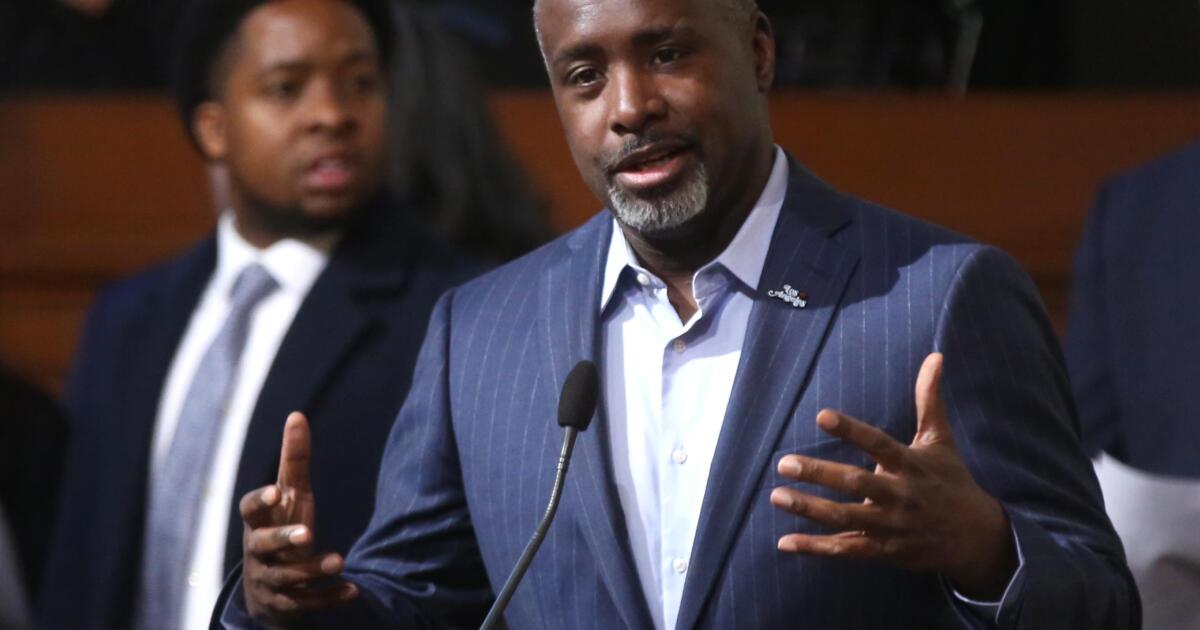
Tru Williams said he just wants to get his parents back home.

Tru Williams said he just wants to get his parents back home.

(Myung J. Chun / Los Angeles Times)

In December, state regulators ordered Edison to identify fire risks on its 355 miles of out-of service transmission lines located in areas of high fire risk and tell regulators how executives planned to use the lines in the future.

This week, Edison disclosed that the Los Angeles County district attorney was investigating whether Edison should be criminally prosecuted for its actions in the fire.

West Altadena became one of L.A.’s first middle-class Black neighborhoods in the 1960s, partly because discriminatory redlining practices for years kept Black homebuyers from settling east of Lake Avenue.

Heavenly Hughes, co-founder of My Tribe Rise, told the crowd she had lived in Altadena for 50 years.

“I was raised in a thriving working-class community and they have destroyed that community,” Hughes said, referring to Edison.

Added Ford, “The people making these decisions aren’t suffering at all. They’re still getting their paychecks, bonuses and stock options.”

Source link

Stephen Colbert, Trump and the clash over the FCC equal time rule

It was an extraordinary media moment: CBS late-night host Stephen Colbert on Tuesday publicly blasted his own employer over its handling of his interview with Democratic U.S. Senate candidate James Talarico of Texas.

Colbert contended that his own network prevented him from airing the interview in an effort to appease the Trump administration, which CBS has denied. He chose instead to put the sit-down with the Texas state legislator on YouTube, which is not regulated by the FCC.

The standoff not only highlighted the simmering tensions inside CBS with the late-night host, it also marked the latest flash point in the ongoing clash between the Trump administration and leading media and entertainment figures — including other late-night hosts Seth Meyers and Jimmy Kimmel — who have been openly critical of the president’s policies.

Federal Communications Commission Chairman Brendan Carr has been leading the charge, aggressively attempting to wield the long dormant equal time rules forcing broadcast TV stations to offer equal time to opposing candidates as a means of influencing the legacy media companies who President Trump believes treats him unfairly.

Carr contends the effort is a long overdue corrective to combat what he and Trump believe is liberal bias in broadcast network news coverage. He has even threatened to pull TV station licenses if programmers don’t get in line.

Last fall, he warned ABC that it could lose its TV station licenses after Kimmel made remarks on his program about slain right-wing activist Charlie Kirk that upset conservatives. Two major TV station groups pulled the program and the network suspended Kimmel‘s program for a week.

But experts say the efforts — along with the recent arrest of former CNN journalist Don Lemon over civil rights charges — pose a threat to constitutionally protected freedom of speech and would likely face court challenges.

“We don’t want the government trying to make decisions as to what counts as political speech and what doesn’t and what counts as fairness and what doesn’t,” media consultant Michael Harrison told The Times last month.

Some experts are also skeptical that Carr will ever make good on those threats through greater enforcement of the equal time provision.

Andrew Jay Schwartzman, a public interest communications attorney, said Carr is using his bully pulpit at the FCC to intimidate “a timorous broadcasting industry.”

"The Late Show with Stephen Colbert " on July 23, 2024.

“The Late Show with Stephen Colbert “ on July 23, 2024.

(Scott Kowalchyk / CBS)

“It’s just all bluster,” said Schwartzman. “Broadcasters are more interested in short-term regulatory relief from the FCC, and in the case of [CBS parent] Paramount, getting approval of a possible Warner Bros. Discovery deal.”

CBS cited financial losses as the reason for the cancellation of Colbert’s show, which ends in May, just two months before CBS parent Paramount Global closed its merger deal with Skydance Media, which required regulatory approval from the Trump administration. Paramount also has been attempting a hostile bid for Warner Bros. Discovery.

Paramount also drew scrutiny over its controversial decision to pay $16 million to settle Trump’s legal salvo against “60 Minutes” over the editing of an interview with his 2024 opponent, then-Vice President Kamala Harris. Most legal analysts viewed the case as frivolous.

Jeffrey McCall, a communications professor at DePauw University, said he understands why CBS did not want to invite FCC scrutiny.

“CBS could have other matters in front of the FCC,” McCall said. “So, I don’t blame CBS for trying to tell Colbert like, ‘hey, back off.’”

But McCall added that he sees no reason for the FCC to end or curtail the exemption daytime and late-night television talk shows have from laws requiring stations to offer equal broadcast opportunities to political candidates.

“They have a lot to do otherwise and I’m just not sure this is worth their trouble,” he said.

The equal time rules were devised at a time when consumers had a limited number of media options. Broadcast TV is no longer dominant in the era of streaming as evidenced by how the Talarico interview drew 8 million views on YouTube — more than three times the typical TV audience for Colbert’s “Late Show.”

Schwartzman noted that equal time provision cases are typically resolved quickly, as the rule only applies during an election campaign.

If Talarico’s interview had aired on TV and his opponents requested time, CBS would have to accommodate them ahead of the Texas primary election on March 3. (The network would not have been required to give time to Republican candidates).

CBS could have fulfilled the request by providing time on its affiliated stations in Texas. The opposing candidates did not have to appear on Colbert’s show.

“The remedy is you have to give them airtime,” Schwartzman said. “That’s all.”

CBS wanted Colbert to steer clear of Talarico because the FCC previously announced it is “investigating” ABC over the candidate’s appearance on “The View,” according to a network executive not authorized to discuss the matter publicly. Talarico was on the daytime talk show Feb. 2, which has led to the FCC launching an “enforcement action” on the matter.

Representatives from CBS and ABC declined comment.

Appearing Wednesday on Fox News Channel’s “The Ingraham Angle,” Carr brushed off accusations by Democrats that he was using the rule to silence their candidates.

“What we’re doing now is simply applying the law on the books,” Carr said.

When host Laura Ingraham noted that if CBS had aired the Talarico interview, it would have meant free airtime for Tarico’s primary opponent and high-profile Trump critic Rep. Jasmine Crockett (D-Texas), Carr replied, “Ironically, yes.”

But Schwartzman noted that if the FCC punished a network for ignoring the rule, the move would likely be challenged in court and take years to resolve. Even if the policy were violated, that would not be enough to get a station license pulled.

“A single violation or even a couple of violations of FCC policy are meaningless,” Schwartzman said. “You have to demonstrate a pattern of violations.”

Carr has also publicly supported Nexstar Media Group’s proposed $6.2-billion merger with Tegna, which would require the government to lift the ownership cap that limits TV station owners to coverage of 39% of the U.S. with their outlets.

Not surprisingly, the merger has the support of Trump, who is pals with top Nexstar executive Sean Compton, who oversees its cable channel NewsNation.

“We need more competition against THE ENEMY, the Fake News National TV Networks,” Trump wrote Feb. 7 on Truth Social. “Letting Good Deals get done like Nexstar — Tegna will help knock out the Fake News because there will be more competition, and at a higher and more sophisticated level.”

How Nexstar could take on the broadcast networks is a mystery. Nexstar is highly dependent on its affiliations with ABC, CBS, NBC and Fox due to their contracts with the NFL, which provide the stations with their highest-rated programming. Those network affiliations also give Nexstar leverage in its negotiations to get carriage on cable and satellite providers.

Source link

A Clash Within : The Mixed Blessings of Rev. Jackson

Jesse L. Jackson glanced out the tinted windows and saw the future overtaking the past.

It was a gray Saturday afternoon in November and he was bound for Montgomery, the capital of Alabama, in a chauffeured limousine as big and luxurious as the President’s.

He settled his 6-foot-3 frame into the plush wine-red rear seat, stretched his legs across to the jump seat and talked quietly of another time, another trip into Montgomery escorted by fear and a pursuing car full of angry white men.

Twenty-two years earlier he had come down this same highway with other young disciples of Dr. Martin Luther King Jr., one anxious eye on the rear-view mirror and another watching for road signs to Selma. They were rushing through the Dixie night to join demonstrations demanding equal rights for blacks. The car behind them was a menacing reminder of how far they still had to go.

‘Long, Dark Night’

“We had been driving all night and they had been following us all the way to Montgomery,” Jackson said, his gaze drifting out to the blur of the passing landscape. “All night. A long, dark night. The fear made it darker.”

But in 1987 Jackson was returning to Montgomery as a candidate for President, leading five white candidates in many national polls for the Democratic nomination. His limousine rolled toward Montgomery and a waiting Civic Center audience half black and half white.

The limousine sped past a golf course with green fairways stretching through trees ablaze with the oranges of autumn. Suddenly, Jackson sat forward, pointing:

“Look there–you see that? See that black guy and white lady out there playing golf together?” He sat back, silent for a moment.

“We’ve come a long way . . . and now politics is catching up.”

It was clear on this gray afternoon on the road to Montgomery that few in modern America have come further faster than Jesse Louis Jackson.

A Powerful Force

From the back roads of a South Carolina mill town, he has emerged as a powerful political force, America’s preeminent black leader.

But for Jesse Jackson, politics probably isn’t catching up fast enough. He may be the front-runner now, but few people–even few of his supporters–realistically believe he has a chance of winning the Democratic presidential nomination.

His supporters say latent racism is the problem. To a degree, that may be reflected in Jackson’s high negative rating in opinion polls. In a Los Angeles Times poll this fall, 68% said they would not consider voting for him.

But there is something more: This 46-year-old minister makes people uncomfortable.

A four-month study of Jackson, including dozens of interviews with friends and foes and travels with him through a dozen states and five foreign countries, yields a bundle of contradictions.

“There is a good Jesse, and a bad Jesse,” said one friend who has known Jackson since his college days. “The two sides of him are often in conflict.”

The good Jesse is the brilliant and courageous man willing to take personal and political risks in pursuit of lofty goals, a man of boundless energy and broad intellect whose political instincts are matched by awe-inspiring oratory, a man who remembers his roots even as he projects a bold vision for a better America.

The bad Jesse is the schemer, the man always looking for the angle to win personal or political advantage, the man who has invented stories or shaded the truth to meet his immediate needs, the man whose actions sometimes seem to say: “Your rules don’t apply to me.”

For all his strengths, for all his successes, Jackson’s future is clouded by the clash within.

For most politicians, such lack of abundant trust by the public would spell their ruination. That is what makes Jackson so remarkable. By most accounts, he is at the height of his powers, broadening his appeal, likely to march to the Democratic National Convention with enough delegates to be a major player in deciding the future of his party and its candidate for President.

Sometimes, Jackson talks about his campaign as if attaining the presidency is secondary to a life mission of peace, prosperity and justice for all. But at the same time, he dismisses talk that he can’t realistically expect to win the office.

“They say, ‘Well you’re leading but you can’t win.’ That’s irrational.”

With a flicker of annoyance in his eyes, he sighs: “You learn to live with being under-counted, under-estimated, under-respected. But you don’t let it break your spirit. Just because it rains you don’t have to drown.”

Jesse Jackson, said Dr. Alvin F. Poissaint, a Harvard psychiatrist and long-time friend, is “fascinated by his own success and by the possibilities of accomplishing more and more, to prove that he can go to the mountaintop, as Dr. King used to say.

“It’s more than ‘I am somebody,’ ” Poissaint said, quoting a phrase that became a familiar litany in Jackson’s speeches through the past decade.

“It’s more than ‘respect me,’ ” he added, quoting another phrase used in those speeches–a phrase many journalists have seized upon in an effort to explain Jackson’s boundless drive.

“It’s more like, ‘I am going to show you what I can do, even against all odds,’ ” Poissaint continued. “And that has always been his case. Some of it, and I think Jesse himself recognizes it, has a lot to do with his feelings about being a child born out of wedlock to a teen-age mother, that he was poor, that he was disgusted by the segregation he saw.

“That is very much in his psyche.”

And yet it is in searching for Jackson’s psyche in the crucible of his childhood that the contradictions begin.

The truth in the broadest sense is simple enough. He grew up in the segregated South, neither poor nor rich, neither firebrand nor Philistine.

But over the years, that truth was not enough for Jesse Jackson. He later made up events to suit the needs of the moment and to enhance his mystique.

To demonstrate his radical credentials in 1969, he said he showed his contempt for white customers he served as a teen-ager in a hotel coffee shop by spitting in their food in the kitchen. “I did not do that, and I really shouldn’t have said it,” he says now.

To enhance his bona fides as a victim of poverty, he told a Chicago television interviewer that “I used to run bootleg liquor and buy hot clothes. I had to steal to survive.” But his stepfather Charles Jackson remembered it differently. As a Post Office employee in the 1950s he earned a salary equivalent to a teacher’s, and told Jackson biographer Barbara Reynolds: “We were never poor. We’ve never been on welfare. My family never went hungry a day in their lives.”

To demonstrate the personal hurt of racial discrimination, Jackson has allowed to stand uncorrected an account in three biographies and numerous profiles that he left the University of Illinois in 1960 because coaches told him he could not play quarterback–only whites could call the signals.

But university records show that the quarterback for Illinois that year was Mel Meyers, a black. Jackson left after being placed on academic probation during his second semester, according to the late Ray Eliot, then head football coach.

Other Jackson recollections that bolster his credentials as one who knows first-hand the horror of society’s boot on his neck cannot be independently verified.

One such scene in his hometown of Greenville, S.C., about 1950, he would say many years later, was “my own most frightening experience . . . a traumatic experience I’ve never recovered from.”

As an 8-year-old, he said, he hurried into a neighborhood grocery store operated by a a white man named Jack. Other customers were crowded around the counter. “I was in a hurry. I said, ‘Jack, I’m late. Take care of me.’ He didn’t hear me so I whistled at him. He wheeled around and snatched a .45 pistol from a shelf with one hand and kneeled down to grab my arm in his other fist.

“Then he put the pistol against my head and, kneading my black arm in his white fingers, said, ‘Goddamn it! Don’t you ever whistle at me again, you hear?’ ”

The other black customers in the store did nothing, Jackson said. “That was the nature of life in the occupied zone.”

Is it real or a respinning of history? Jackson didn’t tell his parents at the time, he said, for fear his father “would kill Jack or be killed.” None of the grocers who were around then and could still be located can remember a white grocer named Jack who kept a .45 on a shelf.

In one sense, the veracity of the stories may not matter. Jackson recounts them emotionally, conveying the real fear and degradation of the time. As a spokesman for the underprivileged, few can doubt his credentials.

It was a boyhood with “a lot of pain,” Jackson said a few months ago. “Bitterness for awhile. I grew out of the bitterness, and I attribute a lot of that in some sense to Dr. King, who argued that we should get better not bitter.”

Some of the pain and bitterness revolved around the fact he was born out of wedlock–feelings he says he came to grips with years ago.

His mother, Helen, was a high school student living with her mother, Matilda Burns, in 1941 when she became pregnant by Noah Robinson, a married man who lived next door. Robinson had three stepchildren but “wanted a man-child of his own,” Jackson has said many times. “His wife would not give him any children. So he went next door.”

It was a neighborhood scandal that brought schoolyard taunts: “Jes-se ain’t got no dad-dy, Jes-se ain’t got no dad-dy.” And it was an experience that Jackson would cite many years later in inspirational, you-are-somebody speeches to young black audiences:

“You are God’s child. When I was in my mother’s belly, I had no father to give me a name . . . . They called me a bastard and rejected me. You are somebody! You are God’s child!”

Reynolds, in her 1975 book, “Jesse Jackson: The Man, The Movement, The Myth,” recounted a poignant scene in Jackson’s childhood: A young Jesse standing for hours in the backyard of Noah Robinson’s house, looking in the window. When Robinson came to the window, Jesse would run away.

Now, on Father’s Day, Jackson calls Robinson on the telephone. And when the candidate gave CBS’ Mike Wallace and a crew from “60 Minutes” a tour of Greenville several months ago, he took them to visit Robinson. “Two fathers,” Jackson said. “I was blessed. I was blessed.”

Stepfather Charles Jackson was a quiet, hard-working, church-going man whom his mother married when the candidate was a toddler and “who adopted me and gave me his name, his love, his encouragement, discipline, and a high sense of self-respect,” Jackson wrote in the dedication of a recently published collection of his speeches and writings, “Straight from the Heart.”

When he was a teen-ager, the family moved to Fieldcrest Village, which the city directories of the 1950s called “a housing project for colored located at the end of Greenacre Road.”

It was a community, Jackson recalled, where people cared for one another:

“There were two or three people in the neighborhood who just kept big pots of vegetable soup on. When folks didn’t have any food, they couldn’t go to the Salvation Army because they were black. They couldn’t get Social Security; they couldn’t get welfare. But folks had a tradition of being kind to one another, because that was our roots.

“We didn’t have a neighborhood, we had a community. There’s a difference between a bunch of neighbors . . . and a community that’s made out of common unity where there’s a foundation.”

And often from the pulpit or political lectern he speaks of the strength brought to his childhood by the church and by his grandmother, Matilda Burns, now 80 and living with his mother in a comfortable house on Greenville’s tree-shaded Anderson Street–a house Jackson purchased several years ago.

“My grandmother doesn’t have any education,” he says. “She can’t read or write, but she’s never lost. She knows the worth of prayer . . . . To the world she has no name, and she has no face, but she feels like she has cosmic importance because there’s a God she communicates with in the heavens who is eternal. And so she knows that every boss is temporary, that every rainy day is temporary, that every hardship is temporary. She used to tell me, ‘Son, every goodby ain’t gone. Just hold on; there’s joy coming in the morning.’ ”

And so, despite the pain, Jackson grew, and succeeded.

At all-black Sterling High School in the late 1950s he was elected class president, Student Council president, Honor Society president, state president of the Future Teachers of America. He also was the star quarterback on the school’s football team–big, aggressive and smart, his coach recalls.

His athletic ability landed him a scholarship to the University of Illinois. After his first year he transferred to North Carolina A&T;, a predominately black school in Greensboro. There not only was he the starting quarterback but also the student body president. And there he got his first taste of the civil rights movement and a whiff of Democratic Party national politics.

Lunch counter sit-ins had begun in Greensboro months before Jackson arrived in 1960, but he soon emerged as a leader of student civil rights protests there. In June, 1963, he led a column of students to block a busy street in front of City Hall and was arrested for inciting a riot. He was recorded as telling his followers: “I know I am going to jail. I’m going without fear . . . I’ll go to the chain gang if necessary.”

There were no chain gangs in North Carolina at the time, biographer Reynolds said, noting that even in college Jackson “was developing his proclivity for overstatement.”

At A&T;, Jackson noticed a pretty, slender coed from Florida who would march in Greensboro’s civil rights demonstrations. She was Jaqueline Lavinia Davis and, years later, she recalled that she first thought Jesse Jackson was a bit too fast, a bit too full of himself for her taste. But he sought her out for advice on a term paper–”Should Red China be Admitted to the U.N.?”–and a serious romance blossomed.

Their first child was born six months after their marriage in 1962–a fact they never concealed.

With a wife and daughter, Jackson found himself at a career crossroads when he graduated from A&T; with a degree in sociology in 1963: He could go on to law school at Duke University in North Carolina or he could accept a Rockefeller Foundation grant to attend Chicago Theological Seminary.

He chose the seminary–”I thought I might flunk out at Duke,” he later admitted to Reynolds in a comment uncharacteristic of his usually bountiful self confidence. At the seminary, he thought “it would be quiet and peaceful and I could reflect.”

But with peace and quiet at the seminary came network television scenes of the racial violence in the South–blacks were being tear-gassed by police, beaten with night sticks, poked with electric cattle prods. Jackson decided he had to head South.

Betty Washington, then a reporter for the Chicago Daily Defender, recalls the scene outside Brown’s Chapel Church in Selma. Hundreds of marchers were camped on the grounds and members of King’s Southern Christian Leadership Conference staff were taking turns making speeches to bolster their spirits. “Up popped Jesse,” she says. “I thought it was strange that he would be making a speech, when he was not on the SCLC staff and had not been included in any of the strategy meetings. He just seemed to come from nowhere . . . but he spoke so well.”

Other SCLC staffers thought this seminary student was too pushy, but when Jackson volunteered to work as an organizer in Chicago, King accepted. Jackson soon impressed King with the way he rallied Chicago’s black ministers behind SCLC’s Operation Breadbasket, a campaign to get more jobs for blacks in bakeries, milk companies and other firms with heavy minority patronage of their products.

Within months King named Jackson to head Operation Breadbasket and doubled his salary–from $3,000 to $6,000 a year. And in the spring of 1967, when King reorganized the SCLC staff, he appointed Jackson to head the new labor and economic affairs department with instructions to expand Operation Breadbasket into a national program.

But as Jackson moved into SCLC’s hierarchy, tension began developing. David J. Garrow, a professor who has written three books about King and the SCLC, said some on the SCLC staff wondered aloud about Jackson’s motives: “Is it for Jesse or for the movement?” The professor said King himself expressed concern about Jackson’s ambitions and his spirituality. King “used to tell Jesse: ‘Jesse, you have no love,’ ” Garrow quoted a former SCLC executive as saying.

At one SCLC staff meeting, Jackson raised questions and objections to a planned march on Washington and suggested instead that SCLC do more to expand his Operation Breadbasket, Garrow said:

“King railed at the staff’s disunity and finally announced he was going to leave . . . . As King headed for the door, Jackson started to follow, but King turned and delivered a personal blast: ‘If you are so interested in doing your own thing that you can’t do what the organization is structured to do, go ahead. If you want to carve out your own niche in society, go ahead, but for God’s sake don’t bother me.’ ”

And the spring evening before King’s assassination in Memphis in 1968, Garrow said, the civil rights leader was openly expressing frustration and annoyance with Jackson. Citing interviews with SCLC staffers, the professor reported that “King again berated Jackson . . . he said, ‘Jesse, just leave me alone’ . . . Jackson responded, ‘Don’t send me away, Doc. Don’t send me away.’ ”

The next day, King was felled by a sniper as he stood on the balcony of the Lorraine Motel. Jackson’s actions in the minutes and hours following the assassination have remained in dispute ever since.

Scores of media accounts of the assassination described–generally without attribution–how Jackson was the last person to whom King spoke and how Jackson cradled the mortally wounded civil rights leader in his arms before an ambulance arrived.

Others who were at the scene say Jackson was the source of the stories, and they are insistent that it didn’t happen that way–that King spoke his last words to another assistant on the balcony, and that the Rev. Ralph David Abernathy, not Jackson, held King’s head before the ambulance came.

Twenty years later, it is virtually impossible to pin down exactly what Jackson said in that heated period. Television film of his appearances then was not stored.

Some facts are not in dispute: Jackson was in the courtyard below at about 6 p.m. when King was shot. In the hours after King was pronounced dead, Jackson flew back to Chicago, was interviewed the next morning by NBC’s “Today” show and later that day spoke at a meeting of the Chicago City Council, wearing a sweater he said was stained with King’s blood.

Jackson now says he rushed from the courtyard to the balcony after King was shot. “When I got there blood was everywhere . . . I reached down, as did a couple of other people . . . I tried to console him, you know, ‘Doc, we’re with you. Hang on . . . ‘ I remember hearing somebody say an ambulance had been called. I stood up and wiped my hands off and went to the phone and called Mrs. King.”

That night, Jackson recalled, “I decided to go back to Chicago . . . the body was gone . . . the arrangements had obviously been made by the family. There wasn’t anything for the staff people to do. I caught an 11 o’clock plane that went through St. Louis, made a stop, got to Chicago at three in the morning . . . .

“I went home and laid across my bed. The “Today” show was calling. I got up and kept on what I had on . . . then the city council meeting . . . they put on a big memorial service . . . and I had on those same clothes.”

With King’s death, the SCLC became fragmented and ripped by conflict. Abernathy took over as president at the Atlanta headquarters but soon found himself eclipsed by Jackson, then in his late 20s, a striking figure with an Afro hair style and a penchant both for African garb and for publicity.

Jackson dropped out of the seminary with six months left in his studies to devote full time to civil rights work. He was ordained a Baptist minister in 1968 but has never held a full-time pulpit.

Within a year of King’s assassination, the New York Times called Jackson “probably the most persuasive black leader on the national scene.” Playboy hailed Jackson as “the fiery heir apparent” to King and spread an interview with him across 19 pages. Time, in a special issue on Black America in April, 1970, put Jackson on the cover and published a lengthy profile on the young man who, it said, modestly insisted he was but “one leader among many.”

Some within SCLC saw the surge of publicity as part of a deliberate attempt by Jackson to take control of the organization.

Tensions reached a breaking point when Jackson, without consulting SCLC’s headquarters, helped organize widely publicized trade fairs in Chicago for black businessmen. The SCLC’s board in December, 1971, suspended him for 60 days for “administrative impropriety” and for “repeated violation of organizational discipline.”

Jackson quickly resigned from SCLC, declaring, “I need air. I must have room to grow.” And he quickly gained the backing of a score of nationally known blacks–from singers Roberta Flack and Aretha Franklin to politicians Carl Stokes and Richard Hatcher–who gathered at New York’s Commodore Hotel to endorse Jackson’s plan to form his own organization.

“That was the politician in him, coming out back then,” said one participant in the New York meeting. “He knew he had to have some national support if he struck out on his own.”

On Christmas morning of 1971, Jackson unfurled the banner of a new civil rights operation: People United to Save Humanity, or PUSH. (The “save humanity” in the name was later changed to a less grandiose “serve humanity.”)

Like Operation Breadbasket, PUSH would concentrate on improving minority employment and bolstering minority businesses. One of its affiliates, PUSH for Excellence, would concentrate on improving ghetto schools.

Over the next dozen years, PUSH and its affiliates collected at least $17 million in government grants and private and corporate donations, according to public records. And Jackson collected a reputation as a man strong on inspirational oratory and ideas but weak on follow-through, a man with expensive tastes and a large ego but with little management skill and scant administrative discipline.

In city after city, from Los Angeles to Boston and Seattle to Miami, Jackson carried to ghetto school auditoriums a rousing message on the importance of self esteem, self confidence and self discipline. He invariably exhorted his audiences to respond in unison to his rhythmic chant:

“I am somebody . . . I may be poor . . . but I am somebody . . . respect me . . . I am somebody . . . “My mind . . . is a pearl . . . I can learn anything . . . in the world . . .

“Down with dope . . . up with hope . . .

“Nobody will save us . . . for us . . . but us.”

By the thousands, students signed pledges to turn off the television and do their homework, to avoid drugs and teen-age sex, to work hard, to excel.

Since Jackson has never held public office, journalists often have examined PUSH’s operations in search of a yardstick of Jackson’s management skills. Usually, they found those operations to be chaotic. So did the government when, five years after PUSH-Excel was launched, it hired experts to review the program. The experts also declared it short on documented accomplishments.

The program “turned out to be mainly paper,” said a report prepared by the American Institute for Research under government contract.

More criticism came from Department of Education auditors, who contended PUSH-Excel failed to account for how it spent $1.2 million of $4.9 million in federal grants. PUSH-Excel’s managers disputed the claim and Jackson himself dismissed it as an argument between accountants.

One former PUSH official said the criticism of the content and accountability of the program came as no surprise. “While Jesse was flying around the country,” said this former official, who asked to remain anonymous, “things in Chicago were in absolute chaos. We stumbled from one crisis to another.”

Part of the problem, this former official said, was, “Jesse didn’t always have the best and brightest people running things. The key staff people were put there on the basis of their loyalty to him, not on their ability. Loyalty, absolute loyalty, was always the most important thing to him, not whether you could do the job.”

In the early 1980s, with PUSH-Excel’s sloppiness and weakness coming under increasing scrutiny and criticism, Jackson shifted his focus from education programs to negotiating promises of increased minority hiring, promotions and contracts with major corporations. In a three-year period, PUSH signed agreements–called “covenants”–with such firms as 7-Up; Coca-Cola Co.; Heublein Corp.; Southland Corp., which operates 7-Eleven stores; Burger King Corp. and Adolph Coors Co.–often after threatening boycotts by blacks unless agreements were reached.

Corporate executives reacted to Jackson in dramatically different ways.

Jeffrey Campbell, now chairman of the Pillsbury Co.’s restaurant division, was president of Burger King when Jackson and PUSH opened negotiations with the fast-food chain in 1983. “Before they came in, my view was that we ought to fight them, that this guy Jackson was a monster, and I had the backing of my bosses to walk out if necessary,” Campbell said from his skyscraper offices in Minneapolis.

But Campbell said he quickly changed his mind about the “very impressive man” on the other side of the negotiating table. “He handled himself very professionally, and he got to me very quickly, without me realizing it, when he started talking about fairness. He would say: ‘What is fair? Blacks give you 15% of your business–isn’t it fair that you give 15% of your business, your jobs, your purchases back to the black community, the black businesses? You tell me, isn’t that fair?’ ”

“That little seed began to grow in the back of my mind,” Campbell said. “It was the right question to ask me.”

Before long, Burger King signed a $460-million minority opportunity program with PUSH. “It has turned out to be a very positive experience for me,” Campbell said. “Twenty years from now, when I sit back and think of the things I’m proudest of at Burger King, one of them will be the impact we were able to make through this covenant.”

But, in another executive suite in another city, a starkly different picture of Jackson’s operations is painted by a corporate official who declined to be identified.

“We had been doing a very good job of hiring and promoting blacks and giving our business to minorities, and they marched in and ignored all that we had done and began demanding we do this or we do that,” this executive said.

“It seemed like a shakedown to me. They had lists of people they wanted us to do business with, lists of things they wanted us to do, donations and things like that.”

When Jackson carried PUSH’s campaign to St. Louis in 1982 and sought contributions from black businesses to finance an investigation and possible boycott of Anheuser-Busch Co., he ran into opposition from local black organizations and a black-owned newspaper, the St. Louis Sentinel. The newspaper said that when Jackson demanded $500 from each businessmen by saying “you must pay to play” he was taking a “kickback approach.”

In an editorial headlined “Minister or Charlatan?” the newspaper accused Jackson of defrauding the black community and having a “million-dollar commitment to himself.” Jackson promptly filed a $3-million libel suit against the newspaper but later dropped the case when a judge granted the newspaper’s request to inspect PUSH’s financial records.

Part of those records came to light in early 1984 and caused problems for Jackson’s first presidential bid, a campaign which had received a boost a short time earlier when he flew to the Middle East and dramatically negotiated the release of a downed Navy pilot held by the Syrians.

After newspaper disclosures, Jackson and his lawyer acknowledged that in 1981 and 1982, PUSH affiliates received $200,000 in contributions from the Arab League, a confederation of 21 Arab states and the Palestine Liberation Organization. They also confirmed the organizations got an anonymous $350,000 donation but said they did not know who the donor was.

The contributions from the Arab League upset some Jewish leaders, but Jackson said a “double standard” was being applied: “If the Arab League can contribute to Harvard and Georgetown and other institutions of higher learning, can they not contribute to the PUSH Foundation?”

It was not the first chapter in the saga of uneasy relations between Jackson and Jews. Nor would it be the last.

Jews had been concerned earlier by the disclosure that PUSH had received a $10,000 check in 1979 from a Libyan diplomat. This donation led to a four-year-long Justice Department investigation of whether Jackson should have registered as a foreign agent for Libya. The department eventually concluded he did not have to.

And Jews were privately outraged in 1979 when, during a trip to the Middle East, Jackson was photographed embracing PLO leader Yasser Arafat.

Their anger exploded into public view with the “Hymie” incident.

What would become the greatest crisis of Jackson’s first presidential campaign began quietly. While waiting for his airplane at Washington’s National Airport in January of 1984, Jackson paused in the cafeteria to chat with Milton Coleman, a black reporter for the Washington Post who was covering his campaign.

“Let’s talk black talk,” the candidate is reported to have remarked. By this, his friends later said, Jackson meant that his comments were not for publication.

Three weeks later, the Post reported: “In private conversations with reporters, Jackson has referred to Jews as ‘Hymie’ and to New York as ‘Hymietown.’ ”

Suddenly, Jackson was facing a political firestorm. On national television interview programs and everywhere else he appeared, reporters were asking him to explain the remarks. He first denied making them–”It simply isn’t true”–and then began talking about a “conspiracy” to poison his relations with an important bloc of voters just before the crucial New Hampshire primary.

The crisis worsened when Black Muslim minister Louis Farrakhan warned Jews “if you harm this brother, it will be the last one you harm.” Jackson, standing a few feet away, said nothing.

More headlines, more shouted questions from reporters, more turmoil in the campaign.

Finally, three weeks after the original Post article appeared, a grim-faced candidate stood before an audience of national Jewish leaders at a synagogue in Manchester, N.H., and apologized. “In private talks we sometimes let our guard down and we become thoughtless,” he said. “It was not a spirit of meanness, an off-color remark having no bearing on religion or politics . . . . However innocent and unintended, it was wrong.”

Looking back several years later, one friend said Jackson failed to handle the “Hymie” crisis correctly. “He felt he was being attacked unjustly, unfairly,” this friend said. “He should have apologized right away, but his stubborn streak got in the way. He can be very stubborn sometimes, particularly when he feels he is being wronged.”

Another friend insisted that the “Hymie” controversy showed another side of Jackson. “He spent the rest of the campaign, in fact he is still doing it, reaching out to the Jewish community,” this friend said. “He has always done that. He has always tried to reach out. That’s the minister in him, the conciliator.”

Jackson finished third in the 1984 race for the Democratic nomination. Listening to him now, his first national campaign was a smashing success, a model of cost efficiency that carried him through to the convention while five other candidates dropped out.

Others remember the 1984 campaign differently. Veteran reporters called it the most chaotic, mismanaged campaign they had ever covered.

The candidate paid little attention “to the work that needs to be done in the trenches,” said one top official of the 1984 campaign. Another said Jackson regularly would berate in public his overworked aides and was “always telling you what you had done wrong, not what you had done right.”

Willie Brown, the California Assembly Speaker who has been involved in state and national politics for a quarter-century and now is Jackson’s campaign chairman, says it will be different in the 1988 campaign.

“We’re building an infrastructure to relieve him of the day-to-day responsibility of running his campaign,” Brown said from his Sacramento office.

“He has literally been a one-man operation, and if anyone would ever really report the story, they would see that Jesse Jackson is a phenomenon,” Brown added. “There is just no single national candidate who has ever done, or could do, what he has done.”

Jackson’s physical and mental stamina is indeed impressive.

He says he arises about 5:30 most mornings “for a quiet time of study and prayer.” His friends say he does more than study and pray during those early morning hours. “When the phone rings at 5 o’clock on Sunday morning and wakes us up, I look at my wife and we both say, ‘Jesse’s calling,’ ” laughs Harvard’s Poissaint. “And it is always him. He doesn’t say who it is, he’ll just start talking, ‘Poissaint, I have this idea . . . ‘ He never wastes a minute.”

Eighteen- or 20-hour work days are common for Jackson. On Labor Day, for example, he was up before dawn in Pittsburgh’s Hyatt Regency Hotel, preparing for an appearance on ABC’s “Good Morning America” show.

Then it was on to a Catholic church for a special Mass, news conference and rally. On to downtown for a Labor Day parade, a flight to Cleveland for a motorcade through the city’s slums, and an address to a black-sponsored picnic at a crowded park.

Back to the airport for a flight to New York, a parade sponsored by Brooklyn’s Caribbean community, a speech from the steps of a museum and walking the picket line with striking union members outside NBC’s headquarters at Manhattan’s Rockefeller Plaza.

It was nearly midnight before he reached his $250-a-night room at Manhattan’s Grand Hyatt Hotel. At dawn the next morning, he was striding down a concourse at La Guardia Airport, on to the next stop.

Jackson has been hospitalized at least six times in the past 20 years, usually for what is described as exhaustion.

Asked about this, the candidate said, “Those are not all exhaustion. Bronchitis sometimes, or I was simply run down . . . I’ve gone in on occasion just to get a full checkup and all that stuff you do to get your body worked back up.

“When you travel in as many climates as I have, and you have sickle cell traits, not anemia but traits, sometimes it catches up with you.”

According to medical authorities, sickle cell trait is an abnormal gene carried by about 2 million black Americans, or about 8% of the black population. Sickle cell anemia afflicts about 50,000 black Americans who have inherited two copies of the abnormal sickle-cell gene.

Sickle cell trait was identified in one medical study as a common denominator in the sudden deaths of black Army recruits who collapsed during strenuous exercise. But one expert, Dr. Louis W. Sullivan of Morehouse School of Medicine in Atlanta, wrote in the New England Journal of Medicine earlier this year that “all available evidence suggests that sickle cell trait is a benign condition that, with rare exceptions in special circumstances, has no adverse effect on health.”

Few questions ever are asked about Jackson’s health–he’s gained a few inches around the middle but he still projects an athlete’s vigor.

More questions are asked about his personal finances, prompted by his apparently comfortable life style.

Since his first campaign for the presidency, Jackson’s reported annual income has more than doubled. Then, he released his 1983 tax return showing an annual income of $115,000. Now, according to a financial disclosure statement he filed in October with the Federal Election Commission, his annual income exceeds $250,000.

This included a salary of $192,090 from Personalities International Inc., a Chicago speaker’s bureau formed in 1984 by Jackson’s family; $18,750 in payments from his National Rainbow Coalition, and more than $33,000 in honorariums for speeches at colleges, conventions and churches.

The October report showed he had deposits or investments of between $97,000 and $235,000 in various banks and more than $250,000 in ICBC Inc., described as a New York-based inner city broadcasting company.

Jackson has told reporters this year he is receiving a $350,000 advance for an autobiography to be published next year, but it was unclear whether any of this advance was reflected in his most recent financial statement.

Other records disclosed that Jackson owns three homes–one in Chicago valued at more than $100,000, one in Washington purchased for $100,000 in 1985 and the house in Greenville where his mother lives, purchased in 1984 for $40,000.

In the past, Jackson has sounded a bit defensive when questioned about his income. “It’s hard to help hungry people when you are hungry,” he told reporters in his last campaign. “I have a wife and five children. My income, according to my talents and abilities, is modest.”

Even though he doesn’t like to talk about his personal finances, Jackson usually is far more open on that subject than he is on one other question: What he will do, what he will accept, what does he want if his bid for the Democratic presidential nomination falls short? Does he seek the vice presidential nomination?

Jackson usually brushes off the question with a non-answer. But on a spring evening this year, James P. Gannon, editor of the Des Moines (Iowa) Register, sat with the candidate on the deck of Jackson’s mother’s home in Greenville and coaxed an answer from him.

“I do not have a longing ambition for a certain position,” Jackson said when asked specifically about the vice presidency. “My sense of public service is much broader than that. I have an interest, for example, in ending the war in Central America, which I could do without an official position, as a special envoy . . . the right working relationship with the President would allow me to serve our nation in many ways, without having a certain position.”

It is an an answer that characterizes Jesse Jackson, the candidate whose ambition exceeds public office, and whose campaign seemingly knows no end.

Source link

France set to clash with Germany and Italy as EU leaders seek economic boost

Two competing visions for the EU’s economic future are set to collide on Thursday, when the bloc’s leaders gather for an informal retreat to discuss reviving the bloc’s competitiveness.

On one side stands France; on the other, a newly aligned Germany and Italy.

Paris made a last-minute move to join an informal pre-summit scheduled by Berlin and Rome ahead of the retreat on Thursday morning in an unusual bid to coordinate their positions before leaders convene.

The French intervention followed remarks on Tuesday from President Emmanuel Macron to several European media outlets, and amounts to an effort to assert Paris’ agenda in response to a document circulated in recent days by Germany and Italy that lays out a sharply different vision for the EU economy.

In doing so, the French president has flipped the script and introduced firmly on the table one of the most divisive matters for EU leaders: pooling debt to prop up the bloc.

The timing is no coincidence either.

Earlier this month, Mario Draghi, called on the EU to work as a true union and urged leaders to implement a “pragmatic” federalist approach to survive in a new, more brutal world.

The retreat in Alden Biesen, Belgium comes a year and a half after a landmark report by Draghi warned of a bleak outlook for Europe’s economy unless decisive steps were taken to boost competitiveness.

Since the report’s publication in 2024, the global geo-economic landscape has shifted dramatically, with the US and China’s aggressive agendas adding pressure on the EU’s 27 countries.

Macron is the most loyal to Draghi’s ambitions but also the weakest leader at home compared to Meloni and Merz.

Divisions expected on eurobonds

During the retreat, leaders will focus “on strengthening the Single Market, reducing barriers to growth and enhancing Europe’s strategic autonomy,” according to the agenda presented by the Cypriot EU presidency.

Draghi, along with another former Italian prime minister, Enrico Letta – who published his own landmark report on the Single Market the same year – will attend parts of the discussions.

Still, a senior EU official said the time for diagnosis was over, and that leaders now need to take “concrete measures” to move the EU’s economic agenda forward.

Reaching consensus, however, will be difficult. The EU’s Franco-German engine appears to be sputtering, with Paris now facing a fresh Berlin-Rome alliance. On 23 January, Germany and Italy agreed to coordinate their push to deregulate industry.

The first flashpoint is expected to be Macron’s call, made Tuesday, for issuing common EU debt – eurobonds – to finance the massive investments needed to lift competitiveness. Draghi’s report in 2024 put those needs at between €750 billion and €800 billion a year.

“We have three battles to fight: in security and defence, in green transition technologies, and in artificial intelligence and quantum technologies. In all of these areas, we invest far less than China and the United States,” Macron said, adding: “If the EU does nothing in the next three to five years, it will be swept out of these sectors.”

Berlin, however, has long resisted repeating the joint borrowing used to fund the €750 billion post-Covid recovery plan.

Instead, Germany and Italy are expected on Thursday to call for expanded venture-capital financing and stronger exit options for investors. The document circulated by Rome and Berlin suggests “the creation of a pan-European stock exchange, a pan European secondary market, and a review of capital requirements for lending without impeding financial stability”.

On eurobonds, Nordic countries have traditionally sided with Germany.

Still, the same senior EU official noted that “when the European Union needs to take those decisions, it has taken so,” adding that joint borrowing remains an option after the bloc again turned to it at the end of 2025 to support Ukraine. “There is no dream of European debt. There is European debt out in the markets and we’ve just increased by 90 billion last December.”

In a letter sent to leaders on Monday, Commission chief Ursula von der Leyen did not mention joint borrowing, doubling down on cutting excessive regulation and integrating the 27-nation single market.

In the run-up to a meeting with European industry leaders, she also appealed to establish the so-called 28th regime to harmonise rules for companies operating across Europe.

Germany’s strict conditions

France is also pressing for a long-standing priority: a European preference, or “Made in Europe,” policy that would favour EU-content products in public procurement.

“It’s defensive, but it’s essential, because we are facing unfair competitors who no longer respect the rules of the World Trade Organization,” Macron said on Tuesday.

While the idea has gained traction in EU capitals and at the European Commission, Nordic and Baltic countries as well as the Netherlands warned in a non-paper circulated ahead of the summit that the European preference “risks wiping out our simplification efforts, hindering companies’ access to world-leading technology, hampering exchange with other markets and pushing investments away from the EU.”

Germany, meanwhile circulated a document seen by Euronews in December as part of discussions among the 27 laying out strict conditions. Berlin wants the European preference to be time-limited, broadly defined, and applied only to a narrow list of products. It also favours a “Made with Europe” approach, open to countries with EU free-trade agreements and other “like-minded” partners.

Italy, the EU’s third-largest economy, has sided with Germany. Both countries say their priority is not only to support European businesses but also “to attract new business from outside the EU,” according to their document to other capitals.

Macron appeared to partially align with that view on Tuesday, saying the European preference should focus on limited sectors such as clean tech, chemicals, steel, automotive or defence. “Otherwise Europeans will be swept away,” he said.

Berlin and Rome want more deregulation

At the retreat, Berlin and Rome are also set to push a deregulatory agenda. As the European Commission rolled out several simplification packages in 2025, the two countries are calling “for further withdrawals and simplifications of EU initiatives across the board”.

They also propose an “emergency brake” allowing intervention if legislation raises “serious concerns regarding additional administrative burden both on enterprises and on national authorities”.

Last but not least, the Mercosur trade agreement looms large. During the retreat, the Commission plans to consult EU countries on its provisional implementation after a judicial review triggered by the European Parliament suspended ratification of the deal, signed with Brazil, Argentina, Paraguay and Uruguay.

France remains firmly opposed to the Mercosur agreement, citing farmers’ fears of unfair competition from Latin American imports. But the deal nonetheless won backing from a majority of member states in January after Italy gave its support.

Berlin and Rome leave little room for doubt in their document: “We call for an ambitious EU trade policy taking full account of the potentials and needs of all economic sectors, including agriculture. The finalisation of the EU-Mercosur Agreement was an important step in that direction.”

Source link

One in four couples clash when travelling as budgets and bedtimes spark rows

One in four couples consider themselves incompatible travel partners, with disagreements over budgets, itineraries and even bedtimes – take this quiz to discover how compatible you are

Railcard.co.uk quizzes Brits on travel habits

One in four couples consider themselves incompatible travel partners, with tensions most likely to flare over budgets, itineraries – and even bedtimes. A survey of 2,000 people in a relationship found of the 89% who have travelled with their partner, 23% do not think they are well-matched in their preferences.

Only 28% think their partner ‘ticks all the boxes’ when it comes to travelling together. Among the top things couples disagree about when having a trip away were where to eat, what times to wake up and go to bed, and the budget. However, differences aren’t necessarily a relationship ender.

A quarter believe opposites attract as it helps prevent rows such as not wanting the same seat when using shared transport (43%) and prompts them to venture beyond their comfort zone (35%).

The study, commissioned by Railcard.co.uk, also revealed the benefits of travelling as a duo, including making memories together (57%), consistently having someone to talk with (47%) and building emotional bonds (36%).

Over half reckon it requires one to two journeys to determine if they are genuinely travel compatible with someone. Those who are in sync (77%) credit shared preferences around accommodation (60%), activities (48%) and budget (43%).

Uncover your ultimate travel compatibility score – take the quiz now.

Catherine Lyver from Railcard.co.uk said: “The study shows that travelling with a plus-one comes with its quirks – from debating who gets the window seat to discovering you have very different definitions of an ‘early start’.

“But that’s all part of the fun. Travelling together sparks the kind of conversations that help you learn more about each other and create the memories you laugh about later.

“And with a Two Together Railcard, couples, friends or relatives can save a third on their rail journey while enjoying quality time – even if it’s spent negotiating playlists.”

The research also revealed that despite nine in 10 believing travel compatibility matters, over half (51%) reckon compromise is crucial to a happy relationship.

Being more thoughtful of each other’s needs (34%) and discussing priorities before a trip (25%) are amongst some of the ways travellers have overcome differences with a companion.

Of the 30% who said a train journey is where they and their partner are most travel compatible, 55% viewed these trips as quality time together and 41% said it gives them a chance to catch up.

Catherine Lyver added: “This Valentine’s Day, it’s likely many couples will be travelling together for a day trip or night away.

“Why not make the train journey a part of the experience and make the most of the quality time together”.

TOP 10 THINGS COUPLES DISAGREE ABOUT WHEN TRAVELLING TOGETHER:

  1. Where to eat
  2. Time to wake up
  3. Budget/cost
  4. Length of a stay
  5. Time to go to bed
  6. Itineraries (e.g., how to fill the days)
  7. Activities
  8. Type of music to listen to
  9. Time of day to travel
  10. Sight-seeing plans

Source link

Lawmakers clash over opt-outs in school lessons over religious beleifs

Yeshiva University Assistant Professor of Law Zalman Rothschild said in a congressional hearing Tuesday that he fears the Supreme Court decision on opting out of lessons over religious grounds could have broad implications and could be disruptive for education. Photo courtesy of Yeshiva University

WASHINGTON, Feb. 10 (UPI) — Some seven months after a Supreme Court Case gave parents sweeping rights to remove their children from lessons that violate religious beliefs, Republicans expresses concern Tuesday about school districts ignoring the ruling, while Democrats voiced fears that the ruling condoned discrimination.

​”In a world where new and controversial types of content are finding their way into classrooms, it is essential that parents maintain control over their child’s education,” Rep. Kevin Kiley, R-Calif., said in a congressional hearing of the Subcommittee on Early Childhood, Elementary and Secondary Education, which he chairs.

​In Mahmoud vs. Taylor, the high court ruled in June that Maryland parents had a First Amendment right to opt out their children from public school lessons involving LGBTQ+ themed storybooks that conflict with their religion. Tuesday’s hearing provided a venue for House members to reflect on how the ruling has changed classrooms.

Democrats, for example, voiced worries about the dangerous precedent it sets for censorship and exclusion.

​”Inclusion is not indoctrination,” said the committee’s top Democrat, Rep. Suzanne Bonamici, D-Ore. “Differences exist in the world around us. and part of a good education includes teaching students about tolerance and understanding.”

Bonamici said Republicans are using parental rights as another means to undermine public education.

One witness, Yeshiva University Assistant Professor of Law Zalman Rothschild, said he fears the decision could have broad implications and could be disruptive for education.

​”I have no idea how in any sense this can be bounded,” Rothschild said.

“For example, say a teacher tries to teach the value of nondiscrimination against religion and specifies its wrong to discriminate against Jews or against Muslims, and some parents have a problem with that because of their sincerely held religious beliefs, because Chapter 16 of Mark says that those who are not baptized are condemned,” he said.

Rep. Adelita Grijalva, D-Ariz., urged her Republican colleagues not take the ruling as permission to turn public schools into the “latest front in a culture war.”​

Grijalva said Republicans were hypocritical to encourage federal involvement in education when they call themselves “the party that wants things to go back to the local level.”​

“I want us to continue to support our duly locally elected school districts to make decisions about school curriculum,” Grijalva said.

Rep. Summer Lee, D-Pa., held up a children’s picture book from the Montgomery Area School District curriculum, “Uncle Bobby’s Wedding,” while she questioned witnesses. The story follows a young girl as she learns that her favorite uncle is getting married to his male partner, Jamie.

Lee said providing holistic education to American children became harder after the ruling.

“It’s about exploiting religious exemptions to shield children from the reality of queer people existing,” he said.

​Conservative education groups, however, applauded the power shift in schools after the ruling.

“Two of the story books, not only “Uncle Bobby’s Wedding” but “Pride Puppy!” addressed non-binary individuals, drag queens and pride parades. These are individuals who don’t have a clear sense of their identity regarding whether they want to be a firefighter or a fairy when they grow up. What we’re dealing with is a designed attempt to change minds on perspectives,” said Sarah Perry, vice president of Defending Education, a national advocacy group that supports more parental involvement in schools.

​Throughout the hearing, Bonamici tried to steer the conversation to “hearing topics that actually matter,” including ICE allegedly inflicting trauma in schools and the effects of the dismantling of the Department of Education.

She pointed out that the committee had yet to hold a hearing on gun violence in schools and that just Monday, a 16-year-old was shot at a Montgomery County Public School.

​”No one is arguing that parents should not be involved in their children’s education. We all agree on that,” Bonamici said. “Banning books or preventing students from learning about differences only serves to perpetuate a culture of hatred and fear.”

Source link

ICC in Pakistan talks to revive India T20 World Cup clash | ICC Men’s T20 World Cup News

Cricket’s global governing body hopes to persuade Pakistan to reverse decision to boycott India T20 World Cup fixtures.

The International Cricket Council is in talks with the Pakistan Cricket Board to resolve the boycott of its T20 World Cup 2026 fixture against India on February 15.

Any clash between archrivals India and Pakistan is one of the most lucrative in cricket, worth millions of dollars in broadcast, sponsoring and advertising revenue.

Recommended Stories

list of 4 itemsend of list

But the fixture was thrown into doubt after Pakistan’s government ordered the team not to play the match in Colombo.

The Pakistan Cricket Board reached out to the ICC after a formal communication from the cricket world body, a source close to the developments has told the AFP news agency.

The ICC was seeking a resolution through dialogue and not confrontation, the source added.

The 20-team tournament has been overshadowed by an acrimonious political build-up after Bangladesh, which refused to play in India, citing security concerns, was replaced by Scotland.

As a protest, Pakistan refused to face co-hosts India in their Group A fixture.

Pakistan, which edged out the Netherlands in the tournament opener on Saturday, will lose two points if they forfeit the match and also suffer a significant blow to their net run rate.

India skipper Suryakumar Yadav said this week that his team would travel to Colombo for the clash.

Pakistan and India have not played bilateral cricket for more than a decade, and meet only in global or regional tournaments.

Source link

Italian police fire tear gas in clash with protesters near Olympics venue

Italian police fired tear gas and a water cannon at dozens of protesters who threw firecrackers and tried to access a highway near a Winter Olympics venue Saturday.

The brief confrontation came at the end of a peaceful march by thousands highlighting the environmental impact of the Games and the presence of U.S. Immigration and Customs Enforcement agents in Italy.

Police held off the demonstrators, who appeared to be trying to reach the Santagiulia Olympic ice hockey rink. By then, the larger peaceful protest, including students and families with small children, had dispersed.

Earlier, a group of masked protesters had set off smoke bombs and firecrackers on a bridge overlooking a construction site about half a mile from the Olympic Village that’s housing about 1,500 athletes.

Police vans behind a temporary metal fence secured the road to the athletes’ village, but the protest veered away, continuing on a trajectory toward the Santagiulia venue. A heavy police presence guarded the entire route.

There was no indication that the protest and resulting road closure interfered with athletes’ transfers to their events, all on the outskirts of Milan.

The demonstration coincided with U.S. Vice President JD Vance’s visit to Milan as head of the American delegation that attended the opening ceremony Friday, during which Vance was booed.

He and his family visited Leonardo da Vinci’s “The Last Supper” closer to the city center, far from the protest that denounced the deployment of ICE agents to provide security for the U.S. delegation. ICE has drawn international condemnation for its role in the Trump administration’s aggressive immigration crackdown in U.S. cities, including the fatal shooting of two people in Minneapolis last month by ICE and U.S. Border Patrol agents.

U.S. Homeland Security Investigations, an ICE unit that focuses on cross-border crimes, frequently sends its officers to overseas events like the Olympics to assist with security. The ICE arm at the forefront of the immigration crackdown in the U.S. is known as Enforcement and Removal Operations, and there is no indication its officers are being sent to Italy.

At the larger, peaceful demonstration, which police said numbered 10,000, people carried cardboard cutouts to represent trees felled to build the new bobsled run in Cortina d’Ampezzo. A group of dancers performed to beating drums. Music blasted from a truck leading the march, one a profanity-laced anti-ICE anthem.

“Let’s take back the cities and free the mountains,” read a banner by a group calling itself the Unsustainable Olympic Committee. Another group called the Assn. of Proletariat Excursionists organized the cutout trees.

“They bypassed the laws that usually are needed for major infrastructure projects, citing urgency for the Games,” said protester Guido Maffioli, who expressed concern that the private entity organizing the Games would eventually pass on debt to Italian taxpayers.

Homemade signs read “Get out of the Games: Genocide States, Fascist Police and Polluting Sponsors,” the final one a reference to fossil fuel companies that are sponsors of the Games. One woman carried an artificial tree on her back decorated with the sign: “Infernal Olympics.”

The demonstration followed another recently at which hundreds protested the deployment of ICE agents.

Like that protest, demonstrators Saturday said they were opposed to ICE agents’ presence, despite official statements that a small number of agents from an investigative arm would be present in U.S. diplomatic territory, and not operational on the streets.

Barry and Rosa write for the Associated Press.

Source link

‘Game is over’: Iran’s ex-leaders, hardliners clash after protest killings | Politics News

Tehran, Iran – Several of Iran’s former leaders, including some who are currently imprisoned or under house arrest, have released damning statements over the killing of thousands during nationwide protests, garnering threats from hardliners.

The Iranian government claims that 3,117 people were killed during the antiestablishment protests. The government has rejected claims by the United Nations and international human rights organisations that state forces were behind the killings, which were mostly carried out on the nights of January 8 and 9.

Recommended Stories

list of 3 itemsend of list

The United States-based Human Rights Activists News Agency (HRANA) says it has verified 6,854 deaths and is investigating 11,280 other cases.

“After years of ever-escalating repression, this is a catastrophe that will be remembered for decades, if not for centuries,” wrote Mir Hossein Mousavi, a former reformist presidential candidate who has been under house arrest since the aftermath of the Green Movement of 2009.

“How many ways must people say that they do not want this system and do not believe your lies? Enough. The game is over.”

Mousavi told state forces to “put down your guns and step aside from power so that the nation itself can bring this land to freedom and prosperity”, and stressed that this must be done without foreign intervention amid the shadow of another war with the US and Israel.

He said that Iran is need of a constitutional referendum and a peaceful, democratic transition of power.

A group of 400 activists, including figures from inside and outside the country, backed Mousavi’s statement.

Mostafa Tajzadeh, a prominent jailed former reformist politician, said that he wants Iran to “move beyond the wretched conditions that the guardianship of Islamic jurists and the failed rule of the clergy have imposed on the Iranian nation”.

In a short statement from prison last week, he said this would be contingent upon the “resistance, wisdom, and responsible action of all citizens and political actors” and called for an independent fact-finding mission to uncover the true aspects of “atrocities” committed against protesters last month.

‘Major reforms’

Other former heavyweights have heavily criticised Iran’s current course, but have avoided calling for the effective removal of the Islamic Republic from power.

Former President Hassan Rouhani, who many believe is eyeing a potential future return to power, last week gathered his ex-ministers and insiders for a recorded speech, and called for “major reforms, not small reforms”.

He acknowledged that Iranians have been protesting for a variety of reasons over the past four decades, and insisted the state must listen to them if it wants to survive, but did not mention the internet blackout and killing of protesters during his tenure in November 2019.

Rouhani added that the establishment must hold public votes on major topics, including foreign policy and the ailing economy, in order to avoid further nationwide protests and prevent the population from looking to foreign powers for help.

Mohammad Khatami, the reformist cleric who was president from 1997 to 2005, adopted a softer tone and said violence derailed protests that could have helped “expand dialogue to improve the country’s affairs”.

He wrote in a statement that Iran must “return to a forgotten republicanism, and an Islamism that embraces republicanism in all its dimensions and requirements, placing development together with justice at the core of both foreign and domestic policy”.

Mehdi Karroubi, another senior reformist cleric who had his house arrest lifted less than a year ago after 15 years, called the protest killings “a crime whose dimensions language and pen are incapable of conveying” and said the establishment is responsible.

“The wretched state of Iran today is the direct result of Mr. Khamenei’s destructive domestic and international interventions and policies,” he wrote, in reference to Supreme Leader Ayatollah Ali Khamenei, who has been in absolute power for nearly 37 years.

Karroubi noted one prominent example as the 86-year-old leader’s “insistence on the costly and futile nuclear project and the heavy consequences of sanctions over the past two decades for the country and its people”.

Iran US timeline
Former Iranian President Hassan Rouhani in 2013 [File: Frank Franklin II/AP Photo]

Political prisoners rearrested

Three prominent Iranian former political prisoners were arrested and taken to prison by security forces once again last week.

The Fars news agency, affiliated with the Islamic Revolutionary Guard Corps (IRGC), said the reason for the arrests of Mehdi Mahmoudian, Abdollah Momeni, and Vida Rabbani was that they had sneaked out Mir Hossein Mousavi’s statement from his house arrest.

Mahmoudian is a journalist and activist, and co-writer of the Oscar-nominated political drama movie, It Was Just an Accident, which won the Palme d’Or at the 2025 Cannes Film Festival. Momeni and Rabani are also political activists who have previously been arrested by the Iranian establishment multiple times.

The three were among 17 human rights defenders, filmmakers and civil society activists, including Nobel Peace Prize laureate Narges Mohammadi and internationally recognised lawyer Nasrin Sotoudeh, who co-signed a statement last week that put the blame for the protest killings on the supreme leader and the theocratic establishment.

“The mass killing of justice seekers who courageously protested this illegitimate system was an organised state crime against humanity,” they wrote, condemning the firing on civilians, the attacks on the wounded, and the denial of medical care as “acts against Iran’s security and betrayal of the homeland”.

The activists called for holding a referendum and constituent assembly to allow Iranians to democratically decide their political future.

Hardliners incensed

In hardline-dominated circles and among their affiliated media, the mood has been entirely different.

On Sunday, lawmakers in parliament donned the uniforms of the IRGC, which was last week designated a “terrorist” organisation by the European Union.

They chanted “Death to America” and promised they would seek out European military attaches working at embassies in Tehran to expel them as “terrorists”.

Nasrollah Pejmanfar, a cleric who represents northeast Mashhad in the parliament, told a public session of parliament on Sunday that former President Rouhani must be hanged for favouring engagement with the West, echoing a demand also made by other hardline peers in recent years.

“Today is the time for the ‘major reform’, which is arresting and executing you,” he said, addressing Rouhani.

Amirhossein Sabeti, another firebrand lawmaker, condemned the government of President Masoud Pezeshkian – but not Khamenei or the establishment – for proceeding with mediated talks with the US.

“Today, the people of Iran are waiting for a pre-emptive attack on Israel and US bases in the region, not talks from a position of weakness,” he claimed.

Source link

Trump and Petro clash over how best to uproot Colombia’s cocaine crops | Donald Trump News

All about the numbers

The Petro administration has also continued to target criminal networks that traffic in cocaine through arrests and the seizure of shipments.

In November, Petro announced the Colombian government had made its largest drug bust in a decade, with law enforcement nabbing nearly 14 tonnes of cocaine.

Gloria Miranda was appointed by Petro in 2024 to lead Colombia’s Directorate for the Substitution of Illicit Crops, the agency overseeing the voluntary eradication efforts.

She believes that the Petro administration’s efforts have been mischaracterised as ineffective.

“There’s been a narrative that Colombia isn’t doing anything in the fight against drug trafficking,” she told Al Jazeera.

“But we’ve seized 276,000 kilogrammes [608,500 pounds] of cocaine, destroyed 18,000 laboratories, arrested 164,000 people, and are replacing more than 30,000 hectares [about 74,100 acres] of illicit crops.”

But critics — including Trump — argue Petro’s measures have yet to translate into results. Coca cultivation and cocaine production remain stubbornly at record levels.

According to the latest United Nations figures, coca cultivation rose in Colombia by about 10 percent in 2023. Potential cocaine output also jumped 53 percent to about 2,600 tonnes.

Gloria Miranda stands next to Gustavo Petro at an event
Gloria Miranda, second from right, stands next to President Gustavo Petro at a government event [Catherine Ellis/Al Jazeera]

Petro has questioned the accuracy of those numbers, though. Last week, ahead of Petro’s meeting with Trump, his government announced it would no longer use the United Nations figures, arguing that they rely on an “obscure statistical method”.

Michael Weintraub, the director of the Center for the Study of Security and Drugs (CESED) at the University of the Andes, told Al Jazeera that some of Petro’s pushback is political.

But he added that there is a genuine basis for questioning the UN’s methodology.

“The ‘potential cocaine production’ measure has a lot of baked-in assumptions that make it very difficult to trust,” Weintraub said.

It predicts coca production from selected plots, but yields vary by region and season. The UN itself has admitted there are limitations in its method.

Despite these concerns, coca cultivation in Colombia has trended upward for decades.

Analysts note one overriding factor: demand. Consumption in North America and Europe remains strong, and new markets have emerged in Asia, Africa and South America.

“Coca can only grow in limited places due to climate, soil and elevation,” Weintraub said. “So Colombia is likely to remain a major producer for the foreseeable future.”

Source link

Nicola Peltz and Victoria Beckham in fresh clash as feuding pair both release modelling shoots on exact same day

VICTORIA and Nicola clashed again this week – but for once it wasn’t with each other. 

The pair released brand new modelling shoots on exactly the same day as they made a bid to put Brooklyn’s statement behind them. 

Victoria Beckham and Nicola Peltz clashed again this week – but for once it wasn’t with each otherCredit: Genny
The pair clashed at Paris Fashion Week, where Victoria launched her debut eyewear range on the same day that Nicola was showcasing her role with fashion brand GennyCredit: Victoria Beckham Eyewear/Mert and Marcus

Nicola has been signed up as the face of Italian fashion brand Genny to front their new Spring/Summer 2026 collection. 

As well as a pink trouser suit, Nicola wore a number of elaborate, colourful gowns for the brand.

Victoria meanwhile launched her debut eyewear range on the same day. 

She posed up in a pair of her own frames and said: “I wanted strong, instantly recognisable silhouettes that felt effortless to wear, so the focus for this collection was really on refining shape and proportion.” 

BURGLARY HELL

Maya Jama & Ruben Dias ‘devastated’ after burglars ransack £4million mansion


NOT LEE-VING

Katie Price’s husband in shock U-turn he WON’T fly to UK to see her

It came just one day after David signed a huge 20-year deal for creating fragrances

He entered a new agreement with Interparfums, Inc to make scents under his brand. 

David said: “Together with their world-leading team, we will create products that are distinctive and timeless. I can’t wait to get started.” 

The family feud exploded after Brooklyn accused mum Victoria of ruining his wedding by dancing “inappropriately on me in front of everyone”.

Brooklyn, who wed actress Nicola Peltz in April 2022, said: “I’ve never felt more uncomfortable or humiliated in my entire life.”

The aspiring chef, 26, shared a furious tirade on Instagram in a move to defend his wife Nicola, and himself, amid the bitter family feud.

In six blistering posts on his Instagram stories, he claimed dad David and Victoria have been trying to “endlessly ruin my relationship” with Nicola.

Nicola is now the face of Italian fashion brand GennyCredit: Instagram
Brooklyn and Nicola have cut ties with David and VictoriaCredit: Splash

Source link

Nigella Lawson ‘frightened’ by Bake off and fearing Paul Hollywood clash

Nigella Lawson has admitted that she’s “frightened” but “excited” ahead of joining The Great British Bake Off as a new judge, but warned that she’s very different to Paul Hollywood

The Great British Bake Off‘s new judge Nigella Lawson has admitted that she’s “a teeny bit frightened” to take on the show – and will have a different approach to co-star Paul Hollywood. The 66-year-old was confirmed earlier this week as the new star who’ll be replacing Prue Leith.

Appearing on This Morning today, Nigella said that she plans to take the show “very seriously” – and warns that she’ll be applying a different judging “philosophy” to co-judge Paul. She told hosts Ben Shephard and Cat Deeley: “I’m a teeny bit frightened. I’d be lying if I didn’t say that. I am excited but I take it very seriously.

“The thing about Bake Off is it’s about the programme. – an institution of national treasure status and it’s about the bakers. I want to be there and be part of it,” she added. “One of the reasons it’s been enduringly popular is that feels like it’s about community and I guess we just all need that.”

As for how she’ll fare in the iconic Bake Off tent, Nigella admitted that she’s “the clumsiest person in the world“, which could lead to disaster. “As long as I don’t knock any of their cakes off the table or the stand,” she said.

“I feel like I’m not someone who looks for fault, I look for pleasure. My basic attitude in life. I feel Paul Hollywood is Mr. Technical, I’m all about the eating.”

Nigella added: “If I see my job as eating, it’s not too daunting. I can eat.”

Nigella will be the third judge to take on that Bake Off slot alongside Paul Hollywood, with Prue Leith and Dame Mary Berry coming before her.

Mary was one of the show’s original judges when it started on the BBC in 2010, however she left the show alongside hosts Mel Giedroyc and Sue Perkins when it moved to Channel 4 in 2016. Prue took over the following year for Channel 4’s first series and has been with the show ever since.

Earlier this month, Prue announced that she was leaving Bake Off for good, saying in a statement: “Bake Off has been a fabulous part of my life for the last nine years, I have genuinely loved it and I’m sure I’ll miss working with my fellow judge Paul, Alison and Noel and the teams at Love Productions and Channel 4.

“But now feels like the right time to step back (I’m 86 for goodness sake!), there’s so much I’d like to do, not least spend summers enjoying my garden.”

“Whoever joins the team, I’m sure they’ll love it as much as I have. I feel very lucky to have been part of it.”

This Morning airs weekdays from 10am on ITV1 and ITVX. The Great British Bake Off returns to Channel 4 later this year.

Join The Mirror’s WhatsApp Community or follow us on Google News , Flipboard , Apple News, TikTok , Snapchat , Instagram , Twitter , Facebook , YouTube and Threads – or visit The Mirror homepage.


Source link

Korean lawmakers clash over Trump tariff threat, U.S. investment bill

Foreign Minister Cho Hyun answers lawmakers’ questions during a National Assembly committee hearing in Seoul on Wednesday. Photo by Asia Today

Jan. 28 (Asia Today) — South Korea’s opposition People Power Party and the ruling Democratic Party traded accusations Wednesday over U.S. President Donald Trump’s remarks about restoring higher tariffs, with conservatives faulting the government’s diplomacy and liberals arguing Seoul must move quickly to pass pending legislation tied to a bilateral investment package.

The dispute unfolded at a National Assembly Foreign Affairs and Unification Committee hearing, where Foreign Minister Cho Hyun faced questions about what the opposition described as a sudden reversal after the government promoted a tariff outcome that did not require a formal agreement document.

People Power Party floor leader Song Eon-seok said the public had been led to believe tariffs would remain lower once legislation related to U.S.-bound investment was introduced and processed. He said Trump’s renewed tariff warnings felt like a betrayal to many South Koreans and criticized the government for opposing parliamentary ratification procedures, arguing major commitments should be handled through proper legislative channels.

Several People Power Party lawmakers pressed the government over the effectiveness of its communication channel with Washington, mocking earlier claims that a high-level “hotline” had been established and questioning whether Seoul had meaningful leverage if tariff threats resurfaced so quickly.

Rep. Ahn Cheol-soo said the government’s claim that negotiations were so successful they did not require a joint statement was not credible. He argued that if talks had been truly successful, the two sides would have presented the outcome publicly through a joint briefing.

Ruling party lawmakers countered that Trump’s unpredictability is well known and that repeated focus on ratification could slow Seoul’s ability to respond diplomatically and economically. They urged swift deliberation and passage of a special bill tied to U.S. investment commitments, saying similar memorandums and fact sheets with partners are often handled without full treaty-style ratification.

The dispute comes as South Korea moves to implement a bilateral memorandum and related measures that had been linked to tariff levels, while Seoul says it has not received an official U.S. notice of any change.

— Reported by Asia Today; translated by UPI

© Asia Today. Unauthorized reproduction or redistribution prohibited.

Original Korean report: https://www.asiatoday.co.kr/kn/view.php?key=20260129010013250

Source link