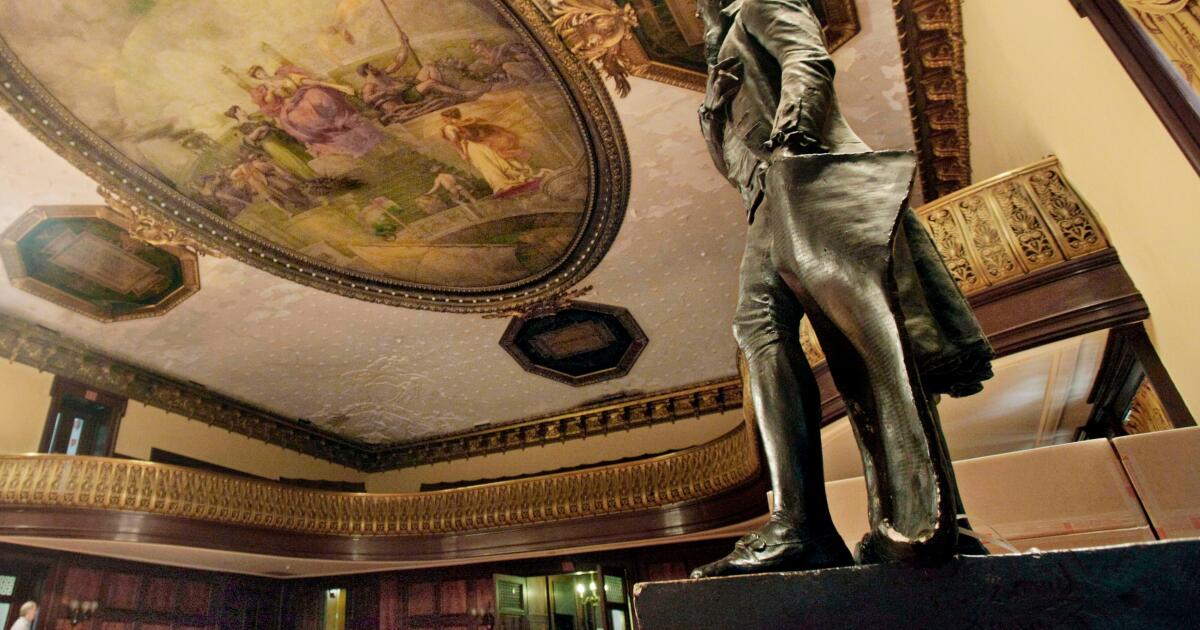
A Jefferson for every era, from Lincoln to Trump, and the contradictions that endure
CHARLOTTESVILLE, Va. — He’s a prize-winning presidential historian who wrote an entire biography of Thomas Jefferson. But even Jon Meacham needs to think for a moment before defining what it means to be a “Jeffersonian.”
“Well for a long time, before the civil rights movement, it meant to be more inclined toward states’ rights and limited government,” says Meacham, the National Constitution Center’s Semiquincentennial Scholar. He then pauses, and asks to start over, recalling how President Franklin Delano Roosevelt evoked Jefferson as an “apostle of liberty” who would have supported the U.S. fighting the Nazis in World War II.
You could define it in so many ways. Historians may argue over the “greatness” of individual founders, but as the country’s 250th anniversary approaches many agree that no one’s life and work resonates like Jefferson’s. He embodied the “very best and the very worst” of the United States, Meacham says.
And a great deal in between.
America’s birth is rooted in his most profound contradiction — the man who proclaimed that “all men are created equal” while being a slaveholder to the end of his life. But Jefferson advanced and explored both sides of so many issues and world views that have defined the country’s path: agrarian self-sufficiency and worldly innovation, pluralism and separatism, limited government and dreams of an “empire of liberty.”
“There is no more malleable figure in early America than Jefferson,” says Andrew Burstein, a professor of history at Louisiana State University who has summed up Jefferson’s legacy in a book he published a decade ago: “Democracy’s Muse: How Thomas Jefferson became an FDR Liberal, a Reagan Republican, and a Tea Party Fanatic, All the While Being Dead.”
“There have been times in American history when just about everyone would have considered themselves ‘Jeffersonian,’” says historian Peter S. Onuf, author of numerous works on Jefferson. “Yet even at those moments, he was a controversial figure.”
It’s an argument without end
Jefferson’s legacy is debated even in settings that owe their existence to him.
On the campus of the University of Virginia, the college he founded and regarded as a signature achievement, stands a memorial to thousands of enslaved people who lived and worked there.
At Monticello, the mountaintop estate and plantation outside of Charlottesville where Jefferson lived when not in public office, a banner near the entrance features the Declaration and the caption, “After all, our guy wrote it.” But once on the grounds, reminders of his enslavement of hundreds are found throughout, from its “Burial Ground for Enslaved People” that includes dozens of graves to an exhibit dedicated to Sally Hemings, the enslaved woman with whom Jefferson is widely believed to have had six children.
Monticello’s director of historic interpretation and audience engagement, Brandon Dillard, cites the staff’s mission “to tell unflinching stories of America’s complex origins and fitful progress toward the ideals Jefferson articulated in the Declaration of Independence.”
Jefferson regarded Monticello as a refuge from the times, but the times inevitably find their way here. A guide on the gardens and grounds tour points out that a foldable plant Jefferson tried and failed to grow — the “Mimosa Pudica,” or “sensitive plant” — now thrives because of climate change. The visitors’ center is LEED Gold-certified for green energy, Dillard says, and geothermal systems have been installed in other buildings for temperature control.
Monticello raises questions old and new about race. Virtually all of the guides are white, an issue Dillard notes is prevalent nationwide. A recent survey released by the American Association for State and Local History found that around just 10% of workers at museums, historic sites and historical societies were nonwhite and that many “Latino/a/x, and multiracial respondents reported higher rates of discrimination and harassment.” (Dillard declined to answer in detail the experience of guides of color at Monticello.)
There is a Jefferson for every occasion
Jefferson’s contradictions date back through much of American history; he was claimed by both sides of the Civil War and both sides of the civil rights movement.
Nineteenth-century Confederates and 20th-century segregationists cited his defense of states’ rights, while Abraham Lincoln and civil rights leaders emphasized Jefferson as the author of the Declaration of Independence. In the space of a few months in 1963, he would be invoked in the inaugural speech of Alabama Gov. George Wallace as he vowed defiance of federal efforts to integrate the state’s schools and by the Rev. Martin Luther King as he delivered his “I Have a Dream” speech during the March on Washington.
Roosevelt enlisted Jefferson as an ideological ally for the New Deal (the Thomas Jefferson Memorial in Washington, D.C., began as a New Deal project) and a former New Dealer-turned conservative, President Reagan, held up Jefferson decades later as a foe of wasteful spending. Jefferson has been cited often by free-speech advocates for his crucial support for the Bill of Rights, while President Trump has quoted Jefferson’s 1807 lament that “Nothing can now be believed which is seen in a newspaper” as an implicit endorsement of his modern war against “fake news.”
Jefferson has also been placed on either side of today’s divide over immigration. Ibram X. Kendi, author of “How to Be an Anti-Racist,” cites his well-documented belief in colonization for Black people as inspiration for contemporary scapegoating and xenophobia. Meanwhile, at a time when the Trump administration is aggressively trying to restrict immigration and even denaturalize some citizens, Monticello continues its decades-old July 4 naturalization ceremonies, with Virginia Gov. Abigail Spanberger scheduled as this year’s keynote speaker.
“As new citizens share their personal stories every Fourth of July,” Dillard says, “we are reminded that the values uplifted in that Declaration are values toward which people from all backgrounds aspire.”
Many Monticello visitors, many reasons to visit
Monticello attracts hundreds of thousands of visitors each year. They come for many reasons.
Erin Porter is a Virginia native in her 40s who until recently had never been to Monticello and wanted to cross it off her bucket list, while Nathan Jaycox of Connecticut is a former nuclear engineer now seeking to absorb history for a class he hopes to teach. Duane Cromwell, a longtime resident of Vancouver, was here on a very personal mission.
Cromwell, 70, grew up in Greenville, S.C., where she was taught that slavery was “an economic necessity” and learned nothing about Jefferson’s history of enslavement. In town last month for a family reunion, she arrived at Monticello anxious to get past the “whitewashed Southern version” and the myths of evil “yankees” and the victimized rebels who defied them.
“Did you (ever) notice kudzu growing up over trees and buildings while in the South? It is an invasive plant brought to the region to control erosion. Well, it is like racism. It is pervasive, part of the horizon, always there but soon you don’t notice it,” she says.
“Having said that, I do think that people do go along better, there is more interactions, relationships than when I was growing up. Everyone needs each other and in the South, there is a great sense of humor and friendliness that help people navigate the awkward moments.”
For Cromwell, Monticello was a chance to educate herself, to become a better person — and, like countless others before her, using Thomas Jefferson as a prism.
“Isn’t that what it’s all about?”
Italie writes for the Associated Press.