Jesse Jackson once waged war on Hollywood, with few results
In 1994, the Rev. Jesse Jackson declared war on Hollywood.
The civil rights leader, who died Tuesday, set his sights on the entertainment industry, accusing it of “institutional racism” and calling out what he called the lack of representation of people of color and women, an issue that reverberates today.
Jackson aimed his trademark fiery dynamism at studio and network executives, forming the Rainbow Coalition on Fairness in the Media — an offshoot of his Rainbow Coalition that focused on social justice and economic equality — and threatening boycotts against projects that excluded minorities.
Comparing his campaign to the historic march in Selma, Ala., and other civil rights demonstrations during a news conference, Jackson said, “They think they have the right to not include us in recruitment, hiring, promotion, projection, decision making. But we have consumer power, we have viewer power, we have the power to change dials. … The networks have time now to get their house in order. They can begin to change now.”
The pronouncement was a dramatic contrast to Jackson’s 1984 hosting gig on “Saturday Night Live” and his memorable reading of “Green Eggs and Ham” during a 1991 appearance on the sketch variety series.
But despite his characteristic command and media savvy, Jackson’s campaign never gained true momentum, scoring mixed results. Black actors and creators within Hollywood for the most part failed to rally around him, and leaders of some advocacy groups accused him of losing focus. Whoopi Goldberg made fun of him while hosting the 1996 Oscars.
By 1997, the battle had fizzled out and Jackson had moved on to more political concerns.
The clash with Hollywood was first sparked after several Black-oriented shows on Fox, including “South Central,” “Roc,” “In Living Color” and “The Sinbad Show” were canceled in the July 1994. Jackson felt there would not be much improvement in the diversity on the shows in the upcoming fall season.
“We know that significant shows were cut off from Fox this season, and that is of great concern to us,” Jackson said at a news conference at the African American Community Unity Center where he was accompanied by Brotherhood Crusade founder Danny Bakewell and comedian Sinbad, who starred in his own eponymous sitcom.
And Jackson said it wasn’t the only TV network with this problem. “We look at the data we have on NBC. It is substantial. It is ugly. We look at the projected format for CBS this fall. In the real sense, all of them are recycling racist practices. It is called institutional racism. It is manifest not only in their hiring, but in their priorities.”
He added that he was also concerned about what he claimed was poor representation of people of color and women among network news anchors and on writing staffs on prime-time network series. He criticized the prominence of Black actors having major roles that often involved criminal activity.

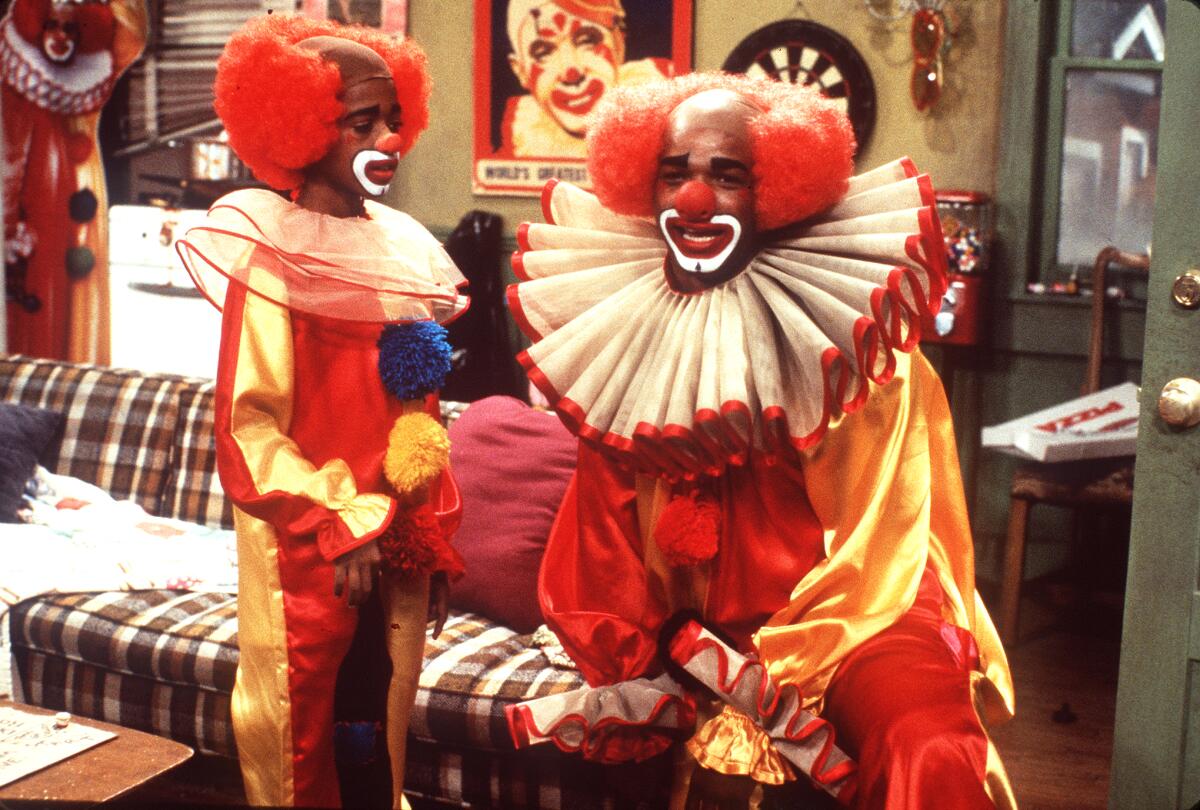
Jameel Hasan as Homey Jr., left, and Damon Wayans as Homey D. Clown on Fox’s “In Living Color,” which was canceled in 1994.
(Nicola Goode / Fox)
“We have written the networks letters, and the response, by and large, has been defensive as they attempt to justify what is unjustifiable,” Jackson said at the news conference. “While we’re willing to talk, we’re also willing to walk. It’s now time for aggressive direct action.”
In a separate interview, he targeted politically oriented Sunday news shows, saying they excluded Black journalists and news figures: “Those all-white hosts determine their guests and set the political agenda for public policy for Monday morning. That’s not America.”
His newly formed commission was researching network hiring practices and minority images. He vowed that boycotts and other actions would take place if there was not significant change.
But those demonstrations never materialized, and no boycotts were called. Roughly a year after his initial declaration, observers inside and outside the industry said networks had mostly ignored Jackson, and that little had changed.
Some leaders at the time questioned his commitment, saying he did not seem truly dedicated to aggressive action.
Sonny Skyhawk, founder and president of American Indians in Film, one of the organizations that had joined forces with Jackson, said the campaign against the networks should have been stronger.
“I would hate to criticize him for not being more diligent, but it is frustrating,” said Skyhawk in a 1995 interview about the initiative. “I don’t know where (the issue) is or why he is not continuing on this. But I think he got sidetracked on a lot of other things.”
Sherrie Mazingo, who was then head of broadcast journalism at USC, said she was not surprised that the Jackson campaign had lost steam: “What happened last season isn’t new, it’s perennial, and may even be cyclical. Protests and accusations and talk like this goes on all the time, and nothing ever happens. Nothing.”
Mazingo cited similar efforts by the National Assn. for the Advancement of Colored People in the early 1980s that had attacked Hollywood’s hiring practices. A boycott of films that failed to use Black artists in front of or behind the camera was proposed but never materialized.
“I believe what happens when these things start is that an individual in the organization who is pushing forward on these issues gets tired of banging their head against a brick wall,” Mazingo said. “They make an all-out assault, exhaust a lot of energy and money, and nothing ever significantly changes, except for a token gesture here and there.”
Sumi Haru, who was president of the Assn. of Asian Pacific Artists, said Jackson had been sidetracked by more topical issues such as a conservative power grab in Washington, D.C., and calls for abolishing affirmative action programs.
“He needed to focus his energy on the civil rights initiative, and affirmative action was a much bigger deal,” said Haru.
But Billie Green, president of the Beverly Hills/Hollywood branch of the NAACP, said Jackson’s campaign would have been more effective if it had joined forces with other organizations that had members within the television industry.
Jackson pushed back against the criticism, insisting that the fight against Hollywood “is still very high on our agenda.” He pointed out that he had worked to continue government funding for the Public Broadcasting Service, protested the cancellation of the Nickelodeon series about two Black brothers, “My Brother and Me,” picketed conservative “hate radio” programs and sent out a fax to 8,000 supporters asking them to rally CBS to bring back the family drama “Under One Roof.”
“It’s going to get more intense,” Jackson said.
In 1996, Jackson turned his attention to the Academy Awards, angered that there was only one Black nominee among the 166 artists nominated. He called for picketing in major cities and and said Black people attending the Oscar ceremony should wear a symbol expressing solidarity against what he called Hollywood’s “race exclusion and cultural violence.”
But during the Oscars, which was produced by Quincy Jones, Goldberg, who was hosting, took a swipe at the civil rights leader who was picketing across town.
“Jesse Jackson asked me to wear a ribbon. I got it,” Goldberg said during her opening. “But I had something I want to say to Jesse right here, but he’s not watching, so why bother?” The remark drew applause and laughter from the black-tie audience.
Some leaders, producers and directors were not amused by Goldberg, saying her remarks were insulting and dismissive of a serious fight to gain diversity within the motion picture industry. But others criticized Jackson, calling his action ill-timed and ill-advised. Several of the most prominent African Americans present, including Oprah Winfrey, Sidney Poitier and Laurence Fishburne, did not wear rainbow-colored ribbons as a sign of solidarity with Jackson and his Rainbow Coalition.
Even though he concentrated on other endeavors, Jackson was not totally done with Hollywood. He and the Rev. Al Sharpton spearheaded a protest in 2002 against the comedy “Barbershop” and its jokes about Jackson and ciivil rights icons Rosa Parks and Martin Luther King Jr. The two leaders also threatened a boycott against the 2004 comedy “Soul Plane.”