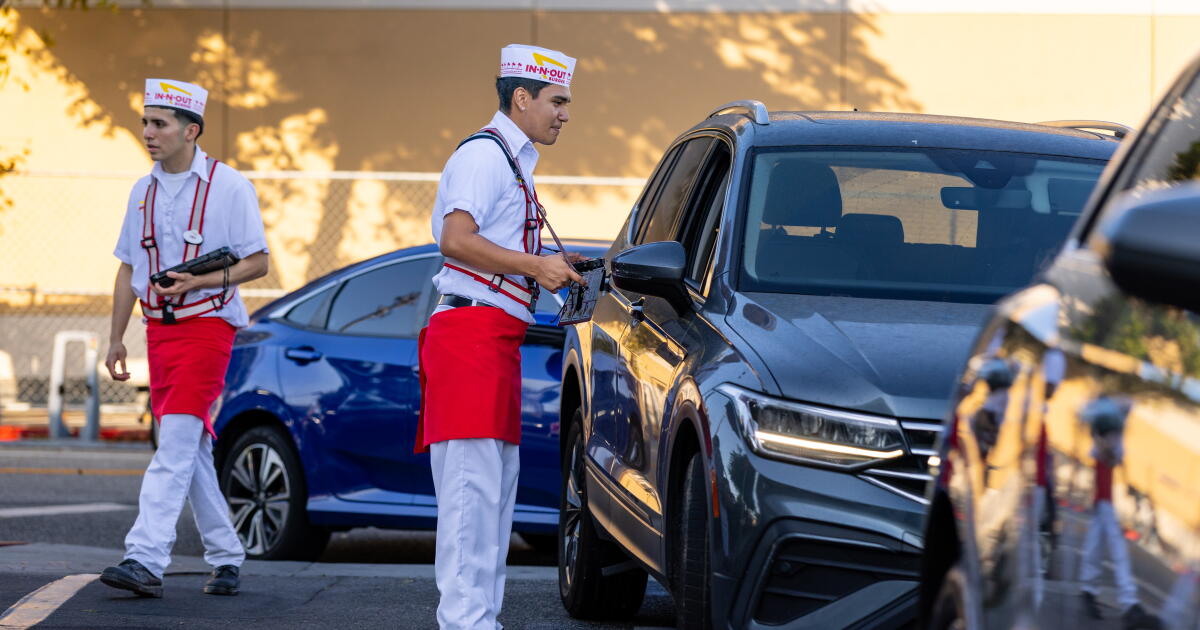
L.A. fast-food workers could get greater protections
Retail employees in Los Angeles working irregular schedules, called in for shifts with just a few hours’ notice, got some relief years ago in the form of a city law requiring large retailers to give them notice of their schedules at least two weeks in advance.
Now, that 2024 law could be expanded to encompass the city’s fast-food industry, whose precarious workforce — largely women from immigrant communities — has long raised concerns over unstable schedules that they say make it difficult to plan their finances, child care, medical appointments and other obligations.
The L.A. City Council’s economic development and jobs committee late last month approved the ordinance, which also would establish a mandatory six-hour paid training to educate workers on minimum wage laws and other labor protections. It goes to the full council for a vote on Tuesday.
The proposal is backed by a statewide union of fast-food workers — established in 2024 — that is affiliated with the Service Employees International Union, which for years has helped organize fast-food employee walkouts over wage theft, safety and pay.
The California Fast Food Workers Union‘s organizing director, Maria Maldonado, said workers often are unaware of their rights regarding heat exposure and other risky conditions common in kitchens. The training, she said, would show them they have recourse and city support for reporting employers when conditions are unsafe.
“If you know there is support to enforce the law, we are going to see a difference in the industry,” Maldonado said.
City Councilmember Hugo Soto-Martinez first introduced the ordinance in 2024.
Although worker-friendly proposals usually are ultimately backed by the L.A. City Council, the process often is lengthy, with business interests lobbying against such measures.
The California Restaurant Assn. wrote in a letter to the council that the ordinance would greatly increase costs in a state that already is expensive to operate in and that it unfairly singles out an industry that has long served as a successful pathway to business ownership for minority entrepreneurs.
In the letter, business groups took issue with third parties administering worker training, arguing that labor groups could use them to prime the workforce for union campaigns.
The ordinance would “not only duplicate existing law but also force neighborhood restaurants to pay thousands of dollars so groups with ulterior motives can hold team members as a captive audience,” the letter said.
The group also argued that training would create third-party access to workers’ data even as many immigrant workers are fearful of heightened immigration enforcement, noting that the training might “require employers to disclose sensitive information to outside entities, creating serious privacy risks.”
A report commissioned by McDonald’s, compiled by the firm Beacon Economics and Pepperdine University, surveyed some 1,200 workers in L.A. County and found that a majority, about 70.6%, opposed the proposed paid training, while 29.4% said they would want such training, the survey said.
California’s fast-food industry employs more than 750,000 people and is a growing sector, according to state data. The state fast-food union has argued that local and state protections are crucial.