Citizens Advice Bureau

Everything you’re entitled to if airline loses your luggage

Holidaymakers may be entitled to claim compensation when an airline loses, damages or delays their luggage

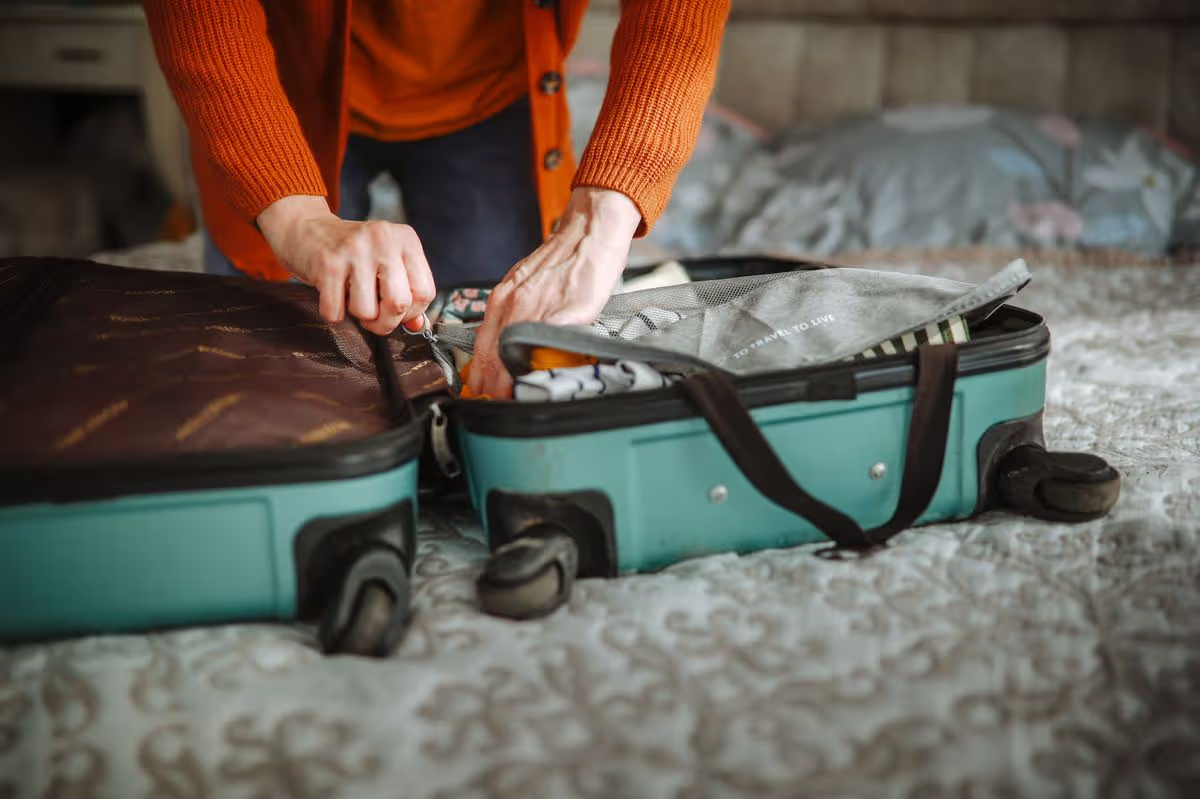
Holidaymakers facing the misery of lost, damaged or delayed luggage could be entitled to compensation from their airline – but they need to act quickly.

Passengers arriving at their destination only to discover their suitcase has failed to make the journey with them have legal rights that can help them recover some of the costs. Citizens Advice says travellers have the right to claim compensation from an airline when checked-in luggage is delayed, lost or damaged. But there are important deadlines – and passengers should report a problem as soon as possible.

The consumer advice charity warns that the rules for cabin baggage are different. You can generally only claim for a problem with hand luggage where the airline was at fault.

Don’t leave it too late

Citizens Advice says holidaymakers should report missing or damaged luggage to the airline straight away. At the airport, this will normally involve completing a Property Irregularity Report (PIR) at the baggage claims area.

Passengers should keep a copy of the PIR, or obtain written confirmation from the airline if they report the problem later. Making a report does not necessarily mean a compensation claim has been made. Passengers will normally still need to submit a separate claim unless the airline agrees to pay certain expenses upfront.

There are strict deadlines

One of the biggest traps is assuming there is plenty of time to make a claim.

Citizens Advice says the usual deadlines are:

  • Damaged luggage: claim within seven days of receiving it.
  • Missing or damaged contents: claim within seven days of receiving the luggage.
  • Delayed or missing luggage: claim within 21 days of the flight.
  • Luggage not returned within 21 days: it is officially treated as lost, meaning passengers should make a claim as soon as possible.

A suitcase that eventually turns up after several days does not necessarily mean a passenger has lost their right to compensation. Citizens Advice says it is still possible to claim for delayed luggage if it is returned within the 21-day period.

What can you claim for?

The compensation available from an airline is generally limited. For delayed luggage, this can include the cost of essential items needed while waiting for the suitcase, such as toiletries and underwear.

Passengers may also be able to claim some of the cost of repairing or replacing luggage and its contents if they are lost or damaged. If a traveller has to collect delayed luggage themselves, says they may also be able to recover reasonable transport costs.

But holidaymakers should not assume they will receive the full replacement value of everything inside a suitcase. Airlines will often ask for receipts and proof of purchase, while Citizens Advice warns that they will not normally pay ‘new for old’ replacement costs.

There can also be restrictions around valuable, fragile or perishable items packed in checked luggage. Total compensation is generally limited to around £1,000 and is often considerably less.

Passengers cannot normally claim for stress or inconvenience caused by the luggage problem, or for knock-on problems such as missing a connection.

Keep every scrap of evidence

Anyone making a claim should keep hold of their paperwork.

Citizens Advice says airlines will usually expect passengers to provide documents such as:

  • their boarding pass;
  • luggage tags showing the identification number;
  • the PIR or written confirmation that the problem was reported;
  • receipts for emergency purchases made because of delayed luggage;
  • proof of purchase for lost or damaged belongings;
  • photographs showing damage; and
  • estimates for the cost of repairs where relevant.

Travellers should keep copies of their claim and the original documents.

How to make the claim

Passengers should check with their airline to find out how it wants compensation claims submitted. If there is no specific claim form, Citizens Advice says travellers may need to write to the airline’s customer service department.

The charity advises making clear that the claim is being made under the Montreal Convention. The claim should include details of the flight, including the date, flight number, departure point and destination.

Travellers should explain what happened, set out the amount being claimed and provide a detailed list of the luggage or contents that were lost or damaged. Any essential items bought because of the delay should also be listed, with copies of supporting receipts and other evidence.

What if several airlines were involved?

Passengers travelling on connecting flights operated by different airlines may be able to claim against any of them. However, Citizens Advice says most airlines expect the claim to be made against the last airline boarded.

An airline cannot simply refuse to deal with a claim because another carrier was involved. If a passenger gets nowhere they can seek advice from the Civil Aviation Authority (CAA).

What if the airline rejects your claim?

Holidaymakers who are unhappy with an airline’s response can take the matter further. Citizens Advice recommends first trying to resolve the complaint through the appropriate process.

The CAA can take up complaints against airlines or airports in certain circumstances, although its role depends on whether the airline or airport belongs to an approved alternative dispute resolution scheme. As a last resort, passengers can consider taking a case to the small claims court.

A luggage claim can generally be taken to court within two years of the flight, although court action can be costly and time-consuming.

Check your insurance too

There is another option that could prove easier and more generous. Citizens Advice says that if luggage is covered by travel insurance or a home contents policy, making an insurance claim may be preferable.

This is because insurance can potentially provide more money and may be easier to claim through than pursuing the airline.

Passengers needing further help can contact the Citizens Advice consumer helpline on 0808 223 1133 or use its online service.

The charity also advises checking the specific rules applying to the airline, as individual procedures and deadlines can vary. More information here.

Source link

Simon Calder urges anyone with package holiday booked to do task ‘immediately’

Important message for anyone with a package holiday booked

Travel expert Simon Calder has shared important advice for anyone with a package holiday booked, as people are being urged to act ‘as soon as possible’. His message comes ahead of the peak travel season, and as new research by Citizens Advice has revealed that four million people have faced issues with their package holiday over the last year.

On today’s (June 8) episode of ITV’s Good Morning Britain, TV host Kate Garraway spoke to correspondent Nick Dixon about the findings. He said: “The complaints that we’ve been hearing about were involving all-inclusive holidays, with many saying they just didn’t ultimately match up to the glossy brochures we see online, or indeed at the travel agents.

“Citizens Advice say that they found 33% of holiday-related complaints ultimately were about things like poor quality hotels, bad food, facilities being unavailable as well – 19% down to customer service.” He added: “Things like long waits on the phone, complaints ignored and administration errors, and 25% of complaints ultimately led to stress, anxiety or upset.

“And if your dream holiday does turn into a wee bit of a nightmare, there are steps you can take… Many of us with these kinds of complaints about our holidays end up trying to fight for compensation, which is why it is so important to keep a record of everything just in case to have any chance of getting money back.”

British travel journalist and broadcaster Simon Calder then spoke to viewers, sharing a crucial message for those with a package holiday, especially if they encounter problems during their trip. He urged holidaymakers to act ‘immediately’.

Content cannot be displayed without consent

He said: “If you get to your destination and things aren’t right, maybe there’s a problem with your room, maybe the facilities are simply not as described, then you have to give the travel company immediate notice and allow them the opportunity to sort things out.”

How can I claim compensation for a holiday?

Reporting a problem right away is a legal concept called “mitigating your losses”. If you don’t allow the travel provider to address the room or facilities issue while you’re there, you could really hurt your chances of receiving a full refund or compensation.

Citizens Advice says: “If you’re still on holiday, tell the company or travel agent about the problem as soon as possible. You might be able to get it sorted quicker – like if there’s a problem with the room. If you don’t say anything until you get home, you might get less compensation or none at all.”

The person you need to contact depends on how you arranged your holiday. If you went for a package holiday, reach out to the customer service team of the tour operator you chose.

However, if you organised it yourself or set up a linked travel arrangement, you should contact the accommodation or service provider directly, such as the hotel or the company offering excursions. Make sure you include:

  • your booking reference
  • clear details of what went wrong
  • copies any evidence you have – like photos
  • copies of receipts
  • how much compensation you want

Citizens Advice adds: “It’s a good idea to send the letter by registered post and keep a copy, so you have proof that the holiday company received it. You can also email them – some of them have online forms. Keep a copy of what you send. If the company makes you an offer that you think is too low, you can ask for more. They might come back to you with a higher offer.”

Source link

Your legal rights as 4million report problems with package holidays

Of the complaints made to the Citizens Advice Consumer Service, 42% involved all-inclusive packages abroad

More than four million people had problems with a package holiday in the past year, a survey for Citizens Advice suggests. The survey found 76% of adults had been on a package holiday before, and 34% of them had experienced a problem. Some 8% had suffered an issue within the last 12 months specifically, equating to an estimated four million travellers, it said.

The charity said it received about 14 complaints a day about package holidays, including issues such as unexpected changes to the hotel, denied refunds, and poor customer service. Of the 3,500 package holiday complaints made to the Citizens Advice Consumer Service in the past year, 42% involved all-inclusive packages abroad.

A third of complaints (33%) related to the quality of the holiday falling short of the agreed deal, such as hotels being misdescribed, bad food or unavailable facilities. Customer service failures made up 19% of complaints, including long waits on the phone, ignored complaints and administration errors made by firms.

As a result, one in four of those who experienced an issue with a package holiday (25%) said they suffered stress, anxiety or upset, while 17% had to pay extra for daily expenses. Citizens Advice encouraged holidaymakers to check what protections were included within their booking.

One complainant, Zorana, a semi-retired NHS doctor from north-east England, reported spending £6,300 on an all-inclusive, seven-night trip to Lanzarote with her daughter through a UK holiday operator. Torrential rain on the second day resulted in “nightmare” flooding, leaving hotel guests without electricity, water, food or internet.

However the woman said she received no on-site support from their operator, causing them considerable stress. Zorana, 66, said: “We spent the morning on the beach and planned the sauna for later. But when we were eating lunch the rain started and didn’t stop.

“By the time we got to the spa, the hotel told us we couldn’t go in because it was flooded. Half an hour later the electricity had gone. Without electricity, everything stopped. There was no more internet and no more water because the pumps were not working.

“We all gathered in the hotel lobby, to hear what was going on. It was the weekend and reps from all the other travel companies were there, talking with people, reassuring them, giving them information. Some were already distributed to other places. We asked, ‘Where is our rep?’ And we were told he doesn’t work on weekends.

“We were very angry. Hotel staff told us our travel company was always a problem and never helped people. We came home after five days and I started to chase the travel company for a refund. But the customer service adviser said they can’t deal with it because compensation was offered. But their offer was not adequate.

“I mentioned the lack of support, the delay, the value of the holiday, that I had to find and pay for another hotel, and because of this it was reasonable that they should give me all my money back. I feel a victim twice over because I had the stress of our holiday being ruined, and then months of trying to get compensation.”

Citizens Advice consumer spokeswoman Jane Parsons said: “Too often, people are left stressed and disappointed when their dream holidays are spoiled because they’re not getting what they paid for. To make matters worse, they’re having to spend a lot of time and effort trying to resolve issues, sometimes with no luck.

“A record of any issues that occur and evidence should be kept – like clear details of what went wrong and when, photos and receipts. If something goes wrong with your holiday you might be able to get compensation from the company you booked with. You should tell them about any issues as soon as possible – if you don’t say anything until you get home you might get less compensation, or none at all.”

Chartered Trading Standards Institute chief executive John Herriman said: “This research highlights the real impact poor practice in the travel sector can have on consumers, specifically the problems for consumers booking holidays online, particularly through social media.

Left out of pocket

“Too many people are left out of pocket or dealing with stress when holidays don’t meet what was promised. What should be a time to relax and unwind can turn into the opposite. While it’s vital consumers understand their rights, check the protections included and keep clear records if something goes wrong, businesses must meet their legal obligations and ensure they deliver the standard of service people have paid for – and resolve issues raised quickly.

“Strong consumer protection depends on both informed consumers and responsible traders.”

Consumers are entitled to compensation for a holiday if it was lower in value than the one booked, spending extra money was required because of a problem, a large part of the booked services were not provided, something goes wrong that causes distress or disappointment or if the holiday was completely ruined.

Yonder surveyed 2,018 adults between April 17-19 about their experiences with package holidays, including problems. Respondents were asked to exclude issues outside the operator’s control, like geopolitical events or natural disasters.

Source link