Chuck Schumer

Trump says he’ll speak with Taiwan’s president about stalled arms deal

May 21 (UPI) — President Donald Trump has said he will speak with Taiwanese President Lai Ching-te about a stalled $14 billion arms deal, a call that would be precedent-setting for a sitting U.S. president and likely anger China.

“I’ll speak to him,” Trump said Thursday from the tarmac of Joint Base Andrews in Maryland.

The president was responding to a reporter’s question on whether he planned to call Lai before making a final decision on the Congress-cleared weapons deal, the future of which remains uncertain following Trump’s visit last week to Beijing for meetings with Chinese leader Xi Jinping.

Taiwan has requested the weapons package as it faces an aggressive China, which claims sovereignty over the self-governing island it views as a breakaway province and has said it will take it back by force if necessary.

The weapons deal was pre-approved by Congress in January 2025, and Taiwan’s legislative body earlier this month approved a special defense budget of $25 billion to buy weapons from the United States. The package now requires Trump to sign off on it.

But Trump on Friday told reporters aboard Air Force One while en route back to the United States following his visit with Xi in Beijing that they had “talked a lot about Taiwan” and that he would “make a determination over the next fairly short period” on whether to give the arms deal final approval.

Taiwan was a significant topic during the trip, with Xi warning Trump that the island was “the most important issue” in bilateral ties and that, if mishandled, could trigger “clashes and even conflicts.”

Amid the uncertainty, Lai issued a Facebook post Sunday night stating Taiwan-U.S. security cooperation and arms sales “are key elements in maintaining regional peace and stability” and that the island’s security is the region’s security.

Trump did not say Wednesday when he would speak with Lai or discuss specifics concerning the arms deal.

“We have that situation very well in hand,” he said, adding that he had an “amazing” meeting with Xi.

“We’ll work on that,” he said.

Trump spoke with Taiwan’s then-President Tsai Ing-wen in 2016, when he was the president-elect, but no sitting U.S. president is known to have spoken with the leader of Taiwan since Jan. 1, 1979, when the Carter administration formally severed diplomatic ties with the Republic of China, the official name of Taiwan’s government, and established relations with the People’s Republic of China in Beijing.

Spokeswoman Zhu Fenglian of Beijing’s State Council Taiwan Affairs Office gave reporters a standard answer during a press conference Wednesday, stating: “We firmly oppose the United States conducting any form of official exchanges with China’s Taiwan region, and we firmly oppose the United States selling weapons to China’s Taiwan region.”

“This position is consistent and clear,” she said.

UPI has contacted Taiwan’s Foreign Ministry for comment.

Democrats and some Republicans have urged Trump to approve the arms deal and expressed concern over its future as the president was in Beijing.

“Trump must not sell out Taiwan, period,” Senate Minority Leader Chuck Schumer, D-N.Y., said in a social media statement.

The Republic of China, the current government of Taiwan, once governed mainland China but retreated to the island following its defeat by the Chinese Communist Party in the Chinese Civil War in 1949.

The Chinese Communist Party views Taiwan as part of China under its One China principle and seeks reunification with the island — an act Taiwan says would amount to an illegal annexation.

Source link

Senate passes resolution to begin budget reconciliation to fund DHS

April 23 (UPI) — Senate Republicans were up all night voting, eventually adopting a budget reconciliation package Thursday morning to prepare to fund the Department of Homeland Security.

The Senate plans to fund the department without Democrats’ help. The resolution was adopted at around 3:30 a.m. EDT Thursday by a vote of 50-48 after about six hours.

The only Republicans to vote against the resolution were Sens. Lisa Murkowski, R-Alaska, and Rand Paul, R-Ky. The bill now goes to the House. If the House adopts the resolution, the final funding bill can be written and voted on by Congress.

They are following a deadline of June 1 set by President Donald Trump.

“We have a multistep process ahead of us, but at the end Republicans will have helped ensure that America’s borders are secure and prevented Democrats from defunding these important agencies,” said Senate Republican Leader John Thune, R-N.D.

Thune told fellow senators to keep the package narrow to ensure speedy passage.

Since the January deaths of Renee Good and Alex Pretti in Minnesota, both shot and killed by DHS officers, Democrats have refused to support funding the department without reforms. The department has been shut down since Feb, 14, though Trump told the department to use emergency funds to pay essential workers.

Just before the Easter recess, the Senate passed a bill that would fund most of DHS but not ICE and Border Patrol. But the House rejected it.

Republicans are hoping to fund the department through 2029 at a cost of between $70 and $80 billion.

The late-night vote-a-rama included votes about amendments that could be added to the resolution. Two Republican Senators who are vulnerable in the November elections — Sens. Susan Collins, R-Maine, and Dan Sullivan, R-Alaska — broke ranks on some amendments.

Collins and Sullivan voted for amendments to lower health care costs, to reverse last year’s Supplemental Nutrition Assistance Program cuts and to tackle insurance companies that delay or deny medical care. Sen. Josh Hawley, R-Mo., joined with Collins and Sullivan on the latter.

Sen. Bernie Sanders, I-Vt., also sponsored an amendment that would tell the budget committee chair to help cut prescription drug prices by half. Hawley, Collins and Sullivan supported Sanders on it. Sanders said his amendment would codify ensuring that Americans wouldn’t pay more for prescriptions than Canadians or Europeans.

The amendments wouldn’t have the power to force Republicans’ hands, but they would make Republicans go on record about their views of these items.

“This reconciliation, or this budget act, will show who’s on whose side, and clearly if Republicans vote against our amendments, they’re not on the side of the American people,” Democratic Leader Chuck Schumer, D-N.Y., said on the Senate floor.

Homeland Security Secretary Markwayne Mullin told Fox and Friends on Tuesday that the department will run out of money for salaries next month.

“I’ve got one payroll left, and there is no more emergency funds so the president can’t do another executive order because there’s no more money there,” The Hill reported he said.

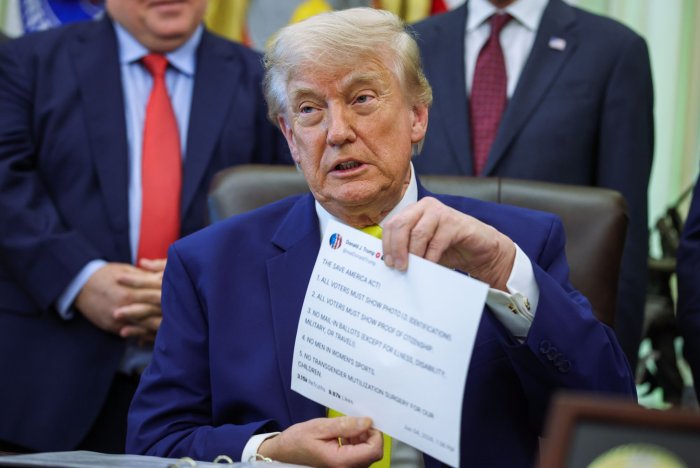
The resolution does not include the SAVE America Act, the voter security bill that Trump and other Republicans have pushed for. Sen. John Kennedy, R-La., sponsored an amendment to add similar restrictions, but it failed 48-50. Collins, Murkowski, Sen. Thom Tillis, R-S.C., and Sen. Mitch McConnell, R-Ky., voted against it.

FBI Director Kash Patel speaks during a press conference at Department of Justice Headquarters on Tuesday. The Trump Administration announced charges against the Southern Poverty Law Center, which the government alleges funneled over $3 million toward white supremacist and extremists groups. Photo by Bonnie Cash/UPI | License Photo

Source link

Thune: Senate may vote next week on ICE, Border Patrol funding

April 14 (UPI) — A budget resolution to fund federal immigration enforcement could hit the Senate floor by next week, Senate Majority Leader John Thune said Tuesday, as Republicans seek to bypass Democratic demands for reforms to Immigration and Customs Enforcement and Border Patrol.

Federal funding for Immigration and Customs Enforcement and Border Patrol lapsed on Feb. 14 after Republicans agreed with the Democrats to remove the Department of Homeland Security from a larger spending package and avert a government shutdown.

Neither agency has been funded through regular DHS appropriations since, though they continue operating through other, emergency funding.

Democrats began demanding reforms to the federal immigration enforcement agencies before agreeing to restore funding after two U.S. citizens were killed by federal immigration officers amid President Donald Trump‘s aggressive immigration crackdown.

Amid a stalemate in negotiations, Republicans are considering passing three years of funding for the agencies through a complicated legislative mechanism called a budget reconciliation bill that permits certain spending legislation to pass with a simple majority rather than 60 votes, Thune told reporters Tuesday in the Capitol.

“Republicans are going to stand with our Border Patrol, with our law enforcement agencies and we’re going to ensure that they are funded, not only today but well into the future,” Thune, R-S.D., said.

Sen. Lindsey Graham, R-S.C., is preparing the resolution to fund the agencies that will be followed by the reconciliation bill “to ensure the job gets done,” he said.

Democrats have blocked funding for ICE and Border Patrol until reforms — including requiring judicial warrants and banning officers from wearing masks — are made, but the reconciliation bill tactic could ensure funding without any votes from Democratic lawmakers.

The same tactic was used last year to pass Trump’s sweeping spending and tax cut bill, which provided $75 billion for ICE.

“All of the things that the Democrats made this about, which was supposed to be about reforms to the way that ICE and Border Patrol operate — they get none of that,” Thune said.

“And now, we’re going to fund those agencies for three years into the future. The only thing the Democrats got out of this was they now own the issue of open borders and defund law enforcement.”

Republicans hold a narrow 53-47 majority in the Senate, with two independents caucusing with the Democrats, as well as a 218-213 majority in the House.

The Senate has twice passed bipartisan bills to fund DHS aside from ICE and Border Patrol, which the House has balked at. Democrats blame the Trump administration’s influence on the lower chamber.

“Republicans are dragging the Senate through a partisan circus just to avoid basic accountability for ICE and Border Patrol,” Senate Minority Leader Chuck Schumer told reporters at the Capitol during a separate press conference on Tuesday.

He said Democrats will continue to push for immigration enforcement reforms.

“So, the pattern, unfortunately, with this administration is clearer and clearer,” the veteran New York Democrat said. “Chaos abroad — the war; chaos at home with not funding DHS with reforms. A failed war overseas, a manufactured crisis here in Washington — in both cases Republicans aren’t leading, they are following orders.”

Source link