California voters favor progressive candidates, split over democratic socialism, poll finds
California voters are more inclined to back progressives running for office than mainstream Democrats, a new poll found, though a marked generational divide separates those who favor each camp.
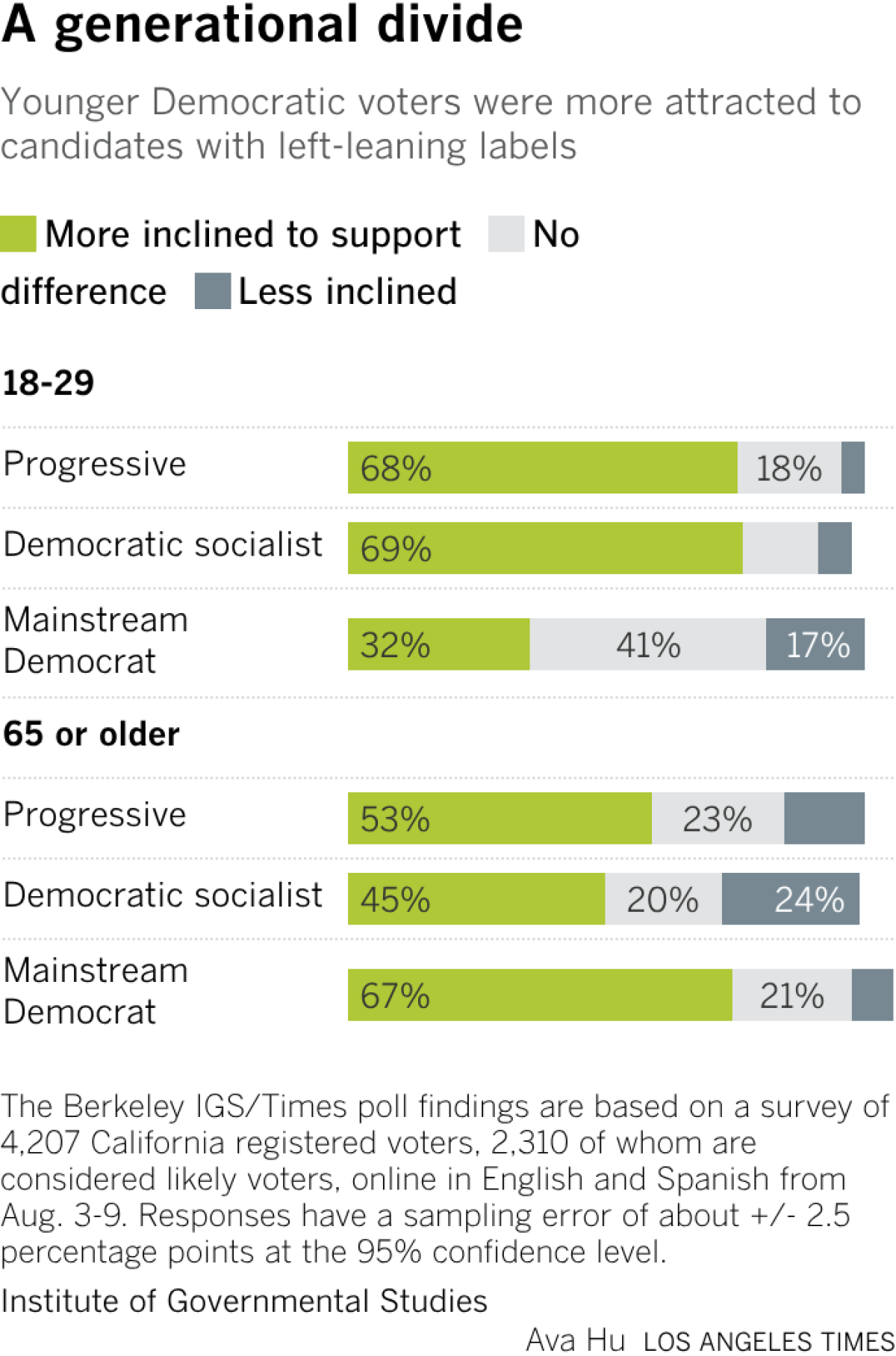
Registered Democratic voters over 65 were overwhelmingly more inclined to support a candidate identified as a mainstream Democrat, whereas more voters under 40 favored those more aligned with the party’s left wing, including democratic socialists.

The results, from a new poll conducted by UC Berkeley’s Institute of Governmental Studies and co-sponsored by The Times, illustrate the highly visible midterm-season debates unfolding within the Democratic Party over age, ideology and the party’s future.
“There’s particular frustration among the younger voting population,” said IGS poll director Mark DiCamillo. “Their views of mainstream Democrats are not that positive, and that’s a long-term problem, I think, for the Democratic Party.”
The poll asked voters about how they perceived candidates described as a progressive, democratic socialist, mainstream Democrat, Republican and MAGA supporter. Voters were asked whether each label made them more inclined or less inclined to back a given candidate, or if they believed there was not much difference or had no opinion.
Among all California voters, a candidate described as “progressive” drew the broadest support — besting both mainstream Democrats and Republicans, as well as democratic socialists and members of President Trump’s MAGA movement. At 40%, support for progressive candidates registered just two percentage points above support for democratic socialists and within the poll’s margin of error, though fewer people felt negatively toward progressives than democratic socialists.
Among registered Democrats, the survey found 60% said they would be inclined to support a candidate identified as progressive; 58% felt the same when asked about a democratic socialist and 48% about a mainstream party member.
The polling offers a glimpse into how California voters feel about democratic socialism, the brand of liberal politics popularized by Sen. Bernie Sanders (I-Vt.) and New York Mayor Zohran Mamdani (D).
The views among all California voters were split, with 38% saying they would be more inclined to support a candidate labeled as a democratic socialist and 38% saying they would be less inclined. That makes the concept both more polarizing and more popular than the idea of a mainstream Democrat.

“To us, it’s honestly an incredibly good thing to hear that by and large, California voters see democratic socialism as a preferable option,” said Misha Kesselman, who leads membership coordination at the California Democratic Socialists of America.
“Being only two percent behind a progressive Democrat is the perfect place for us to be and for our organization to organize from,” Kesselman added. “I don’t see this as our ceiling; this is a great floor for us to start running from.”
Notably, more voters, 36%, said they were less inclined to support a mainstream Democrat than those who said they’d be more inclined, 29%. Twenty-seven percent showed indifference, however, possibly demonstrating that most voters would be fine supporting them in a general election, said Christian Grose, a political science professor at the University of Southern California.
The results could reflect a shift in labeling as much as in politics, Grose said, noting that most California Democrats now refer to themselves as progressive, a term that was not as popular 20 years ago, regardless of policy differences.
“Progressive Democrat in California has really in some ways become a mainstream Democrat, and then ‘mainstream’ is often associated with Washington,” Grose said, referring to the more moderate party establishment.
As the two parties compete for control of Congress in November’s midterm elections, the rise of democratic socialist ideas within the Democratic party has set off a debate among left-leaning leaders and voters about how best to counter Trump’s cultural dominance, appeal to disillusioned voters and create a winning presidential strategy for 2028.
The split does not fully fall along generational lines, but it often overlaps with the growing push by some younger candidates to oust veteran lawmakers, a debate over experience and seniority versus fresh blood.
Republicans have used the phenomenon as a key line of attack, as Trump and others have labeled Democrats as communists and extremists. In recent weeks, Trump argued that Democrats want to “destroy the traditional American way of life.”
“Sadly, young people have not been taught the truth about socialism and communism. It’s a dangerous road, and this is one of our efforts to make sure people know that,” House Speaker Mike Johnson (R-La.) said Saturday on Fox News, after launching a website last week dedicated to the idea that socialism and communism have failed.
Meanwhile, many establishment Democrats fear that a far-left candidate would be unable to win a general presidential election and worry a swing in that direction could jeopardize the party’s chances in 2028. House Minority Leader Hakeem Jeffries (D-N.Y.) said Sunday on NBC News’ “Meet the Press” that he does not support the Democratic Socialists of America agenda, further underscoring internal divisions.
Democratic socialism generally centers on an anti-capitalist agenda, including higher taxes for the wealthy and universal healthcare. Many progressive candidates support policy ideas backed by socialists but do not identify themselves as such.
A handful of high-profile progressive primary wins against Democrats backed by the establishment has supercharged the conversation in recent weeks, including this month in Michigan’s Democratic Senate primary, where progressive Abdul El-Sayed narrowly defeated a moderate opponent.
But progressives have lost elsewhere, including in Wisconsin, where democratic socialist Francesca Hong last week was defeated in the gubernatorial primary by David Crowley, the more moderate Milwaukee County executive.
California was not host to that type of showdown this year, and Democratic gubernatorial candidate Xavier Becerra, though progressive by national standards, was viewed by many left-leaning voters as a safer or more moderate primary choice. He faces Republican Steve Hilton in November.
In Los Angeles, however, the mayor’s race between incumbent Democrat Karen Bass and democratic socialist Nithya Raman is set to draw national attention. A handful of progressive candidates also advanced in House races, including Randy Villegas, who is challenging Rep. David Valadao (R-Hanford); Mai Vang, challenging Rep. Doris Matsui (D-Sacramento); and Angela Gonzales-Torres, challenging Rep. Jimmy Gomez (D-Los Angeles). Vang identifies as a democratic socialist.
The new polling also showed a generational divide among Republican voters: A higher share of older voters than younger said they would be more inclined to back a MAGA supporter, though all ages favored the Republican category over MAGA.
Seventy percent of GOP voters said a Republican label would make them more inclined to support a candidate, and 46% said the same of a MAGA label. Sixteen percent said they would be less inclined to vote for a candidate with a MAGA label and 29% said it didn’t make much difference.
Among California voters who eschew both the Democratic and Republican parties, either registered as no party preference or with other parties, a progressive candidate drew the most favorable reaction, but they also showed more support for a democratic socialist than a mainstream Democrat.
Those voters were not positively inclined toward right-leaning candidates, with 15% responding favorably to Republicans and 7% to MAGA.
In California, Democrats account for nearly 45% of all registered voters, compared to 25% who are Republican and almost 23% who don’t belong to either party, according the California Secretary of State’s office.
Whether voters’ shifting preferences for the progressive or democratic socialist labels translate into any different policy action from those who are elected is an open question, Grose said.
“The labels are changing things… but it’s not clear yet if it’s changing the actual ideology of voters and elected officials,” Grose said. “What the elected officials do in office who are Democrats, that remains to be seen.”
The Berkeley IGS/Times poll findings are based on an online survey in English and Spanish of 4,207 California registered voters from Aug. 3-9. The results are estimated to have a margin of error of about 2.5 percentage points in either direction in the likely voter sample, and larger numbers for subgroups.