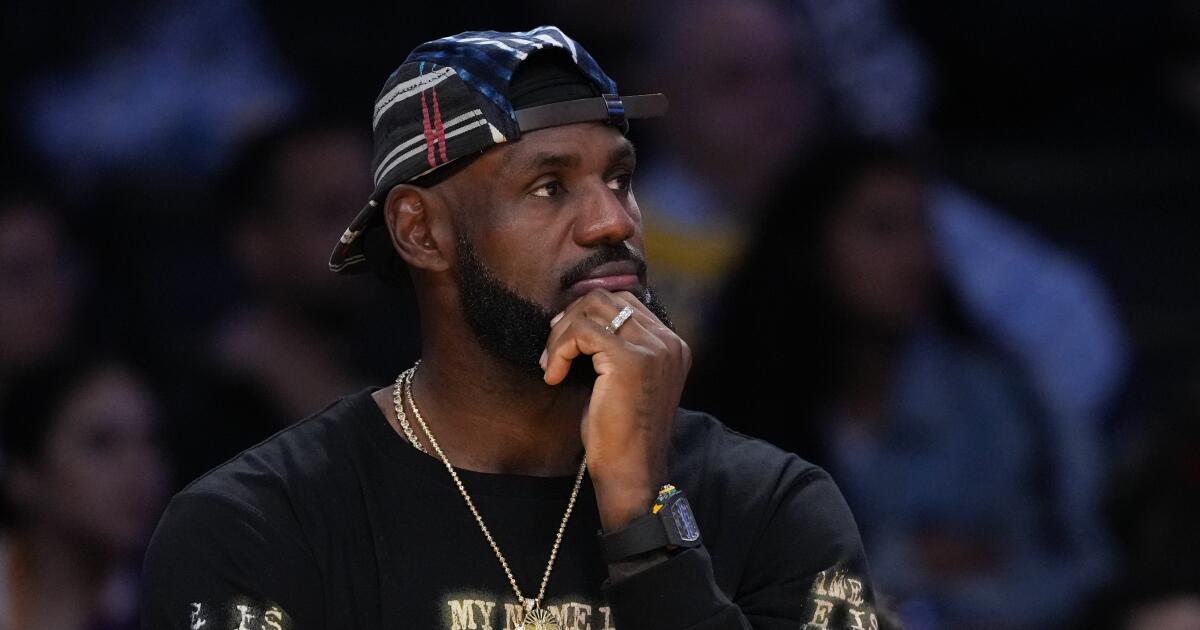
LeBron James chooses the Philadelphia 76ers, will sign a two-year deal
After nearly a month of mulling his options, LeBron James announced in a social media post that he will sign with the Philadelphia 76ers on a two-year, $8-million contract.
James, a small forward, will join guards Tyrese Maxey and V.J. Edgecombe, forward Jaylen Brown and center Joel Embiid in a star-studded 76ers lineup. James’ deal includes a player option, Klutch Sports Group Chief Executive Rich Paul told ESPN.
In a series of X.com posts, James said he contemplated retirement before choosing the 76ers over several other suitors.
“I was honest at that last press conference when I said I needed to look at myself and decide if I still love this game. I still truly love this game, and I have more to give,” he said.
James will hope to break a 43-year championship drought for the 76ers, much the same way he erased a 52-year streak without a title for the city of Cleveland when he won a championship with the Cavaliers in 2016.
This likely will be the final free agency decision James will make as the 41-year-old enters a record-breaking 24th season. He said winning a fifth NBA title is his primary motivation.
“This is my last decision. I’m not going for money. I’m not going for family. What am I really playing for at this point?” James wrote on X. “I still want to sacrifice. I still want to work. I still want to grind. I still want to compete, to win and to have a chance at the feeling of winning another championship.
“I believe I can help make the Philadelphia 76ers a championship team and I am so excited to energize a new fan base and start this incredible journey one last time.”
The 76ers finished 45-37 and seventh in the Eastern Conference last season. However, they traded for Brown, a bona fide superstar, sending Paul George, two first-round draft picks and two second-round picks to the Boston Celtics on July 6. Brown, a nine-year veteran, averaged 28.7 points a game last season and helped the Celtics win the NBA title in 2024.
This was the fourth foray into free agency for James, who played the previous eight seasons with the Lakers, his longest continuous stint with any franchise.
It was widely reported that James would accept the $3.9 million veterans’ minimum exception. He will be paid far less than the approximately $57 million new teammates Embiid and Brown each will make, but James has made a record $584 million in career salary and his net worth is an estimated $1.4 billion thanks to endorsements and investments.
Reaction to the signing was swift. Nobody seemed more excited than Dawn Staley, the decorated South Carolina women’s basketball coach and a Philadelphia native. A longtime friend of James and his family, she posted a video while courtside at a game.
“Yo Philly, yo Philly, yo Philly! We got the King, y’all!” Staley said before telling James’ wife, Savannah, that she is available for advice on a school for the James’ daughter. “Savannah, we got you! ‘Bron, ‘Bron, good, great choice. My guy!”
James’ new teammates also expressed delight on social media. Maxey compared his recruiting skills to his college coach John Calipari, while Edgecombe recreated James’ famous “Can’t believe this is my life” meme.
James, an Akron, Ohio, native, played his first seven seasons with the Cavaliers after being the first overall draft pick in 2003 at age 18, spent four with the Miami Heat then returned to Cleveland for an additional four years before signing with the Lakers ahead of the 2018-2019 season. He has won four NBA championships, including one with the Lakers in 2020.
James informed the Lakers on June 30 that he would be signing elsewhere. Since then several teams made pitches for his services, with the Golden State Warriors, Heat, Cavaliers and Minnesota Timberwolves considered favorites along with the 76ers.
Not only were fans of those teams anxious to learn his decision. Last week, NBA commissioner Adam Silver said the regular-season schedule had not been set because the league was waiting on James.
“We have to finish up the schedule. And where LeBron plays will affect the schedule,” Silver said at the CNBC Sport x Boardroom Game Plan Summit in New York. “So I would like him to make his announcement already, so we can finish the schedule, because, as you might imagine, the teams are calling us, the networks are calling us, and everybody wants to lock in the schedule. But it will influence how we set the schedule, how we set opening week, Christmas Day, etc. So I need him to make a decision.”
A day later, James stood on stage at Fanatics Fest in New York and said he wanted to join a team that “shares the same model as myself, and that’s like practicing championship [habits] every day, but trusting the process more than anything.”
A false alarm became part of the narrative when the Heat posted a link July 21 to a scheduled livestream titled “LeBron James Introductory Press Conference” to its YouTube channel. A team spokesperson said it was a mistake, that the club’s social media department was preparing for the possibility of James’ signing. The post was deleted.
James has announced his agreements with new teams in various ways. When he left the Cavaliers in 2010 to team with Dwyane Wade and Chris Bosh on the Heat, he announced his choice on a live television special called “The Decision,” saying “I’m taking my talents to South Beach.” On Friday morning, a thread on X relayed the big news.
Fans in Cleveland burned his jersey, and Cavaliers owner Dan Gilbert posted a letter on the team website calling James’ decision a “cowardly betrayal.”
Four years and two NBA championships with the Heat later, James returned to his home state of Ohio to play for the Cavaliers again in 2014. His first-person Sports Illustrated essay written with senior writer Lee Jenkins shared his “I’m Coming Home” choice with the world.
“I always believed that I’d return to Cleveland and finish my career there,” James wrote. “I just didn’t know when. After the season, free agency wasn’t even a thought. But I have two boys and my wife, Savannah, is pregnant with a girl. I started thinking about what it would be like to raise my family in my hometown. I looked at other teams, but I wasn’t going to leave Miami for anywhere except Cleveland.”
James led the Cavaliers to four consecutive NBA Finals and a championship in 2016 when Cleveland overcame a 3-1 deficit to defeat the Warriors. It was the greatest NBA Finals comeback in history and brought the Cavaliers their first title.
But it turns out most of his child-rearing came in Los Angeles. In 2018, James decided not to pick up his player option and signed a four-year, $153.3-million contract to play for the Lakers, choosing them over the 76ers and a return to the Cavaliers. His salary escalated each year, rising to $52.6 million last season.
“LA has welcomed the arrival of Rabbit, Logo, Stumpy, Big Dipper, Captain, Silk, Magic, Big Game, Diesel, Mamba, Spaniard and now welcomes a King!!” Lakers co-owner Joey Buss tweeted.
In James’ second season in L.A., the Lakers won their 17th NBA championship in a bubble at Walt Disney World to cap the pandemic-shortened 2020 season. James notched a triple-double in the clinching Game 6 and earned Finals most valuable player for the fourth time in his career.
James set the league all-time scoring record while wearing the purple and gold, but his eight seasons with the Lakers also included failures. The 2021-2022 season is widely regarded as the most disappointing in team history. The overwhelming favorite in Las Vegas to win the championship when the season began, the Lakers finished 33-49 and missed the playoffs.
The Lakers never made it past the Western Conference finals over the next four seasons, including getting swept in the conference semifinals by the Oklahoma City Thunder in 2026. James averaged 20.9 points, 6.1 rebounds and 7.2 assists last season while adding to his list of NBA records, setting marks for games played, all-time wins and field goals made.
The Lakers pivoted quickly after James announced he wouldn’t return, overhauling the roster to complement star guards Luka Doncic and Austin Reaves. They traded for 7-foot-2 center Walker Kessler and signed free agents Sandro Mamukelashvili, Quentin Grimes, Collin Sexton, Matisse Thybulle, Ziaire Williams and Kevon Looney.
Meanwhile, James methodically listened to pitches from a handful of teams, ultimately settling on the 76ers.
Paul, James’ agent and close friend, said on a podcast Monday that the ample time James took making the decision was necessary because the choice was difficult.
“I think it’s important for people to understand: We’re not making this about attention and a spectacle,” Paul said. “It’s not about a ‘Decision’ or anything like that. He has a choice to make. He has a business choice to make.”
Giving himself the best shot at a fifth title was key. James has played in 302 postseason games, by far the most of any NBA player, and scored 20 or more points in 261 of them. His teams are 42-15 in playoff series and 188-114 in games. He has scored the most points in the playoffs (8,521) in addition to the most points in the regular season (43,440).
“It’s amazing what he’s done for the sport, for the league, and he deserves the opportunities that were presented to him to be able to make his own decision on what’s best for him and his family,” Silver said last week. “So I completely respect that.”