chip

KOSPI spikes over 5 pct, briefly topping 9,000 level again on chip rally after Micron earnings

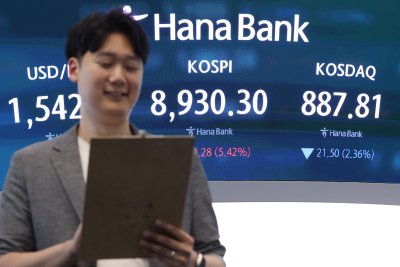
This photo, taken Thursday, shows the trading room of Hana Bank in Seoul as South Korean stocks soared by more than five percent on a tech rally driven by Micron’s earnings report. Photo by Yonhap

South Korean stocks soared by more than 5 percent Thursday, briefly topping the 9,000-point level again, driven by a tech rally ignited by U.S. chip giant Micron Technology’s expectation-beating earnings report. The Korean won fell against the U.S. dollar.

The benchmark Korea Composite Stock Price Index (KOSPI) gained 459.28 points, or 5.42 percent, to close at 8,930.30, following a 3.26 percent gain the previous day.

The index briefly topped the 9,000-point threshold, rising as high as 9,044.04.

Finishing at an all-time high of 9,114.55 on Monday, the KOSPI has remained in the 8,000-point range since it dived 9.99 percent Tuesday.

The index pulled off a strong start, with a buy-side sidecar issued shortly after the market opened, as Micron, the world’s No. 3 memory chipmaker, released its stronger-than-expected quarterly earnings, brushing off lingering concerns about the sustainability of an artificial intelligence (AI) rally.

Micron is a major beneficiary of the AI infrastructure spending boom along with Samsung Electronics and SK hynix thanks to rising demand for memory chips and high-bandwidth memory (HBM).

Trade volume was heavy at 449.3 million shares worth 50.4 trillion won (US$32.7 billion), with losers beating winners 588 to 289.

Institutions purchased a net 3.3 trillion won worth of stocks, while foreigners and individuals dumped a net 819.7 billion won and 2.5 trillion won, respectively.

“Micron’s strong financial report pushed up semiconductor shares here,” Kim Seok-hwan, an analyst at Mirae Asset Securities, said. “Airline shares also rose as the Strait of Hormuz seemed to reopen and global oil prices dropped.”

Samsung Electronics, the world’s largest memory chipmaker, jumped 5.29 percent to 358,500 won, and No. 2 SK hynix surged 13.06 percent to 2.9 million won.

SK Square, the parent of SK hynix, advanced 5.56 percent to 1.9 million won, and Samsung C&T, which holds a stake in Samsung Electronics, soared 7.79 percent to 519,000 won.

Flag air carrier Korean Air vaulted 6.4 percent to 29,100 won, and Asiana Airlines mounted 6.2 percent to 7,710 won.

Brokerages were also strong as Samsung Securities rose 3.07 percent to 110,800 won, and Kiwoom Securities gained 7.48 percent to 337,500 won.

The Korean won was quoted at 1,542.7 won per U.S. dollar as of 3:30 p.m., down 0.9 won from the previous session.

Bond prices, which move inversely to yields, closed higher. The yield on three-year Treasurys fell 1.5 basis points to 3.757 percent, and the return on the benchmark five-year government bonds declined 2.2 basis points to 3.992 percent.

Copyright (c) Yonhap News Agency prohibits its content from being redistributed or reprinted without consent, and forbids the content from being learned and used by artificial intelligence systems.

Source link

Seoul shares close at fresh peak above 9,100 on chip gains amid U.S.-Iran talks

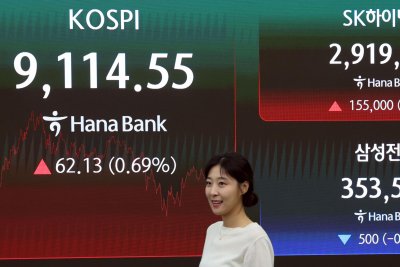
This photo, taken Monday, shows the trading room of Hana Bank in Seoul as South Korean stocks closed above the 9,100-point mark on a semiconductor rally and optimism over a U.S.-Iran deal. Photo by Yonhap

South Korean stocks finished at an all-time high Monday on a continued rally in semiconductor shares amid signs of progress in U.S.-Iran talks to end their monthslong war in the Middle East. The local currency lost against the U.S. dollar.

After opening 1.08 percent lower, the benchmark Korea Composite Stock Price Index (KOSPI) added 62.13 points, or 0.69 percent, to 9,114.55 after rising as high as 9,253.00.

Trade volume was moderate at 377.2 million shares worth 41.4 trillion won (US$26.9 billion) with losers outnumbering winners 739 to 148.

Retail investors and institutions were net buyers, purchasing 2.15 trillion won and 308.4 billion won, respectively, while foreign investors sold a net 2.55 trillion won.

On Sunday, Washington and Tehran wrapped up their first talks and agreed on a road map to reach a final deal within 60 days, according to a statement issued by the mediating countries of Qatar and Pakistan.

The negotiations had been at risk of breakdown as Tehran said it had closed the Strait of Hormuz and U.S. President Donald Trump had repeated his threats to resume attacks on Iran.

“Negotiations went smoothly in general despite some aggressive messages, which were considered short-lived noises,” said Kang Jin-hyeok, an analyst from Shinhan Securities.

Semiconductor shares ended in positive territory.

Chip giant SK hynix jumped 5.61 percent to 2.92 million won, surpassing Samsung Electronics in terms of market capitalization for the first time.

SK Square, the parent of SK hynix, surged 10.67 percent to 1.97 million won, and Hanmi Semiconductor, a leading chip manufacturing equipment provider, increased 2.2 percent to 301,500 won.

Defense giant Hanwha Aerospace advanced 0.27 percent to 1.13 million won, and Korea Aerospace Industries (KAI) climbed 1.43 percent to 148,600 won.

However, Samsung Electronics dropped 0.14 percent to 353,500 won, and Samsung Electro-Mechanics, an electronic components manufacturing affiliate of Samsung Electronics, lost 1.85 percent to 2.23 million won.

Top carmaker Hyundai Motor decreased 5.22 percent to 581,000 won, and leading battery maker LG Energy Solution dipped 4.7 percent to 385,500 won.

Samsung Life Insurance slid 9.36 percent to 450,500 won, and pharmaceutical giant Samsung Biologics retreated 5.75 percent to 1.3 million won.

The Korean won was quoted at 1,537 won against the U.S. dollar, down 10 won from the previous session.

Bond prices, which move inversely to yields, closed lower. The yield on three-year Treasurys rose 2.6 basis points to 3.810 percent, and the return on the benchmark five-year government bonds added 3.9 basis points to 4.044 percent.

Copyright (c) Yonhap News Agency prohibits its content from being redistributed or reprinted without consent, and forbids the content from being learned and used by artificial intelligence systems.

Source link

Analysis: Will Lebanon remain a battlefield, bargaining chip despite U.S.-Iran deal?

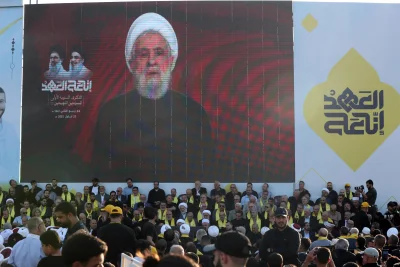
Hezbollah leader Sheikh Naim Qassem delivers a televised speech during a gathering in Beirut, Lebanon, on Sept. 27, 2025. Analysts say southern Lebanon could remain a battlefield and a bargaining chip in regional negotiations despite a preliminary agreement between the United States and Iran. Photo by Wael Hamzeh/EPA

BEIRUT, Lebanon, June 19 (UPI) — The Iran war may be over, but southern Lebanon is likely to remain a battlefield and a bargaining chip in regional negotiations, despite Lebanon’s inclusion in the memorandum of understanding between Iran and the United States — a provision Israel rejected to preserve its freedom of action against Hezbollah, analysts said.

Violence in southern Lebanon subsided after the United States and Iran announced a 14-point preliminary agreement to end hostilities, reopen the Strait of Hormuz, and begin nuclear talks under a 60-day extended ceasefire.

The MOU was signed remotely on Wednesday by U.S. President Donald Trump and Iranian President Masoud Pezeshkian, two days ahead of a formal signing ceremony scheduled to take place in Switzerland.

Rather than a cessation of hostilities, southern Lebanon witnessed a sharp escalation in fighting, with Israel intensifying its airstrikes and Hezbollah targeting Israeli forces seeking to seize the strategic Ali Taher hill in the Nabatiyeh district. Both sides traded accusations of violating the ceasefire established under the MOU.

The overnight exchange left 47 people dead, including women and children, and 97 others wounded in Israeli strikes on several areas of Lebanon, including Nabatiyeh and the eastern Bekaa Valley. Four Israeli soldiers, including a lieutenant colonel, were also killed by Hezbollah fire.

Israeli airstrikes continued beyond a new ceasefire between Israel and Hezbollah, brokered by the United States and Qatar with Iranian assistance, and set to take effect at 4 p.m. Friday.

It remains to be seen how long this new truce will last, as is the case with the U.S.-Iran ceasefire, given ambiguities in the MOU and differing interpretations of its clauses.

Israel, which rejected Trump’s “betrayal” and the agreement with Iran, is seeking to change the arrangement by force in order to preserve its freedom of action against Hezbollah threats in southern Lebanon. It also seeks to maintain control of a security zone in southern Lebanon and is not willing to withdraw its forces unless its northern region is secured and safe.

Riad Tabbarah, Lebanon’s former ambassador in Washington, said Israel believes it has the right, as it usually does, to modify the agreement on the ground after “accepting it on paper, so as not to annoy Trump.”

“This is exactly what they did last time, and what they do every time,” Tabbarah told UPI. “Today, they are doing the same.”

He was referring to the Nov. 27 ceasefire agreement brokered by the United States and France to halt the war that began when Hezbollah opened a support front for Gaza on Oct. 8, 2023.

Despite the truce, Israel continued to carry out strikes against Hezbollah, which refrained from retaliation for 15 months as it sought to reorganize its ranks before resuming fighting on March 2 in support of Iran.

The March escalation increased the human and material toll in Lebanon after Israel applied what was described as a “scorched earth” policy to empty border areas of residents and render them uninhabitable.

More than 3,980 people have been killed and 12,001 injured in the past 109 days, with 1.2 million displaced under Israeli evacuation orders. Large areas were devastated, including the complete destruction of 70 villages and heavy damage to infrastructure.

It would be “pure imagination and illogical” to think that Israel would easily withdraw and relinquish the security zone it is building in southern Lebanon, intended to prevent anyone from crossing its border and carrying out kidnappings like Hamas did from Gaza on Oct. 7, 2023, according to Tabbarah.

What could stop the frustrated Prime Minister Benjamin Netanyahu from sabotaging Trump’s efforts to finalize a lasting peace deal with Iran and continuing his military campaign in Lebanon?

The tension between Trump and his administration on one side, and Netanyahu and his government officials on the other, over the Iran deal “is growing, and we need to wait and see how it will develop,” said Lebanese former foreign minister Fares Boueiz.

As for Iran, Boueiz noted that as long as it believes it is benefiting from the deal with Trump, it “won’t do anything to jeopardize the understanding.”

“It is clear that the U.S.-Iran war is over, with no winner and no loser and no complete victory for anyone,” he told UPI. “The next 60 days will determine whether a final agreement is reached and whether Netanyahu will be able to obstruct it.”

The fear that Lebanon remains an open battlefield and a bargaining chip has grown, despite Iran’s pledge to Hezbollah that it will not proceed with the MOU talks if Israel fails to observe a full ceasefire in Lebanon and withdraw from the southern region.

Lebanese retired Maj. Gen. Abdul Rahman Chehaitli argued that the war in south Lebanon was “an Iran-Israel war sponsored by the U.S.”

“Now that Iran has reconciled with the U.S., signed an agreement, and is negotiating, the battle is over for them,” Chehaitli said in an interview with UPI. “This means that Lebanon should work toward a solution with Hezbollah and engage in serious negotiations to secure Israel’s withdrawal and end any illegitimate armed presence.”

Lebanon, which opted for U.S.-mediated direct talks with Israel to end the war despite Hezbollah’s objections, is preparing for another round of diplomatic talks with Israel scheduled to take place in Washington next week.

While Hezbollah leader Sheikh Naim Qassem has set new terms for the talks, saying they should be limited to “mutual security,” Israel is insisting on disarming the Iran-backed group and keeping it away from its borders.

Hezbollah has also been pushing to drop the Lebanon-Israel direct negotiations in favor of the U.S.-Iran track.

“Hezbollah can say whatever it wants, but Lebanon should negotiate on its own,” Chehaitli said, adding that the militant group “is concerned about the day after, seeking security guarantees or immunity.”

Lebanon has no option but to negotiate its way out of the war, but the process will be long, and southern Lebanon will remain under Israeli fire and a bargaining chip in Iran’s hands until a final deal with Washington is reached, according to some analysts.

Tabbarah argued that Israel did not go through all this war only to back down, while Iran seeks a high price in return for Hezbollah and its other regional armed proxies.

“I don’t think Iran will go to war again. It will find a formula to save face for its armed militias,” he said, adding that the U.S., on its part, will have to restrain Israel and force Netanyahu to accept a full ceasefire in Lebanon.

He explained that a decision by Trump to stop U.S. military assistance to Israel, or “anything of the sort,” would be a serious step.

Tabbarah, however, warned that the solution “is not for tomorrow unless Israel drops its dream of establishing Greater Israel.”

Source link

Seoul stocks end at record peak of above 9,000 on extended chip rally

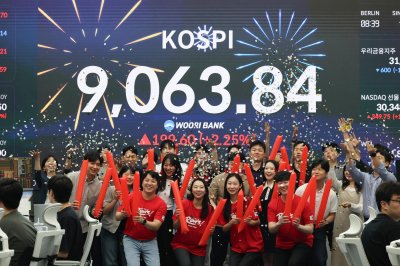
Employees celebrate after the closing bell in a trading room of Woori Bank in Seoul on Thursday, as the benchmark Korea Composite Stock Price Index surpassed a historic landmark of 9,000 points. Photo by Yonhap

Seoul stocks surged by more than 2 percent past another historic landmark, surpassing the 9,000-point level for the first time in history, as investors bet on chipmakers in the face of a hawkish stance by the Federal Reserve and Iran uncertainty.

The benchmark Korea Composite Stock Price Index (KOSPI) closed up 199.6 points, or 2.25 percent, to 9,063.84, after rising as high as 9,106.07.

The KOSPI continued its winning streak for the sixth consecutive session on the back of optimism over artificial intelligence (AI) and related sectors.

Trade volume was heavy at 505.9 million shares worth 49.9 trillion won (US$32.7 billion). Foreigners were net buyers, snatching up 1.3 trillion won, while retail and institutional investors net sold a combined 1.2 trillion won.

Losers outnumbered gainers 109 to 788.

The index bucked overnight losses on Wall Street caused by Fed policymakers’ remarks that a rate hike would be inevitable to tame inflation.

The continued rally was led by the country’s two major chipmakers, Samsung Electronics and SK hynix, said analyst Kim Seok-hwan from Mirae Asset Securities.

“Investors are anticipating that semiconductor companies could gain better bargaining power due to a sustained supply bottleneck,” the analyst said.

A risk appetite was also revived on anticipation the U.S.-Iran war is nearing its end. The United States has said Iran has agreed to reopen the Strait of Hormuz, a key oil shipping route, and revealed a signed memorandum of understanding on ending the war.

The rate freeze from the Fed, the fourth consecutive on-hold decision, appeared to have a limited impact on investor sentiment.

Market top cap Samsung Electronics rose 4.62 percent to 362,500 won, while its rival SK hynix jumped 6.51 percent to 2,685,000 won.

Non-semiconductor sectors lost ground.

Defense giant Hanwha Aerospace fell 2.86 percent to 1,189,000 won, ship builder HD Hyundai Heavy Industries retreated 3.25 percent to 684,000 won, and major financial firm KB Financial inched down 0.55 percent to 163,100 won.

The Korean won was quoted at 1,527.1 won against the U.S. dollar, down 13.7 won from the previous session.

Bond prices, which move inversely to yields, closed lower. The yield on three-year Treasurys rose 4 basis points to 3.75 percent, and the return on the benchmark five-year government bonds added 5.2 basis points to 3.949 percent.

Copyright (c) Yonhap News Agency prohibits its content from being redistributed or reprinted without consent, and forbids the content from being learned and used by artificial intelligence systems.

Source link

World Cup 2026: England 4-2 Croatia – Jude Bellingham says ‘chip on shoulder’ may help him to find best form

Jude Bellingham has said the external “noise” around his place in the England team may help him find his best form during the World Cup.

One of the main talking points around selection before England’s first group game against Croatia was whether boss Thomas Tuchel would select Real Madrid’s Bellingham or Aston Villa’s Morgan Rogers in the number 10 role behind captain Harry Kane.

Bellingham was chosen to start in Dallas and scored England’s crucial third goal just after half-time, with Marcus Rashford adding a fourth late on to complete a 4-2 win.

“For me personally, it was nice to put some of the noise aside and just show my country and my team-mates how committed I am to help us try to win football matches,” the 22-year-old, who is appearing in a fourth consecutive major tournament for England, told BBC Sport.

“To contribute, to help my team and help my country is one of the biggest honours and regardless of the noise outside, that honour doesn’t change for me at all.”

Bellingham conceded that it has been a “bit of a tougher season for me”, with the start of his 2025-26 campaign disrupted by injury, his club side in Spain ending up eight points behind eventual champions Barcelona and his place in the national team under scrutiny.

But Bellingham said he feels “fresh and sharp” heading into the tournament and it was “nice to hear” comments from colleagues such as Jordan Henderson, who said the former Birmingham City and Borussia Dortmund player gives England an “X-factor”.

Asked if he has entered the World Cup with added impetus, Bellingham said: “A little bit – I think I’ve got a little bit of a chip on my shoulder, haven’t I?”

Source link

Nvidia unveils new chip to bring AI directly to personal computers | Technology News

Nvidia is set to bring artificial intelligence to laptop and desktop computers with brands like Microsoft and Dell later this year as the US tech giant broadens its AI presence.

The Santa Clara, California-based AI chipmaker unveiled on Monday at its annual Nvidia GTC event in Taipei new powerful chips that would bring advanced AI functions to laptops and desktop computers.

Recommended Stories

list of 4 itemsend of list

CEO Jensen Huang said that the new development is “going to reinvent the PC [personal computer]”.

The changes come amid three years of collaboration between Microsoft and Nvidia and pit the latter against companies like chipmaker Advanced Micro Devices and personal computer brands Intel and Apple.

“This is going to be the new PC,” Huang said as he unveiled Nvidia’s RTX Spark superchip — which combines CPU, or central processing unit, and GPU, or graphics processing unit, capabilities — that would power new Windows laptop and desktop computer models in what the company called “AI personal computers”, expected to debut in the fall of this year.

The chip, developed with Taiwan’s MediaTek, will be in compact desktops from Dell, HP, Lenovo, ASUS, Microsoft Surface and MSI, with models from Acer and GIGABYTE to follow.

Nvidia, which is already the world’s most valuable company, said the reinvention will be for creating and gaming.

“When it has an autonomous [AI] agent, an agent that’s helping you, that understands you, you could talk to it. It could look at you. You could ask it to read files, go help you do some research. It could do a lot more,” Huang said.

Microsoft said in a separate statement that the personal computers running on Nvidia’s RTX Spark superchips would be able to support “highly capable AI models” and complex workloads. With the new superchips, these personal computers can run AI agents locally, Nvidia said.

“This is the first across the lineup of PC reinvention for 40 years,” Huang said.

Nvidia’s move is significant at a time when demand is growing for the use of personal AI agents, said Lian Jye Su, chief analyst at the technology research and advisory group Omdia.

“For consumers, it means more choices, which is always a good thing,” Su said.

Neil Shah, analyst and co-founder of Counterpoint Research, described Nvidia’s announcement as a move that’s “revolutionising how PCs would look like in the next 10 years”.

The new laptops and desktop computers “will drive agentic AI applications in every home”, Shah said, with an aim of having an “AI supercomputer” in each household.

Also during Monday’s speech, Nvidia’s Huang said its new Vera CPUs for data centres are in full production and are “going to be our new major growth driver” on the boom of AI agents, with early customers including Anthropic, OpenAI and SpaceXAI.


Huang also revealed a humanoid robot reference design that could act as a blueprint for future research, especially within the higher education sector. Nvidia said its “Isaac GR00T” stands nearly 1.83 metres (6 feet) tall and has the humanoid chassis of Chinese robot maker Unitree’s H2. It is equipped with five-fingered dexterous hands, made by Singapore-based robotics startup Sharpa, that are capable of finely controlled movements.

Reception for AI PCs has been mixed so far. HP reported last week that the devices helped prop up quarterly sales, but Dell said earlier this year that demand had fallen short of initial expectations. Qualcomm, looking to capitalise on AI demand, has also been offering AI PCs with Microsoft.

On Wall Street, Nvidia stock rose nearly 4 percent on the news in midday trading. Microsoft ticked up 2.5 percent and Dell surged 9.3 percent. Competitors AMD and Intel, on the other hand, are on the decline. AMD is down 0.1 percent from the market open, and Intel is down by 2.5 percent.

Source link

Ukraine’s forcibly transferred children must not be a bargaining chip | Child Rights

It has been more than four years since Russia launched a full-scale invasion of Ukraine, expanding its occupation of Ukrainian lands, which started in 2014. In the chaos and violence of the first months of the invasion, families were separated, and childcare institutions were cut off from the control of the central authorities in Kyiv. As a result, the occupation forces forcibly transferred more than 20,000 Ukrainian children to Russia.

Russian officials claimed that they did not abduct Ukrainian children, but “saved” them through humanitarian evacuations. However, international investigations have since found that many such transfers were unlawful under international humanitarian law. In many documented cases, transfers were carried out without the consent of the living parent or legal guardians of the child.

International humanitarian law prohibits all forcible transfers and deportations of protected people from occupied territory, except for evacuations strictly required to ensure the population’s safety. Even then, evacuation must happen within occupied territory, be temporary, preserve family unity and return evacuees home as soon as hostilities cease.

Today, the lives of thousands of Ukrainian children are devastated by this forcible transfer. Instead of abiding by international legal obligations and returning them to their homeland, Russia has transformed the issue into yet another bargaining chip against the Ukrainian people.

But Ukraine refuses to abandon its children. For the past four years, there have been intense efforts from families, NGOs and the Ukrainian government to bring them back.

Take the case of Lesya (the name has been changed to protect her identity), whose testimony was recorded by The Reckoning Project— a global team of journalists and lawyers documenting and publicising atrocities committed in the war. Lesya was 15 years old when Russian forces occupied her village in the Kherson region in 2022. When the occupation authorities imposed a mandatory evacuation, she was put on a truck with more than 30 other children and was sent to a rehabilitation centre in Feodosia, Crimea. A woman accompanying the children told her that her mother would join her shortly.

At the facility, Lesya and other Ukrainian children were subjected to a strict routine, forced to do chores and study in Russian, using Russian textbooks. They were kept under surveillance indoors most of the time in a building with windows that could not be opened. Two days a week, the children underwent military training.

Eventually, a relative located her, and with the help of Save Ukraine, a Ukrainian NGO facilitating children’s return, her mother managed to bring her back.

But Lesya’s case is the exception rather than the rule. More than 2,000 Ukrainian children have been brought back thanks to efforts by NGOs, the government and foreign mediators.

Pressure through international institutions has also been pursued, but that has not accelerated the process of return.

In March 2023, the International Criminal Court issued warrants of arrest for Russian President Vladimir Putin and Commissioner for Children’s Rights Maria Lvova-Belova for the unlawful deportation and transfer of Ukrainian children.

In July 2025, the European Court of Human Rights, in Ukraine and the Netherlands v Russia, found Russia responsible for a number of human rights violations, including the organised removal of children. The court also required Russia to cooperate in establishing a mechanism to find and safely return children.

In March this year, the United Nations Independent International Commission of Inquiry on Ukraine concluded that Russia’s deportation and forcible transfer of Ukrainian children amount to crimes against humanity. The report identifies the removal of Ukrainian children as a part of a well-planned and systematically executed policy, conceived at the highest level.

On May 11, the European Union sanctioned 16 individuals and seven entities, while the United Kingdom sanctioned 29 individuals and entities responsible for the deportation, forced transfer, forced assimilation, indoctrination, militarisation and unlawful adoption of Ukrainian children. Overall, the EU has sanctioned more than 130 people and organisations for these actions. The United States, Canada, Australia, Japan, Switzerland and several other countries have introduced similar measures.

The lack of progress on this issue has driven families to desperation. Some have tried to bring their children back on their own or through often-daring missions by Save Ukraine and five other Ukrainian NGOs.

There should be no need for these risky missions. Under international humanitarian law, Russia is obligated to identify and register Ukrainian children in their care, facilitate family reunification, and permit access to neutral actors assisting Ukrainian children.

As negotiations for the end of the war have stalled and other global events have displaced Ukraine from global headlines, we urgently need to put the issue of the abducted Ukrainian children back in the spotlight.

There are several areas in which existing efforts can expand.

First, a comprehensive tracing mechanism needs to be established and financed to track abducted Ukrainian children and prevent their disappearance into dispersed care and adoption systems.

Second, ongoing legal efforts to hold to account Russian officials involved in the abduction should be intensified. This means coordinated prosecutions in states where the universal jurisdiction principle can be applied, as well as joint investigation strategies supported by Eurojust, the EU’s judicial hub. Ukraine’s partners should support its judicial processes launched against Russian officials and cooperate where needed, including through extraditions where legally applicable and other lawful transfer mechanisms. While justice may be slow, the prospect of accountability can have a deterrent effect.

Third, states can and should fully implement sanctions, trade restrictions and other obligations they assumed but did not consistently observe in practice. The sanctions regime on Russia has severely hurt its economy, but it has also seen continuous evasion. A strict implementation can help put more pressure on the regime in Moscow.

While stories of family reunions are heartening, they are just a drop in a bucket compared with the number of children who continue to be separated from their families and absorbed into a system of indoctrination and militarisation.

We must not allow the issue of returning Ukrainian children to be yet another negotiating chip for Moscow. It cannot be put on hold because negotiations have stalled or because other priorities have captured the world’s attention.

Four years is a long time in a child’s life. Each passing day further erodes their national identity and deepens the pain of separation, as they grow up in a hostile environment. There is no principle more universal than the belief that children belong with their parents and loved ones, and Ukrainian children deserve this basic human right today, not at some point in the future.

The views expressed in this article are the author’s own and do not necessarily reflect Al Jazeera’s editorial stance.

Source link

US says ban on AI chip shipments applies to Chinese firms outside China | Technology News

Department of Commerce issues guidance on chip restrictions amid concerns about loopholes in export control regime.

The United States has issued a notice affirming its restrictions on shipments of semiconductors to subsidiaries of Chinese companies located outside China amid concerns about loopholes in Washington’s export control regime.

The Department of Commerce said in the guidance issued on Sunday that its licensing requirements for the export of advanced AI chips applied to all businesses with headquarters or a parent company in China.

Recommended Stories

list of 4 itemsend of list

The Bureau of Industry and Security (BIS), which falls under the Commerce Department, said it issued the clarification in response to questions about whether it was enforcing preexisting licence requirements after it had overturned former President Joe Biden’s AI Diffusion Framework.

“The answer is yes,” the BIS said in the notice.

Unveiled in the final days of the Biden administration, the AI Diffusion proposed the implementation of a globe-spanning framework to control access to AI chips, including export caps for all but the closest US allies.

The framework drew backlash from tech firms, including Nvidia, the world’s most valuable chip company, which cast the proposal as a threat to innovation and cross-border collaboration.

President Donald Trump’s administration scrapped the framework last May, ahead of its implementation, citing the “burdensome new regulatory requirements” and the harm it would do to Washington’s diplomatic relations with other countries.

Chip giant Nvidia, whose top-of-the-line Blackwell GPUs are banned for export to China, said it had already been operating in keeping with the clarified rules.

“The guidance reaffirms that NVIDIA’s sales and vetting process is correct – consistent with our existing approach, licences are required to ship controlled products to PRC headquartered companies,” a Nvidia spokesperson told Al Jazeera, using the acronym for the People’s Republic of China.

AMD and Intel, Nvidia’s main competitors in the GPU space, did not immediately respond to requests for comment.

TSMC, which manufactures the most advanced chips on behalf of clients such as Nvidia, did not immediately return an email seeking comment.

The BIS also did not respond to inquiries.

Chris McGuire, a former State Department official who worked on technology policy in the Biden administration, accused the Trump administration of providing Chinese companies a loophole to buy export-controlled chips.

“Chinese companies have been buying these chips, very likely at scale. And because BIS has not updated export control regulations to clearly state what it IS enforcing, all of this was legal,” McGuire said in a post on X.

“This clarification does make clear that Blackwell shipments to China-headquartered companies outside of China are now illegal again – which is good, although obviously we have to see how many shipments have already gone to assess how much damage was done,” McGuire said.

“BIS’ statement acknowledges these shipments have been happening when it says companies who bought chips under this loophole don’t have to stop using them.”

The US has rolled out numerous restrictions on the supply of high-end technology to China, as Washington and Beijing battle for dominance in AI.

In December, Trump announced that he would allow Nvidia to sell its H200 chip to China, in a major loosening of Washington’s export controls.

While not Nvidia’s most advanced chip, the H200 is about six times as powerful as the H20, the most advanced chip previously allowed for export to China.

Source link

United States China Tech Rivalry Delays Nvidia AI Chip Exports

The latest developments surrounding Nvidia’s H200 chip sales to China highlight the growing complexity of the technological rivalry between the United States and China. Although Washington has reportedly approved several major Chinese firms to purchase Nvidia’s advanced artificial intelligence chips, no deliveries have taken place so far.

The situation reflects how geopolitical competition is increasingly disrupting even officially approved commercial agreements in the semiconductor sector.

Nvidia, the world’s leading artificial intelligence chip manufacturer, now finds itself caught between United States export control policies and China’s push for technological self reliance.

What Is the H200 Chip?

The H200 is Nvidia’s second most powerful artificial intelligence chip and is designed for advanced AI model training and data center operations.

The chip is particularly valuable for companies developing large language models, cloud computing systems, and next generation AI applications.

Before export restrictions tightened, Nvidia dominated China’s advanced AI chip market with an estimated market share of around 95 percent.

China also represented a major source of revenue for Nvidia, making access to the Chinese market strategically important for the company’s long term growth.

Which Chinese Companies Were Approved?

According to reports, the United States Commerce Department approved around ten Chinese firms to purchase H200 chips.

These reportedly include major Chinese technology companies such as:

  • Alibaba
  • Tencent
  • ByteDance
  • JD.com

Several distributors were also reportedly approved, including:

Under the licensing terms, each approved customer could reportedly purchase up to 75,000 chips.

However, despite these approvals, no actual sales or deliveries have yet been completed.

Why Have the Sales Stalled?

The delays appear to stem from concerns on both the United States and Chinese sides.

Chinese Concerns

Chinese authorities reportedly fear that reliance on Nvidia chips could undermine Beijing’s efforts to strengthen its domestic semiconductor industry.

China has invested heavily in local AI chip development, particularly through companies such as Huawei.

Beijing increasingly sees semiconductor self sufficiency as a national security priority amid escalating technological competition with Washington.

There are also concerns within China regarding supply chain security and possible vulnerabilities linked to imported American technology.

Recent Chinese regulations aimed at reducing foreign dependence in critical technology sectors have reportedly intensified scrutiny of these chip purchases.

United States Restrictions

The United States has simultaneously imposed strict export control requirements on advanced semiconductor sales to China.

Chinese buyers must reportedly prove that the chips will not be used for military purposes and that adequate security procedures are in place.

Nvidia must also satisfy inventory and compliance conditions under American export laws.

Additionally, reports suggest the Trump administration negotiated an unusual arrangement in which the United States would receive a portion of revenue generated from the chip sales. This reportedly requires the chips to pass through American territory before shipment to China.

Such conditions have further complicated the transaction process.

Jensen Huang’s Diplomatic Push

Nvidia Chief Executive Officer Jensen Huang has emerged as a key figure in efforts to preserve Nvidia’s access to the Chinese market.

Huang reportedly joined President Donald Trump during a diplomatic visit linked to talks with Chinese President Xi Jinping.

His participation underscores the economic significance of the semiconductor dispute and the importance of China to Nvidia’s business strategy.

Huang has repeatedly warned that export controls risk permanently weakening Nvidia’s position in China while encouraging Chinese firms to accelerate domestic alternatives.

The Larger Strategic Battle

The Nvidia dispute reflects a broader struggle between the United States and China over technological dominance in artificial intelligence.

Washington increasingly views advanced semiconductor technology as a strategic national security asset. American policymakers fear that unrestricted access to advanced AI chips could strengthen China’s military and technological capabilities.

China, meanwhile, sees semiconductor independence as essential to reducing vulnerability to foreign pressure and sanctions.

As a result, both sides are attempting to balance economic interests with long term strategic competition.

Implications for the Global AI Industry

The uncertainty surrounding Nvidia’s China business could have major implications for the global artificial intelligence industry.

If Chinese companies lose access to Nvidia chips, they may accelerate investment in domestic alternatives, potentially reshaping the global semiconductor market over time.

At the same time, restrictions on AI chip trade risk fragmenting the global technology ecosystem into competing American and Chinese spheres.

This could reduce international collaboration, disrupt supply chains, and intensify geopolitical competition over emerging technologies.

Future Outlook

Despite current delays, neither the United States nor China appears willing to completely sever technological and commercial ties.

However, the Nvidia case demonstrates that semiconductor trade between the two powers is becoming increasingly politicized and strategically sensitive.

The future of AI competition may ultimately depend not only on innovation, but also on which country can build the most resilient and independent technology ecosystem.

For Nvidia, maintaining its position between the world’s two largest economies will likely remain one of its greatest strategic challenges.

Conclusion

The stalled Nvidia H200 deal illustrates how deeply geopolitical tensions now shape the global technology industry.

Although the United States has approved limited chip exports to China, political distrust, national security concerns, and strategic competition continue to obstruct implementation.

As artificial intelligence becomes central to economic and military power, semiconductor trade is no longer simply a commercial issue. It has become a defining arena in the broader contest between Washington and Beijing for technological leadership in the twenty first century.

With information from Reuters,

Source link