children

The world cannot afford to fail women, children and adolescents | Health

In too many parts of the world, giving birth still comes with more fear than hope: a clinic without electricity, a nurse without supplies, a mother who knows that giving life may cost her own. These fears are not merely emotional, they are borne out by the facts. Every two minutes worldwide, a woman dies while giving life. Every year, nearly five million children do not live to see their fifth birthday. A toll that will rise if aid cuts continue. The Lancet medical journal estimates that by 2030, more than 14 million additional people could die, including 4.5 million children under five – the equivalent of erasing a city the size of Abuja, Brasilia or Rome.

The true measure of global progress is not found in financial markets or summit declarations. It is found in whether a woman survives pregnancy and childbirth, whether a child is vaccinated and nourished, and whether an adolescent can grow up healthy, safe and hopeful. When women, children and adolescents thrive, societies are stronger, economies are more resilient, and nations are better prepared for the future. When they are failed, the costs are measured not only in preventable deaths and suffering, but in lost human potential on a massive scale.

This is why investing in women’s, children’s and adolescents’ health is one of the most important investments any government can make. The evidence is overwhelming. Closing the gap in women’s health alone could add at least $1 trillion to the global economy every year by 2040. Every dollar invested in childhood vaccination or adolescent mental health returns about $20 over a lifetime – in healthcare savings, in productivity, in lives that go on to build something. Healthy women anchor families and economies. Healthy children grow into workers and citizens. Healthy children and adolescents are better equipped to participate in society, build livelihoods and shape more stable, prosperous futures.

Yet health systems around the world are being pushed to breaking point by aid cuts, debt, conflict and shrinking fiscal space. In 2025, official development assistance fell by 23 percent – the largest annual drop in history. In more than 50 countries, health workers are losing their jobs and training pipelines are breaking down. In some places, maternal care, vaccination and emergency response have been cut by 70 percent. At the same time, sexual and reproductive health rights are under intensifying political attack, putting hard-won progress at risk.

Women and girls bear the heaviest burden. In 2023, six in 10 maternal deaths worldwide were in countries in conflict or fragility. In fact, a woman living in a conflict-affected country is five times more likely to die from pregnancy-related causes than her counterpart in a stable country. Too many women still lack access to quality maternal healthcare, contraception and essential reproductive services. Too many girls face violence, discrimination and barriers to healthcare that limit not only their well-being, but their freedom and future. When budgets tighten, women and children are too often the first to feel the cuts and the last to be protected.

This is not inevitable. It is a matter of political choice.

In South Africa, we are working to strengthen primary healthcare, expanding equitable access to quality services, investing in the health workforce and building a more inclusive health system that reaches those most in need. We understand that progress in health is inseparable from progress in equality and development. A society cannot prosper if women are denied care, if children are left unprotected, or if adolescents are excluded from the services and opportunities they need to thrive.

In Spain, a public national health service has delivered universal coverage and one of the world’s lowest maternal and infant mortality rates. We believe – with vision, determination and solidarity – that what we have achieved at home can be achieved globally. This is why Spain’s Global Health Strategy 2025–2030 places equity, resilient health systems and sexual and reproductive health rights at the centre of our international action, and why we are working to raise the global ambition on sustainable development financing and to defend gender equality as a democratic and development imperative.

At the Fourth International Conference on Financing for Development in Sevilla last year, through the Sevilla Commitment and the Sevilla Platform for Action, we helped focus international attention on debt distress, sustainable investment and reform of the global financing architecture.

These issues may appear technical, but their consequences are deeply human. They determine whether health systems can recruit and retain workers, whether medicines reach clinics, whether women can access care safely, and whether children and adolescents are given a fair chance at life.

We must also be unequivocal in defending sexual and reproductive health and rights. These rights are not secondary, and they are not negotiable. They are central to dignity, equality and public health. No woman or girl should be denied access to life-saving care because of politics, poverty or discrimination. No society can claim to value justice while tolerating persistent gender-based violence or the systematic erosion of women’s autonomy and rights.

The question before the international community is therefore not whether we can afford to invest in women, children and adolescents. It is whether we can afford not to. The answer is clear. The long-term costs of inaction – greater instability, deeper inequality, weaker economies and millions of preventable deaths – are far higher than the cost of acting now. Higher than the cost of keeping the lights on in that clinic.

This is the spirit in which Spain is joining the Global Leaders Network, which brings together 12 heads of state and government committed to advancing the health and rights of women, children and adolescents. But this effort must not stop with us. The challenges are too large, and the stakes are too high, for leadership to remain limited to a few countries.

We need more governments to step forward, to protect essential health services, invest in frontline health workers, defend sexual and reproductive health and rights, and ensure that financing reforms deliver for the people who need them most. We need more leaders to recognise that women, children and adolescents are not a peripheral concern of global policy. They are its clearest test.

This is a moment for political courage. A moment to choose investment over retreat, solidarity over indifference, and action over complacency. Above all, it is a moment to recognise a simple truth: if women, children and adolescents are not at the centre of our decisions, then the future will not be fair, stable or sustainable. But if they are, then a better future remains within reach.

The views expressed in this article are the author’s own and do not necessarily reflect Al Jazeera’s editorial stance.
Source link

Who is Look Mum No Computer’s wife Melanie and how many children do couple have?

LOOK Mum No Computer is competing for the UK at the iconic Eurovision Song Contest tonight.

As one of Eurovision’s “Big Four” (formerly “Big Five”), the UK gets an automatic place in this Saturday’s final.

Sam Battle married his wife Melanie in 2012 Credit: Instagram

But the competition gets real this evening for Sam Battle, who is representing the UK with his single Eins, Zwei, Drei, because there can only be one winner.

Speaking about Eurovision in a press conference ahead of the final, the artist said: “It has been a lot of work, especially as I have just become a new dad at the same time as prepping for Eurovision.”

Look Mum No Computer has been into electromechanics since early childhood Credit: © Corinne Cumming

Who is Look Mum No Computer?

Sam Battle, widely known as Look Mum No Computer, is an English musician and electronics enthusiast from Peterborough, Cambridgeshire.

On his YouTube channel with more than 700k subscribers, he posts videos about making pro audio gear and synthesizers, as well as original music tracks.

Read more on Eurovision 2026

CLEMMIE MOODIE

Celebs calling for Israel to be axed from Eurovision are parroting Hamas


MILLS OUT

New Eurovision host revealed after Scott Mills axed from coverage

Battle is known for playing unusual musical devices made from vintage technology, such as a classic Raleigh Chopper bicycle and a Game Boy.

A large chunk of the chorus for Eins, Zwei, Drei is in German instead of English in a new move for the UK Credit: © Alma Bengtson

The YouTuber also runs This Museum Is Not Obsolete, a museum in Ramsgate, Kent, showcasing vintage devices repurposed for comic uses.

Sam has been curious about mechanics since early childhood, when he spent much of his time building rockets and robots.

After starting a university course in chemistry, he realised that he “was really not cut out for that” and switched to a music tech course instead.

However, he still quit his studies halfway through to join a music band in London for three years.

Stuck with an album that wasn’t being released and no gigs, Sam used this time to learn electronics.

He worked in numerous jobs, from fixing bicycles at Halfords to cooking in a restaurant, before before setting up indie-rock group ZIBRA with his three friends.

They performed at the Glastonbury Festival in 2015 as the final act on the BBC Introducing stage.

The musician launched his YouTube channel in 2013, primarily posting content for the the band — until its end in 2016 when he switched to his solo music project.

His younger sister Jodie Bartle, who appears in the music clip for Eins, Zwei, Drei by Look Mum No Computer, plays football for Wrexham.

In 2025, Sam developed a video game in collaboration with German indie studio The Bitfather and publisher Headup Games.

The game, called Look Mum No Computer, was nominated for the German Developer Award for Best Audio Design.

Who is Look Mum No Computer’s wife Melanie?

Sam Battle has been married to his wife Melanie for more than a decade.

On her Instagram, Melanie shared that she met Sam after “nicking a piece of plastic from outside of [his] house”.

The couple tied the knot in 2012 and have three children together.

Originally from Manchester, Melania King now lives in Ramsgate, Kent Credit: Facebook

Dr Melanie King is an awarded artist and curator based in Ramsgate who specialises in astronomy, alternative and analogue photography.

She works as a co-director of Lumen Studios, an art collective exploring the themes of astronomy and light, and super/collider, an independent agency that “celebrates and champions the connections between science, creativity and culture”.

In 2013, Melanie founded the London Alternative Photography Collective, which has grown from a small group of analogue and alternative photography practitioners to a collective producing large-scale symposiums, exhibitions and workshops.

Recently completing her PhD in Fine Art at the Royal College of Art, the mum-of-three also teaches Photography at Canterbury Christ Church University.

The couple welcomed their baby boy Max in April 2026, as Sam had been working hard on his performance in the iconic song contest.

On his Instagram page, the musician has recently posted more photos of the baby, adding: “Not long till he (Max) will be holding a soldering iron and helping!”


Source link

EU, UK sanction Russians over deportations of Ukrainian children | Russia-Ukraine war News

Russian institutions and officials accused of systemic deportation and indoctrination of children during the war on Ukraine.

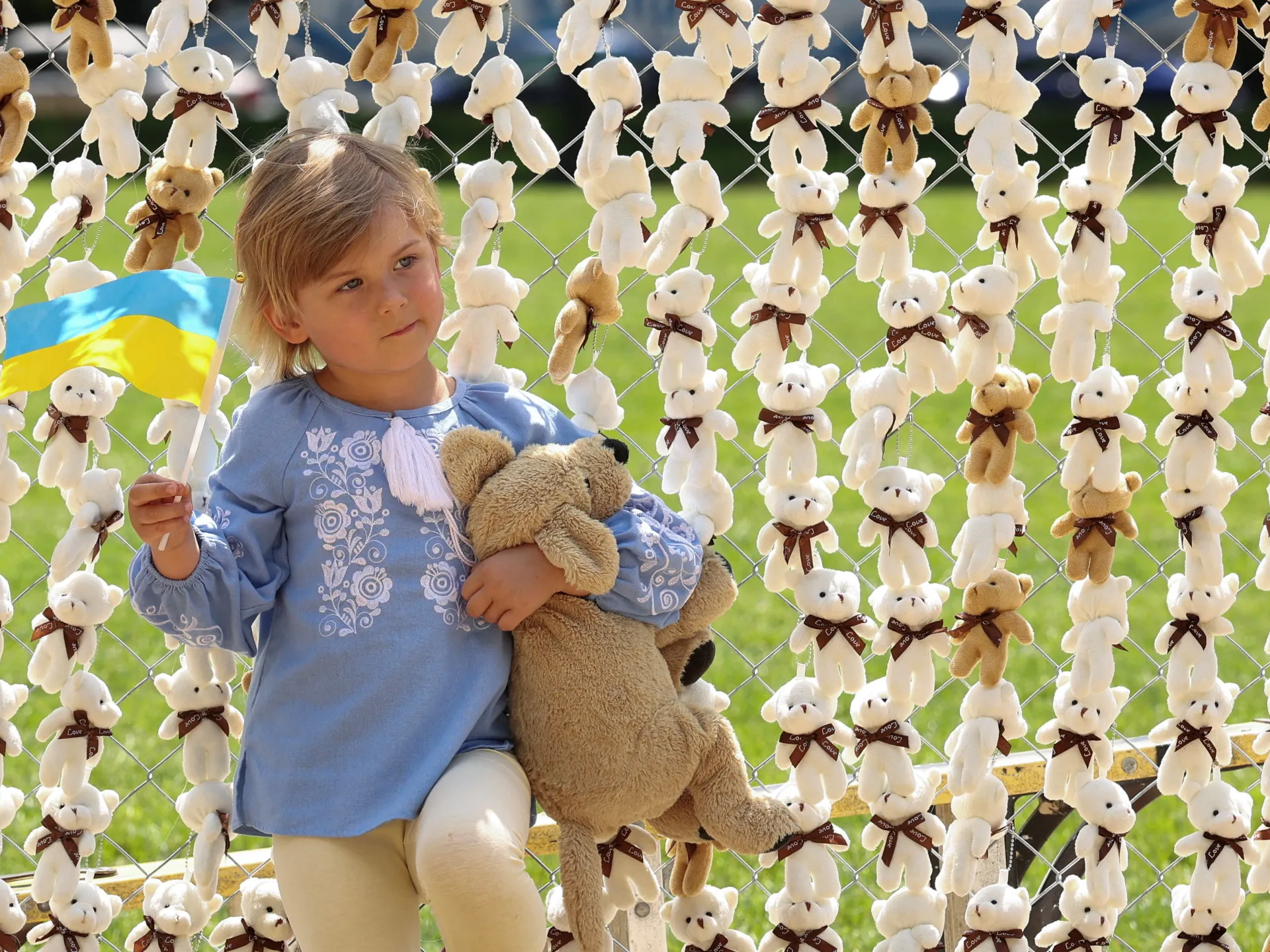
The European Union and United Kingdom have imposed sanctions on Russian institutions and officials accused of systematically deporting and indoctrinating Ukrainian children.

The EU announced measures against 23 state institutions and people on Monday. The UK simultaneously unveiled a broader package targeting 85 people and entities, roughly a third of them linked to what was described as Russia’s campaign to forcibly deport and militarise Ukrainian children.

Recommended Stories

list of 3 itemsend of list

Russia has deported and forcibly transferred nearly 20,500 Ukrainian children since Moscow launched its full-scale invasion in February 2022, an EU statement noted. It branded the actions as grave breaches of international law.

The EU said its designations target institutions and individuals involved in programmes subjecting children to pro-Russian indoctrination, including patriotic events, ideological education and military-oriented activities.

The sanctions, which include asset freezes and travel bans, were approved by the EU’s 27 nations in coordination with Canada and the UK, which announced similar measures.

“Stealing children is not incidental. It is a deliberate Russian policy, a calculated attack on Ukraine’s future,” the EU’s top diplomat, Kaja Kallas, told a news conference.

The UK sanctions announcement named the Centre for Military and Patriotic Training and Education of Youth, known as the warrior centre, a Russian state institution at which Ukrainian children are reportedly subjected to military training and pro-Kremlin ideology.

Also targeted was Yulia Sergeevna Velichko, the Moscow-installed minister for youth policy in the so-called Luhansk People’s Republic, for her role in implementing state-led initiatives.

UK Secretary of State for Foreign Affairs Yvette Cooper said the UK would continue working alongside allies to support every effort to identify and trace children who had been taken.

Russia does not deny taking the children but has said it has done so for their protection, moving them away from front-line areas, and claims it is willing to return them when relatives come forward and can be verified.

The International Criminal Court (ICC) issued an arrest warrant for Russian President Vladimir Putin in 2023 for the war crime of illegal deportation of children from Ukraine.

Responding to the announced sanctions, Ukrainian President Volodymyr Zelenskyy said: “These are the ones who ‘rewire’ the identity of Ukrainian children, help make them hate their homeland, and one day take up arms to fight against Ukraine.”

The UK’s broader sanctions package also took aim at Russian information warfare operations, with the remaining measures targeting individuals and entities linked to alleged Kremlin propaganda campaigns.

Among them were 49 people working for the Social Design Agency, a state-funded Russian organisation accused of running disinformation and interference operations, including attempts to establish pro-Russia organisations in Armenia and influence the outcome of upcoming elections.

Traditionally a strong Russian ally, the Caucasian country has recently been moving away from Moscow’s orbit.

Last week, the Armenian ambassador was summoned to protest what the Kremlin described as “terrorist threats against Russia” made by Zelenskyy in a speech delivered in Yerevan.

Source link

A Mother Awaits the News of Her Abducted Children

It is Ramadan, and Bintu Suleiman, a 55-year-old mother and trader from Ngoshe in Borno State, North East Nigeria, is about to break her fast with her family.

Then, the gunshots begin, and within the hour, her home is on fire. As the terrorists round people up, she manages to slip away with her children and grandchildren into the bush. Later, she realises four of them did not make it with her. They are somewhere up in the mountains.

In this episode of #VOV, we see that, after the attack, Bintu, now displaced, is sheltering at a government primary school in Pulka and has no news of her children and grandchildren.


Reported by Sabiqah Bello

Voice acting by Rukayya Saeed

Multimedia editor is Anthony Asemota

Executive producer is Ahmad Salkida

Bintu Suleiman, a 55-year-old mother from Ngoshe, Borno State, is disrupted during Ramadan as terrorists attack her home, forcing her to flee with part of her family. Unfortunately, four family members are left behind in the mountains. Now displaced, Bintu seeks refuge at a primary school in Pulka, anxiously waiting for news of her missing children and grandchildren. This episode of #VOV highlights her plight amidst the ongoing violence.

Source link