chavismo

The End of the Padrino López Era

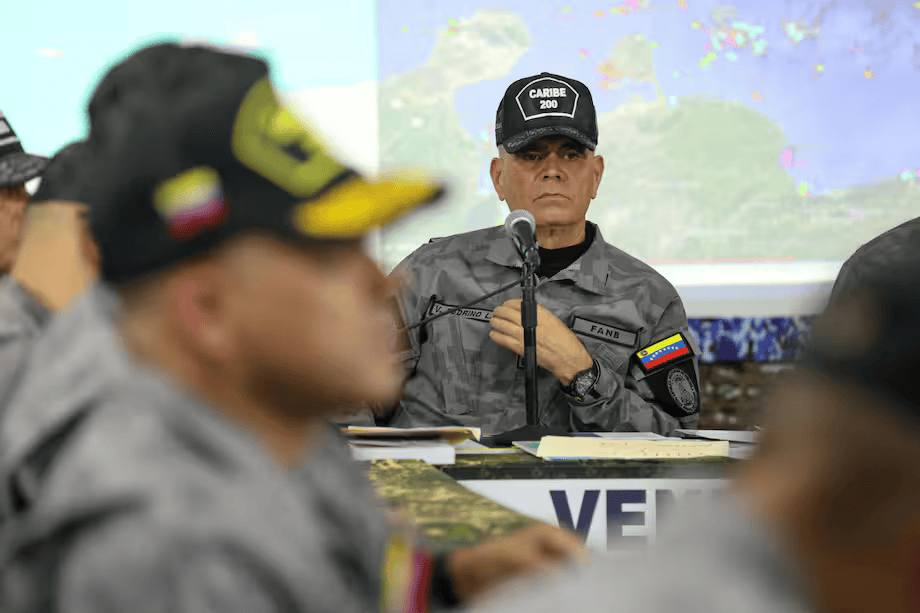
In another timeline, in that parallel universe where Venezuela is a normal Latin American country and not a case study of self destruction and democratic retreat, Vladimir Padrino López might have been a good military officer. A native from Caracas, he graduated with honors in the Military Academy in 1984, and as was normal for promising Venezuelan Army officers like him, he was sent to study in the infamous School of the Americas where the United States managed to train the armies of their allied countries. Padrino Lopez was sent later to command an Army post in the border with Colombia, and then came Hugo Chávez.

He was back in Caracas when the crisis of April 2002 allowed Chávez to purge the armed forces and control them as a whole, after promoting the politicization—to his favor, of course—of the military caste. Padrino read the room and focused on rising as a hardcore chavista. By the end of the Chávez years, he was leading the chief of staff of the Army, in the pole position to jump into the highest job an active military officer can get in Venezuela: minister of defense. Nicolás Maduro appointed him as such in October 2014, as well as chief of the FANB’s Strategic Operations Command. 

By then, he was a general-in-chief with four stars on his uniform, but the most important thing is what he did, and what he didn’t. 

Padrino López didn’t stop Colombian guerrillas from controlling villages, rivers, mines and illegal businesses in Venezuela. On the contrary, he helped him to use our territory as a sanctuary that protected them from Colombian soldiers and as a hunting ground for kidnapping and drug trafficking. He didn’t purge military intelligence from Cuban advisors and spies, but let them impose terror in the ranks and prevent the rise of conspirators against Maduro with extreme prejudice. What Padrino López focused on was on lucrative arms trade and cooperation with the Russian and Iranian industrial-military complexes. His most important function for Maduro was to help him to keep FANB in line, to lead the different military tribes around the chavista regime, and to ensure support from the women and men in uniform to an autocratic consolidation—through the illegal Constituent Assembly, and the two illegitimate inaugurations of Maduro in 2019 and 2025.

He was the minister of defense when FANB was tasked with overseeing the Mining Arc, when the protest wave of 2017 was drowned in blood, when FANB deployed with the police the killing squads of the Operación de Liberacion del Pueblo, and when DGCIM became the spearhead of the worst place Venezuela has been in terms of human rights since the military dictatorship of General Marcos Perez Jimenez. This is why you can find the name of Padrino López in several reports on repression and crimes against humanity in Venezuela: he was at the top of the military chain of command responsible for kidnapping, torturing and killing people.

Now he has completed his comeback, with the mission of helping Delcy and Jorge Rodríguez keep stability, to deter potential spoilers from trying to change the post-Maduro order.

The demise of Padrino López has been a rumor for years, as his ascendancy among troops decayed. Thousands of members of the armed forces have been victims of witchhunts or abandoned FANB, by quitting or even deserting, fed up with abuse, low wages, corruption and miserable operational arrest. In January 3, years of preaching about asymmetric war and millions spent on Russian toys did nothing to avoid the capture of Maduro and the bombing of Fuerte Tiuna. Delcy Rodriguez found a pretext to send Padrino to retirement, which was way past due. Naturally, she didn’t do it to punish him for being useless as an army leader, incapable of defending the country and his commander in chief, but because she needed someone she trusts more.

The successor might not be as visible or as well known as Padrino Lopez, but he is not very different. General Gustavo González López is also an alumni of the School of the Americas, a loyal chavista and a longtime member of the Maduro regime’s military elite. Twenty years ago he was already serving in civilian positions, like director of the Caracas Metro, that had nothing to do with his training, and everything to do with his loyalty to Chávez and the chavista (but not only chavista) myth that military officers are good managers because they know how to boss people around and impose order. González López’s organizational abilities, though, were more in the realm of building an efficient repressive apparatus than in running a decades-old public transport system.

He was appointed head of SEBIN, the civilian political police in charge of the dungeons in El Helicoide, during the 2014 repression wave. That meant González López was one of the men who dragged the country down the ladder of poor human rights indicators. Just like Padrino López, he quickly entered the list of Venezuelan high-level officials targeted by international sanctions and investigations. One year later, he became interior minister. Just when an assassination attempt with drones surprised Maduro and his security ring during a military parade in Caracas, and a scandal followed the murder of opposition councilman Fernando Albán in the SEBIN headquarters, González López was dismissed and put aside. 

Now he has completed his comeback, with the mission of helping Delcy and Jorge Rodríguez keep stability, to deter potential spoilers from trying to change the post-Maduro order. González López was appointed chief of the DGCIM and commander of the Presidential Guard just after January 3, and now is at the top of the pyramid. 

This is about loyalty, not about any political transition. We can’t expect justice, reconciliation or any movement towards the restoration of the rule of law with a man like González López heading the Venezuelan military. No one in the barracks or the streets is safer because one symbol of the Maduro regime, Vladimir Padrino Lopez, has been replaced by another.
Source link

Six Signs of Chavismo’s Mutation under US Oversight

A longer version of this piece in Spanish was published on Marisela’s Substack.

After the systemic rupture that the US incursion of January 3 represents, chavismo has embarked on its third great metamorphosis, carrying out a profound reengineering in a context of tutelage and transactional pragmatism. In my view, the Venezuelan State is undergoing a deep transformation rather than facing an imminent transition to democracy. Nevertheless, the government of Delcy Rodríguez is pursuing this transformation with remarkable speed and bluntness.

The survival of the chavista system has required the sacrifice of its original forms, forcing a mutation that uses economic opening as social anesthesia and the sophistication of repression as a guarantee of stability.

From the oil embargo on Cuba to microeconomic measures that we will discuss in the following lines, these milestones are the material proof of a power that has chosen to fill itself with realism, and to sacrifice its traditional epic narrative.

The case of Alex Saab and friends

A most scandalous event over which public officials have remained silent is the alleged arrest of Alex Saab. Saab was removed as Minister of Industries and National Production on January 17. Although Delcy initially presented the move as a departure to assume new responsibilities, it ultimately marked the beginning of his demise in Venezuela. According to reports from The New York Times, La Nación, and Infobae, SEBIN agents detained Saab and businessman Raúl Gorrín, the owner of TV network Globovisión, who has long navigated sanctions and power and lost his media and political shield almost simultaneously with the capture of Maduro. The novel element in this second arrest of Saab is that reports describe an operation carried out with the knowledge and cooperation of the FBI. It would appear that the new leadership in Caracas is willing to hand over key figures to US authorities in exchange for validation and stability.

Both men immediately disappeared from the public radar. Two weeks later, the Spanish broadsheet ABC claimed that the Trump administration has demanded judicial cooperation from Delcy regarding nine figures close or formerly close to the government, including Maduro’s son (known as Nicolasito), Tareck El Aissami (arrested by Maduro in 2024) and, of course, Alex Saab and Raúl Gorrín. The report describes Saab as “the man who knows where the money is.” The dismissal on February 23 of Saab’s wife, Camilla Fabri (appointed vice minister for international communication a year earlier) reinforces the hypothesis of Saab’s detention.

In the mining sector, foreign capital has abandoned concessions due to the absence of minimal infrastructure and the suffocating control of armed groups.

In theory, the US would be seeking access to Saab’s testimony and archives in order to finish dismantling the money laundering and drug trafficking networks surrounding Maduro’s inner circle. Following his arrest in Cape Verde in 2020 and a prolonged legal battle in Florida over his alleged diplomatic immunity, Saab was released and sent back to Venezuela in December 2023 through a complex prisoner exchange. Upon arrival, he was granted a high political profile and appointed president of the International Center for Productive Investment, positioning him as the key operator for attracting foreign capital under sanctions.

The Saab-Gorrín case demonstrates that chavismo’s ongoing metamorphosis involves sacrificing the financiers who helped evade sanctions in previous years. Even after leading an intense campaign for Saab’s release in 2023, National Assembly president Jorge Rodríguez has shown no hesitation in serving in a government that makes him disappear on the orders of a foreign power. Ruling chavismo now seeks to present itself before Trump as a renewed, pragmatic actor and, above all, one unified under a centralized command without visible fractures. The official silence surrounding this issue stems from the fact that the capture of strategic allies buys the Rodríguez siblings time to manage the internal divisions this would inevitably generate.

Supervised economic liberalization

Since early January, the government has accelerated decrees and measures of economic opening that were previously unthinkable, such as the Hydrocarbons Law’s reform. The objective is to accelerate economic timelines in order to demobilize political demands. However, while the government is betting on a rapid economic rebound to pre-empt any possibility of opposition reorganization, a deep gap is beginning to emerge between the rhetoric of hope and the reality of purchasing power, which continues to deteriorate.

To assess the supposed implementation of these measures, I spoke with economist Manuel Sutherland to unpack the speculation that currently dominates public debate. According to his analysis, the exchange rate system has not undergone structural change: the allocation of foreign currency remains discretionary. Financial flows reveal a complex triangulation in which oil revenues are deposited in a fund in Qatar and then routed to an account at the US Treasury Department. From there, major banks acquire foreign currency through auctions restricted to the purchase of American goods. This process, executed in an opaque environment by private banks, occurs alongside discussions of tax exemptions for certain goods, such as vehicles.

Contrary to public perception, there has been no acceleration of privatization, while in the mining sector, foreign capital has abandoned concessions due to the absence of minimal infrastructure and the suffocating control of armed groups. What initially appeared to be a fast-tracked path toward economic recovery under American supervision now seems to be advancing at the same pace as, or even behind, political changes. The dissonance that once represented a danger for democratization (rapid economic liberalization coexisting with political stagnation) is not occurring. On the contrary, the slow economic rebound is unable to keep pace with the acceleration of political dynamics, which has gained renewed vigor through the mobilization of relatives of political prisoners. While the economy remains trapped in inertia and opacity, the political chessboard is being shaken by social pressure that the government appears not to have anticipated in its calculations for stability.

Amnesty and softer repression

By managing to adapt to this new scenario, chavismo shows it retains room of maneuver to ensure its permanence. This continuity is guaranteed by opening strategic pressure valves in response to the two main sources of coercion: internal social pressure and external pressure. The tactical softening of repression manifests itself as an unfolding of chavismo toward more sophisticated forms of exercising power. During the opening of the judicial year, the acting president delivered a striking speech announcing an amnesty law. The timeframe established for the law (1999-2025) functions as a symbolic rupture with the era that precedes her. All of this seeks to project renewed leadership based on the pillars of efficient technocracy and a pacifist façade.

The Amnesty Law thus operates as both a pacification mechanism and a transactional trophy for the Trump administration. A trophy meant to reduce the political cost of external pressure without implying any real dismantling of the repressive apparatus. It is a functional mutation that attempts to stabilize the system through a new version of authoritarian peace that can only be challenged if social pressure and mobilization manage to move beyond the mirage of this merely symbolic rupture.

Venezuela has ended up suffocating Cuba more effectively than the Helms-Burton Act.

However, attempts to “unify” the country through this law have had the opposite effect. Instead of extinguishing the spirit of struggle, it has revived it. On February 6, while the amnesty bill was still being debated, National Assembly president Jorge Rodríguez appeared at an infamous detention center before the mothers of political prisoners who were on vigil. Rodríguez established a novel form of blackmail: if the law were approved within a record seven days, their children could be released. None of this happened. The discussion was delayed, and once the law was enacted, the release process proved extremely slow. In addition, new cases of abductions and disappearances have emerged, while those who have been released leave prison without fear and determined to remain in the streets. None of this had been anticipated by Jorge Rodríguez.

This whole process, which is still ongoing, has brought the tacit recognition of political prisoners, the implementation of mass release measures, and the positioning of political prisoners within the public discourse—an issue the Maduro government always preferred to deny.

Oil embargo on Cuba and sales to Israel

The abrupt halt in crude shipments to Cuba—confirmed through maritime tracking by specialized firms—has also not been officially acknowledged by Venezuela. Reuters has been the leading outlet reporting the drop in shipments. According to its investigations, based on internal documents from the state oil company PDVSA and export data, Venezuela has prioritized cargoes destined for companies such as Chevron in order to secure foreign currency flows, leaving supply to Cuba in operational limbo. What is new? The beginning of a phase of energy suffocation for Havana led by Venezuela.

Despite the evidence of reduced shipments, neither Caracas nor Havana has issued statements acknowledging a suspension. What has been officially reported, however, is the dismantling of Cuban missions in Venezuela. Official Gazette No. 6,885 published decrees ordering the intervention, restructuring, and liquidation of emblematic social programs such as Mission Barrio Adentro and the Housing Mission.

In addition, international correspondents in Caracas, such as Sarah Kinosian, have reported the departure of Cuban medical personnel and military advisers. These reports cite internal sources in ministries and testimony from health workers who have been notified that their contracts are ending and that they must return immediately to the island.

Within a span of only a few minutes, the Venezuelan Foreign Ministry published and then deleted from all its platforms a statement expressing solidarity with the Islamic Republic of Iran following recent bombings.

How long can the rupture between Caracas and Havana remain hidden in discourse? And what implications does it hold for the Latin American left, which has remained silent about Venezuela’s authoritarian drift in order to preserve a utopian narrative? The only official source regarding the oil embargo on Cuba came from Miguel Díaz-Canel, who admitted that “we are going to live through difficult times” and announced a plan to deal with “acute fuel shortages,” acknowledging that no crude has arrived since December. As one of history’s paradoxes, Venezuela has ended up suffocating Cuba more effectively than the Helms-Burton Act.

Another shift that also lacks official confirmation is the presumed resumption of oil sales to Israel, reported only by Bloomberg and maritime tracker Kpler. Although the government has dismissed these reports as fabricated news through its communications minister, the flow of roughly 200,000 barrels toward the Haifa refinery suggests a reality consistent with the scenario of tutelage and its geopolitical ramifications (Venezuela severed relations with Israel in 2009).

The erosion of the anti-imperialist narrative

An episode that occurred on March 1 offers a window into the speed with which the government has decided to push through a compliant policy shift and how it appears to be redefining its strategic ties. Within a span of only a few minutes, the Venezuelan Foreign Ministry published and then deleted from all its platforms a statement expressing solidarity with the Islamic Republic of Iran following recent bombings.

The episode suggests a latent tension between the discursive inertia of certain officials and the logic of tutelage guiding the government’s current decisions. More than a mere coordination error, the incident could be interpreted as a symptom of constant monitoring of Venezuelan foreign policy by the US embassy in Caracas, or of unclear internal guidelines regarding this shift, where preserving negotiation channels with Washington must prevail over historical ideological loyalties.

The novelty of this shift lies not only in the rhetorical distancing, but in the fact that the internal fissure has become visible. For the first time in decades, the opportunity cost of maintaining a symbolic alliance with Tehran appears to be perceived by the political leadership as greater than the benefit of ideological consistency. This exercise in digital cleansing reinforces the hypothesis of a system that will prioritize the stability of financial flows guaranteed by American tutelage over the rhetoric of confrontation, marking a drastic departure from the alliances that once sustained chavismo.

The reality is that there has been a change in governmental behavior. Not only has the government implemented measures that clash with the historic conduct of a regime attached to the ideological agenda of the revolution, but it has also shown clear difficulty in the communication management of these measures. This suggests they may respond to a strategy of obedience to the occupying power while exploiting certain windows of opportunity for remaining in power.

Delcy Rodríguez’s government knows that exposing the measures recently adopted could generate even deeper cracks within the internal structures of chavismo. So now, in many instances, we just have silence.

Source link

Is Venezuela Getting Ready for Post-Maduro Elections?

Even if we aren’t yet in a place where we can say that a democratic transition has begun, election talk is back, and with it, the activity of political parties, as many political prisoners are being released and some being granted full freedom. The old reflexes of electoral politics, that constitute the backbone of all political forces in Venezuela, are kindling again after the long, hard night of brutal repression that came with the steal of the July 2024 presidential election. The unsaid assumption is that Edmundo González Urrutia already did his historical role, and that fresh elections with a new CNE and a new TSJ must come to effectively start a democratic transition and put in place an essential component that has been missing for years, and is still missing after January 3: the people’s will.

A recent poll by Gold Glove Consulting, based on 1,000 in-person interviews on the ground, found that María Corina Machado would capture 67% of the vote against Delcy Rodríguez in a hypothetical head-to-head, although the latter’s tenure in office isn’t met with complete rejection by many respondents. The idea of that matchup remains a cherished possibility among Machado’s staunch supporters, who would love to see her being allowed to run in a presidential election against PSUV for the first time. But with the opposition leader still in Washington DC, and a domestic political ban still in place, others have emerged from the opposition dugout to stir up the yearning for change that the 2024 electoral campaign awakened.

People have seen how presidential pre-candidate Delsa Solórzano and Primero Justicia leader Juan Pablo Guanipa, visible members of Machado’s campaign entourage in 2024, have come back to give press conferences and even stir the pot, challenging the newly enacted amnesty law and demanding more releases (which initially earned Guanipa a few days in house arrest). In a new effort to embody a non-aligned or centrist lane, former presidential candidate Enrique Márquez showed up at the US Congress in a seemingly staged TV moment meant to let Trump boast about the success of his Venezuela operation. There has been speculation about whether Márquez was being considered as the White House’s favorite for a transition, and the Zuliano politician started to speak like a man with a mission, even if he got only a tiny fraction of the vote in 2024 (minor runners including Márquez, Antonio Ecarri, and the faux AD candidate Luis Eduardo el Burro Martínez together garnered 2%).

The most coherent voice in the Trump administration, Secretary Marco Rubio, said last week during a summit in St. Kitts and Nevis that “ultimately, in order for them [us Venezuelans] to take the next step to truly develop that country and to truly benefit from that country’s riches for the benefit of their people, they will need the legitimacy of fair, democratic elections.” Other US officials had mentioned that the US expects to see elections taking place in Venezuela around 2027. They know that a legitimate government—and Delcy Rodríguez’s local management is not one—would not only give more confidence to foreign investors, especially if such a government is not burdened with a history of expropriations as chavismo is. It would be free of sanctions and have access to multilateral organizations, financial aid, international arbitrage, commercial treaties, and diplomatic and commercial relations with everyone. Machado’s message last weekend, announcing plans to return to Venezuela in the coming weeks, revitalized electoral spirits in parts of the country and gave opposition parties fodder to build suspense on social media.

Could Vente be Venezuela’s largest movement? Potentially. Machado remains undisputed as the country’s dominant political leader.

As calls for the release of political prisoners evolve into a broader push for a true democratic transition, the country’s political heat map is beginning to warm up. Let’s examine how party movements are re-emerging: who the opposition is coalescing around, the numbers that might back each group, and which players are positioned to exert influence.

Vente Venezuela

Machado’s party was founded in 2012, and after a decade being a marginal group in the anti-Maduro coalition, it managed to exploit María Corina’s 2023-2024 electoral marathon by catching a wave of new recruits, which is not uncommon when a party with a suddenly popular leader takes the reins of the opposition. But this transformation is not just a product of public disaffection with the mainstream G4 parties (the interim government of Guaidó being the latest, crucial example). The Machado phenomenon and her connection with deprived Venezuelans produced the country’s most formidable electoral force since Hugo Chávez, and its performance in 2024 can put Vente among the strongest parties in the country. Except for a minor detail: the CNE has never allowed it to register as a political party—if elections were held in Venezuela tomorrow, its candidates would need to use the MUD slot to run (unless the likes of Capriles and Rosales also decided to support them).

Could Vente be Venezuela’s largest movement? Potentially. Machado remains undisputed as the country’s dominant political leader (with a 52% approval rating according to the Gold Glove Consulting survey) and her party saw significant growth two years ago. Of course, these organizations don’t disclose their actual membership numbers, and if they did so (even before an internal audience) they would almost certainly inflate the figures. Whatever the scale of the actual growth, Machado is faced with two realities. Number one: Vente’s human capital is unable to cover the country’s 30 thousand polling stations, and as in 2024, it would need help from other experienced parties and regional platforms to attempt a repeat of the 28J feat. And number two: Venezuelan politics is waking up from a calamitous hangover lasting from the last presidential vote to the US intervention on January 3rd, a period where Machado’s party bore the brunt of State terror.

Around 150 members were arrested soon after the CNE declared Maduro the elected president, while Machado had to hide and her top aides were besieged in the Argentinean Embassy in Caracas. Since Delcy took power, however, Vente Venezuela and other parties have turned the release of political prisoners into a public celebration, which is both a challenge to the security apparatus still in place, and a recognition for much-needed activists (and their families) after months of despair, where it was natural for many of them to question whether being in politics was worth the risk. Reassured by the level of American surveillance on the interim post-Maduro management, Vente activists have started to meet again, and you can see how they are summoning small groups in places like Margarita municipality Antolin del Campo, Guama in Yaracuy or Monay in Trujillo. In Portuguesa, María Oropeza, the local leader who became famous when she broadcasted her detention in Acarigua, has openly spoken about how to rebuild a true democracy. In Mérida, they gathered an even larger crowd, while Machado summoned party supporters in the US for a meeting in Washington DC. She has insisted she is ready to lead a genuine transition, offering her own timeframe and reform goals to challenge other stakeholders in the current political process. On February 5, she told Politico that elections could be organized within nine to ten months, not with the existing electronic machines, but by shifting to a manual voting system that for over a decade she has claimed would make domestic elections more effective and transparent.

Acción Democrática, Primero Justicia & Voluntad Popular

Acción Democrática is a historical party in a permanent state of survival-through-maneuvering; the other two (Primero Justicia and Voluntrad Popular) were once led by charismatic young figures meant to be a new generation of politicians that would lead the country into a new era and failed because dictatorship. Today, they all seem to be placing their cadres at the service of a Machado-led democratic transition. Two days ago in Valencia, AD’s Henry Ramos Allup said in front of his national leadership board that the party would endorse Machado in a presidential election—“with a dedicated and generous campaign”—if that’s what it took to get rid of the Delcy Rodríguez regime. Party Vice President Édgar Zambrano didn’t look too happy and didn’t applaud, but Ramos Allup is the boss, one that knows very well that AD could again fall to irrelevance if Maria Corina gave him the Capriles treatment (bear in mind that Acción Democratica was the last mainstream party that decided to boycott the May 2025 regional vote, where Capriles and Un Nuevo Tiempo formed an ephemeral alliance that could not win a single governorship while Machado called for abstention, something she later labelled an outright victory).

It’s no wonder that Primero Justicia members are relieved to know they have a national leader that has the charisma to be a presidential contender at some point.

The other two parties were also hit hard during the post-election crackdown, with leaders from recent years like María Beatriz Martínez and Paola Bautista from PJ still in hiding or exiled, or Freddy Superlano as an emblematic victim of forced disappearance and abuse. But these organizations will benefit from having Juan Pablo Guanipa and now Superlano roaming the streets again. In the case of Guanipa, who María Corina considers a dear friend (not just an ally), he has the potential to be more than a supporting actor in a democratic transition. Many opposition supporters see him as a brave, honorable figure that never bent the knee before chavismo, with tons of energy to address crowds and journalists whenever he has a chance, even instants after setting foot outside El Helicoide for the first time in eight months.

The re-arrest episode a few weeks ago only showed he’s still a man eager to talk truth to power sin medias tintas, like demanding the release of all political prisoners and the return of fellow politicians in exile. It’s no wonder that PJ members are relieved to know they have a national leader that has the charisma to be a presidential contender at some point—somewhere Julio Borges couldn’t get to, and a position a now-ostracized Henrique Capriles couldn’t cement—but we’ll see where that leaves him as long as María Corina tries to land in Miraflores. Machado will require the organizational structures these leaders command once an electoral process begins to unfold. In turn, these leaders recognize that Machado represents their best chance to be part of (or at least influence) a democratic national government that would allow them to capitalize on decades of anti-chavista struggle and serve as core components of a new era’s party system.

Bancada Libertad: the Capriles-UNT faction

Capriles and Tomás Guanipa finally broke away from Primero Justicia last year, having negotiated with the regime to lift their individual political bans. This allowed them to run in the parliamentary elections and secure an official CNE slot for their fledgling platform, Unión y Cambio. The former PJ figures are not the loudest voices in the National Assembly presided over by Jorge Rodríguez; that role has been assumed by their Un Nuevo Tiempo partners—Stalin González, Nora Bracho, and Luis Florido—alongside occasional interjections from former presidential candidate Antonio Ecarri, whom Rodríguez silences from time to time.

In terms of numbers, none of these figures know their true vote count from 2025. While CNE Rector Carlos Quintero claimed they got 5% of the total (roughly 300,000 votes), they did not demand the physical tally sheets as the Edmundo González coalition had done in 2024 (which both Capriles and Stalin were part of). That silence has to do with the fact that Jorge Rodríguez granted them approximately ten more seats than a correct application of the seat-allocation method would have yielded, but that’s that.

Delcy fares better in terms of popularity than security chiefs like Cabello and Vladimir Padrino, or even Capriles.

Are Capriles et al a significant political force? Not in the slightest. Their relevance is derived from being the only non-chavista group currently permitted to participate in elections, opposite to Vente Venezuela and others. They serve as a useful ‘legitimate’ counterpart for Delcy Rodríguez when sanctioning laws or naming new public officials, like we just saw with the appointment of Larry Devoe as Chief Prosecutor and the passage of the amnesty law (the latter featured a poor simulation of a debate with the Libertad fraction, while the critical fine print was being negotiated exclusively among chavistas who control the National Assembly). María Corina Machado views this group as irrelevant to any effort to influence the Rodríguez siblings’ agenda. However, political calculus shifts when elections appear on the horizon. A pivotal reform to the Organic Law of Electoral Processes, now in preliminary stages, may be enough to set old political gears back in motion.

Delcy Rodríguez and the chavista amalgam

The unpopular Diosdado Cabello continues to represent the eternal revolution (even if his characteristic aggressiveness has toned down after the capture of his boss), taking part in PSUV events or attempting to lead a lacking PSUV youth. The Rodríguez tribe might be looking for an electoral rebrand that creates some distance between a discredited PSUV and the technocratic style they want to project.

They know that their status is being reassessed by an electorate that wants quick economic reforms and sees compliance with the United States as favorable. As both the Gold Glove Consulting poll and a February study from Latam Pulse show, Delcy fares better in terms of popularity than security chiefs like Cabello and Vladimir Padrino, or even Capriles. The obvious strategy for the Rodríguez siblings is to capitalize on their time in power by tethering their image to potential improvements in the economy and quality of life, pressing concerns that (they hope) would cushion demands for democratic elections. In other words, they would reasonably try to rule long enough for the public to associate them to a limited recovery, and not the horrors they were part of, eventually running in future elections under banners no longer synonymous with devastation. Delcy may have some of that infrastructure: eight years ago, she founded a progressive political party under the revolutionary umbrella, Movimiento Somos Venezuela, and the Héctor Rodríguez-led Movimiento Futuro (the Chávez-era golden boy, unrelated to Delcy and Jorge) waits in the wings to finally break through with a sanitized version of chavismo claiming to foster youth sports and cultural activities within the framework of the Communal State.

We might see old-school, Siberia-based chavistas like Miguel Rodríguez Torres joining this camp. Old supporters of the former interior minister and political prisoner (2018-2023) are already promoting him as a reasonable acquisition for the Delcy cabinet. And he seems to have a tailwind compared to folks like Cabello, who look condemned, with no place in the future. Tensions that became evident during the amnesty bill’s saga might be early signs: the alliance we have known as the Gran Polo Patriótico could split, sooner or later.


Source link

Chávez’s Communal State is a Failure. Mérida Shows Why

After the fraudulent election of July 28, 2024, Nicolás Maduro announced he would deepen the “Communal State” as a model of popular participation. In his words, it was necessary to “accelerate the construction of popular power” and “transfer more powers to the communes.” The implicit promise: more communes, more consultations, and more participation should equal more solutions.

I put that promise to the test with data from Mérida, a state where public services (especially water and electricity) fail every day. In mid-2024, power outages were almost four hours a day, enough to ruin an entire family.

In May of that year, a professor at the University of the Andes, Israel José Ramirez, died in the building where I lived with my family. That day, the power went out as well. The professor was inside an elevator that became trapped between the first and second floors. When he forced the mechanical lock on the door to try to get out, he found himself facing a void: the elevator car wasn’t at the floor’s level. He tried to jump but couldn’t reach. He fell to the bottom of the elevator shaft, about three stories high. He died on impact.

Electricity in that part of the city usually took four to eight hours to return. That day, it only took half an hour. The desperation of a prolonged power outage led Professor Ramírez to open the elevator doors, and his life ended there. This tragedy was a partial motivation for conducting this research.

Between August and July 2025, I did an internship at the National Institute of Statistics. There, I was able to review the records of 198 projects from the Concrete Action Agendas (ACA in Spanish) in 64 communes in the state of Mérida. The ACAs are the central mechanism of the chavista Communal State for participatory planning: consultations in which the communes identify their priority problems (called “critical nodes”) and vote on the projects they want the State to implement. These 64 communes represented 82% of the 78 registered in the state. The remaining 14 were excluded from the analysis because the officials responsible for transcribing the community assessments into the databases made so many errors that the information was unusable.

The communes understand the workings of the State better than many public officials.

Official reports stated: “Project in progress” or “Project completed.” But something didn’t add up. Local communities kept voting on the same service problems year after year. Someone was lying.

I needed to separate the propaganda from reality. I did something simple: I took each problem that a commune voted on in 2022 and tracked it for four years. If it stopped appearing in subsequent consultations, the government could claim it had been resolved. If it continued to appear year after year, it meant that people had been shouting the same thing for four years. And if it disappeared without explanation (neither resolved nor voted on again), nobody knew what had happened. The State simply ignored it.

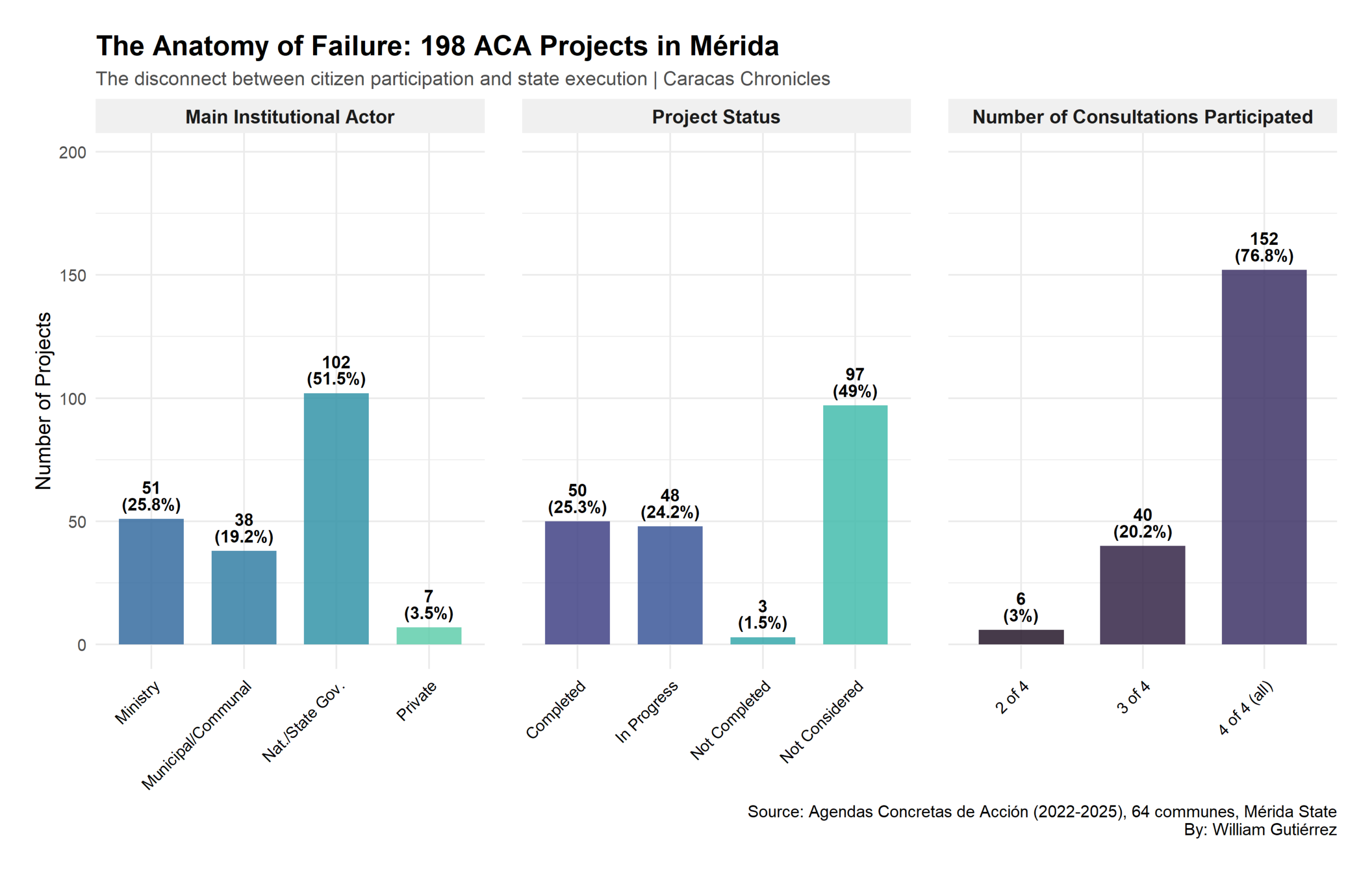
Using this detector, I audited 198 projects. The results are summarized in the following graphs:

These charts reveal three dimensions of failure.

First of all, who decides: of the 198 projects, 51.5% (102) were assigned to ministries and the national government for implementation, while another 25.8% (51) fell to the Mérida governorship. The communes diagnose the needs, but Caracas decides whether to open or close the tap of resources. Only 19.2% (38 projects) remained under municipal or communal control.

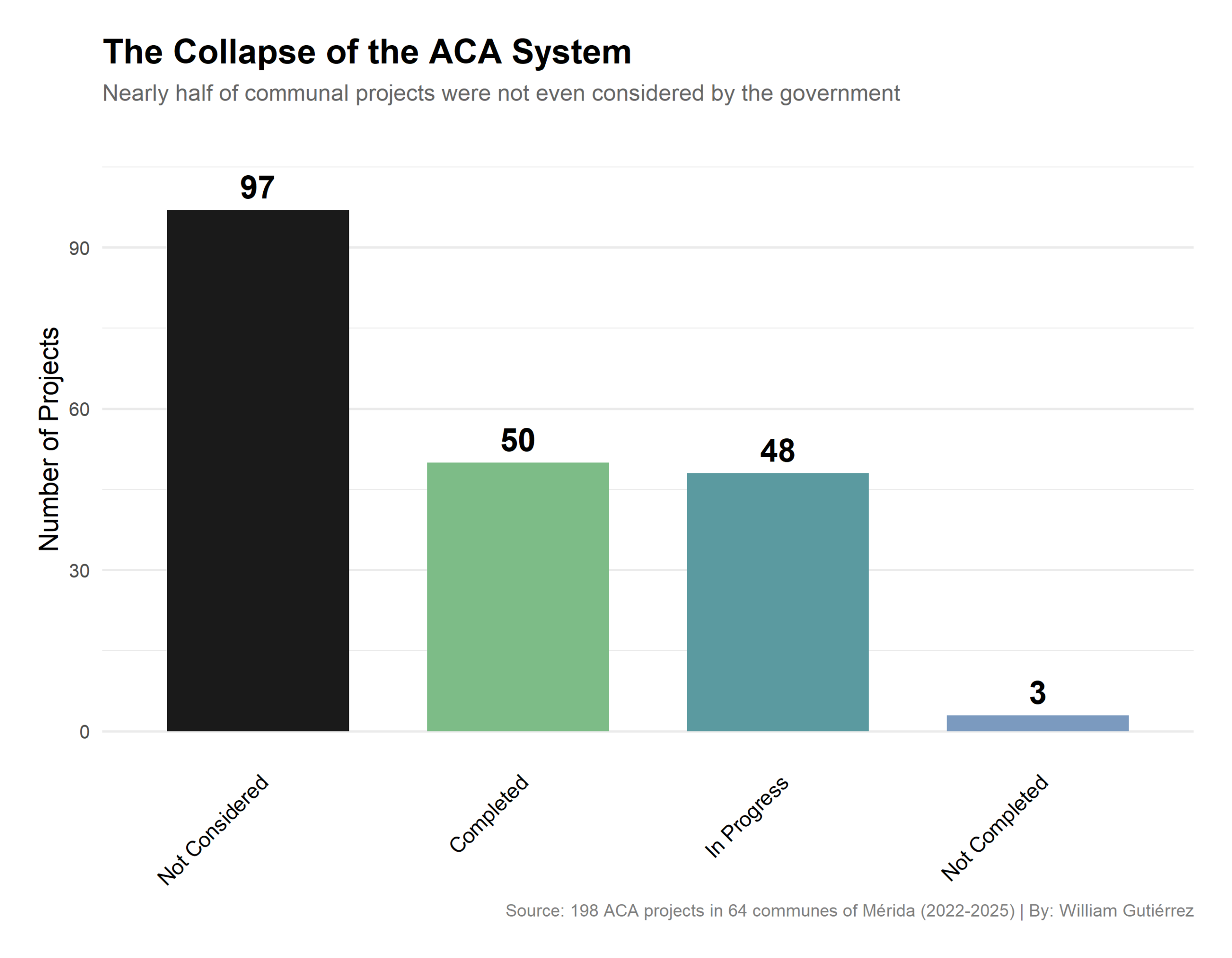
Second, what happened to them: almost half of the projects were not even considered. Only a quarter (50 projects, 25.3%) were completed after years of consultations. The State received the diagnosis, knew exactly what the people needed, and decided to do nothing. Third, participation wasn’t the problem: 76.8% of the communes (152 projects) participated in all four national consultations, from the first in 2022 to the last in 2025. The core chavista voter base mobilized, filled out forms, and voted. The system didn’t fail due to a lack of participation. The problem isn’t that the communities don’t know how to organize themselves. The problem is that when they do organize, the system ignores them.

Now, what problems are the communes identifying? These are summarized in the following chart:

This chart’s revelation is devastating: two out of every three communes in Mérida (43 out of 64, or 67%) identified water as their priority problem. This isn’t an isolated issue affecting just one or two communes. It’s a systemic crisis impacting the entire state. Four problems (water, roads, housing, and electricity) account for 60% of all project requests in Mérida.

Now, we can see how the ACA projects are distributed in Mérida in the following chart:

Of the 198 projects analyzed, 54 are related to water. More than a quarter (27%) of all projects. The first four categories (water, roads, housing, and electricity) account for 62.63% of all projects. The Pareto principle applied to poverty: 20% of the causes explain 80% of the problems. And how many of those 54 water projects were actually implemented?

Behind these figures are real families, of course. Take the example of the Doña Simona commune in Lagunillas, Mérida, which has a serious drinking water problem. In 2022, they voted for water in the first referendum. In 2023, they voted for water again. In 2024, the same. And in 2025, four years later, they were still voting for water. Four referendums. The same problem. Why? In a conversation with the Mérida’s INE office, where I did a summer internship, they revealed the number that explains everything: $10,000. That’s the budget per project. Always. It doesn’t matter if the community asks for an aqueduct or paint for a school.

With $10,000 you can’t build an aqueduct. It’s barely enough for 200 meters of pipe. You can’t dredge a river. You can’t pave a road. You can’t solve a water crisis that affects 43 of the state’s 64 communes. The communes learned this lesson. If you need water but it costs $50,000, you’re better off asking for paint. At least that’s something they will greenlight.

Four years of voting for water. And in the end, paint for the walls of a run-down public school.

So, what happened in Doña Simona? In the third and fourth consultations, the community changed its vote. They no longer asked for the aqueduct they needed. They voted for something “realistic”: participating in the Bricomiles, the program where soldiers paint school facades and repair sports field roofs. It’s not that the people of Doña Simona are unaware of what’s happening in their community, but rather that they’ve learned to play the system: the State only funds projects that cost less than $10,000. “Citizen participation” then revealed itself not as empowerment, but as an exercise in adjusting real needs to the ridiculously small budget the government is willing to provide. Four years of voting for water. And in the end, paint for the walls of a run-down public school.

However, one thing is certain: the communes of Mérida are always right. When the problem is electricity, they assign it to Corpoelec. When it’s water, to Aguas de Mérida. When it’s housing, to the Ministry of Housing. I reviewed 198 projects and didn’t find a single exception. The communes understand the workings of the State better than many public officials.

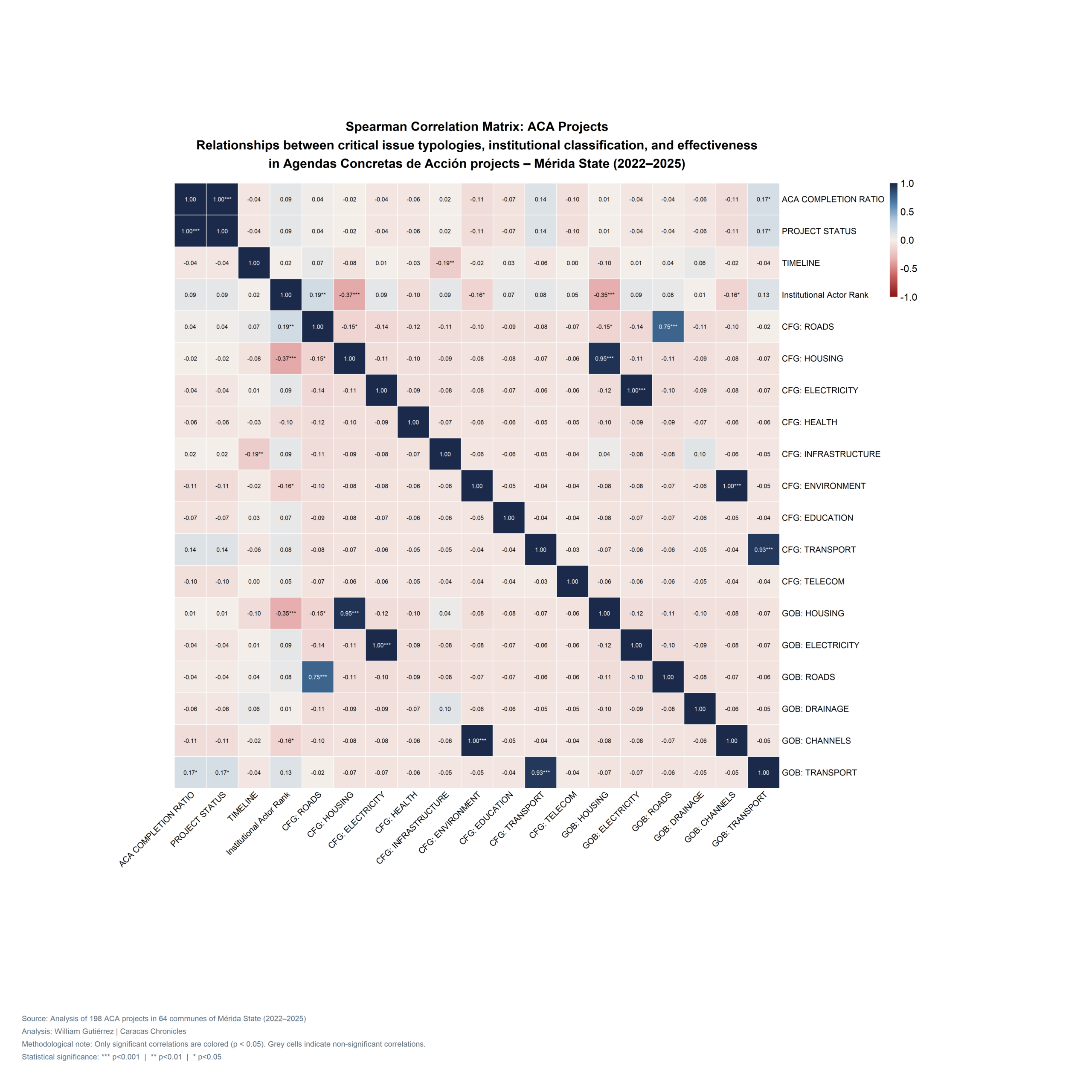
This accuracy remained consistent across all 64 communes, throughout the four consultations, and in all 198 projects. Then I thought: if the diagnosis is so precise, if the communes are doing their job, the system should be producing results. Water flowing through pipes. Paved streets. Stable electricity. I measured the relationship between the quality of the diagnosis and the effective resolution of problems. This graph shows the main conclusion of this research, which I call the Great Disconnect.

The dark blue cells confirm what we already saw: the communes diagnose with surgical precision. The system works like clockwork in the diagnostic phase. So I asked the obvious question: if the communities diagnose perfectly, does the State provide solutions?

The answer was once again devastating. There is no correlation. None. The gray cells say it all: a commune correctly identifying its problem predicts absolutely nothing about whether that problem will be solved. Neither the accuracy of the diagnosis, nor the urgency of the problem, nor how many times people have voted for the same thing matters. None of that matters.

The factors that determine whether a project is implemented operate completely outside the formal Commune Action Board (CAB) system. They are external, opaque, probably related to circumstantial political will, erratic budgets, or the constant turnover of officials.

This is the Great Disconnect: a system that diagnoses with surgical precision and does nothing.

My data shows what that means: more people shouting in empty rooms. The communes are just an authoritarian excuse to overrepresent their political power.

The success or failure of a project doesn’t depend on whether the commune identified its need, whether the responsible institution was selected correctly, how urgent the problem is, or how many times people have voted for the same thing. What determines whether a project is implemented operates entirely outside the formal CAB system. These are external, opaque factors, probably related to short-term political will, erratic budgets, or the constant turnover of officials. The communities do their part. The Venezuelan State does not.

The problem with the Communal State in Mérida isn’t one of scale, it’s structural. There’s no shortage of communes: 64 are already functioning. There’s no lack of participation: 76.8% of the communes participated in the four consultations. The system works exactly as it was designed, mobilizing the chavista base to diagnose problems, making them believe they are participating, and then systematically ignoring their demands. It’s not a failure. It’s the design.

My data shows what that means: more people shouting in empty rooms. The communes are just an authoritarian excuse to overrepresent their political power. The reality is that the wife of Professor Israel Ramírez found him dead in the elevator shaft because there was no electricity in the building that day. In some neighborhoods of Mérida, people probably voted for electricity in 2022, 2023, 2024, and 2025. And in 2026, if this policy continues, they will continue to vote for it.

Source link