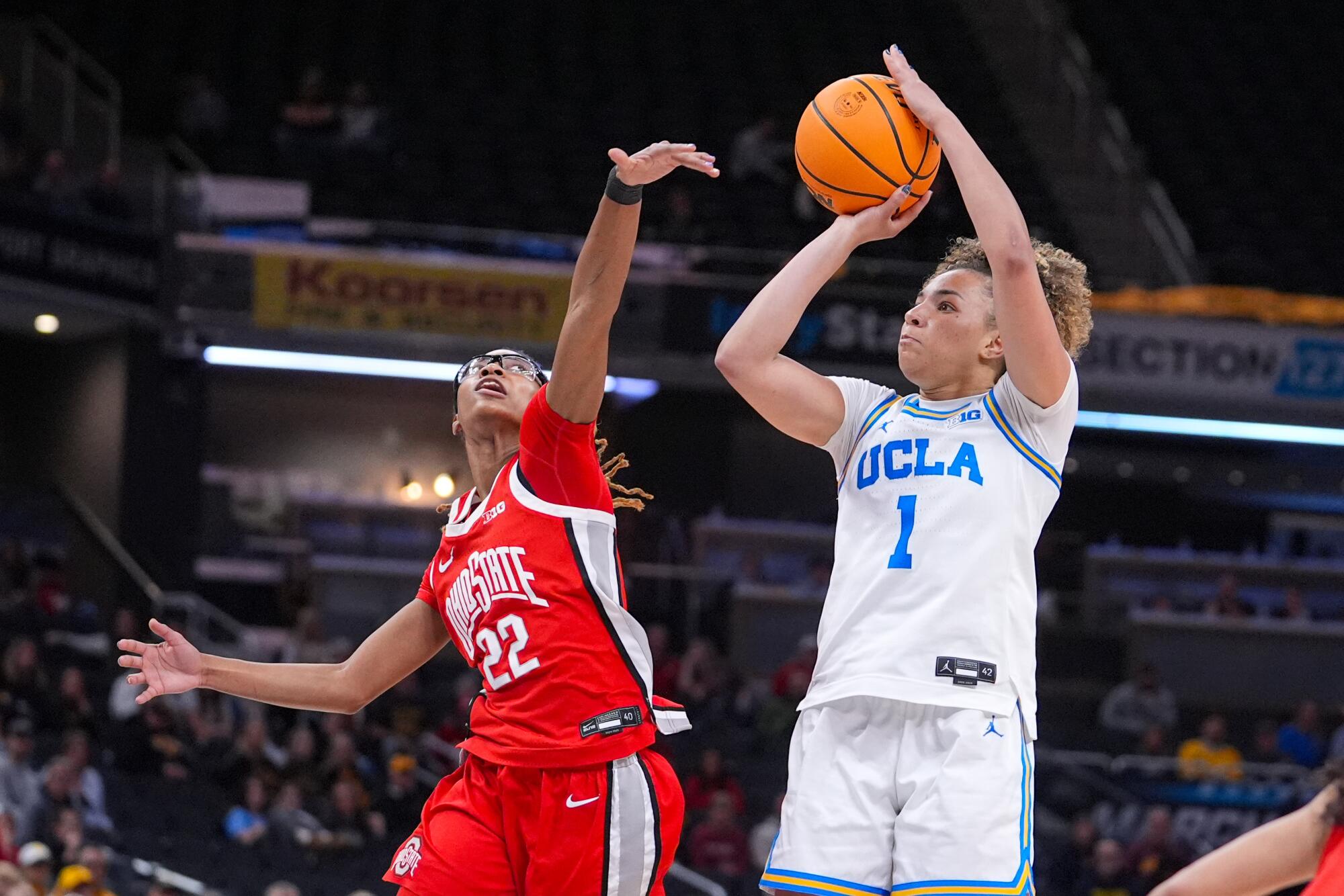
charlisse leger-walker

How Charlisse Leger-Walker, Gianna Kneepkens elevated UCLA

While the UCLA women’s basketball team has a veteran roster that was in this exact position a season ago, the Bruins have an entirely different vibe during their current postseason run.

The No. 1-seed Bruins (34-1) will face No. 3-seed Duke (27-8) in the Elite Eight on Sunday for the chance to go back to the Final Four a year after UCLA beat Louisiana State to reach the Final Four before immediately suffering a blowout loss to eventual national champion UConn.

This year, they expect something different, in large part because of an upgraded starting lineup.

A tangible difference is the addition of Charlisse Leger-Walker and Gianna Kneepkens. Each was the top scorer on their former squads — Washington State and Utah, respectively — and have taken on drastically different roles as arguably the fourth and fifth pieces of this Bruins team.

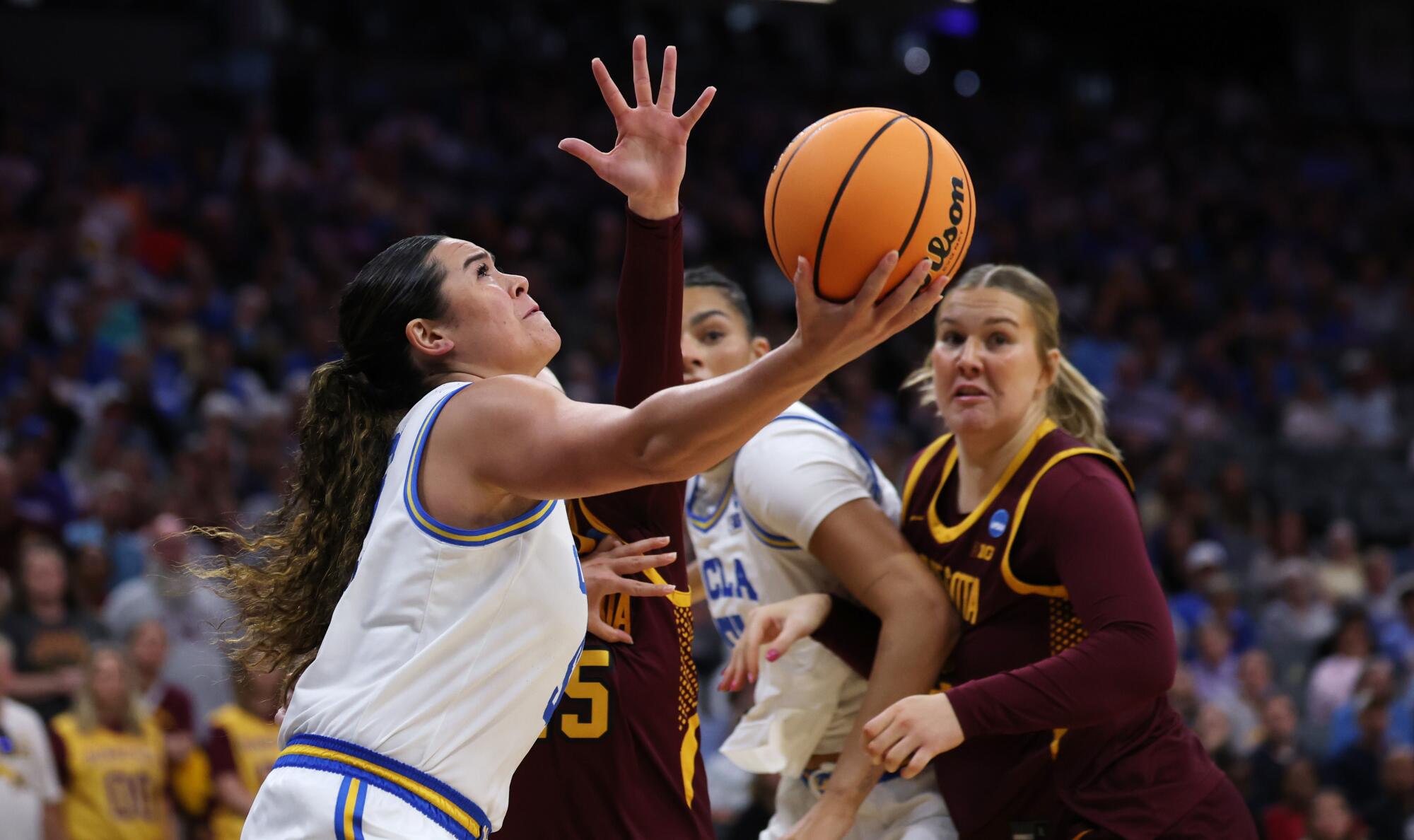
Charlisse Leger-Walker hits a reverse layup in front of Minnesota's Grace Grocholski during the tournament.

Charlisse Leger-Walker hits a reverse layup in front of Minnesota’s Grace Grocholski during the tournament on Friday in Sacramento.

(Eric Thayer/Los Angeles Times)

“It’s huge we have them,” said senior Gabriela Jaquez, who has spent her entire NCAA career with the Bruins. “They’re perfect fits here. Charlisse as a point guard has been great, and then just being a guard out there, a ready shooter, doing whatever we need, and obviously them being able to defend is really great for our team.”

With the Cougars, Leger-Walker averaged double-digit scoring and more than 10 shots per game in every season. With the Bruins, her production has dropped to 8.7 points per game on 7.1 shots.

Where she has improved, though, is a career-high 5.7 assists per contest.

“I look at the talent we have, especially on the offensive end, there are a lot of times where I don’t have to shoot and force some of the shots that I would have to back at Washington State,” she said. “I’ve always been able to facilitate and be that connector, but this is the role I am needed in the most here.”

Kneepkens was the Utes’ top shooting option and Pac-12 freshman of the year. There, she was relied on as the team’s top three-point shooter, and after Alissa Pili left, their top scorer overall.

During her graduate season, she has taken a significant reduction in shots per game, going from 12.3 field goals per game to 9.4.

“I think it tells you what their ‘why’ is, what their purpose is, why they came here,” UCLA coach Cori Close said. “It wasn’t to get their own stats. It was to be a part of something bigger than themselves.”

On a night where neither of them did much shooting against Minnesota, though, it was their defensive length that made a significant difference against a physical Golden Gophers team. It was the kind of defense they could not have played a year ago with Londynn Jones, who transferred to USC, in the spot Leger-Walker now occupies and Angela Dugalic starting rather than providing invaluable depth coming off the bench.

UCLA guard Gianna Kneepkens dribbles under pressure from Oklahoma State forward Achol Akot against the Oklahoma State.

UCLA guard Gianna Kneepkens dribbles under pressure from Oklahoma State forward Achol Akot during an NCAA tournament game at Pauley Pavilion on March 23.

(Ronaldo Bolanos/Los Angeles Times)

Offensively, Leger-Walker’s presence has given the Bruins more options to score from throughout the floor. Known as a three-point threat at Washington State, she needs to be guarded on the perimeter but also not be left to connect to other open players.

“But I think Charlisse, specifically, is one of the best processing point guards I’ve ever been around,” Close said. “Her ability to understand how rotations are happening in the second line, what’s the next play and if she makes one mistake, boy, she’s not making it a second time. … Having Charlisse on our team has freed Kiki [Rice] up in some ways and vice versa. So that’s been really fun to see.”

Rice has played more of a shooting guard role this season with Leger-Walker taking over at point guard, which has opened her up to shoot more and drive to the hoop without facilitating as often.

That freedom has given Rice her best offense season yet.

“[Leger-Walker’s] basketball IQ is insane,” Rice said. “She gets buckets, she defends super well, she does it all for us. She’s selfless, and she kind of knows when to take over. I’m grateful we’ve had her this year.”

Close said that Kneepkens played one of her best defensive games in the win over Minnesota, but that her length playing as a wing has opened up the UCLA defense to guard the perimeter all season.

“It’s just learning to play with great players,” Kneepkens said. “If that’s finding them when they’re open, then I’ll do that. Or if I need to take my shot, I’ll do that too.”

UCLA’s biggest wins have featured dominant performances from Lauren Betts and generally, its other bigs — Sienna Betts and Dugalic — playing at their best.

But the true depth of the Bruins has come from having long guards who can defend and change up what they need to do in any given matchup. They might be the difference going into the toughest parts of the tournament.

“Coming to a program also where you are surrounded by elite players, and at the end of the day we want to win and be a part of a program that can do that,” Leger-Walker said. “Whatever that role is that we have to adjust to throughout the season, I think, we really bought into that.”
Source link

UCLA stars now have a better chance of sticking with WNBA rosters

In less than two months, six UCLA women’s basketball players might be working out with WNBA teams. The draft is April 13, a week after the NCAA national championship game, and the season starts less than a month later.

One of the most consequential pieces of the new WNBA collective bargaining agreement for current college players, including the UCLA super senior class, is expanded rosters.

Not only are two new teams — Portland and Toronto — entering the WNBA this season and adding 24 roster spots, but the new CBA will allow each team to have 12 traditional roster spots and two developmental player spots.

The new developmental players will get housing assistance and can practice and travel with their respective WNBA squads.

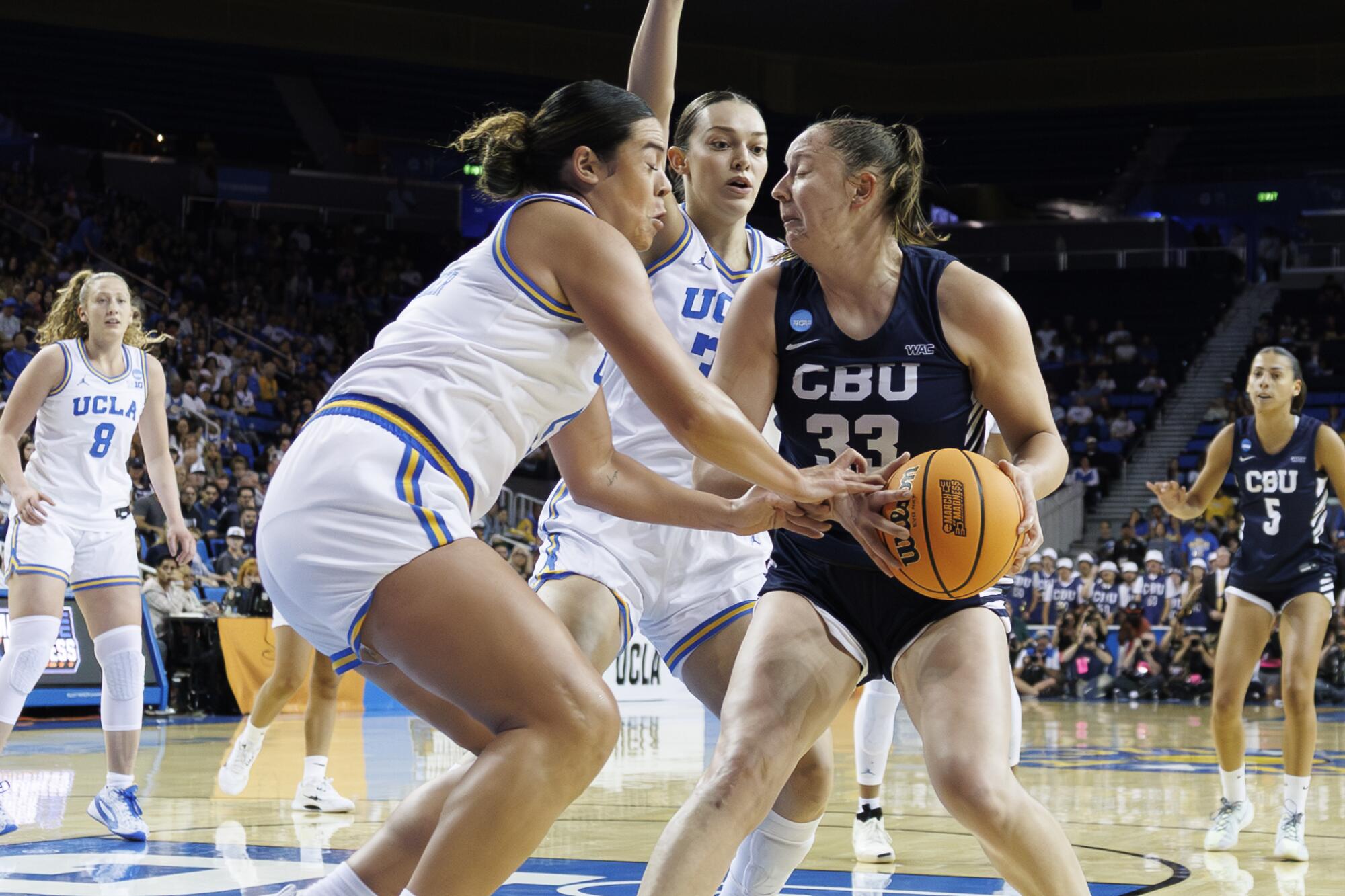
UCLA's Charlisse Leger-Walker and Angela Dugalic swarm California Baptist forward Grace Schmidt.

UCLA’s Charlisse Leger-Walker, left, and Angela Dugalic, back, swarm California Baptist forward Grace Schmidt during an NCAA tournament game at Pauley Pavilion on Saturday.

(Gina Ferazzi / Los Angeles Times)

Across the country during the NCAA tournament, players and coaches have noted how much the new WNBA CBA changes the future for the next generation of players.

South Carolina coach Dawn Staley noted to reporters last week that it’s one of the first times many women’s basketball players will be able to accumulate generational wealth. And they can do so without necessarily having to play in other leagues around the world during the WNBA offseason.

“The WNBA will make you make a choice because you have to be on time in training camp.” Staley said. “It’s worth it now. It’s worth it to actually have your body recover and just play in the WNBA season.”

Last season, just 20 rookies made rosters out of training camp. The fight for those spots might get more competitive for some young players now that the league offers higher salaries and some high-end international players might find it more worthwhile to sign in the WNBA.

Teams are now required to roster 12 players, compared with the option to have 11 instead of 12 under the previous CBA, which allowed franchises to spend more on top players and have less of a cap hit by triming their roster size.

But likely, more players who otherwise wouldn’t have gotten looks or would have been cut during past training camps will now have a realistic shot a developmental player spot.

“I just feel a lot of pride,” said UCLA sixth-year forward Angela Dugalic. “Because of them, I’m able to have a lot of things that they maybe weren’t able to have at the start of their career. And some of them, like, they’re either at the end of their career or they’re even finished right now, they’re still fighting for us.”

The entire UCLA starting lineup — Charlisse Leger-Walker, Kiki Rice, Lauren Betts, Gianna Kneepkens and Gabriela Jaquez, plus Dugalic off the bench — project as WNBA picks, most as early as the first round.

Kneepkens or Leger-Walker (though she was recovering from an ACL injury) would have been WNBA draft-eligible after last season. Their rookie salaries would have been around $70,000, depending on where they were selected. This year, the rookie minimum will be $270,000, and top picks, which Betts and Rice are projected to be, will make as much as $500,000.

“Just like the growth we’re even experiencing now in college, we have so many people before us to thank that. [They] fought for better exposure and TV rights … fought for Title IX and resources to be allocated appropriately,” UCLA coach Cori Close said. “I think it’s similar right now in terms of the CBA. We need to really thank the people in that room that fought hard.”

UCLA guard Kiki Rice dribbles up the floor under pressure from California Baptist guard Filipa Barros.

UCLA guard Kiki Rice dribbles up the floor under pressure from California Baptist guard Filipa Barros Saturday at Pauley Pavilion.

(Gina Ferazzi / Los Angeles Times)

UCLA players are understandably locked in on the NCAA tournament, but they haven’t ignored an important moment.

“I think it’s awesome for women’s basketball and the progress going forward,” Leger-Walker said. “I love that we have players who are willing to advocate and really stand on what they believe in. We’re making steps forward.”

Where they all fit on individual teams or in respective mock drafts will all be more clear after free agency begins in the week ahead of the draft. Around 80% of the league are free agents, so there are going to be plenty of new-look teams.

UCLA players will soon get a chance to join those roster makeovers under working conditions past players never enjoyed.

“I’m just grateful for all the women who fought for what they’ve earned,” Kneepkens said. “That’s just super cool for anyone that’s a WNBA fan and anyone that’s part of it. They made this happen.”

Source link

How Kiki Rice became the UCLA Bruins’ top WNBA draft prospect

The WNBA will likely get an injection of UCLA talent. One of the players most equipped to make an impact right away, it turns out, might be Kiki Rice.

Some mock drafts have the senior guard as high as being picked No. 5 overall after concerns she might fall out of the first round entirely before this season.

After a career-best season, though, Rice is one of the top prospects in a loaded class. That wasn’t a given after taking a step back in all statistics other than shooting last season.

The No. 1 seed Bruins are hoping to ride that to a national title, with the next step coming Saturday against No. 16 seed California Baptist in the first round of the NCAA tournament. Tipoff is at 7 p.m. at Pauley Pavilion.

UCLA guard Kiki Rice shoots over Ohio State guard Jaloni Cambridge during the semifinals of the Big Ten tournament.

UCLA guard Kiki Rice shoots over Ohio State guard Jaloni Cambridge during the semifinals of the Big Ten tournament on March 7 in Indianapolis.

(Michael Conroy / Associated Press)

WNBA scouts are hoping Rice proves she can be one of the best early first-round investments in the league.

“The work she did on her mentality, film study, with leadership, using her voice, working on her handles, I just think it’s her commitment to the details,” UCLA coach Cori Close said. “I’m not surprised that she’s playing this way because of the intentional work that she puts in.”

A Big Ten All-Defensive Team and unanimous All-Big Ten First Team selection this season, Rice is averaging career highs in points (15.3), rebounds (6.0) and shooting percentage (50.4%). Her assist numbers have dropped since the addition of Charlisse Leger-Walker, but that’s allowed Rice to create her own offense.

“I think one of the things that Kiki’s been able to do is have different kinds of scoring catches this year because of Charlisse’s presence on our team,” Close said. “But I do think the biggest thing has probably been her passing, her facilitation, as well as her ability to shoot.”

WNBA scouts have taken notice, too. One evaluator said her ability to play with a “group of weapons” has set herself up to be taken seriously for a larger role even as a rookie. For a long time, among those scouting in the league, she was viewed as a potential backup point guard, but her shooting ability and defensive consistency has made her a more complete prospect.

Her 2.2 defensive win shares are third in the Big Ten and her 83.0 defensive rating is seventh.

“I worked a ton of [defense] in the offseason and really stepped up to the challenge of guarding the other team’s best perimeter player,” Rice said. “I think me being challenged in that way, it’s been a really great area of growth, and that’s probably the area that I’m most proud of.”

Rice’s improvement from the three-point line is a big one for WNBA scouts. She improved her deep shot from 21.7% to 38.1% across four seasons.

UCLA guard Kiki Rice steals the ball from Washington guard Chloe Briggs at Pauley Pavilion on Thursday night.

UCLA guard Kiki Rice steals the ball from Washington guard Chloe Briggs at Pauley Pavilion on Feb. 19.

(Gina Ferazzi/Los Angeles Times)

That, plus her defensive prowess and ability to play point guard and more of a loose guard role, have helped her WNBA stock rise tremendously.

“Defensively has been probably the most impactful growth thing that she’s had,” Close said. “But Kiki — people don’t realize she was out for six months. She had surgery on April 15th last year and was out for six months.”

Rice was injured at the start of last season and then underwent right shoulder surgery right after the Final Four. Despite the injury, she played in 34 games last season, averaging 12.8 points and 5.0 assists per game.

Rice won the Big Ten tournament’s most outstanding player award after UCLA thrashed Iowa by 51 points in the championship. She averaged 16.6 points and 5.3 assists during three Big Ten tournament games.

Her numbers might be even better if she were the team’s top offensive option, like Hannah Hidalgo with Notre Dame. Instead, she is sharing time with other top WNBA prospects such as Lauren Betts, Gianna Kneepkens and Leger-Walker.

“What I love most is she’s one of the most selfless people I’ve ever played with,” Betts said of Rice. “She really could [not] care less about all of the attention. She just wants to win games. She’s always there for her teammates. I’m so grateful I get to be her teammate and her friend. She’s amazing.”

In addition to her three-point shot improvement, around 60% of her points still come in the paint from driving to the basket, making her a threat all over the floor.

“There were lots of times in previous years where Kiki could get downhill, but we didn’t have the court spacing because we didn’t have the quality of shooting that allowed those driving lanes to take place,” Close said.

UCLA guard Kiki Rice shoots over USC guard Malia Samuels at Pauley Pavilion on Jan. 3.

UCLA guard Kiki Rice shoots over USC guard Malia Samuels at Pauley Pavilion on Jan. 3.

(Eric Thayer/Los Angeles Times)

The biggest question with Rice is whether her three-point shooting can scale to a higher volume in the WNBA, where guards are more likely to shoot from deep than be relied on in the post. She has never taken more than 2.7 attempts per game.

Part of that is because there are so many options from three-point range that Rice doesn’t have to be the primary shooter. Kneepkens is making 44.2% of her three-pointers and Gabriela Jaquez has hit 41.1% while Leger-Walker is shooting 36.4% from range.

That hasn’t affected Rice’s efficiency, though.

“I think this year the way that we moved the ball and everyone gets touches is so important for everyone and allows me to be successful,” Rice said.

UCLA guard Kiki Rice celebrates with teammates as she's handed the Big Ten tournament most outstanding player trophy.

UCLA guard Kiki Rice celebrates with teammates as she’s handed the Big Ten tournament most outstanding player trophy on March 8 in Indianapolis.

(Michael Conroy / Associated Press)

With the way the draft order falls, Rice is likely to end up with either an expansion team or a team that struggled last season, such as Washington or Chicago. That might mean she’ll need to step in and produce in her first season as a pro.

That is why her stock has risen so much this season — she’s shown she has the versatility to do what is needed.

“Kiki has been playing the best basketball of her career,” Close said. “I think she has put in the work. She knows what she’s earned, and she’s sort of ‘that girl’ for us.”

Source link