In the Season 3 finale of ‘The Rings of Power,’ the ‘endlessly cunning’ Sauron has a surprise
The third season of “The Lord of the Rings: The Rings of Power” ends not with a bang but with a calculated manipulation. After setting up a climactic battle, the show instead culminated in Sauron’s seeming surrender to Pharazôn’s Númenórean army. Although he kneels, Sauron has a master plan, which comes directly from J.R.R. Tolkien’s writing.
“That is one of my favorite moments in the whole legendarium,” says Charlie Vickers, 34, who has embodied Sauron since the first season of “The Rings of Power.” “The forging of the ring is amazing and it’s the thing Sauron has been building towards. But this was what I was most excited for because it’s such a big canonical moment.”
In Episode 7, Sauron finally forges the all-powerful One Ring in the fires of Mount Doom. He pours his entire being into the act and emerges triumphant. But showrunners J.D. Payne and Patrick McKay didn’t want to end the season there.
“There’s a journey of how it changes him, but you know he’s going to achieve it,” McKay says, speaking with Payne over video call ahead of the finale. “We wanted to use that as a jumping off point into the next stage of his journey. All that power is still not enough. He’s going to have to go to greater depths and find an even darker, more powerful version of Sauron to truly eliminate any rivals.”
The finale purposefully brings together many of the characters, including Pharazôn (Trystan Gravelle), Galadriel (Morfydd Clark), Elrond (Robert Aramayo), Gil-galad (Benjamin Walker) and Celeborn (Jamie Campbell Bower). Sauron initially seems to have the might necessary to defeat the elves and the men. He has a vast army of orcs and the power of the dark wizard Pallando (Ciarán Hinds). But when Pallando is killed, his followers abandon Sauron. As Pharazôn amasses his army on the battlefield, Sauron realizes he can’t win by traditional means.
“Tolkien is all about the ways that many small moments of heroism can be more powerful than all of the machine and army and industry that the enemy can bring,” McKay says. “We felt that it was important that all of our heroes across their stories could add up to one thing: They’ve got him cornered. He can’t win. And that’s when he has to raise the ante even further.”
“One of the fun things about working with this character is he’s great at creating lose-lose situations where he’s either going to beat you now or he’s going to beat you later,” Payne adds. “He’s endlessly cunning.”

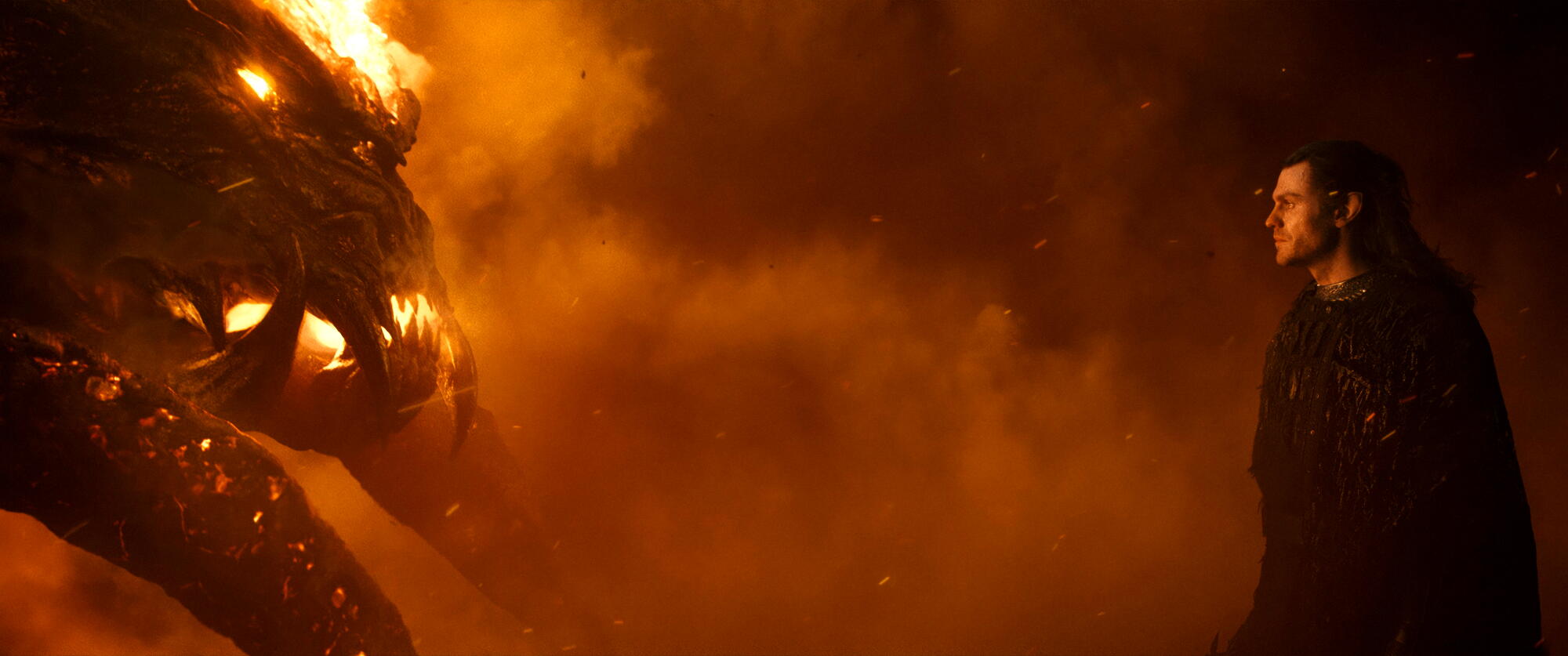
The Balrog and Sauron (Vickers) face to face in Episode 7.
(Prime Video)
The final sequence was filmed on a real field at Hankley Common in Surrey, England. Director Charlotte Brändström created the army of 5,000 with only about 30 horses and 120 extras, who were later augmented by VFX. She met with military advisors to understand how the army would move onto the field. Vickers repeatedly walked nearly half a mile across the field to film Sauron’s face-off with Pharazôn and the elves. Brändström then elevated Vickers onto a platform so she could capture the final shot of his face, where it becomes clear that there is a devious motive behind Sauron’s surrender.
“He has found his way out of this situation,” Vickers says, speaking from his home in London. “Tolkien writes that it … all went according to Sauron’s design in this moment. I wanted to have a little flash of the thrill he feels.”
Brändström built everything up to that close-up. “It’s stronger than any visual effect,” she says in a separate video call. “Spectacle is really important for us and we need it, but the most important are those moments of decisions characters have. We don’t know that’s what he’s going to do.”
The closing shot sets up the series for an even more calculating version of Sauron. In the lore, he is taken to Númenor, where he successfully corrupts the kingdom from within and brings about its eventual destruction. That seems to be where the series is heading — a fourth season was announced on Tuesday.
“If you capture Sauron, what should you do with him?” Payne asks. “You could have all kinds of different ideas about what it would be. But how are each of those going to come back and bite you? That becomes the real animating question that’s going to kick off our next season.”
“It’s clear he has a plan,” Brändström adds. “As everyone knows in the book, he’s planning to get to Númenor. But what is he going to do and how is he going to do it? And where is the ring?”
Before Sauron surrenders, he removes the One Ring from his finger. It’s unclear what he does with it.
“That was a big thing,” Vickers says. “There were a lot of logistics while filming about when he has the ring and when he doesn’t, and when he puts it on and when he takes it off.”
Payne says Tolkien never clarified the answer. “There are places [in Tolkien’s writing] where it suggests it was not brought to Númenor and there are places where it suggests it was,” he says. “Tolkien actually received letters about it. And his answer was, ‘Don’t think too hard about it.’”
The showrunners and Vickers do, however, know the answer — at least within the world of “The Rings of Power.”
“I would say we know he has a weapon of ultimate power, and he seems to take it off before he surrenders,” McKay says. “Where is it? What is his plan?”

Co-showrunner J.D. Payne on Sauron, played by Vickers: “He’s endlessly cunning.”
(Prime Video)
Season 3 has largely centered on Sauron and his rise to power as the Dark Lord. Vickers was originally cast as Halbrand, a human disguise for Sauron, in Season 1. The actor didn’t actually know he would be playing the villain until filming had commenced, although he had enough of a suspicion to create a dossier about him in preparation.
“I was told I was playing a human character,” Vickers says. “I was asked to audition with pieces from ‘Richard III’ and ‘Paradise Lost,’ so I thought there might be more to him. But I wanted to be as prepared as I could be. They told me after I filmed the second episode and I was relieved. It helped to inform his inner life.”
Each season has seen Sauron shift in his approach. In the first season, he used the Halbrand form to get close to Galadriel and to gain control of the orcs. In the second season, he took on the form of Annatar to convince Celebrimbor to teach him to make the rings. Now, he has stepped into a more imposing role as ruler.
“Tolkien wrote of Sauron during this period as being a king of men,” Vickers says. “I don’t think he’s any more Sauron now than he was in the second season or in the first season. It’s just a different version of him. My understanding of him deepens every season, but he is still the same character at the core.”
The depiction of Sauron during the Second Age is unexpected for those who know him as the glowing eye in Peter Jackson’s “The Lord of the Rings” films.
“People have preconceptions about this character,” Vickers says. “Part of this show is breaking those down and showing them what Tolkien intended Sauron to be.”

Before the series, Sauron is depicted simply as a glowing eye. “People have preconceptions about this character,” Vickers says.
(Prime Video)
The finale features a confrontation between Sauron and Gandalf (Daniel Weyman). Sauron offers Gandalf control of Middle-earth in exchange for bending the knee. That encounter was imagined by the showrunners.
“The idea of the two of them meeting in this era felt plausible,” McKays says. “And it felt plausible that Sauron would approach a character of as much power and integrity as Gandalf with an offer like that.”
“There’s always a catch with Sauron,” Vickers adds. “I don’t think Sauron would ever truly share power, despite the fact that he might offer it. Those are hollow promises. He will stop at nothing. He is relentless.”
Vickers’ version of Sauron is cold, unscrupulous and often eerily still. Brändström says the character is “most frightening when he’s subtle.”
“He has such an interiority about his performance,” Payne adds. “He’s so restrained. With that character it could be so easy to want to really go over the top. But he always takes it the other direction. You look at his face and a single muscle twitches and the entire world of his performance is contained within that single muscle twitch.”
The forging of the One Ring was one of the most challenging sequences in Season 3. Vickers spent two weeks inside of a soundstage at Shepperton Studios acting opposite tall pillars of light, which stood in for the expansive volcano. It’s a moment of genuine struggle for the otherwise unflappable character.
“Sauron’s idea of struggle should be very different to our idea of struggle because he’s inhuman, but he doesn’t get angry and upset,” Vickers says. “I thought a lot about: How is he feeling this pain? How does it manifest in his body? He has to basically submit himself to the pain and the frustration. But perhaps he doesn’t know exactly what it’s going to cost him.”

Sauron (Vickers) with the One Ring. “He has to actually give his life to make the ring,” says co-showrunner Patrick McKay.
(Prime Video)
“It’s the greatest challenge of his life,” McKay adds. “He has to actually give his life to make the ring. He leaves it all in the field, and that, in our estimation, is what animates the ring.”
As Sauron has stepped into his power this season, the fact that he is attractive and charismatic is intentional. Vickers is aware of the “hot Sauron” memes and chatter online.
“Tolkien said he came in a ‘fair’ form,” Vickers says. “It depends on how you interpret the word fair. But he is meant to be hot. Flora Moody, our makeup designer, wanted to lean into that as much as possible. It is part of his manipulation.”
Vickers, who grew up in Australia, was largely unknown when he was cast as Sauron in 2019. He has since starred in 2023 miniseries “The Lost Flowers of Alice Hart” and Netflix’s “The Survivors.” He also recently shot a horror film, “Playback,” in Spain. He’s interested in roles that take him beyond the villain. But playing a character as complicated as Sauron has given Vickers the chance to fully embrace himself as an actor.
“This was maybe my fourth professional job,” he says. “I remember being terrified on those first few days. But the gift of this job is that I now feel comfortable working at this scale. It’s made me feel equipped to deal with anything.”
Vickers is curious about the possibilities for Sauron in Season 4. “His next step along this path is my favorite bit of all of Tolkien’s stuff,” he says. “I’m looking forward to hearing more about what is happening. I’m hugely excited about the prospect of telling that story in Númenor.”
And as for that finale, Vickers appreciates that the show doesn’t succumb to narrative expectation.
“You think it’s going to go one way and it goes another,” he says. “And if people are upset that there’s no battle after all the buildup, you can’t blame us. That’s what Tolkien wrote. Sauron kneels. And for him this is only the beginning.”