Kaiser made $9.3 billion last year. Critics say it has strayed from its charitable mission
Some employees called it the “dash for cash.”
Months after Kaiser Permanente doctors saw a patient, federal prosecutors said, administrators pushed the physicians to add new, false diagnoses to the medical record in a billion-dollar scheme to defraud the government. Kaiser in February paid $556 million to settle the allegations.
“Deliberately inflating diagnosis codes to boost profits is a serious violation of public trust,” said Scott Lambert, acting deputy inspector general for the U.S. Department of Health and Human Services.
Kaiser faced further scrutiny a month later when the nonprofit healthcare giant paid $30 million to settle another case brought by federal investigators, this one involving claims it had failed for years to provide patients with adequate access to mental health care.
Kaiser said it settled the fraud case without admitting wrongdoing. It said the mental health settlement did not involve its current practices.
Yet critics have pointed to the repeated legal payouts, saying they reflect how Kaiser has veered from its charitable mission in recent years and is now virtually indistinguishable from its for-profit competitors keenly focused on the bottom line.
That shift has also fueled recent tensions with its employees, who have complained about inadequate resources to address staffing shortages and patient delays.
“Their focus is on profit and in doing more with less,” said Kadi Gonzalez, a nurse who works in Kaiser’s obstetrics and gynecology clinic in Downey. Gonzalez was one of more than 30,000 nurses and other Kaiser professionals who walked out in a four-week strike that ended last month.
The unions said their strike was as much about staffing levels and patient safety as it was about wages.
“The more patients a nurse has, the higher the mortality rate,” Gonzalez said. “We don’t have enough providers.”
The Oakland-based giant insures almost 1 of every 4 Californians. It operates as both an insurer and a provider of care in a closed system that makes it difficult for patients to get treatment elsewhere.

Kaiser declined to make its executives available for comment, but issued a statement disputing the claims.
“Our charitable purpose guides every decision we make,” the statement said. “Driven by our mission, we offer better care and coverage to our members, invest billions of dollars in our communities every year, and work to advance high-quality, affordable, equitable, evidence-based care in communities across the country.”
The statement added that its hospitals are “among the best staffed in California” and that staffing levels always meet or exceed state requirements.
A surge in profits
Founded in 1945, Kaiser has long gained national attention for its managed care model and focus on preventative care.
The nonprofit says its mission is “to provide high-quality, affordable health care services and to improve the health of our members and the communities we serve.”
The Kaiser system — the largest healthcare nonprofit in the country — serves 9.5 million Californians. The Times offers Kaiser insurance to its employees.
Last year, Kaiser took in more than $127 billion in revenue, earning a profit of $9.3 billion. The net income was mainly from investments, with a smaller share ($1.4 billion) from its sprawling operations as well as insurance premiums.
Kaiser has continued to hike its insurance premiums faster than inflation.
In 2025, premiums increased an average of 5.1% in Southern California and 8.2% in Northern California, according to Beere & Purves, a general insurance agency. In January, it raised them by another 6.5% in Southern California and 7.1% in the northern part of the state.
Kaiser has been rapidly expanding nationwide. It now has hospitals and clinics in at least 10 states and the District of Columbia, some operating under a separate nonprofit that it created in 2023 called Risant Health.
Kaiser said in its statement that D.C.-based Risant “is a way for us to expand access to high-quality, affordable care to millions more people, in fulfillment of our mission.”
“As a nonprofit, any returns are reinvested back into patient care, infrastructure, workforce benefits, and community health programs—not distributed to shareholders,” it said.
Kaiser said that its annual premium increases were “generally lower” than its competitors.
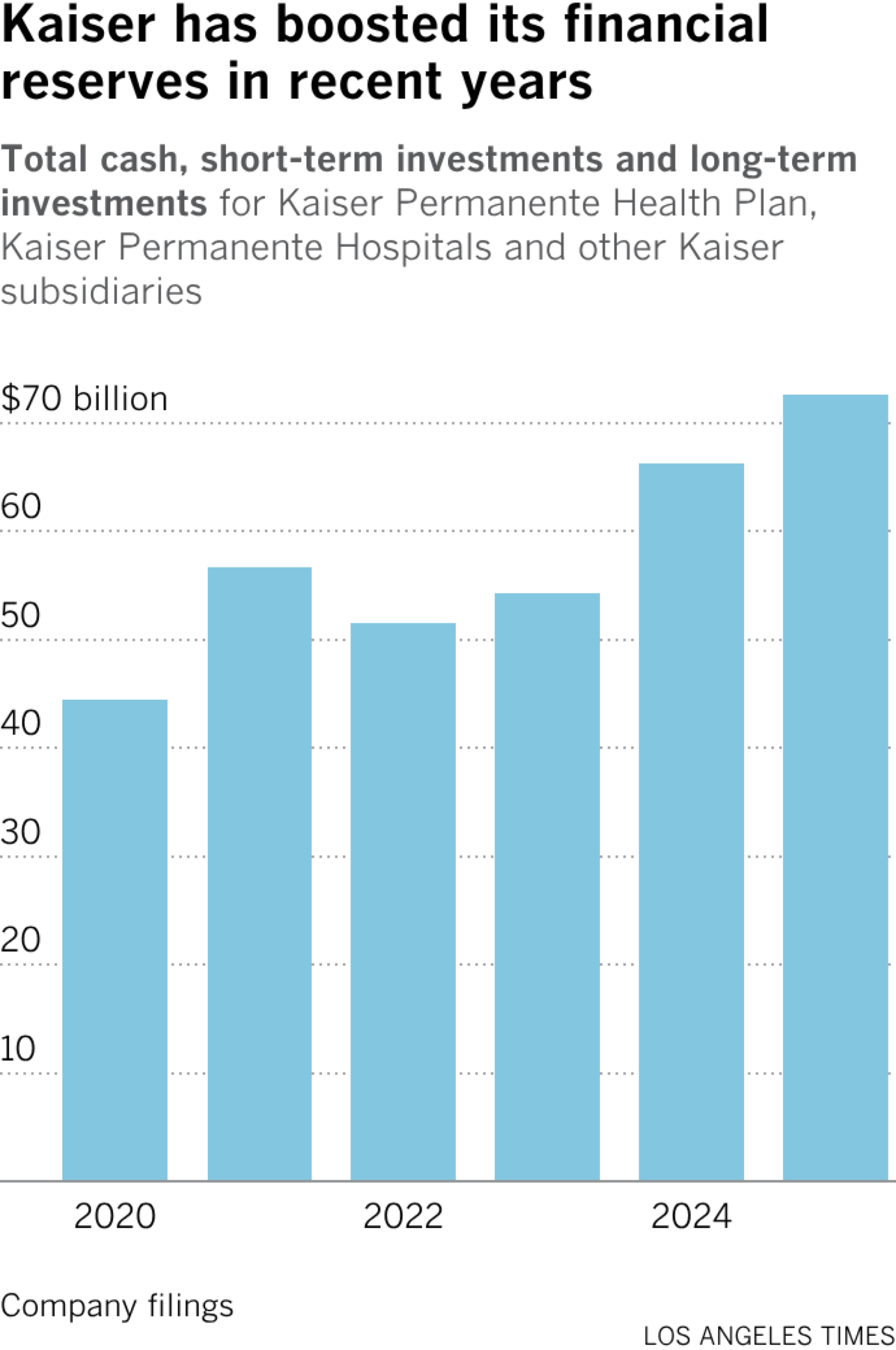
The surge of money has increased Kaiser’s reserve of cash and investments, which reached $73 billion in 2025 — 68% higher than in 2019, according to its financial statements.
Because Kaiser is registered as a charity, it pays no taxes on its profits or its extensive real estate holdings. After a recent buying spree, the nonprofit system said it had 847 medical offices and 55 hospitals at the end of 2025.
The arm of Kaiser that operates its hospitals and clinics avoided $784 million in federal income tax, $372 million in state income tax and $204 million in property tax in 2024, according to an analysis by the Lown Institute, a healthcare think tank.
In all, Kaiser Foundation Hospitals received nearly $1.5 billion in tax and other benefits by registering as a charity, the institute calculated.
Laws exempt nonprofits from paying taxes with the assumption they will give back to the community.
In 2024, Kaiser Foundation Hospitals provided $963 million in patient financial assistance and contributions to community health programs, but that still fell short of its tax benefit by more than $500 million, according to the Lown Institute.
Dr. Vikas Saini, the institute’s president, said that amount of money could help solve a myriad of California’s social problems.
“If they closed that gap, what would that $500 million get you?” he asked.
In a 2024 study, the institute found that Kaiser had the largest gap between its tax benefits and charitable spending of any of the nation’s nonprofit hospital systems.
Kaiser said in its statement that its combined charitable spending was far more than the institute’s calculation for its hospital arm. It said it not only provided patients with financial assistance, but also spent money on affordable housing, food access, community health and disaster recovery — efforts that totaled $5.3 billion last year.
After the January 2025 wildfires, Kaiser said it provided 2,400 households with financial assistance, opened evacuation centers, deployed mobile health vehicles and provided mental health services to victims.
“We have never been prouder of how we are delivering on our mission for the public good,” the statement said.
As Kaiser has grown, so has compensation for its top executives, which is among the highest of all California nonprofits.
In 2024, Greg Adams, Kaiser’s chief executive, was paid nearly $13 million, according to its filings. At least 40 other executives received total compensation of more than $1 million that year.
The nonprofit has a board of directors of more than a dozen members, with all but a few receiving $250,000 or more a year, according to the filing.
The board helps to oversee Kaiser’s fast-growing operations as well as its $73-billion financial reserve, which healthcare advocates and experts have said is far higher than its competitors and the level the state requires.
“I’m flabbergasted,” Saini said when told of the reserve’s size. “Who decides how big of a reserve is enough?”
Kaiser said it maintained the large financial reserve “to ensure long-term stability, manage emergencies, support major capital investments, and support our people’s retirement benefits.”
And it said senior managers were paid less than most for-profit health plans.
Patients delays, staffing shortages
Some longtime Kaiser members have left for other insurers, citing a decline in care.
Mark Schubb, a Santa Monica resident, had been a Kaiser member since 1995. He said he left in 2022 after experiencing months-long delays to visit his primary care doctor and specialists.
When he complained, Schubb said, “the answer was, ‘Well, you can always go to urgent care.’ “
Gonzalez, the nurse in Downey, said patients often wait three months for an appointment. And when they finally get in, the 20-minute appointment may be double-booked, she said, leaving the physician assistant with 10 minutes to see them.
“They can wait months for an appointment and then they are rushed through,” she said. “Kaiser has the resources to fix these things.”
In one case, 53-year-old Francisco Delgadillo arrived at the Kaiser ER in Vallejo, Calif., in December 2023 with severe chest pain. After an initial assessment, he waited eight hours for care, according to state regulators.
He died in the lobby.
A state and federal investigation found multiple violations, including that Kaiser failed to have a licensed nurse monitoring the dozens of patients in the ER’s waiting room.
Kaiser didn’t respond to a request to comment on the death but has disputed claims of inadequate staffing at its hospitals.
Complaints about a lack of available mental health care go back more than a decade.
In 2023, Kaiser agreed to a $200-million settlement after the state found it had canceled tens of thousands of mental health appointments and failed to provide timely care. The settlement included a $50-million fine — the largest the state had ever levied against a health plan.
Garie Connell, a Kaiser therapist and licensed clinical social worker in Encino, said the system had been rationing mental health care for years, while earning big profits.
“They’ve really lost their way,” she said.
Kaiser said it had “made significant investments to expand choice and access to mental health care over the past several years.” The healthcare provider said it now has more than 35,000 employed and contracted clinicians delivering mental health and addiction care.
Unsupported diagnoses
Kaiser said that it settled the alleged $1-billion fraud case last month to avoid the “cost of prolonged litigation” and that the findings of federal investigators involved “a dispute regarding certain documentation practices.”
In their complaint, prosecutors alleged that Kaiser mined data to find possible diagnoses that could be added to patients’ records to make them look sicker than they were. The patients were in Kaiser’s Medicare Advantage plan, which received bigger government payments for patients with multiple ailments.
Doctors were praised and given gifts, including bottles of champagne, the complaint said, for agreeing to the administrators’ requests to add the diagnoses.
As one Kaiser slide in an internal training session explained, “Medicare Queries: Why Now?”
The slide then provided the answer: “Diagnoses = Revenue.”