charges

Fury over Kern County politician avoiding jail for child abuse charges

A mental health diversion granted to a former Kern County politician is coming under fire from numerous California lawmakers and child welfare advocates, who say a repeatedly amended state law is allowing an accused child abuser to avoid prosecution and possible jail time.

Zack Scrivner, a former Kern County supervisor, was charged with felony child abuse in February after he was accused of inappropriately touching one of his children in 2024. But because of a Dec. 19 ruling by a judge, he will avoid a trial and instead be funneled into a mental health diversion program — an initiative aimed at helping defendants with mental health disorders get treatment instead of imprisonment for certain crimes.

While supporters say mental health diversions help certain defendants get needed mental health treatment, lawmakers in both parties have blasted the Scrivner decision and the legislative changes that led to it. Assemblymember Dr. Jasmeet Bains (D-Delano) issued a scathing statement, describing the ruling as an “Epstein loophole,” a reference to convicted child sex offender Jeffrey Epstein.

“I specialize in family and addiction medicine, so I know the value of mental health diversion … It was designed to help people get treatment and rehabilitation in appropriate cases, not to provide an escape hatch to sexually assault children,” she said. “This Epstein loophole needs to be closed.”

At the end of their 2018 legislative session, California lawmakers approved a number of legal reforms, many aimed at keeping homeless people out of jail. One of these altered what defendants could qualify for mental health diversions. The change specifically excluded people accused of crimes such as murder, rape and child sex crime but did not exclude those accused of child abuse. Then, in 2022, another amendment to the law directed courts to allow a diversion if a diagnosed mental health disorder played a significant role in the alleged crime unless there is “clear and convincing” evidence it wasn’t a motivating factor.

Since then, controversies have arisen over several judicial decisions. In 2024, a judge granted a mental health diversion to a Pasadena doctor accused of trying to kill his family by driving the family Tesla off a cliff with his wife and two children inside. In Sacramento County, Sheriff Jim Cooper and other officials have criticized a mental health diversion granted to a father arrested in connection with the death of 1-year-old “Baby A,” who had suffered from severe injuries while in her father’s custody.

San Mateo County Sheriff's Office emergency personnel respond to a vehicle over the side of Highway 1 on Jan. 1, 2023.

Emergency personnel respond to a vehicle over the side of Highway 1 on Jan. 1, 2023, in San Mateo County. A Pasadena doctor, Dharmesh Patel, was charged that year with three counts of attempted murder in crashing the car over a cliff, injuring his two young children and his wife. A judge granted him a mental health diversion in 2024, allowing him to live with his parents while receiving treatment.

(Sgt. Brian Moore / Associated Press)

“People are becoming very skeptical of mental health treatment because it’s being used in ways nobody ever intended,” said Matthew Greco, deputy district attorney of San Diego County and author of the California Criminal Mental Health Handbook. The 2022 law change limited the discretion of judges — one reason the California District Attorneys Assn. opposed it, he said. Greco has since heard from judges across the state that they feel their hands are tied. In San Diego County, the number of mental health diversions granted has steadily risen since 2019.

The 2018 law establishing the program had good intentions, he said, but lacked proper legislative vetting.

“We know the central premise behind mental health diversion is that if we obtain mental health treatment for those that are mentally ill that are committing crimes, the public will be safer,” he said. “But we need to have both public safety and treatment.”

In Kern County, Scrivner has numerous political connections in the Republican Party and beyond. He served for 13 years as a county supervisor before resigning in August 2024. He also served on the Bakersfield City Council and had spent four years working for former House Speaker Kevin McCarthy.

Kern County Dist. Atty. Cynthia Zimmer is also the aunt of Scrivner, and before recusing herself from the case, she played a key role in alerting law enforcement to his actions.

At a news conference in April 2024, Kern County Sheriff Donny Youngblood said he received a call from Zimmer that Scrivner was armed and experiencing “some type of psychotic episode” at his Tehachapi home. Deputies responded and found that Scrivner had fought with his children, with one of them stabbing him in his torso amid allegations that he had sexually assaulted another of his children, Youngblood said. While Scrivner’s four minor children were at the house at the time, his wife, who had previously filed for divorce, was not.

According to Youngblood, detectives obtained a search warrant and ended up seizing 30 firearms, psychedelic mushrooms, electronic devices and possible evidence of sexual assault in the house.

Things got complicated at that point, given that Kern County’s district attorney was obligated to recuse herself and Atty. Gen. Rob Bonta’s office took over the case.

In February 2025, Bonta’s office charged Scrivner with two felony counts of possessing assault weapons and three felony counts of child abuse. The charges, however, did not include sexual assault, even though the state’s complaint said Scrivner had “consumed mind and/or mood altering drugs and substances, got into bed” with a child and inappropriately touched the child.

On Dec. 19, a Kern County Superior Court judge approved a motion filed by Scrivner’s attorney, H.A. Sala, to allow the former county supervisor to enter a mental health diversion program. Sala, who has not returned multiple requests for comment, presented the court with a medical diagnosis conducted by doctors that Scrivner had been suffering from mental health disorders, including alcohol-use disorder, depression and anxiety, according to a report in the Bakersfield Californian. Sala argued that a treatment program would be the best option for Scrivner, in keeping with the intent of the Legislature.

ln her ruling, Superior Court Judge Stephanie R. Childers sided with Sala, noting the state had “offered no alternative” to the medical diagnosis of Scrivner that had been submitted to the court, according to the Bakersfield Californian.

In response, the state attorney general’s office released a statement saying that it opposed the judge’s decision and “we are reviewing our options.” It added that the office filed charges that it believes the state “can prove beyond a reasonable doubt at trial.” So far, the Kern County Superior Court has declined to release Scrivner’s attorney’s motion, stating it is confidential.

During Scrivner’s Dec. 19 court appearance, according to the Californian, Deputy Atty. Gen. Joe Penney stated that Scrivner “got into bed with the minor victim — while he had alcohol, Ambien, benzos (benzodiazepines) and cocaine metabolites in his system — and fondled her breast area and genital area for a period about 10 minutes while she was frozen in fear.”

State Sen. Shannon Grove (R-Bakersfield) is one of the lawmakers calling for reform of the program in light of Scrivner’s case. She questioned when the state justice system would prioritize vulnerable victims over “the monsters who harm them.”

“A program intended to promote treatment must never be allowed to erode accountability for the most serious and violent crimes against children,” she said in a statement online.

Several lawmakers have introduced bills to modify the mental health diversion law. In 2024, Assemblymember Maggy Krell (D-Sacramento) was unsuccessful in her attempt to exclude defendants from qualifying from the program if they had been charged with child abuse and endangerment, domestic violence that causes great bodily harm or human trafficking.

Krell, a former deputy attorney general, said cases that have stirred outrage seem to be appearing in just about every county, including in her district.

“We should ensure that people who are mentally ill are receiving treatment,” she said, but there has to be accountability when people break the law as well. Krell said she intends to try to submit the bill again. “We need to give courts discretion to make these determinations. We also need to make sure we’re keeping victims safe. There’s just too many examples where this has failed.”

Although some elected officials are seeking reforms to the program, Kern County organizer Flor Olvera said she thinks the focus should include whether Scrivner received preferential treatment.

“You can have a mental health diversion granted, but what is the justice system doing to hold people accountable?” she said. “When it’s people in these powerful positions, it does seem like the system moves differently for them.”

In a Dec. 20 statement, Bains said she sent a letter asking U.S. Assistant Atty. Gen. Harmeet Dhillon and U.S. Atty. Eric Grant to investigate whether Scrivner violated federal civil rights statutes by leveraging his former status as an elected official.

“This is not justice, and this is not over,” she said.

In a Dec. 24 interview with radio host Ralph Bailey, Sheriff Youngblood said that deputies arrived at Scrivner’s home that day in 2024 and confirmed that the county supervisor was unarmed. Scrivner then got on the phone and asked the sheriff to send the deputies away.

“My response was, ‘no, they’re going to do what they have to do,’” he said. A deputy said there was more to investigate, and Youngblood supported it. Zimmer, the Kern County district attorney, did not ask for a favor, Youngblood said.

Yet questions remain as to why deputies did not arrest Scrivner immediately. Speaking to local media, Youngblood said he had no one who could arraign the supervisor within a limited time frame, but Kern County prosecutors dispute that. Late Wednesday, the sheriff’s office directed inquiries to the state attorney general’s office, after declining to respond to questions over the last week.

Joseph A. Kinzel, the county’s assistant district attorney, said in an email that because Scrivner was not arrested that night, there was no request from law enforcement that charges be filed. Kinzel said that the office immediately determined it would be inappropriate to get involved with the case, and that the office “did everything it should have to ensure that a conflict-free prosecution would occur.”

In the radio interview, Youngblood said that he believed the state attorney general’s office “didn’t do their job correctly” by letting Scrivner avoid a sex crime charge.

“I can only speak for the sheriff’s office, and I can tell you that the deputies that investigated that did absolutely the right thing,” he said. “I believe that the children were all on board and would have done exactly what the court asked them to do, and that is, tell the truth. So from my standpoint, this stinks.”

Source link

Maduro says, ‘I was captured,’ as he pleads not guilty to drug trafficking charges

A defiant Nicolás Maduro declared himself the “president of my country” as he protested his capture and pleaded not guilty on Monday to the federal drug trafficking charges that the Trump administration used to justify removing him from power.

“I was captured,” Maduro said in Spanish as translated by a courtroom reporter before being cut off by the judge. Asked later for his plea to the charges, he stated: “I’m innocent. I am not guilty. I am a decent man, the president of my country.”

The courtroom appearance, Maduro’s first since he and his wife were seized from their home in a stunning middle-of-the-night military operation, kick-starts the U.S. government’s most consequential prosecution in decades of a foreign head of state. The criminal case in Manhattan is unfolding against the diplomatic backdrop of an audacious U.S.-engineered regime change that President Trump has said will enable his administration to “run” the South American country.

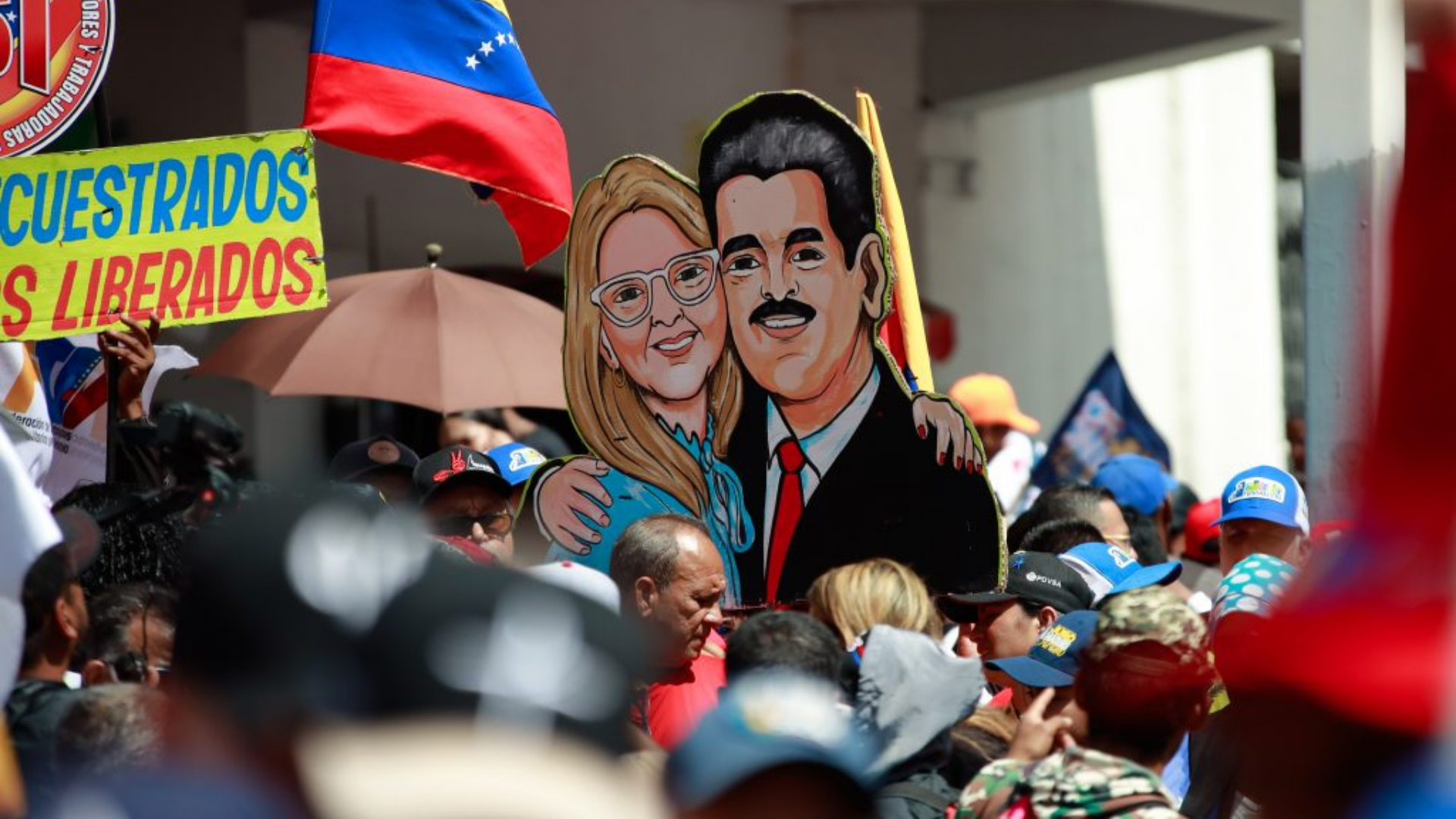
Maduro, wearing a blue jail uniform, was led into court along with his co-defendant wife just before noon for the brief, but required, legal proceeding. Both put on headsets to hear the English-language proceeding as it was translated into Spanish.

The couple were transported to the Manhattan courthouse under armed guard early Monday from the Brooklyn jail where they’ve been detained since arriving in the U.S. on Saturday.

The trip was swift. A motorcade carrying Maduro left jail around 7:15 a.m. and made its way to a nearby athletic field, where Maduro slowly made his way to a waiting helicopter. The chopper flew across New York Harbor and landed at a Manhattan heliport, where Maduro, limping, was loaded into an armored vehicle.

A few minutes later, the law enforcement caravan was inside a garage at the courthouse complex, just around the corner from the one where Trump was convicted in 2024 of falsifying business records. Across the street from the courthouse, the police separated a small but growing group of protesters from about a dozen pro-intervention demonstrators, including one man who pulled a Venezuelan flag away from those protesting the U.S. action.

As a criminal defendant in the U.S. legal system, Maduro will have the same rights as any other person accused of a crime — including the right to a trial by a jury of regular New Yorkers. But he’ll also be nearly — but not quite — unique.

Maduro’s lawyers are expected to contest the legality of his arrest, arguing that he is immune from prosecution as a sovereign head of state.

Panamanian strongman Manuel Noriega unsuccessfully tried the same defense after the U.S. captured him in a similar military invasion in 1990. But the U.S. doesn’t recognize Maduro as Venezuela’s legitimate head of state — particularly after a disputed 2024 reelection.

Venezuela’s new interim president, Delcy Rodríguez, has demanded that the U.S. return Maduro, who long denied any involvement in drug trafficking — although late Sunday she also struck a more conciliatory tone in a social media post, inviting collaboration with Trump and “respectful relations” with the U.S.

Before his capture, Maduro and his allies claimed U.S. hostility was motivated by lust for Venezuela’s rich oil and mineral resources.

The U.S. seized Maduro and his wife in a military operation early Saturday, capturing them in their home on a military base. Trump said the U.S. would “run” Venezuela temporarily, but Secretary of State Marco Rubio said Sunday that it would not govern the country day-to-day other than enforcing an existing “ oil quarantine.”

Trump suggested Sunday that he wants to extend American power further in the Western Hemisphere.

Speaking aboard Air Force One, he called Colombia’s president, Gustavo Petro, “a sick man who likes making cocaine and selling it to the United States. And he’s not going to be doing it very long.”

He called on Venezuela’s Rodriguez to provide “total access” to her country, or else face consequences.

Trump has suggested that removing Maduro would enable more oil to flow out of Venezuela, but oil prices rose a bit more than 1% in Monday morning trading to roughly $58 a barrel. There are uncertainties about how fast oil production can be ramped up in Venezuela after years of neglect and needed investments, as well as questions about governance and oversight of the sector.

A 25-page indictment made public Saturday accuses Maduro and others of working with drug cartels to facilitate the shipment of thousands of tons of cocaine into the U.S. They could face life in prison if convicted.

He and his wife, Cilia Flores, have been under U.S. sanctions for years, making it illegal for any American to take money from them without first securing a license from the Treasury Department.

While the indictment against Maduro says Venezuelan officials worked directly with the Tren de Aragua gang, a U.S. intelligence assessment published in April, drawing on input from the intelligence community’s 18 agencies, found no coordination between Tren de Aragua and the Venezuelan government.

Maduro, his wife and his son — who remains free — are charged along with Venezuela’s interior and justice minister, a former interior and justice minister and Hector Rusthenford Guerrero Flores, an alleged Tren de Aragua leader who has been criminally charged in another case and remains at large.

Among other things, the indictment accuses Maduro and his wife of ordering kidnappings, beatings and murders of those who owed them drug money or undermined their drug trafficking operation. That included a local drug boss’ killing in Caracas, the indictment said.

Flores, Maduro’s wife, is also accused of accepting hundreds of thousands of dollars in bribes in 2007 to arrange a meeting between “a large-scale drug trafficker” and the director of Venezuela’s National Anti-Drug Office, resulting in additional monthly bribes, with some of the money going to Flores, according to the indictment.

Sisak, Neumeister and Tucker write for the Associated Press. Tucker reported from Washington. AP writers John Hanna in Topeka, Kan., Josh Boak in Washington, Darlene Superville aboard Air Force One and Joshua Goodman in Miami contributed to this report.

Source link

Germany charges ex-Syrian prison guard over Assad-era abuses | Syria’s War News

Prosecutors accuse the official, named as Fahad A, of torturing dozens of prisoners in jail run by Syrian intelligence.

German prosecutors have charged a former Syrian security official with crimes against humanity, accusing him of torturing dozens of prisoners at a Damascus jail while ex-President Bashar al-Assad was in power.

Germany’s Federal Public Prosecutor General’s office announced the indictment on Monday, alleging the ex-prison guard, named only as Fahad A, took part in more than 100 interrogations between 2011 and 2012 in which prisoners were “subjected to severe physical abuse”.

Recommended Stories

list of 3 itemsend of list

The abuse included electric shocks, cable beatings, forced stress positions and suspensions from the ceiling, according to a statement by the prosecutor’s office.

“As ‌a result of such mistreatment and the catastrophic prison conditions, at least ‌70 prisoners died,” said the statement, noting the former guard is also charged with murder.

The official was arrested on May 27 and formally indicted on December 10.

He is being held in pre-trial detention, the German prosecutor’s office added.

Syrians have demanded justice for crimes committed under the decades-long rule of al-Assad, who was removed from power in December 2024 after a rapid rebel offensive.

The Assad regime, which was accused of mass human rights abuses, including the torture of detainees and enforced disappearances, fell after nearly 14 years of civil war.

Universal jurisdiction

In Germany, prosecutors have ⁠used universal jurisdiction laws to seek trials for suspects in crimes against humanity committed anywhere in the world.

Based on ‌these laws, several people suspected of war crimes during the Syrian conflict have been arrested in the last ‍few years in Germany, which is home to about one million Syrians.

In June, a court in Frankfurt handed a life sentence to a Syrian doctor convicted of carrying out acts of torture as part of al-Assad’s crackdown on dissent.

The doctor, Alaa Mousa, was accused of torturing patients at military hospitals in Damascus and Homs, where political prisoners were regularly brought for supposed treatment.

Witnesses described Mousa pouring flammable liquid on a prisoner’s wounds before setting them alight and kicking the man in the face, shattering his teeth. In another incident, the doctor was accused of injecting a detainee with a fatal substance for refusing to be beaten.

One former prisoner described the Damascus hospital where he was held as a “slaughterhouse”.

Presiding judge, Christoph Koller, said the verdict underscored the “brutality of Assad’s dictatorial, unjust regime”.

Source link

Hong Kong court convicts democracy activist Jimmy Lai on conspiracy charges | News

The High Court of Hong Kong has convicted pro-democracy activist and newspaper founder Jimmy Lai on three charges related to accusations that he undermined China’s national security, as part of a widely scrutinised trial.

Lai now faces the possibility of a life sentence in prison.

Recommended Stories

list of 3 itemsend of list

On Monday morning, a panel of three judges found Lai, 78, guilty of two counts of conspiring with foreign forces to threaten national security and one count of conspiracy to publish seditious material.

Lai had pleaded not guilty to all the charges. He has been in detention since December 2020, when he was arrested in the midst of a series of antigovernment protests that gripped Hong Kong.

The case has been seen as a test of Hong Kong’s “one country, two systems” principle, which was established after the former British colony was returned to China in 1997.

The principle affirmed that Hong Kong was part of China, but in theory, it allowed the territory to retain its own governance and administrative structure, separate from Beijing.

But activists say that autonomy has been threatened in recent years, as China seeks to assert greater control over Hong Kong. The territory, once seen as a beacon of free speech in Southeast Asia, has seen its protesters, journalists and publishers targeted for arrest and prosecution in recent years.

On Monday, Judge Esther Toh accused Lai of making “constant invitations” to the United States to take action against the People’s Republic of China (PRC) and its ruling Communist Party.

She and her fellow judges, Alex Lee and Susana D’Almada Remedios, issued an 855-page verdict in the case, which described Lai as the “mastermind” of a criminal conspiracy.

“There is no doubt that the first defendant had harboured his resentment and hatred of the PRC for many of his adult years,” Toh told Monday’s packed courtroom.

Human rights groups and media advocacy organisations quickly slammed the verdict as a miscarriage of justice.

“We are outraged that Jimmy Lai, Hong Kong’s symbol of press freedom, has been found guilty on trumped-up national security charges,” Thibaut Bruttin, the general director of Reporters Without Borders, said in a statement.

“This unlawful conviction only demonstrates the alarming deterioration of media freedom in the territory,” he added.

“Make no mistake: it is not an individual who has been on trial – it is press freedom itself, and with this verdict, that has been shattered.”

Another free-speech organisation, the Committee to Protect Journalists (CPJ), also denounced Lai’s conviction, calling it an act of “persecution”.

“The ruling underscores Hong Kong’s utter contempt for press freedom, which is supposed to be protected under the city’s mini-constitution, the Basic Law,” Beh Lih Yi, the group’s Asia-Pacific director, said.

“Jimmy Lai’s only crime is running a newspaper and defending democracy.”

Lai is set to reappear in court on January 12 for a pre-sentencing hearing. It is not yet clear whether he will seek to appeal Monday’s verdict.

The trial against him stretched for 156 days. Lai himself testified for 52 days, arguing that he had not called on the US to impose sanctions or other economic penalties on China, as the prosecution alleged.

The charges he faced came under the 2020 Hong Kong National Security Law, a far-reaching piece of legislation enacted in the midst of the pro-democracy protests of 2019 and 2020.

The law imposed steep penalties for actions deemed to be “subversion” or “secession”, effectively criminalising Hong Kong’s pro-independence movement, as well as any criticisms of the Chinese Communist Party.

As an outspoken critic of the government in Beijing, Lai was quickly charged under the newly imposed law.

His publication, the Apple Daily, published its first edition in 1995, and it became known as Hong Kong’s largest pro-democracy newspaper.

During Lai’s trial, prosecutors presented 161 articles from the newspaper as evidence.

In August 2020, less than two months after the national security law came into effect, Lai was arrested for the first time, then released. He was arrested again in December, only to be released and re-arrested a third time. He has remained in custody ever since.

By May 2021, authorities had frozen Apple Daily’s assets. And in June of that year, five Apple Daily executives, including its editor-in-chief, were taken into custody amid a police raid on the newspaper’s headquarters.

The newspaper printed its final edition that month.

Lai’s defence team and family have repeatedly petitioned Hong Kong’s High Court for leniency, citing Lai’s age and health conditions, including diabetes and high blood pressure.

World leaders like US President Donald Trump have previously called for Lai’s release.

Source link