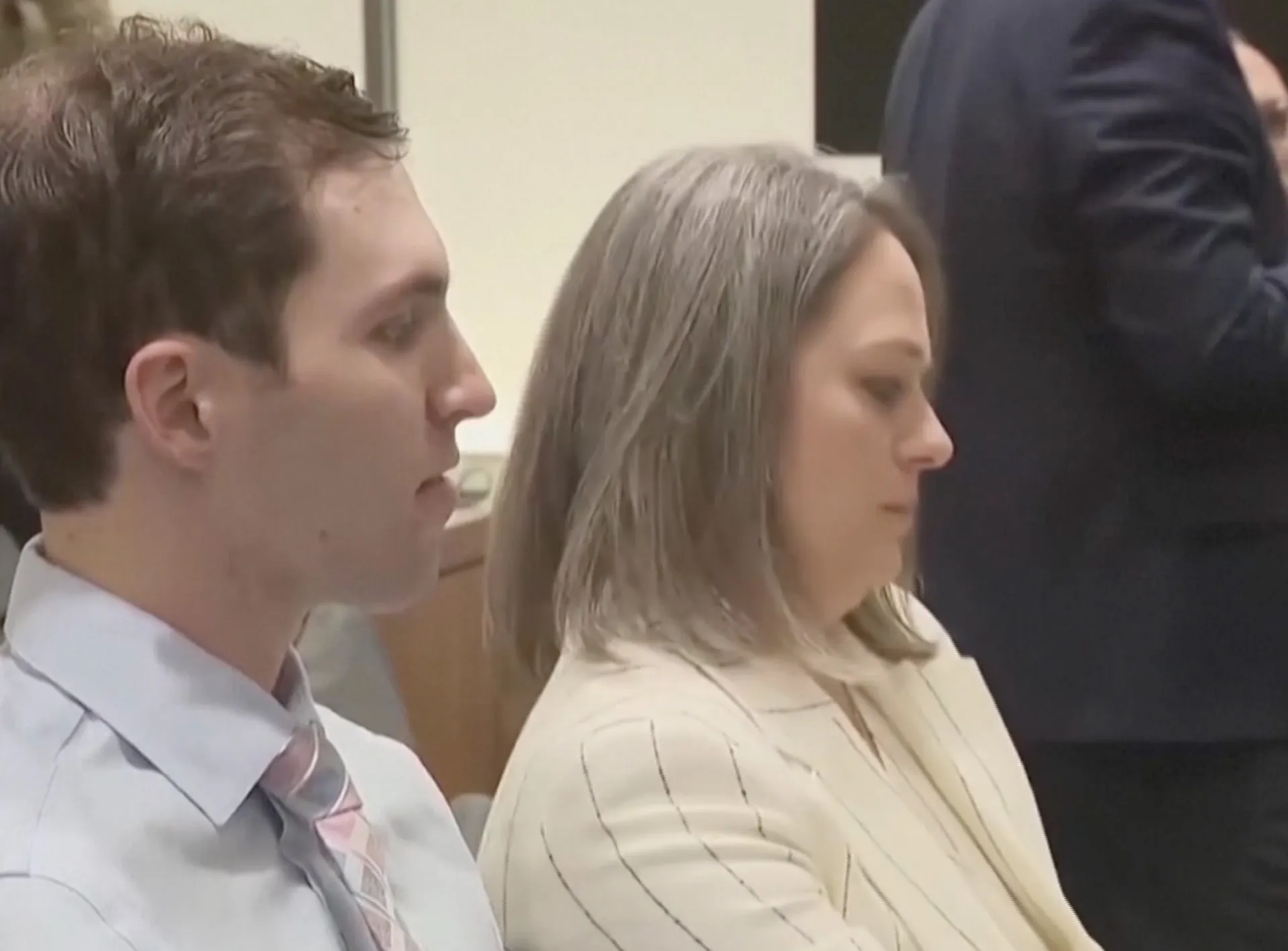
An allegedly intoxicated driver who hit and killed high school tennis star Braun Levi in Manhattan Beach was charged with murder Tuesday, authorities said.
Jenia Resha Belt, 33, of Los Angeles also faces charges of gross vehicular manslaughter while intoxicated and driving with a suspended license, said Pamela Johnson, a spokesperson for the L.A. County district attorney’s office.
Around 12:46 a.m. on May 4, Belt struck Braun, who was walking near Sepulveda Boulevard and 2nd Street, authorities said.
Belt, who was arrested at the scene, had a blood alcohol level nearly twice the legal limit and was driving on a suspended license from a prior DUI arrest, according to court records. Four passengers inside the car fled the area after the collision.
Belt was released in June and then apprehended again months later.
Braun’s parents, who lost their home in the Palisades fire and relocated to the South Bay, filed a $200-million wrongful death lawsuit against Belt in November.
Their son was a standout at Loyola High School and had been slated to play tennis at the University of Virginia. The Levis started the Live Like Braun Foundation in his memory.
Belt is in custody on $2 million bail and is scheduled to be arraigned Wednesday, Johnson said.
Los Angeles County Dist. Atty. Nathan Hochman and Jennifer Levi, Braun’s mother, plan to discuss the charges at a news conference Monday.
Times staff writer Clara Harter contributed to this report.
Former UCLA football star Myles Jack was arrested on suspicion of deadly conduct Tuesday after an incident in which Texas police say he fell from a second-story window.
The former Jacksonville Jaguars and Pittsburgh Steelers linebacker faces charges of deadly conduct, including the third-degree felony of discharge of a firearm and the Class-A misdemeanor of discharge of a firearm in certain municipalities.
The Frisco Police Department said in a news release that officers visited a residence Tuesday at approximately 5:40 a.m. in response to a welfare concern and upon arrival heard gunshots from inside. A perimeter was established and several nearby residences were evacuated as the area was secured.
During the incident, a second-story window was broken and Jack allegedly climbed outside, then fell to the ground. He was taken into custody at 7:12 a.m. and transported to a hospital where he was treated for non-life-threatening injuries sustained in the fall. A search of the residence found no one else inside.
Charges were filed with the Denton County Sheriff’s Office. Jail records show Jack posted $100,000 bail. The investigation remains ongoing and no further details have been released.
Jack was a standout linebacker for the Bruins who also saw significant playing time at running back. He was named the Pac-12 freshman player of the year on defense and offense in 2013. After a knee injury ended his college career three games into his junior season, Jack was selected by the Jaguars in the second round of the 2016 draft. He played six seasons with the Jaguars and two with the Steelers.
In 2023, Jack and his mother, LaSonjia Jack, were announced as the majority owners of the Allen Americans, an ECHL minor league hockey team in the Ottawa Senators organization.
It is suggested the rules could be going ahead as soon as January 7.
However, Rome‘s city council said they were considering the new fee but that there was no confirmation it would be going ahead next month.
The new rule has divided people with some backing it in the hopes to reduce crowds.
One person said on social media: “Good idea. I tried walking through the area last November and could barely move, so many people.”
However, most said it would “ruin the charm” of the fountain.
Others said: “Nothing like taking away from the beautiful view of the fountain.”
Another agreed: “More companies making money!”
A third said: “How does one completely ruin and destroy the beauty of historical Italian architecture and monuments? Stick an ugly turnstile entrance and barriers in front of it.”
Most people visit it to throw a coin in, with legend saying one coin to return to Rome, two for love and three for marriage.
Swansea City boss Vitor Matos says facing Welsh rivals Wrexham provides a different “emotional charge” compared to other Championship games.
The two sides face each other on Friday, 19 September at Swansea.com Stadium in the first league contest between the Swans and the Dragons since 2003 (20:00 GMT).
Despite a geographical distance over more than 100 miles between Swansea in south west Wales and Wrexham in the country’s north east, Matos insists he is treating the game as a derby.
“I think from what I feel from our supporters, I think we can call it a derby, straight on,” said Matos.
“It’s a game with a different emotional charge, but in these games we need that emotion and the passion to drive us forward and that I think that’s quite important.
“For that we need clarity, we need discipline, we need identity and that’s what we will need to focus on our game.
“We need to respect Wrexham. What they’ve done in the recent years, being promoted, and how they are doing this season as well.
“If we look back on the last 10 games, they have only lost one. So I think that deserves, like all teams, our respect and deserves a lot of credit.
“It will be a good game, 100%, and a game that we need to be on our toes to compete, and that’s really important.”
A former Los Angeles Police Department commander who authorities said tipped off CBS to a rape allegation against the network’s top executive will not face criminal charges, with two LAPD detectives claiming department leaders undermined the investigation, according to documents obtained by The Times.
The L.A. County district attorney’s office decided in April it would not prosecute Cory Palka for warning CBS executives in 2017 that a woman had walked into the LAPD’s Hollywood station and accused then-Chief Executive Les Moonves of sexual assault, according to a document provided to The Times in response to a public records request.
Although heavily redacted, the declination memo includes details and a timeline that match up with the findings of a 2022 New York state attorney general’s office investigation that first revealed Palka’s relationship with Moonves. The TV executive’s career ended in disgrace after dozens of women came forward to accuse him of sexual harassment and abuse in 2018.
Palka has not disputed that he improperly disclosed information to CBS, but denied any improper benefit from his relationship with Moonves when reached for comment by The Times this week.
The former LAPD chief who led the department during the investigation, Michel Moore, called allegations the matter was not properly handled “absolutely false.”
Representatives for CBS and Moonves declined to comment.
The Moonves affair drew significant attention at the height of the #MeToo movement, but the fate of Palka has remained a question mark in the years since. The newly uncovered documents shed light on both the outcome of the investigation and tensions within the police department over scrutinizing one of its own.
Palka, a former station captain who retired as a commander in 2021, was often referred to as “Capt. Hollywood” and known for mingling with stars, scoring a bit part in the TV series “Bosch.”
In 2022, the New York state attorney general’s office released a report that revealed Palka left a voicemail for a CBS executive in November 2017, shortly after an 81-year-old woman walked into his station and accused Moonves of sexually assaulting her on two occasions in the late 1980s.
“Somebody walked in the station about a couple hours ago and made allegations against your boss regarding a sexual assault,” he said in a voicemail message left for Ian Metrose, who was then CBS’ senior vice president for talent relations, according to reports made public by prosecutors. “It’s confidential, as you know, but call me.”
For months, Palka gave Moonves and other CBS leaders inside information about the rape investigation and slipped the network a copy of the accuser’s report, according to the New York attorney general’s office. At one point, Palka and Moonves met in person and the executive told the captain he “wanted the LAPD investigation closed.”
Ultimately, prosecutors could not bring a rape case because the statute of limitations had long expired. The accuser, Phyllis Golden-Gottlieb, was a television development executive who previously told The Times that Moonves assaulted her in 1986 and 1988. Those dates match an alleged victim described in the L.A. County district attorney’s office’s memo on Palka. Golden-Gottlieb died in 2022.
Former television executive Phyllis Golden-Gottlieb talks about alleged sexual abuse at the hands of Les Moonves in the law offices of Gloria Allred in L.A. on Sept. 11, 2018. Golden-Gottlieb, who died in 2022, worked with Moonves in the 1980s.
(Brian van der Brug / Los Angeles Times)
After hearing from Palka, top CBS executives “began investigating the victim’s personal circumstances and that of her family,” according to the New York attorney general’s report, which was produced as part of an investigation into the TV network’s leaders for selling stock and allegedly misleading investors while not disclosing the allegations against Moonves.
The district attorney’s office said in the memo obtained by The Times that it declined to bring charges, in part, because the statute of limitations on one of the potential charges against Palka had run out.
The LAPD claimed it didn’t learn of Palka’s alleged misconduct until 2022, but a whistleblower complaint filed in late 2023 by Det. Jason Turner alleges Moore knew of the issue much earlier and ignored it, allowing Palka to escape accountability.
Turner also alleged he found evidence that Palka told at least two other LAPD employees about his relationship with Moonves, but said he was barred from interviewing them, according to the complaint, which was filed with the LAPD’s Office of the Inspector General in November 2023.
“Chief Moore’s failure to initiate a complaint circa 2018-2021 against Palka compromised the investigation and allowed Palka to avoid criminal charges,” Turner wrote in the complaint obtained by The Times.
The LAPD declined to comment. Moore unequivocally denied Turner’s allegations, but did not elaborate further in response to questions about the handling of the investigation. Moore announced his retirement from the LAPD in January 2024.
“It is absolutely baseless,” Moore said of Turner’s claim, adding that the Office of the Inspector General had determined the complaint was unfounded.
A spokesperson for the inspector general’s office said they could not discuss the status of Turner’s complaint.
Michel Moore announces his retirement as LAPD chief at a press conference with Mayor Karen Bass at L.A. City Hall on Jan. 12, 2024.
(Luis Sinco / Los Angeles Times)
The ex-chief described the whistleblower complaint as a “distraction” from Palka’s “terrible actions.”
“It was a disservice. It lacked integrity. It tarnished the badge. It was wrong,” Moore said of Palka.
Turner declined a request to comment through his lawyer Thursday. .
In September 2023 — 10 months after the allegations against Palka became public — a different LAPD internal affairs detective presented a case for L.A. County prosecutors to consider against Palka, according to a memo explaining the decision to decline charges. Prosecutors weighed charges of bribery, obstruction and disclosing information from a criminal investigation for financial gain.
LAPD detectives “suspected Palka had possibly engaged in bribery,” according to the document. While there was no evidence Palka was paid directly for leaking the information about Moonves, he received $500 annually to be part of Moonves’ security detail at the Grammy Awards, according to the New York attorney general’s report.
After leaving the LAPD, Palka was hired as chief of security to billionaire hedge fund manager Michael Milken, according to public records and testimony given by Moonves in a deposition for a civil lawsuit reviewed by The Times. Palka is still employed by Milken today, the records show.
Moonves said in the deposition that he recommended Palka for the job.
A separate complaint to the inspector general’s office obtained by The Times shows another internal affairs detective made allegations that echoed Turner’s. In that complaint, the second detective said LAPD supervisors blocked attempts to interview Moonves, Milken and Metrose, the CBS vice president that Palka purportedly first tipped off about the rape case.
“It is my belief that the refusal by our supervisors to permit us to interview these key individuals jeopardized the integrity of the investigation and was done for improper motives,” wrote the detective, who requested anonymity, fearing professional repercussions.
The April memo from L.A. County prosecutors said there was substantial evidence Palka had improperly disclosed information from a criminal case, but they lacked proof that “Palka gained financially,” so charges of bribery and disclosure of confidential information for financial gain could not be filed.
Asked whether Moonves helping Palka land a high-level security job would be considered financial gain, a district attorney’s office spokesman said prosecutors “could not prove beyond a reasonable doubt that Palka disclosed confidential information in return for financial gain, which is an essential element of the crime of bribery.”
In an email to The Times, Palka did not address questions about the alleged bribery or the district attorney’s charging decision, but challenged the idea that there was any link between Moonves’ recommendation for his current job and the leak of information to CBS.
“My post retirement employment was not considered until I completed my career and fully separated from the LAPD,” Palka said.
Les Moonves, former chairman and CEO of CBS Corporation, poses at the premiere of the new television series “Star Trek: Discovery” in Los Angeles on Sept. 19, 2017.
(Chris Pizzello / AP)
Caleb Mason, a partner at Brown White & Osborn LLP in Los Angeles and a former federal prosecutor, said charges related to Palka’s post-LAPD work would be challenging to prove in court.
“I think a lot of prosecutors would get anxious about filing a case where the theory was simply he had this relationship and after he retired the relationship would get him a job,” Mason said.
In his complaint to the inspector general, Turner said department executives knew of the Hollywood captain’s links to CBS much earlier than has been publicly reported.
CBS attorneys questioned Palka about his relationship with Moonves in 2018, while performing an audit connected to the rape allegations, according to the detective’s complaint. At that time, Palka demanded that the LAPD Command Officers Assn., the union that represents officers above the rank of captain, provide him an attorney, according to the complaint.
“Chief Moore was the Chief at the time and had to have been aware that one [of] his Captains was being interviewed in his official capacity by CBS attorneys for misconduct,” the complaint read. “However, Chief Moore did not initiate a complaint/internal investigation into Cory Palka.”
Muna Busilah, the attorney who Turner claimed represented Palka, declined to say whether or not she was involved in the case. She confirmed she did work with the Command Officers Assn. in 2018, and said there was no requirement to formally notify Moore if a member of the command staff sought legal counsel through the union.
Turner’s complaint accused Moore and LAPD Det. Jason De La Cova, an internal affairs division supervisor, of obstructing justice and dissuading an investigation. De La Cova was the detective who presented a case to the district attorney’s office, according to the declination memo.
“The Chief doesn’t want heads to roll,” De La Cova said to Turner when blocking one of his requests to interview another member of the LAPD, according to the whistleblower complaint.
When reached on Wednesday, De La Cova declined to comment.
A district attorney’s office spokesperson would not say if prosecutors were aware of the misconduct allegations levied against Moore and De La Cova while reviewing Palka’s case. The allegations of obstruction made against the ex-chief and De La Cova in Turner’s complaint have never been presented for consideration of criminal charges, the spokesman said.
De La Cova was previously named in another complaint filed by Tuner.
In 2023, Turner and another detective alleged they were ordered to launch an investigation into Mayor Karen Bass’ receipt of a scholarship from the University of Southern California at Moore’s behest. When both refused, the case was taken over by De La Cova.
Moore has repeatedly denied the allegations. Moore was later cleared of wrongdoing by the department’s inspector general, which concluded in June 2024 after a months-long probe that the detective’s claims were “unfounded.”
WASHINGTON — Republican critics of affirmative action hailed Monday’s Supreme Court decision as a mandate for even more sweeping action by Congress and vowed to press home their attack on federal programs of racial preference.
Senate Majority Leader Bob Dole called the ruling–that preferential treatment based on race is almost always unconstitutional–”one more reason for the federal government to get out of the race-preference business” and summoned fellow lawmakers “to follow the court’s lead and put the federal government’s own house in order.”
Dole, once a supporter of affirmative action, has called for hearings on the subject in the Senate, and has said he may sponsor legislation to rewrite many of the programs. He was joined in his praise of the court ruling by fellow presidential contender Sen. Phil Gramm (R-Tex.), who said Monday’s decision “greatly strengthens the prospects” that he would seek to amend all funding bills passing through Congress this year to bar the use of federal dollars for “quotas and set-asides.”
The court’s dramatic ruling, meantime, thrust President Clinton and other Democrats into a new bind both legally and politically. Administration officials acknowledged it has disrupted a review of the federal government’s 180-odd affirmative action programs now under way. Clinton had sought the review to help deflect criticism both from the GOP and conservative forces within his own party.
Legally, Clinton now can hope to save parts of affirmative action only if he can come up with new rationales that are defensible under the narrow terms outlined by the Supreme Court on Monday. The court said affirmative action programs can be upheld as a means to correct specific, provable cases of discrimination, but not to correct suspected discrimination by a society over time.
That, in turn, underscores Clinton’s political challenge in dealing with the charged issues of race and gender. The President must either acquiesce in cutbacks to affirmative action programs, thereby risking alienation of minority voters who are crucial to his party’s base, or actively defend the programs and risk offending large numbers of white voters.
“This has really intensified the question of which programs should live and which should die,” said one Senate Democratic aide. “And that really raises the heat on what Clinton has been doing.”
The White House has said it expects to complete its review of affirmative action by the end of this month. Before the court announced the rulings, officials familiar with the review have predicted that it would essentially affirm most principles of federal affirmative action, while calling for changes in the procurement “set aside” programs that have attracted so much criticism.
Administration aides were in general agreement that the decision now would considerably delay the results of the review, which were to be released in a major thematic speech.
“If we’re not back to square one, we’ve at least moved back some distance,” said one Administration official.
But with the White House still contemplating its next move on the issue, House Republicans are set to redraft completely the controversial programs that were launched in the early 1960s to compensate women and minorities for past discrimination in higher education and the job market.
Rep. Charles T. Canady (R-Fla.), a one-time Democrat who now chairs the House Judiciary Committee’s constitution subcommittee, is set later this month to unveil legislation that would forbid the federal government to use gender or race preferences in any federal program, and dismantle many of the programs that have come to be central to affirmative action.
The House bill would effectively repeal one of the central features of 160 government programs that use racial and gender preferences in hiring and promoting federal workers, granting federal contracts and awarding benefits under federal programs. It would call a virtual halt to federal programs that “set aside” slots and pools of funding for businesses owned by minorities and women, and would require substantial changes in other programs.
On Monday, Canady said the court’s decision “gives impetus” to Republicans’ political efforts to roll back many such programs, by making clear the court’s intent to “return to a focus on individual rights” over groups’ rights.
But the complex ruling, he added, also makes it vital for Congress to weigh in quickly with its own views on affirmative action. “You’ll now see all kinds of challenges and litigation moving through district appeals courts, all the way to Supreme Court,” Canady said.
But Democratic proponents of affirmative action on Monday said that the court’s ruling had increased pressure on the White House to act, and to do so quickly, before Congressional Republicans seize the initiative.
“It is perhaps even more important that the President take time to delineate a vision and a course of action . . . as only the President can do,” said Rep. Kweisi Mfume, (D-Md.) former chairman of the Congressional Black Caucus.
Mfume, focusing on one of the majority opinion’s few comments that could be construed as justifying existing programs, lauded the court for acknowledging that “race discrimination is real and government has a role in eradicating it.”
“For those Republicans who have some notion that they ought to do away with all set-asides in the government because there’s no need for them, the court is saying, that is not correct, there is still,” he said.
Mfume’s positive tone was echoed by Rep. Maxine Waters (D-Los Angeles), who said she was “somewhat disappointed . . . but certainly not discouraged” by the stringent standards called for by Monday’s Supreme Court ruling.
“We may have to do a lot more work and it’s going to be a little confused,” said Waters. But she asserted the new standards applied by the Supreme Court would by no means spell an end to existing affirmative action programs at the federal level.
“This ruling suggests that the strict scrutiny standards would have to be met, and that there is overwhelming and compelling reasons out there to meet them. It doesn’t take a Harvard scholar to do that. The group certainly has been discriminated against.”
The author of major affirmative action laws in California, Waters stated that with a simple technical change, California statutes allowing set-asides for women- and minority-owned contractors would be able to meet the standards set out by the Supreme Court Monday.
Times staff writer Janet Hook contributed to this story.
ALEXANDRIA, Va. — A grand jury declined for a second time in a week to re-indict New York Attorney General Letitia James on Thursday in another major blow to the Justice Department’s efforts to prosecute the president’s political opponents.
The repeated failures amounted to a stunning rebuke of prosecutors’ bid to resurrect a criminal case President Trump pressured them to bring, and hinted at a growing public leeriness of the administration’s retribution campaign.
A grand jury rejection is an unusual circumstance in any case, but is especially stinging for a Justice Department that has been steadfast in its determination to seek revenge against Trump foes such as James and former FBI Director James Comey. On separate occasions, citizens have heard the government’s evidence against James and have come away underwhelmed, unwilling to rubber-stamp what prosecutors have attempted to portray as a clear-cut criminal case.
A judge threw out the original indictments against James and Comey in November, ruling that the prosecutor who presented to the grand jury, Lindsey Halligan, was illegally appointed U.S. attorney for the Eastern District of Virginia.
The Justice Department asked a grand jury in Alexandria, Va., to return an indictment Thursday after a different grand jury in Norfolk last week refused to do so. The failure to secure an indictment was confirmed by a person who was not authorized to publicly discuss the matter and spoke on the condition of anonymity.
It was not immediately clear Thursday whether prosecutors would try for a third time to seek a new indictment. A lawyer for James, who has denied any wrongdoing, said the “unprecedented rejection makes even clearer that this case should never have seen the light of day.”
“This case already has been a stain on this Department’s reputation and raises troubling questions about its integrity,” defense attorney Abbe Lowell said in a statement. “Any further attempt to revive these discredited charges would be a mockery of our system of justice.”
James, a Democrat who infuriated Trump after his first term with a lawsuit alleging that he built his business empire on lies about his wealth, was initially charged with bank fraud and making false statements to a financial institution in connection with a home purchase in 2020.
During the sale, she signed a standard document called a “second home rider” in which she agreed to keep the property primarily for her “personal use and enjoyment for at least one year,” unless the lender agreed otherwise. Rather than using the home as a second residence, prosecutors say James rented it out to a family of three, allowing her to obtain favorable loan terms not available for investment properties.
Both the James and Comey cases were brought shortly after the administration installed Halligan, a former Trump lawyer with no previous prosecutorial experience, as U.S. attorney amid public calls from the president to take action against his political opponents.
But U.S. District Judge Cameron McGowan Currie threw out the cases last month over the unconventional mechanism that the Trump administration employed to appoint Halligan. The judge dismissed them without prejudice, allowing the Justice Department to try to file the charges again.
Halligan had been named as a replacement for Erik Siebert, a veteran prosecutor in the office and interim U.S. attorney who resigned in September amid Trump administration pressure to file charges against both Comey and James. He stepped aside after Trump told reporters he wanted Siebert “out.”
James’ lawyers separately argued the case was a vindictive prosecution brought to punish the Trump critic who spent years investigating and suing the Republican president and won a staggering judgment in a lawsuit alleging he defrauded banks by overstating the value of his real estate holdings on financial statements. The fine was later tossed out by a higher court, but both sides are appealing.
Comey was separately charged with lying to Congress in 2020. Another federal judge has complicated the Justice Department’s efforts to seek a new indictment against Comey, temporarily barring prosecutors from accessing computer files belonging to Daniel Richman, a close Comey friend and Columbia University law professor whom prosecutors see as a central player in any potential case against the former FBI director.
Prosecutors moved Tuesday to quash that order, calling Richman’s request for the return of his files a “strategic tool to obstruct the investigation and potential prosecution.” They said the judge had overstepped her bounds by ordering Richman’s property returned to him and said the ruling had impeded their ability to proceed with a case against Comey.
Richer and Kunzelman write for the Associated Press. Richer reported from Washington. AP reporter Eric Tucker in Washington contributed to this report.