chair

Ex-US Fed Chair Powell warns against politicisation amid Trump’s attacks | Business and Economy

Jerome Powell says the US central bank is undergoing a ‘stress test’ like other institutions in the current era.

Former US Federal Reserve Chair Jerome Powell has warned against the politicisation of monetary policy amid President Donald Trump’s repeated attacks on the independence of the central bank.

In a speech at an awards ceremony in Boston on Sunday, Powell said that the Fed had been undergoing a “stress test” like many other institutions in the Trump era.

Recommended Stories

list of 4 itemsend of list

Powell said the US Congress had “wisely” chosen to insulate the central bank from political pressure and that all other advanced economies had similar norms upholding the independence of monetary policy.

“These protections have served the public well, and administrations from both parties have respected them,” Powell said after accepting the 2026 John F Kennedy Profile in Courage Award.

“If any administration finds a way to remove Fed officials over policy differences, then future administrations will do so as well,” Powell said.

“The public would lose faith that the central bank will make decisions based only on what’s best for all Americans.”

Powell, who stepped down as the head of the central bank last month, said that the Fed’s credibility would be “lost” in such a scenario.

“That credibility enables the Fed to support a strong and stable economy for the benefit of American families and businesses,” he said.

“Our credibility has been built and sustained over many decades, and we have a duty to safeguard that priceless asset for our fellow citizens and for generations to come.”

Powell, who made the usual decision to stay on as one of the seven members of the Fed’s Board of Governors after stepping down as chair, also offered a broader defence of democratic institutions generally.

“Partisan political differences are normal – indeed essential – in a thriving democracy. But we ought to be united in our commitment to the higher principles that define our nation,” Powell said.

“Chief among them is respect for the rule of law. As John Adams wrote, ours is ‘a government of laws and not of men’. Our public institutions carry us forward through change. These institutions embody our commitment to freedom, democracy, and service of the public good.”

While Powell did not mention Trump by name, the US president has waged a sustained pressure campaign against the central bank for not heeding his demands to cut interest rates more sharply.

Trump repeatedly threatened Powell with dismissal during his tenure, while Trump appointee and ally Jeanine Pirro opened a short-lived criminal investigation into Powell’s congressional testimony about ongoing renovation works at the Fed’s headquarters.

Trump also ordered the removal of Fed governor Lisa Cook over unproven claims of mortgage fraud, though the Supreme Court has ruled that she can remain in her position while it considers a legal challenge against her firing.

Under the Federal Reserve Act, the US president must demonstrate “cause”, widely interpreted to mean malfeasance, to remove any of the Federal Reserve’s governors.

The John F Kennedy Profile in Courage Award was created in 1989 to honour those who demonstrate courage in public service without regard to professional or personal consequences.

Past winners of the award, which is named after Kennedy’s Pulitzer-winning book Profiles in Courage, include former US President Barack Obama, then-Ukrainian President Viktor Yushchenko, and then-UN Secretary-General Kofi Annan.

Source link

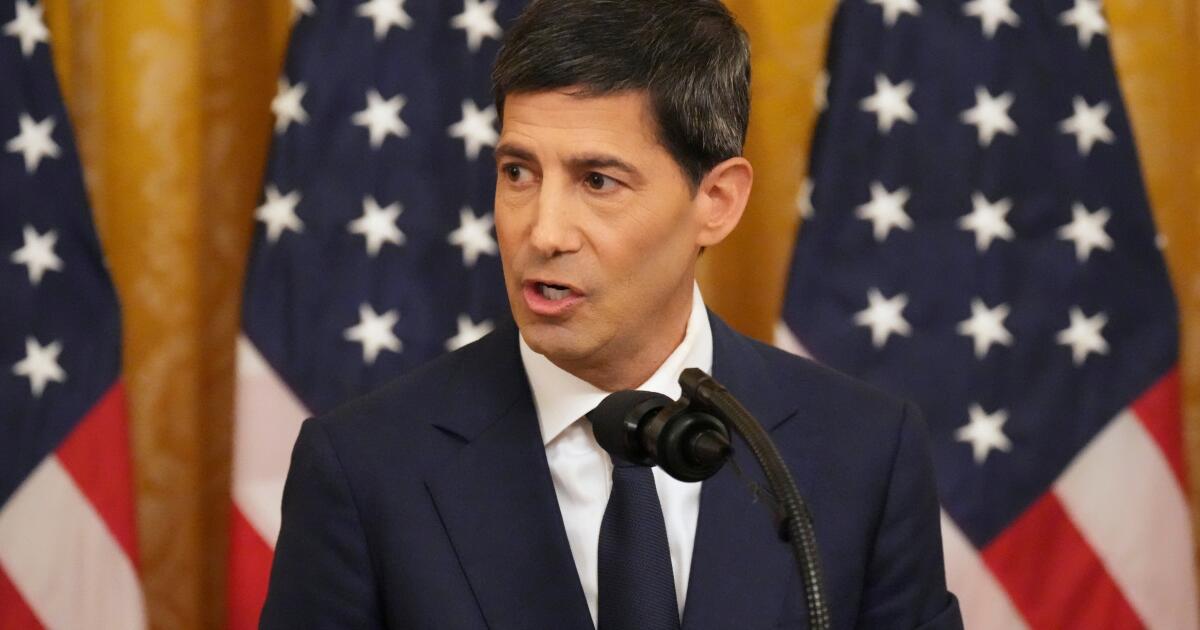
Warsh is sworn in as the Fed chair after Trump’s bid for greater control over the independent bank

President Trump on Friday oversaw the White House swearing-in of the new Federal Reserve chair and said he would like Kevin Warsh’s help in stimulating the economy even as he tried to emphasize that the nation’s central bank would remain independent.

Trump spent months criticizing Warsh’s predecessor, Jerome Powell, for being reluctant to cut interests rates, with the Republican president arguing that lower borrowing costs would provide an economic boost. By taking the unusual step of holding the ceremony in the East Room and not the Fed, Trump made clear his pleasure that Warsh is now in charge.

The war with Iran has caused gas prices to spike, unsettled financial markets and driven inflation concerns across the economy. Those developments have led to recent doubts about whether Warsh might heed Trump’s calls and push the Fed to lower rates.

Still, Trump said he had faith that Warsh would prioritize a strong economy.

“Thankfully, unlike some of his predecessors, Kevin understands that when the economy is booming, it is, that’s a good thing,” the president said. Trump said it was not necessary “to go crazy. Just let it go. We want it to boom.”

Supreme Court Justice Clarence Thomas administered the oath of office. Also on hand were House Speaker Mike Johnson (R-La.), Justice Brett Kavanaugh, CIA Director John Ratcliffe and Cabinet members.

“I expect he will go down as one of the truly great chairmen of the Federal Reserve that we’ve ever had,” Trump said of Warsh.

Republican President Reagan swore in Alan Greenspan as Fed chair at the White House in 1987. Republican President George W. Bush attended the 2006 ceremony at central bank headquarters when Ben Bernanke became chair.

But having the event at the White House raises more questions about the Fed’s independence at a time when Trump has constantly sought to bend the independent central bank to his will.

Trump’s Department of Justice began an investigation into Powell and the Fed’s extensive building renovations. That drew backlash from lawmakers and the department scrapped the investigation. The Fed’s internal watchdog is now handling the matter. Powell’s term as chair ended last week, though he has opted to remain on the Fed board for now.

Trump made a point of saying during his remarks, “Honestly, I really mean this. This is not said in any other way: I want Kevin to be totally independent.”

“I want him to be independent and just do a great job,” Trump said. “Don’t look at me, don’t look at anybody. Just do your own thing.”

In the next breath, however, Trump said that “in the eyes of many, the Fed has lost its way in recent years” under his predecessor, Democratic President Biden. Trump also suggested that Warsh is looking to lead policies that promote “positive economic growth” and that doing so did not have to mean higher inflation.

Trump also noted that the stock market had risen Friday. “That means they like you,” he said of Warsh.

Warsh once harshly criticized Fed’s policies, including its low interest rate policies coming out of the pandemic, which he says contributed to the largest U.S. inflation spike in four decades in 2021-22. More recently, he has sometimes echoed Trump’s demands for lower rates.

Warsh says productivity gains from artificial intelligence will help the economy grow more quickly without spurring inflation, enabling the Fed to reduce borrowing costs. Many Fed officials, however, disagree that AI’s development will support rate cuts, especially because the technology has also been blamed for large-scale layoffs in the computer sector and other parts of the economy.

On Friday, Warsh promised “to lead a reform oriented Federal Reserve, learning from past successes and mistakes, both escaping static frameworks and models and upholding clear standards of integrity and performance.”

He told Trump that he believes “these years can bring unmatched prosperity that will raise living standards for Americans from all walks of life. And the Fed has something to do with it.”

Warsh further noted that the Fed’s mandate “is to promote price stability and maximum employment. When we pursue those aims with wisdom and clarity, independence and resolve, inflation can be lower; growth, stronger; real take home pay, higher and America … more prosperous.”

As he left the ceremony, Treasury Secretary Scott Bessent reinforced Trump’s message, predicting to reporters that Warsh will “do the right thing for inflation and growth.”

Weissert and Price write for the Associated Press.

Source link

Kevin Warsh sworn in as new US Fed chair | Business and Economy News

Warsh will lead the central bank at a time when its independence has come under scrutiny amid political pressure.

Kevin Warsh has been sworn in as the new chair of the United States Federal Reserve Board of Governors, succeeding Jerome Powell, who has held the position since 2018.

Warsh took the oath of office on Friday, following a contentious nomination period, with the Senate voting along party lines on both his confirmation to the Board of Governors and as chairman. Only Pennsylvania Senator John Fetterman broke with his Democratic colleagues to advance his nomination.

Recommended Stories

list of 4 itemsend of list

Warsh, 56, will lead the central bank at a time when its independence has come under scrutiny amid political pressure on the historically non-partisan institution.

US President Donald Trump, aware of that critique, in his opening remarks said, “I want Kevin to be totally independent and do a great job. Don’t look at me and don’t look at anybody. Just do your own job”.

During his confirmation hearing before the Senate Banking Committee, ahead of a vote by the full Senate, Democratic Senator Elizabeth Warren accused Warsh of being a “sock puppet” for Trump. Warsh denied the allegations and said he would remain independent in his monetary policy decisions.

When Joe Biden was president, Warsh advocated against cutting interest rates, but changed his tune when Trump took office. In December 2025, Trump said that he would only appoint someone to lead the central bank who agreed with him on cutting rates.

Regardless, Warsh cannot unilaterally make policy decisions. He is one of 12 voting members.

The first policy meeting Warsh will lead will be on June 16-17.

Inflationary pressures

Pressure from the White House to cut rates comes amid rising inflation in the US economy.

Consumer prices increased 0.6 percent in April after a 0.9 percent rise in March, according to the most recent Consumer Price Index report released by the Labor Department’s Bureau of Labor Statistics earlier this month.

On an annual basis, prices were also higher, rising 3.8 percent compared with the same month in 2025, marking the largest increase in three years. The largest surge has been in energy prices, which have risen 17.9 percent over the last year.

US consumers are feeling the strain at the pump. The average price for a gallon of petrol (3.78 litres) is $4.56, according to the American Automobile Association (AAA), which tracks daily petrol prices. That is up from $2.98 per gallon on February 28, when the US and Israel first struck Iran.

After he was sworn in, Warsh said he was “not naive” about the challenges facing the US economy, and that inflation can be lower and growth strong.

Surging prices could put pressure on the central bank not to cut rates. Analysts from JPMorgan Chase forecasted last month that rates will likely remain unchanged until mid-2027 and anticipated then that rates could rise rather than be cut.

“With inflation having run significantly above 2 percent over the past five years, with further increases in inflation likely to occur as a result of the conflict in the Middle East, and with emergent price pressures in a few categories that appeared unrelated to tariffs or energy prices, the staff viewed the possibility that inflation would be more persistent than anticipated as a salient risk,” the central bank said in the newly released minutes of its April policy meeting.

CME Group’s FedWatch tool, which tracks the likelihood of monetary policy decisions, says there is a 97 percent chance that rates will remain unchanged at the next policy meeting.

Source link

Senate confirms Trump pick Warsh as chairman of the Federal Reserve

The Senate confirmed President Trump’s nominee to lead the Federal Reserve, Kevin Warsh, bringing new leadership to the world’s most powerful central bank at a fraught moment for the global economy.

Warsh was confirmed Wednesday in a largely party-line vote. His nomination had been thrown into doubt in recent months after Republican Sen. Thom Tillis of North Carolina said he would block the nomination while the Justice Department investigated Fed Chair Jerome H. Powell. The Powell inquiry was dropped in April, clearing the way for the Senate to confirm Warsh.

Senate Majority Leader John Thune (R-S.D.) urged colleagues to support Warsh during a floor speech Wednesday morning, saying it’s crucial that a Fed chair “understand not only the macro” but also “appreciate the microeconomy: and that’s the hardworking Americans, their jobs and their livelihoods.”

“Kevin Warsh is just such a person,” Thune said.

Warsh, 56, a former top Fed official, will become chair at an unusually difficult time for the independent agency.

Inflation has topped the Fed’s 2% target for five years and is now rising faster because of surging gas prices. The Fed’s interest rate-setting committee is divided and saw the most dissenting votes in more than three decades last month. And Powell, after years of personal attacks from the Republican president and an unprecedented legal investigation by the Justice Department, plans to stay on the Fed’s board even after his term as chair ends, potentially creating a competing power center.

Trump has demanded change at the Federal Reserve

The Fed has faced numerous threats to its independence from Trump, who has repeatedly attacked Powell for not cutting interest rates. Trump also sought to fire Fed Gov. Lisa Cook and launched an investigation into brief Senate testimony by Powell on a building renovation.

Kevin Hassett, director of the White House’s National Economic Council, said in a Fox News interview on Sunday that he believes the markets are relieved that Warsh “is going to help lower interest rates over time.”

“Obviously, data driven,” said Hassett. “I’m not putting any pressure on Kevin Warsh.”

In December, Trump said on his social media platform that he wanted a Fed chair who would cut interest rates when the stock market rose — the opposite of what traditional economics would prescribe — and added, “Anyone that disagrees with me will never be the Fed chairman!”

Trump’s comments have fueled concerns over whether Warsh will set rates based on economic conditions or seek to cut rates to appease Trump, even if doing so could worsen inflation. At Warsh’s confirmation hearing last month, Sen. Elizabeth Warren, a Democrat from Massachusetts, derided him as a “sock puppet” for Trump. Warsh declined to say that Democrat Joe Biden had won the 2020 election against Trump, who has falsely claimed that voter fraud cost him reelection.

Still, Warsh denied at the hearing that Trump had pressured him to reduce the Fed’s key rate.

“The president never once asked me to commit to any particular interest rate decision, period,” Warsh said then. “Nor would I ever agree to do so if he had. … I will be an independent actor if confirmed as chair of the Federal Reserve.”

A critic of the Fed’s leadership in the past

Warsh has been highly critical of the Fed’s recent track record, particularly the inflation spike in 2021-22, the worst in four decades, and has called for “regime change.” Yet he has provided only broad outlines of what that change would involve.

He has called for limiting the Fed’s communications, which would be a sharp shift after decades of increasing transparency. He has argued that some of its communications tools, such as quarterly forecasts of where its key rate may head, have made it harder for officials to switch gears.

Senate Democrats also have condemned Warsh for not fully divulging the details of his extensive wealth, which disclosures show amounts to at least $100 million. His investments include stakes in Polymarket and SpaceX, but he hasn’t revealed how large those holdings are. He promised to sell all such assets within 90 days of being sworn in.

“He will be the wealthiest Fed chair in history, but he refuses to provide transparency to the American people about who he is entangled with,” Warren said.

Warsh faces difficult economic conditions

The Fed is still grappling with how to respond to the 50% jump in gas prices from the Iran war. The increase has boosted inflation, which reached 3.8% in April.

The Fed is tasked by Congress with keeping prices stable, which it seeks to do by raising its short-term rate to make borrowing and spending more expensive, cooling growth and inflation.

The Fed typically looks past temporary price increases that stem from supply disruptions, such as the war’s cutoff of oil through the Strait of Hormuz, because those prices typically level off — or even fall back down — once the supply is restored.

But the Fed also followed that approach after the COVID-19 pandemic snarled global supply chains for goods, lifting prices for things such as cars, furniture and electronics. Inflation turned out to last longer than expected, and Powell and other Fed officials have acknowledged they waited too long to raise rates. Inflation surged to 9.1% by June 2022.

The Fed’s rate-setting committee has kept rates unchanged for three straight meetings as it evaluates the effect of the gas price spike. At its most recent meeting last month, three members of the committee objected to language that suggested its next move would be a rate cut. They preferred more neutral language that would allow for a hike. Many Fed watchers saw those dissents as a warning shot to Warsh that he won’t be able to easily engineer rate reductions.

A fourth member of the 12-member committee, Stephen Miran, dissented in favor of a rate cut, as he has at every meeting since Trump appointed him to the Fed’s board last September. Miran is serving until a replacement is named, and Warsh will take his spot.

Powell, meanwhile, said at a news conference April 29 that he would remain as a Fed governor until the Justice Department closes its investigation into the Fed’s building project, the first time a chair may stay on the board for an extended period since 1948. His term as a governor lasts until January 2028.

U.S. Atty. Jeanine Pirro has dropped the government’s investigation, but she has said it could be reopened if the Fed’s inspector general office, which has looked into the renovation project since last July, finds evidence of criminal activity.

Rugaber and Cappelletti write for the Associated Press.

Source link

Hegseth faces bipartisan grilling about weapons drawdown during the Iran war

Defense Secretary Pete Hegseth faced tough questions Tuesday from Republican and Democratic lawmakers about the Trump administration’s end game for the Iran war, the cost of the conflict and its impact on diminishing U.S. weapons stockpiles.

For his part, the Pentagon chief softened his tone from hearings before Congress nearly two weeks ago, notably avoiding the same pointed criticism of lawmakers in his opening remarks as he outlined the Trump administration’s efforts to ramp up production of weapons and other military capabilities.

Even so, Hegseth insisted that the military has plenty of missile defense systems and other munitions for the Iran war or future conflicts as both Republicans and Democrats hammered him with those concerns.

“I take issue with the characterization that munitions are depleted in a public forum,” Hegseth said. “That’s not true.”

The cost of the Iran war has risen to about $29 billion, the vast bulk of which — $24 billion — is related to replacing and repairing munitions but also includes operational costs to keep forces deployed, Pentagon comptroller Jay Hurst said. That’s up from $25 billion that he told lawmakers nearly two weeks ago.

The powerful House and Senate Appropriations subcommittees that oversee defense spending are holding back-to-back hearings to review the Trump administration’s 2027 military budget proposal, which calls for a historic allocation of $1.5 trillion. The discussions in the House quickly veered into the handling of a war that appears locked in a stalemate as higher fuel prices pose political problems for Republicans in the midterm congressional elections.

Hegseth and Caine face bipartisan pushback on munitions stockpiles

Rep. Rosa DeLauro, the ranking Democrat on the House Appropriations Committee, told Hegseth that the “question must be answered at the end of this crisis: What have we accomplished and at what cost?”

“This administration has not presented Congress with any kind of clear or coherent strategy week to week, day to day, hour to hour,” DeLauro said. “The rationale shifts, the objectives change. The end game is ill-defined when it is defined at all.”

California Republican Rep. Ken Calvert, the House subcommittee’s chair, also asked about the impact of the Iran war on military funding as well as the U.S. military’s weapons stockpiles.

“Questions persist about whether we are building the depth and reliance required for a high-end conflict,” Calvert said.

Minnesota Rep. Betty McCollum, the defense subcommittee’s ranking Democrat, pressed Hegseth on whether the military has a plan to draw down troops in the Middle East if Congress passes so-far-unsuccessful efforts to end the Iran war.

“We have a plan to escalate if necessary,” Hegseth said. “We have a plan to retrograde if necessary. We have a plan to shift assets.”

He said he would not reveal any next steps publicly. Noting repeated questions from lawmakers over the military’s weapons stockpiles, drawn down from the Iran war, Hegseth said the concerns have been “unhelpfully overstated” and that “we have plenty of what we need.”

He said the defense industry has been told to “build more and build faster,” blaming the military industrial base’s inadequate capacity on previous administrations and U.S. aid to Ukraine in its war with Russia.

Trump administration faces pressure from impact of the Iran war

President Trump is facing increasing pressure from the economic shocks of Iran effectively closing the Strait of Hormuz, a vital shipping corridor where 20% of the world’s oil normally flows. The U.S. military in turn has blockaded Iranian ports and the two sides have traded fire, with American forces thwarting attacks on their warships and disabling Tehran-linked oil tankers.

Trump said Monday that the ceasefire is on “massive life support” and criticized Iran for its latest proposal, pointing to his demands that Iran significantly limit its nuclear program.

“I would call it the weakest right now after reading that piece of garbage they sent us,” Trump said.

The Republican president also said he wanted to suspend the federal gas tax to help Americans shoulder surging fuel prices. He has previously said higher costs are worth it to prevent Iran from getting a nuclear weapon.

Tuesday’s hearings are giving a mostly new group of lawmakers the chance to grill or applaud Hegseth and Gen. Dan Caine, chair of the Joint Chiefs of Staff, on the planning and execution of the war.

The Senate hearing later Tuesday will include Sen. Susan Collins of Maine, a Republican whose reelection this year is far from guaranteed. She voted with Democrats on an effort to halt the conflict late last month, saying she wants to see a defined strategy for bringing the war to a close.

Alaska Sen. Lisa Murkowski, another Republican on the Senate Appropriations defense subcommittee, has voted against the string of unsuccessful war powers resolutions but spoken of the need for congressional authorization so Americans will know the war’s limits and objectives.

He also will face plenty of friendly Republicans, including the Senate subcommittee’s chair, Sen. Mitch McConnell of Kentucky, and perhaps the Iran war’s biggest booster in Congress, Sen. Lindsey Graham of South Carolina.

Finley, Toropin and Barrow write for the Associated Press. Barrow reported from Atlanta.

Source link

Oversight chair seeks information from OpenAI’s Sam Altman about potential financial conflicts

The chair of the House Oversight Committee has sent a letter to OpenAI Chief Executive Sam Altman requesting information about potential conflicts of interest between Altman’s personal investments and his operation of the company.

The letter, sent Friday, comes amid a high-stakes legal battle currently playing out in an Oakland federal courtroom between one-time partners Altman and Elon Musk, the world’s richest man, who in 2015 co-founded the AI company best known for creating ChatGPT.

The company was first established solely as a non-profit corporation and the letter sent to Altman by Rep. James Comer (R-Ky.), the Republican chair of the Oversight committee, indicates that the committee is “investigating potential conflicts of interest involving capital from nonprofit corporations invested in startups and other for-profit companies.”

Comer has requested by May 22 a briefing from the company official responsible for oversight of potential conflicts involving company officers and directors, including Altman, as well as all documents related to conflict of interest policies and guidance for those executives.

While OpenAI was created as a non-profit designed to responsibly harness the power of the emerging artificial intelligence technology, the company created a for-profit subsidiary in 2019 and three years later released ChatGPT, which jumpstarted widespread adoption of the technology.

Musk, the chief executive of Tesla, left Open AI’s board in 2018, one year before the creation of the for-profit arm. He is arguing that Altman and another co-founder, Greg Brockman, betrayed the original mission of the non-profit organization, driven by their desire to “cash in” on the technology.

Musk added Microsoft, a significant investor in OpenAI, to the lawsuit in 2024. OpenAI is rumored to be gearing up to go public later this year or early next, and was recently valued at $852 billion.

Musk has said that he invested $38 million in the OpenAI non-profit, but he does not stand to benefit from a potential OpenAI public offering.

He created a rival company xAI in 2023 that was later folded into his company SpaceX

In the lawsuit, Musk is seeking $150 billion in damages, for Altman to be removed from the company and for the company to be fully returned to its non-profit status.

Musk’s complaint also alleges that Altman engaged in self-dealing by directing OpenAI to pursue deals with companies in which he also held a personal stake, including nuclear fusion power company Helion.

Comer’s letter cites reporting that Altman’s pursuit of a Helion deal, which is still ongoing, would come at a lofty valuation of the power-company, boosting the company’s worth, and the value of Altman’s investment.

Altman was briefly forced to step down from leadership of OpenAI in 2023 in part due to concerns about potential conflicts between his personal investments and his operation of the company, but was soon reinstated.

While the company’s board created an audit committee to investigate the potential conflicts of Altman and other officers, the findings were never disclosed.

Comer has requested that Altman turn over all documents and communication related to that audit committee.

Representatives for OpenAI did not immediately respond to requests for comment.

Source link

Kevin Warsh is one step closer to top job at the Fed after Trump’s pick approved by Senate committee

The Senate Banking Committee voted on party lines Wednesday to approve Kevin Warsh as the next chair of the Federal Reserve to replace Jerome Powell, a longtime target of President Trump’s insults for not cutting borrowing costs as far as the president wanted.

The vote was 13-11, with all Republican senators voting in favor and Democrats opposed.

Warsh is a former top Fed official but has also been a sharp critic of the institution and Powell’s leadership. He has called the inflation spike to 9.1% in 2022 the central bank’s biggest policy mistake in four decades. A vote on his nomination probably won’t take place until next month, but he could be confirmed by the time Powell’s term as chair ends May 15.

The Senate Banking vote is the first of two key events surrounding the future of the Fed’s leadership. Also Wednesday, Powell is presiding over what will probably be his last meeting of the Fed’s interest rate-setting committee. At a news conference Wednesday afternoon, Powell may indicate whether he will remain as a member of the central bank’s board of governors after his term as chair ends.

It would be unusual for Powell to stay, but doing so would deprive the Trump administration of an opportunity to appoint a new member to the board. Powell may choose to stay if he sees it as necessary to protect the Fed’s independence, which has become part of his legacy as its leader.

Sen. Tim Scott, a South Carolina Republican and chair of the committee, said Warsh is “battle tested” and added that, “It is incredibly important that we break the bind of Bidenomics on households across this nation.”

Sen. Elizabeth Warren, a Democrat from Massachusetts, criticized the banking panel for voting on Warsh’s nomination. Doing so “will bring the president one step closer to completing his illegal attempt to seize control of the Fed and artificially juice the economy,” she said, citing Trump’s effort to fire Fed governor Lisa Cook and investigate Powell.

The Fed on Wednesday is widely expected to leave its key rate unchanged at about 3.6% for its third straight meeting, defying Trump’s calls for lower rates.

Warsh has called for “regime change” at the Fed and could alter many of its practices, including the economics models it focuses on, how it communicates with the public, and how large its bondholdings will be in the long run.

Those changes could affect financial markets, but otherwise won’t necessarily be visible to the general public. But Warsh has also advocated for additional interest rate cuts, which could potentially lower borrowing costs for mortgages, auto loans, and business loans. He will face barriers to implementing those cuts anytime soon, however, largely because the Iran war has caused a spike in gas prices, pushing inflation to a two-year high of 3.3%.

The Fed typically keeps rates elevated, or even raises them, to combat worsening inflation.

Most of the other 11 members of the Fed’s rate-setting committee have indicated they would prefer to wait and evaluate where inflation and the economy are headed before making any changes to rates. It could take time for Warsh to build up enough influence to push for rapid rate cuts. He will also replace Stephen Miran, a member of the Fed’s rate-setting committee who was appointed by Trump last September and is the most consistent advocate for rate reductions at the central bank.

Warsh also faces questions about his independence from the White House, a key issue that dogged him during a Senate Banking hearing last week. On Wednesday, Warren said, “Mr. Warsh is a Trump sock puppet who is so cowed by the president that he could not even say that Trump lost the 2020 election.”

Last December, Trump called for much lower interest rates in a social media post, and added that “anyone who does not agree with me will never be Fed chair!” And just last week he told Fox Business that he expects rates to head lower, “when Kevin gets in.”

Warsh denied at his hearing, however, that Trump had ever pressured him directly to cut rates.

Rugaber writes for the Associated Press.

Source link

Dylan Carter dead: Contestant on Season 24 of ‘The Voice’ was 24

Dylan Carter, a contestant on Season 24 of “The Voice,” died in a car accident on Saturday.

According to the NBC affiliate serving the Lowcountry region of South Carolina, the musician died in a single-vehicle crash on a rural road in Colleton County. He was 24.

Country music legend Reba McEntire, who was Carter’s coach on “The Voice,” posted a tribute on social media Monday morning, writing, “We will miss Dylan so much. He was a brilliant, kind and talented young man who brought a huge ray of sunshine to The Voice. Rest in peace, my dear friend.”

Moncks Corner Mayor Thomas Hamilton Jr. also memorialized the Lowcountry singer, writing on Facebook that his family was “heartbroken” to hear about the accident.

“As a gifted singer, he frequently entertained our community with his performances at Town events,” read the post. “His kindness and charm earned him immense respect, and his absence will be deeply felt.

“To the loved ones and acquaintances of Dylan, we offer our sincerest condolences during this difficult period. The Town of Moncks Corner, its Council, and entire staff extend their deepest sympathies. He was much more to our family than an entertainer he was our friend and we are deeply saddened.”

Carter was slated to perform Monday night at the town of Moncks Corner’s “Music on Main” event. The organizer posted that the event had been canceled, and the comments section was filled with an outpouring of shock and grief.

Carter competed on Season 24 of “The Voice” in 2023. During his blind audition, he sang Whitney Houston’s “I Look to You,” which he dedicated to his mother, who had died the year before. During his audition, all four judges turned their chairs for the contestant, with Gwen Stefani hitting her red button during the song’s first verse.

“You only get four chairs if you really move the room,” said judge Niall Horan, who called his performance spectacular.

McEntire was choked up and said she could feel and hear Carter’s emotion while he sang. “That’s when you know you’ve got a great song and a great singer,” she said. “When it touches your heart.”

“When I saw y’all turn around, I saw my mom,” Carter told the judges. “She passed back in October and she wanted me to sing it at her funeral, so I did it — I tried, but I couldn’t make it through it. This was the best second chance. I just made her so proud.”

After Carter was eliminated from the competition series, he posted on Instagram, reflecting on his experience: “Well last night did not go as we all were hoping, but I am proud to say that I went out there on that stage and gave it MY ALL.”

Carter admitted that he felt defeated when he was eliminated, adding, “but it did not take me long to realize that I actually didn’t lose anything, instead I gained EVERYTHING!”

“I came to The Voice unsure of myself, unsure of my future, and still grieving the loss of my mom. I left LA with confidence in myself and my future, with a sure purpose as to why I was put on this Earth, and with peace of mind moving on from my mom’s death. I’ve been afraid of moving on from my mom’s death because I thought moving on meant forgetting her. Boy was I wrong!!! I’m moving forward with her, as she shines through me! All she ever wanted was for me to find myself, to find my voice, and for me to be happy…. I left LA with all of that plus more!!! I even gained all of you guys.”

The South Carolina Highway Patrol is investigating the accident.


Source link

Sen. Thom Tillis will vote to confirm Trump nominee for Fed chair

Sen. Thom Tillis, R-N.C., said on Sunday that he will vote to confirm President Donald Trump’s nominee for Federal Reserve chairman after the Department of Justice assured him it has ended its investigation into current chair Jerome Powell. Photo by Bonnie Cash/UPI | License Photo

April 26 (UPI) — U.S. Sen. Thom Tillis, R-N.C., said on Sunday that he will end his blockade of Kevin Warsh’s confirmation as Federal Reserve chair after the Department of Justice ended its investigation into current chair Jerome Powell.

U.S. Attorney Jeanine Pirro on Friday said the Justice Department was ending its investigation into Powell over the Fed’s budget for renovations to its headquarters and has threatened him with criminal charges over testimony he gave about the costs.

Tillis made the announcement during an interview on NBC News’ “Meet The Press,” because the department assured him that it has “completely and fully ended” the investigation.

He had previously said he would block all Trump nominees until the probe was dropped.

“We worked a lot over the weekend to make sure that we were very clear that we have assurances from the Department of Justice that I needed to feel like they were not using the department as a weapon to threaten the independence of the Fed,” Tillis told NBC News.

The Justice Department launched a criminal investigation into Powell in January after President Donald Trump questioned the Fed being over budget on renovations to its headquarters in Washington, D.C.

The investigation was condemned by several members of Congress as improper, including Tillis, because it was seen as politically motivated punishment from Trump for not setting interest rates at levels he preferred.

Pirro said Friday that she has asked the Federal Reserve’s inspector general to investigate the renovation costs, which she said is “billions of dollars” over budget, and that she expects a “comprehensive report” on the matter.

She noted, however, that she “will not hesitate to restart a criminal investigation should the facts warrant doing so.”

President Donald Trump and first lady Melania Trump participate in the 2026 White House Correspondents’ Association Dinner in Washington on April 25, 2026. Photo by Yuri Gripas/UPI | License Photo

Source link

US Justice Department drops criminal probe of Fed chair Jerome Powell | Business and Economy News

The announcement on Friday is expected to clear the path for the confirmation of his successor, Kevin Warsh.

The United States Department of Justice has ended its probe into US Federal Reserve chair Jerome Powell, clearing a major roadblock to the confirmation of his successor, Kevin Warsh.

US Attorney for the District of Columbia Jeannine Pirro said on X on Friday that her office was ending its probe into the Fed’s extensive building renovations because the Fed’s inspector general would scrutinise them instead.

Recommended Stories

list of 4 itemsend of list

Pirro, a Trump ally and the top federal prosecutor in Washington, DC, said she had instead asked the Fed’s internal watchdog, the Office of Inspector General, to examine cost overruns in renovations of the central bank’s Washington headquarters.

“The IG has the authority to hold the Federal Reserve accountable to American taxpayers,” Pirro said in a social media post. “I expect a comprehensive report in short order and am confident the outcome will assist in resolving, once and for all, the questions that led this office to issue subpoenas.”

The move could lead to a swift confirmation vote by the Senate for Warsh, a former top Fed official whom US President Donald Trump, a Republican, nominated in January to replace Powell. Powell’s term as chair ends May 15.

Senator Thom Tillis, a North Carolina Republican, had said he would oppose Warsh until the investigation was resolved, effectively blocking his confirmation.

The leadership transition at the world’s leading central bank could now proceed quickly.

Republicans praised Warsh during a Tuesday hearing even as Democrats questioned his independence from Trump, the lack of transparency around some of his financial holdings, and what they said was his flip-flopping on interest rates. Senator Elizabeth Warren of Massachusetts, the ranking Democrat on the committee, questioned if Warsh will be a “sock puppet“.

Still, Trump’s previous appointment to the Fed’s board of governors, Stephen Miran, was approved by the full Senate just 13 days after his nomination.

No evidence

The investigation was among several undertaken by the Department of Justice into Trump’s perceived adversaries. For months, it had failed to gain traction as prosecutors struggled to articulate a basis to suspect criminal conduct.

A prosecutor handling the case conceded at a closed-door court hearing in March that the government had not yet found any evidence of a crime, and a judge subsequently quashed subpoenas issued to the Federal Reserve.

The judge, James Boasberg, said prosecutors had produced “essentially zero evidence” to suspect Powell of a crime. Boasberg branded prosecutors’ justification for the subpoenas as “thin and unsubstantiated”.

More recently, prosecutors made an unannounced visit to a construction site at the Fed’s headquarters but were turned away, drawing a rebuke from a defence lawyer in the case who called the manoeuvre “not appropriate”.

Warsh said during the Senate hearing on Tuesday that he never promised the White House that he would cut interest rates, even as the president renewed his calls for the central bank to do so.

“The president never once asked me to commit to any particular interest rate decision, period,” Warsh said during the hearing. “Nor would I ever agree to do so if he had … I will be an independent actor if confirmed as chair of the Federal Reserve.”

Warsh’s comments came just hours after Trump, in an interview on CNBC, was asked if he would be disappointed if Warsh did not immediately cut rates and responded, “I would.”

The decision to abandon the investigation represents a rare pullback for a Department of Justice that over the last year has moved aggressively, albeit unsuccessfully, to prosecute public figures the president does not like.

Robert Hur, an lawyer for the Federal Reserve Board of Governors, did not immediately respond on Friday to an email seeking comment.

Source link

Justice Department drops criminal probe of Fed chair Powell, likely clearing way for Warsh

The Justice Department has ended its probe into Federal Reserve chair Jerome Powell, clearing a major roadblock to the confirmation of his successor, Kevin Warsh.

U.S. Attorney for the District of Columbia Jeannine Pirro said on X that her office was ending its probe into the Fed’s extensive building renovations because the Fed’s Inspector General would scrutinize them instead.

The decision ends an investigation, one of several undertaken by the Justice Department into President Trump’s perceived adversaries, that for months had failed to gain traction as prosecutors struggled to articulate a basis to suspect criminal conduct.

A prosecutor handling the case conceded at a closed-door court hearing in March that the government hadn’t yet found any evidence of a crime, and a judge subsequently quashed subpoenas issued to the Federal Reserve. The judge, James Boasberg, said prosecutors had produced “essentially zero evidence” to suspect Powell of a crime. Boasberg prosecutors’ justification for the subpoenas as “thin and unsubstantiated.”

More recently, prosecutors made an unannounced visit to a construction site at the Fed’s headquarters but were turned away, drawing a rebuke from a defense attorney in the case who called the maneuver “not appropriate.”

The move could lead to a swift confirmation vote by the Senate for Warsh, a former top Fed official whom Trump, a Republican, nominated in January to replace Powell, whose term as chair ends May 15. Sen. Thom Tillis, a North Carolina Republican, has said he would oppose Warsh until the investigation was resolved, effectively blocking his confirmation.

Warsh said Tuesday that he never promised the White House that he would cut interest rates, even as the president renewed his calls for the central bank to do so.

“The president never once asked me to commit to any particular interest rate decision, period,” Kevin Warsh, a former top Fed official, said under questioning by the Senate Banking Committee. “Nor would I ever agree to do so if he had. … I will be an independent actor if confirmed as chair of the Federal Reserve.”

Warsh’s comments came just hours after Trump, in an interview on CNBC, was asked if he would be disappointed if Warsh didn’t immediately cut rates and responded, “I would.”

Source link

House Oversight chair says some members support a Ghislaine Maxwell pardon

The Republican chair of the House Oversight Committee said some of its members would support a presidential pardon for convicted sex trafficker Ghislaine Maxwell in exchange for her assistance in the committee’s investigation into Jeffrey Epstein.

But good luck getting any of them to admit it.

Rep. James Comer (R-Ky.) told Politico Wednesday that “a lot of people” support the idea of Maxwell receiving a pardon from President Trump in exchange for her cooperation in the committee’s investigation.

Although Comer said he opposed a pardon himself — “other than Epstein, the worst person in this whole investigation is Maxwell” — he offered that his committee was “split” on the issue.

Rep. Robert Garcia of Long Beach, the top Democrat on his committee, condemned the idea of a Maxwell pardon and said Democrats on the committee uniformly oppose it.

“It’s outrageous that Republicans on the Oversight Committee are considering a pardon for Ghislaine Maxwell,” Garcia said in a statement. “She is a sexual abuser who facilitated the rape of women and children.”

The Times reached out to all 26 Republicans on the committee to see who, if anyone, supported the idea of a pardon.

Although most didn’t respond, the few who did expressed outrage at the idea.

“I am absolutely not supporting a pardon for her nor have I heard that from anyone else,” said Rep. Anna Paulina Luna (R-Fla.).

“Never in a thousand years,” said Rep. Clay Higgins (R-La.).

Maxwell declined to answer the committee’s questions during a video deposition in February from the Texas federal prison where she is serving her 20-year prison sentence.

She is still challenging her 2021 conviction on five counts related to the sex trafficking of minors for her role in recruiting and grooming girls for Epstein to abuse. She was accused at trial of also participating in the abuse of one victim.

At the time of her February deposition, Maxwell’s attorney David Oscar Markus said she would offer the “unfiltered truth” if granted clemency by Trump.

Attorneys who have represented victims abused by Epstein and Maxwell strongly opposed the idea of a pardon.

“This is a woman who belongs behind bars for the rest of her life for what she did to women,” said Spencer Kuvin, who has represented numerous Epstein victims.

Sigrid McCawley, a managing partner at Boies Schiller Flexner, questioned the value of information Maxwell could provide.

“Ghislaine Maxwell is a proven self-serving liar,” McCawley said in a statement. “There is nothing credible that she will offer the government, and the assertion that she would provide information is simply a smoke screen.”

Trump has not said he is considering a pardon but when asked by reporters he has declined to rule it out.

Epstein abused more than 1,000 girls and young women over the span of decades. He negotiated a lenient deal nearly two decades ago with federal prosecutors in south Florida that allowed him to serve 13 months in a Palm Beach County jail where he was allowed to come and go freely to settle claims that he had abused dozens of high school girls.

Following investigative reporting on that deal by the Miami Herald, federal prosecutors in the Southern District of New York brought new sex charges against Epstein in July 2019. He died in federal custody one month later.

Epstein and Maxwell counted members of the British royal family, multiple presidents and business titans among their friends.

They have been accused of forcing some of their victims to have sex with some of those men. But Maxwell is the only other person who has ever been charged in connection with Epstein’s crimes.

The committee has deposed numerous people who knew Epstein, including Ohio billionaire Les Wexner, who hired Epstein to manage his finances, and former President Clinton and former Secretary of State Hillary Clinton.

The committee has not, however, deposed Trump, who once famously called Epstein a “terrific guy” and said, “I just wish her well,” when told of Maxwell’s arrest in 2020.

The Department of Justice has also released millions of pages of documents from its investigations into the deceased sex offender in response to the bipartisan Epstein Files Transparency Act, which was signed into law last year.

The release of the files has led to criminal inquiries in the United Kingdom into Andrew Mountbatten-Windsor, the former prince, and Peter Mandelson, the former British ambassador to the United States, over allegations that they provided secret government information to Epstein.

So far, the files have not led to any publicly known criminal investigations in the United States.

Source link

Fed chair nominee Warsh rejects ‘Trump sock puppet’ label at Senate hearing

Kevin Warsh, the man nominated to lead the Federal Reserve, the world’s most important financial institution, told the US Senate Banking Committee on Tuesday that he had made no secret agreements with the White House over interest rate policy, defending his professional integrity.


ADVERTISEMENT


ADVERTISEMENT

He said he would act independently if confirmed to succeed Jerome Powell, despite continued public pressure from US President Donald Trump for lower borrowing costs.

The question of that independence was put sharply to him during the hearing, when Republican Senator John Kennedy asked whether he would be Trump’s “human sock puppet”. Warsh replied: “Absolutely not.”

His comments came amid broader concerns on Capitol Hill about the future direction of the central bank, with lawmakers divided over his past record and approach to monetary policy.

Warsh insisted that the President had never asked him to commit to any specific interest rate path and said he would not have agreed to such a request.

The hearing highlighted the significant pressure facing the Federal Reserve as it maintains its independence while addressing inflation, which remains at 3.3%.

Just hours before the session began, US President Donald Trump stated in a CNBC interview that he would be disappointed if Warsh did not immediately implement rate cuts.

This current friction suggests that the White House may struggle to secure the necessary votes to confirm Warsh before Powell’s term as Fed Chair expires on 15 May.

Democratic opposition and Republican dissent

Democratic senators were particularly vocal in their scepticism, accusing Warsh of shifting his economic stance to suit the political climate.

US Senator Elizabeth Warren labelled the nominee a “sock puppet”, suggesting his installation would facilitate an “illegal takeover” of the institution.

Critics also pointed to his historical record, alleging that he favoured higher rates during Democratic administrations but has become more dovish under Republican leadership.

US Senator Ruben Gallego cited reporting from the Wall Street Journal (WSJ), which claimed the President had previously urged Warsh to reduce borrowing costs. Warsh responded by stating that such reports were based on inaccurate sources and reiterated that the independence of the Fed is “essential” for economic stability.

Despite Trump’s backing, the nomination also faces a critical roadblock within the Republican Party.

US Senator Thom Tillis, a Republican from North Carolina, reiterated his refusal to support Warsh as long as a Department of Justice investigation into Jerome Powell continues.

The probe, led by Assistant US Attorney Jeannine Pirro, is examining whether Powell committed perjury during testimony last year regarding the budget of a Federal Reserve building renovation project.

Tillis and other Republican colleagues have expressed their support for Powell, arguing that the investigation is meritless. According to Tillis, he will not vote for a successor until the “investigation is dropped,” a stance that effectively freezes the nomination in a closely divided committee.

Federal prosecutors have reportedly continued their efforts to access Fed records as recently as last week, even after a judge previously found no evidence to support the charges.

Legal and ethical hurdles

The proceedings also delved into Warsh’s personal financial interests and the logistical challenges of a potential leadership transition.

US Senator Elizabeth Warren raised questions about the nominee’s investments in private entities, including SpaceX and Polymarket, noting that the specific size of these holdings had not been fully disclosed to the public.

Warsh defended his position by stating that the Office of Government Ethics has already approved his plan to divest all assets within 90 days of his confirmation.

Compounding the uncertainty is the unique situation involving Jerome Powell.

Unlike most departing Chairs, Powell has indicated he intends to remain on the Federal Reserve’s governing board until his separate term ends in 2028, or until the perjury investigation is concluded.

This could create an awkward power dynamic where the former Chair sits alongside his successor, a scenario not seen in Washington since the late 1940s.

While US President Donald Trump has threatened to remove Powell from the board entirely, legal experts suggest such a move would be difficult, particularly given recent US Supreme Court precedents relating to the protection of Fed governors from political dismissal.

Source link

Warsh says he got no pressure from Trump to cut rates even as president publicly pushes for them

President Trump’s nominee to chair the Federal Reserve said Tuesday that he never promised the White House that he would cut interest rates, even as the president renewed his calls for the central bank to do so.

“The president never once asked me to commit to any particular interest rate decision, period,” Kevin Warsh, a former top Fed official, said under questioning by the Senate Banking Committee. “Nor would I ever agree to do so if he had. … I will be an independent actor if confirmed as chair of the Federal Reserve.”

Warsh’s comments came just hours after Trump, in an interview on CNBC, was asked if he would be disappointed if Warsh didn’t immediately cut rates and responded, “I would.”

The comments underscore the challenge faced by Warsh, 56, a financier and former member of the Fed’s board of governors whom Trump named in January to replace the current Fed chair, Jerome H. Powell. Democrats on the committee accused Warsh of flip-flopping on interest rates over the years, supporting higher interest rates under Democratic presidents and advocating rate cuts during Trump’s time in office. Investors are watching the hearing closely to see how Warsh balances Trump’s demands with worsening inflation, as the war in Iran pushes up the price of gasoline.

Higher inflation typically leads the Fed to raise rates, or at least keep them unchanged, rather than cut them. When the Fed changes its key rate, it can affect mortgages, auto loans and business borrowing.

Yet Warsh’s account was challenged by Sen. Ruben Gallego, an Arizona Democrat, who said that Wall Street Journal reporting last year found that Trump had urged Warsh to reduce borrowing costs.

“Who’s lying here? Is it you or the president?” Gallego asked.

“I think those reporters need better sources,” Warsh responded.

For all the back and forth, the hearing didn’t appear to advance Warsh’s nomination, which has been delayed by a Justice Department investigation into the Fed and Powell, over brief testimony Powell gave last June before the same panel about a building renovation.

Sen. Thom Tillis, a North Carolina Republican on the committee, reiterated Tuesday he wouldn’t vote for Warsh until the investigation is dropped. With the committee closely divided and all Democrats opposed to his nomination, Tillis’ opposition is enough to bottle it up in committee.

“We have got to get rid of this investigation,” Tillis said, “so I can support your nomination.”

Tillis has previously said that all seven Republicans on the committee have signed a letter stating that Powell did not commit a crime when he testified before the panel last June. Federal prosecutors, led by U.S. Atty. Jeanine Pirro, are investigating his testimony for potential perjury, though a judge said last month they offered no evidence to support the charge when he threw out subpoenas Pirro had issued.

Prosecutors from her office as recently as last week sought access to the Fed’s building project but were turned away, revealing that the Trump administration has not reversed course despite opposition from members of his own party that are essential to Warsh’s confirmation.

In his opening remarks, Warsh told the Senate Banking Committee that one of his top goals would be to fight inflation, which remains elevated at 3.3% annually.

“Congress tasked the Fed with the mission to ensure price stability, without excuse or equivocation, argument or anguish,” Warsh said. “Inflation is a choice, and the Fed must take responsibility for it.”

Warsh would be in a tough spot if confirmed. Inflation is worsening, making it much harder for the Fed to implement the interest rate cuts Trump so desperately seeks. The conflict could also slow the economy, as well as hiring. And if Warsh ultimately becomes chair, he may very well find his predecessor, Powell, still sitting on the Fed’s governing board, an uncomfortable arrangement that hasn’t occurred since the late 1940s.

Warsh said the Fed’s political independence is “essential,” and that the central bank wasn’t threatened when “elected officials — presidents, senators, or members of the House — state their views on interest rates.” Trump has repeatedly urged Powell to cut the Fed’s key rate from its current level of about 3.6% to as low as 1%, a view almost no economist shares.

Sen. Elizabeth Warren, a Massachusetts Democrat, said that Trump has not just stated his opinions on rates, but has sought to fire a Fed governor and is investigating Powell.

“The Senate should not be aiding and abetting Donald Trump’s illegal takeover of the Fed by installing his chosen sock puppet as chair,” she said Tuesday.

Warren also noted that Warsh has not disclosed all of his financial holdings, which include investments in startups and private companies, or the size of those financial stakes. For example, Warsh has said he has holdings in SpaceX and Polymarket, but has not said how large those investments are.

Warren charged that Warsh is not in compliance with ethics requirements. Warsh argued that the Office of Government Ethics has signed off on his plan to sell all his assets within 90 days of his confirmation.

The turmoil could make a potential transition from Powell to Warsh an unusually turbulent one for the world’s most pivotal central bank, which has historically experienced smooth transfers of power. Should the change in leadership prove particularly bumpy, it could unnerve markets and lift longer-term interest rates.

Powell’s term as chair ends May 15. He said last month that he would remain as chair until a successor is named. Powell also is serving a separate term as a member of the Fed’s governing board that lasts until January 2028. Fed chairs typically leave the board when their terms as chair end, but Powell said last month he would remain on the board, even if a new chair is approved, until the investigation is dropped.

Trump said he would fire Powell if he attempted to remain at the Fed. Yet Trump’s previous attempt to remove a Fed governor, Lisa Cook, has been tied up in court. During oral arguments in January, a majority of justices on the Supreme Court appeared to lean toward leaving Cook at the Fed.

Rugaber writes for the Associated Press.

Source link

Prosecutors sought access to Federal Reserve building as Trump threatens to fire Powell

Federal prosecutors made an unannounced visit this week to a construction site at Federal Reserve headquarters that is the focus of an investigation into a $2.5-billion renovation project, according to two people familiar with the visit.

Two prosecutors and an investigator from U.S. Atty. Jeanine Pirro’s office were turned away on Tuesday by a building contractor and referred to Fed attorneys, one of the people said. The two people familiar with the visit spoke on condition of anonymity because they weren’t authorized to publicly discuss an ongoing investigation.

The visit underscores that the Trump administration is not backing down from its investigation of the Fed and its chair, Jerome Powell, even though the probe has delayed the confirmation of a new chair nominated by President Trump. The investigation is focused on cost overruns and brief testimony about the project last summer by Powell. Trump confirmed in an interview that aired Wednesday on Fox Business that he wants to continue the probe.

Last month, during a closed-door hearing before a federal judge, a top deputy from Pirro’s office conceded that they hadn’t found any evidence of a crime in their investigation of the headquarters project.

Robert Hur, an attorney for the Federal Reserve board of governors, sent an email to Pirro’s prosecutors about their visit and their request for a “tour” to “check on progress” at the construction site. Hur’s email, which the Associated Press has viewed, noted that U.S. District Judge James Boasberg concluded that their interest in the Federal Reserve’s renovation project was “pretextual.”

“Should you wish to challenge that finding, the courts provide an avenue for you; it is not appropriate for you to try to circumvent it,” Hur wrote.

Republican Tillis is key vote

Sen. Thom Tillis, a North Carolina Republican who is a key member of the Senate Banking Committee, has vowed to vote against Kevin Warsh, Trump’s nominee to replace Powell as Fed chair, until the investigation is dropped. With the committee closely divided on partisan lines, Tillis’ opposition is enough to block Warsh.

The Banking panel said Tuesday that it will hold a hearing on Warsh’s nomination April 21. Powell’s term as Fed chair ends May 15, but Powell said last month he would remain as chair until a replacement is named.

Powell is serving a separate term as a member of the Fed’s governing board that lasts until January 2028. Chairs typically leave their posts as governor when their terms as chair end, but they can remain on the board if they choose.

Last month, Powell said, “I have no intention of leaving the Board until the investigation is well and truly over, with transparency and finality.” If he remains in his seat, even after Warsh is confirmed, it would deny Trump the oppotunity to fill a seat on the seven-member board.

Late Tuesday, Tillis posted a link on social media to the Wall Street Journal’s article on the visit below an image of the Three Stooges and wrote, “The U.S. Attorney’s Office for D.C. at the crime scene.”

Investigation centers on building renovations

The investigation by Pirro’s office centers on an appearance by Powell before the Senate Banking Committee last June, when he was asked about cost overruns on the Fed’s extensive building renovations. The most recent estimates from the Fed suggest the current estimated cost of $2.5 billion is about $600 million higher than a 2022 estimate of $1.9 billion.

“It is probably corrupt, but what it really is, is incompetent,” Trump said on Fox Business. “Don’t you think we have to find out what happened there?”

The president’s support for the investigation threatens a time frame set out by Sen. Tim Scott, a South Carolina Republican who chairs the Banking Committee. Scott said Tuesday on Fox Business that he believed the investigation would be “wrapped up in the next few weeks,” allowing Warsh to be confirmed soon after.

Threat to fire Powell

News of the unannounced visit by prosecutors comes as Trump has again threatened to fire Powell, if the Federal Reserve chair decides to stay on the central bank’s governing board after his term as chair expires next month.

“Well then I’ll have to fire him, OK?” Trump said when reminded that Powell has said he won’t leave the Fed while the Justice Department investigates a $2.5-billion renovation project at the bank. Powell has also said he will remain as chair of the Fed’s rate-setting committee until a replacement is confirmed by the Senate, following the precedent of previous chairs.

Trump has for months wanted to remove Powell as chair of the Fed, saying he has been too slow in orchestrating interest rate cuts that would give the U.S. economy a quick boost. Powell has said the investigation is a pretext to undermine the Fed’s independence to set rates.

Supreme Court weighing another Trump removal

Trump’s threat to fire Powell comes as the Supreme Court is weighing the president’s effort to remove another central bank governor, Lisa Cook. Lower courts have so far allowed Cook to remain in her job while her legal challenge to the firing continues. The Supreme Court also seemed likely to keep her on the Fed when the court heard arguments in January. A decision could come any time.

The issue in Cook’s case is whether allegations of mortgage fraud, which she has denied, is a sufficient reason to fire her or a mere pretext masking Trump’s desire to exert more control over U.S. interest rate policy.

The Supreme Court has allowed the firings of the heads of other governmental agencies at the president’s discretion, with no claim that they did anything wrong, while also signaling that it is approaching the independence of the nation’s central bank more cautiously, calling the Fed “a uniquely structured, quasi-private entity.”

Kunzelman and Rugaber write for the Associated Press. AP Writer Mark Sherman contributed to this report.

Source link