That’s for sure. It’s reminiscent of the panic that followed Joe Biden’s wretched debate performance in Atlanta, the biggest disaster to hit the city since a 2009 flood caused more than half a billion dollars in damage.
In California, the high anxiety is a result of the state’s “jungle” primary, in which all candidates appear on the same ballot, regardless of party, with the top two finishers advancing to a November runoff. With so many Democrats running, there’s the genuine prospect of them splintering partisan support, resulting in the leading GOP candidates — Chad Bianco and Steve Hilton — grabbing both slots and moving past June 2.
How likely is that to happen?
I can’t say. And Nostradamus is away on spring break.
But one of California’s leading political savants, Paul Mitchell, has developed a helpful online tool to suss out the possibilities. Visitors to his site have run tens of thousands of simulations, which right now put the odds of a Democratic freeze-out at about 17% to 20%.
Which suggests it’s unlikely. But it’s also not impossible.
Why don’t some Democrats step aside, for the good of the party?
That’s easy for you to say.
Anyone putting themselves out there by seeking public office has to have a certain amount of faith, in both their capabilities and the prospect of good fortune smiling upon them. (Luck being a greatly undervalued factor in political success.)
To be clear, no one is running away with the gubernatorial contest. For all the talk of Republicans “leading” in the polls, it’s more like a four- or five-way tie for first place, when you factor in the margin of error. And 20% support — which is roughly what the top candidate receives in surveys — is hardly a number to strike fear in the heart of rivals.
Several of the candidates mired near the bottom of polls — Antonio Villaraigosa, Xavier Becerra,Betty Yee — are probably looking at the end of the line if they lose this race. So you can understand, if not necessarily agree with, their reluctance to drop out and call it a day, in the hope that, just maybe, that proverbial bolt of lightning will strike.
So why doesn’t someone force some candidates to drop out?
Like who? There is no Tammany Hall. This isn’t Chicago under Boss Daley. Modern-day California has never had that kind of all-powerful political machine.
The closest approximations were in San Francisco, where brothers Phil and John Burton held great sway, and Los Angeles, where another pair of siblings, Howard and Michael Berman, exercised enormous clout with their compatriot, Henry Waxman. But their influence was mainly limited to Congress, the Legislature and local politics. They weren’t kingmakers when it came to electing California governors.
And the two major political parties, which never wielded the power they enjoy in other states, have become even less influential in this entrepreneurial age of politics, when candidates raise their money online and boost their profile by going on the political chat shows on TV.
The governor could certainly try to pare the Democratic field. But he’d risk humiliating himself and hurting his presidential prospects in the process.
How so?
It would be embarrassing if Republicans were to seize the governorship on Newsom’s watch. (At least among those political insiders who pay attention to that kind of stuff.) It would also be embarrassing if the governor tried to muscle candidates aside and failed.
It’s not at all clear Newsom would have much clout. He isn’t particularly close to any of the candidates running. No one needed his blessing to enter the race, or his backing to sustain their candidacy. And there isn’t very much the term-limited governor, playing out his final months in office, can offer as incentive to quit.
Newsom also has to consider how it would look if he tried to ease out the laggards — whose ranks happen to include all the prominent candidates of color: Becerra, Villaraigosa, Yee and state Supt. of Public Instruction Tony Thurmond.
“Trump’s endorsement would be huge,” said Jon Fleischman, a conservative strategist and former executive director of the state GOP.
“Actually,” he went on, ‘I think it would be determinative” — virtually guaranteeing either Hilton or Bianco finished in the top two in the June 2 primary, ushering them past the rope line into November’s runoff.
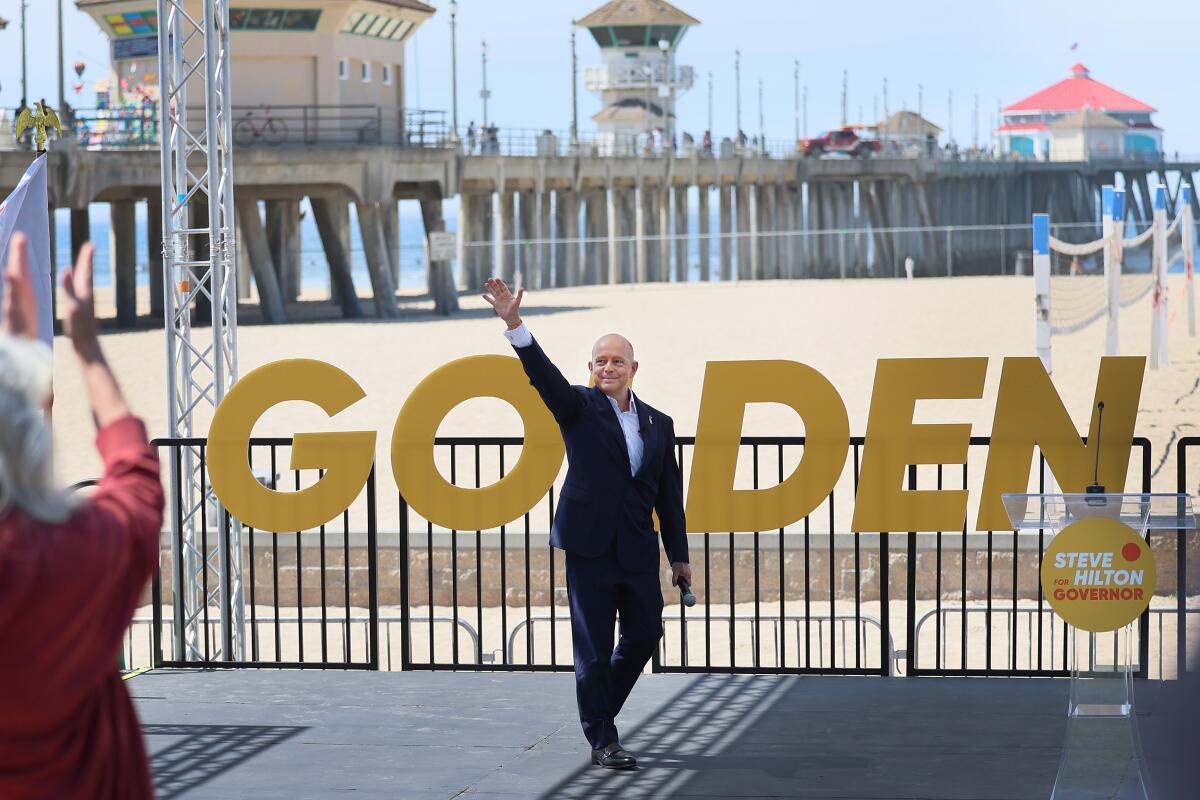
If there’s an inside edge in the Trump Endorsement Sweepstakes, it would seemingly go to Hilton.
He’s familiar to the president as a former Fox News host. He’s interviewed Trump several times and the two occasionally text and talk on the phone. Bianco has no such personal connection, which might explain his ballot-seizing stunt.
Steve Hilton could have the inside track on a Trump endorsement, given their personal relationship.
A Trump endorsement comes in all sorts of flavors.
As The Downballot recently noted, “His bag of tricks includes dual endorsements, triple endorsements, pre-endorsements, Election Day endorsements, yanking endorsements … belated endorsement of a candidate after initially endorsing just one candidate [and] non-endorsements after promising to endorse.”
There was also the time Trump endorsed “ERIC” when Republicans Eric Schmitt and Eric Greitens faced each other in Missouri’s Senate primary. (Schmitt won and is now the state’s junior U.S. senator.)
Trump’s backing still counts a good deal, even as his approval ratings sink to sub-basement levels. The president remains popular with Republicans and, critically, the kind of GOP loyalists who vote in primary contests, which is why both Hilton and Bianco would welcome a presidential laying on of hands.
There’s good reason, however, to think Trump might pass on endorsing in the governor’s race, or opt to deliver one of his dual he-and-him endorsements.
The GOP’s best — and perhaps only — hope of winning the governorship is the Democratic-freeze-out scenario. So, tactically, Trump’s wisest move may be to bless neither Hilton nor Bianco. Or support both. That would avoid elevating one over the other, which could make it easier for a Democrat to finish among the top two and advance past the June primary.
“I think Trump’s people are smart enough to know that there’s a reason why he may not be served by endorsing a candidate,” Fleischman said. “I wouldn’t be surprised if the prevailing wisdom there is we better not endorse anybody, because we don’t want to tilt this one way or the other.”
If Trump were to back Hilton or Bianco, it’s not hard to imagine Democratic interests seizing upon the president’s benediction and putting significant money behind an ad blitz promoting the president’s favorite in hopes of boosting him — and him alone — into the top two.
In 2018, his main rival was fellow Democrat Antonio Villaraigosa. Two major Republicans were also in the race, John Cox and Travis Allen. There was no real concern about those two nabbing both spots in the June primary. Rather, Newsom and Cox had a shared interest in boxing out Villaraigosa.
So the Newsom and Cox campaigns opened a private back-channel, trading gossip, swapping insights on the race and even sharing some empirical data. One poll, showing Cox getting a bigger boost from a Trump endorsement than Allen, passed from Democratic hands in hopes it would reach the White House and nudge the president into supporting Cox.
REDDING — At a Board of Supervisors meeting in rural Shasta County last month, Clint Curtis dropped a bombshell: A sheriff way down in Riverside was going to confiscate all the ballots from a recent election.
Curtis, the county registrar of voters, was the first to announce the planned ballot seizure. Even the sheriff himself, Chad Bianco, had not publicly revealed his intentions.
Later, as Bianco’s move grabbed headlines — he is a leading Republican candidate for governor — Curtis’ behind-the-scenes maneuvering remained largely unknown. The registrar had worked with the Riverside County citizens group whose fraud allegations had sparked Bianco’s investigation, even traveling 600 miles south to speak on their behalf.
Shasta County Clerk and Registrar of Voters Clint Curtis poses last month in the new election observation room at the elections office in Redding.
In his short time in Shasta County, Curtis, whose claims about rigged voting machines stretch back to the early 2000s, has solidified his position as a torchbearer of the election denialism movement, vowing to take his message about untrustworthy machines and potential fraud across California and beyond.
Critics here say he has steadily disenfranchised voters. He has eliminated nine of the vast county’s 13 ballot drop boxes, telling The Times he did not trust ballots in the hands of “little old ladies running all over” to collect them. And he has advocated for a local ballot initiative that would limit elections to one day, eliminate most voting by mail and require voter ID as well as a hand count of ballots.
Curtis also has accused his predecessors in the registrar’s office, without evidence, of election fraud and has called for federal authorities to raid the office he now runs.
“Do I think ballots were stuffed? Yes. Have I contacted the DOJ? Yes,” Curtis said at the Feb. 24 Shasta County supervisors’ meeting just before announcing Bianco’s planned ballot seizure.
Curtis, a 67-year-old attorney, was appointed by the Shasta County supervisors last April. He lived in Florida then, had no previous ties to the area and had never run an election.
He got the job based largely on two stated qualifications: He wanted to hand-count votes. And he had worked with Mike Lindell, the MyPillow chief executive and pro-Trump conspiracy theorist.
In his public job interview, Curtis promised to grill local elections staffers to “find out what they know.”
Now Curtis is running for election himself, trying to keep his job in this Northern California county where a majority of the supervisors were so swept up in President Trump’s discredited election fraud claims that they ditched their Dominion voting machines in 2023 and opted to hand-count ballots (quickly prompting a new state law that banned them from doing so).
Share via
Curtis says he is running to make elections more transparent by questioning the status quo and hanging cameras everywhere to capture election workers’ every move.
“Republicans love me,” Curtis told The Times. “The Democrats are pretty good. And then I have these crazy socialist people that just hate me.”
Beliefs aside, Curtis has quickly become a colorful local character.
He took a lie detector test to attest that he didn’t rig the November election. He chose as his number two a heavy metal guitarist from San Francisco — stage name “Turmoil” — who is a progressive Democrat.
And last September, surveillance cameras captured him pushing an antique metal safe through the Shasta County elections office on a Saturday while his wife assisted with a pulling harness. Curtis wore blue jeans — and no shirt.
He said he moved the safe, which contained odds and ends, on a hot day to make more room for election observers.
Curtis first gained national attention for election skepticism in December 2004, in testimony before Congress.
He had been working as a computer programmer in Florida and was brought in as an expert witness by Democrats on the House Judiciary Committee, who were reeling over President George W. Bush’s defeat of John Kerry a few weeks earlier and furious about an error with an electronic voting machine that gave Bush extra votes in Ohio.
Curtis claimed that he had written “a prototype” of software that would allow cheaters to alter votes using “invisible buttons” on touch-screen balloting machines. His claims were largely dismissed. But he continues to tout his congressional testimony to cast himself as an expert on election malfeasance.
A woman passes by a “Greetings From Redding” mural on Feb. 25.
After testifying, he unsuccessfully ran for office multiple times in Florida. He refused to concede after one loss, alleging the machines were rigged.
In Shasta County, he saw a chance for redemption.
During the COVID-19 pandemic, the Board of Supervisors gained a hard-right majority supported by anti-vaxxers, secessionists, members of a local militia and pro-Trump election deniers.
In 2022, someone hung a trail camera — the kind hunters use to track wildlife — behind the elections office to monitor the staff. Some observers yelled at staffers and got in the face of Cathy Darling Allen, the longtime registrar, who installed a 7-foot metal fence to keep them at bay.
Joanna Francescut, who worked in the elections office for 17 years, is running to be county registrar.
Darling Allen clashed with the supervisors as they pushed to hand-count votes, a process she argued would be slow, expensive and prone to error. She retired in 2024, citing health reasons.
Her successor resigned after less than a year. The supervisors appointed Curtis in a 3-2 vote, passing over Joanna Francescut, who had worked in the elections office since 2008 and was Darling Allen’s number two.
Days later, Curtis fired Francescut. She is now running against him in the June 2 election.
David Becker, executive director of the Center for Election Innovation & Research and a former senior trial attorney overseeing voting enforcement for the U.S. Department of Justice’s Civil Rights Division, called Curtis a “nationally known conspiracy theorist.”
“I can’t imagine bringing in someone who is neither an election administrator nor a Californian for a job like that and basically chasing out experienced election officials whose work had withstood scrutiny for decades,” Becker said. “The voters of Shasta County, unfortunately, are paying the price.”
Curtis has accused Francescut and other elections staffers of stuffing ballots to sabotage conservative Republicans.
“I want to laugh because it’s that ridiculous,” Francescut, 43, said of the allegations.
“People that work in this field, they’re doing this work because they care about elections,” she said. “They want the community to be better. They want what both sides want — transparent and accurate elections.”
During her 17-year tenure, the elections office got little public attention. But “once 2020 hit, people went from completely trusting us to, the day after election day, calling and yelling at our staff so much that we couldn’t get the work done to count ballots,” she said.
Curtis was a favorite of then-board chairman Kevin Crye, a hard-right supervisor who enlisted Lindell to support the county’s crusade against Dominion. Crye had survived a 2024 recall effort by just 50 votes.
1
2
1.Carl Bott, co-owner of KCNR 96.5 FM, interviews Joanna Francescut on Feb. 25, 2026, in Redding, Calif.2.Joanna Francescut’s campaign manager, Mary Williams, wears an orange button that reads “Vote for Jo for County Clerk” as Francescut waits in the offices of talk radio station KCNR.
Citing that close margin, Curtis said he believed recent elections were rigged because Republicans were not winning by large enough margins in a county where registered Republicans greatly outnumber Democrats.
In a letter to the U.S. Justice Department, Curtis said he had learned of lax security and potential ballot stuffing in 2024, the year of the attempted recall against Crye. Curtis sent a copy of the letter to Trump and requested a federal investigation because “the destruction of these ballots is nearing.”
In 2019 and 2024, a Shasta County grand jury investigated local election procedures and found no wrongdoing.
“How does it make me feel? Really angry,” Darling Allen, who is advising Francescut’s campaign, said of Curtis’ allegations. “It calls into question the integrity and character of every single person who worked in the elections department.”
To replace Francescut, Curtis hired Brent Turner, the guitarist from San Francisco. He is a longtime election reform activist who has pushed for nonproprietary open-source voting systems with software code that can be examined by anyone.
Turner described their partnership as: “Republican and Democrat team up to fight outdated software for elections. Oh, my!”
“We have to have the adult conversation in the United States that if the systems are loose enough to allow people — in this case, we’re talking about even people internal to the system — to cheat, they might cheat,” Turner said.
Last October, Secretary of State Shirley Weber wrote to Curtis, asking him to detail planned changes to voting procedures. He responded with a 15-page letter.
Election observers, he wrote, were “treated like invaders … corralled behind spiked fences.” And drivers who picked up ballots from drop boxes sometimes left them in their vehicles. Under his watch, he wrote, “no detours or even bathroom breaks are allowed.”
A woman exits the Cottonwood Post Office in Shasta County.
Curtis told Weber that someone had carved death threats on his vehicle and left “antifa” business cards on his windshield wipers.
Weber’s communications team said in an email that her office “continues to monitor new election processes proposed by Shasta (or any county) County to ensure they do not violate state law.”
In his letter to Weber, Curtis promised to take a lie detector test after each election. Answering pre-written questions he had submitted, Curtis said in a January polygraph test that he did not change the results of the November election and believed a predecessor had rigged previous contests, according to a summary obtained by The Times.
The examiner wrote that he “was likely telling the truth.”
Inside the elections office, Curtis created a large room, decked out with American flags, for citizens to observe the vote-counting process.
More than a dozen large TV monitors display close-up video, also streamed online, of election workers’ hands inserting ballots into machines. On June 2, those workers will sit beneath iPhones hung overhead to record them while observers are positioned on barstools a few inches behind them.
The new public observation room at the Shasta County elections office is decorated with American flags.
Curtis has been traveling across California to tout his methods. He told The Times he has spoken about his video setup in Kern and San Joaquin counties and discussed it with candidates for state office.
And he advised the Riverside County citizens group that claimed to have found an overcount of 45,896 ballots in the November election for Proposition 50, which redrew the state’s congressional districts to favor Democrats.
Art Tinoco, the Riverside County registrar of voters, has refuted that number — saying it was based on a misunderstanding of raw data that had not been fully processed.
After Bianco last week announced that his office had seized more than 650,000 ballots, Curtis appeared on the social media broadcast of a right-wing election integrity advocate who called him “the stealth behind the scenes in making that happen.”
Curtis smiled and repeated what he has been espousing since the early 2000s: “You can’t really trust a computer.”
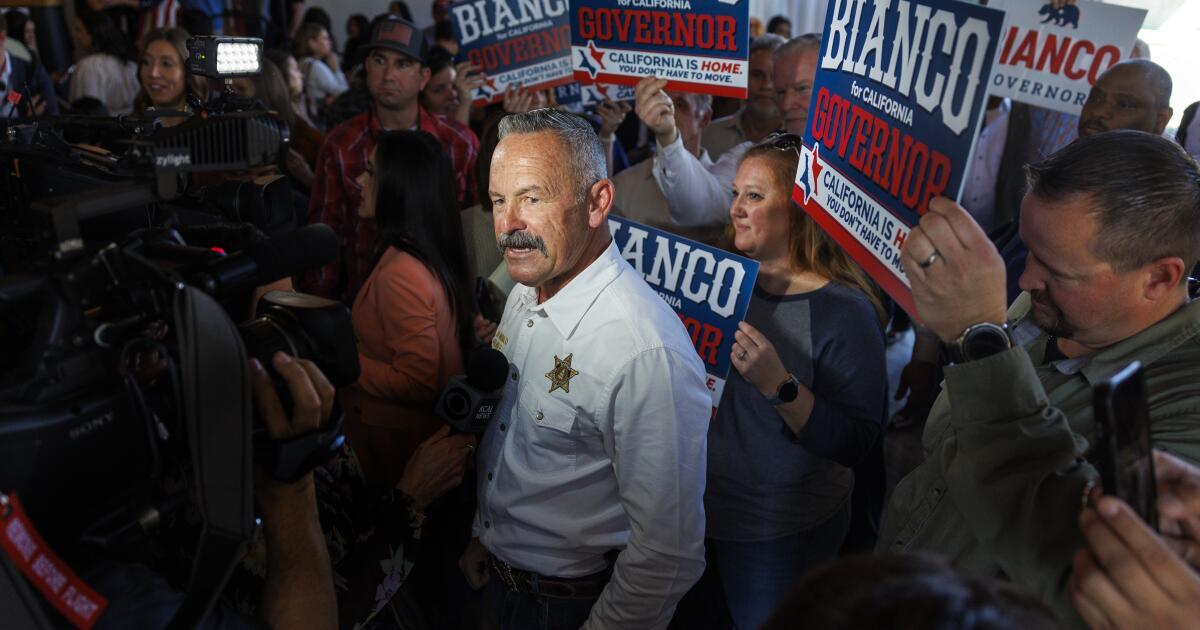
Chad Bianco, the Riverside County sheriff and a leading Republican candidate for governor, has seized more than 650,000 ballots from last November’s election as part of an investigation that he called a “fact-finding mission” to determine if they were fraudulently counted.
Atty. Gen. Rob Bonta, the state’s top law enforcement official, has sharply criticized the probe, which he called “unprecedented in both scope and scale.”
In a March 4 letter to the sheriff, Bonta said the seizure of the ballots “sets a dangerous precedent and will only sow distrust in our elections.” He threatened to seek legal recourse if Bianco does not halt his investigation.
Bianco said Friday that his investigators are looking into allegations by a local citizens group that “did their own audit” and found that the county’s tally was falsely inflated by more than 45,000 votes — a claim that local election officials have emphatically rejected.
Here is what we know.
Why were ballots taken?
According to Bonta’s office, Bianco’s department on Feb. 26 took about 1,000 boxes of ballot materials in Riverside County related to the November election for Proposition 50, which temporarily redrew the state’s congressional districts to favor Democrats in response to partisan redistricting in Republican states, including Texas.
Bianco said that it’s his “constitutional duty” to investigate a potential crime and that he is not trying to change the election results.
The investigation includes all of the ballots cast in the county, where Proposition 50 passed with 56% of the vote, a margin of more than 82,000 ballots. Statewide, it passed with 64% of the vote, a margin of more than 3.3 million ballots.
Bianco said he had been contacted by “a group of citizen volunteers” that said it performed an audit finding that 45,896 more ballots were counted than were cast. He did not name the group, but the allegations match those made by a group called the Riverside Election Integrity Team.
In a February presentation to the Riverside County Board of Supervisors, Registrar of Voters Art Tinoco disputed the group’s allegations and said they were based on a misunderstanding of raw data that had not been fully processed.
The actual discrepancy, Tinoco said, was 103 votes — a variance of 0.016%.
How did the sheriff get the ballots?
Bianco said his department served the registrar with a warrant “approved and signed by a judge” on Feb. 9.
According to Bonta’s office, an additional warrant was issued on Feb. 23. Bianco said the warrants are now sealed.
In the March 4 letter to Bianco, the attorney general said he had “serious concerns” about whether the sheriff had probable cause to seize the election materials.
Bonta questioned whether Bianco had concealed information from the magistrate judge who approved the warrants, including details from the registrar’s analysis of the citizen group’s allegations.
An official from Bonta’s office told The Times that the attorney general “found out in the middle of the week that [Bianco] was going to execute the warrants on a Friday.” Bonta’s office asked the sheriff to slow down and share information about the investigation, but “instead of waiting, he actually moved it up” and seized the ballots sooner than planned, said the official, who would only speak on background.
Bianco said a Riverside County Superior Court judge ordered the appointment of a special master to oversee the ballot count. His investigators had already begun counting, but the tally would start over under the court’s guidance, Bianco said.
The ballots would have soon been destroyed
California law requires county officials to keep election materials — including ballots and voter identification envelopes — for 22 months for elections involving a federal office and for six months for all other contests.
The materials must be sealed and then destroyed at the end of the retention period.
The Proposition 50 election took place on Nov. 4, so the ballots are scheduled to be destroyed in May.
Why investigate now?
Political observers say that Bianco — a leading gubernatorial candidate — appears to be vying for attention from President Trump and his supporters.
Kim Nalder, a political science professor and director of the Project for an Informed Electorate at Sacramento State, said the investigation appears to be “an electoral ploy.”
“At this stage in the election, most voters haven’t really tuned into the gubernatorial race, and there are a ton of candidates,” she said. “People who don’t know his background will know now. This is clear signaling.”
Trump has repeatedly called on the federal government to “nationalize” state-run elections. He remains fixated on his 2020 election loss and has falsely claimed widespread fraud.
In January, the FBI raided the elections office in Fulton County, Ga., seizing 2020 presidential election records. And this month, the Republican leader of Arizona’s state Senate said he had handed over 2020 election records to the FBI, complying with a federal grand jury subpoena for records related to a controversial audit of the election in Maricopa County.
Bianco is an outspoken Trump supporter.
A poll released last week by UC Berkeley’s Institute of Governmental Studies and co-sponsored by The Times showed Bianco and conservative commentator Steve Hilton leading the crowded field of gubernatorial candidates by slim margins, with the Democratic vote split among multiple candidates in a left-leaning state.
The top two vote getters, regardless of party, will advance to the November election.
Bianco said the investigation was “not a recount” for Proposition 50 and had nothing to do with his campaign for governor.