Siân Heder on following ‘CODA’ and opening Toronto’s festival
It’s pronounced “human.” Yet writer-director Siân Heder acknowledges that the unusual spelling of the title of her new movie, “Being Heumann,” is something people might give a puzzled second look, unsure of how to say it and possibly dismissing it altogether.
Which, the more she sat with it, made it perfect as the title for a portrait of real-life disability rights activist Judy Heumann, who, while being in a wheelchair, made herself undismissable.
More specifically, the film looks at the pivotal 1977 protest in which Heumann led a group in a 26-day sit-in at a federal office building in San Francisco until the government began enforcing Section 504 of the Rehabilitation Act of 1973 — the first federal law that recognized disability as a civil rights category.
“The fact that her last name was ‘human’ has so many beautiful layers of meaning,” says Heder, 49, during a recent interview in Los Angeles. “I think Judy was asking for the world to see disabled people as human beings who were worthy of rights and being looked at and being included.”
A world premiere and the opening-night selection of this year’s Toronto International Film Festival, which begins on Thursday, “Being Heumann” will hit theaters Nov. 6 and begin streaming on Apple TV Nov. 13. It is also, crucially, Heder’s first film since 2021’s “CODA,” the bittersweet drama about a young woman in a Deaf family (the title is an acronym for “child of Deaf adults”) that won three Academy Awards including adapted screenplay for Heder and best picture.

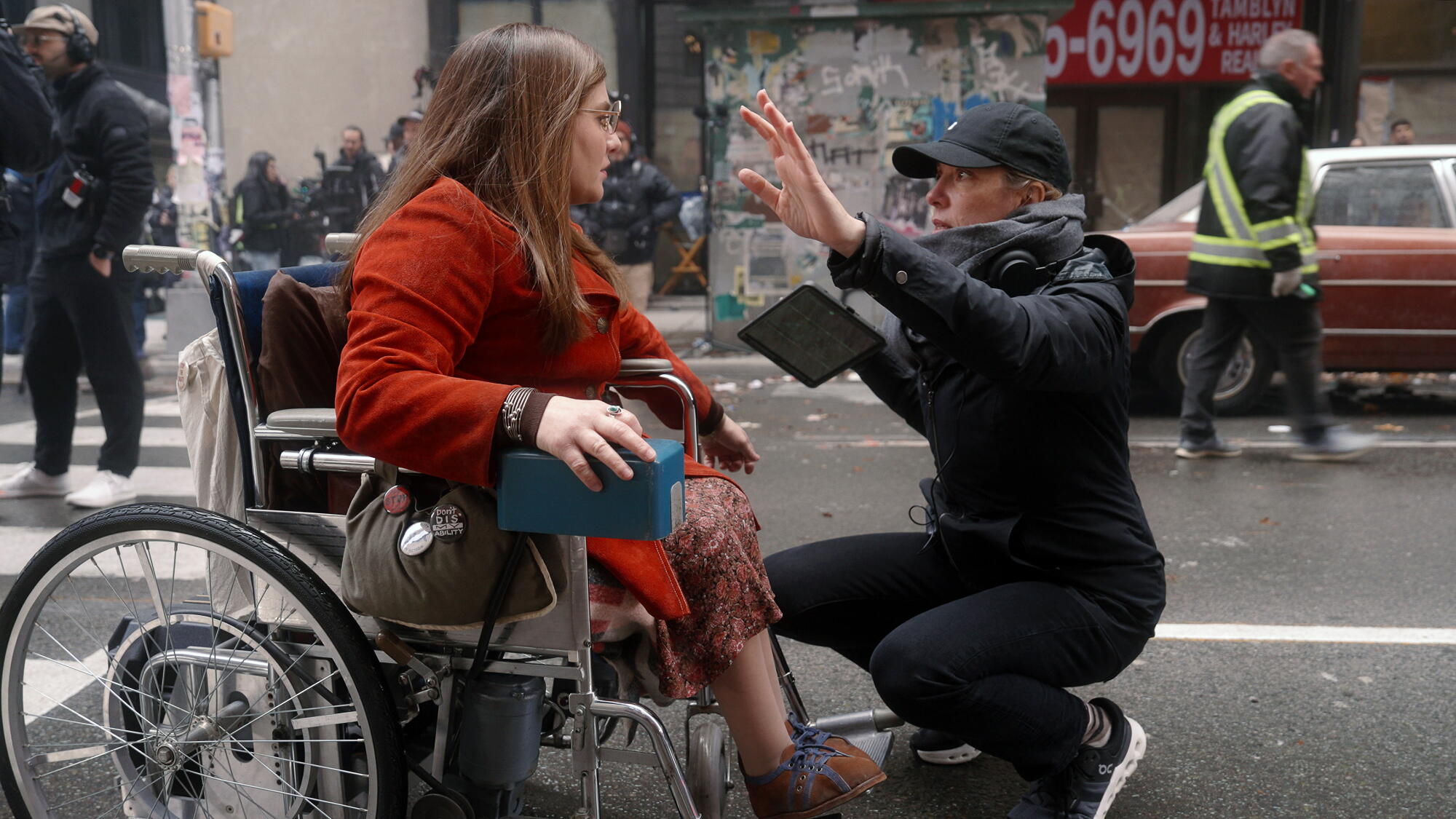
Actor Ruth Madeley and filmmaker Siân Heder during production on “Being Heumann.”
(Apple TV)
In Heumann, a wheelchair user after contracting polio as a child, Heder found a subject who was in the process of discovering herself as a leader: learning when to hold firm and when to cede ground and empower other people. And for someone who was grappling with the aftermath of unexpected success, that felt familiar.
“I think I was making a movie about myself, honestly,” Heder says. “When you’re moving forward on a massive project or a movement or anything, there’s a necessary drive and ambition and focus that is needed. And if you look at any major change that’s happened in human history, it takes a certain kind of person to push that through. I’m not identifying myself with great leaders of the civil rights movement, but directing a movie is a similar thing.”
Heder is tucked into a quiet corner of a busy coffee shop in L.A.’s Eagle Rock neighborhood, where she has long lived. She is in the process of moving from one historic house to an even older one a few blocks away. Heder didn’t want to disrupt the schooling of her two young children, ages 10 and 12, and has become too enmeshed in the area to want to leave it.

“There’s definitely an element of: ‘She manipulated everyone with that movie. She made us all cry and that’s why she won,’” Heder says of “CODA,” her Oscar-winning best picture. “I was an indie filmmaker that was compelled to tell that story.”
(Jason Armond / Los Angeles Times)
Community is a word that comes up often over the course of a conversation with Heder, who has a warm manner and a quiet self-possession. Though “CODA” may have brought her wider attention, she was far from a novice by the time she made that film. She won a Peabody Award as a writer on the series “Men of a Certain Age” and was a writer, director and producer on the acclaimed “Orange Is the New Black.” She expanded her 2006 short film “Mother” into her first feature “Tallulah,” about a young woman who takes a baby from a reckless mother and tries to pass it off as her own. It premiered at Sundance in 2016.
Winning the Oscar created changes in her life both big and small. Heder at first kept it on her desk at home, but had to move it because she began to feel the statuette’s crossed arms quietly judging her as she worked. When she drove herself to the Spirit Awards the year after “CODA’s” triumph and spontaneously gave a ride to an afterparty to Maggie Gyllenhaal and Ebon Moss-Bachrach, Heder suddenly realized her 10-year-old Subaru wasn’t going to cut it anymore.
“I have a nicer car now,” she says, laughing at the memory. “It’s baby steps.”
The day after the Oscars, Heder recalls that she couldn’t stop crying, all the pressure built up from months of campaigning events and Q&As finally letting itself out.
She says two things changed almost immediately after winning the Oscar. One was a sense of expectation, wanting to make the most of whatever the moment might allow.
“This was not a part of my plans,” she says. “I didn’t ever intend to have so many eyeballs turn to me and go, ’What are you doing now?’”
The second was simply the volume of material and opportunities incoming. Heder says she met with Marvel “so many times” about different projects but none of them felt right. As an independent filmmaker “you’re always pushing against the no,” she puts it, moving projects forward against all odds. But now she felt she had to be the resistance, the one to ask whether something was worthwhile.
“Suddenly there are a lot of voices chiming in too because your reps have an idea of what you should do next and the industry has an idea of what you should do next,” Heder says. “And it was really important for me to center myself back in a feeling of: I’ve always been drawn to stories because they move me. And that hasn’t changed.”
Her Oscars triumph was also the night of the notorious Will Smith-Chris Rock on-stage slap, which overshadowed coverage. Heder is online enough that she knows that some film fans would want an asterisk next to the Oscar wins for “CODA,” as if to note some sort of COVID-era exception for the first film from a streaming service to win Hollywood’s top award.
“There’s definitely an element of: ‘She manipulated everyone with that movie. She made us all cry and that’s why she won,’” Heder says with a edge of defiance. “I was an indie filmmaker that was compelled to tell that story. And then audiences embraced that story and that story took off in a way that was unexpected and surprising even for me.”

Siân Heder holds her Oscar for best adapted screenplay for “CODA” backstage during the Oscars in 2022.
(Robert Gauthier / Los Angeles Times)
Heder had been developing “Being Heumann” before “CODA” was released. A friend encouraged Heder to see the 2020 documentary “Crip Camp,” which includes Heumann as a subject, and the filmmaker was so struck by that story, she followed up by reading Heumann’s 2020 memoir.
She sent Heumann a cold email expressing interest in the book. As it turned out, Heumann was deciding that very day who should direct a movie of her life. Heumann gave the filmmaker a last-minute chance to pitch herself. After saying she’d cast authentically disabled performers as she did on “CODA,” Heder got the job.
Heder would work for two years on researching and developing the project with Heumann, interviewing dozens of people involved in the actual Carter-era protest. When Heumann died unexpectedly in 2023, Heder did not think she could continue, but it was “Crip Camp” co-director James Lebrecht who convinced her otherwise.
“I think Judy’s death, which was sudden — it made me feel like she had left her legacy in my hands,” remembers Heder.
After developing other scripts post-Oscars that never quite became her next film, Heder eventually found herself in the enviable position of having two projects greenlit at once: “Being Heumann” at Apple and an adaptation of Gabrielle Zevin’s popular novel “Tomorrow and Tomorrow and Tomorrow” at Paramount.
As she was trying to make a decision, she went to a meeting with several other directors about the relaunching of the Village Theater in Westwood. She found herself having coffee with Guillermo del Toro and asked him how he decided between potential projects.
“And he said, ‘Make the movie that can’t get made without you,’” she recalls. “And that was very clarifying for me. When you are the element that gets that story told, it takes on an importance and urgency.”
As can often be the case, Del Toro’s advice confirmed what she already felt and she began to move forward with “Being Heumann.” (She is currently prepping “Tomorrow and Tomorrow and Tomorrow” so there will not be another five-year gap between releasing films.)
“I was having a rare moment of power in the industry to push something forward,” Heder says, “and it felt like there was a path to go make a big paycheck and have that kind of jump up, or I could use that moment of power and success to try to push through the hardest project I could think of. It was in that moment, after ‘CODA,’ where I really realized: I could make this incredibly difficult movie that no one might make.”

Andrew Pilkington, from left, Siena Rafter, Charlie Rush-Reese, Dylan O’Brien, Roberta Colindrez, Ruth Madeley and Madeline Delp in the movie “Being Heumann.”
(Apple TV)
Following what Heder describes as “the casting Olympics,’ she arrived at BAFTA-nominated actor Ruth Madeley, a wheelchair user, to play the lead role. “Being Heumann” was shot in Toronto, largely on a soundstage built to stand in for the San Francisco federal office building where the sit-in took place.
“Hollywood might be the least accessible industry out there,” Heder notes while beginning to explain the accommodations that needed to be made for a cast that included performers with a wide range of disabilities. Custom-built trailers were created and the set had to be made accessible in ways that a filming location typically is not. An accessibility team oversaw everything, from large-scale logistics to the personal needs of individual background actors.
Rather than a more conventional biopic, Heder wanted to tell the more specific story of the 504 sit-in, building out an ensemble of characters around Heumann.
“I said, “It’s almost like ‘Bad News Bears’ and ‘Dog Day Afternoon’ together,” says Heder. “There’s an underdog-sports-team feeling and bank-heist-gone-wrong.”
But a filmmaker friend asked her: Is making movies about disability now her “thing”? It is a question Heder had already considered.
“Of course it was on my mind if it starts to feel like: Oh, is Siân Heder a social justice warrior who’s just out to try to make these movies that have some kind of message behind them,” she says preemptively. “But I think this is just a great story. Outside of disability, outside of anything else, it is a great story.”
Heder remains interested in stories about outsiders, about class and people generally ignored by or on the fringes of society. And it remains important that she herself feel a part of a larger community in her life and her work.
“My daughter said to me the other day, ‘Mom, I think you’re the right kind of famous because you are important to people who know who you are, but you can still just be in the world and be anonymous.” And I think there’s something true about that.”
Her daughter has obviously inherited Heder’s deep well of empathy, one that is more concerned with bringing new, unseen stories to the screen than with the pursuit of cool points or pure fame.
“‘Earnest’ has become a dirty word,” says Heder. “And what earnest actually means is direct and truthful.”