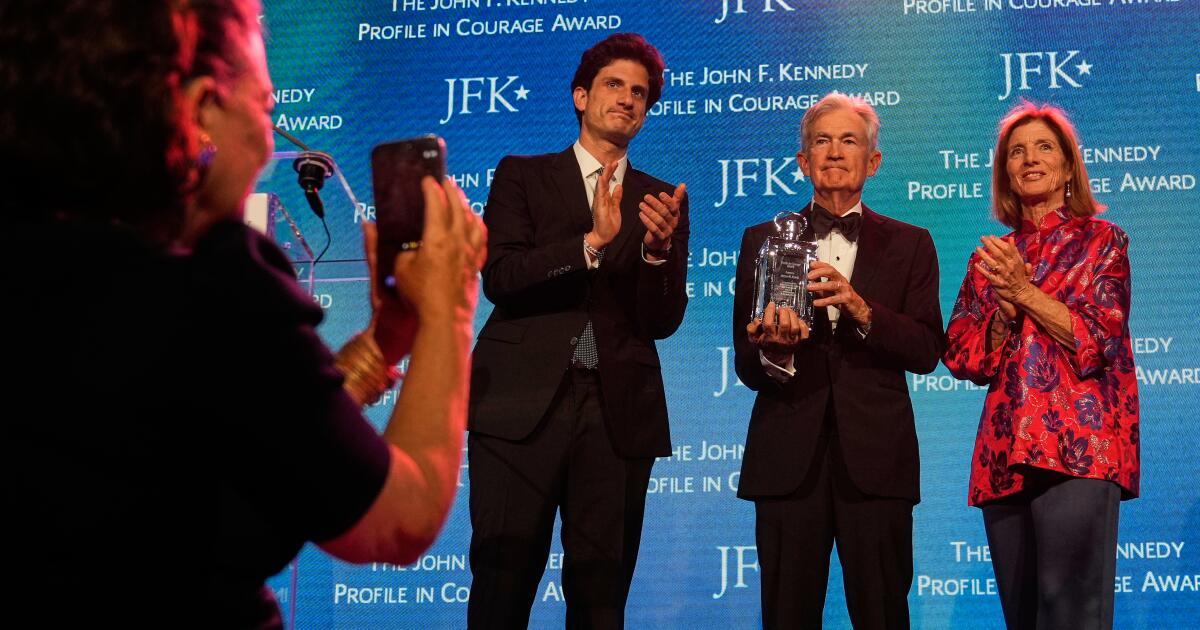
Jerome Powell uses JFK award speech to warn against political pressure on Fed, courts and schools
BOSTON — Former Federal Reserve Chair Jerome Powell used one of his first major public appearances since leaving office to defend independent institutions while accepting an award Sunday honoring his efforts to preserve the central bank’s independence.
Speaking at the John F. Kennedy Presidential Library overlooking Boston Harbor, Powell called universities, courts, Congress and the central bank “the foundation and the embodiment of our democracy” and argued that the Fed’s independence was a “priceless asset” that must be protected.
It was one of his most direct defenses of Fed independence, warning that a single administration’s decision to remove bank officials over policy differences would open the way for future elected officials to follow suit, ultimately undermining the credibility that the Fed has spent decades building.
Powell, who frequently clashed with President Trump during his eight years as chair, stepped down as his term expired in May. He was succeeded by Kevin Warsh, whom Trump selected to lead the central bank.
After stepping down as chair, Powell took the unusual step of keeping his seat on the Fed’s governing board, which he has until January 2028. By doing so, he has deprived the Trump administration of an opportunity to appoint another member of the board.
The Trump administration has also sought to fire Fed governor Lisa Cook, which would open an additional seat on the rate-setting committee the president could fill. Yet Cook sued and the courts have so far let her keep her seat.
While Powell never mentioned Trump by name Sunday, he repeatedly returned to the importance of protecting institutions from political pressure and preserving public trust in their independence.
“Like many other institutions, the Fed has been undergoing a stress test,” he said. “Congress wisely chose to insulate monetary policy decisions from political pressure. All other advanced economy nations have done the same.”
Since 1989, the John F. Kennedy Profile in Courage Award has recognized public servants who make what the foundation describes as courageous decisions of conscience despite personal or professional consequences.
Previous recipients include former Presidents Barack Obama and George H. W. Bush, Ukrainian President Volodymyr Zelensky and former Vice President Mike Pence.
In March, the foundation said it was awarding Powell for protecting the independence of the Federal Reserve “despite years of personal attacks and threats from the highest levels of government.”
Trump harshly criticized Powell throughout his tenure as chair, frequently attacking the Fed’s interest-rate decisions and urging the central bank to cut borrowing costs more aggressively.
Beyond the Federal Reserve, Powell defended U.S. universities and research institutions, the Constitution, Congress and the court system.
“The United States has long been the leader of the world’s freedom-seeking people — the indispensable nation. Other countries know us as a nation built on integrity, and that integrity must be maintained,” he said.
In his remarks, Powell indirectly acknowledged mistakes as chair. The Fed is legally required to seek stable prices, but inflation surged amid the pandemic’s supply chain crunch. Many economists believe the central bank should have raised interest rates more quickly in response.
“At the Fed, we are, of course, human and thus imperfect,” Powell said. “When we make mistakes, we acknowledge them and change course.”
Powell was honored alongside residents of Minnesota’s Twin Cities, who received the award for what the Kennedy Foundation described as acts of courage during a federal immigration crackdown that led to thousands of arrests and the deaths of Minneapolis mother Renée Good and nurse Alex Pretti, both of whom were killed while observing or documenting enforcement activity.
“It’s wonderful just to be invited, honoring Renée,” Good’s father, Tim Granger, said as he entered the library with family members.
Kennedy’s only surviving child, Caroline Kennedy, and her son, Jack Schlossberg, said in a statement that without people like Powell and those in Minnesota “willing to put their lives on the line to hold America to its promises, our democracy can’t survive.”
Attendee U.S. Sen. Amy Klobuchar, who is running for governor of Minnesota next year, reflected that the award was unusual because it recognized ordinary residents rather than elected officials.
“This didn’t go to an elected leader for a reason,” Klobuchar said. “It’s because the people stood up. They stood up by marching 50,000 strong. They stood by bringing kids they didn’t even know — strangers’ kids — to school, by bringing them groceries and they didn’t blink. And that’s what this award is about. It’s about courage.”
Willingham writes for the Associated Press. AP journalist Christopher Rugaber contributed to this report from Washington.