Central Bank of Venezuela

Venezuela’s Central Bank Confirms External Audit of US-Controlled Resources

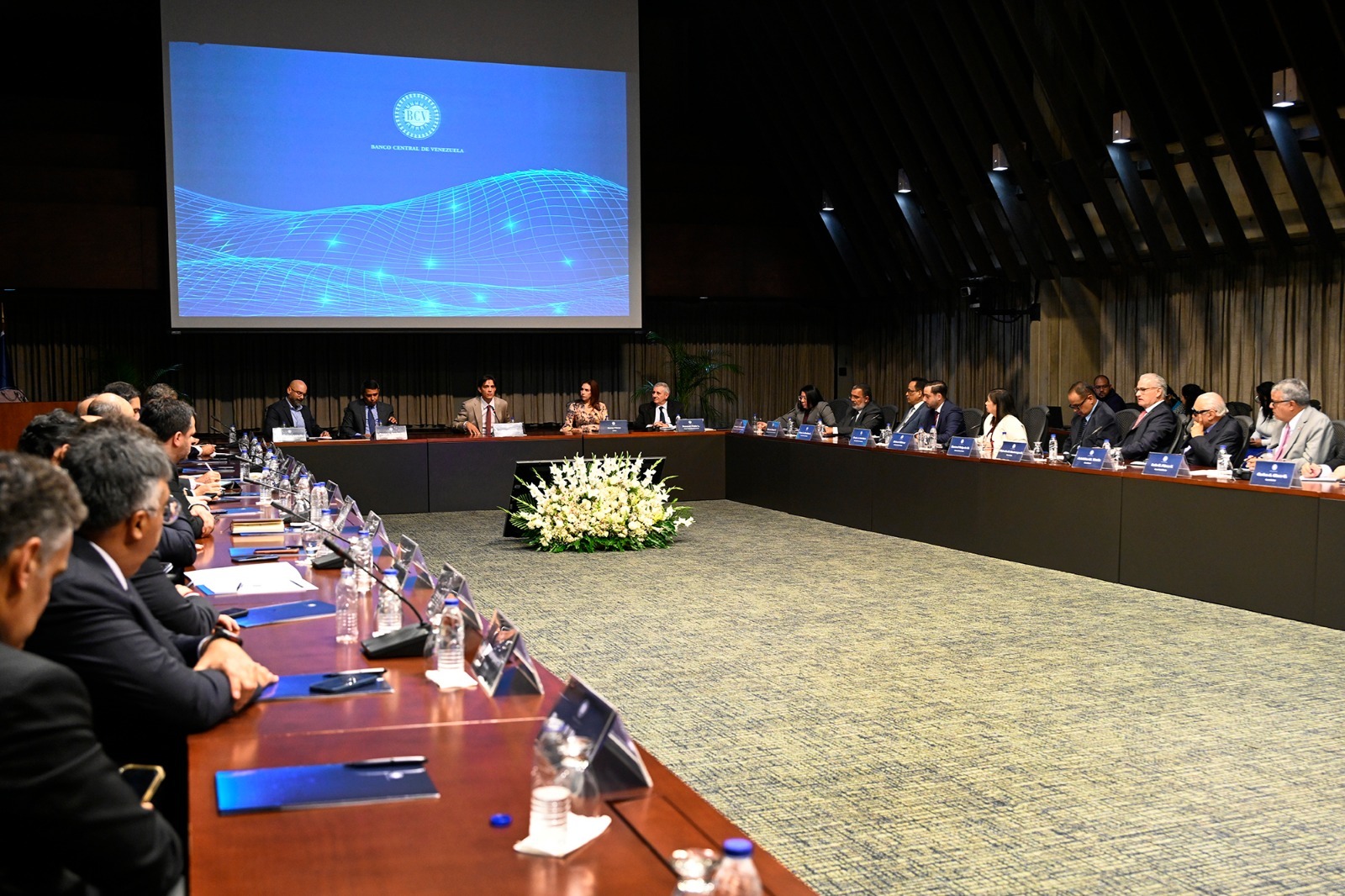
BCV authorities recently met with banking executives and pledged to loosen credit restrictions. (BCV)

Caracas, April 27, 2026 (venezuelanalysis.com) – The Venezuelan Central Bank (BCV) has announced the hiring of outside firms to audit Venezuelan export revenues currently controlled by the Trump administration and disbursed to Caracas.

In a press statement, BCV Acting President Luis Pérez confirmed that both the Venezuelan and US governments had hired auditing companies to “ensure peace of mind and impartiality.”

“The auditing of the country’s resources by external consultants gives us peace of mind,” Pérez stated. “Venezuela can be confident that the resources are being channeled where they have to and getting where they need to.”

According to Reuters and Bitácora Económica, Deloitte is one of the firms selected to inspect the Central Bank’s accounts, though it is not known whether it was chosen by Washington or Caracas.

One of the largest global consulting corporations, Deloitte has close ties to the US political establishment and national security state.  The London-based firm has a well-documented history of hiring former CIA agents and undertaking corporate espionage.

Since the January 3 US military strikes and kidnapping of Venezuelan President Nicolás Maduro, the Trump administration has taken control over Venezuelan oil revenues, mandating that all royalty, tax, and dividend payments be deposited in US Treasury-run accounts before a portion is returned to Caracas at the White House’s discretion.

US officials, including Secretary of State Marco Rubio and Treasury Secretary Scott Bessent, have stated before congressional committees that the Venezuelan government’s allocation of its own resources, once returned by Washington, would be subject to outside audits.

Rubio additionally claimed that Caracas needs to submit “budget requests” before accessing funds. Both US and Venezuelan officials have acknowledged the use of US-managed funds for imports of medicines and medical equipment from US manufacturers.

The sequestered Venezuelan earnings have not been returned directly to the BCV but injected into foreign currency auctions run by banks. US officials have confirmed the transfer of US $500 million of a projected $2 billion initial agreement, though analysts have reported a higher volume of foreign currency made available in recent weeks.

Recently issued US Treasury licenses allowing transactions with the Venezuelan Central Bank are expected to restore some of the institution’s capacity to intervene in the economy. In a recent meeting with banking executives, Acting President Pérez stated that the BCV was prioritizing inflation control and forex market stability. A black market exchange rate has consistently hovered above the official one, with a gap currently at around 30 percent. Critics have blamed the BCV’s lack of oversight for the proliferation of currency speculation.

Pérez likewise pledged to review the Central Bank’s current reserve requirements, a recurring demand from banks in recent months. Banks are presently forced to hold 73 percent of deposits as reserves.

The contraction of credit, alongside reduced public spending and the freezing of wages, were policies adopted by the Maduro government in recent years in an effort to slow down inflation in the sanctions-hit Venezuelan economy.

Pérez was appointed acting president of Venezuela’s financial authority on April 16. He replaced Laura Guerra, who had been in the post since April 2025. Last week, the Venezuelan government’s “rapid response” social media denied reports of negotiations with the US State Department and the far-right opposition to select a new BCV board.

Since January, the Venezuelan government led by Acting President Delcy Rodríguez has fast-tracked a diplomatic rapprochement with the Trump administration.

The White House’s recognition of Rodríguez as Venezuela’s sole leader has paved the way for the resumption of dealings with the International Monetary Fund (IMF), while creditors of Venezuela’s sizable foreign debt anticipate a lucrative restructuring agreement.

The Rodríguez administration has likewise driven a pro-business legislative agenda with the goal of attracting foreign investment. The Caribbean nation’s parliament has approved reforms to the hydrocarbon and mining sectors that grant increased control to foreign conglomerates, alongside reduced fiscal responsibilities and the possibility of taking disputes to international arbitration bodies.

Canadian miner Gold Reserve issued a statement Monday “welcoming” the new mining law, noting that some of its “key recommendations were reflected in the final enacted law,” including the repeal of a 2015 decree establishing majority Venezuelan state control over the sector.

Acting President Rodríguez, as well as National Assembly President Jorge Rodríguez, have both acknowledged receiving “recommendations” and “suggestions” from oil majors in the hydrocarbon industry overhaul.

Edited by Lucas Koerner in Fusagasugá, Colombia.

Source link

Venezuelan Gov’t Resumes IMF, World Bank Ties, Appoints New Central Bank President

Former Venezuelan President Hugo Chávez denounced the IMF and the World Bank as “weapons of US imperialism.” (AFP)

Caracas, April 17, 2026 (venezuelanalysis.com) – Venezuela has reestablished ties with the International Monetary Fund (IMF) after a seven-year hiatus.

Acting President Delcy Rodríguez confirmed the news on Thursday night, calling it a “great achievement of Venezuelan diplomacy” and a “very important step” for the Venezuelan economy.

“This is the result of months-long negotiations that the Venezuelan far-right unsuccessfully tried to sabotage,” she stated in a televised broadcast. “Good has triumphed.”

The IMF announced the “resumption of dealings” with Venezuela in a statement on Thursday, stating that the decision was “guided by the views of IMF members representing a majority of the total voting power.”

Managing Director Kristalina Georgieva stated earlier this week that the IMF had been approached by Venezuelan authorities at a technical level and that the Caribbean nation “desperately needs help.”

The World Bank likewise issued a statement disclosing the resumption of dealings with the acting Rodríguez government. Venezuela’s last loan with the institution concluded in 2005.

Venezuela had its relationship with the IMF suspended in 2019 after the first Trump administration and allies recognized the self-proclaimed “interim government” led by Juan Guaidó as the Caribbean nation’s legitimate authority.

In March, the White House recognized Rodríguez as Venezuela’s “sole leader” and later withdrew sanctions against her, while US officials spoke of efforts to reincorporate Caracas into the IMF fold.

Though relations were officially frozen in 2019, Venezuela had sought to distance itself from the Washington-based institution more than a decade prior. In 2007, former President Hugo Chávez formally withdrew Venezuela from the IMF and the World Bank, calling them “weapons of US imperialism.”

Chávez repeatedly denounced the US-controlled multilateral institutions’ role in promoting debt and underdevelopment in Global South countries and pushed for the creation of lending institutions as part of Latin American integration efforts. Under Chávez’s predecessors, Venezuela implemented draconian IMF-conditioned structural adjustment policies that saw over half of Venezuelans living in poverty by 1998.

Last year, President Nicolás Maduro stated that Venezuela had “broken the shackles” of the World Bank and the IMF and was instead building its own “self-sustainable model and relations with a new world.”

Venezuela’s priority will be accessing US $5.1 billion in Special Drawing Rights (SDR) that it is entitled to as an IMF member. In 2021, the lending institution issued $650 billion amid the Covid-19 pandemic as an effort to help countries boost reserves and address fiscal needs. 

However, Venezuela was blocked from accessing the funds as the IMF refused to rule on the country’s legitimate authorities.

Caracas’ reengagement with the IMF and the World Bank also comes amid growing speculation about the fate of Venezuela’s sizable foreign debt. The Caribbean nation owes as much as $170 billion from a combination of defaulted bonds, unpaid loans, and international arbitration awards that have accrued interest for years as US sanctions battered Venezuela’s economy and cut it off from credit markets.  

Venezuelan bonds have been rallying in recent weeks following Washington’s rapprochement with Caracas as creditors bet on a debt restructuring deal that can bring significant windfalls.

Since the January 3 US military strikes and kidnapping of President Nicolás Maduro, the Rodríguez administration has fast-tracked a number of pro-business reforms, including in the hydrocarbons and mining sectors. Upon enacting the Mining Law on Thursday, the acting president thanked Trump, Rubio, and other administration officials for their “good disposition” in establishing “cooperation.”

Rodríguez recently announced further plans to overhaul the South American country’s labor, pension, and tax legislation, while also identifying state assets that are “not strategic.” The Cisneros Group, one of Venezuela’s largest business conglomerates, recently announced the raising of funds ahead of expectations of a “wave of privatizations.”

Since January, the Trump administration has imposed control over Venezuelan oil revenues, mandating that royalties, taxes, and dividends be deposited in US Treasury accounts. In a congressional hearing on Thursday, Assistant State Secretary Michael Kozak stated that “around $3 billion” have moved through the dedicated accounts. 

He did not specify what portion of the revenues has been returned to Caracas, only that the funds had been used to pay public sector incomes and import oil industry inputs, while blocking any transactions with China, Cuba, and Iran.

Earlier this week, the Treasury’s Office of Foreign Assets Control (OFAC) issued new restricted licenses allowing transactions with the Venezuelan Central Bank and public banks that are expected to facilitate the partial return of seized Venezuelan export revenues.

On Thursday, Venezuelan authorities additionally announced a change in the Central Bank leadership, with Luis Pérez replacing Laura Guerra as president of the institution. Guerra had been appointed to the post in April 2025 by Maduro.

Pérez is an economist who had served on the BCV board of directors since 2018. In his social media profile, he describes himself as a cryptocurrency enthusiast.

Edited by Lucas Koerner in Fusagasugá, Colombia.


Source link

Venezuela: Trump Administration Issues Banking Licenses as Rodríguez Eyes ‘Long-Term’ US Energy Ties

Rodríguez hosted US Energy Assistant Secretary Kyle Haustveit at Miraflores Palace. (Presidential Press)

Caracas, April 15, 2026 (venezuelanalysis.com) – The US Treasury Department’s Office of Foreign Assets Control (OFAC) issued two new general licenses on Tuesday facilitating transactions with Venezuelan state institutions.

 for Venezuela on Tuesday: a commercial license (No. 56) and a financial license (No. 57), signaling a partial easing of restrictions while maintaining key controls.

General License 56 (GL56) authorizes US entities to negotiate and sign “contingent contracts” for future commercial operations in Venezuela. This allows firms to move forward with agreements, investments, or projects, though their final execution remains subject to separate OFAC approval.

The waiver maintains important restrictions, including a ban on payments in gold or cryptocurrencies, as well as prohibitions on transactions involving China, Russia, Iran, North Korea, and Cuba. It likewise forbids transactions involving Venezuelan debt and does not unblock currently frozen Venezuelan assets.

For its part, General License 57 (GL57) permits a broad range of financial operations with the Venezuelan Central Bank (BCV), as well as Venezuela’s public banks: Banco de Venezuela, Banco Digital de los Trabajadores, Banco del Tesoro, and entities in which these institutions hold a 50 percent or greater stake.

The allowed transactions include opening and managing accounts, conducting US dollar transfers, issuing loans, and providing banking services. The BCV was sanctioned in April 2019, effectively isolating Venezuela from international financial circuits and increasing costs for basic transactions.

The latest sanctions waivers are expected to facilitate financial flows to the Venezuelan economy, including the transfer of Venezuelan oil revenues that are currently controlled by the Trump administration. US authorities have returned a confirmed US $500 million out of an initial deal estimated at $2 billion, while US and Venezuelan officials have confirmed the purchase of US-manufactured medicines and hospital equipment using Venezuelan funds.

Analyst Hermes Pérez warned that reincorporation into the SWIFT system and establishment of US-based accounts could take several months due to security and technological requirements. Other economists argued that GL57 could allow the Central Bank to stabilize the Venezuelan foreign exchange system.

For several years, a parallel exchange rate between the US dollar and the Venezuelan bolívar has coexisted with the official one set by the Central Bank, often with a gap above 50 percent that fueled distortions in retail activities and currency speculation.

Since the January 3 military strikes and kidnapping of Venezuelan President Nicolás Maduro, the Trump administration has issued several licenses to expand US influence in the Caribbean nation, particularly in key economic sectors such as hydrocarbons and mining.

In parallel, Venezuelan authorities have promoted several pro-business reforms, while multiple Trump officials and corporate executives have come the South American country and held meetings with the acting government led by Delcy Rodríguez.

The latest waivers coincided with the visit to Caracas of a US Department of Energy delegation led by Assistant Secretary Kyle Haustveit. Rodríguez hosted the official on Wednesday in a work meeting at the presidential palace.

During a short, televised intervention, Rodríguez argued that OFAC licenses do not provide sufficient “legal certainty” and reiterated calls for Trump to lift unilateral coercive measures against the country.

“An investor requires greater legal certainty. A license does not provide long-term legal guarantees because it is subject to temporality,” she argued. Rodríguez claimed Washington and Caracas have “enough maturity” to establish “long-term” energy cooperation ties.

“We are working very hard on changes that can attract investment, and which can build an energy cooperation agenda with the United States,” she said.

Rodríguez additionally disclosed recent meetings with representatives from ExxonMobil and ConocoPhillips, stating that authorities have “taken into account recommendations” from oil majors in recent legislative overhauls. Both ExxonMobil and ConocoPhillips refused to accept hydrocarbon reforms under former President Hugo Chávez in the 2000s, later securing multi-billion-dollar arbitration awards against the Caracas as compensation for the nationalization of their assets.

Haustveit and the Energy Department delegation were also present on Monday during the signing of agreements with Chevron that granted the Texas-based conglomerate an increased stake in the Petroindependencia joint venture and awarded an additional extra-heavy crude bloc for exploration to the Petropiar mixed company. Chevron owns minority stakes in both joint enterprises with Venezuelan state oil company PDVSA.

Shell, Eni and Repsol are among the other energy giants to have recently advanced in deals with the Venezuelan government under the improved conditions of the new Hydrocarbon Law.

US Chargé d’Affaires in Venezuela Laura Dogu was also present at the Chevron deal-signing ceremony and the meeting with Haustveit’s delegation. However, the White House announced Wednesday that her post will be taken over by veteran diplomat John Barrett.

Barrett, who previously served as chargé d’affaires at the US Embassy in Guatemala since January 21, 2026, was recently accused by Guatemalan President Bernardo Arévalo of interference during judicial elections for the Constitutional Court held in March.

Edited by Ricardo Vaz in Caracas.

Source link