CBP

Trump plans to appeal order allowing all U.S. companies that paid illegal tariffs to seek refunds

American businesses big and small have started receiving tariff refunds after the U.S. Supreme Court ruled that President Trump lacked the constitutional authority to impose higher import taxes on goods from nearly every other country.

The process could grind to a halt, however, after the Trump administration said Friday that it intended to appeal a federal judge’s order to allow all companies that paid the illegal import taxes to seek refunds, not just the ones that filed lawsuits.

Until the Department of Justice informed the judge of its planned appeal, the refund system overseen by U.S. Customs and Border Protection had been working fairly smoothly. Refunds reached the bank accounts of the first successful applicants on May 12, about three weeks after American importers and their customs brokers could start submitting claims through an online system, according to CBP.

Applications for refunds totaling $85 billion — more than half of the $166 billion the agency estimated the government owes to companies that paid the illegal tariffs on imported goods — were accepted for processing as of May 22, CBP reported in a legal filing earlier in the week. It said it had so far directed the Treasury Department to issue $20.6 billion in refunds.

The administration revealed its appeal preparations while objecting to a demand by Judge Richard K. Eaton for CBP Commissioner Rodney Scott to appear in the U.S. Court of International Trade to answer questions about how long it would take to repay all 330,000 importers that might be eligible for refunds. The judge has scheduled a June 9 hearing on why he shouldn’t require the government do whatever it takes to speed up the process.

Justice Department lawyers asked Eaton to allow one or two of Scott’s deputies to appear in his place, arguing that as a high-ranking presidential appointee, the CBP chief could not be compelled to testify in court. They also argued that Eaton exceeded his own authority when he determined in March that the Supreme Court’s ruling entitled “all importers of record’’ to refunds.

“For that reason, defendants intend to appeal the court’s universal injunction,” the lawyers wrote, adding that CBP would continue to move “as quickly as it can to process refunds in a phased approach” for businesses that filed some 485 pending trade court complaints to assert their rights to refunds.

In a terse reply Friday, Eaton said he needed to hear directly from Scott whether the government would return all of the money it collected between when Trump imposed what he called “reciprocal” tariffs on goods from most countries in April 2025 and when the Supreme Court struck them down in late February.

“This case involves $166 billion,” the judge wrote. “It is undisputed that the remedy for this unlawful collection is for the United States government to refund the unlawfully collected duties.”

Some national retail chains said they planned to use their tariff refunds to lower customer prices on some items. Walmart Chief Financial Officer John David Rainey told analysts last week that the company would implement price cuts even though the maximum refund it might be eligible for represented less than half of 1% of Walmart’s $483 billion in annual U.S. sales.

Some smaller companies told the Associated Press that the partial refunds they’ve received so far would go toward paying remaining or future tariffs, reducing debt or just keeping the lights on after more than a year of uncertainty and additional import costs.

Jay Foreman, chief executive of toy company Basic Fun, said he received about $450,000, or 7% of his total claim, over two consecutive days this month. He took the initial repayment as a positive sign but said that after having less than $10,000 refunded since then, the process seemed like a “total slow roll.”

“It’s time to release the funds back into the economy, especially given how much we and others need these funds to support our businesses and fund our operations,” Foreman said.

Anderson writes for the Associated Press.

Source link

Border wall construction is desecrating sacred Indigenous sites

White sage burning, Norma Meza Calles gathers guests at a Mexican wellness resort into a semicircle facing Kuuchamaa Mountain and asks everyone to close their eyes and feel its presence.

“This is sacred to us like a church for you all. The mountain is our healer, our psychologist,” said Meza Calles, a Kumeyaay Nation tribal leader who explains that in its creation story a shaman transformed into the mountain. “Here is where we gather strength to live in this difficult world.”

Then she calls for a moment of reflection. But the silence is pierced by the crushing of rock. U.S. federal contractors have been blasting and bulldozing Kuuchamaa, which straddles the U.S.-Mexico frontier, to make way for new sections of border wall.

Indigenous leaders say that in the Trump administration’s rush to build border wall segments, contractors are desecrating Native American sacred places and cultural sites at an unprecedented pace, more than 170 years after the international boundary split the territories of dozens of tribes.

Blasts on sacred mountain

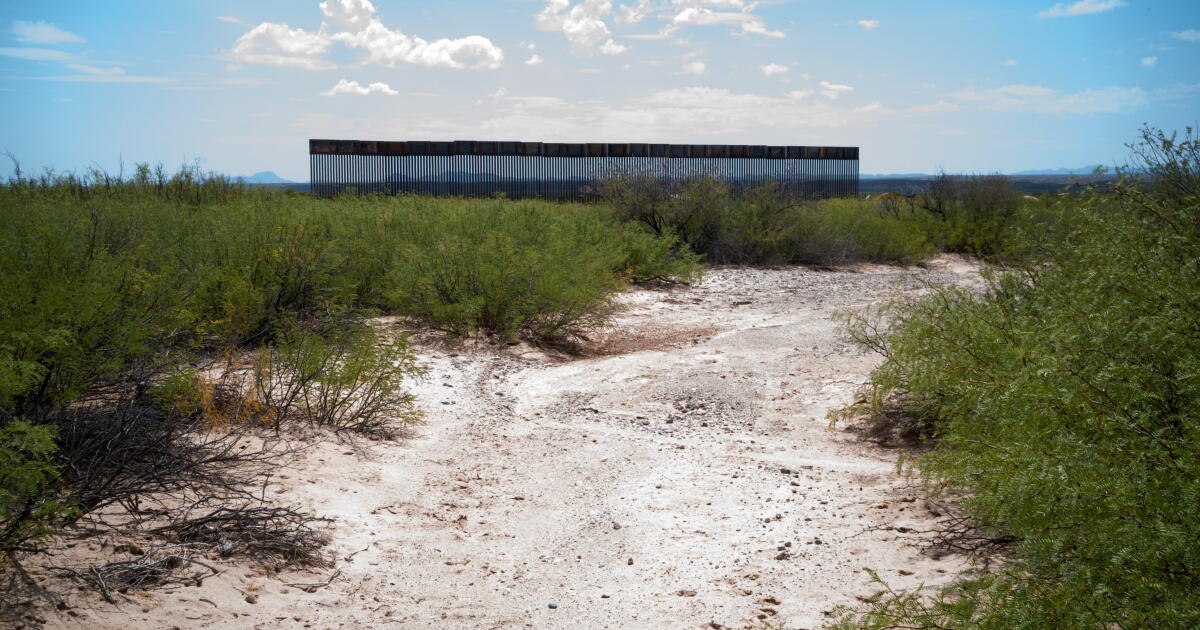
Wall construction has ramped up along the 1,954-mile border even as illegal crossings have plummeted to historic lows. Much of it began this year after the U.S. Department of Homeland Security waived cultural and environmental laws.

In California, explosions on Kuuchamaa, also known as Tecate Peak, send rocks hurtling down its Mexico side.

“We feel that in our DNA,” said Emily Burgueno, a California member of the Kumeyaay Nation, noting that “body” and “land” are the same word in the Kumeyaay language. Some tribal leaders met with Homeland Security officials to urge them to protect Kuuchamaa and are looking into legal action.

“No one ever consented or supported the use of dynamite on the mountain,” Burgueno said.

The nation consists of more than a dozen tribes in California and Mexico’s Baja California. The Kumeyaay have been working to block construction of the border wall since Trump’s first term.

In Arizona, Homeland Security contractors last month carved through a massive, 1,000-year-old fish-shaped geoglyph called Las Playas Intaglio. The rare drawing, etched into the desert floor much like Peru’s Nazca Lines, was created on a lava field in what is now the Cabeza Prieta National Wildlife Refuge.

Construction crews work on a new border wall segment on a steep slope.

Construction crews work April 24 on a new border wall segment near the end of a previously built section on Kuuchamaa Mountain, seen from Tecate, Mexico.

(Gregory Bull / Associated Press)

The Tohono O’odham Nation said it had pointed out the site on its ancestral land for contractors to avoid.

“This was a devastating and entirely avoidable loss,” Tohono O’odham Chairman Verlon Jose said in an April 30 statement. “There is nothing more important than our history, which is what makes us who we are as O’odham. The site was also an irreplaceable piece of the United States’ history, one none of us can ever get back.”

U.S. Customs and Border Protection said in a statement that a contractor “inadvertently disturbed” the site west of Ajo, Ariz., on April 23, but it vowed to protect the remaining portion. CBP Commissioner Rodney Scott is talking to tribal leaders to determine next steps.

Members of the Inter-Tribal Assn. of Arizona, which represents 21 tribes, traveled to Washington last month to lobby against a 20-foot secondary wall being built along that section of the border, as well as a primary 30-foot bollard wall planned on Tohono O’odham tribal lands.

They met with Homeland Security Secretary Markwayne Mullin, a Cherokee Nation member, who listened but made clear his intent is to build more border wall as fast as possible, the Tohono O’odham Nation said in a statement.

Hundreds of miles under contract

The Trump administration says the barriers are necessary to keep people and drugs from entering the U.S. illegally. It wants walls to cover at least 1,400 miles of the border.

Trump’s One Big Beautiful Bill Act last year devoted more than $46 billion to the effort.

CBP has awarded contracts or begun construction on over 600 miles of new border wall, with companion surveillance technology. A double wall is planned or under construction along an additional 370 miles.

In Arizona, where the Patagonia Mountains descend to the border, heavy machinery crawls along freshly graded roads to extend a double wall that could block a wildlife corridor for endangered ocelots and jaguars. Jaguars have long coexisted with the Tohono O’odham, who consider the species “spiritual guardians,” Austin Nunez, a tribal leader, said in a 2025 lawsuit that unsuccessfully challenged the Homeland Security waivers.

In Sunland Park, on New Mexico’s border with Mexico, crews this year set off blasts on Mt. Cristo Rey, a pilgrimage site topped with a limestone crucifix.

CBP is seeking to seize a strip of the mountain owned by the Roman Catholic Church for wall construction. The Diocese of Las Cruces asked a judge this month to deny the land transfer as an affront to religious liberties and the “faithful who seek to commune with God on Mount Cristo Rey.”

In western Texas, the federal government in February notified ranchers on the Rio Grande east of Big Bend National Park of its interest in their land that contains canyonland pictographs and petroglyphs, said Raymond Skiles, a retired Big Bend National Park ranger.

“There are pictographs, paintings of shaman figures and various things that we don’t know how to interpret,” said Skiles, describing the drawings on his family’s ranchlands.

After community backlash, CBP’s online planning map showed the 30-foot-wall plans were scrapped for surveillance technology, patrols and some vehicle barriers. A segment in the national park and neighboring Big Bend Ranch State Park would rely on technology alone.

CBP says it recognizes the importance of natural and cultural resources and is working to minimize the construction’s impact, including leaving drainage gates open in wildlife corridors for animal passage. Illegal border crossings have littered, polluted and trampled sensitive habitat, the agency says.

CBP also says 535 miles of remote, rugged border terrain will solely rely on detection technology.

Many tribes would prefer that to walls.

Norma Meza Calles, a Kumeyaay Nation leader, touches a branch.

Norma Meza Calles, a Kumeyaay Nation leader, leads a guided tour of traditional Kumeyaay uses for local plants at a wellness center in Tecate, Mexico.

(Gregory Bull / Associated Press)

Desecrating Native American sites is a felony

Tribes along the border “are all experiencing the same tragic desecration of our cultural and sacred sites,” said Burgueno, chair of the Kumeyaay Diegueño Land Conservancy, a nonprofit organization in California that works to protect Kumeyaay lands. “This is a great example of the federal government not following federal laws.”

Desecrating a sacred Native American site on U.S. federal or tribal land is a felony, punishable by imprisonment and fines. In 1992, the National Park Service listed Kuuchamaa Mountain in the National Register of Historic Places, giving it limited protection. It noted that “discarding or disturbing the mountain’s natural state would be sacrilegious.”

Rising 3,885 feet above sea level, Kuuchamaa has also captivated non-Native people.

Sarah Livia Brightwood Szekely said her father, Edmond Szekely, felt the mountain’s healing energy when he arrived in Tecate, Mexico, as a Hungarian Jewish refugee during World War II, and started the renowned wellness resort, Rancho La Puerta, which she now runs.

“There are all of these people that have a deep relationship with the mountain,” she said.

Meza Calles leads walks at Rancho La Puerta to teach guests about Kuuchamaa.

Traditionally, young men would spend 40 days at its base in a coming-of-age ceremony before becoming warriors or shamans, she said. Today’s rituals are shorter. People suffering from a death, debt, divorce or other difficulty seek Kuuchamaa’s healing, she said.

“It’s sad they are ruining the mountain,” she said. “We’ll see how far they go. Destiny is destiny. But the fight is not over.”

Watson and Lee write for the Associated Press and reported from Tecate and Santa Fe, N.M., respectively.

Source link

U.S. Border Patrol chief Michael Banks is resigning, in latest DHS leadership change

The head of U.S. Border Patrol, the agency tasked with securing the nation’s frontiers and increasingly tapped by the Trump administration for immigration operations in American cities, announced his resignation Thursday.

Michael Banks’ decision, announced in a Fox News interview and later confirmed by the Department of Homeland Security, is the latest leadership shake-up of officials implementing President Trump’s immigration crackdown and comes as the Republican administration appears to be recalibrating its approach.

“It’s just time,” Banks was quoted as saying in a report on the Fox News website. “I feel like I got the ship back on course from the least secure disastrous chaotic border to the most secure border this country has ever seen,” he said.

In a statement, the U.S. Customs and Border Protection commissioner, Rodney Scott, thanked Banks for his service “during one of the most challenging periods for border security.”

The White House did not immediately respond to a request for comment.

It was not immediately clear who will replace Banks. He led an agency at the forefront of Trump’s high-profile immigration enforcement efforts but kept a lower profile than some other officials such as Gregory Bovino, a now-retired commander who became a public face of the city operations.

CBP is one of the federal agencies that participated since last year in a series of immigration enforcement operations, carried out primarily in cities governed by Democrats —an effort that triggered a spike in arrests and led to the fatal shooting of two U.S. citizens in Minneapolis this year at the hands of federal immigration officers.

Banks’ resignation takes place two months after Markwayne Mullin, a former Republican senator from Oklahoma, became homeland security secretary. DHS oversees CBP and U.S. Immigration and Customs Enforcement, also known as ICE.

Banks is stepping down at the same time that ICE is also going through a leadership transition. Todd Lyons, the acting ICE director, is leaving later this month and will be replaced by David Venturella, who worked for years for private contractors before returning to government service.

CBP was established in 2003 and handles customs, immigration, and agricultural regulations to secure U.S. borders.

Banks returned to the Border Patrol last year after a long agency career that had never landed him in its senior ranks. His star had risen as border czar to Gov. Greg Abbott, R-Texas, during a period when illegal crossings reached record highs and the state launched a multibillion-dollar enforcement surge that led to turf battles with the Biden administration.

Banks kept a relatively low public profile as arrests for illegal crossings that have plunged to their lowest levels since the mid-1960s, a trend that began toward the end of that Democratic administration.

Banks did not appear publicly at the Border Security Expo this month in Phoenix, an annual conference at which government officials update contractors on the state of the border. Scott, who was Banks’ supervisor, is a close ally of Trump border czar Tom Homan and has acted more as the agency’s public face.

In the interview with Fox News, Banks said that after 37 years, “it’s time to enjoy the family and life.”

Source link

Trump to again end legal status of people who entered US with CBP One app | Donald Trump News

Judge had previously blocked move to end temporary legal status for those who entered US via Biden-era application.

The administration of President Donald Trump plans to again end the temporary legal status of hundreds of thousands of people who applied for asylum in the United States via the CBP One app.

The plan was detailed in a court filing in Boston, Massachusetts, and comes after a judge ruled that Trump’s earlier effort to terminate the legal status of those individuals was unlawful.

Recommended Stories

list of 3 itemsend of list

Under US President Joe Biden, individuals who registered for an appointment with US Customs and Border Protection (CBP) were preliminarily vetted and granted temporary legal status in the US as their asylum cases were adjudicated.

About 900,000 people were granted so-called humanitarian parole under the programme.

But in April of last year, just months after Trump took office for a second term, many of those individuals received emails saying their status had been terminated.

The message told its recipients it was “time for you to leave the United States”.

Federal Judge Allison Burroughs subsequently ruled that the Department of Homeland Security did not follow the proper procedures in terminating the legal status immigration status of CBP One users.

The US Department of Justice, in the new filings, told Burroughs that the Trump administration was complying with ⁠her order.

However, the department said the administration would begin issuing new parole termination notices, pursuant to a Tuesday memo from CBP’s head, Rodney Scott.

The memo is not public, but according to the Justice Department, Scott provided ‌an explanation for why, in his opinion, “parole is no longer appropriate for those aliens”.

Lawyers for Democracy Forward and Massachusetts Law Reform Institute, which represent the individuals whose status faces termination, urged Burroughs in a subsequent filing to prevent what they called a “deliberate attempt to evade compliance with the court’s order”.

The next hearing was set for May 6.

During his second term, Trump has pursued a hardline immigration policy that has included staunching nearly all asylum claims at the southern border.

Shortly after taking office, Trump’s officials also dissolved the CBP One app and relaunched it as CBP Home, a tool for self-deportation.

His administration has claimed there was an “invasion” at the border that constituted a “national emergency”, thereby allowing Trump to bypass legal requirements to allow individuals seeking asylum into the country.

Asylum, however, is a right enshrined both in domestic and international law, to protect people fleeing persecution on the basis of race, religion, nationality, political opinion or membership in a particular social group.

Separately, on Friday, a federal appeals court ruled against the Trump administration’s ban on asylum at the southern US border, potentially clearing the way for applications to once again be processed.

The administration is expected to appeal the decision.

Source link