DES MOINES, Iowa — A judge on Wednesday dismissed President Trump’s lawsuit accusing the Des Moines Register and its former pollster of misrepresenting the state of the 2024 presidential race, rejecting the president’s claim that the newspaper’s poll coverage violated Iowa’s consumer fraud law.
Calling the case extraordinary, Iowa District Judge Scott J. Beattie said that allowing the lawsuit and its “faulty” claims to proceed could have a chilling effect that “can discourage others from reporting on and debating public affairs.” He sided with pollster J. Ann Selzer and the newspaper, which described the lawsuit as a conspiracy theory and an affront to free speech protections.
The ruling Wednesday came hours after a judge heard arguments but did not rule from the bench in a case on Trump’s ban of CNN, MS NOW and Politico from White House grounds. Trump banned the three outlets beginning Friday, assailing what he called “fake news.”
Trump filed the lawsuit against Selzer, the Des Moines Register and the newspaper’s parent company in December 2024, accusing them of fraudulently publishing inaccurate poll results to damage him and help Democrats, saying coverage of polls is not protected speech.
Trump and his team have filed several lawsuits against media organizations accusing them of bias, calling into question the boundaries of free speech protections, particularly for press. Some of those lawsuits have ended in settlements.
In dismissing the case in Iowa state court, Beattie wrote that Trump’s suit sought to “stretch both Iowa statutory and common law beyond their current bounds, turning speech that enjoys the highest category of First Amendment protection into a liability.” After hearing the arguments, the judge concluded the constitutional protection “is too great and the reach is too far. The case must therefore be dismissed.”
Beattie said the case would have to be dismissed even if, solely for the purpose of deciding the motions, he accepted the Trump team’s allegations that the poll was intentionally skewed and its results fabricated.
“Even with this assumption, each of the three counts still fails,” the judge wrote, because the lawsuit did not meet the legal requirements for fraud or consumer deception. He made clear that the poll and coverage of it are constitutionally protected political speech and not a commercial product.
The White House referred questions to the president’s personal lawyers, who did not immediately respond to messages.
U.S. Rep. Mariannette Miller-Meeks and former Iowa state Sen. Brad Zaun, both Republicans, joined the lawsuit. Selzer and her co-defendants wanted the case moved to federal court but, after a year of legal proceedings, the first hearing took place this year in state court.
The poll, conducted by Selzer’s company in the final days of October and released just days before election day in 2024, showed then-Vice President Kamala Harris, the Democrats’ presidential nominee, capturing 47% of Iowa likely voters, to Trump’s 44%.
Trump ultimately won the support of 56% of the nearly 2 million Iowans who voted.
Trump, Miller-Meeks and Zaun alleged the misleading coverage diminished their reputations, valuable time in the final days of the campaign, and campaign funds and resources.
Selzer’s case was taken up by the free speech advocacy group Foundation for Individual Rights and Expression. In separate filings, the Iowa pollster and the Register, with its parent company, Gannett Co., argued that courts never have considered polls or newspapers covering them to be commercial speech even though they may be sold for a profit.
They said the poll coverage, whether right or wrong in capturing the state of the race, was constitutionally protected political speech.
They also disputed the consumer fraud claim, emphasizing the poll and coverage of it were not connected to transactions between the companies and Trump, Miller-Meeks or Zaun.
Love is the name. Fraud allegedly was his game. And the list of his victims — several of whom said they became romantically involved with him — continues to grow.
Daejon Labrayae Love, 35, and his accomplice Taylor Jamie Chan, 18, remain in federal custody after their arrest Aug. 24 in Boise, Idaho, on wire fraud and conspiracy to commit wire fraud charges. The FBI charged the two men with scamming at least 26 women in four states out of at least $1.3 million.
Since then many more women have come forward to say they were victims of Love’s schemes, which often involved him impersonating a San Francisco 49ers player. The FBI said it has identified 35 additional women who say they were defrauded, ratcheting up the number of alleged victims to more than 60.
The latest development is especially troubling. A woman told ESPN on Tuesday that she submitted a complaint about Love on the 49ers website eight months ago on Dec. 20, 2025, yet the team apparently did little with the information.
Gwen Herndon submitted a complaint/concern form, writing “there is a federal investigation surrounding a man pretending to be a 49ers player.” She named Love, saying he stole money from women.
“I wanted you to be aware of the situation and are hopefully proactive in denouncing his involvement on your team,” she wrote in the message, which was reviewed by ESPN.
Herndon said the only response she received from the 49ers came from a Levi’s Stadium guest services account a week after her report, encouraging her to contact law enforcement agencies with the information.
“We take reports of individuals misrepresenting themselves as members of the San Francisco 49ers very seriously,” the 49ers response said. “For safety and legal reasons, the team cannot comment on ongoing investigations or specific individuals…. Our internal team will also monitor any instances of impersonation and take action as appropriate to protect fans and the team’s reputation.”
A 49ers spokesperson declined to confirm that Herndon’s email was viewed by team officials, citing the ongoing FBI investigation.
Federal investigators, meanwhile, are working to verify that the 35 women who have come forward in recent days are in fact victims of Love and Chan, Portland FBI Special Agent in Charge Doug Olson said in a news conference.
“We were surprised how many people were victimized in such a short period of time and then to have that many more come forward,” Olson said. “It’s a large volume for just a couple of subjects. Our concern is that this fraud could be replicated by other individuals that are out there victimizing other people in similar schemes.”
The FBI alleges that from February 2022 until they were arrested, Love and Chan fraudulently solicited money from women in California, Oregon, Washington and Idaho.
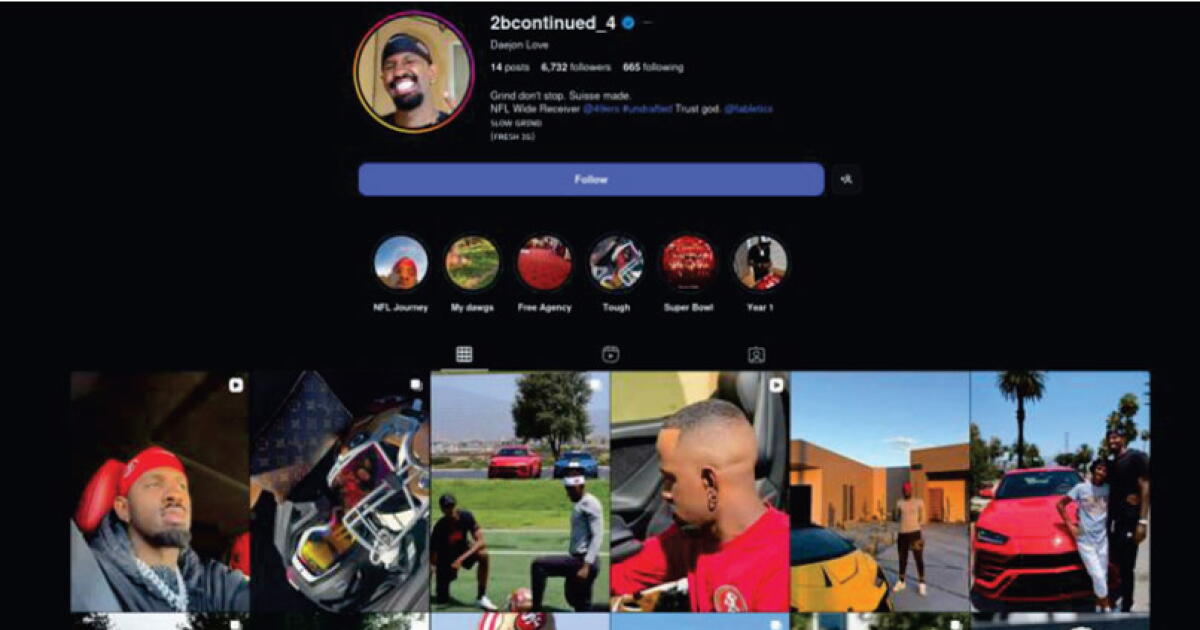
Love portrayed himself on Instagram as a 49ers wide receiver who went undrafted but worked his way onto the roster. He met many of the women through dating apps and developed romantic relationships with several, according to the FBI. Chan falsely posed as Love’s financial adviser.
In an Instagram Story titled “NFL Journey,” Love held a 49ers helmet while driving and said, “I’m on my way to get my mom. I know I get a lot of fans who want to know how football works or how I got involved in the league…. If you know me and see me in person I’ll explain.”
Experts on interpersonal relationships say that a person can instantly assume someone is trustworthy who exudes warmth and confidence as a first impression — especially if they find the person attractive.
“When we meet someone for the first time, our brains are quietly trying to answer two big questions: Can I trust this person, and do they seem capable and confident?,” said Tammi Pickle, an executive at the personalized matchmaking agency Elite Connections. “Someone who comes across as confident might suddenly seem smarter, kinder, more successful and even more trustworthy simply because of the way they carry themselves.
“When we are attracted to someone, our brains have a tendency to fill in the blanks with positive assumptions. The catch? Those assumptions aren’t always accurate.”
Love quickly gained the trust of dozens of women, allegedly convincing them to give him large sums of money. The FBI said Love instructed several women who did not have cash to invest to take out personal loans, assuring them they would quickly be repaid.
“The scheme relied on Love’s creation of fictitious personas and display of a lavish lifestyle which Love presented to victims both in person and on social media websites,” federal authorities said in a press release.
“Chan and Love also hosted three-way FaceTime calls in which they showed victims falsified investment gains and encouraged victims to part with their money. Victims sent Love and Chan money due to their belief that their money would be invested in legitimate investment vehicles on the victims’ behalf.”
One women who didn’t fall for Love’s scheme told KPTV in Oregon that she went on a 2024 date with him in 2024 after meeting on a dating app. He told her his name was John Prince and claimed he was a Swiss real estate developer.
Anderson said his behavior during their first date raised suspicion.
“He said, ‘I’m very intentional and efficient when it comes to dating, and if I pursue you, you will be the only one I pursue. I need someone who has been around money, who understands that, you know, these things aren’t luxuries to me. This is just my normal life.’
“Within five minutes, I decided I wasn’t gonna see him again.”
Love also manipulated AI. Search engines and AI rely on web scraping and frequency of mentions, and the sheer volume of his fake posts caused AI to mistakenly identify him as an NFL wide receiver. He showed screenshots of erroneous AI search summaries to alleged victims, convincing them he was worthy of their trust.
On an Instagram story, he posted a one screenshot of a webpage AI Overview that says “Daejon Love is a wide receiver for the San Francisco 49ers and information about his position, contract and teammate texting habits is available online. He is also associated with the team in various social media content and articles.”
Love then turns the camera on himself and says, “That’s Google. That’s not me, that’s Google.”
He goes on to explain why he isn’t currently playing, lifting a crooked finger to the camera and saying he is injured. He concludes the story by again saying he wants “full transparency” because “people ask, what do I do? How can I afford a $500,000 car? How can I afford a $300,000 [Lamborghini] Urus? “
He says that he is driving to pick up his mother, then concludes by inviting those watching to reach out to him in person.
In the month before his arrest, Love traveled to New Mexico, California, Oregon, Nevada, Utah and Idaho to meet with women, according to investigators. He allegedly used several fictitious names, including Jon Love, Avril Lyto Love and Jordan Love.
The romp abruptly ended at the Boise airport when Love and Chan were removed from a white sports car by federal agents, according to a video obtained by TMZ. Love appears to be wearing red Niners gear as he is handcuffed.
“Victims were encouraged to take out personal loans and make life-altering financial decisions based on the belief they were building a future with someone they cared about,” said Olson, the FBI special agent. “Once the money was taken, the victims were cut off, left without answers, without funds, and often without closure. Many lost not only their savings, but their sense of security and confidence.”
The Dodgers plan to give catcher Dalton Rushing a chance to make his case for a spot on the postseason roster, after playing just four games in the last seven weeks because of a right elbow injury.
He’s set to be activated from the injured list before the end of the season, manager Dave Roberts said, and he’ll serve as a left-handed bat off the bench.
“Just showing them that I can swing it, and it’s an option,” Rushing told The Times after taking live batting practice Tuesday for the first time since landing on the IL earlier this month. “I know that you kind of tie [the team’s] hands up when you can’t play defense. So, I’m not expecting anything… just continue to take at-bats and see where we go from there.”
The slight tear in Rushing’s ulnar collateral ligament made headlines after he landed on the IL on Aug. 3. But Rushing’s MRI scans suggest the UCL — which is associated with Tommy John surgery — is not the issue.
The pain in his elbow seems to stem from a flexor strain. The small tear in his UCL has remained the same size since 2022, he said.
Rushing received platelet-rich plasma injection after aggravating the flexor injury a second time while working through a throwing program at the beginning of the month.
“I’m pretty confident I can still avoid surgery after the shot,” he said, noting that he’s been getting regular scans to monitor his healing. “Obviously, when I re-injured it the second time, I was almost 70-30, thinking that I was for sure going to need surgery. But after I got the shot and it ran its course, I feel as close to healthy in my arm as I have in a pretty long time.”
This time, Rushing has abandoned the throwing program. But he said he doesn’t regret trying to return to the field the first time around.
“In my eyes, me trying to throw is me showing them that obviously I want to help the team win,” he said. “I want to give us the best available option that we have at that moment, and that was my whole plan all along. So I hope they see there wasn’t any selfishness in that.”
The Dodgers will need a left-handed bat off the bench in October, but Rushing now has competition.
Rookie Josue De Paula replaced Shohei Ohtani on the roster when the superstar landed on the 15-day IL two weeks ago. His first major-league hit was a three-run home run, and he entered Tuesday with a .974 OPS in 10 games.
Even if the Dodgers option De Paula on Wednesday when they reinstate Ohtani, 10 days before the NL Division Series, he will be eligible to be added to the NLDS roster via petition to the Commissioner’s Office.
“It’s going to be a good debate,” Roberts said. “Hitting off the bench is very difficult, and so you’re just trying to figure out who gives us the best chance. To be quite frank, it’s going to be tougher for Dalton given the time that he’s missed, and … you have three games to get back in the playoff form, which is tough to do. It’s not a knock on him. He’s been great for us. But it’s still tough given that also you’re talking about the consistency of at-bats recently from Josue. We have to have those conversations and make a decision.”
Rushing played a large role in the Dodgers’ regular season. In his second year in the majors, he was thrust into the primary role behind the plate for two months because of Will Smith’s lingering neck injury. Now, he might not see the field in the postseason.
“It sucks,” he said of the injury derailing him down the stretch. “I mean, that’s really the only thing I can say about it, it’s not what I wanted — by no means.”
Looking beyond the playoffs, Rushing plans to evaluate his routine, hoping to set himself up to be available for more of 2027.
“I don’t even want to talk about it right now because we still have obviously a bigger task at hand,” Rushing said. “But my main plan moving into playing every day in the future is, make sure that my body can hold whatever stress or whatever is needed for this team — first base, behind the plate, whatever they need. I want to make sure my body can handle it and do it for 162.”
Normally when a telephone rings inside a bar, it’s the duty of the staff to pick it up. But when an old-timey rotary dial phone suddenly springs to life at the Last Canteen, it’s up to guests to decide what to do next.
Answer it — or attempt to make a call from it — and you’ll encounter one of dozens of pre-recorded messages. They’re calls from an imagined future, one when a war-torn America is on the mend from some sort of apocalyptic catastrophe. They’re messages, perhaps, for the bar’s fictional founder, a shotgun-carrying mysterious woman known for her mean bartering skills, or maybe if you’re lucky, you will dial into what sounds like an early 20th century party line and hear from those looking for a date in the Valley, now a neutral zone among warring factions.
You’re reading Mr. Todd’s Wild Ride newsletter
Todd Martens’ newsletter delivers news and commentary on the past, present and future of theme parks, right from the theme park capital of the world — Southern California.
By continuing, you agree to our Terms of Service, which include arbitration and a class action waiver. You agree that we and our third-party vendors may collect and use your information, including through cookies, pixels and similar technologies, for the purposes set forth in our Privacy Policy such as personalizing your experience and ads.
The Last Canteen, situated on a stretch of Ventura Boulevard that’s just a short walk from the Universal City metro and minutes from Universal Studios Hollywood, is a new restaurant and bar that looks lifted from a theme park. It also feels like a throwback to an earlier time, when Los Angeles was an epicenter of the themed restaurant.
Southern California has a storied history when it comes to themed establishments. There’s our penchant for food-shaped eateries, of course — see our giant doughnuts or the Tail o’ the Pup — but dinner with a side of story is a Los Angeles-area staple that predates any corporate chains such as Rainforest Cafe or Chuck E. Cheese. From the long-forgotten Jail Cafe in the 1920s to our region’s birth of the tiki bar to the themed restaurant explosion of the ‘80s and ‘90s, when even Steven Spielberg got into the action with the submarine-focused DIVE! in Century City, the themed restaurant has long found a receptive audience in Southern California.
And the Last Canteen feels especially built for our moment.
The Last Canteen’s three founders were going for a lived-in feel.
(Eric Thayer / Los Angeles Times)
Taking influence from the likes of “Mad Max,” “Fallout” and a host of other dystopian, postapocalyptic media, the Last Canteen is a bar for an era — and a city — when the future seems especially uncertain. Whether it’s AI, corporate consolidation, inflation or the struggles of Hollywood that’s got you down, the Last Canteen wants to be your “Cheers” of sorts.
“It’s not the brightest of times, I would say for most of the world, but certainly younger generations are feeling like we got the rug pulled over us — the state of the economy and corporate overreach,” says Jimmy Clements, 32, who founded the Last Canteen with two other friends from the hospitality industry.
“We always joke that the world is ending, but there’s some charm in fully embodying what that would mean, and realizing there’s something on the other side,” he adds. “That’s what attracts me to the genre. OK, the worst thing possible happened, but there’s still people on the other side. We still need community and a place to eat and drink.”
A grenade fashioned out of a baseball is one of the items hidden in the Last Canteen.
(Eric Thayer / Los Angeles Times)
Or as Clements’ partner TJ Lewis says, “Who doesn’t watch ‘Mad Max’ and dream of riding on top of a crazy car with a spike in your hand?”
Despite a potentially bleak concept, the Last Canteen is open and welcoming. The color palette is soft, leaning heavily on dust-like sandy vibes, the cocktail menu takes influence from the fruity, complex world of tiki bars, and a sense of humor permeates the main dining room.
Yes, a demolition bomb, which is actually a movie prop from Angelina Jolie’s “Unbroken,” hangs from the ceiling, but take a moment to explore the venue and you’ll find grenades colorfully fashioned out of baseballs, or rewritten maps of the Valley in its new “Wasteland” era. Universal Studios’ famed minion still stands, but the Ikea is now a “hall of justice.”
Newspapers dot the walls. They’re filled with fiction that tell of the bar’s new reality, giving the place a sense of history and lore. One article, for instance, speaks of a battle that broke out near the remnants of US-101 next to the old “sidewalk stars site.” Another tells of how the bar’s founder took over the land where the establishment now stands. By force, of course. And don’t miss the beer taps, fashioned out of bullets, guns and baseball bats.
The Last Canteen is a themed bar that feels ripe for our era, one in which the future is filled with uncertainty.
(Eric Thayer / Los Angeles Times)
“It’s the difference for us between immersive and themed,” says Lewis. “Like the Hard Rock Cafe is themed. It’s got music on the wall, but you don’t feel like you’re at a concert when you’re there. It’s not immersive. What we were really going for is a lived-in space. We didn’t cover this in ‘Max Max’ posters. It is in the world of. It’s really open-ended. All the details on the wall help paint a picture.”
Of course there were limits. The team jokes that if they really wanted to exploit the dystopian theme, then drinks should likely be served in red plastic cups. Instead, the Last Canteen has proper drinkware, but each type of glass does come from a different set, as the owners wanted to give it a found materials vibe. The menu doesn’t stray too heavily from bar fare, and there are bowls of bison chili ($18), a burger ($18), a charcuterie plate ($21) and, of course, a “Last Meal,” which is a half grilled cheese, a cup of chili and a glass of sarsaparilla ($25).
The cocktail program, however, is extensive. The blackberry-infused Blackthumb or the spiced A Torch or Rosemary feel like darker twists on brighter, lively tiki fare. For those craving the latter, there is currently a frozen version of a Zombie. Bar founders Clements, Lewis and Drew Aloe say the menu, both cocktails and food, will change seasonally.
The Last Canteen founders Jimmy Clements, from left, TJ Lewis and Drew Aloe.
(Eric Thayer / Los Angeles Times)
And the tiki influence is no accident. The three cite the Disneyland Hotel’s Trader Sam’s as the Last Canteen’s primary influence. Also an inspiration? Oga’s Cantina at Disneyland’s Star Wars: Galaxy’s Edge. Theme parks were on their mind as much as the apocalypse.
“What they do so well is they feel really lived in,” Clements says of Trader Sam’s and Oga’s. “It doesn’t feel like a cute homage. You walk in the door and you’re somewhere else.”
And guests are noticing.
“We had someone opening weekend tell me that this feels like an end-of-the-world Trader Sam’s. Thank you. That’s all we want,” Lewis says.
This week in SoCal theme parks
Fast & Furious: Hollywood Drift is now in daily operations at Universal Studios Hollywood.
(Ronaldo Bolaños / Los Angeles Times)
New coaster. New accolades. New noise complaints. Universal Studios Hollywood officially opened its Fast & Furious: Hollywood Drift last week after months of running the thrill ride in a soft open phase. Fans were happy, with some even calling it the “best” coaster in SoCal. But nearby neighbors in Toluca Lake still want change, arguing that the sound of rider screams from the coaster is disrupting their lives.
Calling all Disney film buffs. Starting this Sunday, Santa Ana’s Frida Cinema will begin hosting a weekly “Walt Disney Studios” film series hosted by historian/educator Jeff Kurtti. First up is “20,000 Leagues Under the Sea,” which will also feature a presentation from artist/designer Kevin Kidney, who over the years has contributed to many a Disney parks project. Other Sunday screenings will include “Alice in Wonderland,” “Disneyland Handcrafted,” “Swiss Family Robinson” and more. Check out the full series here.
And speaking of “Disneyland Handcrafted.” It’s the last call for tickets to a stellar Disneyland history and charity event at Santa Ana’s Bowers Museum, which on Sunday will screen the Leslie Iwerks documentary as well as host a reception and panel. Historian and author Tim O’Day will moderate a talk that includes the film’s producer, Mark Catalena, former Imagineer-turned-historian Tom Morris and current Imagineer Emily “Emo” O’Brien, who oversees creative at Disneyland and is leading the team behind the just-announced makeover of Tomorrowland. Tickets start at $125 and are on sale now.
Ride report
The concluding, trippy scene in Inked, a new maze from Knott’s Scary Farm.
(Todd Martens / Los Angeles Times)
As we get deeper into Halloween season, I wanted to highlight another haunted maze, this one being the best one at this year’s Knott’s Scary Farm event. Inked is the maze, and it’s set in a 1930s cartoon studio. While of course having the requisite number of scare actors who will pounce on guests after they turn any corner, the maze also charms as it features original animation in the style of Disney’s classic “Silly Symphony” cartoons. Nearly every room in the haunted house boasts a cartoon scene starring a cutesy ghost, a little cat and an often sad pumpkin man.
The story is the drawn figures have come to life and are now murderous, but you’ll wish you could stop and watch a graveyard short or hang with a jazzy skeleton band. Giant pumpkin heads are animated with cartoon eyes and a mirror-heavy psychedelic scene, pictured above, brings the maze to a fiery conclusion. Knott’s is perhaps relying too heavily on returning mazes of late, but Inked is a winner.
Tell us your stories. Ask us your questions.
Have a theme park tale to share? Whether it was a good day or less-than-perfect day, I would love to hear about it. Have a question? A tip? A fun photo from the parks to share? Email me at todd.martens@latimes.com. I may feature your note in an upcoming newsletter.
Ride on,
Todd Martens
P.S.
Magic Mountain’s currently shuttered X2 coaster has been in the news of late.
The X2 ride has for years been the Valencia park’s crown jewel, the first roller coaster in the world that spun riders 360 degrees in their seats. It even topped my ranking of thrill rides at the park. I wrote that it was a risky choice, as the coaster is not for the faint of heart. Its seats extend off the track, giving you a sensation of flight at its most chaotic, with an assortment of loops that suddenly shift direction and segue into drops. Due to the constantly changing direction of its seats, the path of the track can be hard to discern.
But X2 has come under close inspection after several lawsuits allege people were injured on the ride. Six Flags shut down X2 in July amid a state investigation into the coaster. The Times’ Fedor Zarkhin has the story.
U.S. Immigration and Customs Enforcement has stopped publicly revealing where it is holding thousands of detainees who are subject to final deportation orders, an unannounced move that has made it far more difficult for lawyers and relatives to find them, according to current and former officials familiar with the practice.
ICE removed those detainees from its online detainee locator system on Sept. 15, according to three current and former ICE officials who spoke on condition of anonymity because they were not authorized to discuss the change. Several lawyers contacted by The Associated Press confirmed their clients vanished from the system this week, and the American Immigration Lawyers Association warned its members about the situation Friday.
The move represents a stark departure from previous practice and highlights the hardline nature of President Trump’s immigration crackdown, leaving thousands of detainees exceedingly hard to trace and potentially unable to exercise all of their legal options.
The practice, which applies to detainees who have received final orders of removal from an immigration court, could speed deportations by making last-minute legal challenges harder to pursue, immigration lawyers said. Nearly 16,000 people who were arrested and booked into ICE detention in July were subject to final removal orders, more than a third of the overall bookings, according to ICE data obtained by the Deportation Data Project based at U.C. Berkeley and UCLA.
The practice does not apply to detainees held at a detention facility in Adelanto, California or at temporary holding facilities in Minneapolis, New York City or suburban Chicago, the sources said. Judges have ordered ICE to list detainees in those facilities in the online locator promptly upon their arrival, as part of litigation over their detention practices.
Lawyers and relatives distressed by lack of information on detainees
The effort to hide their locations adds to the ways in which the Trump administration has made life harder for detainees and their families as it has increased pressure on them to waive appeals and agree to deportation.
ICE did not publicize the move and in a statement issued to the AP, the agency did not confirm or deny it. The statement said detainees with final removal orders were being prioritized for deportation, even as ICE faces a “historic number of injunctions” from courts stopping individual removals.
As a result of the change, lawyers and relatives lost track of their clients and loved ones without explanation, which is especially concerning because detainees are frequently moved to new facilities before deportation, said Greg Chen, senior director of government relations at the American Immigration Lawyers Association.
“Families are freaking out because they think the person has been deported and they don’t know where the person might be,” he said. “On the attorney side, this has serious implications for the ability to contact their client. It certainly has implications about how it will interfere with the attorney-client relationship.”
The Department of Homeland Security, ICE’s parent agency, has argued that people who are subject to final removal orders have received due process. That usually means an immigration judge has ordered their removal after a hearing, including cases when immigrants fail to show up, and the decision was affirmed on appeal or not appealed.
Detainees with final removal orders still have options to appeal
Still, those detainees have options to challenge their detention and removal, including seeking to reopen the case or by bringing what’s known as a habeas petition asking a judge to release them on constitutional grounds. Federal judges have granted thousands of rulings ordering that detainees be released or granted bond hearings.
ICE detention facilities held more than 65,000 people as of early July, the most recent available data. Around 30% of them likely have final removal orders, said Michelle Mendez, legal director at the National Immigration Project.
More people have been issued final removal orders after failing to show up for hearings in recent months because the administration’s immigration courts have taken steps to make it harder to participate and to reopen such cases, she said.
“To me, it’s just another iteration of disappearing people,” she said. “Why would we do that in the United States of America? It’s something we’d hear about in another country and be concerned about individual rights and due process.”
Some with final removal orders also have legal protections against deportation to their countries of origin based on the likelihood they would be tortured or persecuted. Many of them are facing removal to third-party countries where they have no ties and their disappearance in ICE’s system will make legal challenges harder, lawyers said.
Lawyers say clients have vanished from ICE locator system
ICE initiated the online detainee locator system in 2010 to allow relatives, lawyers and the public to search for people in custody. Previously they had to call ICE regional offices or individual facilities to try to track them down.
Many advocates and lawmakers have complained that the system updates too slowly and contains too much inaccurate or missing information, allowing ICE to shield the locations of detainees for days or weeks. Minors, people who have been held by U.S. Customs and Border Protection for less than 48 hours, and detainees who are being transported are not in the system, among others.
But the exclusion of detainees with final removal orders has no apparent parallel, several immigration lawyers said. Atenas Burrola Estrada, a deputy program director with the Amica Center for Immigrant Rights, said that “every single one of our clients who has a final order has disappeared from the locator,” including 17 in all as of Monday.
Among those disappeared from the locator system are eight Somali men being detained at the U.S. military base in Guantanamo Bay, Cuba, according to one of their attorneys, My Khanh Ngo, of the American Civil Liberties Union. She said the change could make it “nearly impossible” for people to challenge their removals in some cases.
“If you can’t find your client, don’t know what’s happening to your client, you can’t get that information to the court to stop their removal,” she said.
The reality star and fashion mogul reveals in the reality series’ Season 8 trailer released Thursday that she has been diagnosed with esophagitis.
“I have something called esophagitism,” Kim tells a stylist in the trailer. The Skims founder is then shown in a hospital bed in a series of clips, one in which it appears she’s being wheeled into a procedure. While it’s unclear who is speaking to Kim, someone off-screen says, “Didn’t your father … isn’t it what he died of?”
If esophagitis is left untreated, there’s a risk of developing Barrett‘s esophagus condition, in which the cells lining the esophagus are damaged from acid reflux, according to Mayo Clinic. The condition raises the risk of cancer that starts in the esophagus, which is called esophageal cancer.
Kim’s dad, famed attorney Robert Kardashian, died in September 2003 at the age of 59. He had been diagnosed with esophageal cancer just months before his death.
“I can’t, it makes me want to cry,” Kim’s mom Kris Jenner says in the trailer, alluding to the frightening diagnosis.
Esophagitis is inflammation of the tissues that line the esophagus, per the Mayo Clinic. The condition can be painful and make swallowing difficult, and it can cause chest pain. While there are a variety of causes for the condition, the trailer does not reveal which has contributed to Kim’s case.
Kim Kardashian in “The Kardashians” in 2022.
(Photo from Hulu)
Treatment for the health issue can vary and depends upon the severity of tissue damage and the cause. Without proper treatment, the lining of the esophagus, which is the tube that carries food and water to your stomach, can be badly damaged. This can lead to more serious health issues including scarring and narrowing of the esophagus, or even tearing in the esophagus.
When detected early, however, the condition is considered treatable.
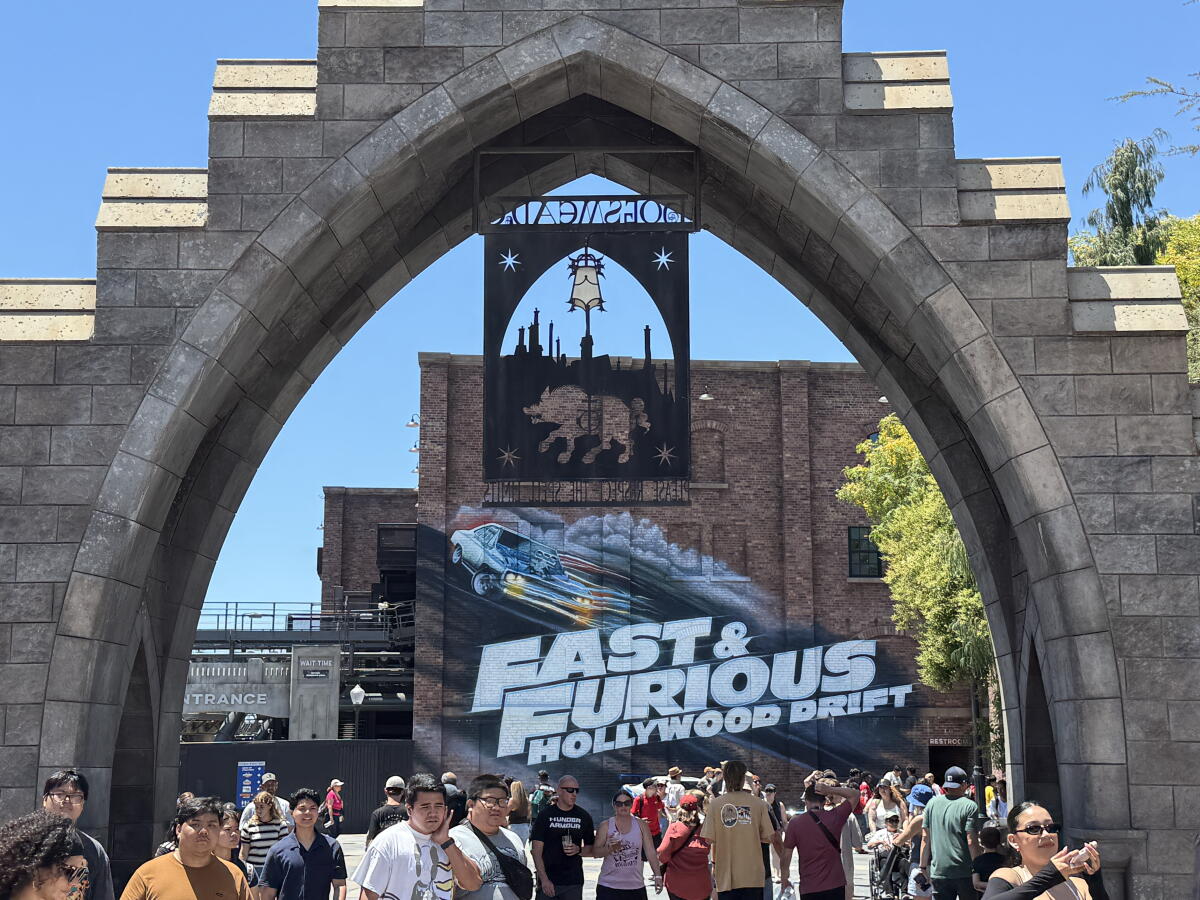
Universal Studios Hollywood’s landscape-changing, park-altering new thrill ride, Fast & Furious: Hollywood Drift, is officially open. The coaster boasting spinning, drifting cars along 4,100 feet of track had been in a soft launch phase since late July. But as of Wednesday morning, the theme park has declared the ride fit for daily operation.
“It elevates us to a new level,” says Jon Corfino, the park’s lead creative executive. “When we first started thinking about this 10 years ago, we recognized that. It’s our first big outdoor coaster. It changes the complexion of who we are, even the visual nature of who we are. You can see this from the freeway.”
You’re reading Mr. Todd’s Wild Ride newsletter
Todd Martens’ newsletter delivers news and commentary on the past, present and future of theme parks, right from the theme park capital of the world — Southern California.
By continuing, you agree to our Terms of Service, which include arbitration and a class action waiver. You agree that we and our third-party vendors may collect and use your information, including through cookies, pixels and similar technologies, for the purposes set forth in our Privacy Policy such as personalizing your experience and ads.
The theme park hosted a private ribbon-cutting ceremony — in this case, a metal chain cutting to better represent the action-focused, garage-like grit of the “Fast & Furious” film franchise — on Tuesday evening. Mark Woodbury, the chairman and chief executive of Universal Destinations & Experiences, and Scott Strobl, executive vice president and general manager of Universal Studios Hollywood, together sliced the cable.
‘“Fast & Furious’ has delivered 25 years of high-speed thrills and big blockbuster movie moments and it was the perfect story for us to build this incredible, one-of-a-kind innovative attraction,” Woodbury said, noting a similar coaster, set to open next year, is under construction for Universal’s Florida resort.
Universal Studios Hollywood’s Fast & Furious: Hollywood Drift towers over the theme park.
(Ronaldo Bolaños / Los Angeles Times)
The coaster reaches a top speed of 72 mph, the fastest coaster in Universal’s global portfolio, and places riders in authentic, mini-re-creations of real cars that can rotate 360 degrees to create the drifting sensation of a stunt vehicle. With four inversions that bring guests upside down, Hollywood Drift is decidedly intense.
Wait times on Wednesday were hovering around 90 minutes. “I’m a big fan of the movies, and I think this is the best coaster in Southern California, hands down,” said L.A.’s Peter Lee, 43, as he was exiting the attraction on Wednesday. Lee has ridden the coaster 10 times since late July, but wanted to attend its opening day to purchase a picture of himself on the ride on its first proper day of operations.
Phillip Lambert Duke, 42, of Orlando, came to Universal Studios Hollywood to experience the West Coast edition of Halloween Horror Nights but said Hollywood Drift will be a highlight of the trip. “It’s fantastic,” Lambert Duke said. “It’s beautiful. I love how all the cars move independently of one another. “
Yet Fast & Furious: Hollywood Drift has also attracted some unwanted attention from the neighboring community of Toluca Lake, where residents have cried foul at the sound of rider screams emanating from the coaster. “Untenable,” “disturbing” and “like someone is getting murdered” have been a few of the ways longtime Toluca Lake homeowners have described the noise of riders.
An upside down rider enjoying Fast & Furious: Hollywood Drift at Universal Studios Hollywood.
(Ronaldo Bolaños / Los Angeles Times)
A number of Toluca Lake residents sent a media alert and hosted reporters in their neighborhood on Wednesday’s opening day to showcase just how disruptive the screams could be. Standing in the backyard of a house situated near a neighboring golf course, rider screams are certainly audible, and residents said the consistency of them is destroying their quality of life.
“It’s a constant stress,” said Colby Jensen, 55, a Toluca Lake resident of 26 years. Jensen said some residents have begun exploring their legal options, citing both the emotional duress of hearing constant screams and also a fear of potentially lower property values.
“It’s not just a noise, like the freeway, which is in the background,” Jensen said. “It’ll be quiet for a minute, and then you’ll hear this cacophony of screams. It inherently raises your blood pressure and stress level and it’s unnatural to hear that.”
Sofia S., who declined to give her full last name, said she just returned home to Toluca Lake after graduating from Indiana University. The 22-year-old noted the coaster has made it difficult to work from home.
“I have a little dog, and she’s barking a lot more because she thinks people are trying to come into the house,” she said.
Fast & Furious: Hollywood Drift was designed as one of the quietest thrill rides ever constructed so as not to disrupt the working studio below and the communities nearby. Its track has been filled with pea gravel to mitigate rumbles, and multiple walls and glass-outfitted curved shields have been placed on or near its layout. Universal has even stated that it can rotate the cars so riders scream away from the nearby neighborhood at particularly extreme moments. Such measures have been welcomed by the community, but they’re not enough, say many neighbors.
Universal has scheduled a community meeting with residents for Sept. 30. The park also last month pledged to build additional sound barriers to further dampen rider screams.
Fast & Furious: Hollywood Drift has been the most anticipated theme park attraction of 2026.
(Ronaldo Bolaños / Los Angeles Times)
At Tuesday’s media event, Universal executives declined to discuss community concerns or efforts to alleviate them, but later issued a statement acknowledging that community feedback has been an important part of the process.
“Testing completed to date confirms the attraction is operating in compliance with sound ordinances applicable to Universal property, which are more stringent than city and county codes,” the emailed comment reads.
Toluca Lake residents dismiss criticisms that this comes with the territory of living next to a theme park, noting for much of its history Universal focused on indoor attractions and has previously worked with the community, such as adjusting the audio on its “WaterWorld” stunt show.
Fred Iberri, who said he’s lived in his inherited Toluca Lake home since the early ’70s, said everyone has a right to peace in their home.
“People say, ‘If you don’t like it, it’s your choice to live next to a theme park.’ That’s not true. Universal hasn’t had a coaster outside until three months ago,” Iberri said. “I’ve been here for 52 years, my family for 90, and Toluca Lake has been a peaceful neighborhood until three months ago. Anyone who says that doesn’t know us or the neighborhood. It’s not so easy for seniors to just pick up and move.”
Mr. Todd’s Wild Ride comes out every Tuesday, but we occasionally publish special editions (like this one!) when we have breaking theme park news. Make sure you’ve signed up to be the first to know.
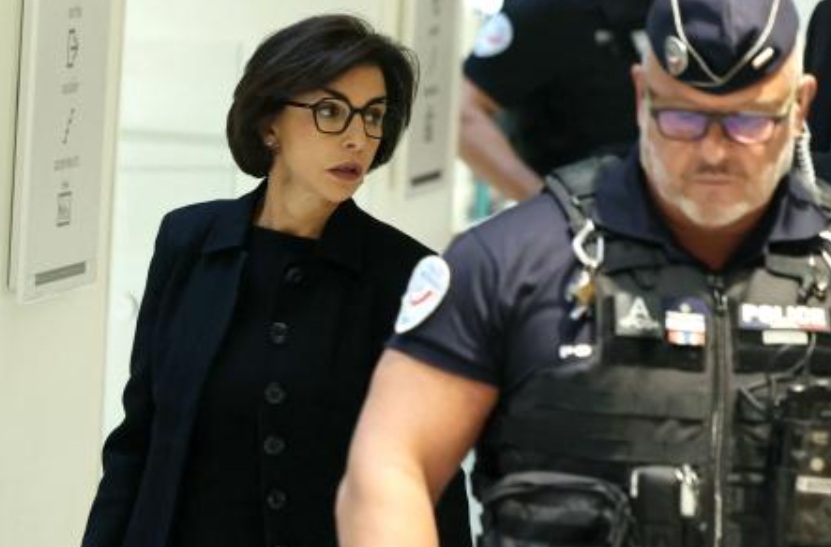
PARIS: France’s ex-culture minister Rachida Dati appeared in court Wednesday on corruption charges linked to dealings with the Renault-Nissan group, just months after her bruising defeat in the Paris mayoral race.
One of the most prominent figures on the French right, Dati, 60, stood in court dressed in black to hear the charges against her, all of which she denies.
Carlos Ghosn, the fugitive former Renault-Nissan chief now living in Lebanon, is being tried in absentia.
Dati has been dogged by controversies for much of her political career.
She resigned as culture minister in February to concentrate on the Paris mayoral race, but lost to Socialist rival Emmanuel Gregoire in March.
She stands charged with corruption and influence-peddling over alleged lobbying for Renault-Nissan between October 2009 and February 2013 while she was a member of the European Parliament.
She became an MEP after serving as justice minister between 2007 and 2009 under President Nicolas Sarkozy.
She has been accused of accepting 900,000 euros (around $1 million) in lawyers’ fees from a Netherlands-based subsidiary of Renault-Nissan.
Dati, who is still the mayor of the French capital’s wealthy seventh district, denies all the charges.
She faces up to 10 years in prison and a fine of up to 450,000 euros, if convicted. She could also face a five-year ban on holding public office.
Her legal team said Dati worked “exclusively” as a lawyer for the Netherlands-based subsidiary.
“Unfounded allegations of influence-peddling in the European Parliament stem from an artificial intellectual construct devised by the prosecution,” her lawyers said.
– ‘Explain facts’ –
French prosecutors argue that a legal services contract signed in 2009 between Dati and Ghosn, under which the former minister was paid an annual fee of 300,000 euros, was used to disguise lobbying work.
Investigators obtained the contract in 2019 during a search of Renault’s headquarters following Ghosn’s arrest in Japan, in a separate case.
Ghosn, the 72-year-old former chairman and chief executive of the Renault-Nissan-Mitsubishi alliance, was arrested in Japan in 2018 on suspicion of financial misconduct, before being sacked by Nissan’s board.
He made a dramatic escape from Japan hidden in an audio-equipment box, landing in Beirut, where he remains at large.
Ghosn faces a litany of charges, including abuse of power and bribery. He has denied any wrongdoing.
In a letter sent to the court in August and seen by AFP, Ghosn requested that the proceedings be postponed.
Denying any attempt to “delay the trial”, Ghosn said he was prepared to appear by video link to “explain facts” that he disputes.
Dati has repeatedly sought to have the charges against her quashed.
She has also been accused of accepting nearly 300,000 euros in undeclared payments from energy group GDF Suez, also while an MEP.
Prosecutors said last year they were looking into reports that Dati failed to declare jewelry and watches worth 420,000 euros upon taking ministerial office.
Early in life I discovered I had a particular affliction, and that was a proclivity for spending time at theme parks. I only phrase it that way because I understand some may find such a desire peculiar, which has made me particularly attuned to many comments about theme parks, especially those that aren’t positive.
Too hot, too crowded, too expensive or simply geared only for children. And while I’m happy to discuss or debate all aforementioned topics, there’s one particular criticism that I find especially grating: Theme parks are fake.
This is the argument that they are heavily fabricated and designed to elicit an emotional response, or worse, manipulate us. And it’s one I hear time and time again from grown-up peers. Over the years, it’s cropped up from friends. “Why do you go there?” they will say. “Everything is fake.” It’s appeared in books such as Henry A. Giroux’s and Grace Pollock’s scathing “The Mouse that Roared,” which dismisses the parks as presenting an “infantilized” worldview. And I’ve heard it from people I’ve interviewed, such as the USC professor of psychology who told me that theme parks were so fake, they forbade surprises.
You’re reading Mr. Todd’s Wild Ride newsletter
Todd Martens’ newsletter delivers news and commentary on the past, present and future of theme parks, right from the theme park capital of the world — Southern California.
By continuing, you agree to our Terms of Service, which include arbitration and a class action waiver. You agree that we and our third-party vendors may collect and use your information, including through cookies, pixels and similar technologies, for the purposes set forth in our Privacy Policy such as personalizing your experience and ads.
The criticism irks me, in part, because of what it implies. By dismissing a Disneyland or a Universal Studios park as “fake,” there’s an implication that something is “more real.” A national park, perhaps, or a dedicated art institution. I adore those types of spaces as well, of course, but there’s an ignorant snobbery to this sort of remark, a thumbing of the nose that seems to argue I should spend some of my free time elsewhere.
This has been on my mind of late for a pair of reasons. One, I recently visited the Lucas Museum of Narrative Art and have been consumed with the discourse surrounding the value of story-driven art. And two, I recently read “Floating Mountains: The Art of Imagining the Impossible” by famed Disney designer Joe Rohde. The book is many things — an impassioned dissection of creative collaboration, a look at Rohde’s 40 years with Walt Disney Imagineering — but it is also a subtle argument that theme parks are vital, artistic spaces.
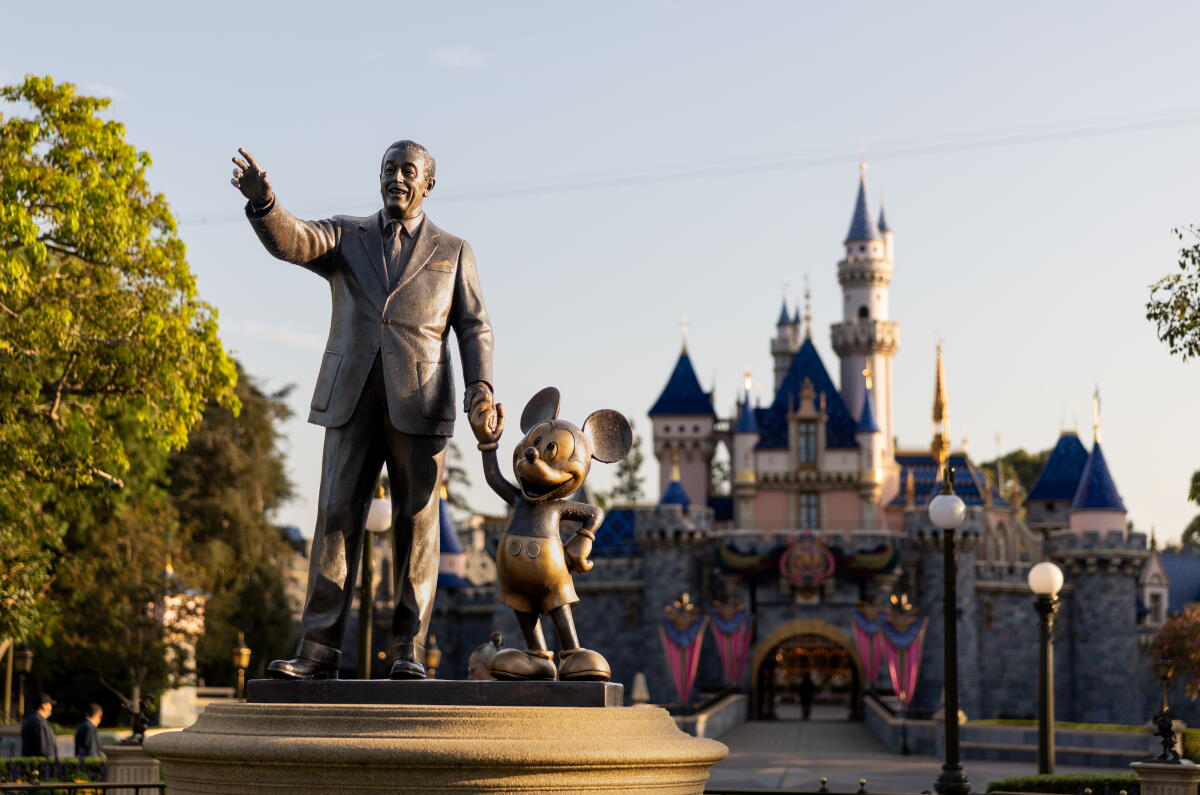
A statue of Walt Disney and Mickey Mouse in front of a very real fantasy castle.
(Christina House / Los Angeles Times)
I agree, and so I decided to bring up my pet peeve while talking to Rohde at the recent all-things-Disney fan convention D23.
“It’s a very odd criticism,” Rohde says of the knock on theme parks as being fake.
“Of course they are not real,” he tells me. “Movies are not real. Theater is not real. It’s like René Magritte, ‘Ceci n’est pas une pipe.’ Of course, a picture of a pipe is not a pipe. I don’t understand why that is an issue. It is a creation. In some cases it is a photo-realistic creation. In some cases it is a stylistic creation. But it is a creation. That’s what makes it a work of art.”
In “Floating Mountains,” Rohde, the primary creative behind the stunning Disney’s Animal Kingdom (second only to the original Disneyland in my mind), documents the myriad of disciplines that must come together to create such spaces. Animal Kingdom is full of real-world details. I can spend days exploring just the Africa section of the park, reading anti-poaching signs and piecing together a story that helps inform the area’s magnificent safari ride.
This is a work of art, albeit a less understood one, for narrative place-making and environmental storytelling are borderline experimental, less common than, say, a book or a film. Place-making requires that we not just take in our surroundings but constantly analyze them for story insights.
Joe Rohde, in 2017, discussing Pandora — the World of Avatar at Disney’s Animal Kingdom in Florida’s Walt Disney World.
(Jay L. Clendenin / Los Angeles Times)
Rohde also notes the degree to which Imagineers are taking influence from real-world spaces in an effort to bring narrative details into the parks, ensuring they appear at once familiar and fantastical. In the case of Animal Kingdom, it was Africa’s Lake Manyara National Park, among many other locales, that gave that park its realistic grit. And when it came to the fully imagined floating mountains of Pandora — The World of Avatar, it was finding inspiration in the Italian Baroque art of Gian Lorenzo Bernini, as seen in the entangled vines descending from the apparently hovering mountains.
Now, I am not someone who argues that a trip to Animal Kingdom is a stand-in for a vacation to Africa. Or that visiting the World Showcase of Epcot is akin to a jaunt around Europe. Or that hanging out in Cars Land is a substitute for a drive down Route 66. And an afternoon slugging pints at Hog’s Head at Wizarding World of Harry Potter is certainly not the equivalent of a day at an authentic British pub. No, what a theme park offers is an artistic interpretation, one that filters the natural world through the stories that define our lives.
Theme parks are not so much an escape from the world but a way to make sense of it. View them with an open mind, and they are an entree into storytelling exploration. This is different to me than, say, a re-creation of the Eiffel Tower being plopped into Las Vegas, which is preying on replication as generic spectacle. Theme parks, of course, can fall victim to this, too, when they utilize signposts or characters from a film as a substitute for innovation (see much of the design of Pixar Pier at Disney California Adventure).
Cars Land in Disney California Adventure was inspired by the scenery and history of Route 66.
(Mark Boster / Los Angeles Times)
France at Epcot’s World Showcase, in contrast, aims to weave a brochure-like tale of the country, to introduce us to culinary and architectural standouts that can inspire us to dig deeper. For some, sure, that’s deeper into their wallets, but World Showcase inspired a young me to be curious about the world beyond the suburban Chicago neighborhood I grew up in.
And purely fantastical creations — at least the ones that are done well — are not just references to things we saw on a movie or television screen. I think of Guardians of the Galaxy — Mission: Breakout! at Disney California Adventure, which is specifically designed as a cartoon-like intrusion, a building meant to clash and call attention to its surroundings. It’s all an effort to heighten the concept that the modern American myth — the superhero film — is work that encroaches, with uplifting exaggeration, on real-world settings.
And even a Disneyland classic such as Pirates of the Caribbean requires deep analytical reframing to properly understand it. Sure, it’s a boat ride with singing robot pirates, but that’s not the reason it has endured for more than half a century. I’ve described the attraction as the template for the perfect theme park ride, one that invites the guest to discover a host of mini stories based upon where riders are directing their focus. It’s a huge influence, for instance, on the world of open-world video games, which allow players to pick a direction and discover a narrative path. It’s anything but fake.
Pirates of the Caribbean is a study in environmental storytelling.
(Christina House / Los Angeles Times)
The criticism that theme parks are fake is a surface one, one that fails to properly meet the medium where it’s at. It’s easy, of course, to look at the nostalgia of a Main Street, U.S.A, and the castle up ahead and to write off Disneyland as a rosy, idealized take on America. This is the undiscerning view, for Disneyland is a presentation of an America that never existed, one disrupted by a castle that also doubles as an extended hand.
Think of it as an ask to use one’s imagination and to be open to play: Theme parks are a wholly unique medium that requires a different set of criticism, one that is looking at architecture and design as a storytelling device. And when one gets on a ride, a theme park expects us to be open to a somewhat abstract form of storytelling. Theme parks are also, at their core, a form of participatory art, inviting us to take on a starring role.
The mechanization of what makes a theme park a theme park is simply too complex, too vast and involving too many people to be dismissed as fake. And let me say that there’s no shame in wanting to be immersed in a world crafted by the hands of many a skilled artist, whether that’s the new David Geffen Galleries at LACMA or the Disneyland Resort.
This week in SoCal theme parks
Concept art for Magic Mountain’s upcoming 2027 coaster Thrill Glider.
(Six Flags Magic Mountain)
A new coaster coming to Magic Mountain. Six Flags announced that coming in 2027 to its Valencia park will be Thrill Glider, a first of its kind thrill ride designed by coaster manufacturer Vekoma exclusively for Magic Mountain. Riders will board what the park is referring to as “hoverbikes,” essentially bike vehicles designed to simulate a flying sensation by being suspended from the track.
Scary Farm is upon us. Halloween season is officially in full swing as Knott’s Scary Farm opens Thursday. New this year are two mazes, including one that intermixes a host of vintage animation, as well as a magic show collaboration with the Magic Castle.
Fast & Furious: Hollywood Drift officially opens. Though it’s been in a soft open phase since late July, Universal Studios Hollywood’s Fast & Furious: Hollywood Drift will be properly open as of Wednesday. This means the coaster has passed its final testing and is ready for daily operation. Here’s everything you need to know about Universal’s fancy new coaster.
Legoland expands its Halloween event. Brick or Treat at Carlsbad’s Legoland begins on Saturday and it’s bigger than ever in 2026. The family friendly event, for which costumes are encouraged, this year has added Brick or Treat Street, with six life-size monster homes to interact with. Also, be sure to head to the park’s new coaster, the Galacticoaster, which has received a Halloween overlay.
A Walt Disney exhibition at Forest Lawn. Head to Glendale’s Forest Lawn Museum on Saturday evening for the opening reception of “California Visionaries: The Lives and Legacies of Walt Disney and Hubert Eaton,” which explores the connection between Disney and Forest Lawn Memorial-Parks founder Eaton. The exhibition, which promises concept art, rare Disney sheet music as well as items from early Disneyland attractions, is on display until Feb. 7.
Tell us your stories. Ask us your questions.
Have a theme park tale to share? Whether it was a good day or less-than-perfect day, I would love to hear about it. Have a question? A tip? A fun photo from the parks to share? Email me at todd.martens@latimes.com. I may feature your note in an upcoming newsletter.
Ride on,
Todd Martens
P.S.
Attention readers who are in or near Fillmore: This Saturday is the first-ever edition of the “Time Travel Convention,” a new interactive theatrical experience from Live Action Attractions. Many veterans of the theme park industry worked to bring this event to life, including some who collaborated on the now-shuttered Star Wars: Galactic Starcruiser, colloquially known as the “Star Wars” hotel.
The story: Once a year, time travelers from the distant future head back in time to witness a historic day in small-town America. Players are cast in the role of time travelers, and throughout the day Saturday expect a series of games and costumed characters to interact with. There will be three theatrical moments staged throughout downtown Fillmore beginning at 10:01 a.m.
Register online, and you’ll receive info on where to meet. The event is highly recommended.
Boxer Fernando Vargas Jr. was arrested on suspicion of DUI following a multi-vehicle collision at a Universal Studios Hollywood parking lot, according to law enforcement and multiple media outlets.
California Highway Patrol responded to the incident on Thursday after receiving a call at 7:51 p.m.
CHP confirmed to The Times that one arrest was made at the scene for “suspicion of DUI.” No other injuries were reported at the scene.
Reports by KTLA confirmed that the 29-year-old was the individual arrested after officers observed “signs of alcohol impairment from Vargas” and conducted a DUI investigation.
Officers took him to the CHP Central Los Angeles Area office. The case will be submitted to the Los Angeles city attorney’s office for possible charges.
Hours before the arrest, Vargas posted a video to Instagram of himself and a woman inside a vehicle, who appeared to be in the passenger seat, TMZ reported.
The super welterweight boxer is the oldest son of two-time middleweight world champion Fernando Vargas. The famed Mexican American fighter from Oxnard — who at one point was the youngest U.S. national amateur champion — also faced legal troubles of his own for his role in a 1999 assault case.
Since fighting his first professional match in 2020, Vargas Jr. himself has built a steady record in the ring with 15 knockouts in 17 wins. His last bout was during the Canelo Alvarez-Terence Crawford card in September 2025, where he lost to Irish boxer Callum Walsh.
WASHINGTON — An Afghan woman who was accused of supporting an Islamic State-inspired plot in the United States and whose case was the first for an obscure and long-dormant court has been deported, the Justice Department said Friday.
Nazira Haji Zada, 47, was arrested in July at her Fort Worth home and brought before the Alien Terrorist Removal Court on a Justice Department application to deport her from the U.S. On Friday, the department said that she had waived her rights to challenge her detention and had agreed to be deported to Afghanistan.
Haji Zada’s attorneys said her decision to consent to removal “should not be seen as an endorsement of this court’s legitimacy.”
“Dragging lawful permanent residents into court but refusing to show them or their attorneys the evidence that will be used against them is a plain violation of due process,” the defense lawyers said in a statement Friday. “We are confident that the Alien Terrorist Removal Court will be struck down as unconstitutional as soon as a judge is asked to address the issue.”
Court filings about Haji Zada’s deportation, including a judge’s Aug. 20 removal order, remained under seal until after she reached her destination.
The swift resolution averts what could have been a protracted legal fight testing the authority of the court, which was established in 1996 but until July had not received any petitions, as well as the strength of allegations against Haji Zada.
Atty. Gen. Todd Blanche said the case’s outcome is “a win for national security and the rule of law.”
“Those who support and condone terrorism should not be living in the United States, and this first-ever case before the [court] shows how the Department will use every tool at its disposal to protect our country,” Blanche said in a statement.
The Justice Department has described Haji Zada as a supporter of the Islamic State and identified her at the time as the mother and mother-in-law of two Afghan men who were convicted in Oklahoma of plotting an attack in the U.S. on election day in 2024. The plans were foiled before any attack took place.
Her lawyers at the time of the deportation had been pressing the court to force the Justice Department to share information and other evidence to support the allegations in the case.
The court has specific authority to conduct deportation proceedings for people whom the Justice Department classifies as “alien terrorists.” The court is composed of five federal judges from different districts across the country who are appointed by the U.S. chief justice.
“Those who plot acts of terrorism against the United States have no place in our country,” Homeland Security Secretary Markwayne Mullin said in a statement. “We will find them, and we will use every lawful tool available to remove them.”
On July 30, Judge Joan Ericksen presided over the first hearing for the court’s first case since its creation 30 years ago.
One of Haji Zada’s attorneys argued at the hearing that the Trump administration’s activation of the court violates her constitutional rights. Attorney Matthew Farley urged the judge to dismiss the case and immediately release his client.
An FBI memo dated July 15 said it “developed information” that Haji Zada is an Islamic State supporter who had her children pledge their loyalty to the terrorist group. Her son, Abdullah Haji Zada, was sentenced in November to 15 years in prison and court records show he previously agreed to be removed from the U.S. after his release.
Her son-in-law, Nasir Ahmad Tawhedi, previously worked as a security guard for an American military installation in Afghanistan. He pleaded guilty to conspiring and attempting to provide material support to the Islamic State group. Prosecutors have said he took steps to advance his attack plans by ordering AK-47 rifles, liquidating his family’s assets and buying one-way tickets for his wife and child to travel home to Afghanistan.
Tucker and Kunzelman write for the Associated Press.
EXCLUSIVE: A contestant on The Jury has revealed just how difficult it was for the group to reach a verdict in the latest episode
The Jury star shared the extraordinary difficulty of reaching a verdict(Image: Channel 4)
A man who appeared on The Jury has opened up on ‘most difficult’ deliberation yet.
The contestant took part in the Channel 4 hit show and explained the extraordinary difficulty of reaching a verdict as the gripping series heads towards its final episode.
Speaking to The Daily Mirror about the experience, he said it was “probably one of the most challenging deliberations and claimed it was the most difficult the jurors had faced across the series so far.
James added, “I know for a fact out of 2 seasons previously, it was probably the most difficult of deliberations so far, and I suppose we really, really struggled to come to a decision.”
His comments come as The Jury reached the crucial stage of its four-part run, with the final episode airing on Channel 4 tonight (September 9).
The series has placed ordinary members of the public in the extraordinary position of having to decide the fate of two brothers accused of killing their stepfather.
Unlike a conventional documentary, the programme recreates a real-life murder trial using actors, with the jurors watching the evidence and arguments before being asked to reach their own verdict.
In the real case, the brothers were accused of killing their stepfather after years of alleged abuse and violence within the family home.
The Channel 4 series changed the defendants’ names, with the teenage brothers referred to as Daniel and his older brother as Luke.
The case presented the jurors with a particularly difficult question: could the brothers’ age, background, and claims of abuse alter how responsibility for the killing should be judged?
Reaching a conclusion was far from straightforward, and for James, it was even more difficult as he was voted as the jury’s foreperson.
He recalled the moment he was left feeling “really disrespected” when he was called out by a fellow juror. He said, “There was a moment where I went around all the jury members.
“I went around individually, and I asked people for their final decision, and when it came to be, quite literally, the last person to go, I was really thinking about what I was saying. And then another member of the jury, Phil, called me out, basically said, ‘Come on mate, we’ve not got all day, get a move on’”.
James added: “I just felt really disrespected because I had been voted in as the foreperson, so I had a responsibility to moderate a conversation, a really serious one of that, but also have my say at the same time.”
You can stream the new season of The Jury on Channel 4
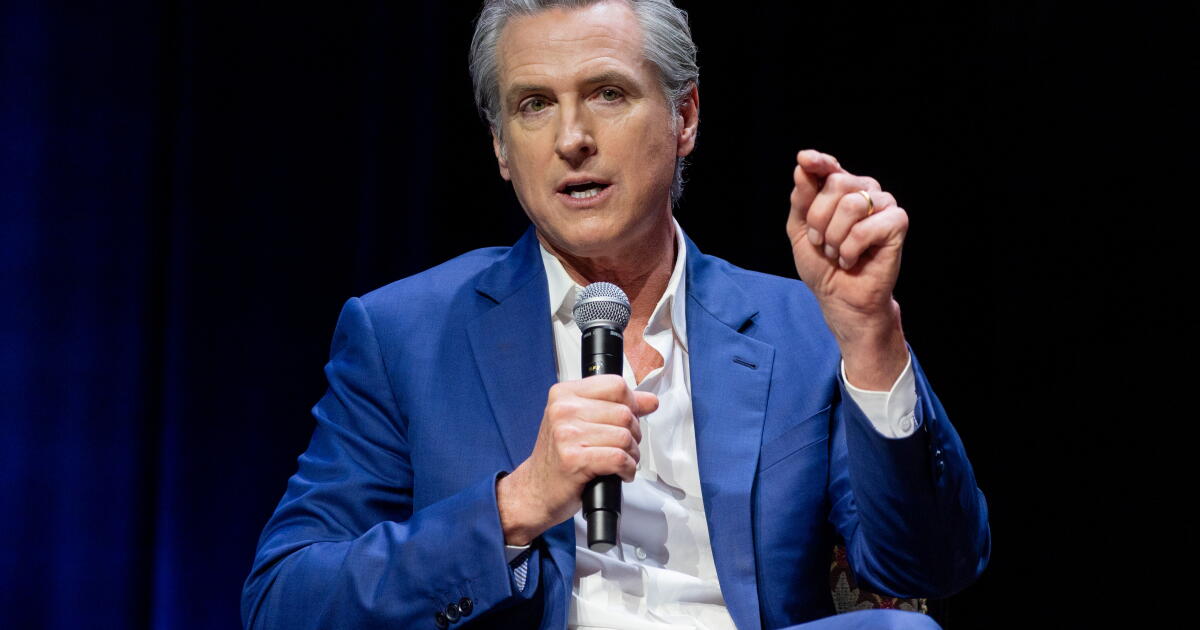
SACRAMENTO — Gov. Gavin Newsom’s pending defamation case against Fox News could go to trial in early 2028, around the same time the governor could be running a 2028 campaign for president.
Newsom sued the news network last year over its coverage of a phone call that took place between the governor and President Trump in June 2025, as unrest simmered over federal immigration raids in downtown Los Angeles. The governor accused the news outlet of intentionally manipulating its coverage to give the appearance that he lied about the call.
Despite an on-air apology from Fox News host Jesse Watters and attempts from the network to have the lawsuit thrown out, a Delaware Superior Court judge late last month set a trial date for March 6, 2028. Newsom filed the lawsuit in Delaware, where Fox News and its parent company, Fox Corp., are incorporated.
Newsom’s final term in office ends in early January and he is considering a run for president. The lawsuit seeks $787 million in damages, the same amount the network paid to settle a defamation suit brought by voting machine company Dominion. The company accused Fox News of airing false claims that voting machines were manipulated to help Joe Biden win the 2020 presidential election.
Lawyers for Fox News sought to have the case dismissed and Newsom ordered to pay attorneys’ fees. Judge Sean P. Lugg denied both motions this year, a ruling upheld by the Delaware Supreme Court.
“We will continue to vigorously defend against Governor Newsom’s meritless claims, which directly implicate core First Amendment protections for free speech, political commentary and a free press,” the network said in a statement to The Times.
“No media empire, no matter how rich and powerful, should get to lie to the American people with impunity,” said Michael Teter, the attorney representing Newsom in the case. “Governor Newsom is holding Fox accountable — and looks forward to proving this case in court. The truth matters.”
The case stems from a phone call between Trump and Newsom in early June 2025 as unrest brewed in Los Angeles over federal immigration raids and hours before the president took control of state National Guard troops, ordering them to protect federal buildings and immigration agents.
Newsom’s lawsuit accuses Fox hosts Watters and John Roberts, along with two senior news staffers, of misrepresenting Trump’s statements and asserting that Newsom lied about whether the call had happened.
The governor had previously publicly spoken about a late-night phone call he had with Trump on June 6 in California, which was early June 7 for Trump on the East Coast. He said that the National Guard was never discussed during that call and that the two did not speak about the immigration raids and protests again.
Trump told reporters on June 10 that he had spoken with Newsom “a day ago.”
“Called him up to tell him, got to do a better job, he’s doing a bad job,” Trump said.
Newsom disputed Trump’s timeline, writing on social media, “There was no call. Not even a voicemail.”
Roberts then said on social media and on air that Trump sent him evidence that the call took place. Newsom’s lawsuit accused Roberts of leaving out key details about the time of the call.
Roberts “did not provide the critical fact that on June 10, President Trump had stated that he had spoken to Governor Newsom ‘a day ago.’ Nor did Mr. Roberts note that June 6 — or June 7 at 1:23 am — is not ‘a day ago’ when one is speaking on June 10,” the complaint states.
The lawsuit also accused Watters’ show of playing a clip of Trump’s remarks that was edited to remove the president’s reference to “a day ago.”
“Newsom responded, and he said there wasn’t a phone call,” Watters said after showing the clip. “He said Trump never called him. Not even a voicemail, he said. But John Roberts got Trump’s call logs, and it shows Trump called him late Friday night and they talked for 16 minutes. Why would Newsom lie and claim Trump never called him? Why would he do that?”
A caption at the bottom of the screen during the report read, “Gavin lied about Trump’s call.”
Newsom declined to drop the suit and in court documents demanded a jury trial.
Getting a trial date doesn’t necessarily mean a trial will take place, Loyola Law School professor Jessica Levinson said.
Fox’s “motion to dismiss was denied. That means the case is continuing,” she said. “But what’s also happening throughout all of this is the sides are probably talking about some sort of settlement.”
The case now enters the discovery phase, where each side collects evidence to build their case.
Court records show Fox News lawyers last month sent subpoenas to Newsom’s political action committee and several top advisors, including his chief of staff, Nathan Barankin; communications director Bob Salladay; legal affairs secretary David Sapp; and political consultants Ace Smith, Lindsey Cobia, Jason Elliott and Nathan Click.
The subpoenas ordered them to produce documents related to the network’s coverage of Newsom, the phone call with Trump and the governor’s response strategy.
If a trial does happen, Levinson said, the timing could either help or hurt Newsom’s potential presidential campaign.
“He can use it as a talking point and say, ‘I don’t leave any stone unturned. I’m seeking to vindicate my reputation. I believe in the truth, and the other side does not believe in the truth. That’s why I’m bringing this case.’ So, he can use it as a part of his stump,” she said.
But if the trial proceeds and Newsom believes it would take time away from his campaign, he could ask for it to be moved to a different date.
“Trial dates get changed all the time for much less,” Levinson said.
The US has evolved its method of criminal executions, but drug shortages and protests over medical ethics have made lethal injections increasingly difficult to carry out. John Malcolm of the Meese Institute tells Al Jazeera that the US should ‘go back to a firing squad’.
Ten years ago, Walt Disney Imagineering announced what was widely perceived by the public as a risky — and ill-advised — project: Disney California Adventure’s Twilight Zone Tower of Terror would be remade into a ride featuring Marvel’s “Guardians of the Galaxy.” And it would open in just a few months, ahead of the 2017 summer tourist season.
Fans, to say the least, were not happy. They saw the makeover as a marketing move, done solely because a new movie in the franchise was being released. They were also skeptical of the tight timeline.
Retired Imagineer Joe Rohde, who led the project, heard the complaints.
Sign up for Mr. Todd’s Wild Ride
An insider guide to the ever-changing world of theme parks, coming to you straight from SoCal — the theme park capital of the world.
By continuing, you agree to our Terms of Service, which include arbitration and a class action waiver. You agree that we and our third-party vendors may collect and use your information, including through cookies, pixels and similar technologies, for the purposes set forth in our Privacy Policy such as personalizing your experience and ads.
“They look at the schedule and go, ‘You can’t do anything in that amount of time. There’s nothing you can do that is worth doing in this short amount of time, so we think this is going to be bad,’ ” says Rohde, whom I chatted with at the recent Disney fan convention D23.
Rohde‘s new book, “Floating Mountains: The Art of Imagining the Impossible,” is out this week and in it, he demystifies the creative process, heavily touching on his four-decade career at Imagineering as a jumping-off point on how to stay inspired and find art in the everyday. In a revealing chapter on what became Guardians of the Galaxy — Mission: Breakout!, Rohde writes about creating art out of a series of limitations.
Famed retired Disney Imagineer Joe Rohde, whose book “Floating Mountains: The Art of Imagining the Impossible” demystifies the creative process.
(Jay L. Clendenin / Los Angeles Times)
He notes that the new “Guardians of the Galaxy” film was not the reason for changing the drop tower ride — rather, the motivating factor was giving the Disneyland Resort something new to promote for 2017 and to begin to bring Marvel into the parks.
When assigned the project, Rohde initially pitched a Dr. Strange-inspired attraction, believing the hotel facade of Tower of Terror could quickly and easily translate to a mysterious sanctum. Execs, however, rejected the concept, arguing Dr. Strange wasn’t popular enough. They told Rohde and the team to focus on Spider-Man.
Now it was Rohde’s turn to say no. “Spider-Man needs room to swing,” Rohde writes in his book. “We only go up and down. There’s nowhere for Spider-Man to be!”
Bringing Marvel superheroes into a theme park, Rohde tells me, is something of a challenge.
“Marvel is a character brand,” Rohde says. “When we watch these movies or read the comics, our primary investment is in the psychology of the character. Spider-Man is a great example of this. Spider-Man’s life is a constant emotional crisis of one kind or another. It’s almost more of a soap opera format.
Guardians of the Galaxy — Mission: Breakout! is today the dominating structure of Avengers Campus at Disney California Adventure.
(Allen J. Schaben / Los Angeles Times)
“So, you have an art form — the Marvel Cinematic Universe and the Marvel Comic Universe — in which settings are disposable and are disposed of in order to drive character development. That works great in a film, but when it comes to place-making, it is difficult to lock yourself on the experiences of places, which is part of what makes theme parks theme parks. All through your day in a theme park the primary actor you engage with is the architecture and the landscape.”
With Spider-Man out, “Guardians of the Galaxy” was the compromise everyone could agree on. Only now the clock was ticking. Rohde notes that the team had to stop viewing the Tower of Terror as a hotel, and instead look at it as something of a blank page — an empty canvas that just happened to be in the shape of a blocky silhouette that jolts guests 190 feet in the air. Remove the hotel signage, and suddenly the mass resembled many things: “a grain silo, a fortress, a bank, a storage facility, possibly a prison,” Rohde writes.
Arguably, the facade for Mission Breakout! represents a bit of each of those. In “Floating Mountains,” Rohde says he began reimagining the building by taking inspiration from Marvel comic artist Jack Kirby, but he has also spoken of finding influence in architect Renzo Piano, who worked on France’s Centre Pompidou. The end result is a retro sci-fi building with high-tech-like pipes drawing one’s attention.
The chapter documents a frantic race against time. The star of the ride is an audio-animatronic of the Rocket Raccoon character, but it wasn’t always clear the figure could be finished by the deadline. And instead of using just one ride profile like the Tower of Terror, Mission Breakout! aimed for four, but Rohde writes the team had two as a fall-back plan (ultimately, they prevailed with their original intent).
Rohde notes that to get it done, a concession was made: limited reviews but a fixed, unchangeable budget with a strict deadline. And the team had to make a decision and commit. Little tinkering.
Guardians of the Galaxy — Mission: Breakout! is now considered one of the most popular attractions at Disneyland.
(Jason Armond / Los Angeles Times)
“You have to allocate a certain percentage of time and energy to prepare for a review, and that can be two weeks of energy,” Rohde says. “In this case, the most crucial thing about this project was its opening day. If you back out of that opening day just with production time, it becomes clear there’s no time to change. There’s no time to ask someone if they like it or don’t like it. So we have to decide we’re going to do it, and we’re going to do it for this much money, and you can look at it once before we start, and once before we build.”
Guardians of the Galaxy — Mission Breakout! opened on time, and with enough budget left over to create an “after dark” version during the Halloween season, which is currently running. And those fans who initially viewed the project with skepticism? Many were quiet after opening day, as Mission Breakout! is considered one of the Disneyland Resort’s most popular attractions.
Aside from replacing the former tension with chaotic elevator maneuvering, the makeover was a success because it’s not a rehash of a scene from the film. Rather than rely heavily on plot, it focuses on one frantic moment — a prison breakout — to create a zany, screwball comedy feel. In short, it’s a singular work of art, one that stands apart from its cinematic counterparts.
And that’s key to the appeal of “Floating Mountains,” as throughout Rohde makes the case that theme parks — often derided as commercial entities — are indeed vital spaces. He speaks of art as living on a spectrum. On one end, “art for art’s sake,” and on the other, “utterly commercial enterprises with no purpose other than to harvest value out of an intellectual property.”
“Theme parks,” says Rohde, “rocket somewhere in the middle of this.”
“I do believe that their social impact alone should argue for the fact that, no matter what you think of high art, of low art, something is going on here that people find very affecting,” he says of theme parks. “I think it is an art form.”
This week in SoCal theme parks
Inside Kingswell skate shop is a wall documenting the building’s history as the first L.A. outpost of what would become the Walt Disney Co.
(Todd Martens / Los Angeles Times)
A Disney history celebration. Walt Disney launched his animation career in Kansas City, Mo., in 1920. But when his Laugh-O-gram Studio failed after only about two years, he decided to move west. Here in Los Angeles, Walt and his brother Roy would in 1923 rent a small studio space on Kingswell Avenue in Los Feliz, near where he was staying with his uncle. They called their operation the Disney Bros. Studio, and it was officially the formation of what would become the Walt Disney Co. In September 2024, a small strip on the corner of Kingswell and Vermont avenues was designated the Disney Bros. Cartoon Studio Square. This Sunday, the space will host a mini-block party from noon to 5 p.m., with photo ops, events and skating demonstrations courtesy of the Kingswell skate shop,
Welcome the Lucas Museum. The long-awaited Lucas Museum of Narrative Art has arrived in L.A. and is welcoming members for previews. The space officially opens Sept. 22, and its emphasis on pop culture and “Star Wars” likely means there’s many an overlap with the Disney fan community. The Times has a bevy of coverage, including an architecture review as well as an analysis of its collection and how it deviates from typical art gallery fare.
Meow Wolf taps dozens of L.A. artists for new venue. Meow Wolf is getting closer to unveiling its Los Angeles locale. When doors open — the company is targeting late 2026 — expect a walk-around, floor-to-ceiling experience that pays homage to the art of cinema with a sci-fi, psychedelic-like bent. And to bring that vision to life, the Santa Fe, N.M.-based experiential art collective will be working with nearly 40 L.A. artists across multiple mediums. Meow Wolf last week unveiled its roster of artists with ties to the L.A. region.
A new Magic Mountain coaster is on the way. Six Flags Magic Mountain, garnering headlines tied to the safety of its X2 coaster, is looking ahead to 2027 and teasing a Thursday announcement for its next big thrill ride. The park last week posted a video to social media hinting at more info to come this week on what is expected to be a glider coaster with bike-like seating.
Ride report
An actor performing as Ozzy Osbourne during a haunted house at Universal Studios Hollywood’s Halloween Horror Nights.
(Scott Strazzante / For The Times)
This week’s ride report is actually a haunted house report. Of the eight spooky mazes at Universal Studios Hollywood this year, there were two clear standouts for me: the “Sinners” maze, which I documented last week, and Ozzy Osbourne: Prince of Darkness. This walk-through attraction, which Halloween Horror Nights mastermind John Murdy has described as something of a passion project, is a filled with cartoonishly sinister imagery in an homage to the recently deceased heavy metal legend.
Murdy says he didn’t have any hesitation about crating a haunted house based on Osbourne’s solo career so soon after he died last summer. “It hit everybody really hard,” the lifelong Osbourne fan says of the artist’s death. “It hit his fan community really hard. We needed to do something for the fans to celebrate this guy’s legacy.”
A giant animatronic bat in a haunted house inspired by the music of Ozzy Osbourne.
(Scott Strazzante / For The Times)
In an unique twist, nearly every scare actor is performing as some embodiment of Osbourne. The attraction is also filled with little nods to Osbourne’s life and legacy, including pictures donated from the family and a toy cow as a nod to an early job of Osbourne’s in a slaughterhouse. Murdy estimates the house features about 20 songs from Osbourne’s solo career, bookended by “Crazy Train” and “See You on the Other Side.” A train, of course, figures heavily into the maze, and an early ride scene appears to take us straight to hell.
It gets demented, but in a silly way that feels all-in-good-fun rather than anything frightening. Case in point: A centerpiece of the attraction is a giant animatronic bat, which is holding the severed head of Osbourne, only here the musician is depicted as a werewolf. Osbourne, says Murdy, was also heavily religious, so the walk-through culminates with the artist on a church-like throne. But it’s no ordinary cathedral, as jetting our from under Osbourne’s chair is a blue dragon, a nod to the tattoo the singer had on his chest.
It’s a love letter to Osbourne, and Murdy’s appreciation of the artist runs deep. He notes that as a seventh- or eight-grader in the early ‘80s, he wrote a term paper defending the artist. “I didn’t like the fact that people were condemning things when they hadn’t even bothered to read the lyrics and know what they are about,” Murdy says. “Take ‘Crazy Train.’ It’s about the Cold War. It’s about a fear that society is going off the rails. At an early age I was already going, ‘Don’t trust things that you hear at face value.’ ”
Tell us your stories. Ask us your questions.
Have a theme park tale to share? Whether it was a good day or less-than-perfect day, I would love to hear about it. Have a question? A tip? A fun photo from the parks to share? Email me at todd.martens@latimes.com. I may feature your note in an upcoming newsletter.
Ride on,
Todd Martens
P.S.
I can admit when I was largely wrong. Last week I expressed concerns about the way Halloween Horror Nights was adding the character of Nikki from “Obsession,” worrying a hyped incognito approach could open up the actor — or regular paying guests — to being uncomfortably approached by attendees. But while Nikki is not easy to find, she’s far from anonymous, all bloodied up and holding a brick. Plus, she’s accompanied by multiple handlers who keep folks from crowding the performer’s space.
There is a game-like aspect to this. Those who speak a password, released via social media, receive a fake business card, which does mean many a guest is standing there shouting a password at the actor. This is slightly awkward, and where I still have some reservations.
An actor as Nikki from “Obsession” interacting with guests during Halloween Horror Nights at Universal Studios Hollywood.
(Scott Strazzante / For The Times)
But many who find Nikki may discover it’s a highlight of the night. I’m not someone who seeks out characters at theme parks, largely because they’re there more for photos than to completely interact. Nikki is different. Nikki is in full immersive theater mode, responding entirely in character and pushing guests to talk about their devotion — to her, to another, to anything. In my minute with the actor, she aggressively quizzed me on my nonexistent love life, forcefully walking toward me so I had to gently stumble backward, which she lightly mocked.
Despite the unnerving tone of the actor’s questions, I was charmed. More of this type of interacting and play is always welcome. Now, I just wonder why she was so consumed with the health and age of my cat.
WASHINGTON — Federal prosecutors have charged a U.S. Immigration and Customs Enforcement officer with lying to investigators about the events leading up to the shooting of a Venezuelan man during the Minneapolis immigration crackdown earlier this year, a person familiar with the matter told the Associated Press.
The person was not authorized to publicly discuss the investigation and spoke on condition of anonymity. The person said Christian Castro, the officer who authorities say shot Julio Cesar Sosa-Celis in the leg in January, has been charged with making false statements to federal investigators.
The federal charges, which remain under seal, follow Castro’s release from jail last week after Texas’ governor refused to immediately sign an extradition warrant to hand him over to Minnesota authorities, who have charged him separately with assault and false reporting of a crime related to the same shooting.
Federal authorities had initially accused Sosa-Celis and another man of beating an officer with a broom handle and a snow shovel during the confrontation. But federal prosecutors dropped charges against the men after video evidence showed the officers may have lied about the encounter, and officials opened an investigation.
Earlier this week, a federal prosecutor working on the case told lawyers for Sosa-Celis and other victims that Justice Department officials blocked the prosecutor’s push to bring a more serious civil rights charge against the officer for the shooting, ProPublica reported.
But the person familiar with the investigation disputed the prosecutor’s characterization, saying the civil rights probe is continuing and there has been no final decision on whether to bring additional charges. The prosecutor, Matthew Evans, was fired on Thursday and is now under investigation for alleged obstruction of a grand jury probe, the person said.
An automatic email response from Evans’ Justice Department account said he was on leave. Other attempts to reach him were not immediately successful.
Castro was initially arrested in May in the Minnesota case, and he was held in custody in Brownsville, Texas, a city bordering Mexico, while Minnesota officials sought his extradition. But Texas Gov. Greg Abbott refused to immediately sign off, citing continuing investigations of fraud in government social service programs in Minnesota, which Trump used to justify his immigration crackdown there.
Minnesota officials had sought to stop the sheriff in Cameron County, Texas, from releasing Castro, out of fear that he would flee to Mexico. According to a lawsuit filed by Minnesota, Castro had a conversation with a woman, while he was incarcerated, where he spoke about marrying her and buying a house in Mexico after his release.
But Castro was released a week ago after a federal judge refused to order Texas to extradite him.
The Department of Homeland Security previously called Minnesota’s prosecution of Castro “unlawful and nothing more than a political stunt,” saying only federal authorities have jurisdiction in the case.
Castro was suspended from ICE without pay in February while federal authorities conducted the investigation.
“The men and women of ICE are entrusted with upholding the rule of law and are held to the highest standards of professionalism, integrity, and ethical conduct,” ICE’s acting director at the time, Todd Lyons, said then. “Violations of this sacred sworn oath will not be tolerated. ICE remains fully committed to transparency, accountability, and the fair enforcement of our nation’s immigration laws.”
Minnesota officials alleged that Castro, 52, fired through the front door of a home and shot Sosa-Celis in the thigh.
Castro and another officer had chased a different man, Alfredo Alejandro Aljorna, to the Minneapolis apartment duplex where he and Sosa-Celis lived. Minnesota prosecutors said the officer then falsely accused Sosa-Celis and another man of attacking an ICE officer with a broom handle and a snow shovel.
Attorneys for Sosa-Celis and Aljorna, who Minnesota officials have said were legally in the U.S., didn’t immediately respond to emails Thursday from the Associated Press.
Guendouzi and Greenwood made provocative gestures towards the Lyon supporters after their Champions League playoff.
Published On 3 Sep 20263 Sep 2026
UEFA has opened disciplinary proceedings against Fenerbahce’s Matteo Guendouzi and Mason Greenwood following the second leg of a Champions League playoff match at Olympique Lyonnais, the Turkish club said.
“Our club will present the necessary defences before the relevant UEFA bodies in order to protect the rights and interests of our players and Fenerbahce during this process,” the Turkish outfit added in a statement on Thursday.
French midfielder Guendouzi and English forward Greenwood allegedly made provocative gestures towards the Lyon supporters, which was followed by a brawl as Guendouzi left the pitch, following Fenerbahce’s 2-1 win last month.
It led to clashes between players and coaching staff on and off the football pitch, and the visiting team’s celebrations descended into chaos.
Fenerbahce said they are also under scrutiny.
“Everything from that match is still with the disciplinary body,” a UEFA spokesperson said.
Fenerbahce progressed to the league phase of the Champions League with a 3-2 aggregate victory.
Universal Studios Hollywood’s Halloween Horror Nights was built on an outsize reputation. Jump scares, dudes with chainsaws, fake blood and adult drinks accentuated with gummy worms.
Some of these staples haven’t changed. Jump scares aren’t going anywhere, and at a behind-the-scenes walk-through of this year’s haunted houses, dozens of mannequins laid splayed across floors with baggies of custom-made faux blood ready to be drizzled on them before showtime.
You’re reading Mr. Todd’s Wild Ride newsletter
Todd Martens’ newsletter delivers news and commentary on the past, present and future of theme parks, right from the theme park capital of the world — Southern California.
By continuing, you agree to our Terms of Service, which include arbitration and a class action waiver. You agree that we and our third-party vendors may collect and use your information, including through cookies, pixels and similar technologies, for the purposes set forth in our Privacy Policy such as personalizing your experience and ads.
But a Halloween Horror Nights evolution, one that began in 2019 with the arrival of Jordan Peele’s “Us,” has been underway. Today, haunted mazes are works of mini theater, one where scares are drawn out and choreographed. A single room may feature as many as six actors, and now, for the first time, professional stunt performers. Driving this change is the content, the films that inspire the tone of Halloween Horror Nights. And this year, two of the showcase properties are Ryan Coogler’s “Sinners” and Curry Barker’s “Obsession.”
“This is a different time, and we try to live on the edge of that,” says longtime Halloween Horror Nights mastermind John Murdy, talking about modern horror films. “When we started, we were Freddy, Jason, Leatherface and Michael Myers. It was all slashers.”
A foreboding scene from the “Sinners” haunted house at Universal Studios Hollywood.
(Ronaldo Bolanos / Los Angeles Times)
“Sinners” demanded a different approach. Yes, it’s a vampire movie, but it’s so much more.
In a shift for Halloween Horror Nights, the “Sinners” maze will begin with an extended pre-show, meaning about 90 seconds of a lip-synced concert designed to re-create the film’s centerpiece performance of Miles Caton’s “I Lied to You.” Halloween Horror Nights actors will, of course, play a version of Caton’s Sammie strumming a guitar, but as the scene continues other musicians will materialize behind scrim scenes — a DJ, an electric guitarist — to heighten the film’s themes of the timelessness and spirituality of music.
“Music was such a huge part of ‘Sinners,’ so when we were sitting down to figure out what we wanted to do, we knew we had to rethink how we do stuff,” Murdy says. “It starts with storytelling.”
Murdy and the Halloween Horror Nights team wanted to attempt to re-create the thrill of that scene, when “I Lied to You” bridges cultures and conjures artists from different eras. It’s designed to be a celebratory moment before mayhem descends. Consider it an attempt to capture, if even for a moment, the complexity of “Sinners” in a walk-through attraction, one guests will ultimately spend just a few minutes in.
“What I thought Ryan did so brilliantly in ‘Sinners’ is he took vampire mythology and combined with the devil-at-the-crossroads story, the Robert Johnson story, and then brought in the Jim Crow South,” Murdy says.
A burnt vampire as part of the “Sinners” haunted house at Halloween Horror Nights.
(Ronaldo Bolanos / Los Angeles Times)
Murdy concedes, of course, Halloween Horror Nights can only glance at some of the film’s deeper meaning. Ultimately, the goal is to thrill guests. So don’t expect, for instance, a metaphor or a statement on racism, and how prejudice continues to fuel, rule and terrorize culture.
“That’s Ryan’s job in the film,” Murdy says. “Our job is to represent the film as closely as possible. We’re not trying to extrapolate on the film. This was pretty strictly an interpretation of the film. Ryan is the authority.”
‘Sinners’ brings ‘a whole new technology’ to Halloween Horror Nights
But do expect a maze that exploits the park’s movie magic history. Tapping the stunt performers behind the “WaterWorld” special effects show, “Sinners” will boast a scene in which an actor playing the vampire Remmick will descend from the ceiling to fright guests. And making the eyes of the vampires glow red was no easy feat. The film utilized specially made metallic contact lenses, which wouldn’t work at Halloween Horror Nights due to the limited amount of time performers can wear them. Instead, the park’s makeup team constructed prosthetic eyelashes that hide a rice-sized LED light that hangs in front of the performer’s eyes.
“We did a bunch of mock-ups and tests and eventually got the green light,” Murdy says. “We’re doing a whole new technology that we’ve never done before, just to pay that off.”
John Murdy, left, who leads the creative direction of Universal Studios Hollywood’s Halloween Horror Nights, poses for a photo with a young fan who goes by the name “Christian the Ghostbuster.”
(Ronaldo Bolanos / Los Angeles Times)
For those who worked on the film, Halloween Horror Nights is an opportunity to keep “Sinners” in the cultural zeitgeist, while hopefully inspiring some guests to dig a little deeper, says Sev Ohanian, a producer of the film and a founder, along with Coogler and his wife and producer, Zinzi, of Proximity Media.
“We want to make event-driven movies that bring audiences in close proximity to often overlooked subjects,” Ohanian says. “But at its core, it features subject matter that maybe a lot of folks don’t have all that much familiarity with.”
A skeleton mariachi band on the set of the Killceañera haunted house at Universal Studios Hollywood.
(Ronaldo Bolanos / Los Angeles Times)
“That’s the magic of this experience,” Ohanian continues. “Maybe somebody has never seen ‘Sinners’ and they go through this fun spectacle attraction and are exposed to really beautiful blues music and they get to see the artistry of that era of a certain group of people.”
Experimenting with narrative will continue across a number of Halloween Horror Nights houses. Killceañera, which turns a quinceañera into an event in which a teen takes revenge on her bullies, will feature an outdoor performer lip-syncing a song co-written by Murdy and Slash from a balcony. Ozzy Osbourne: Prince of Darkness will intermix the iconography of Osbourne’s solo music with religious undertones, culminating with a giant animatronic bat biting the head off of Osbourne in werewolf form.
The ‘Obsession’ approach
And then there’s “Obsession.” The film was released too late for a large-scale Halloween Horror Nights attraction, but the event will feature an actor dressed as Inde Navarrette’s Nikki walking the grounds. Murdy describes it as a “Where’s Waldo?” moment, as Nikki will be largely incognito and hidden throughout the park, her whereabouts teased nightly via Instagram. Nikki will be seeking a password, also hinted via social media, that will change nightly, from guests.
The first 100 who find Nikki and speak the correct password will be given a business card for the One Wish Willow agency from the film. I do worry slightly about this approach, as, while costumes are not allowed, Nikki could inspire some cosplay at the event, which would open non-scare actors to being approached throughout the evening. But the hope is to bring a more interactive element to Halloween Horror Nights, one that can invite a deeper interaction with character actors.
A look inside the Ozzy Osbourne-themed haunted house at Universal Studios’ Halloween Horror Nights.
(Ronaldo Bolanos / Los Angeles Times)
“We’re not going to tell you exactly where she’s going to be,” Murdy says. “Your job is try to find her and give her the password and you might get a wish in return.”
Bringing “Obsession” into the event did raise some eyebrows. While Murdy notes that Barker is supportive of the approach and collaborating with the team, it was questioned whether a character many see as a target of assault and manipulation would make an appropriate scare actor. Murdy has heard such protests.
“So is Regan in ‘The Exorcist,’” says Murdy, referring to the young victim of the classic horror story.
Audiences still, of course, want to see their favorite characters represented in real life. And Murdy wasn’t going to miss an opportunity to have one of the year’s most buzzed-about horror films at the event. “It blew me away,” he says of “Obsession.” “I was like, ‘Wow.’”
This week in SoCal theme parks
An examination of coaster intensity. On a more serious note, Magic Mountain’s X2 remains shut down while state safety officials continue an investigation involving the attraction. The ride, first opened in 2002 as X, has been the subject of controversy and at least one high-profile lawsuit stemming from a 22-year-old man’s death. Six Flags bills the ride as “a right of passage for the ultimate daredevil” that goes up to 76 mph. A CNN report recently took a look at other, more recent injuries allegedly stemming from the attraction.
What to eat at Halloween Horror Nights. The Times’ Nava Rawls has a look at new food items coming to Halloween Horror Nights this week. Are you brave enough to eat a 22-inch beef hot dog covered in cheese sauce, coleslaw, sriracha aioli, banana peppers and Hot Cheetos inspired by the video game “Fortnite”?
A Marvel legend, honored. Avengers Campus at Disney California Adventure has added a memorial honoring legendary comic artist/creator Jack Kirby. The plaque can be found at the main entrance near the land just past Carthay Circle, and sits opposite a similar plaque recognizing Stan Lee.
Event report
A scene from Oogie Boogie Bash’s Haunted Mansion-inspired street parade.
(Todd Martens / Los Angeles Times)
Disney California Adventure’s Oogie Boogie Bash has been underway since mid-August. It’s a popular event, and excellent for families with little ones, as the emphasis is on character interactions and candy rather than scares. I do, however, wish it offered a bit more variety from year to year.
New this year is a Haunted Mansion-inspired street party, which takes the place of the event’s full-scale parade, which is currently on hold due to construction of the new “Coco” attraction. It’s short, but lively, offering a couple of Mansion floats from the parade as well of dozens of dancers. The party stops at various points along the route for a mini dance presentation, and if you’re seated in one of these locales, it’s a better experience. Or else it’s just a too-mini parade. I wondered if a night-long party in the Hollywood Land section of the park would have been a better way to go, even if it meant losing one of the candy giveaway spots.
As someone who isn’t a character person, the centerpiece for me is Villains Grove, which takes over the Redwood Creek Challenge Trail with projections and effects that nod to various evil characters. Seeing ominous vines twist to life on towering trees, or watching the Cheshire Cat materialize through the woodland setting, is always a delight. But, sadly, Villains Grove hasn’t changed much since 2019, and it’s time for Disney to rethink the space. I miss, too, the days when Oogie Boogie Bash had its own spooky World of Color show. As it stands, I just wonder if there are enough attractions if you’re not interested in character hunting.
Have a theme park tale to share? Whether it was a good day or less-than-perfect day, I would love to hear about it. Have a question? A tip? A fun photo from the parks to share? Email me at todd.martens@latimes.com. I may feature your note in an upcoming newsletter.
Ride on,
Todd Martens
P.S.
Fast and Furious: Hollywood Drift will officially open on Sept. 16.
(Todd Martens / Los Angeles Times)
Fast & Furious: Hollywood Drift at last gets a proper opening date. Universal Studios’ high-speed thrill ride, which has been operating in technical rehearsals since late July, will open on Sept. 16. By giving the ride an official opening date, the theme park is announcing that the attraction is ready for daily operations.
Curious to ride? Don’t miss my rundown of everything you need to know before you head to the park. Looking for a review? I have that too. Want to know about the 10-year journey to bring the attraction to park? Read this. And if you’ve heard about some drama involving the park’s neighbors in Toluca Lake, this story will catch you up.
Universal Studios Hollywood is almost ready to properly open its new Fast & Furious: Hollywood Drift coaster. The high-speed thrill ride, which has been operating in technical rehearsals since late July, has an opening date: Sept. 16.
The coaster has essentially been in an extended testing phase. By giving the ride an official opening date, the theme park is announcing that the attraction is ready for daily operations.
You’re reading Mr. Todd’s Wild Ride newsletter
Todd Martens’ newsletter delivers news and commentary on the past, present and future of theme parks, right from the theme park capital of the world — Southern California.
By continuing, you agree to our Terms of Service, which include arbitration and a class action waiver. You agree that we and our third-party vendors may collect and use your information, including through cookies, pixels and similar technologies, for the purposes set forth in our Privacy Policy such as personalizing your experience and ads.
Fast & Furious: Hollywood Drift, which seats riders in expertly designed mini-vehicles designed to reference real automobiles, has long been circled as the most important theme park attraction of 2026, a feat of engineering nestled on a steep hill between the park’s upper and lower lots that was 10 years in the making.
The ride — designed by Universal, manufactured by Intamin — has already changed the look and feel of Universal Studios, giving the park its first major outdoor thrill ride. Once known primarily as a studio tour park, Universal has been undergoing a large-scale overhaul throughout the last decade-plus, adding immersive lands such as the Wizarding World of Harry Potter and Super Nintendo World.
Now it has a coaster that feels akin to taking a joyride, complete with authentic engine and brake sounds. So if you’re thinking of taking Fast & Furious: Hollywood Drift for a spin, here’s what you need to know.
The view of Fast & Furious: Hollywood Drift from Universal Studios Hollywood’s Wizarding World of Harry Potter.
(Todd Martens / Los Angeles Times)
Is the ride included with Universal Studios admission?
Yes. A daily ticket starts at $109.95, although prices vary by day and expect to pay in the $150 range for a weekend date. Unlike Disneyland, Universal does not require reservations, but it is recommended to buy in advance.
Are express passes available?
Universal Studios will sell front-of-the-line access as an add-on to a daily ticket — but not yet. Fast & Furious: Hollywood Drift will not be included in express pass offerings at launch, according to a Universal spokesperson. That means all guests will have to wait in the same line. Express access is expected to be offered at a later date.
So, how long should I expect to wait in line?
A while. During technical rehearsals, afternoon waits routinely topped two hours, with some waiting longer than three and closer to four, although the last was rare. Expect operations to run a little smoother thanks to the soft open phase, but come prepared to be patient.
Is the ride included with Halloween Horror Nights?
The short answer is no. The longer answer: Those who spring for what Universal calls the R.I.P. Tour, however, will be able to ride. A guided experience, that ticket is $479 per person. (The fine print: Earlier this summer Universal did promise Hollywood Drift access with some tickets, but has since removed that option. The park has stated it will honor the terms of those who purchased the tickets before access was removed, and those buyers should have received instructions from Universal.)
The Fast & Furious: Hollywood Drift coaster features multiple inversions.
(Todd Martens / Los Angeles Times)
Tell me about the ride. How intense is it?
The ride reaches speeds of 72 mph, the fastest coaster in Universal’s global portfolio, while traversing 4,100 feet of track, two towering inverted loops and a pretzel loop. There are four individual launch points, and the coaster cars have the ability to rotate 360 degrees. It’s intense, but it’s also incredibly smooth, which helps it feel more approachable.
Wait, 360 degrees? Will I get motion sick?
Individual results will vary, of course, but for reference I am someone who can’t do extreme coasters — Magic Mountain’s Wonder Woman Flight of Courage is too much for me — and struggle on attractions that spin, such as Walt Disney World’s Guardians of the Galaxy: Cosmic Rewind. Yet I’ve been completely fine on multiple rides of Hollywood Drift. The spinning isn’t gratuitous, as the cars turn and drift with the flow of the track, so the movement feels aligned with direction.
Can I request a specific car?
You can! But be kind and patient with Universal staffers, who may not always be able to grant such requests due to crowding. If you have a specific concern, however, raise it with the coaster staff, and they will likely accommodate.
One of the ride vehicles of Fast & Furious: Hollywood Drift.
(Todd Martens / Los Angeles Times)
What’s the ‘easiest’ car for those who are nervous?
The middle cars, although not by much. All rotate, all experience the same speed and inversions. There are four vehicles, and the first provides the most striking views, including of the track’s drops, so the squeamish are advised to aim for the middle two cars, as it will provide a better sense of where the coaster train is heading. I’ve been told by some at Universal that the last row of the last car — each car seats four — can feel a little more riveting as it will heighten some of the speed and lift sensations. But I’ve sat in the front and the last car, and still don’t know if any differences were in my head or not.
Is there a height requirement/maximum?
Yes, you must be at least 51 inches tall to experience the coaster. There is no listed height or weight maximum, but guests are encouraged to sit in a test vehicle outside the attraction before getting in line. Riders must be seated completely inside the vehicle, which uses a pull-down lap bar, and be fitted against the headrest.
How accessible is it?
Modern roller coasters are not known for their accessibility, but Hollywood Drift is surprisingly accommodating for how intense it is. I am not small. I am 6-foot-2 and more than 210 pounds, and found Hollywood Drift to be one of the more comfortable coasters I have been on. There’s also plenty of leg room. I know a number of people significantly larger than me who have been able to ride successfully.
Where is the ride located in the park?
Across from the Wizarding World of Harry Potter. But you can’t miss it, as you need to pass it to get to the park’s lower lot, and it’s viewable from pretty much anywhere.
Well, is it worth riding? What’s your verdict?
I think it’s a blast. I rode the coaster on its first day of technical rehearsals, and as I wrote in my review, it’s full of surprises, of wondering where and when a coaster vehicle will be spin, careen or accelerate. Every turn, twist, flip leaves you guessing. Some of the park’s Toluca Lake neighbors, however, may be less enamored with it.
Mr. Todd’s Wild Ride comes out every Tuesday, but we occasionally publish special editions (like this one!) when we have breaking theme park news. Make sure you’ve signed up to be the first to know.
NEW YORK — A federal judge on Friday once again spurned President Trump’s effort to erase his hush money conviction, rejecting the president’s bid to move the state court case to federal court and have it dismissed on presidential immunity grounds.
Judge Alvin K. Hellerstein reiterated his earlier finding against Trump, saying that the reasons Trump cited for renewing his request were “neither new nor legally sufficient.”
The judge added: “He has failed to show good cause and diligence.”
It is the third time Hellerstein has blocked Trump from having the U.S. District Court in Manhattan seize control of the case from the New York court where he was tried and convicted.
And, like before, Trump will appeal, according to a spokesperson for his legal team who called Hellerstein’s ruling “baseless and lawless.”
“The Supreme Court’s historic decision on Immunity, the Federal and New York State Constitutions, and other established legal precedent mandate that the Witch Hunt perpetrated by the Manhattan DA be removed to federal court, and immediately overturned and dismissed,” a statement issued on behalf of the legal team said. “President Trump will be filing a powerful appeal, and will continue defeating Democrat weaponization at every turn.”
The guilty verdict, reached in May 2024 while Trump was between terms, made him the first former — and now current — U.S. president to be convicted of a crime. Trump is also challenging his conviction through the state court appellate process, which is pending.
Hellerstein’s decision came after a federal appeals court last year ordered him to reconsider his prior denial. The judge previewed his ruling during oral arguments in February, slamming Trump’s lawyers for legal maneuvers that amounted to taking “two bites at the apple.”
State prosecutors did not immediately respond to a request for comment.
The case centered on a payment to Stormy Daniels
Trump was convicted in May 2024 of 34 felony counts of falsifying business records to conceal a $130,000 hush money payment to adult film actor Stormy Daniels, whose claim of a sexual encounter with Trump a decade earlier had threatened to upend his 2016 presidential campaign.
Trump was sentenced to an unconditional discharge, which left his conviction intact but spared him any punishment. He had long denied Daniels’ claim and said he did nothing wrong. He has sought to get the conviction overturned both by attempting to move the case to federal court and through the appeals process in state court, which is pending.
Hellerstein rejected Trump’s requests to move the case twice before. The first was after Trump’s March 2023 indictment. The second was after Trump’s trial, as his lawyers sought to nix his conviction in the wake of the Supreme Court’s July 2024 ruling that presidents and ex-presidents can’t be prosecuted for official acts and prosecutors can’t use official acts as evidence that unofficial actions were illegal.
Trump appealed Hellerstein’s post-trial ruling and, last November, the U.S. 2nd Circuit Court of Appeals ordered the judge to reconsider his decision, finding that he had failed to consider “important issues relevant” to the president’s request to move the case.
A three-judge appellate panel said it expressed no view on how he should rule but instructed Hellerstein to closely review evidence that Trump claimed was related to official acts and whether Trump could argue those actions were taken as part of his White House duties.
The judges also instructed Hellerstein to determine if Trump had “diligently sought” to have the case moved to federal court and whether the case can even be moved to federal court now that Trump has been convicted and sentenced in state court.
The judge questioned the Trump legal team’s strategy
During oral arguments in February, Hellerstein took issue with the Trump legal team’s decision-making after the Supreme Court ruling.
Instead of immediately seeking to move the case to federal court, he noted, Trump’s lawyers first asked the trial judge in state court, Juan Merchan, to throw out the verdict on immunity grounds. Normally, such a request must be made within 30 days of an arraignment, but a federal appeals court in Washington, D.C. has ruled that exceptions can be made if “good cause” is shown.
Trump, a Republican, did not attend the arguments.
Trump lawyer Jeffrey Wall argued that prosecutors rushed to trial instead of waiting for the Supreme Court’s presidential immunity decision and that Trump’s legal team was crunched for time after the high court’s ruling because his sentencing was scheduled for just 10 days later.
Trump’s lawyers did not ask Hellerstein to intervene until nearly two months later, while their request to Merchan was still pending. The judge called that a “strategic decision” and suggested that by going to the state court first, Trump’s lawyers cost him the right to pursue remedies in federal court.
“No, your honor,” Wall replied. “It is what any sensible litigant would do” in that situation.
“Not so,” Hellerstein replied.
“That is a decision on your part,” the judge added. “You didn’t have to do that. You could have come right to the federal court. Just by filing a notice of removal, there would be no sentencing.”
Trump’s lawyers “made a choice,” Hellerstein said, “and you sought two bites at the apple.”
In his written ruling Friday, Hellerstein said Trump was asking for a “‘second bite at the apple,’ a result the law disfavors.”
The judge added that “Trump’s delay in filing for removal constitutes a ‘quintessential strategic decision,’ and the ‘fact that he later came to view that decision as a poor one is not sufficient, by itself, to establish cause.’”
Sisak and Neumeister write for the Associated Press.
SAN JUAN, Puerto Rico — Atty. Gen. Todd Blanche’s fidelity to President Trump nearly cost him his confirmation. Now comes Blanche’s real test.
Trump’s former personal attorney has stepped into the commanding role facing a challenge that other leaders of the Republican president’s Department of Justice could not overcome: threading the needle between Trump’s boundary-busting demands and a prosecutor’s duty to uphold the rule of law. At the same time, Blanche must try to stabilize a workforce shaken by an exodus of experienced lawyers and an erosion of trust in the judicial branch.
In a wide-ranging interview with the Associated Press during a trip to Puerto Rico this week, Blanche promised to lead the department with integrity, dismissing concerns from critics who say his actions so far — including an indictment against longtime Trump foe and former FBI Director James Comey — call into question whether Blanche is still functioning as Trump’s personal lawyer.
A slew of ongoing politically charged investigations under Blanche’s watch could force him to choose between his long-standing loyalty to the president and the foundational principles of the Cabinet agency he leads. At stake is the fate of a department already reeling under a president who has made clear his desire for retribution over the criminal scrutiny he faced.
“My integrity, my commitment to the rule of law is the same today that it was the day I graduated,” Blanche told the AP when asked where he would draw the line on requests from the White House. “I would never do anything unethical or improper or violate my oath, no matter the circumstances.”
Critics disagree.
As acting attorney general, Blanche came under fire from lawmakers, including many Republicans, for signing off on a $1.8 billion fund meant to compensate Trump’s allies who believed they were politically prosecuted. He also greenlit a deal that granted Trump, the Trump Organization, and two of his sons immunity from tax audits. Those moves, unusual steps aimed at granting the president and his allies far-reaching benefits, put Blanche’s confirmation at risk, prompting key senators to express concern.
Blanche, like Trump’s other attorneys general, walks a tightrope
In the AP interview, Blanche addressed criticism of the department under his leadership, his priorities as attorney general and losses the administration has had in high-profile cases. He also depicted the Justice Department as an institution whose independence had eroded long ago — a characterization at odds with decades of fierce autonomy that challenged the highest echelons of power in Washington and beyond.
Blanche, a former federal prosecutor in New York, is walking the same tightrope as Trump’s three other Senate-confirmed attorneys general. They found their pledges to uphold the rule of law and the department’s ethical norms at odds with the president’s demands to bend the institution to his will.
During Trump’s first term, one attorney general infuriated Trump over his withdrawal from an investigation into Trump’s winning White House campaign and was forced out. Another submitted his resignation weeks after breaking with Trump over Trump’s false claims of election fraud. Blanche’s immediate predecessor, Pam Bondi, was ousted in April after failing to deliver successful prosecutions against the president’s political enemies.
Blanche’s narrow confirmation this month over opposition from two Republican senators underscored growing concerns about the dismantling of the Justice Department’s long-standing tradition of independence from the White House, which is meant to protect the impartiality of politically sensitive investigations and prosecutions.
Concerns that the Justice Department is being weaponized
Blanche bristles at the suggestion that the Justice Department should be independent of the president and he has made clear his view that the executive has both the power and the right to shape and control the law enforcement agency.
He has staunchly defended the integrity of cases the administration has brought against the president’s perceived political opponents, often pointing to his own experience representing Trump in criminal cases brought by Democratic President Joe Biden’s Justice Department. Blanche and the president have characterized those cases as politically motivated.
“I think attorneys general and others have said, ‘Oh, we’re independent.’ I don’t think that’s actually true,” Blanche told the AP.
Blanche claimed the Justice Department was not truly independent when he was a federal prosecutor or during the Biden administration. But that characterization ignores the fact that under Biden, the Justice Department investigated Biden himself over his handling of classified documents and secured felony charges in two separate cases against his son Hunter before Biden pardoned him.
The two criminal cases filed by special counsel Jack Smith against Trump were based on allegations, supported by long-running investigations, that Trump had classified documents at his Mar-a-Lago estate in Florida and obstructed government efforts to get them back, and conspired to overturn the 2020 election.
Growing distrust of the Justice Department among judges
Blanche has sought to highlight the administration’s focus on tackling illegal immigration, violent crime and drug-trafficking cartels, spotlighting cases such as the takedown of a Puerto Rican gang that he announced during his visit to the U.S. island territory.
But Blanche’s policy priorities are often overshadowed by a growing number of investigations that have drawn criticism that the department is being used as a weapon in the president’s campaign of retribution.
Blanche’s supporters have argued that the close relationship he developed with Trump while serving as his criminal defense lawyer can make him more effective at pushing back on or explaining the legal constraints of the president’s demands. Others wonder whether he will fare any better than Bondi up against the same skeptical court system, and factual and legal hurdles, that impeded efforts to deliver the sought-after results.
Blanche is also confronting growing distrust of the Justice Department among judges, who in multiple cases have accused government lawyers of withholding information or misleading courts. Courts in some cases have quashed subpoenas or ordered the review of grand jury transcripts, and the criminal cases against Comey and New York Attorney General Letitia James were dismissed after a judge found the prosecutor who brought them was illegally appointed.
But Blanche played down concerns that the erosion of judicial trust could impede his efforts to advance his agenda.
“The isolated incidents that make the news are not reflective of the way the bench feels in my view, or the way prosecutors are doing their job around the country,” Blanche said.
Richer writes for the Associated Press. AP writer Eric Tucker in Washington contributed to this report.
Not a stellar look for a politician relatively new to elected office.
After speaking with Hochman about the reversal, I have a more optimistic take on it — drawn from a Talmudic quote that Hochman keeps on his desk, and which his father — a tax lawyer who represented at least one mobster — kept on his desk before him.
It’s that double justice that holds weight in this situation, because, as Hochman explains it, his god rarely repeats himself without reason. Hochman said he reads that echo as referring to two parts of delivering justice — the process and the result.
“We try to get the right result. We try to get it in the right way,” Hochman told me.
When things go wrong, like they did in this case, he’ll reevaluate, he said, even if it leaves him with egg on his face.
“If that means that I have to publicly come out at a press conference and say that our initial decision-making, and what went into it, turns out not to have been perfect, and it is not set in stone, and we think there’s a better way of doing something, I’m going to stand up in a press conference and say exactly that,” he said.
A prosecutor who is willing to change his or her mind is critical to delivering real justice, because people get things wrong. Hochman holds incredible power over the thousands of lives entangled in the matters his office handles. Leaving that power of process in the hands of someone who can’t admit they made a mistake (as is the case with more D.A.’s than not) puts justice on a greased slide into a cesspool of hubris.
The distinction between the two forms of justice may seem like splitting hairs, but to anyone who has ever been involved with our justice system — as a victim or defendant, innocent or guilty — being dragged into a prosecution can often feel like an avalanche of misfortune.
Don’t get me wrong. I don’t think every person charged with a crime is a victim. There are plenty of predators out there, committing violations big and small, that require accountability.
But the process of administering justice is far more subjective and messy than we often admit. Sometimes, even when the prosecutor involved almost certainly knows something other than justice is in the works, there is a momentum of ego and bureaucracy that is hard to reverse.
And it doesn’t take a guilty verdict to derail a life. Simply having charges filed can mean a job loss, losing custody of kids, incarceration for months or years waiting for a trial, financial hardship and stigma.
We like to think of an innocent verdict as a great vindication, but by the time one arrives, if it does, a lifetime of damage may already have been done — that is the unseen power of process.
Just ask Daniel Flores, the LAPD officer whose case we’re talking about. Though he likely will eventually see all criminal charges dismissed, Flores told my colleagues Libor Jany and Richard Winton that this incident has “ruined” his life.
Hochman for weeks has faced intense public anger over his initial decision to charge Flores with 16 felonies. Folks from the lofty heights of the mayor to this lowly columnist objected, pointing out that punishing whistleblowers, even ones who may have technically broken the law as Hochman said Flores likely did (though Flores’ lawyer disputes that), would chill other officers from coming forward.
Hochman at first defended the charges, pointing out that as a sworn officer, Flores had an even higher duty to adhere to the letter and spirit of the law.
But, he said, he was unprepared for how strongly the public would react to the whistleblower part of the case. Though he contends he never meant to send a message silencing those who would expose wrongdoing, he concedes that did happen.
“People interpreted it that we’re trying to discourage all whistleblowers by the way we went about this prosecution,” Hochman said.
He also acknowledges that he is still learning what it means to be in this elected office. Though he has been both a federal prosecutor and a defense attorney, this is by far the most publicly accountable and visible role he has held, and he’s still figuring out that part of the job. It’s easy to be the candidate lobbing criticisms, or even the defense lawyer arguing the facts. It is much harder to be the person answerable to the nearly 10 million people of Los Angeles County when it comes to ensuring they feel both protected and respected by the law.
“It is a continuous learning experience. In fact, anyone who takes this job and doesn’t view this as a daily learning experience cannot possibly do the job well,” he said. “If you don’t adapt to what’s out there, you don’t listen to what’s going on … you will fail, and by failure, I mean that you won’t achieve a society where people trust that the district attorney’s office is doing its job and doing it as best as it possibly could,” he said.
I’m willing to stand by the process that got me to that opinion, and also to give Hochman credit for being willing to change direction on his process when it was leading our city down the wrong path.
There are plenty of places where I hope Hochman will apply that rigor in the future — issues such as the death penalty, which he has brought back to Los Angeles, or in other difficult cases such as the killing of Keith Porter Jr. by an off-duty ICE agent. Porter’s family recently asked Hochman to convene a grand jury to hear the facts.
But that Hochman thinks about process, and the power that it holds, speaks well for justice in Los Angeles — even, maybe especially, when things go awry.