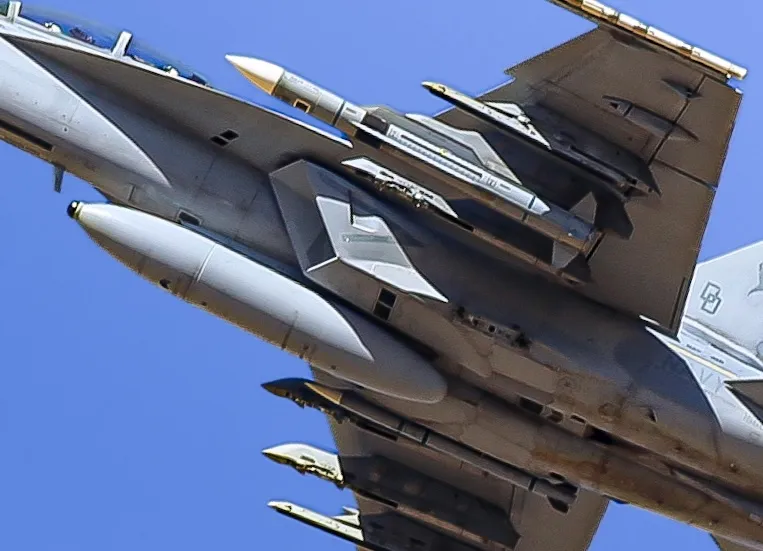
carrying

B-1B Seen Carrying ARRW Hypersonic Missile For The First Time

For the first time, the U.S. Air Force has publicly released imagery showing a B-1B Lancer bomber carrying an AGM-183 Air-launched Rapid Response Weapon hypersonic missile, or ARRW. The development comes with the B-1B now officially slated to serve for another decade, while it has been earmarked as a hypersonic weapons test platform. For its part, the ARRW, at one point expected to be the U.S. military’s first operational hypersonic weapon, is also back from purgatory, after continued questions about its future. The Air Force now wants to develop an improved version, as well as a separate air-launched ballistic missile (ALBM).

A brief clip showing a B-1B flying with an ARRW carried on an external hardpoint was released on Edwards Air Force Base’s Instagram page recently. The emergence of the video was first brought to our attention by The Aviationist.

It is unclear when the test-flight footage was taken, and it is not directly referenced in the video, which is otherwise dedicated to the work of maintainers on different aircraft platforms at Edwards.

The B-1B over a test range, with the ARRW installed. U.S. Air Force screencap

The B-1B was originally designed to carry external stores on up to eight external hardpoints. The Air Force had also developed special pylons that would have allowed the bombers to carry two nuclear-tipped AGM-86B Air-Launched Cruise Missiles (ALCM) on each one. Following the end of the Cold War, the B-1Bs lost their nuclear mission and, as a result, the external pylons fell into disuse, at least as far as weapons are concerned.

B-1B with cruise missile mounting racks attached to external hardpoints during testing back in the 1980s. U.S. Air Force

However, as long ago as 2020, the Air Force detailed plans to add the ARRW to the B-1B, after the service highlighted work to expand the bomber’s ability to carry hypersonic weapons and other new stores, both internally and externally.

“My goal would be to bring on at least a squadron’s worth of airplanes modified with external pylons on the B-1, to carry the ARRW [Air-launched Rapid Response Weapon],” Gen. Timothy Ray, then head of Air Force Global Strike Command, told Air Force Magazine. He added that the service had contemplated several options for integrating the missile onto the bombers, “but we believe the easiest, fastest, and probably most effective in the short term will be to go with the external pylons.”

In the meantime, we have seen examples of the ARRW carried under the wing of the B-52H bomber during multiple test sorties, and a live version also notably appeared on a Stratofortress during a training event at Andersen Air Force Base on Guam.

A live AGM-183A ARRW under the wing of a B-52 bomber at Andersen Air Force Base on Guam ahead of a test over the Western Pacific in 2024. U.S. Air Force

The Fiscal Year 2026 budget request confirmed that the Air Force plans to use the B-1B as a testbed for the Load Adaptable Modular (LAM) pylon, intended for hypersonic weapons and other outsize loads. The B-1B can accommodate six of these pylons, each capable of carrying two 2,000-pound-class weapons or a single 5,000-pound-plus-class weapon. The ARRW would fall into the latter category.

Boeing concept art showing a B-1B fitted with LAM pylons carrying air-breathing hypersonic missiles. Boeing

The budget documents noted: “The Hypersonic Integration Program successfully demonstrated the B-1’s ability to execute a captive carry of a 5,000-pound-class store and the release of a proven weapon shape from a Load Adaptable Modular (LAM) pylon.” This suggests that the video we are now seeing could have been taken during this demonstration, but it might also refer to external load tests involving the Air Force’s new bunker-buster bomb, the 5,000-pound class GBU-72/B.

A model of the LAM pylon, which Atlantic Models in Miami built for Boeing, loaded with two mock-up hypersonic cruise missiles. Atlantic Models

In the same position as seen in the ARRW video, the LAM has also been used for external carriage tests of the Joint Direct Attack Munition (JDAM). More routinely, this same position mounts an external pylon that accommodates a Sniper targeting pod. The same location has previously been used in external carriage tests of the AGM-158 Joint Air-to-Surface Standoff Missile (JASSM) cruise missile, too.

A B-1B Lancer assigned to the 419th Flight Test Squadron conducts flight tests with a JDAM on the Load Adaptable Modular pylon in early 2024. Air Force photo by Richard Gonzales
A 419th Flight Test Squadron B-1B carrying an inert AGM-158 JASSM during a demonstration flight. U.S. Air Force
A close-up look at a Sniper Advanced Targeting Pod on a B-1B. U.S. Air Force

As for ARRW, it carries an unpowered hypersonic boost-glide vehicle as its warhead. A rocket booster accelerates and lifts the vehicle to the required speed and altitude, after which it separates and glides through the atmosphere on a relatively shallow path toward its target. The weapon’s high speed and unpredictable flight path make it difficult for opponents to intercept and engage it, and give very little response time.

B52 ARRW Hypersonic evaluation test at Edwards Air Force Base 12 JUN 2019 thumbnail

B52 ARRW Hypersonic evaluation test at Edwards Air Force Base 12 JUN 2019


The Air Force’s plans to move ahead with purchases of ARRWs notably re-emerged in the Fiscal Year 2026 budget proposal. The service had moved to cancel the AGM-183A in 2023, and refocus resources on the development of the air-breathing Hypersonic Attack Cruise Missile (HACM), but there were steady signs afterward that there was still life left in the ARRW program.

Meanwhile, in its Fiscal Year 2027 budget request, the Air Force seeks funds for the development of what it calls ARRW Increment 2, as well as to kick-start a new air-launched ballistic missile (ALBM) program. The service wants almost $350 million to fund these two efforts. ARRW Increment 2 involves adding undisclosed enhanced capabilities onto the baseline weapon, while the ALBM effort would seek to field a new air-launched, long-range strike capability to complement the ARRW and HACM.

The US Air Force plans to kick off Air Launched Rapid Response Weapon (ARRW) Increment 2 development and stand up a new Air Launched Ballistic Missile (ALBM) program in Fiscal Year 2027. The service has set aside nearly $350 Million combined for these two efforts. ARRW Inc 2… pic.twitter.com/pe0SKPlrDO

— Air-Power | MIL-STD (@AirPowerNEW1) April 27, 2026

In its Fiscal Year 2027 budget documents, the Air Force further notes:

“We are doubling production rates for our two developmental hypersonic weapons, the Air-Launched Rapid Response Weapon (ARRW) and the Hypersonic Attack Cruise Missile (HACM), with a planned investment of $1.8 billion across the FYDP to accelerate delivery of these critical strike capabilities into the hands of the warfighter.”

The documents don’t give any details on how many ARRWs they want to order.

Regardless, these developments are especially notable as China continues to push ahead in the development and fielding of these capabilities, and especially ALBMs.

Mockups of the Chinese JL-1 ALBM on parade in Beijing on September 3, 2025. Central Military Commission of China

Despite previous plans to retire the B-1B by 2030, the bomber’s ability to carry outsize loads, in particular, has helped ensure that it’s now expected to remain in service until at least 2037.

Fiscal Year 2027 budget documents indicate that the Air Force plans to spend $342 million on modernizing its 44 remaining B-1Bs from 2027 to 2031. “This request provides the necessary funding to modernize the platform, ensuring its lethality and relevance through 2037,” the budget said.

The B-2 stealth bomber will also be modernized, as the Air Force seeks to address growing demand for bomber capacity, pending the arrival of the new B-21. The intensity of recent operations against Iran, combined with day-to-day bomber task force operations around the globe, and the growing specter of a conflict with China, underscores just how important the bomber fleet is to the Pentagon at large.

B-1s first mission to Iran out of RAF Fairford UK thumbnail

B-1s first mission to Iran out of RAF Fairford UK


With a capacity to carry more conventional weapons than any other aircraft in the Air Force’s inventory, we will surely see the B-1B carrying additional external weapons and larger numbers of them, as it continues its service career.

Contact the author: thomas@thewarzone.com

Thomas is a defense writer and editor with over 20 years of experience covering military aerospace topics and conflicts. He’s written a number of books, edited many more, and has contributed to many of the world’s leading aviation publications. Before joining The War Zone in 2020, he was the editor of AirForces Monthly.


Source link

Israeli F-16s Appear To Be Carrying Cluster Munitions

The Israeli Air Force has released a picture of F-16I Sufa fighters taking part in strikes on Iran, and the jets appear to be carrying cluster munitions. What submunitions might be inside is unknown. However, just three days before the image was posted, Iranian officials accused the United States of employing air-dropped BLU-91/B anti-tank mines, which are delivered via cluster bomb. This seems most likely to be part of a limited-use area denial strategy to contain long-range missile launches, as you can read about in our previous reporting here.

“In parallel, the Air Force struck sites used for storing and launching ballistic missiles, which pose a direct threat to the citizens of the State of Israel, as well as several defense systems of the terror regime. More than 150 fighter jets struck, over the past day, weapons production sites throughout Tehran,” the Israeli Air Force wrote in a Hebrew language post on X accompanying the picture on March 29, according to a machine translation. “The strikes on the regime’s military industries in Tehran continue at this hour as well. The Air Force continues to deepen the strikes on the regime’s military industries in order to deny the production capabilities it has built up over [the] years.”

The picture, seen at the top of this story and in parts below, is a nighttime shot, making it hard to definitively identify the munitions under the wings of the F-16Is. However, they look to have blunt noses with prominent fuzes sticking out from the center, as well as largely straight bodies and flat tail ends. This is all in line with features typically seen on air-dropped cluster munitions, especially U.S. types that make use of variants of the Tactical Munitions Dispenser (TMD), which we will come back to later on. TMDs, as well as other types of bomb-shaped ‘dispensers,’ can be loaded with different payloads, and each specific configuration generally has its own designation.

Close-ups of the munitions seen in the picture that the IAF released are presented here at top and bottom. A stock picture of a cluster munition utilizing a variant of the Tactical Munitions Dispenser (TMD) loaded on a U.S. Air Force F-16C is present in the middle for comparison. IAF/US Military

It is possible that the munitions seen under the wings of the F-16I are not cluster bombs, but this seems less likely to be the case. The features that are visible are distinctly different from the kinds of precision-guided bombs and missiles more typically seen loaded on Israeli tactical jets.

Another picture of a pair of F-16Is supporting current operations against Iran, which the IAF also released on March 29. A Joint Direct Attack Munition (JDAM) precision-guided bomb is seen under the wing of the jet in the foreground. IAF
The IAF released this picture of an F-16I with a full load of four Rampage missiles on March 6. This is another example of a loadout more commonly seen on these jets. IAF

In terms of what submunitions might be inside the dispensers, as already noted, Iran has previously alleged the use of air-dropped BLU-91/B anti-tank mines, which it blamed on the United States. Reports about the employment of the mines first emerged last week, with Iranian state and quasi-state media publishing what it said were pictures of examples recovered in outlying areas around the city of Shiraz, as seen below.

جنایت جدید آمریکایی ـ صهیونی در برخی مناطق کشور

رهاسازی بسته‌های انفجاری با جنگنده

این بسته‌های انفجاری شبیه کنسرو آماده بوده و حاوی مواد منفجره‌ای است که بعد از بازگشایی منفجر شده و باعث تلفات جانی می‌گردد
#انتقام_سخت pic.twitter.com/0mChpxVhLP

— خبرگزاری تسنیم (@Tasnimnews_Fa) March 26, 2026

Part of a larger scatterable mine system called Gator, BLU-91/Bs, as well as a companion anti-personnel mine designated the BLU-92/B, can be employed via TMD-series dispensers. They can also be dropped using the Mk 7 or SUU-58/B dispensers, the former of which has a notably different nose shape from what is seen in the picture the IAF released. The SUU-58/B is derived from the Mk 7, but has a distinct nose profile. Examples of complete cluster munitions loaded with Gator mines include the CBU-78/B (45 BLU-91/Bs and 15 BLU-92/Bs loaded in either a Mk 7 or SUU-58/B) and the CBU-89/B (72 BLU-91/Bs and 22 BLU-92/Bs loaded in a SUU-64/B TMD).

A general overview of the common cluster munitions loaded with Gator mines. The distinctly different nose USAF
An SUU-58/B dispenser. US military

“The US is the only participant in the Iran war known to possess Gator Scatterable Mines,” Bellingcat reported last week. However, “known users of the CBU-89/B and the CBU-78/B weapons include Israel, the Netherlands, and the United States,” according to a 2003 report from Forecast International.

The F-16 is also on the broad list of platforms that can drop cluster munitions loaded with Gator mines.

As to why BLU-91/Bs might have been scattered over parts of Iran, as TWZ previously wrote:

Iran has been able to preserve a number of its missile launchers, which could involve moving them in and out of underground facilities like the one near Shiraz or hiding them elsewhere in the area and moving them to designated launch points. This is occurring even after these facilities have been repeatedly bombed. These aerial attacks have focused on keeping their entrances caved in. These strikes are on top of the vast, resource-consuming interdiction effort to hunt for and strike launchers that are exposed. So, continued launches from these areas would be a major reason why resorting to deploying anti-tank mines there makes sense and would have a high military value. Mining the entrances of the underground missile cities would also make it harder for heavy equipment to access them in order to open them back up.

🚨 WATCH: CENTCOM releases footage of strikes on fortified missile bases in southern Iran. The first footage includes hits on tunnel entrances and on mobile and stationary launchers at the missile base in Hajjiabad, Iran. pic.twitter.com/wuoi5GEhqp

— Major Sammer Pal Toorr (Infantry Combat Veteran) (@samartoor3086) March 22, 2026

The IDF publishes footage showing a recent airstrike on an Iranian ballistic missile launcher in western Iran that it says was primed for an attack on Israel.

In additional strikes yesterday, the military says the Israeli Air Force hit several ballistic missile storage and… pic.twitter.com/UVE5bTAJNd

— Emanuel (Mannie) Fabian (@manniefabian) March 24, 2026

CENTCOM:

The Iranian regime is using mobile launchers to indiscriminately fire missiles in an attempt to inflict maximum harm across the region.

U.S. forces are hunting these threats down and without apology or hesitation, we are taking them out.pic.twitter.com/l4lxbTlAf4

— Clash Report (@clashreport) March 3, 2026

Designed to attack tanks and trucks, the mines could destroy or disable the launchers and likely the payloads they carry. They could also make roads to and around the underground missile cities unpassable. Even limiting where the launchers could go within these areas could make them more vulnerable.

This would also align with the IAF’s post on X accompanying the image of the two F-16Is, which discussed new strikes on “sites used for storing and launching ballistic missiles.”

Israel does have, or at least had, other air-dropped cluster munitions in its inventory. The IAF employed Cold War-era CBU-58/Bs during the country’s intervention in Lebanon in 2006. Each of those munitions consists of 650 grenade-like BLU-63/B anti-personnel bomblets in a SUU-30-series dispenser, which has a distinctly tapered tail section that is not seen on the munitions in the recently released IAF picture. Israel has also received Rockeye cluster bombs from the United States in the past, which consist of 247 Mk 118 anti-tank bomblets in Mk 7-series dispensers. The current status of either of these munitions in Israeli service is unclear.

An inert CBU-58/B cluster bomb on display at the National Museum of the US Air Force. USAF
An inert example of a Rockeye-series cluster bomb, also on display at the National Museum of the US Air Force. USAF

Israel Military Industries (IMI) also previously developed an air-dropped cluster bomb called the Runway Attack Munition, which is filled with submunitions specifically designed to crater runways. The RAM has reportedly been in Israeli service since 2008.

An IMI promotional image showing the Runway Attack Munition (RAM), at top, and the 1,000-pound-class PB500A1 laser-guided bunker-buster bomb, at bottom. IMI

Runways at Iranian air bases have been cratered by U.S. and Israeli strikes in the course of the current conflict, but there have been no signs so far of the use of cluster munitions to do so. Israel could be employing anti-personnel and/or anti-tank cluster munitions against various other targets in Iran, including missile and drone launchers, but, again, there has been no evidence of this so far.

The employment of BLU-91/Bs in the current conflict with Iran also remains unconfirmed, though the picture of the IAF F-16Is with what look to be cluster munitions does add to the existing evidence. Whether the employment of those mines, whether by the United States or Israel, was an isolated event or a new part of the ongoing campaign is also still not clear. As mentioned earlier, dropping the mines fits with an effort to deny access to remote missile storage and launch areas.

Cluster munitions and landmines are both controversial weapons in their own right, particularly given the risks they can pose to civilians well after a conflict has ended. Many countries have agreed to ban their use. At the same time, the U.S. military and others continue to stress the operational utility these weapons offer, and the steps that can be taken to mitigate the risks of their use. The BLU-91/B, for instance, has a built-in self-destruct feature. Cluster munitions and landmines can also be employed under tightly controlled parameters to reduce the dangers they might pose to innocent bystanders, such as targeting only facilities far from population centers.

If cluster munition use by Israeli and/or U.S. forces does become a more widespread aspect of the ongoing conflict, more evidence of this could continue to emerge.

Special thanks to user @blocksixtynine on X for bringing the IAF picture of the two F-16Is carrying what look to be cluster munitions to our attention.

Contact the author: joe@twz.com

Joseph has been a member of The War Zone team since early 2017. Prior to that, he was an Associate Editor at War Is Boring, and his byline has appeared in other publications, including Small Arms Review, Small Arms Defense Journal, Reuters, We Are the Mighty, and Task & Purpose.


Source link

Military aircraft carrying 125 people crashes in Colombia

March 23 (UPI) — A Colombian Air Force C-130 Hercules aircraft crashed Monday in the southern department of Putumayo while transporting military personnel, with the number of casualties still unknown, authorities said.

Defense Minister Pedro Sánchez confirmed the accident and said the cause remains under investigation. Initial reports indicate the aircraft was carrying about 100 people, including members of Colombia’s armed forces and National Police.

“Military units are already at the scene; however, the number of victims and the causes of the accident have not yet been precisely determined,” Sánchez said on X.

Gen. Carlos Silva, commander of the Colombian Aerospace Force, said the aircraft was carrying “114 passengers on board and 11 crew members.” He also said that “48 injured people have already been rescued,” though he cautioned that the figure is preliminary, France24 reported.

A witness at the crash site told local radio station La FM that several injured people had been evacuated.

“We are in a rural area where the plane went down and we are collecting the injured. About 10 to 15 people have been taken out. We are transporting them in police vehicles and local residents are helping move people on motorcycles,” the witness said.

Early reports indicate the aircraft may have experienced difficulties during takeoff and failed to gain proper altitude, according to Noticias Caracol.

The aircraft, identified as FAC 1016, was carrying troops from the Army’s 27th Jungle Brigade. The personnel were traveling from Puerto Leguízamo to Puerto Asís as part of a troop rotation, and the plane was expected to return to Bogotá.

President Gustavo Petro addressed the incident on X, expressing concern over possible casualties.

“I hope we do not have deaths in this horrific accident that should not have happened,” Petro said.

He added that his administration has sought to modernize the military’s equipment but has faced bureaucratic obstacles.

“If civilian or military administrative officials are not up to this challenge, they must be removed,” he said.

Petro also said his government has worked to modernize the country’s strategic air fleet and has requested the immediate purchase of helicopters and transport aircraft to expand troop mobility, particularly in regions affected by the grounding of Russian-made helicopters.

He said, contrary to some media reports, the military has been losing operational capacity for more than 15 years and that his administration is committed to fully modernizing its equipment.


Source link

EA-18G Growlers Carrying Mixed Load Of Old And New Jamming Pods Are Flying Iran Missions

A picture of a U.S. Navy EA-18G Growler taking part in the current operations against Iran shows the plane carrying an interesting split load of two different electronic warfare pods. Typically, Growlers carry a pair of new AN/ALQ-249 Next Generation Jammer-Mid Band (NGJ-MB) pods or older AN/ALQ-99 pods under their wings, not one of each. The NGJ-MB pods offer a major leap in capability, but have continued to face reliability and other challenges. In general, the capabilities Growlers provide are essential to help support the launching of standoff strikes in the opening phases of a conflict, as well as missions penetrating deeper into defended areas as time goes on.

U.S. Central Command released the image of the EA-18G, seen at the top of this story, and taken as the aircraft was launching from the Nimitz class aircraft carrier USS Abraham Lincoln, last week. The Growler in question is assigned to the Electronic Attack Squadron 133 (VAQ-133). The Lincoln’s air wing, which has been very active in support of Operation Epic Fury since it began, also includes F/A-18E/F Super Hornet and F-35C fighters, E-2D Hawkeye airborne early warning and control planes, CMV-22B Osprey tilt-rotor carrier onboard delivery aircraft, and MH-60R/S Seahawk helicopters.

At first glance, the EA-18G picture is unremarkable, but a closer inspection shows the jet has one ALQ-99 Tactical Jamming System (TJS) pod and one AN/ALQ-249 Next Generation Jammer-Mid Band (NGJ-MB) pod under its left and right wings, respectively. The aircraft also has a drop tank under each wing, as well as what looks to be a third one on the centerline station under its fuselage. The Navy is in the process of replacing the ALQ-99s in part with the ALQ-249, something we will come back to later on.

A close-up look at the AN/ALQ-99 pod under the Growler’s left wing and the AN/ALQ-249 pod under the right wing. USN
An ALQ-99 pod seen being moved within the hangar bay of the Nimitz class aircraft carrier USS Carl Vinson. USN
An ALQ-249 NGJ-MB pod. Raytheon

The Navy is still in the process of transitioning away from the ALQ-99, and those pods remain in active service alongside ALQ-249s. However, TWZ was told in a past interview with two top officers involved in the NGJ-MB effort that the standard mixed loadout for jets carrying ALQ-249s is one of those pods under each wing, along with an ALQ-99 on the centerline. Growlers continue to fly operational missions carrying just ALQ-99s, as well.

A Growler seen carrying ALQ-249s under each wing and an ALQ-99 on its centerline station during a test flight. USN
EA-18Gs with AN/ALQ-249 pods, at left, and ALQ-99 pods, at right, seen on the USS Abraham Lincoln’s flight deck on November 2025. USN

Why the VAQ-133 Growler flew this particular sortie with this split loadout of one ALQ-249 and one ALQ-99 is unknown. It is possible that ALQ-99 was substituted for an ALQ-249 on that particular mission due to a lack of availability of the new pods due to maintenance or other factors.

The NGJ-MB pod has suffered from reliability and other technical issues in the past. At least as of the end of Fiscal Year 2025, the pods have continued to face challenges, according to a newly released report from the Pentagon’s Office of the Director of Test and Evaluation (DOT&E).

“The NGJ-MB with the OFP 5.3 software series is not currently suitable for supporting operational missions, due to additional progress required to improve reliability and availability,” the DOT&E report said. “The NGJ-MB system met its maintainability requirements, and
aircrew and maintainers found training to be adequate. Insufficient data are currently available to draw any significant conclusions
on pilot and maintainer workload and usability, given the sample size of the data.”

What steps the Navy may have taken to mitigate these issues since the end of the 2025 Fiscal Year is unknown. Whether this particular software configuration is found in deployed pods that are being used operationally is also not known.

“The Navy has deployed the NGJ-MB to five different Electronic Attack Squadrons,” the report also notes.

A VAQ-133 Growler assigned to the USS Abraham Lincoln seen with ALQ-249 pods under its wings last year. USN

In a separate report released in 2020, the Government Accountability Office (GAO), a Congressional watchdog, highlighted negative impacts to EA-18G’s combat range when carrying an ALQ-249 under each wing and one ALQ-99 on the centerline. What the Navy may have done to address this since then is unknown.

A desire to ensure a certain mix of capabilities, together with a need for three drop tanks’ worth of additional fuel, may have also factored in the decision.

ALQ-249s do offer a major boost in capability, broadly speaking, compared to the older ALQ-99s. The NGJ-MB’s use of active electronically scanned array (AESA) antennas, which the AN/ALQ-99s do not have, as well as its modular open architecture design, also opens the door to more rapid integration of new and improved functionality down the line. This could include so-called next-generation cognitive electronic warfare capabilities, which you can learn more about here.

An exploded view of the components inside Raytheon’s NGJ-MB pod, including its active electronically scanned arrays. USN
A briefing slide showing the interior layout of the two types of AN/ALQ-99 pod.RAAF

However, as its name makes clear, the ALQ-249 was originally designed primarily to provide mid-band coverage. ALQ-99s come in two separate versions, offering high and low-band coverage, respectively. Air defense radars and other targets for electronic warfare attacks do not all operate in the same frequency ranges, and some are capable of widely modulating their signal outputs specifically to help reduce vulnerability to jamming. Broader frequency ranges could also help when dealing with known threat systems that are being operated in unfamiliar ways.

“The NGJ-MB is assessed to be at least as operationally effective as the legacy AN/ALQ-99 system, against the threats tested on the open-air test ranges during IOT&E,” according to DOT&E’s report. However, the office’s “full assessment of operational effectiveness is provided in the classified IOT&E report published in July 2025.”

A separate Next Generation Jammer-Low Band (NGJ-LB) pod, now designated the AN/ALQ-266, is in development to complement as part of plans to completely replace the ALQ-99 family. However, as of 2024, the NGJ-LB pod was not expected to reach even an early operational capability until 2029. A years-long contract dispute contributed to the delays in work on this pod.

An EA-18G with a prototype NGJ-LB pod on its centerline suspended inside an anechoic test chamber. USN

The Navy has also made a decision to expand the capabilities of the NGJ-MB pod to “extend the upper frequency coverage limit to counter modern and adaptive threats” and to “increase frequency range of the NGJ-MB system and enhance the survivability of the platform and protected entities against emerging threats,” according to official budget documents. When these improved NGJ-MB Extended (NGJ-MBX) pods are expected to enter operational service is unclear.

The Navy has also talked in the past about acquiring a dedicated NGJ-High Band (NGJ-HB) pod to address that end of the frequency spectrum, but the current status of that plan is not clear. “I’ll say high band is still on the to do list, but it’s prioritized appropriately, and we’ll get to it eventually,” Capt. David Rueter, then program manager for airborne electronic attack systems at Naval Air Systems Command (NAVAIR), told TWZ last year.

It’s also worth noting here that external pods are just one part of the complete electronic warfare suite on the EA-18G, which also includes elements integrated inside the fuselage and in fixed pods on the tips of the wings. Just last Friday, Prime contractor Boeing received a new modification to the existing contract, with a value not-to-exceed $489,306,966, for upgrades to Growler’s built-in electronic warfare capabilities with the integration of a new system called the AN/ALQ-264 Beowulf. This is part of a larger ongoing upgrade effort for the Navy’s EA-18G fleet.

A graphic showing various systems on the EA-18G Growler and a typical mission loadout, including the three AN/ALQ-99 pods. RAAF A graphic showing various systems on the EA-18G Growler and a typical mission loadout. RAAF

All of this underscores the overall importance of the Navy’s EA-18Gs to U.S. joint operations, which has been on display as part of the current campaign against Iran. As TWZ has explored in detail, American and Israeli strikes have substantially degraded Iranian air defenses and other military capabilities, but this should not be confused with total air dominance, especially over the northeastern end of the country. When it comes to standoff strikes, the support Growlers provide can help ensure munitions get to their targets, as well as help reduce risks to launch platforms. More recently, there has been a notable shift to direct attacks across other parts of Iran, where air supremacy has largely been achieved. Still, electronic warfare support would help in those areas to mitigate any residual air defense risks.

USS Abraham Lincoln continues flight operations day and night during Operation Epic Fury. Sailing close to Iran, Lincoln and its embarked carrier air wing are executing back-to-back waves of strikes. pic.twitter.com/EPhhmCAyPB

— U.S. Central Command (@CENTCOM) March 16, 2026

Earlier in the year, TWZ had already highlighted the importance of EA-18Gs in the opening act of any major air campaign, as well as follow-on phases, in the lead-up to Operation Absolute Resolve. Growlers were a key component of that operation, which occurred in Venezuela in January, resulting in the capture of dictator Nicolas Maduro.

With the Operation Epic Fury air campaign still in full swing, Growler will continue to provide essential electronic warfare support, whatever mixture of pods they carry.

Contact the author: joe@twz.com

Joseph has been a member of The War Zone team since early 2017. Prior to that, he was an Associate Editor at War Is Boring, and his byline has appeared in other publications, including Small Arms Review, Small Arms Defense Journal, Reuters, We Are the Mighty, and Task & Purpose.


Source link