carrier

Most advanced U.S. aircraft carrier arrives in Caribbean in major buildup near Venezuela

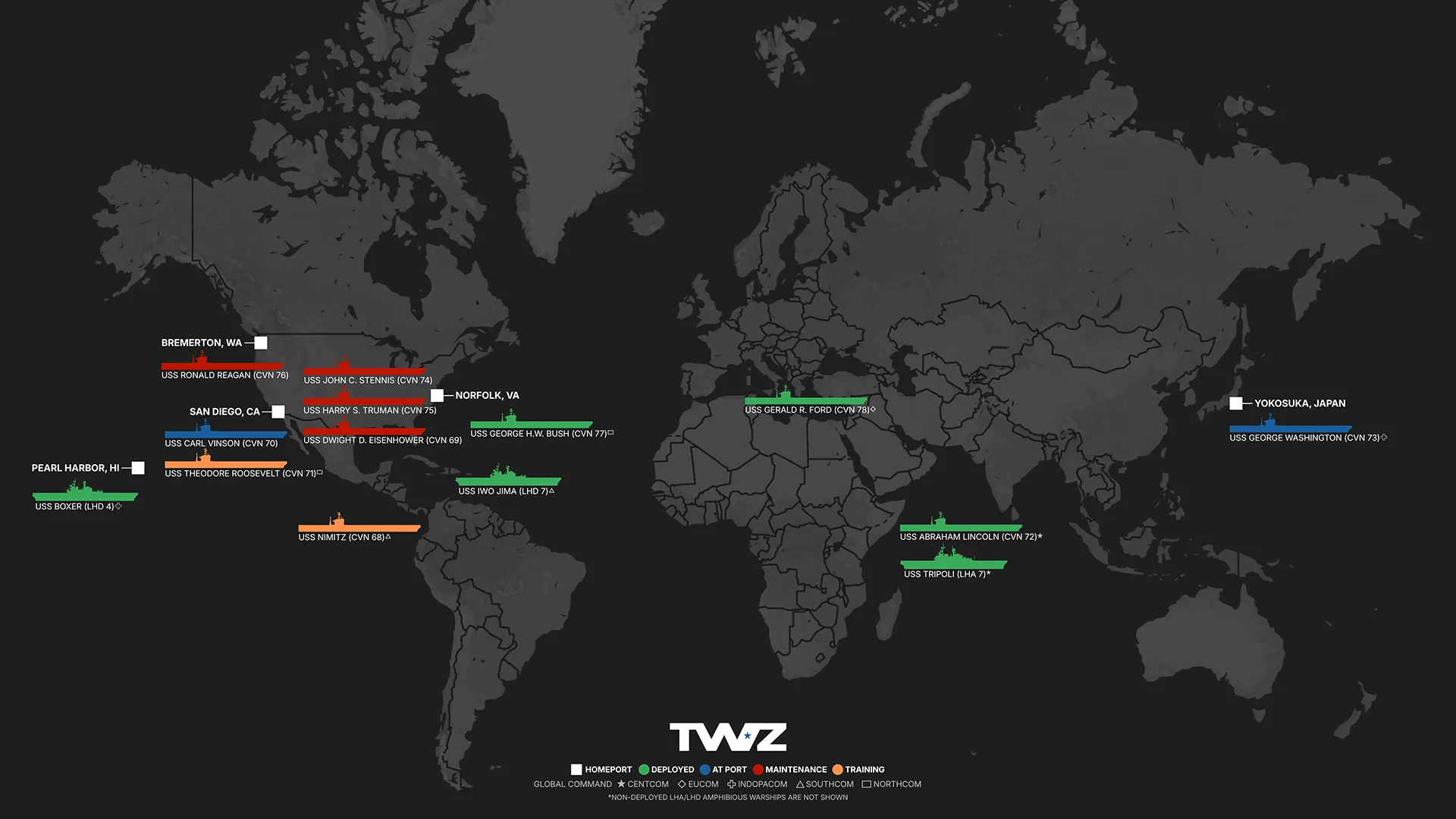
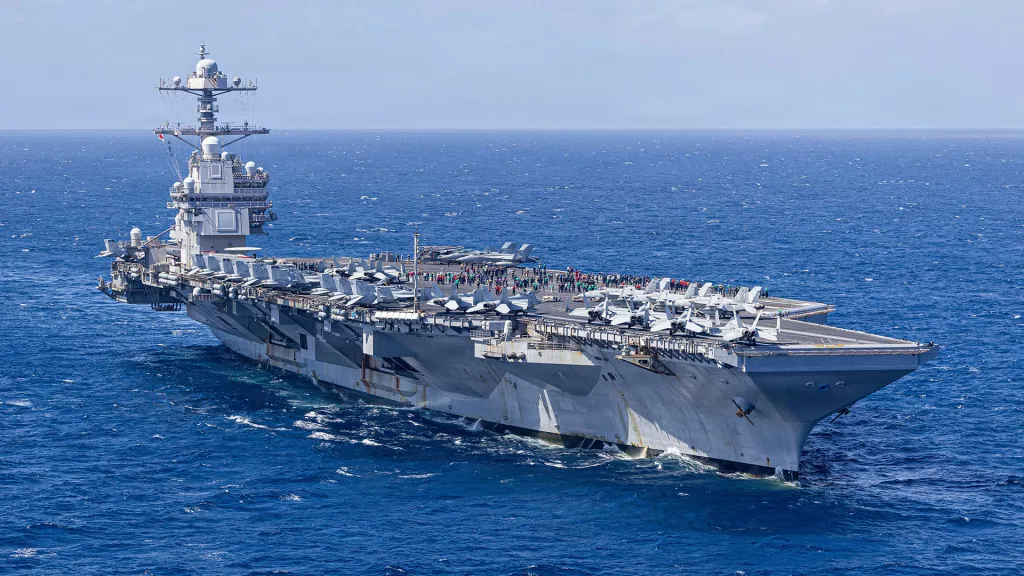
The nation’s most advanced aircraft carrier arrived in the Caribbean Sea on Sunday in a display of U.S. military power, raising questions about what the new influx of troops and weaponry could signal for the Trump administration’s drug enforcement campaign in South America.

The arrival of the USS Gerald R. Ford, announced by the U.S. military in a news release, marks a major moment in what the Trump administration says is an antidrug operation but has been seen as an escalating pressure tactic against Venezuelan President Nicolás Maduro. Since early September, U.S. strikes have killed at least 80 people in 20 attacks on small boats accused of transporting drugs in the Caribbean and eastern Pacific Ocean.

The Ford rounds off the largest buildup of U.S. firepower in the region in generations, bringing the total number of troops to around 12,000 on nearly a dozen Navy ships in what Defense Secretary Pete Hegseth has dubbed Operation Southern Spear.

The Ford’s carrier strike group, which includes squadrons of fighter jets and guided-missile destroyers, transited the Anegada Passage near the British Virgin Islands on Sunday morning, the Navy said in a statement.

Rear Adm. Paul Lanzilotta, who commands the Ford’s carrier strike group, said it will bolster an already large force of American warships to “protect our nation’s security and prosperity against narco-terrorism in the Western Hemisphere.”

The administration has maintained that the buildup of warships is focused on stopping the flow of drugs into the U.S., but it has released no evidence to support its assertions that those killed in the boats were “narco-terrorists.” An Associated Press report recently found that those killed included Venezuelan fishermen and other impoverished men earning a few hundred dollars per trip.

President Trump has indicated military action would expand beyond strikes by sea, saying the U.S. would “stop the drugs coming in by land.”

The U.S. has long used aircraft carriers to pressure and deter aggression by other nations because their warplanes can strike targets deep inside another country. Some experts say the Ford is ill-suited to fighting cartels, but it could be an effective instrument of intimidation for Maduro in a push to get him to step down.

Secretary of State Marco Rubio says the United States does not recognize Maduro, who was widely accused of stealing last year’s election, as Venezuela’s legitimate leader. Rubio has called Venezuela’s government a “transshipment organization” that openly cooperates with those trafficking drugs.

Maduro, who faces charges of narco-terrorism in the U.S., has said the government in Washington is “fabricating” a war against him. Venezuela’s government recently touted a “massive” mobilization of troops and civilians to defend against possible U.S. attacks.

Trump has justified the attacks on drug boats by saying the U.S. is in “armed conflict” with drug cartels while claiming the boats are operated by foreign terrorist organizations.

He has faced skepticism and opposition from leaders in the region, the United Nations human rights chief and U.S. lawmakers, including Republicans, who have pressed for more information on who is being targeted and the legal justification for the boat strikes.

Senate Republicans, however, recently voted to reject legislation that would have put a check on Trump’s ability to launch an attack against Venezuela without congressional authorization.

Experts disagree on whether or not American warplanes may be used to strike land targets inside Venezuela. Either way, the 100,000-ton warship is sending a message.

“This is the anchor of what it means to have U.S. military power once again in Latin America,” said Elizabeth Dickinson, the International Crisis Group’s senior analyst for the Andes region. “And it has raised a lot of anxieties in Venezuela but also throughout the region. I think everyone is watching this with sort of bated breath to see just how willing the U.S. is to really use military force.”

Finley writes for the Associated Press.

Source link

Strong Evidence That China’s Next Carrier Will Be Nuclear Emerges In Shipyard Photo

Recent imagery indicates that China is progressing with work on a new aircraft carrier, its fourth, which is expected by many sources to introduce nuclear propulsion. A new detail that is now visible of the makings of the ship’s hull structure would appear to directly support this. The development comes just a week after the People’s Liberation Army Navy (PLAN) commissioned its first domestically produced carrier, the Fujian. Meanwhile, there are increasing reports that Beijing may also still be working on at least one more conventionally powered carrier, too.

A close-up of the presumed Type 004 aircraft carrier under construction at Dalian. Chinese internet

Imagery of the new carrier, commonly referred to as the Type 004, shows the vessel taking shape at Dalian shipyard in China’s Liaoning province. Visible now is what looks to be a reactor containment structure, which would be a key indicator of its propulsion system. Certainly, the structure is broadly similar to that which is found in U.S. nuclear-powered supercarriers, and there is a general consensus that what we can see here is related to the future installation of a nuclear reactor. However, there remains the possibility that this could be some other test ship or potentially a test module. It could also be a case of this feature looking like it exists for one purpose, but it ends up being for another, although that seems less unlikely.

Renderings related to the Type 004 design that have emerged in the past have shown similarities to the U.S. Navy’s Ford class, as well as France’s future New Generation Aircraft Carrier, both of which are nuclear-powered.

An artist’s concept of a future Chinese aircraft carrier. Chinese internet via @HenriKenhmann

In its latest assessment of Chinese military power, the Pentagon doesn’t explicitly mention a nuclear-powered carrier, but does note that China’s “next generation of carriers” will be characterized by “greater endurance,” which “will increase the striking power of a potential PLAN carrier battle group when deployed to areas beyond the PRC’s immediate periphery.”

In March of this year, Yuan Huazhi, political commissar for the PLAN, confirmed that construction of a fourth carrier had begun, but declined to answer whether it would be nuclear-powered.

Model of a future Chinese nuclear-powered aircraft carrier. The label marked China State Shipbuilding Corporation (CSSC) suggests this could be an official model. Chinese internet

Almost exactly a year ago, evidence emerged that China had constructed a land-based prototype nuclear reactor suitable for a large surface warship. The so-called Dragon Might project is located at a mountain site outside the city of Leshan, in Sichuan province.

The shift to nuclear power for China’s fourth carrier is hugely significant.

Nuclear propulsion will give the Type 004 effectively unlimited range. It will also help meet the power-generation requirements of ever-improving sensors and other mission systems. A nuclear-powered supercarrier would go a long way toward closing the technical gap with the U.S. Navy, and would see China join France as the only other nation operating a nuclear-powered flattop.

Previous satellite imagery confirmed that construction work on the carrier was underway in Dalian before May 2024, when a module, a section of the flight deck, first appeared in satellite imagery.

A view of the carrier module at Dalian, in a satellite image dated May 17, 2024. Google Earth

Apparently evident in the module were trenches for catapult tracks, suggesting that the Type 004 will have two waist catapults, in addition to the two bow catapults. This would match the arrangement of the Nimitz and Ford classes and would add an extra catapult compared with China’s third carrier, the Type 003 Fujian, which has a single catapult in the waist position.

In other respects, too, the Type 004 is expected to be an overall more advanced design than Liaoning and Shandong, which are by now well established with the PLAN fleet, as well as the Fujian.

The Chinese aircraft carrier Fujian, seen during its commissioning ceremony last week. Chinese Ministry of National Defense

Like Fujian — and in contrast to the two previous carriers — the Type 004 will be equipped to launch aircraft via catapults. The earlier Shandong and the Liaoning are both short takeoff but arrested recovery, or STOBAR, types with prominent ‘ski jump’ takeoff ramps. Catapults offer numerous advantages, especially when it comes to launching aircraft at higher gross weights, which translates to larger fuel and ordnance loads. They can also generally accommodate a wider array of aircraft types, too. This includes larger and slower designs, like the KJ-600 carrier-based airborne early warning and control aircraft, as well as smaller ones, such as drones.

Like the Fujian, the Type 004 will presumably be equipped with an advanced electromagnetic aircraft launch system (EMALS), a type of equipment otherwise only in use with the U.S. Navy.

As well as the aforementioned KJ-600, the Type 004’s air wing will likely include the J-35 stealth fighter, supported by advanced developments of the J-15 multirole fighter, including an electronic warfare variant. The carrier is also likely to embark various drones, such as navalized versions of the GJ-11 uncrewed combat aerial vehicle (UCAV), plus helicopters.

A pair of prototype J-35s in close formation. via X

Intriguingly, however, China is reportedly also working in parallel on another new carrier, this one being conventionally powered.

Unconfirmed reports suggest that, in addition to the Type 004 at Dalian, China is poised to start working on a conventionally powered carrier at Jiangnan in Shanghai. This location would make sense inasmuch as this was the yard that built the Fujian. If these reports are correct, the finished product would likely be an improved Type 003 design.

Via Chaos314159/SDF:

“The latest Sentinel satellite imagery suggests that Jiangnan is cleaning a platform outside the dock, raising questions about whether this indicates the start of construction on the so-called Type 003A aircraft carrier.”

Does anyone know more? 🤨🤔 pic.twitter.com/sCSduadhM0

— @Rupprecht_A (@RupprechtDeino) November 11, 2025

Considering China’s huge shipbuilding capacity, it might well make sense to pursue two distinct new-generation carrier designs. An improved Type 003 — which some observers have begun to dub Type 003A — would offer the advantages of a proven design and lower costs, while the more ambitious Type 004 would be more expensive and higher risk.

The model below depicts a follow-on conventionally powered carrier, with the pennant number CV-19, but the source is unknown, and it may or may not be official. Notably, however, the island superstructure has major similarities with that seen on the large-scale, land-based aircraft carrier test facility in Wuhan.

Model of a future Chinese conventionally powered aircraft carrier, CV-19. Chinese internet
The remodeled carrier mockup in Wuhan with its curious island that matches (loosely) the model above. (Chinese internet)

There’s also an argument that China doesn’t necessarily need nuclear-powered carriers for many of its missions. While a nuclear-powered carrier would be a huge advantage for sustained blue-water operations across the globe, for contingencies closer to home, such as in the Taiwan Strait, and even in the disputed South China Sea, a force of conventionally powered flattops is still highly relevant. Conventionally powered carriers have the added advantage that they can be built more quickly and fielded in greater numbers given a set budget, although they are more dependent on a steady supply train, which can be vulnerable in a time of conflict. For its part, even a nuclear-powered carrier still requires a steady supply of other supplies, including fuel for its air wing and for its escorts.

At the same time, it should be noted that China is also working to introduce a number of very large big-deck amphibious assault ships, referred to as the Type 076. Each will feature at least one electromagnetic catapult that is expected to be primarily used to launch drones, as you can read more about here. Again, these would appear to be tailor-made for missions directed against Taiwan, as well as for power projection in the South China Sea.

Continued construction work on what is increasingly likely to be a nuclear-powered carrier, and the possibility of another type of conventional flattop in the works, highlight China’s high ambitions as a naval power and the resources they are willing to invest to achieve their maritime vision. While these developments are significant, it should also be recalled that, for the time being, the PLAN’s fleet of three conventionally powered carriers is still vastly outmatched by the U.S. Navy’s 11 active nuclear-powered supercarriers. Nevertheless, the gap is growing smaller at what seems like an increasing pace.

Contact the author: [email protected]

Thomas is a defense writer and editor with over 20 years of experience covering military aerospace topics and conflicts. He’s written a number of books, edited many more, and has contributed to many of the world’s leading aviation publications. Before joining The War Zone in 2020, he was the editor of AirForces Monthly.


Source link

British Carrier Hosts Largest Number Of F-35Bs On A Ship Ever

The U.K. Royal Navy flagship, HMS Prince of Wales, is now carrying 24 F-35B fighters — the largest number of the jets to go aboard either of the U.K.’s two aircraft carriers, or any ship, for that matter. All 24 of the jets are British, a significant achievement for the British F-35 force, which has long faced questions about the feasibility of deploying a meaningful number of the short takeoff and vertical landing (STOVL) jets at sea, without U.S. Marine Corps aircraft making up the numbers.

The Royal Navy announced today that the 24 British F-35Bs were aboard HMS Prince of Wales for planned multinational maneuvers in the Mediterranean, called Exercise Falcon Strike. The service has not so far published photos showing all the jets on deck, instead posting imagery from Operation Highmast, the eight-month cruise that took the carrier to the Indo-Pacific region.

HMS Prince of Wales entered the Mediterranean, via the Suez Canal, around a week ago. Six additional British F-35Bs embarked in the carrier once it had arrived in the Med, flying from their base at RAF Marham in England.

A pair of F-35Bs landing on board HMS Prince of Wales during Operation Highmast in May 2025. Crown Copyright

As part of the U.K. Carrier Strike Group, the conventionally powered HMS Prince of Wales is accompanied by the Type 45 destroyer HMS Dauntless, the Type 23 frigate HMS Richmond, the replenishment tanker RFA Tidespring, and several allied ships. A Royal Navy Astute class nuclear-powered attack submarine is normally also part of the Carrier Strike Group.

For Exercise Falcon Strike, the U.K. Carrier Strike Group is joined by the Italian frigate Luigi Rizzo, as well as Norwegian warships, for what are Italian Navy-led air and maritime maneuvers.

Commodore James Blackmore, commander of the U.K. Carrier Strike Group, said that Falcon Strike is “a real demonstration of the warfighting readiness” of the group.

The British F-35Bs on the carrier are from the two frontline units, the Royal Air Force’s No. 617 Squadron and the Royal Navy’s 809 Naval Air Squadron, as well as from the training unit, No. 207 Squadron, RAF, which serves as the Operational Conversion Unit (OCU).

Well done to everyone at Marham for making this happen. Whilst it did require the rather unprecedented deployment of the OCU to achieve a totemic milestone, it has readily demonstrated that our Carriers can be reinforced anywhere in the NATO region in a matter of hours. https://t.co/eIWNIyKkLX

— Greg Bagwell (@gregbagwell) November 7, 2025

It’s notable that, in the past, larger F-35B complements on U.K. carriers were assisted by detaching U.S. Marine Corps aircraft during these cruises.

For example, in 2021, HMS Queen Elizabeth deployed with a Marine Corps-augmented air wing. On that occasion, eight F-35Bs from No. 617 Squadron were joined by 10 from Marine Fighter Attack Squadron (VMFA) 211, the “long.” This total is still smaller than the current F-35B complement for Exercise Falcon Strike.

A U.S. Marine Corps F-35B operates from HMS Queen Elizabeth during the U.K. Carrier Strike Group 21 deployment. Crown Copyright POPhot Jay Allen

The number of F-35Bs now on HMS Prince of Wales is also bigger than has been deployed aboard any amphibious assault ship by the Marine Corps. Back in 2022, the USS Tripoli (LHA-7) hosted 20 of the jets during a test of the “Lightning Carrier” concept. This is based upon essentially turning a big-deck “Gator Navy” amphibious assault ship into a light aircraft carrier, packed with F-35Bs.

The biggest carrier embarkation involving fifth-generation fighters also makes an interesting parallel with developments in China, which is now also flying the J-35 stealth fighter, as well as fixed-wing airborne early warning and control (AEW&C) aircraft from its latest flattop, the Fujian. Elsewhere in the Indo-Pacific region, Japan is meanwhile preparing for regular F-35B operations aboard its two amphibious assault ships that have been modified to become STOVL carriers.

A J-35 launches from the Chinese aircraft carrier Fujian. PLAN

Having a larger number of F-35Bs on board the British carrier means that HMS Prince of Wales can contribute more to Falcon Strike, which also involves air assets from France, Greece, Italy, and the United States.

More importantly, a carrier deployment with 24 British F-35Bs is a major requirement for the declaration of full operating capability for the U.K. Carrier Strike capability, once planned for 2023, then delayed to the end of this year. A 24-aircraft total is the minimum required for this declaration, with the Queen Elizabeth class having the capacity to embark more jets, if required.

The move toward full operating capability is also welcome, considering recent criticism of the British F-35 program.

Last week, the U.K.’s Public Accounts Committee released its latest report on the program. Among others, this highlighted the effects of a lack of overall investment in the program. According to the report, cost-cutting measures have had an adverse impact on the F-35B’s capability, availability to fly, and value for money.

The number of British F-35Bs that will ultimately be available to the Royal Navy’s two carriers has long been a matter of intense debate.

To date, the United Kingdom has only placed firm orders for 48 F-35Bs. The previous Conservative government confirmed it was negotiating to buy another 27 F-35Bs for delivery by 2033. However, this batch of 27 jets will now be divided between F-35As (12) and F-35Bs (15). The conventional takeoff and landing F-35A offers a number of advantages, including being cheaper, possessing a bigger weapons bay, having a nuclear capability, and improved performance in many scenarios. However, it cannot embark on a carrier.

Most analysts consider that many more than 48 F-35Bs would be required to meet the ambition of 24 jets available for the baseline Carrier Strike mission, across two carriers, as opposed to just one. Considering training and other demands, a figure of 60-70 jets is generally thought to be reasonable. It is for this reason that U.S. Marine Corps F-35Bs have been relied upon to make up the required aircraft numbers during carrier cruises.

Officially, at least, the U.K. Ministry of Defense says that it still expects to procure 138 F-35s over the lifetime of the program. However, this total now includes at least 12 F-35As. Having a smaller pool of F-35Bs will also put more strain on the fleet of STOVL jets that are required for missions aboard the carriers.

“The new fast jets will be based at RAF Marham, with the Government expected to procure 138 F35s over the lifetime of the programme.” Everything else aside, this is about as clear a commitment to the UK’s full programme of record as you’re ever going to get……

— Gareth Jennings (@GarethJennings3) June 25, 2025

Whatever the final F-35B numbers, the Royal Navy is increasingly looking to the potential of uncrewed aircraft to bolster its carrier air wings. The Royal Navy hopes that a combination of drones and long-range weapons will help to make a more balanced ‘hybrid carrier air wing,’ as you can read about here.

In 2023, the Royal Navy revealed details of its plan to fit its two carriers with assisted launch systems and recovery gear, enabling operations by a variety of fixed-wing uncrewed aircraft and, potentially, also conventional takeoff and landing crewed types.

“We are looking to move from STOVL to STOL, then to STOBAR [short takeoff but arrested recovery], and then to CATOBAR [catapult assisted takeoff but arrested recovery],” Col. Phil Kelly, the Royal Navy’s Head of Carrier Strike and Maritime Aviation, told the Combined Naval Event conference in 2023. “We are looking at a demonstrable progression that spreads out the financial cost and incrementally improves capability.”

A General Atomics rendering of a catapult-equipped HMS Prince of Wales with a Gambit-series drone ready to launch. The rendering also depicts an air wing that includes carrier-capable MQ-9B drones fitted with a STOL kit, as well as F-35Bs. GA-ASI

By the time a British carrier makes its next scheduled deployment to the Indo-Pacific, planned for 2029, the Ministry of Defense hopes that it will include some kind of Collaborative Combat Aircraft (CCA). This aspiration was laid out by First Sea Lord General Sir Gwyn Jenkins earlier this year, when he said he wanted to “launch the first jet-powered collaborative platform drone as a concept demonstrator off a Queen Elizabeth class aircraft carrier” before the end of 2026.

Nevertheless, for the foreseeable future, the F-35B remains the cornerstone of the carrier air wing’s strike capability. Putting the largest number of the stealth jets on a Royal Navy carrier is a visible demonstration of the aircraft’s central role and underscores the British F-35Bs’ progress, despite lingering concerns over final aircraft numbers and other criticisms of the program.

Contact the author: [email protected]

Thomas is a defense writer and editor with over 20 years of experience covering military aerospace topics and conflicts. He’s written a number of books, edited many more, and has contributed to many of the world’s leading aviation publications. Before joining The War Zone in 2020, he was the editor of AirForces Monthly.


Source link

China Commissions Newest Aircraft Carrier With Its Electromagnetic Catapults Front And Center

China has now formally commissioned its first catapult-equipped aircraft carrier, the Fujian, into service. The commissioning ceremony put particular emphasis on the ship’s electromagnetically-powered catapults, with President Xi Jinping shown pressing the launch button inside the control ‘bubble’ built into the flight deck. This all notably comes after U.S. President Donald Trump pledged last week to sign an executive order that would compel the U.S. Navy to go back to using steam-powered catapults on future carriers.

The Chinese aircraft carrier Fujian, seen during its commissioning ceremony. Chinese Ministry of National Defense

Fujian’s commissioning ceremony took place at the naval port in Sanya on the island of Hainan on November 5, according to a press release the Chinese Ministry of Defense put out today. Examples of the key aircraft in the carrier’s air wing – J-35 and J-15 fighters, the KJ-600 airborne early warning and control aircraft, and the Z-20F helicopter – were displayed on the flight deck during the event. The conventionally-powered Fujian was launched in 2022 and has conducted multiple sea trials since 2024, including a major demonstration of its ability to launch and recover aircraft back in September.

President Xi Jinping presided over the flag-granting ceremony of the Fujian in Sanya, officially marking China’s entry into the three-carrier era (Liaoning, Shandong, Fujian).

The 80,000-ton Fujian is China’s first carrier equipped with an electromagnetic catapult system (EMALS)… pic.twitter.com/DwVwspOjjW

— 观察者网 (@realGuancha) November 7, 2025

There had already been signs earlier this week that Fujian, which has received the hull number 18, had officially entered operational service. China’s newest carrier had been in port in Sanya for more than a month. It had also been sharing a pier with the Shandong, one of the other two aircraft carriers in the People’s Liberation Army Navy’s (PLAN) inventory. The Liaoning, China’s first aircraft carrier, and Shandong are both short take-off, but arrested recovery (STOBAR) types with ski jump bows instead of catapults.

Fujian, in the foreground, seen during the commissioning ceremony in Sanya. The Shandong is seen on the opposite side of the pier. Chinese Ministry of National Defense

Nice quality side by side of Fujian with Shandong at Sanya. Illustrates well marginal waterline length increase but providing a considerably wider hull significanly improving deck traffic. The forward elevator position remains somewhat compromised vs starboard launch position. https://t.co/B9a97qvwHf

— Alex Luck (@AlexLuck9) October 5, 2025

As has been made clear, Fujian‘s electromagnetic catapults, also referred to as an electromagnetic aircraft launch system (EMALS), are an especially significant feature of the carrier’s design. There is currently only one other flattop in service globally with an EMALS, the U.S. Navy’s USS Gerald R. Ford, which we will come back to later on.

With Fujian, China has skipped over carriers with steam-powered catapults entirely, a decision the country’s Ministry of National Defense has now said was directed by President Xi himself. Steam has been the default for powering catapults on aircraft carriers equipped with them for decades. As noted, Xi was given the opportunity to press the launch button inside the carrier catapult control ‘bubble,’ though no actual aircraft left the ship’s deck during the in-port ceremony.

Official confirmation:

President Xi personally made the decision for the aircraft carrier Fujian to have the electromagnetic catapult, instead of the steam catapult that was originally designed to have.

At the end, the video shows the sled of the catapult coming to a full stop,… pic.twitter.com/RLCwgjhd7r

— Zhao DaShuai 东北进修🇨🇳 (@zhao_dashuai) November 7, 2025

In principle, an EMALS offers significant advantages over steam when it comes to sortie generation rates. The amount of force electromagnetic catapults exert on the aircraft they launch can also be more finely tuned, increasing the range of types they can accommodate, helping to reduce general wear and tear, and providing additional safety margins. The ability of an EMALS to launch smaller and more fragile designs is seen as particularly critical to opening the door to future carrier-based drone operations, something the PLAN is very actively pursuing. The video clip in the social media post below looks to highlight all of this to a degree by showing how fast and smoothly the catapult shuttles on Fujian can decelerate after being engaged.

PLAN Fujian’s EMALS shuttle goes from rocket boost to slow-roll in a split second. That extreme deceleration is insane—and it’s all real-time. Notice the flags in the background are waving at normal speed, indicating it’s not slow-mo pic.twitter.com/E3SRLnF0TB

— Fighterman_FFRC (@Fighterman_FFRC) November 7, 2025

At the same time, the U.S. experience with EMALS technology on the USS Gerald R. Ford has shown it to be hard to master. The carrier’s catapults, as well as the companion electronically-controlled Advanced Arresting Gear (AAG), have struggled with technical and reliability issues over the years. The ship also has electromagnetically powered elevators for moving munitions and other stores between its magazines and the flight deck, which were plagued with problems in the past. The Navy says it has mitigated the issues with Ford‘s catapults, arresting gear, and elevators, but official details regarding operations as recently as last year highlight continued difficulties. Other elements of the carrier’s design, especially its Dual Band Radar (DBR) system, have faced challenges, as well. Future Ford class carriers will notably feature an entirely new main radar configuration.

During a speech last month, U.S. President Donald Trump assailed the Navy over issues with Ford’s catapult and elevators. He promised to sign an executive order compelling the service to go back to using steam-powered catapults and hydraulic elevators. Though that order has yet to materialize, Trump has been outspoken about the catapult elevator issues with the Ford class on multiple occasions in the past, and has taken a very active role in U.S. naval planning and ship design, as you can read more about here.

This all stands in stark contrast to the developments in China, especially so now, with authorities in the country having said President Xi was personally responsible for the EMALS capabilities on Fujian. The new supersized Type 076 amphibious assault ship for the PLAN also has a single catapult that is understood to be an EMALS type. Other countries are also looking ahead at equipping future carriers and big deck amphibious vessels with electromagnetic catapults.

President Xi Jinping poses with pilots and flight deck personnel during Fujian‘s commissioning ceremony. Chinese Ministry of National Defense

For China, Fujian, which is now officially in operational service, has long been a very significant development, well beyond the design of its catapults. Its carrier air wing is set to offer a host of new naval aviation capabilities, especially with the introduction of the J-35 naval stealth fighter and the KJ-600. The J-35 and KJ-600 were heavily showcased during the most recent round of sea trials, as seen in the videos below.

All three of the PLAN’s aircraft carriers form a centerpiece of a massive naval modernization push that traces back to the 1990s. In addition to offering new ways to project power regionally, including as part of any future intervention against Taiwan, the flattops enable longer-range blue water operations in the Pacific and beyond. The PLAN capabilities and capacity also continue to grow thanks to a still-expanding array of larger and otherwise modern surface combatants and submarines, all being churned out by a naval shipbuilding sector that notably dwarfs that of the United States.

Fujian is also China’s first carrier that is not based on a Soviet design, which is a point of national pride. Liaoning was originally laid down in the Soviet Union as the planned sister ship to the long-troubled Admiral Kuznetsov. Work on the ship came to a halt with the fall of the Soviet Union. The government of the newly independent country of Ukraine subsequently came into possession of the incomplete Kuznetsov class carrier and ultimately sold it to Chinese buyers. There had been speculation that the ship would be turned into a floating hotel or amusement park, something that did happen in China with other ex-Soviet aircraft carriers, before it became clear that the PLAN intended to put it into operational service. The Shandong, which was entirely built in China, was derived from the Liaoning‘s design.

Liaoning and Shandong seen sailing together with an array of escorts. A formation of 12 J-15 fighters is also seen flying overhead. Chinese government

China is already reportedly working on another even more capable carrier, commonly referred to now as the Type 004, which may be nuclear-powered. Renderings related to that design that have emerged in the past have shown similarities to the Ford class, as well as France’s future New Generation Aircraft Carrier, both of which are nuclear-powered.

Altogether, Fujian‘s commissioning is another important step forward for China’s carrier force and its larger naval modernization plans. The heavy focus on its EMALs catapults could have additional ramifications for global carrier developments, including in the United States.

Contact the author: [email protected]

Joseph has been a member of The War Zone team since early 2017. Prior to that, he was an Associate Editor at War Is Boring, and his byline has appeared in other publications, including Small Arms Review, Small Arms Defense Journal, Reuters, We Are the Mighty, and Task & Purpose.


Source link

N Korea threatens ‘offensive action’ as US aircraft carrier visits S Korea | Kim Jong Un News

North Korea issues warning as Washington and Seoul agree on strengthening military ties.

North Korea’s defence minister, No Kwang Chol, has condemned the arrival of a United States aircraft carrier at a port in South Korea and warned that Pyongyang will take “more offensive action” against its enemies.

The minister’s warning comes a day after North Korea launched what appeared to be a short-range ballistic missile into the sea off its east coast.

Recommended Stories

list of 4 itemsend of list

“We will show more offensive action against the enemies’ threat on the principle of ensuring security and defending peace by dint of powerful strength,” the defence minister said, according to a report on Saturday by the North’s state-run Korean Central News Agency (KCNA).

“All threats encroaching upon the sphere of the North’s security” will become “direct targets” and be “managed in a necessary way”, South Korea’s Yonhap news agency also reported the defence minister as saying.

The missile launch on Friday followed after Washington announced new sanctions targeting eight North Korean nationals and two entities accused of laundering money tied to cybercrimes, and a visit to South Korea by US Defense Secretary Pete Hegseth.

Commenting on the visit by US and South Korean defence chiefs to the border between North and South Korea, as well as their subsequent security talks in Seoul, the North Korean defence minister accused the allies of conspiring to integrate their nuclear and conventional weapons forces.

“We have correctly understood the hostility of the US to stand in confrontation with the DPRK to the last and will never avoid the response to it,” No said, using the initials of the North’s official name, the Democratic People’s Republic of Korea.

A TV screen shows footage of missiles.
A TV screen shows a North Korean missile launch at the Seoul Railway Station in Seoul, South Korea, on Friday [Lee Jin-man/AP Photo]

According to KCNA, the defence minister made his comments on Friday in response to the annual South Korea-US Security Consultative Meeting (SCM) and the recent arrival of the USS George Washington aircraft carrier and the Fifth Carrier Strike Group at a port in Busan.

The arrival of the US strike group also coincides with large-scale joint military drills, known as Freedom Flag, between US and South Korean forces.

While in South Korea for the SCM talks this week, Hegseth posted several photos on social media of his visit to the Demilitarized Zone (DMZ) between the North and the South.

Hegseth said that the core of Washington’s alliance with Seoul would remain focused on deterring North Korea, although the Trump administration will also look at flexibility for US troops stationed in South Korea to operate against regional threats.

Pyongyang described the DMZ visit by Hegseth and his South Korean counterparts as “a stark revelation and an unveiled intentional expression of their hostile nature to stand against the DPRK”.

Pyongyang’s latest missile launch, which Japan said landed outside its exclusive economic zone, came just over a week after US President Donald Trump was in the region and expressed interest in a meeting with North Korean leader Kim Jong Un.

On Friday, the US said it was “consulting closely” with allies and partners over the ballistic missile launch.

“While we have assessed that this event does not pose an immediate threat to US personnel or territory, or to our allies, the missile launch highlights the destabilising impact” of North Korea’s actions, the US Indo-Pacific Command said in a statement.


Source link

Carrier USS Ford Holding Off Of North Africa As Trump Reportedly Won’t Strike Venezuela

Two days after passing through the Strait of Gibraltar en route to the Caribbean, the aircraft carrier USS Gerald R. Ford has not moved significantly from a position just west of Morocco in North Africa, the Navy confirmed to us Thursday. The flattop and elements of its strike group were ordered by President Donald Trump to join the ongoing enhanced counter-narcotics mission in the region, but it is unclear if plans have changed.

The relatively static position of the Ford and at least two of its escorts comes as reports are emerging that the Trump administration has decided, for now, not to carry out land strikes against Venezuela. It is unknown at the moment if there is a correlation, and the possibility remains that the carrier could still soon sail westward. We have reached out to the White House for clarification.

The USS Gerald R. Ford remains holding off the coast of Morocco. (U.S. Navy photo by Mass Communication Specialist 2nd Class Jacob Mattingly)

The Trump administration on Wednesday told Congress it is holding off for now on strikes inside Venezuela out of concern over the legal authority to do so, CNN reported on Thursday. The briefing was conducted by Secretary of State Marco Rubio, Defense Secretary Pete Hegseth and an official from the White House’s Office of Legal Counsel, the network reported, citing sources familiar with the events.

Lawmakers were told that the authority given to suspected drug boats did not apply to land strikes, the network noted. So far, nearly 70 people have been killed in at least 16 publicly known attacks on vessels allegedly smuggling drugs in the Caribbean and Pacific. The most recent acknowledged strike took place on Tuesday. The strikes have garnered heavy criticism for being extrajudicial and carried out without Congressional authorization.

Today, at the direction of President Trump, the Department of War carried out a lethal kinetic strike on a vessel operated by a Designated Terrorist Organization (DTO).

Intelligence confirmed that the vessel was involved in illicit narcotics smuggling, transiting along a known… pic.twitter.com/OsQuHrYLMp

— Secretary of War Pete Hegseth (@SecWar) November 5, 2025

Asked if the administration is indeed opting against land attacks on Venezuela, at least for now, the White House gave us the following response:

“President Trump was elected with a resounding mandate to take on the cartels and stop the scourge of narcoterrorism from killing Americans,” a White House official told us. “The President continues to take actions consistent with his responsibility to protect Americans and pursuant to his constitutional authority. All actions comply fully with the law of armed conflict.” 

CNN’s reporting came after a Wall Street Journal story on Wednesday stating that President Donald Trump “recently expressed reservations to top aides about launching military action to oust Venezuelan President Nicolás Maduro.”

Trump feared that strikes might not force Maduro to step down, the newspaper noted. Though ostensibly begun as an effort to stem the flow of drugs, it has grown into a massive show of military force aimed partially at Maduro.

The administration is considering three main options for dealing with Maduro, The New York Times reported earlier this week. They include stepping up economic pressure on Venezuela, supporting that nation’s opposition while boosting the U.S. military presence to add pressure on the Venezuelan leader, and initiating airstrikes or covert operations aimed at government and military facilities and personnel.

However, the goal is in flux, administration officials acknowledge, according to the Journal. Meanwhile, Trump has also delivered mixed messages, saying he doubts there will be an attack but that Maduro must go.

What is clear is that there is a massive U.S. military presence in the Caribbean, which includes at least eight surface warships, a special operations mothership, a nuclear-powered fast attack submarine, F-35B stealth fighters, AC-130 gunships, airlifters, MQ-9 Reaper drones and more than 10,000 troops.

The Ford was supposed to join that force, but if the administration is content for now to hit boats suspected of carrying drugs, it might not make sense to move the carrier and escort ships more than 3,600 miles west, especially as there is high demand elsewhere for American naval presence, including in Europe, where the supercarrier just came from.

The issue of wear and tear on the force is something that the Pentagon will have to evaluate as it decides which assets to keep and which to pull from the Caribbean. Navy vessels began arriving in the region in late August and at some point, they will need relief. That could mean bringing in ships, possibly from other regions. The same can be said for aircraft units and personnel deployed around the region for the operation. Those forces can only remain spun-up for so long, or the operation needs to be adapted for a long-term enhanced presence. This could very well be underway already, although we have not confirmed this as being the case. However, being so close to the U.S. mainland reduces some of those concerns, especially for rotating units in and out.

Regardless of Trump’s intentions, the U.S. military presence continues to endure in the region. Thursday afternoon, two more B-52H strategic bombers flew near the coast of Venezuela, according to online flight trackers. These bomber flights have become something of a routine at this point. In addition, the San Antonio class amphibious transport dock ship USS Fort Lauderdale is once again back in the Caribbean after a pitstop in Florida for routine maintenance.

At 5 p.m., the U.S. Senate is scheduled to hold a floor vote on a bipartisan war powers resolution that would block the use of the U.S. Armed Forces to engage in hostilities within or against Venezuela, unless that action has been authorized by Congress. A similar measure failed several weeks ago and it remains to be seen if news that the administration is holding off on striking Venezuela will move the needle on that resolution.

Meanwhile, we will continue to monitor the progress of the Ford and the U.S. military presence arrayed against Maduro and provide updates when warranted.

Update: 6:07 PM Eastern –

The Senate bipartisan war powers resolution was voted down by a vote of 51 to 49.

Contact the author: [email protected] 

Howard is a Senior Staff Writer for The War Zone, and a former Senior Managing Editor for Military Times. Prior to this, he covered military affairs for the Tampa Bay Times as a Senior Writer. Howard’s work has appeared in various publications including Yahoo News, RealClearDefense, and Air Force Times.


Source link

Chinese ‘Mini Drone Carrier’ Seen Being Used As Test Ship

We appear to have gotten our first look at a curious Chinese ship, which some have dubbed a ‘drone carrier,’ actually in use, supporting at-sea testing of the AR-500CJ uncrewed helicopter. The vessel is one of a number of unusual designs with open flight decks that have emerged in China in recent years as China’s drone ambitions have increasingly extended into the naval domain.

China’s state-run television station CCTV-7, which focuses on news related to the People’s Liberation Army (PLA), broadcast clips of the AR-500CJ being tested at sea back on October 30. The AR-500CJ, a version of the Aviation Industry Corporation of China’s (AVIC) larger AR-500 family optimized for shipboard operations, first flew in 2022.

A screen capture from the CCTV-7 segment showing the AR-500CJ drone helicopter being moved around the deck of the ship during at-sea testing. CCTV-7 capture

The CCTV-7 segment does not appear to name the ship the AR-500CJ is seen operating from, nor does it offer a full view of the vessel. However, the size and configuration of the flight deck, especially a trapezoidal section on the starboard side toward the stern, as well as its markings, match up directly with the design of a ship that was launched at the Jiangsu Dayang Marine shipyard back in 2022. Naval News was first to report in detail on that vessel, which is approximately 328 feet (100 meters) long and some 82 feet (25 meters) across, and has a small island on the starboard side toward the bow, last year.

A screen grab from the CCTV-7 segment offering a wide view of the ship’s deck, including the trapezoidal section on the starboard (right) side. CCTV-7
The ‘mini drone carrier’ as seen from above in this satellite image of the Jiangsu Dayang Marine shipyard taken in August 2024. Google Earth

It had been suggested that the ship seen in the CCTV-7 footage might be a mysterious Chinese vessel with a large open flight deck and three superstructures that TWZ was first to report on last year. That ship bears the logo of the state-run China State Shipbuilding Corporation (CSSC) and may be named the Zhong Chuan Zi Hao, and could also be a first-of-its-kind ostensibly civilian research ship, as you can read more about here. However, the CSSC ‘carrier’ has a much larger and differently shaped flight deck that also has very distinct markings on it.

A side-by-side comparison of the deck of the ship as seen in the CCTV-7 segment, at left, and the stern end of the still-mysterious big-deck ship with the CSSC logo seen in an image that emerged on social media in August, at right. Note the distinct differences in the color and position of the markings, as well as the general configuration of the decks. CCTV-7 capture/Chinese internet

The CSSC aviation platform remains tied up at the cruise ship terminal in Guangzhou, where the vessel was docked in early June.
Via “by78″/SDF. pic.twitter.com/z8eSd4lZT9

— Alex Luck (@AlexLuck9) August 13, 2025

As mentioned, a number of unusual open-decked vessels have emerged in China in recent years. Jiangsu Dayang Marine, also known as the New Dayang shipyard, has become particularly notable in this regard. The yard has also produced at least two catamaran drone ‘motherships,’ which TWZ was also first to report on in detail, as well as various specialized barges. These all largely appear to be intended for use in training and/or testing, and to be particularly focused on replicating drone and/or electronic warfare threats. The first known imagery of one of the catamaran motherships in use also notably came from a CCTV-7 segment in 2022.

A broader look at the Jiangsu Dayang Marine yard in August 2024, showing the two catamaran ‘drone motherships,’ as well as barges, together with the ‘mini drone carrier.’ Google Earth

As TWZ has noted in the past, the maritime platforms that Jiangsu Dayang Marine has produced could potentially have roles in an actual operational context, including when paired with larger crewed warships. At the same time, the relatively small size and general configuration of the ‘mini drone carrier’ would limit its suitability for any kind of sustained employment in support of real-world operations.

An image from the ground of the reported Chinese experimental drone platform. If accurate, it illustrates the relatively modest proportions of the design. Via “斯文的土匪—”/Wb (H/t Temstar/SDF). pic.twitter.com/LAFHRqaGfK

— Alex Luck (@AlexLuck9) May 18, 2024

Even without a secondary operational role, dedicated naval drone test and training platforms still offer value to the PLA, which has been steadily working to expand the scale and scope of its shipboard uncrewed aviation capabilities. AR-500CJ, which AVIC has said could be used as a surveillance asset or an aerial signal relay node, among other roles, is part of this evolving ecosystem. Another drone helicopter intended for shipboard operations, based on the larger AR-2000 design from China National Aero-Technology Import & Export Corporation (CATIC), was among a host of new uncrewed aircraft designs showcased at a huge military parade in Beijing in September.

Navalized drone helicopters based on the AR-2000 design on parade in Beijing in September. Chinese internet

Chinese naval drone developments extend well beyond vertical takeoff and landing capable designs. Work on a navalized version of the stealthy flying-wing GJ-11 Sharp Sword uncrewed combat air vehicle (UCAV) has become a particular centerpiece of these efforts. Imagery just recently emerged that offered the first clear look at one of those drones with its arrestor hook deployed. The naval GJ-11, also sometimes referred to as the GJ-21, is expected to fly from at least some of China’s growing fleet of aircraft carriers and big-deck amphibious assault ships.

As it seems, for the first time clear images of a GJ-21 in flight are posted and this one – based on the still installed pitots – has its tail hook down. pic.twitter.com/5h1nVZHzIe

— @Rupprecht_A (@RupprechtDeino) November 1, 2025

On a broader level, China continues to reinforce its position as a global leader in uncrewed aviation developments in the military and commercial domains, and there is often considerable overlap between the two. Just this year, TWZ was the first to report on the emergence of several previously unseen advanced drone designs, a number of which are also notably large. As we have reported in the past, flying-wing uncrewed aircraft designs also continue to be a particular area of focus for the Chinese aviation industry.

With all this in mind, China’s use of bespoke ships with open flight decks to support drone testing and training, as well as other purposes, only looks likely to grow.

Contact the author: [email protected]

Joseph has been a member of The War Zone team since early 2017. Prior to that, he was an Associate Editor at War Is Boring, and his byline has appeared in other publications, including Small Arms Review, Small Arms Defense Journal, Reuters, We Are the Mighty, and Task & Purpose.


Source link