Arca reconfigures the role of the diva in her new album ‘XXXXX’
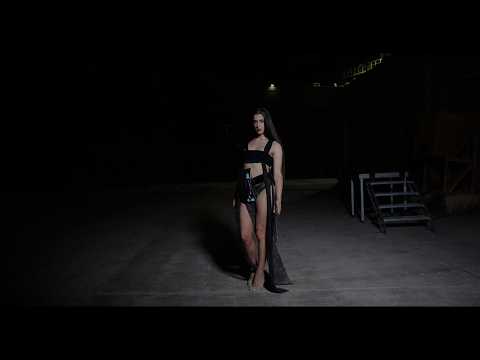
In an abandoned warehouse in Barcelona, the diva concealed her face beneath a helmet. Her hair moved like a black waterfall as she strutted, bare feet arched, as if in heels. The heels do appear later, click-clacking as the camera reveals a screen on her pelvic region, and as she reveals her face, growling a provocative verse from “Taconeando” — “Yo sé que tu quieres que me venga.”
Throughout the course of her July 27 “XXXXX” livestream, which beamed her first album in five years to the world, the artist-producer Alejandra Ghersi Rodríguez, best known as Arca, bathed in the warm hue of red light and strobes — and later, what seemed to be blood.
She blew kisses to the camera and toward the sky. She let out vocoded screams as she writhed on an industrial floor and lay resplendently upon a mountain of sand. She covered her bikini-clad body in peonies, visually echoing an Ana Mendieta “Silhueta.”

It would be too simplistic to label “XXXXX” as a return to form for the expansive Venezuelan artist; this record is more than a pop-timized syncretization of her previous electronic experimentations, such as her 2013 debut EP “&&&&&,” or the hourlong single “@@@@@.”
Lest we forget her celebrated self-titled album in 2017, which was the first time we heard Arca’s voice untreated to the doleful melody of a tonada, the Venezuelan folk genre popularized by llanero troubadour Simón Díaz; or the wildly ambitious five-album “Kick” cycle, in which she indulged in the Caribbean sounds of dembow and reggaeton, then melded them together into one ambient stream, with her signature glitchy flair.
The album cover of “XXXXX,” which calls to mind one of Swiss artist’s H.R. Giger’s biomechanoid machine-human chimeras, nods to the much-ness inherent here: specifically the post-humanist conceit of “diva as technology” that lies at the bloody, beating heart of this record.
What best captures her ambitions on “XXXXX” is the aptly named song “Everything,” which centers a soft-hard sequence of percussion that threatens to consume you — and if it does, you let it.

When every color of paint is mixed together, a dark color emerges. When every sound is blended together, what does it become? An orchestral flourish slowed to a whisper as in “Finisher?” An explosion, like in the fast-rattling crackle of “Syncope?” Or a hand on your hookup’s throat, telling them they know exactly what you want from the interaction as in “Fxck?”
The alchemy on “XXXXX” doesn’t always go down smoothly. Arca’s never been an artist to be easily swallowed and thrown back into the ouroboros of the pop machine; if she’s always been the sand in the cog, what happens when the underground diva herself surfaces to mainstream superstardom? These are problems to ponder in the shadows of a club.
The diva as a concept is already rooted in transformation. A beautiful, powerful woman flaunts her voice dramatically onstage, reaching new heights and incarnating — to paraphrase Wayne Koestenbaum’s observations on operatic divas, like Maria Callas in his seminal text “The Queen’s Throat” — an airy sense of freedom.
Arca — a nonbinary trans woman who makes uncategorizable music and embodies unquestionable glamour — anchors her divahood in a mutation of body, soul and sound. It’s a concept she has been playing with since her second album, “Mutant,” which also gave her fanbase a name.
Still, attempting to situate her in any tradition is moot.
Her divahood exists in the context of Venezuelan underground electronic music, where Arca was the youngest of a generation of DJs and producers. This includes the raptor house don DJ Babatr; hard fusion father DJ Yirvin; Luis Garban (who plays as Cardopusher and Safety Trance); MPeach; and Phran.
It was two years ago that Arca brought all of them together in Caracas; it was then that the glitchy young experimentalist, now the most famous contemporary Venezuelan musician, became the gravitational center of a scene as fractured as the country it was born from.
Arca is now the kind of artist who could be seen walking runways in Berlin, or seated front row at the Saint Laurent show at Paris Fashion Week. Last month in Iceland, Arca served as the high priestess of Echolalia: an eclipse rave helmed by longtime collaborator Björk and a coterie of local acts.
Arriving in a summer defined by pop divas switching gears — Charli XCX turning to rock music (in a sense), Madonna leaning hard into nostalgia after a career of refusing to repeat herself, and the ever-smiley Karol G surrendering to her saudade — Arca’s “XXXXX” is similarly an invitation to transmute.
But if we can locate Arca’s divahood in a lineage, it might be in the modern tradition of the anonymous and enigmatic doll at the rave: ready to let her ego dissolve into the bass.

You listen to the quiet internal world Arca conjures on “Raver,” with its jangling and haunted electronic keys. You can see her clearly there: lost under the strobes, eyes turned up toward heaven, letting herself sway, sweaty, between moments of euphoria, completely in her body. Has anyone ever been more enraptured and glorious? Every raver has, in a sense, wandered gladly to oblivion with “eyes closed and heart open,” as Arca says on “Cinch.”
We may get drugged up to forget it all; or we go sober with earplugs and water and good sneakers and coffee, or cold yerba mate toward the music. Yet all of us seek to get lost in the sound, to cinch our waists and let the bass move through us — to have the transcendental experience of “[letting] the beat f— you,” as Australian scholar McKenzie Wark describes halfway through her essential book, “Raving.”
The aesthetics of ravers reaching the mainstream — and into the hands of normies through the rise of so-called “corporate raves” — has allowed for the creation of depictions that exist outside of the real, silent moments of transcendence. It’s the communion, after so much ceremonial dance, with the divine.
For all the modernity of its rave philosophy and sci-fi metallic soul, “XXXXX” has a connection to an ancient divinity — to older technologies, from ritual to radio.
Near the beginning of “XXXXX,” the song “Willow” ushers us into this new world, with a clanging that evokes the sound of church bells in space. After a minute of this, the crash of hi-hat punctures the silence. Arca’s pitched-up vocals seep through, matching the beat in a disjointed chant: “Willow tree blowing in the wind, let it fall.” The song continues flourishing with the deconstructed trap beat and dark synthesizers that call to mind the classic sounds of witch house. It’s the opening of the ceremony, the energetic cleansing of the space.
The album’s loose framework as a transmission from an intergalactic underground radio station, “Diva Experimental FM,” is a structure she’s been playing with for years in the form of a show streamed on NTS. She launched this new era with another mix for the show called “Airdoll,” a storm of baile funk with currents of ambient music, R&B and Gregorian chants. These various sonic streams fuel the mechanical but witchy futurist soul of “XXXXX.”
In their multi-genre 2025 book “Dysphoria Mundi,” Spanish trans philosopher and activist Paul B. Preciado points to gender dysphoria as a symptom of the world’s broken state and the utopia that could well rise from the ashes. The constant procession of natural disasters — and the indifferent leaders and the violent bloodthirsty systems they work under — push society to mutate into something better. As with Arca the artist, “XXXXX” is a curse-breaker, a cultural palate cleanser and a call to evolve.