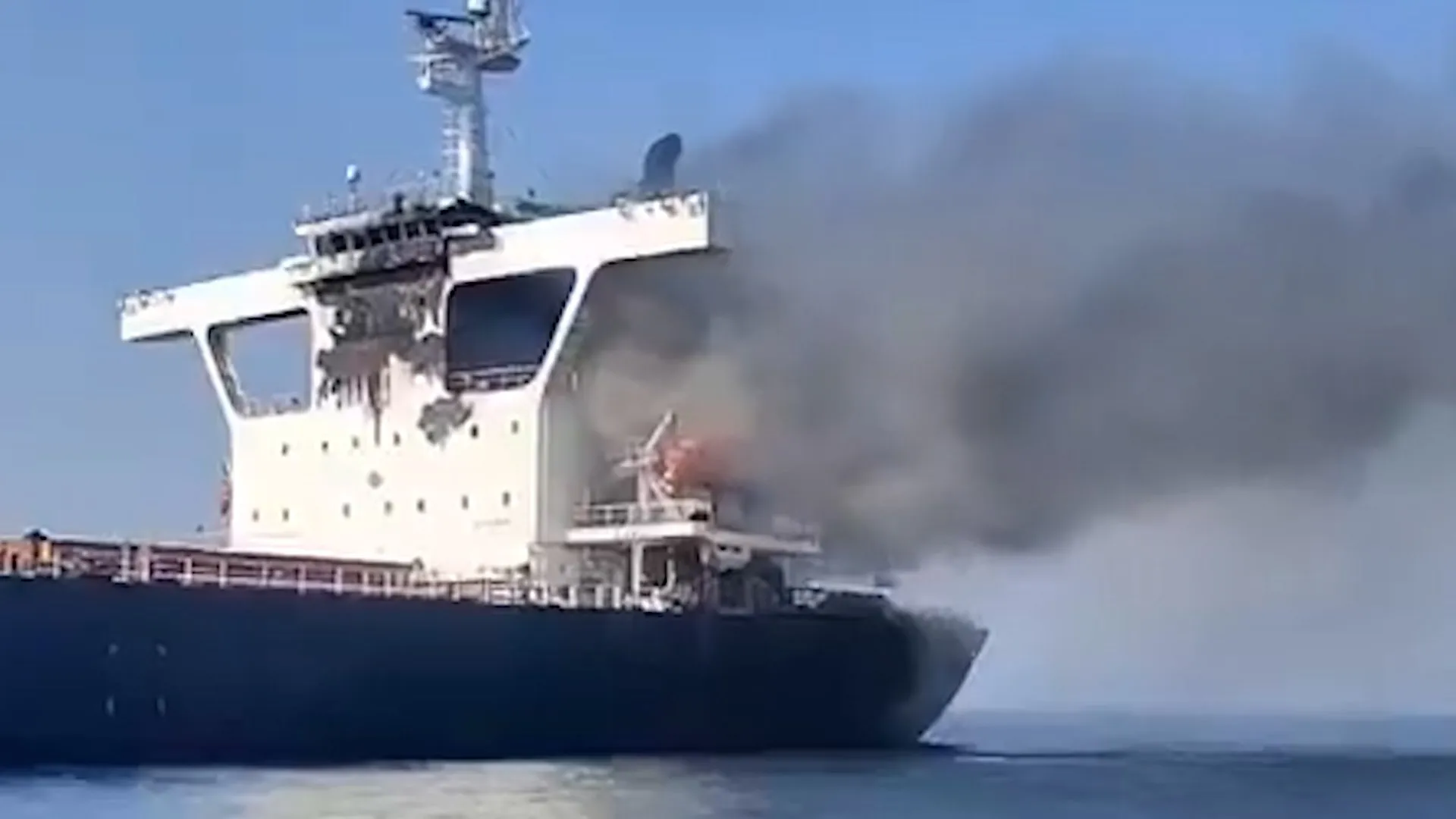
A crew member was killed in an attack on an Indian cargo vessel off the coast of Oman. MV Cape Dao was heading to India when it was struck twice by a projectile, setting the vessel on fire.
A new drone collaboration by Cessna owner Textron and autonomy provider Merlin Labs aims to offer the U.S. military a hot production line and a familiar platform for uncrewed aerial logistics, including in contested environments.
The product is SkyCourier UX, a drone version of the Cessna 408 SkyCourier that has flown for FedEx, foreign special operations forces and small remote commercial airlines during its six years of active service. TWZ previously covered how the SkyCourier would likely end up taking on military applications when it was first announced, which you can read here.
Introducing SkyCourier UX
A partial full-size model on the show floor at the Air & Space Forces Association’s Air, Space & Cyber Conference in Washington, D.C., this week showed a nose that opened with hydraulics to a cargo bay in lieu of a cockpit. We have seen this same front door conversion concept for uncrewed cargo-carrying helicopters as of late. This allows for easy loading of outsized cargoes without specialized equipment, according to the company, though it does not increase the payload. Like the original SkyCourier, it’s good for about 6,000 pounds, or three standard containers.
(Hope Hodge Seck)
The form factor of the uncrewed SkyCourier variant is otherwise identical to its crewed counterpart, with twin turboprops, a high-wing configuration and an aluminum body.
As with the base SkyCourier, a major advantage of the aircraft is its optimization for loading and carrying standard pallets. This means that cargoes don’t necessarily have to be downloaded, broken up and repackaged for movement to forward positions. This is a big logistical advantage and can speed the flow of critical supplies to where they are needed most.
The aircraft’s range is about 900 nautical miles, which the makers say suits it well for Pacific island-hopping, allowing for refueling stops on austere runways. It can take off on runways as short as 3,300 feet and land in just 2,500 feet, according to a spec sheet.
SkyCourier can hold three standard LD3 pallets. (Textron)
The Textron/Merlin collaboration aims to differentiate itself with proven capability in the missions it intends to fulfill, along with the ability to roll out a new drone variant fast and one it can sustain consistently. Bob Gibbs, Textron’s vice president of special missions sales, told reporters in a Monday briefing that the conventional SkyCourier was now fulfilling new orders, not previously announced, to deliver modified aircraft to foreign nations for medical evacuation, casualty evacuation and environmental protection.
“The aircraft’s being operated literally from the Arctic to the Amazon,” Gibbs said. “There are three different island nations in the Pacific that have airline fleets of them. We support our aircraft in 170 countries around the world. So, just like a Cessna Caravan or a Beechcraft King Air, they’re ubiquitous. You find them anywhere, and we support them anywhere in the world.”
The $7 Million Flying Box: Inside the Cessna SkyCourier
While the 900-mile range can’t take the loaded-up aircraft the nearly 2,000-mile stretch between the first and second island chains, Merlin and Textron executives said they don’t need to accomplish that to make it effective.
“This is the ability to disperse the forces among the second island chain … to do the island-hopping to be able to get to, whether it’s Palau, Tinian, Saipan, pick your various islands there,” Kyle Kremer, a retired Air Force major general who now advises Merlin, said. “With the range that it has, it has the ability to agilely move through there” and connect logistics pipelines.
SkyCouriers are flying all over the world, including in some very harsh environments. (Textron)
The autonomy package, Merlin Pilot, is already in use under a $105 million U.S. Special Operations Command contract to develop autonomy for the C-130J Super Hercules transport aircraft. It’s been flown aboard four different single and multi-engine airframes, the company says. A promotional web page for Merlin Pilot shows tanker-class and commercial cargo applications with developing and future capabilities.
Merlin has also teamed with the Air Force to develop an AI copilot for KC-135 tankers that can decrease crew workload and even possibly fly the aircraft on its own in the future. TWZ reported on planned tests for these autonomy-enabled tankers in 2024, with the flights set to begin the following year.
However, the Air Force has not confirmed the completion of any flight tests for the effort since. And on Wednesday, Lt. Gen. Daniel Tulley, commander of Air Force Mobility Command, appeared to confirm that the tests had never taken place.
“There’s some companies out there who have offered to develop things where they can bring a carry-on kit onto old KC-135s and other aircraft, but we haven’t seen them test those successfully,” he said.
He added that autonomy technology may lack the maturity needed for tanker missions.
“An optionally manned or an unmanned tanker at range, [at] the ranges we needed to operate at. It’s a very large aircraft, and we’re not yet to where we’re employing fully autonomous large aircraft. But the technology, I would say, is there and rapidly getting there,” he said.
Tulley did stress that the Air Force saw a need for unmanned aircraft in the last-tactical-leg delivery.
“I’m wrestling with that as we develop an AMC strategy,” he said. “There is absolutely room for some sort of autonomous or other small light lift capability, and that’s just one domain in the air, right? This could be by sea, could be by land, but there is absolutely some requirement for distribution from those major points of debarkation.”
In addition to autonomous takeoff, landing and navigation, and protection of the flight envelope, Merlin Pilot, the company says, has digital copilot human-machine teaming characteristics that include pilot health monitoring, gaze tracking and fatigue detection; pilot incapacitation and contingency response; and flight monitoring and assistance.
A military variant concept of the SkyCourier. (Textron)
Some of Textron’s new features are making light steps toward autonomy already. Gibbs pointed out that the company’s Cessna Citation Gen3 business jets now include standard Garmin auto-land technology.
“Obviously, it’s a different scale than what Merlin’s doing as far as automation,” he said. “But … as we develop new products, we try to future-proof them, and so that’s where you get this nice transition between us.”
The SkyCourier can cost up to $8.5 million, depending on modifications, and while the SkyCourier UX sports GPS-denied navigation and the ability to seek different flight paths to avoid danger, it doesn’t have other built-in defenses. For contested logistics missions, it’s not clear how much risk the services are willing to tolerate for a relatively small logistics payload capability. Kremer maintained, though, that a drone of this size could be a mission-saving capability when dispatched to austere locations. And, in a Pacific conflict, it may reduce demand on already-stretched C-130 transports, now the smallest platform capable of carrying standard containers and long overtasked.
A U.S. Military C-130 prepares for takeoff at Pohakuloa Training Grounds, Hawaii, Oct 28, 2022. (U.S. Army photo by Pfc. Wyatt Moore / 28th Public Affairs Detachment) Spc. Wyatt Moore
“If you can’t get the spare tire, if you can’t get the component, that small thing where you need it in these dispersed operations, they don’t keep the big logistic supply chain built up in these locations,” Kremer said. “You have to be able to get it where you need it, when you need it, and that’s what this provides.”
Nonetheless, the Air Force has a clear appetite for a capability like this. Last year, it signed a $17.5 million contract to put a Reliable Robotics autonomy package on a Cessna 208B Caravan.
On Monday, Air Force Chief of Staff Gen. Ken Wilsbach reiterated the Air Force’s interest in unmanned aerial logistics platforms.
“We’re doing testing on them,” he said in response to an audience question. “We believe that there’s some value in that as well. It certainly could be valuable in the Pacific with the ranges that we’re talking about, and so we’re looking at several different options and evaluating them. But I would say nothing, no program of records just yet, but [we’re] certainly taking a look at some demonstrators and the like to see what’s available to us.”
Notably, China has made significant advancements in developing logistic drone capabilities, with reported successful flight tests of massive heavy-lift uncrewed aircraft, including a 7-ton cargo plane that’s currently the world’s largest uncrewed freighter to take flight. Among them is China’s CH-YH1000, a medium-altitude cargo drone developed by the China Academy of Aerospace Aerodynamics that boasts, like SkyCourier UX, a hatch in lieu of a cockpit for ease of flat-pallet loading up to a weight of 1.2 tons. These are just some of an increasing number of similar systems being developed in China that aim to take the crew out of lower-end logistical missions over short, medium and long distances.
China’s big CY-8 uncrewed logistics aircraft undergoing testing. (Chinese Internet)
Though Textron and Merlin have yet to build a SkyCourier UX prototype, Merlin CEO Matt George emphasized that the company had chosen to partner with Textron because they could start delivering aircraft fast.
“You’ll see over the course of the show a lot of concept aircraft. You’ll see a lot of renders. You’ll see a lot of people who have big empty factories all around the country,” he said. “But I also want to be very clear about the fact that none of this matters without production … There’s 14,000 Americans working in Wichita, Kansas, on a production line where these aircraft, at least in the crewed configuration, are coming off the production line. So when we talk about capability, we’re talking about that capability and bringing that capability to bear soon, rather than in the future.”
Next in the development process, executives say, will be an optionally piloted version of SkyCourier that will allow users to develop comfort with the platform and open the door to further iteration.
The Textron/Merlin team is also leaving its options open in terms of which U.S. military customer might find its platform most useful.
“I hope [the Army and Air Force] fight over it,” Gibbs said.
Last week, Miami authorities identified the five people who died as Rolando Aleman Leon, 55; Yoel Rodriguez Naranjo, 53; Julio C Pineda, 75; Carlos Acosta Fajardo, 53; and Javierkys Reyes Quevedo, 47.
Five others were also injured.
“Our deepest condolences are with the families and loved ones of those who lost their lives,” 21 Air chief executive Keith Winters previously said.
“Our immediate priorities are supporting those affected, assisting the appropriate authorities, and ensuring that accurate and verified information is communicated as it becomes available,” he added.
NTSB chairwoman Jennifer Homendy called the crash site a scene of “utter devastation”.
The safety board’s investigators have recovered the flight recorders to analyse the conditions leading up to the crash.
Investigators released details that a pilot onboard the cargo plane noted that it was going too fast before it overshot the runway, the NTSB said in the early stages of investigation.
It said that one of the pilots warned the other pilot multiple times about “the aircraft’s excessive speed” but noted “there was not a consistent verbal response”, even as an altitude alarm sounded.
There were other electronic warnings designed to alert the pilots to danger while landing, investigators reported.
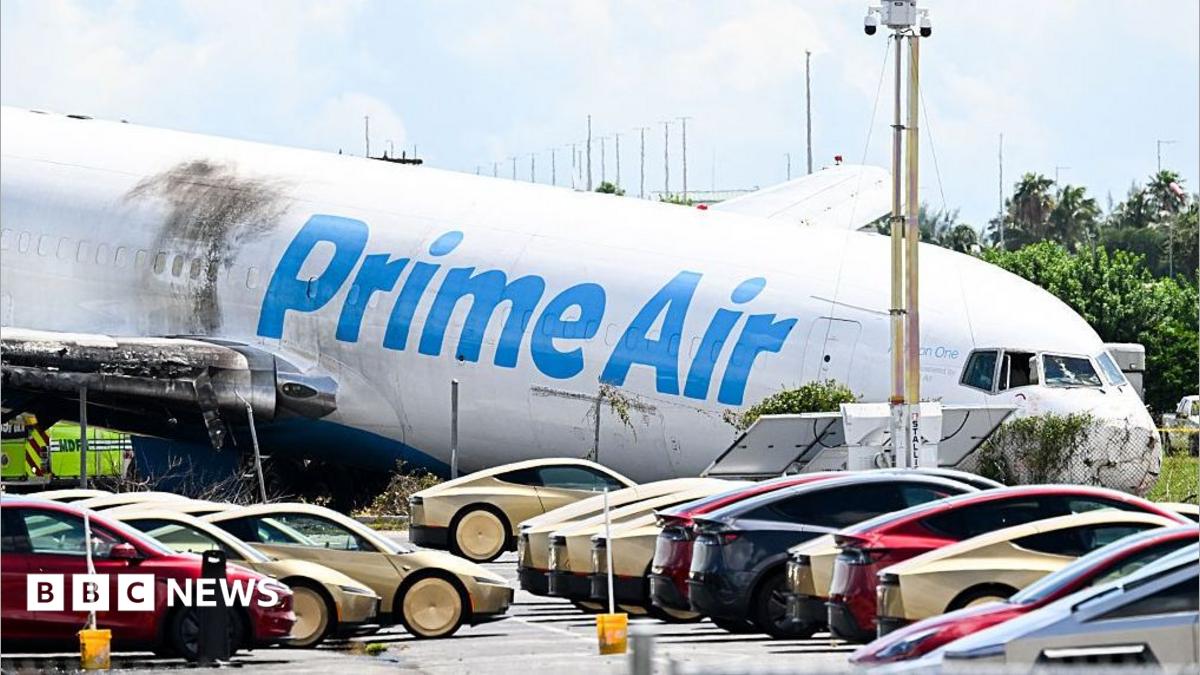
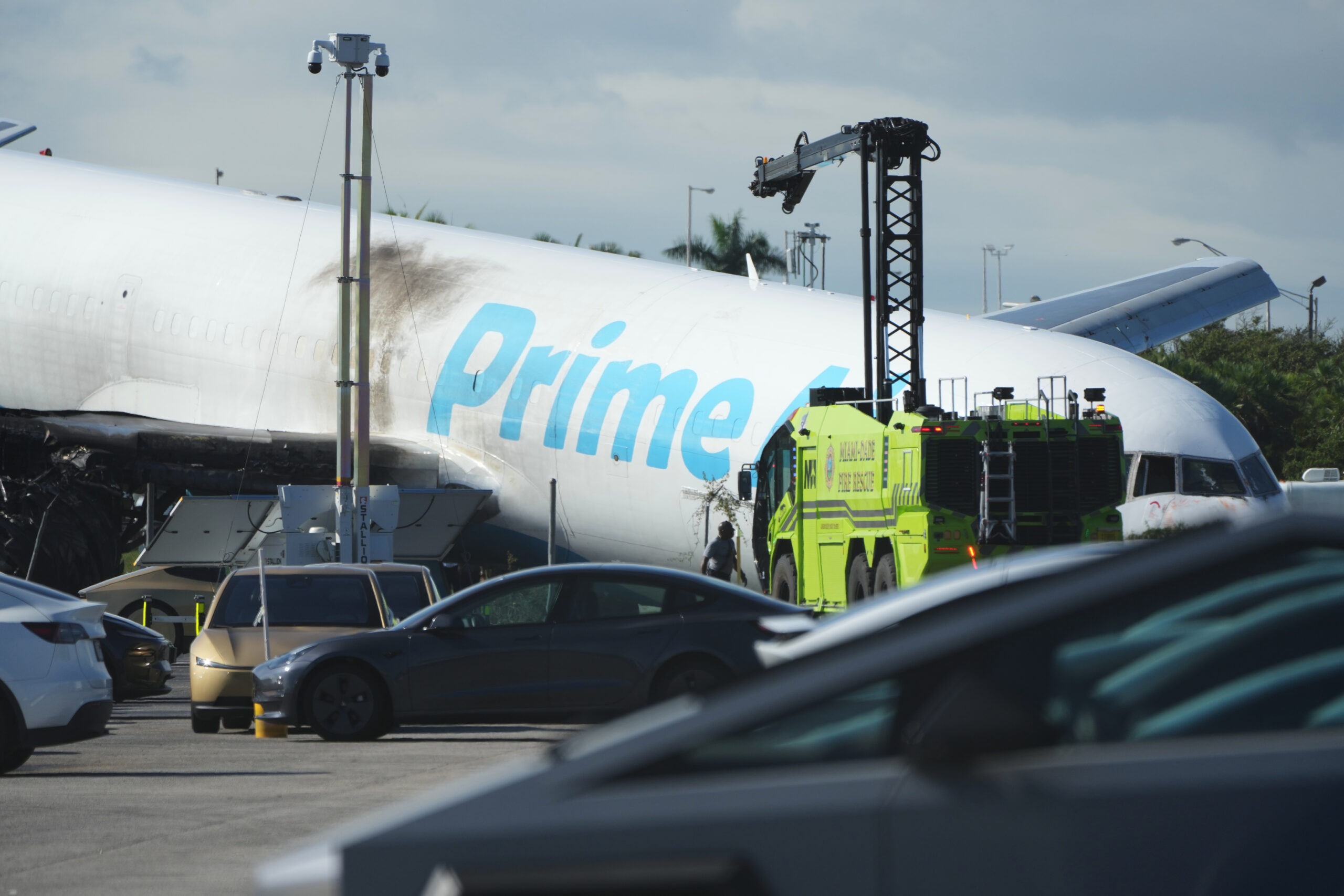
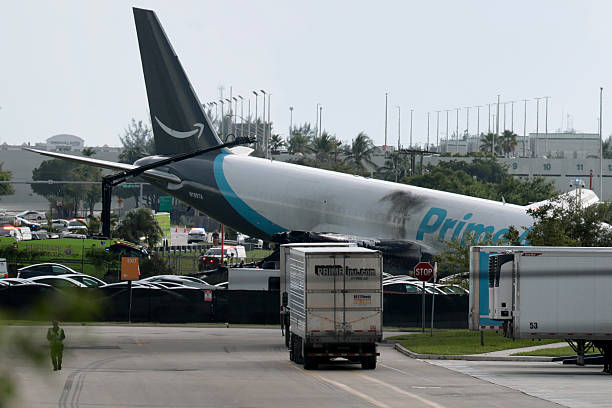
Miami: The two pilots of an Amazon cargo plane that overran the runway while landing at Miami International Airport, striking a van and killing five people, have been released from hospital, officials said Tuesday.
Three people are in hospital, two in critical condition and one stable, following Sunday’s accident, Miami-Dade Sheriff Rosie Cordero-Stutz said at a news conference.
Cordero-Stutz said the National Transportation Safety Board (NTSB) was leading the investigation into the accident while the Miami-Dade Sheriff’s Office would conduct its own inquiry into the deaths on the ground.
NTSB chief Jennifer Homendy said officials were reviewing flight data and cockpit voice recorders from the plane.
Flight data released by investigators on Tuesday suggests the plane tried to abort a landing, before it tore through a perimeter fence and slammed into two vehicles.
NTSB investigator Chihoon Shin said the plane attempted to perform a “go-around” — a routine safety maneuver where a pilot stops a landing attempt and returns to the air to safely make another approach — before abandoning it.
The pilots then applied the brakes to try to stop the plane and put the throttle into idle, Shin said.
Homendy said the plane’s pilot and co-pilot, aged 55 and 37, would be interviewed on Wednesday.
The plane came to a halt about 1,300 feet (400 meters) past the end of the paved runway surface, Homendy said. The five fatalities were in a cleaning-services van.
Hundreds of flights were delayed at Florida’s busiest airport following the crash.
Homendy said the plane was a Boeing 767-300 built in 1994 and operated by 21 Air LLC, based in Miami and contracted to Amazon.
It was on its third flight of the day, and arriving from San Juan, Puerto Rico.
At least five people were killed and five others injured Sunday when an Amazon Air (AMZN) cargo plane overran a runway at Miami International Airport, struck several vehicles and caught fire, officials said.
A cargo plane for the retail company Amazon has crashed in the United States after overrunning its runway while landing at Miami International Airport, disrupting one of the country’s busiest airports.
In a post on social media, the US Federal Aviation Administration (FAA) said a Boeing 767-300 aircraft overran the runway at 2pm ET (6pm GMT) upon arriving from San Juan, Puerto Rico.
Recommended Stories
list of 3 itemsend of list
Miami-Dade Fire Rescue said “multiple vehicles” were struck by the plane, which caught on fire after it crashed. The department said it was working to extinguish the blaze and is assessing the status of people affected by the crash.
It’s not clear how many crew members or passengers were on board the plane. No details regarding potential injuries or fatalities were provided.
An Amazon spokesperson said the plane was operated by 21 Air and experienced “an incident” while attempting to land.
“We’re working closely with local authorities and officials to understand exactly what happened,” Amazon spokesperson Kelly Nantel said. “Right now, our absolute priority is the safety, wellbeing, and care of everyone involved. We’re doing everything we can to support those affected.”
Videos circulating online show black smoke billowing from the scene near the runway. Early reports indicated that the aircraft veered off the runway and crossed a road near the airport.
The US National Transportation Safety Board (NTSB), which investigates major transportation-related accidents, confirmed that it was aware of the crash and would provide additional updates as more information became available.
US Department of Transportation Secretary Sean Duffy said his agency had issued a full ground stop in Miami after the incident, urging travellers to anticipate “significant delays”.
The cause of the incident is unknown. The FAA said it is investigating.
Search and rescue operations under way as authorities lose contact with 10 crew members after a vessel collision near Istanbul.
Published On 2 Sep 20262 Sep 2026
Turkiye’s coastguard has launched a search and rescue operation after two Turkish-flagged commercial vessels collided off Istanbul and contact was lost with one vessel and its crew of 10.
The collision took place at 3am (00:00 GMT) in the Marmara Sea a little more than 20 miles (32 kilometres) south of Silivri, a suburb of Turkey’s largest city, the Istanbul governor’s office said in a statement on Wednesday.
Recommended Stories
list of 2 itemsend of list
Contact was lost with the crew of the Tugberk Imamoglu, flagged to Turkey, after the collision with the Turkish-flagged Alsu, which appeared undamaged, the governor’s office said.
“Numerous naval units from the coast guard’s Marmara and Bosphorus Command and a coast guard helicopter were dispatched to the scene,” the office said.
Germany has now formally accused Russia of directing an attempted explosive-drone attack against Ukrainian cargo aircraft at Leipzig/Halle Airport, a story we previously reported on. At the same time, authorities are separately investigating a sophisticated sabotage attack against a critical power-grid node in Brandenburg, underscoring Germany’s growing concern over hybrid threats to its critical infrastructure.
The two incidents, occurring against the backdrop of growing German and European warnings about Russian hybrid warfare, underscore the expanding range of vulnerabilities facing critical infrastructure across the country.
We now know that Russia is responsible for the attempted explosive attack at Leipzig airport. Russia’s repeated hybrid attacks on Germany and Europe are unacceptable. (1/4) pic.twitter.com/o3vBjgpeb1
German Interior Minister Alexander Dobrindt and Foreign Minister Johann Wadephul said Tuesday that the Russian state had apparently provided the equipment and technical know-how for the Leipzig operation, with locally recruited “low-level agents” allegedly tasked with carrying it out.
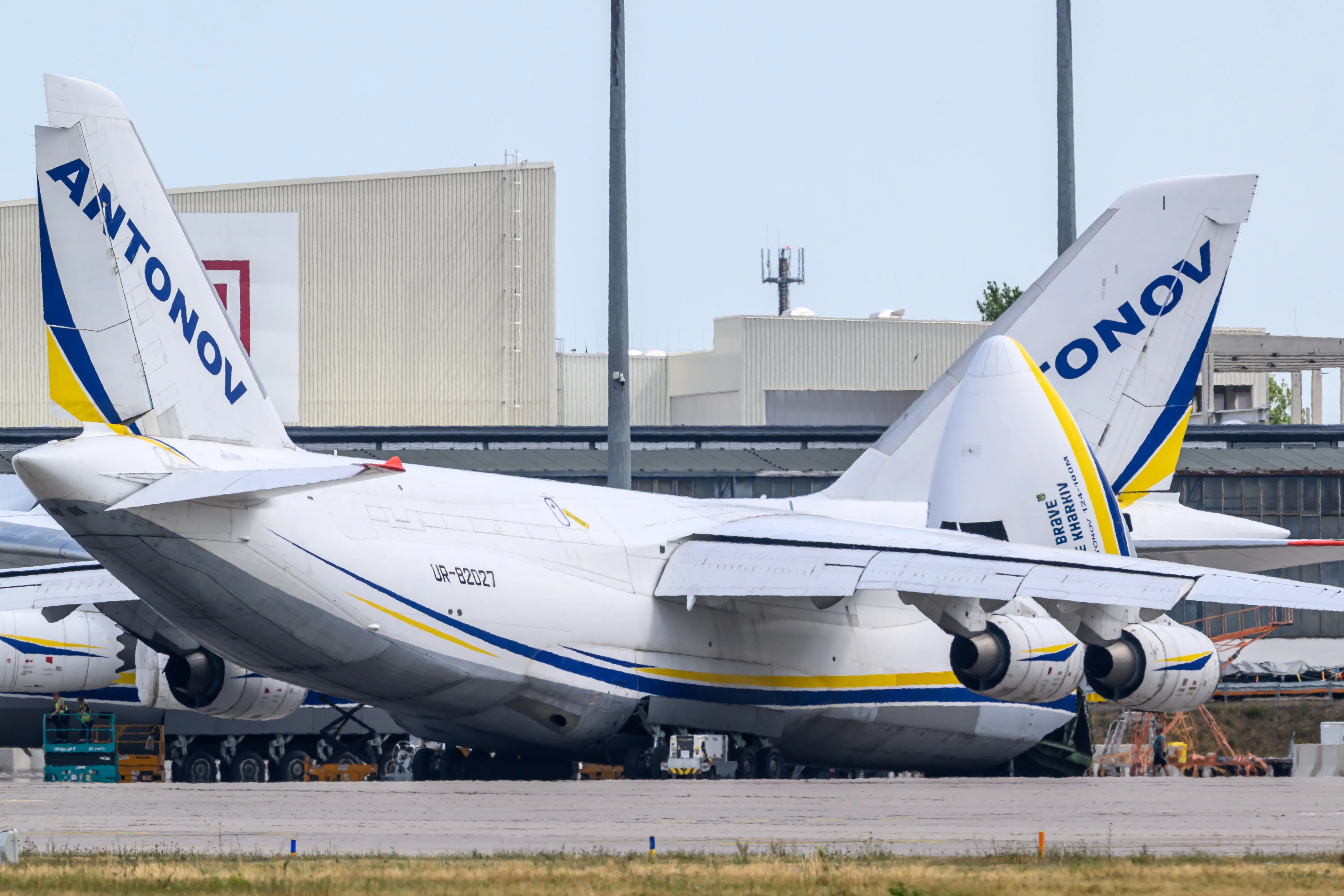
The drone, discovered inside the secured area of Leipzig/Halle Airport during the night of August 4-5, was carrying approximately 1.3 pounds of explosives and was found close to a Ukrainian-operated Antonov An-124 heavy cargo aircraft used to transport weapons to Ukraine.
New footage of yet another act of Russian terrorism on EU soil, showing the drone loaded with explosives on the tarmac at Leipzig/Halle Airport, just meters from a Ukrainian Antonov An-124 cargo aircraft.
— SPRAVDI — Stratcom Centre (@StratcomCentre) August 5, 2026
The detonator on the device apparently failed, preventing what German officials said could have been a catastrophe.
The incident appears to have combined several characteristics of the emerging European hybrid threat: a relatively inexpensive drone, military-grade explosives, a strategically significant target, and the alleged use of local operatives to provide distance between the attack and its suspected state sponsor.
As we discussed at the time, the choice of target at Leipzig/Halle is particularly significant. The airport is an important cargo hub, and Ukrainian Antonov aircraft operating there have been used to move weapons to Ukraine. At the very least, an explosive device detonating near one of those aircraft could have disrupted a logistics link supporting Kyiv while simultaneously creating a major aviation safety incident.
Ukrainian An-124 aircraft were serviced at Leipzig/Halle Airport last month. Photo by Hendrik Schmidt/picture alliance via Getty Images
A successful attack on one of Antonov’s cargo aircraft could have caused casualties, damaged or even destroyed the aircraft, and disrupted airport operations. The presence of explosive material inside a secured airport area also demonstrates the potential for covert actors to penetrate or exploit security around critical aviation infrastructure. But above all else, the loss of an Antonov Airlines An-124 would have been highly symbolic as the huge aircraft are a global symbol of Ukraine and its resilience.
Investigators later found traces of hexogen, or RDX, a military explosive near the airport on August 14, together with another drone.
A police investigator works on the tarmac with a robot capable of defusing explosives near a Ukrainian An-124 cargo plane at Leipzig/Halle Airport on August 5, 2026. Photo by Jens Schlueter/Getty Images
Authorities initially believed the second drone could have been part of the planned attack, although investigators have since expressed doubts about that assessment. Nevertheless, German officials now say there is sufficient evidence to attribute the attempted operation to Russia, an accusation that Moscow rejects.
The Leipzig incident was not the only major security concern confronting Germany on Tuesday.
In the eastern state of Brandenburg, authorities said the power grid was deliberately targeted with specially prepared incendiary devices and rockets carrying conductive material. The attack targeted the Turnow-Preilack substation, a critical high-voltage node connecting the Jänschwalde power plant to the 50Hertz transmission network.
Police officers are standing in front of a barrier at the substation in Turnow-Preilack. A high-voltage power line can be seen in the background. Photo by Markus Lenhardt/picture alliance via Getty Images
According to Brandenburg Interior Minister Jan Redmann, rockets carrying conductive material were fired into extra-high-voltage transmission lines, producing two short circuits. Authorities recovered more than a dozen devices at the site, with the number still increasing as the search continued. Redmann said the design and deployment of the devices required substantial preparation.
The attack caused a brief power interruption, but 50Hertz said all affected lines had returned to operation and that the general electricity supply was never disrupted.
At the Jänschwalde power plant, the incident triggered an automatic shutdown of one generating unit. The unit was expected to return to service Tuesday evening.
A substation and Germany’s Jänschwalde coal-fired power plant were attacked today, knocking a generating unit offline.
Local authorities report that the attackers launched rockets carrying payloads of “conductive material,” causing short circuits. pic.twitter.com/dxPNmi2i9W
While the physical damage was limited, the nature of the attack is likely to attract significant attention from German security officials. Unlike Leipzig, German authorities are not currently attributing the Brandenburg sabotage to Russia. Redmann said authorities could not rule out the involvement of a foreign power, while also declining to exclude domestic extremist or activist groups. Left-wing activists have previously attacked German electricity infrastructure.
But the incident demonstrates the same underlying vulnerability Berlin is increasingly concerned about. In an age of hybrid warfare, relatively small-scale acts of sabotage exploiting weaknesses in infrastructure can have outsized consequences. Redmann described Germany’s critical infrastructure as excessively vulnerable.
“When it comes to our critical infrastructure, we in Germany are far too vulnerable,” he said, adding that the vulnerability extended to airports.
View of the power plant units at the Jänschwalde power plant. Unconventional explosive devices were found at the substation today. Photo by Markus Lenhardt/picture alliance via Getty Images
Taken together, the incidents illustrate the breadth of the threat German officials are attempting to address.
Germany’s assessment of the Leipzig operation also points to an increasingly familiar model of suspected Russian covert activity. German officials say Russian state actors supplied the expertise and equipment but relied on local agents to conduct the physical operation. That type of operation could provide Moscow with additional deniability while allowing sabotage to be conducted by individuals already inside the target country. It also complicates the security challenge for European governments.
German intelligence sources cited by German media have reportedly identified possible links between drone, explosive, and weapons incidents in Germany and other European countries, including Bulgaria, Italy, Poland, Romania, and the United Kingdom. Investigators are understood to be examining the incidents in parallel.
If those links are confirmed, the Leipzig operation could represent one element of a broader campaign involving recruited personnel, explosives, and uncrewed systems operating across multiple European countries. Europe has spent much of the past several years strengthening conventional military deterrence while simultaneously confronting an expanding gray zone of cyberattacks, espionage, sabotage, and influence operations. Critical infrastructure is an especially attractive target in that environment. Power grids, airports, railways, telecommunications networks, ports, undersea cables, and industrial facilities are typically dispersed, difficult to protect comprehensively, and often interconnected.
Police officers searching for evidence and recording the scene after unknown actors sabotaged a power cable in Gelsenkirchen, North Rhine-Westphalia, in April 2026. Photo by Christoph Reichwein/picture alliance via Getty Images
An attacker does not necessarily need to destroy infrastructure to achieve an effect. A temporary shutdown, disruption to logistics or forced security response can itself create economic and operational costs, and help generate a climate of fear and mistrust. This has already been seen in the mass drone incursions over sensitive locations across NATO countries, and especially in Germany.
There has been a growing acknowledgement of a new kind of threat, in which state-backed or state-directed actors could potentially use inexpensive systems, local recruits, and covert methods to create disruption without crossing the threshold of an overt military attack, for years now. Germany is now preparing measures aimed at increasing the costs of executing these kinds of operations for Moscow. The Russian consulate in Bonn is scheduled to close later this month. Berlin also intends to remove Russian House, a cultural and scientific organization in the German capital that German authorities have associated with alleged Russian intelligence activity.
Berlin is also preparing additional measures against Russia’s so-called shadow fleet, vessels used to transport Russian oil and other commodities while circumventing Western restrictions.
A border security vessel patrols the detained Smyrtos vessel outside the harbour, in Portland, England, in June 2026. The oil tanker was operating as part of Russia’s shadow fleet when it was intercepted by British forces in the English Channel. Photo by Finnbarr Webster/Getty Images
Germany also plans additional sanctions and tighter border controls for Russian nationals entering the country.
At the European level, Berlin is supporting the European Commission’s proposed 22nd sanctions package against Russia, reportedly covering approximately 1,600 additional companies and organizations linked to Russia. Russian Foreign Ministry spokeswoman Maria Zakharova said Russia would respond to what she called Berlin’s “anti-Russian action.”
NATO and EU officials have backed Germany following the Leipzig attribution. NATO Secretary General Mark Rutte said Berlin had presented clear evidence supporting its assessment of Russian involvement. European Commission President Ursula von der Leyen likewise pledged European solidarity.
I just spoke with @Bundeskanzler Friedrich Merz. NATO stands in full solidarity with Germany after the Russian hybrid attack in Leipzig on 4 August.
The evidence is clear. And I welcome the measures announced by Germany in response. NATO will continue to strengthen our ability…
The incidents at Leipzig/Halle Airport and in Brandenburg underscore Germany’s growing concern over hybrid threats to its critical infrastructure. Both demonstrate how an adversary could potentially impose costs on a NATO country while operating below the threshold of open warfare.
Regardless, for Germany and its European allies, the biggest question that needs to be answered may now be how many apparently isolated incidents could actually be pieces of a larger campaign?
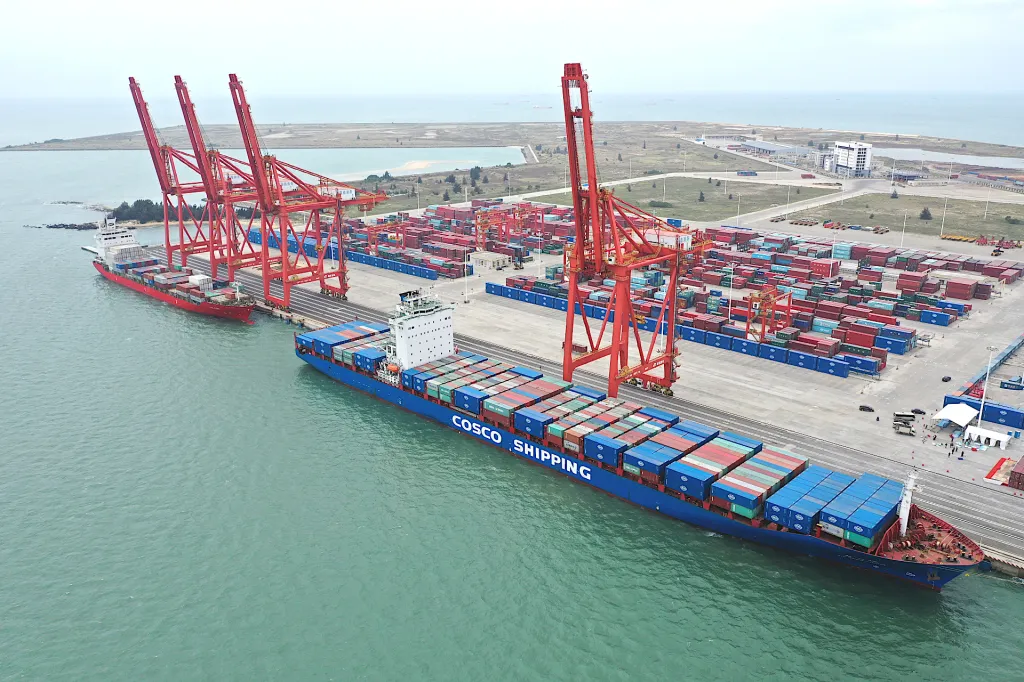
Chinese state-run shipping company COSCO has been using concealed systems on its vessels to gather signals intelligence around North American, European, and Asian coastlines for decades, it has been alleged. Similar claims have been made in the past, and overlap between nominally civilian enterprises in China and the country’s military and intelligence services is well established at this point.
Reuters first reported on the use of COSCO ships as discrete signals intelligence platforms earlier today, citing two unnamed officials within President Donald Trump’s administration.
“The officials, who spoke on condition of anonymity to discuss the U.S. assessment of the Chinese program, said COSCO has a decades-long intelligence-collection partnership with Beijing,” according to the report. “The arrangement allows China to collect communication signals from vessels and aircraft operating across Europe, North America and Asia, they said.”
COSCO container ships in port. COSCO
It is worth noting here that China’s National Intelligence Law, enacted in 2017, includes a specific provision that requires all organizations and citizens within the country to support state intelligence work as required. It also obligates the state to protect entities that do so.
“The advanced equipment aboard the ships is intended to enable China to gather information about ‘military communications technologies and encryption developments,’ one of the officials said,” Reuters‘ story today added. “The officials did not detail the type of equipment COSCO ships were allegedly using, but said they were ‘sophisticated signals intelligence collection’ platforms, not routine communications hardware.”
Officials at the Chinese Embassy in Washington, D.C., unsurprisingly denied these assertions, according to that outlet.
Purpose-built signals intelligence suites can range widely in size and shape, as can their capabilities. They can be very small and basic or far more elaborate systems. Even the latter could be concealed as modern commercial ships, which already feature lots of antennas.
COSCO
What might happen to intelligence collected by the ships is unknown. At the very least, systems onboard could record the data, which could then be batched out when safe to do so, either physically or via transmission. Basic passive signals suites can also run autonomously, or even be controlled from anywhere in the world if the ship is connected via satellite communications (SATCOM). High-bandwidth SATCOM is very common now on ships around the globe.
Personnel on the ship could also operate the systems, and even process receptions of interest. It might be possible to fit the ships with suitable datalinks to then transmit the collected data in near-real-time to other nodes, including ones back in China, for further analysis and exploitation.
Reuters‘ sources said scooping up data on “military communications technologies and encryption developments” was a priority for the commercial vessels turned spy ships. Signals intelligence can take many other forms, from emissions from radars to communications chatter. Depending on what is collected and how, specialists can use that information to glean details about how systems function, as well as insights into standard operating procedures and other details. This is especially true when multiple forms of intelligence are fused together. Generally speaking, signals intelligence is routinely used to help build out so-called ‘electronic orders of battle’ detailing the disposition and capabilities of an opponent’s forces, especially air defense and command and control networks. Fusing multiple forms
As mentioned, this is not the first time claims in this general vein have emerged, either. At least some evidence has been presented in the past, through open-source analysis. Reuters‘ sources directed that outlet to a report published last year by the China Maritime Studies Institute at the U.S. Naval War College exploring exactly this topic in relation to China’s quasi-military maritime militia. The maritime militia is made up of ostensibly civilian fishing fleets, but has direct ties to the People’s Liberation Army (PLA) and the Chinese Coast Guard. It is routinely used to harass and intimidate foreign vessels in disputed waters, especially in the South China Sea.
Chinese fishing vessels seen stopped right in front of US Navy’s ocean surveillance ship USNS Impeccable in 2009. USN
“Undergirding these operations is a cadre of maritime militia intelligence specialists called ‘information personnel.’ Information personnel are organized into force contingents that support operational militia forces,” according to that report. “Most have day jobs in the fishing industry, but many hale [sic; hail] from other sectors, including marine shipping and even maritime law enforcement units.”
“It is more likely than not that PRC [People’s Republic of China] vessels operating overseas have already begun embarking information personnel to serve intelligence collection and reporting functions. In the case of China’s fishing fleet, serving this foreign intelligence collection function could be as simple as adding a new duty to the ‘information personnel’ that already embark aboard some distant-water fishing vessels,” that report added. “Aside from their primary responsibilities of tallying and reporting production numbers, serving as experts on international and national fisheries regulations that affect their work, and handling interactions with foreign officials while at sea and in port, they might also be tasked with collecting and reporting military and political intelligence while operating overseas.”
“Similar processes may already be in place in the commercial shipping industry,” it continued. “For instance, Guangxi province’s Beihai city has built up its ranks of maritime intelligence specialists by recruiting from among marine shipping personnel.”
No explicit mention is made in the report about signals intelligence gathering.
French forces seen boarding the Comoros-flagged tanker Grinch, part of Russia’s so-called ‘shadow fleet,’ in January 2026. French Navy
There is other tangential evidence that also lends credence to today’s report from Reuters. As mentioned, in the midst of still mysterious drone swarms that harassed U.S. Navy ships off the coast of southern California back in 2019, U.S. authorities at least explored the possibility that a Hong Kong-flagged bulk carrier, the M/V Bass Strait, might have been a launch point. It remains unknown, at least publicly, whether the Bass Strait or another nearby ship might have been the source of the harassment, or if it came from somewhere else, potentially further away. TWZ was the first to report on this detail as part of a deeper investigation into these incidents, which came amid a spike in news about claimed sightings of what are now commonly referred to as unidentified aerial phenomena (UAP). We have been saying for years now that, while some UAP sightings do remain unexplained, many more are likely to have been drones (as well as balloons), which foreign governments could be using for intelligence gathering and other malign purposes.
A US Navy briefing slide discussing an interaction with the M/V Bass Strait on July 15, 2019. This says that at least at that time the bulk carrier was assessed to be “likely using UAVs to conduct surveillance on US Naval Forces while transiting to [a] scheduled port of call, [in] Long Beach, CA.” USN via FOIA
It’s also worth noting here that intelligence collection from international waters and airspace is a practice that nation state armed forces and intelligence agencies globally, including those in the United States, engage in regularly with varying degrees of openness. Leveraging nominally civilian ships, as well as aircraft, for these purposes is hardly new.
Despite the official denials to the Reuters piece today, it would be hard to imagine Chinese authorities not making use of commercial ships for this purpose, if possible, given that major deepwater ports worldwide are often dual-purpose civilian/military facilities. Radar sites and other critical facilities are often positioned along or near coastlines. Cargo ships and tankers often pass by major exercises and under major military operating airspace, where they could scoop up critical data.
With commercial ships already plying their routes, this would also just offer the Chinese government ways to readily bolster maritime intelligence-gathering capacity at low cost and low risk. China’s commercial fleets dwarf any other on Earth, making their presence commonplace and providing many opportunities to hide these operations.
Shipyard in Snow
A 2021 report published through the U.S. National Geospatial-Intelligence Agency’s (NGA) Tearline Project also highlighted the possibility of Chinese-owned facilities at ports around the world being used for intelligence gathering or even for launching non-kinetic attacks, including electronic warfare jamming. It specifically noted how COSCO’s facility in Belgium’s Port of Zeebrugge is “in close proximity to a Belgian Naval Base and thus could fulfill additional militarized requirements.”
Reuters‘ piece does not say what, if any, steps U.S. authorities have taken or may be planning to take now to monitor for or take more active countermeasures against Chinese-flagged ships being used for intelligence gathering, despite this being said to be a decades-old practice. The report does note that “the Pentagon put COSCO on its list of companies linked to China’s military in January 2025, a designation that carries serious reputational costs for companies as well as U.S. government procurement bans, but does not entail formal sanctions.”
Though no hard evidence has yet been provided, Chinese authorities using cargo ships as additional discreet signals intelligence-gathering assets is very plausible, and would certainly seem to be an issue that should be taken seriously, if it is not already being addressed.
Somali authorities say 14 pirates were killed in the 10-day operation to free a Cameroon-flagged cargo vessel.
Published On 30 Aug 202630 Aug 2026
Turkish and Somali forces have freed a cargo ship held captive by pirates off the coast of Somalia’s semi-autonomous Puntland state, according to authorities.
In a statement on X on Saturday, the Somali Ministry of Defence said that “14 pirates” died in the operation to free the Cameroon-flagged MV Latuf.
Recommended Stories
list of 3 itemsend of list
Four of their boats were also destroyed, it said.
The Defence Ministry said that “sustained pressure from the forces ultimately compelled the remaining pirates to abandon the vessel”, allowing the forces to take control of the ship.
The rescue operation was conducted under a defence cooperation agreement between Somalia and Turkiye, aimed at strengthening maritime security, protecting Somalia’s coastline and combating piracy, it said.
The Somali Defence Ministry did not provide details about any casualties or the wellbeing of the ship’s crew.
A local elder, Abdullahi Warsame, from the Jiifle community in the Godob Jiraan district of Puntland’s Nugal region, told The Associated Press news agency that the vessel and its crew had been freed.
The MV Latuf left the Turkish Port of Tekirdag in late July. It was hijacked on August 17 in waters off the coast of the Nugal region of Puntland, a semi-autonomous federal state in northeastern Somalia.
According to the Marine Traffic website, the cargo ship has continued its voyage to its reported destination in Dar-es-Salaam in Tanzania.
Piracy was rampant off the coast of Somalia in the 2000s, peaking in 2011, before being curbed by international naval deployments and new protection measures for commercial shipping.
But attacks have surged since April, with at least 15 attacks off the coast of Somalia this year, the highest since 2013, according to figures from the International Maritime Organization. At least five cargo ships have been held hostage, the last of which was seized on August 20 off the coast of Yemen.