'The final indignity' – Families battle to claw back care home cash
Relatives say it has taken months, and in some cases years, to get back money owed by a care home operator.
Source link
Relatives say it has taken months, and in some cases years, to get back money owed by a care home operator.
Source link

WASHINGTON — President Trump is singling out the Los Angeles Homeless Services Authority as a cautionary tale about Democratic mismanagement of publicly funded programs, using it to justify proposed cuts to homeless assistance services across the country.
Trump’s proposed budget for the next fiscal year, released Friday, asks Congress to eliminate the Continuum of Care — a federal program that funds housing and services for homeless Americans — citing concerns about “fraud and corruption” among local agencies that administer it.
The White House points to LAHSA, which manages many homeless services for the city and county, as the example of why the program needs to go.
The agency has faced criticism locally for years for lack of proper oversight and the county is in the process of transitioning programs to an internal department.
“LAHSA has an abysmal record of reducing what is the highest number of street homeless individuals in the United States, and an independent audit issued in March 2025 found that the authority failed to accurately track billions of Federal and local dollars,” the budget says.
The local agency pushed back in a statement after the budget was released.
“Cutting this funding or destabilizing the Continuum of Care program would directly result in more tents on our streets, not fewer,” said Gita O’Neill, the agency’s interim chief executive, adding that under its leadership unsheltered homelessness in Los Angeles has fallen 15% and that 90% of the program’s funding goes “directly to rental assistance.”
Local officials are already grappling with homeless service cuts at the state and county level given budget constraints and LAHSA warned Trump’s proposal would make matters worse.
“If anything, we need additional funding to cover rising costs, not fewer, to maintain our current momentum,” the agency said Friday.
The funding dispute over homelessness services is one front in a broader budget assault on California programs by the Trump administration.
Trump’s proposal also asks Congress to eliminate millions in funding from state initiatives the White House is characterizing as wasteful, ineffective or “woke.”
The cuts, if enacted, would cancel $4 billion in unspent funding for the state’s high-speed rail project, which the White house called a “boondoggle,” and strip grants from the Fair Housing Advocates of Northern California, which the budget criticized for “actively working to dismantle systems of power and privilege that favor whiteness.”
Smaller items are also targeted on the White House’s chopping block: a Los Angeles gelato festival, a dance building in Santa Cruz — which the White House dubs “one of the richest cities in the nation” — and a $3-million grant for a playground tied to an unspecified performing arts center in California.
Trump’s proposed cuts to California projects are part of a broader effort by the Trump administration to reshape federal spending priorities, largely by trading social programs for a massive military buildup.
The president is asking Congress to approve $1.5 trillion for defense and to slash $73 billion from domestic programs, a massive restructuring that would leave states, including California, to absorb costs Washington no longer wants to carry.
Trump made that vision explicit at a private Easter lunch at the White House on Wednesday, telling guests that the federal government should no longer be responsible for funding social programs that many Americans rely on.
“We can’t take care of daycare. We are a big country,” Trump said. “We are fighting wars. We can’t take care of daycare.”
If states want to offer those services, Trump said, they should raise taxes to pay for them.
“Medicaid, Medicare, all these individual things, they can do it on a state basis,” he said. “We have to take care of one thing: military protection.”
His proposed budget reflects that priority, which lawmakers will need to contend with as they grapple with the mounting costs of the Iran war and an economic fallout from a military operation that has left Americans paying more items, including gas pump.
Under the proposed budget, Trump is also seeking to make some investments in California projects.
The White House, for example, is seeking $152 million from Congress to turn Alcatraz back into a maximum-security prison, an idea the president has talked about for several years.
He also called on Congress to establish a National Center for Warrior Independence at the West Los Angeles VA Medical Center.
Times staff writer Andrew Khouri, in Los Angeles, contributed to this report.
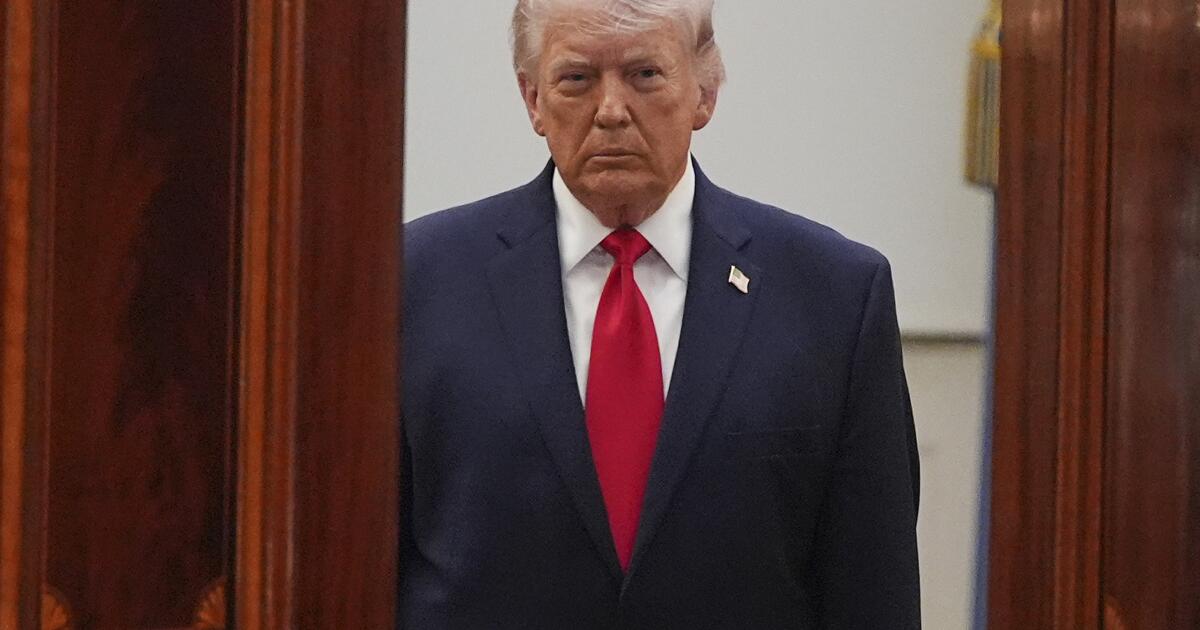
WASHINGTON — President Trump has proposed boosting defense spending to $1.5 trillion in his 2027 budget released Friday, the largest such request in decades, reflecting his emphasis on U.S. military investments over domestic programs.
The sizable increase for the Pentagon had been telegraphed by the Republican president even before the the U.S.-led war against Iran. The president’s plan would also reduce spending on non-defense programs by 10% by shifting some responsibilities to state and local governments.
“President Trump is committed to rebuilding our military to secure peace through strength,” the budget said.
The president’s annual budget is considered a reflection of the administration’s values and does not carry the force of law. The massive document typically highlights an administration’s priorities, but Congress, which handles federal spending issues, is free to reject it and often does.
This year’s White House document, prepared by Budget Director Russ Vought, is intended to provide a road map from the president to Congress as lawmakers build their own budgets and annual appropriations bills to keep the government funded. Vought spoke to House GOP lawmakers on a private call Thursday.
Trump, speaking ahead of an address to the nation this week about the Iran war, signaled the military is his priority, setting up a clash ahead in Congress.
“We’re fighting wars. We can’t take care of day care,” Trump said at a private White House event Wednesday.
“It’s not possible for us to take care of day care, Medicaid, Medicare — all these individual things,” he said. “They can do it on a state basis. You can’t do it on a federal.”
Among the budget priorities the White House called for:
-Supporting the Trump administration’s immigration enforcement and deportation operations by eliminating refugee resettlement aid programs, maintaining Immigration and Customs Enforcement funds at current year levels and drawing on last’s year’s increases for the Department of Homeland Security funds to continue opening detention facilities, including 100,000 beds for adults and 30,000 for families.
— A 13% increase in funding for the Department of Justice, which the White House said would be focused on violent criminals.
— A $10 billion fund within the National Park Service for beautification projects in Washington, D.C..
— A $481 million increase in funding to enhance aviation safety and support an air traffic controller hiring surge.
With the nation running nearly $2 trillion annual deficits and the debt swelling past $39 trillion, the federal balance sheets have long been operating in the red.
About two-thirds of the nation’s estimated $7 trillion in annual spending covers the Medicare and Medicaid health care programs, as well as Social Security income, which are essentially growing — along with an aging population — on autopilot.
The rest of the annual budget has typically been more evenly split between defense and domestic accounts, nearly $1 trillion each, which is where much of the debate in Congress takes place.
The GOP’s big tax breaks bill that Trump signed into law last year boosted his priorities beyond the budget process — with at least $150 billion for the Pentagon over the next several years, and $170 billion for Trump’s immigration and deportation operations at the Department of Homeland Security.
The administration is counting on its allies in the Republican-led Congress to again push the president’s priorities, particularly the Defense Department spending, through its own budget process, as it was able to do last year.
It suggests $1.1 trillion for defense would come through the regular appropriations process, which typically requires support from both parties for approval, while $350 billion would come through the budget reconciliation process that Republicans can accomplish on their own, through party-line majority votes.
The president’s budget arrives as the House and Senate remain tangled over current-year spending and stalemated over DHS funding, with Democrats demanding changes to Trump’s immigration enforcement regime that Republicans are unwilling to accept.
Trump announced Thursday he would sign an executive order to pay all DHS workers who have gone without paychecks during the record-long partial government shutdown that has reached 49 days. The Republican leadership in Congress reached an agreement this week on a path forward to fund the department, but lawmakers are away on spring break and have not yet voted on any new legislation.
Last year, in the president’s first budget since returning to the White House, Trump sought to fulfill his promise to vastly reduce the size and scope of the federal government, reflecting the efforts of billionaire Elon Musk’s Department of Government Efficiency.
As DOGE slashed through federal offices and Vought sought to claw back funds, Congress did not always agree.
For example, Trump sought a roughly one-fifth decrease in non-defense spending for the current budget year ending Sept. 30, but Congress kept such spending relatively flat.
Some of the programs that Trump tried to eliminate entirely, such as assisting families with their energy costs, got a slight uptick in funding. Others got flat funding, such as the Community Development Block Grants that states and local communities use to fund an array of projects intended mostly to help low-income communities through new parks, sewer systems and affordable housing.
Lawmakers have also focused on ensuring the administration spends federal dollars as directed by Congress. This year’s spending bills contained what Sen. Patty Murray, the ranking Democratic member of the Senate Appropriations Committee, described as “hundreds upon hundreds of specific funding levels and directives” that the administration is required to follow.
Mascaro and Freking write for the Associated Press. AP reporter Bill Barrow in Atlanta contributed to this report.
Some employees called it the “dash for cash.”
Months after Kaiser Permanente doctors saw a patient, federal prosecutors said, administrators pushed the physicians to add new, false diagnoses to the medical record in a billion-dollar scheme to defraud the government. Kaiser in February paid $556 million to settle the allegations.
“Deliberately inflating diagnosis codes to boost profits is a serious violation of public trust,” said Scott Lambert, acting deputy inspector general for the U.S. Department of Health and Human Services.
Kaiser faced further scrutiny a month later when the nonprofit healthcare giant paid $30 million to settle another case brought by federal investigators, this one involving claims it had failed for years to provide patients with adequate access to mental health care.
Kaiser said it settled the fraud case without admitting wrongdoing. It said the mental health settlement did not involve its current practices.
Yet critics have pointed to the repeated legal payouts, saying they reflect how Kaiser has veered from its charitable mission in recent years and is now virtually indistinguishable from its for-profit competitors keenly focused on the bottom line.
That shift has also fueled recent tensions with its employees, who have complained about inadequate resources to address staffing shortages and patient delays.
“Their focus is on profit and in doing more with less,” said Kadi Gonzalez, a nurse who works in Kaiser’s obstetrics and gynecology clinic in Downey. Gonzalez was one of more than 30,000 nurses and other Kaiser professionals who walked out in a four-week strike that ended last month.
The unions said their strike was as much about staffing levels and patient safety as it was about wages.
“The more patients a nurse has, the higher the mortality rate,” Gonzalez said. “We don’t have enough providers.”
The Oakland-based giant insures almost 1 of every 4 Californians. It operates as both an insurer and a provider of care in a closed system that makes it difficult for patients to get treatment elsewhere.

Kaiser declined to make its executives available for comment, but issued a statement disputing the claims.
“Our charitable purpose guides every decision we make,” the statement said. “Driven by our mission, we offer better care and coverage to our members, invest billions of dollars in our communities every year, and work to advance high-quality, affordable, equitable, evidence-based care in communities across the country.”
The statement added that its hospitals are “among the best staffed in California” and that staffing levels always meet or exceed state requirements.
Founded in 1945, Kaiser has long gained national attention for its managed care model and focus on preventative care.
The nonprofit says its mission is “to provide high-quality, affordable health care services and to improve the health of our members and the communities we serve.”
The Kaiser system — the largest healthcare nonprofit in the country — serves 9.5 million Californians. The Times offers Kaiser insurance to its employees.
Last year, Kaiser took in more than $127 billion in revenue, earning a profit of $9.3 billion. The net income was mainly from investments, with a smaller share ($1.4 billion) from its sprawling operations as well as insurance premiums.
Kaiser has continued to hike its insurance premiums faster than inflation.
In 2025, premiums increased an average of 5.1% in Southern California and 8.2% in Northern California, according to Beere & Purves, a general insurance agency. In January, it raised them by another 6.5% in Southern California and 7.1% in the northern part of the state.
Kaiser has been rapidly expanding nationwide. It now has hospitals and clinics in at least 10 states and the District of Columbia, some operating under a separate nonprofit that it created in 2023 called Risant Health.
Kaiser said in its statement that D.C.-based Risant “is a way for us to expand access to high-quality, affordable care to millions more people, in fulfillment of our mission.”
“As a nonprofit, any returns are reinvested back into patient care, infrastructure, workforce benefits, and community health programs—not distributed to shareholders,” it said.
Kaiser said that its annual premium increases were “generally lower” than its competitors.
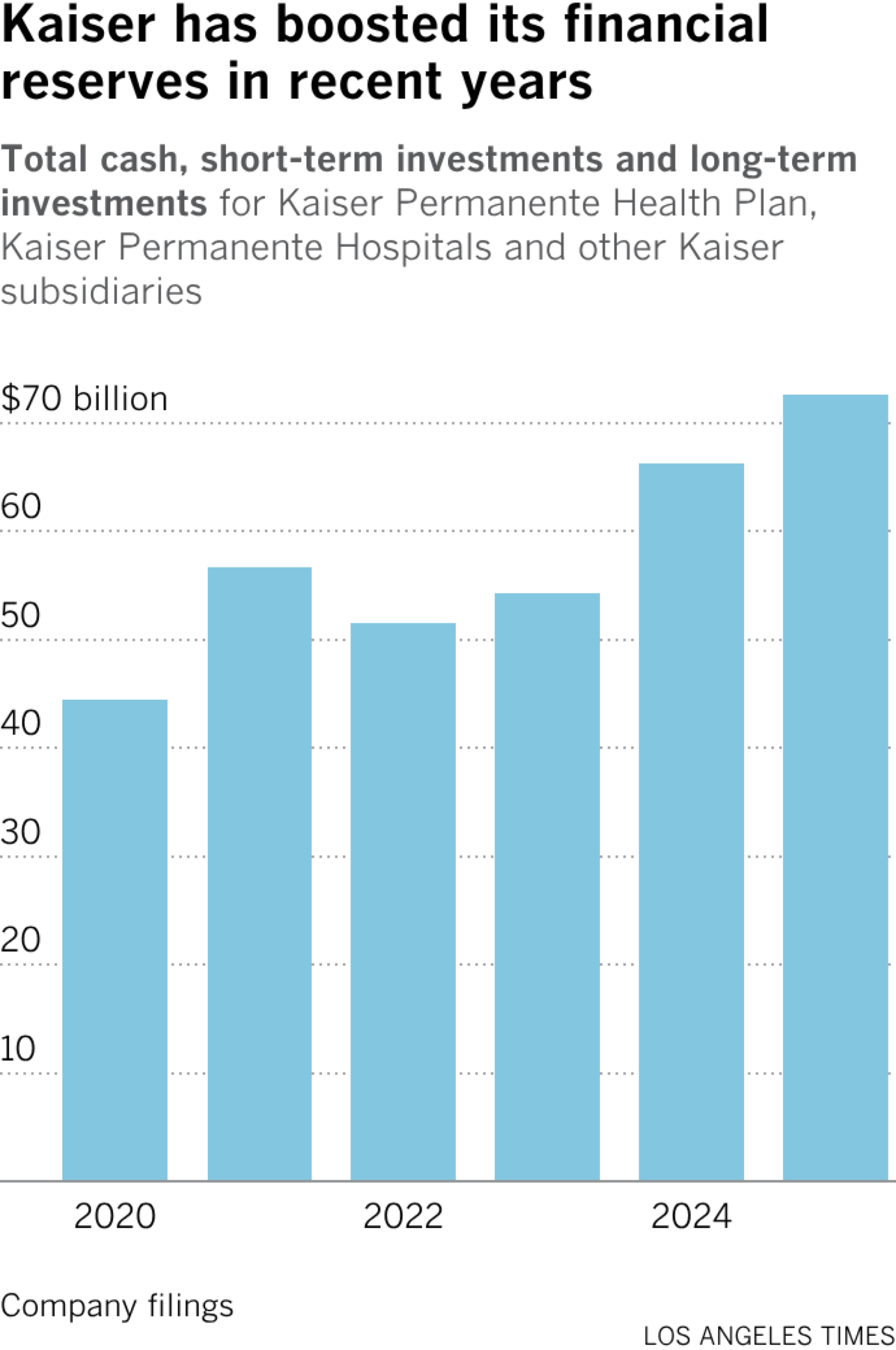
The surge of money has increased Kaiser’s reserve of cash and investments, which reached $73 billion in 2025 — 68% higher than in 2019, according to its financial statements.
Because Kaiser is registered as a charity, it pays no taxes on its profits or its extensive real estate holdings. After a recent buying spree, the nonprofit system said it had 847 medical offices and 55 hospitals at the end of 2025.
The arm of Kaiser that operates its hospitals and clinics avoided $784 million in federal income tax, $372 million in state income tax and $204 million in property tax in 2024, according to an analysis by the Lown Institute, a healthcare think tank.
In all, Kaiser Foundation Hospitals received nearly $1.5 billion in tax and other benefits by registering as a charity, the institute calculated.
Laws exempt nonprofits from paying taxes with the assumption they will give back to the community.
In 2024, Kaiser Foundation Hospitals provided $963 million in patient financial assistance and contributions to community health programs, but that still fell short of its tax benefit by more than $500 million, according to the Lown Institute.
Dr. Vikas Saini, the institute’s president, said that amount of money could help solve a myriad of California’s social problems.
“If they closed that gap, what would that $500 million get you?” he asked.
In a 2024 study, the institute found that Kaiser had the largest gap between its tax benefits and charitable spending of any of the nation’s nonprofit hospital systems.
Kaiser said in its statement that its combined charitable spending was far more than the institute’s calculation for its hospital arm. It said it not only provided patients with financial assistance, but also spent money on affordable housing, food access, community health and disaster recovery — efforts that totaled $5.3 billion last year.
After the January 2025 wildfires, Kaiser said it provided 2,400 households with financial assistance, opened evacuation centers, deployed mobile health vehicles and provided mental health services to victims.
“We have never been prouder of how we are delivering on our mission for the public good,” the statement said.
As Kaiser has grown, so has compensation for its top executives, which is among the highest of all California nonprofits.
In 2024, Greg Adams, Kaiser’s chief executive, was paid nearly $13 million, according to its filings. At least 40 other executives received total compensation of more than $1 million that year.
The nonprofit has a board of directors of more than a dozen members, with all but a few receiving $250,000 or more a year, according to the filing.
The board helps to oversee Kaiser’s fast-growing operations as well as its $73-billion financial reserve, which healthcare advocates and experts have said is far higher than its competitors and the level the state requires.
“I’m flabbergasted,” Saini said when told of the reserve’s size. “Who decides how big of a reserve is enough?”
Kaiser said it maintained the large financial reserve “to ensure long-term stability, manage emergencies, support major capital investments, and support our people’s retirement benefits.”
And it said senior managers were paid less than most for-profit health plans.
Some longtime Kaiser members have left for other insurers, citing a decline in care.
Mark Schubb, a Santa Monica resident, had been a Kaiser member since 1995. He said he left in 2022 after experiencing months-long delays to visit his primary care doctor and specialists.
When he complained, Schubb said, “the answer was, ‘Well, you can always go to urgent care.’ “
Gonzalez, the nurse in Downey, said patients often wait three months for an appointment. And when they finally get in, the 20-minute appointment may be double-booked, she said, leaving the physician assistant with 10 minutes to see them.
“They can wait months for an appointment and then they are rushed through,” she said. “Kaiser has the resources to fix these things.”
In one case, 53-year-old Francisco Delgadillo arrived at the Kaiser ER in Vallejo, Calif., in December 2023 with severe chest pain. After an initial assessment, he waited eight hours for care, according to state regulators.
He died in the lobby.
A state and federal investigation found multiple violations, including that Kaiser failed to have a licensed nurse monitoring the dozens of patients in the ER’s waiting room.
Kaiser didn’t respond to a request to comment on the death but has disputed claims of inadequate staffing at its hospitals.
Complaints about a lack of available mental health care go back more than a decade.
In 2023, Kaiser agreed to a $200-million settlement after the state found it had canceled tens of thousands of mental health appointments and failed to provide timely care. The settlement included a $50-million fine — the largest the state had ever levied against a health plan.
Garie Connell, a Kaiser therapist and licensed clinical social worker in Encino, said the system had been rationing mental health care for years, while earning big profits.
“They’ve really lost their way,” she said.
Kaiser said it had “made significant investments to expand choice and access to mental health care over the past several years.” The healthcare provider said it now has more than 35,000 employed and contracted clinicians delivering mental health and addiction care.
Kaiser said that it settled the alleged $1-billion fraud case last month to avoid the “cost of prolonged litigation” and that the findings of federal investigators involved “a dispute regarding certain documentation practices.”
In their complaint, prosecutors alleged that Kaiser mined data to find possible diagnoses that could be added to patients’ records to make them look sicker than they were. The patients were in Kaiser’s Medicare Advantage plan, which received bigger government payments for patients with multiple ailments.
Doctors were praised and given gifts, including bottles of champagne, the complaint said, for agreeing to the administrators’ requests to add the diagnoses.
As one Kaiser slide in an internal training session explained, “Medicare Queries: Why Now?”
The slide then provided the answer: “Diagnoses = Revenue.”
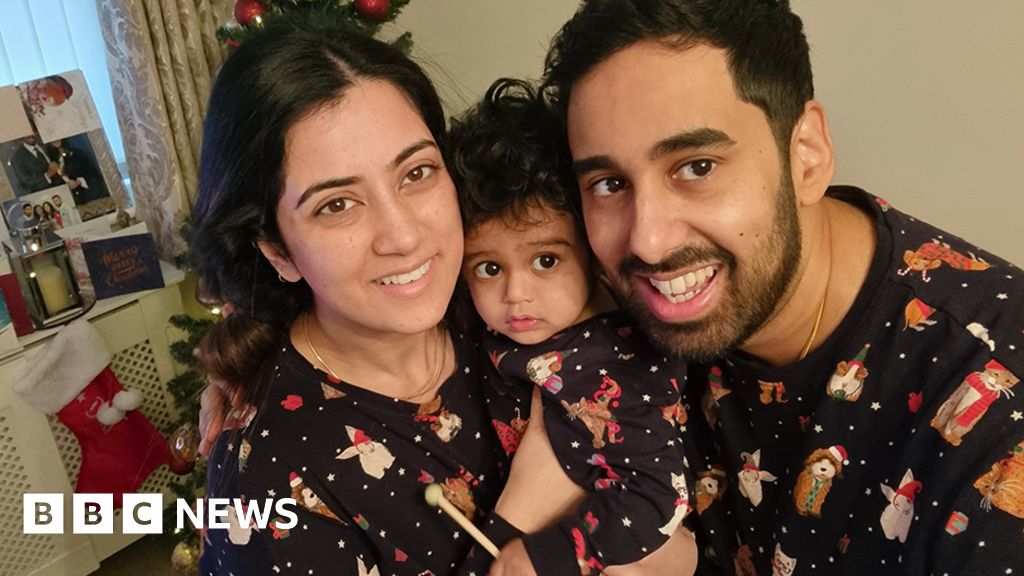
The couple’s solicitor, Catherine Lee, from legal firm Irwin Mitchell, added: “Whilst the trust has recognised the severity of the failings Aarav suffered and the need for improvements, it’s now vital that staff are supported to uphold the highest standard of care at all times.”
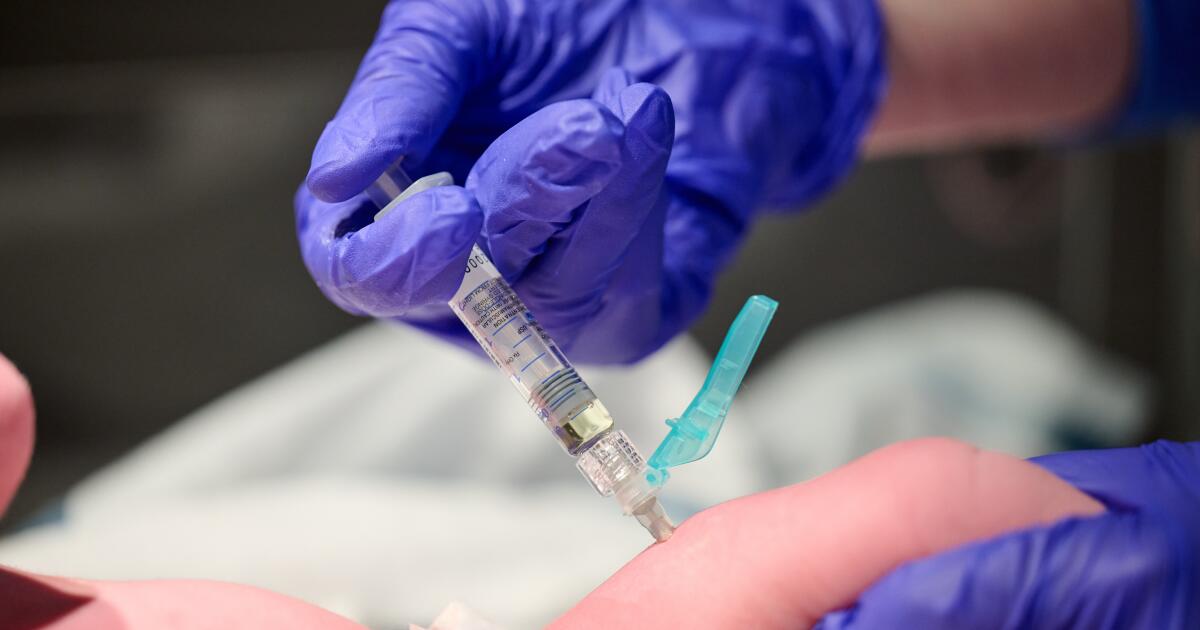
One day at an Idaho hospital, half the newborns Dr. Tom Patterson saw didn’t get the vitamin K shots that have been given to babies for decades to prevent potentially deadly bleeding. On another recent day, more than a quarter didn’t get the shot. Their parents wouldn’t allow it.
“When you look at a child who’s innocent and vulnerable — and a simple intervention that’s been done since 1961 is refused — knowing that baby’s going out into the world is super worrisome to me,” said Patterson, who’s been a pediatrician for nearly three decades.
Doctors across the nation are alarmed that skepticism fueled by rising anti-science sentiment and medical mistrust is increasingly reaching beyond vaccines to other proven, routine preventive care for babies.
A recent study in the Journal of the American Medical Assn., which analyzed more than 5 million births nationwide, found that refusals of vitamin K shots nearly doubled between 2017 and 2024, from 2.9% to 5.2%. Other research suggests that parents who decline vitamin K shots are much more likely to refuse getting their newborns the hepatitis B vaccine and an eye ointment to prevent potentially blinding infections. Rates for that vaccination at birth dropped in recent years, and doctors confirm that more parents are refusing the eye medication.
“I do think these families care deeply about their infants,” said Dr. Kelly Wade, a Philadelphia neonatologist. “But I hear from families that it’s hard to make decisions right now because they’re hearing conflicting information.”
Innumerable social media posts question doctors’ advice on safe and effective measures like vitamin K and eye ointment. And the Trump administration has repeatedly undermined established science. A federal advisory committee whose members were appointed by Health Secretary Robert F. Kennedy Jr. — a leading anti-vaccine activist before joining the administration — voted to end the long-standing recommendation to immunize all babies against hepatitis B right after birth. On Monday a federal judge temporarily blocked all decisions made by the reconfigured committee.
One common thread that ties together anti-vaccine views and growing sentiments against other protective measures for newborns is the fallacy that natural is always better than artificial, said Dr. David Hill, a Seattle pediatrician and researcher.
“Nature will allow 1 in 5 human infants to die in the first year of life,” Hill said, “which is why generations of scientists and doctors have worked to bring that number way, way down.”
Babies are born with low levels of vitamin K, leaving them vulnerable because their intestines can’t produce enough until they start eating solid foods at around 6 months old.
“Vitamin K is important for helping the blood clot and preventing dangerous bleeding in babies, like bleeding into the brain,” said Dr. Kristan Scott of the Children’s Hospital of Philadelphia, lead author of the JAMA study.
Before injections became routine, up to about 1 in 60 babies suffered vitamin K deficiency bleeding, which can also affect the gastrointestinal tract. Today the condition is rare, but research shows that newborns who don’t get a vitamin K shot are 81 times more likely to develop severe bleeding than those who do.
Hill has seen what can happen.
“I cared for a toddler whose parents had chosen that risk,” the Seattle doctor said. The child essentially had a stroke as a newborn and wound up with severe developmental delays and ongoing seizures.
At a February meeting of the Idaho chapter of the American Academy of Pediatrics, doctors said they knew of eight deaths from vitamin K deficiency bleeding in the state over the preceding 13 months, said Patterson, who is president of the chapter.
Infections prevented by other newborn measures can also have grave consequences. Erythromycin eye ointment protects against gonorrhea that can be contracted during birth and potentially cause blindness if untreated. The hepatitis B vaccine prevents a disease that can lead to liver failure, liver cancer or cirrhosis.
Even if a pregnant woman is tested for gonorrhea and hepatitis B, no test is perfect, and she may get infected after testing, said Dr. Susan Sirota, a pediatrician in Highland Park, Ill. Either way, she risks passing the infection to her child.
Parents give many reasons for turning down preventive measures, including fear that they might cause problems and not wanting newborns to feel pain.
“Some will just say they want more of a natural birth philosophy,” said Dr. Steven Abelowitz, founder of Ocean Pediatrics, which has three clinics in Orange County. “Then there’s a ton of misinformation. … There are outside influences, friends, celebrities, nonprofessionals and political agendas.”
Abelowitz practices in an area of the county with about an equal mix of Republicans and Democrats.
“There’s more mistrust from the conservative side, but there’s plenty on the more liberal side as well,” he said, “It’s across-the-board mistrust.”
Social media provides ample fuel, spreading myths and pushing unregulated vitamin K drops that doctors warn babies can’t absorb well.
Doctors in numerous states say parents refusing vitamin K shots often also decline other measures. Sirota, in Illinois, encountered a family that refused a heel stick to monitor glucose for a baby at high risk for having potentially life-threatening low blood sugar.
Care refusals aren’t a new phenomenon. Wade, in Philadelphia, said she’s seen them for 20 years. But until recently, they were rare.
Twelve years ago, Dana Morrison, now a Minnesota doula, declined the vitamin K shot for her newborn son, giving him oral drops instead.
“It came from a space of really wanting to protect the bonding time with my baby,” she said. “I was trying to eliminate more pokes.”
Her daughter’s birth a couple of years later was less straightforward, leaving the infant with a bruised leg. Morrison got the vitamin K shot for her.
Knowing what she does now, Morrison said, she would have gotten it for her son, too.
Doctors hope to change minds, one parent at a time. And that begins with respect.
“If I walk into the room with judgment, we are going to have a really useless conversation,” Hill said. “Every parent I serve wants the best for their children.”
When parents question the need for the vitamin K shot, Dr. Heather Felton tries to address their specific concerns. She explains why it’s given and the risks of not getting it. Most families decide to get it, said Felton, who has seen no uptick in refusals.
“It really helps that you can take that time and really listen and be able to provide some education,” said Felton, a pediatrician at Norton Children’s in Louisville, Ky.
In Idaho, Patterson sometimes finds himself clearing up misconceptions. Some parents will agree to a vitamin K shot when they find out it’s not a vaccine, for example.
These conversations can take time, especially since the parents doctors see in hospitals usually aren’t people they know through their practices.
But doctors are happy to invest that time if it might save babies.
“I end every discussion with parents with this: ‘Please understand at the end of the day, I’m passionate about this because I have the best interest of children in my mind and heart,’” Patterson said. “I understand this is a hot topic, and I don’t want to disrespect anybody. But at the same time, I’m desperately saddened that we’re losing babies for no reason.”
Ungar writes for the Associated Press.

The latest episode of Season 2 of ‘The Pitt’ shows ICE agents at the ER, dramatizing what has happened at hospitals across the country, including in California.
Source link

WASHINGTON — An advocacy group hoping to expand support for child and elder care is planning to spend $50 million to back Democrats in congressional races, tying the costs of caregiving to the nation’s affordability debate.
The Campaign for a Family Friendly Economy, created a decade ago, aims to make caregiver issues more salient in elections. The announcement comes as the cost of child care continues to rise and as waiting lists for federal child-care subsidies, which support working families in poverty, continue to grow.
Sondra Goldschein, executive director of the campaign and its political action committee, said child care and elder care are important to the affordability conversation, especially as child-care costs exceed what families pay for housing. Then there is the pressure on the “sandwich generation,” composed of middle-aged people who are caring simultaneously for their own children and parents.
“When child care can cost more than your rent or a mortgage, or you have to sacrifice a paycheck in order to be able to take care of a loved one,” that can motivate how people vote, said Goldschein. “Each election cycle, we see candidates recognizing that more and more.”
She hopes the message will resonate as families face a slew of rising costs, including climbing gas prices driven by a war in Iran that is unpopular with many voters.
The campaign plans to pour support for Democrats into Senate races in North Carolina, Georgia, Michigan, Maine and Ohio and into House races in Iowa and Pennsylvania. It is also slated to dispatch volunteers to talk with voters about caregiving.
The National Republican Congressional Committee did not immediately respond to a request for comment.
Republicans have begun to back child care as an issue crucial to growing the workforce, but their proposals tend to be less dramatic than those offered by Democrats. Last year, through President Trump’s One Big Beautiful Bill, Republicans made an estimated 4 million more families eligible for a child-care tax credit. The law also increased child-care aid for military families and tax credits for employers who provide child care to their workers.
Before 2020, many candidates rarely spoke about child care. But the COVID-19 pandemic laid bare the child-care industry’s precarity and necessity. Preschools and child-care centers were pressed to stay open so parents in front-line jobs — such as those in healthcare — could return to work.
Then-President Biden successfully persuaded Congress in 2021 to pass $39 billion in aid for child care, allowing states to offer support to more families and subsidizing wages for child-care workers. Later that year, Biden sought to create nationwide universal pre-kindergarten and to vastly expand child-care subsidies for families so that none would pay more than 7% of their household income for care. But the proposal narrowly failed in Congress. Since then, the pandemic aid has dried up and families are feeling the pinch of rising costs.
Now, several candidates have centered their campaigns around child-care affordability. New York Mayor Zohran Mamdani, a democratic socialist who won election after pledging to make the city more affordable for middle-class residents, ran on universal child care. Democratic Gov. Mikie Sherrill of New Jersey and Gov. Abigail Spanberger of Virginia won elections after pledging to expand child-care subsidies.
Candidates this election cycle are running on universal child-care pledges. They include Democrats Janeese Lewis George, who is running for mayor in Washington, D.C., and Francesca Hong, a gubernatorial candidate in Wisconsin. New York Gov. Kathy Hochul, who is up for reelection this year, has pledged to support Mamdani’s ambitions and eventually to expand universal child care statewide.
Neither the White House nor the Department of Health and Human Services, which oversees federal child-care programs, responded to requests for comment. In his 2024 campaign, during an address to the Economic Club of New York, Trump said increasing foreign tariffs would “take care” of the expense of child care. That plan, thus far, has not materialized.
In Trump’s current term, the administration has largely focused on cracking down on fraud, after a viral video alleged Somali-run child-care centers in Minneapolis were billing the government for children they weren’t caring for.
While there have been prosecutions stemming from child-care subsidy fraud, the Minneapolis video’s central claims were disproven by state inspectors. Nonetheless, the Trump administration attempted to freeze child-care funding for Minnesota and five other Democratic-led states until a court ordered the funding to be released.
Balingit writes for the Associated Press.