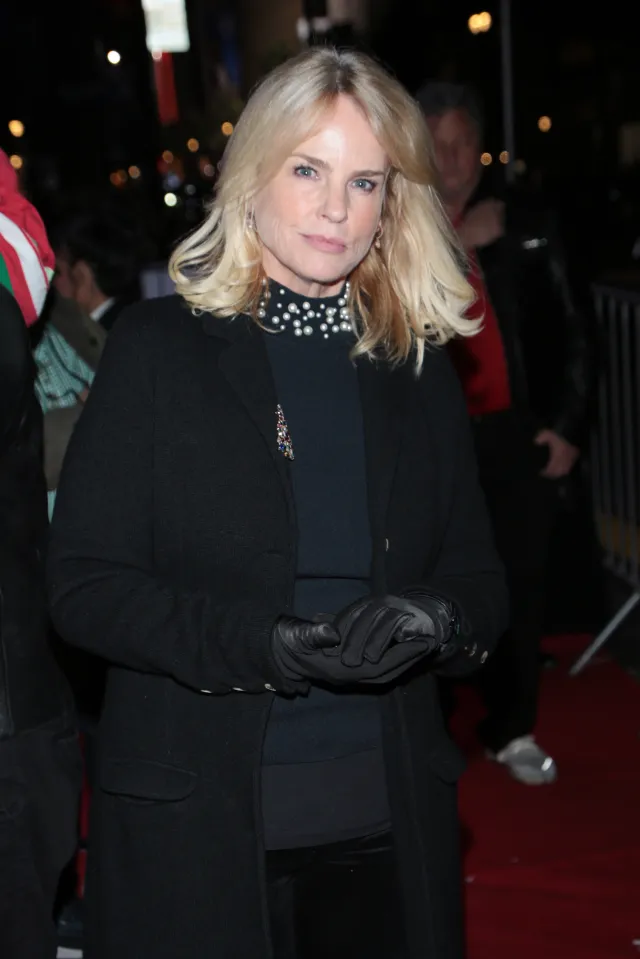
Jane Fallon has shared a fresh health update just days after undergoing surgeryCredit: Instagram/janefallon2The author is the partner of Ricky GervaisCredit: Getty Images – Getty
Now, Jane has revealed the positive news that the surgeons have “basically got it all”.
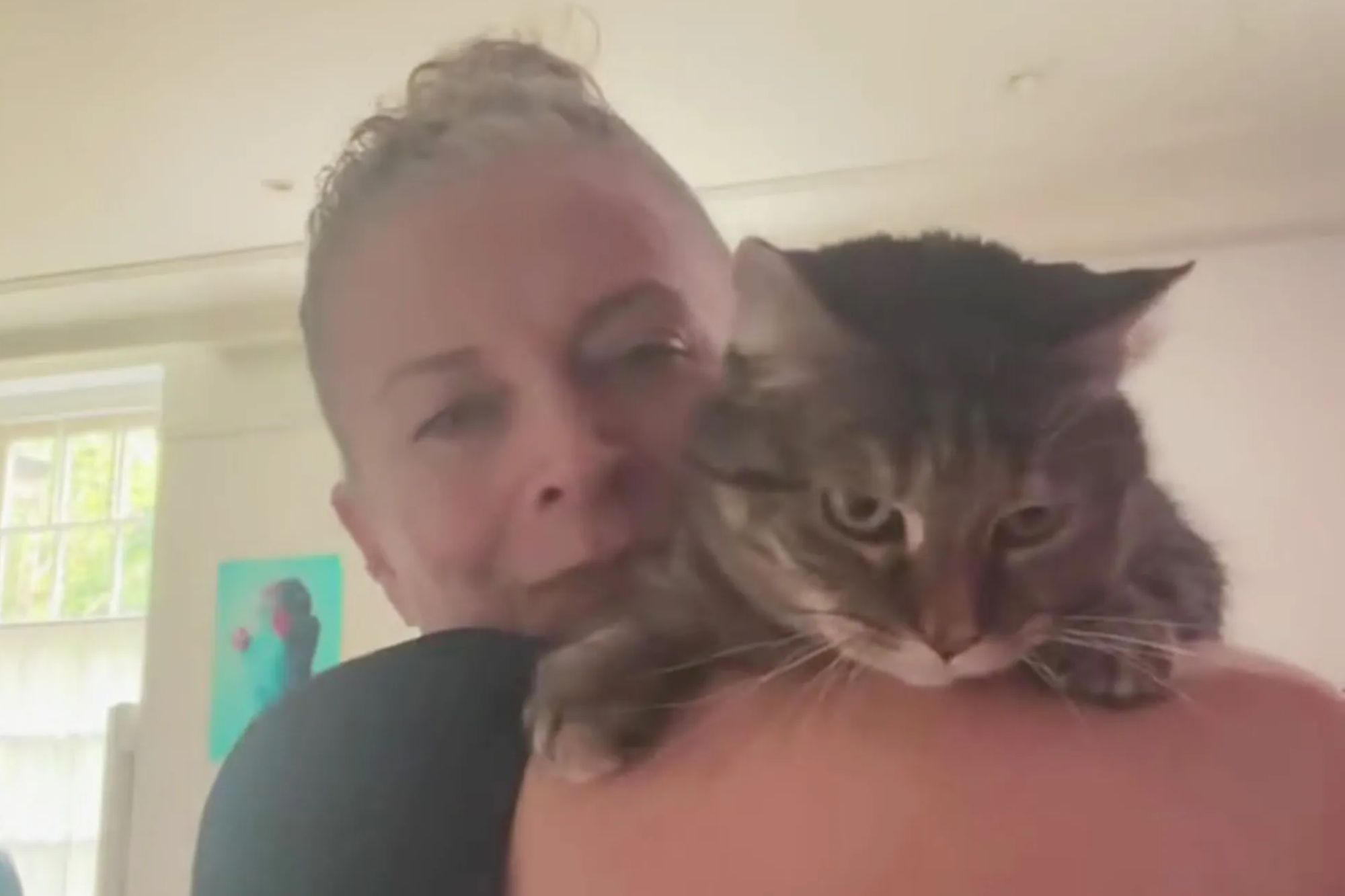
She said in a clip shared to her X account: “The surgeon said I can lift some weights so I’m starting with this one,” as she picked up her cat.
“Just a little update, all is good, yesterday I had my follow up and they have basically got it all.”
Jane explained that she will be having another procedure to ensure that they have removed “everything”.
“What they haven’t got is a clear margin around the edge of what they have taken so I am going to have to have another op,” she continued.
“It will be just to make sure they get everything, which is a bit of a pain, but it isn’t a worry they just need to make sure they have a clear margin, so will be the exact same operation as last time.”
Opening up about her second operation, Jane said she is feeling more confident especially as the recovery has been better than she expected.
She shared: “But I do know now that the recovery is so much easier than I thought it was going to be, this is me 10 days later.
“It’s a pain but not a worry at all [having a second op].
“So it’s good and hopefully next week I will hear after Easter to get it out of the way and then will have to wait for that to be tested and see where we are.
“Meanwhile I’m going to try and get a few workouts in and carry my cat around.”
Jane admitted she was “lucky” she was diagnosed “so early” and that is it important for women to get screened.
She wrote in her caption: “(Mostly) good update: Things I forgot to say in the video: I’m still getting fabulous treatment.
“And I know how lucky I am to have had my diagnosis so early – from a routine mammogram with absolutely no symptoms.
Jane is preparing for a second procedure but said she is feeling confidentCredit: X/JaneFallon
“I’ve had so many conversations with lovely people who’ve come up to me in the street in the last couple of weeks & told me their own personal experiences, and it’s totally rammed home both how different it is for everyone and also how important screening and early diagnosis really is.
“Oh, and as Tamoxifen is one of the options being debated for me I wanted to ask if anyone has experience and how the side effects were.
Revealing her breast cancer diagnosis earlier this month, Jane assured fans not to “panic” and said her prognosis was “excellent”.
She said on Instagram: “About a month ago I was diagnosed with breast cancer – very early stage thankfully & the prognosis is excellent.
“I had a routine mammogram a week before Christmas. I had no symptoms but the brilliant radiographer spotted something iffy & sent me for further tests & eventually a biopsy.
“Since then I’ve had more mammograms, more biopsies and an MRI so they can pinpoint the problem area precisely. It’s been a lot, I’m not going to lie.”
The star added that she has been under “incredible” care.
Jane Fallon has revealed she has undergone surgery following her breast cancer diagnosisCredit: X/JaneFallonThe presenter and author is recovering back home after her opCredit: X/JaneFallonJane has been with Ricky Gervais for over 40 yearsCredit: Getty Images – Getty
Now, Jane has confirmed that her operation is over and assured fans she is feeling in high spirits after the procedure.
Sharing some snaps of herself from hospital, Jane wrote to X: “So… I had my op today.
“I’m feeling remarkably fine, which is possibly the drugs & that might also explain why I’m cross eyed in pic 4).
“I had quite a lovely couple of hours drinking tea & reading the brilliant @CatSteadman ‘s new one (more on that later).”
Revealing her breast cancer diagnosis earlier this month, Jane assured fans not to “panic” and said her prognosis was “excellent”.
She said on Instagram: “About a month ago I was diagnosed with breast cancer – very early stage thankfully & the prognosis is excellent.
“I had a routine mammogram a week before Christmas. I had no symptoms but the brilliant radiographer spotted something iffy & sent me for further tests & eventually a biopsy.
“Since then I’ve had more mammograms, more biopsies and an MRI so they can pinpoint the problem area precisely. It’s been a lot, I’m not going to lie.”
The star added that she has been under “incredible” care.
Jane said that she will know the outcome of the surgery in 8-10 daysCredit: X/JaneFallonJane shared her diagnosis news earlier this month, revealing that she had no symptoms priorCredit: Getty
It is now three years since Brooks emotionally returned to the Premier League in March 2023, when he came off the bench to applause from all four sides of the ground at Aston Villa.
There was a loan spell with Southampton before re-establishing himself at the Vitality, earning a new four-year deal a few months back.
“I thought he was Bournemouth’s best player in pre-season and he carried that on when the season started,” adds Mepham, with Brooks now remarkably looking like he’s never been away rather than missed almost two years of top-flight football.
“There have never been any question marks around his ability, the only concerns have been about his fitness, but his running data in games was a lot higher than before.”
It would have to be, given the style of Bournemouth’s approach under Andoni Iraola, both the Cherries and Craig Bellamy’s Wales sharing an intensity to the way they want to play.
There is an effectiveness too. Brooks is fifth highest in the Premier League for expected assists averaged over 90 minutes, and in the top ten for carries with the ball that result in a chance.
“I think he’s really stepped up,” says former Bournemouth and Wales Under 21 defender Joe Partington, part of the BBC Solent team that regularly cover the Cherries.
“You can see the influence he has on and off the pitch – he’s been captain and you don’t get that if the manager doesn’t have real faith in what you can do as a player.
“I think it would have been natural for people to wonder if he would reach the levels again, but he’s done that and when you think about it, it’s incredible.”
A sentiment agreed with wonderment by Kieffer Moore, another former Bournemouth team-mate who also shared Wales’ Euro 2020 dressing room with Brooks.
“He’s gone from strength to strength – remarkable, really, given what his body and mind have been through,” says the Wrexham striker.
A BELOVED actress has been remembered as a “powerhouse of vitality and goodwill” after tragically dying following a battle with breast cancer.
Carrie Anne Fleming, 51, passed away in Sidney, British Columbia, and was best known for her role in the fantasy drama Supernatural.
Sign up for the Showbiz newsletter
Thank you!
Carrie Anne Fleming, 51, has tragically died after a battle with breast cancerCredit: GettyFleming’s death was confirmed by her Supernatural co-star Jim Beaver in a touching Facebook tributeCredit: Alamy
She is survived by her daughter Madalyn Rose.
Fleming was confirmed dead by her co-star and friend Jim Beaver in a statement to Variety.
The star died on February 26, from complications after battling the deadly illness.
Later, in a lengthy heartfelt tribute posted to Facebook, 75-year-old Beaver called Fleming his “soulmate”.
“To find a soul mate once in life is something of a miracle. To find one twice is almost unimaginable,” he said.
“To love and be loved is a pearl above price, but such pearls do come more than once or twice to the lucky.”
Beaver said loving her had been devastating, after losing Cecily – the mother of his child – to the same disease.
“I lost Cecily to cancer in 2004,” he said.
“Thursday, I lost Carrie to the same disease. I never thought my heart could break so badly more than once.
“But it has. But, oh, the two torches I carry – what bright, bright light they shed.”
He continued, recounting the first time they met on the set of the popular television series.
“Carrie Anne Fleming was cast as my wife on Supernatural in my fifth season on the show,” he said.
Beaver revealed he had “fallen for her hard” just seconds after meeting her for the first time.
He said he had been “shocked” to find she felt the same way.
“To find oneself paired with someone who not only loves and is loved, but who seems by magic or the grace of the gods to understand you, to want what you are, to want you to be what you are, who GETS you and never feels the need to have you defend who you are, and about whom you feel the same – how many of us can say that spark of divinity has alighted on us once, much less twice? I can,” he said in the heartbreaking tribute.
The pair bonded over both having daughters named Madeline Rose, with Beaver saying the discovery had been “the beginning of a beautiful friendship”.
The star was known for her roles in numerous popular TV showsCredit: GettyShe was born in Digby, Nova ScotiaCredit: Alamy
“We ran lines of dialogue together in my trailer and talked for hours that first day, and the electricity between us was practically visible,” he wrote.
Beaver said the actress had “an amazingly good nature … a rapturous laugh and an utterly adorable personality that didn’t seem to have an off switch”.
“I was so in love I think my eyes turned silver,” he said.
“She seemed to think I was worth hanging around with, too.”
Fleming also starred in other popular shows including iZombie, Smallville, Good Luck Chuck, The L Word, Married Life and Supergirl.
Born on August 16, 1974, in Digby, Nova Scotia, Fleming studied at Mount Douglas Senior Secondary in Victoria, British Columbia, and later attended the Kaleidoscope Theatre as well as the Kidco Theatre Dance Company for drama.
She broke into the industry through an uncredited appearance in Adam Sandler’s Happy Gilmore, and later in a role in Viper.
In 2005 she was cast in Dario Argento’s show Masters of Horror, starring as a disfigured woman with cannibalistic urges.
She went on to appear and star in other horror shows, including Bloodsuckers and The Tooth Fairy.
More recently Fleming played Candy Baker on five seasons of the CW’s iZombie.
She also appeared in the 2015 TV film The Unauthorized Full House Story, exploring the behind-the-scenes making of the hit sitcom.
Fleming played the mother of Full House star Candace Cameron Bure, who portrayed D.J. Tanner on the show.
Fleming also performed in a number of British Columbia stage productions, including Steel Magnolias, Noises Off, and Romeo and Juliet.
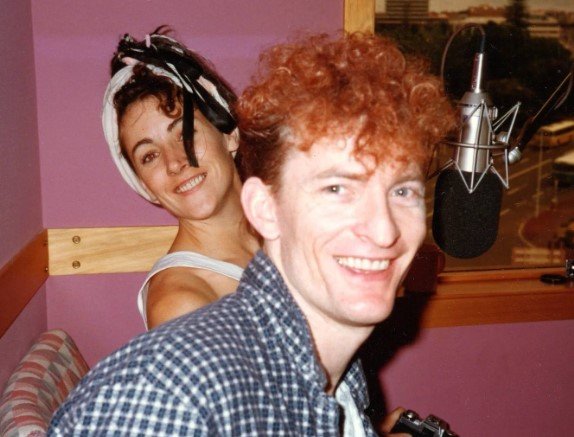
Eurogliders founder Bernie Lynch died after battling with throat cancer.
Sign up for the Showbiz newsletter
Thank you!
Perth musician Bernie Lynch has died aged 65 after a battle with cancerCredit: genBernie last performed with Eurogliders in November during a brief remission of his cancerCredit: http://www.perthnow.com.au
His death was announced this morning by fellow band member Grace Knight, who gave an emotional tribute.
Brit-born Grace wrote: “It’s with the heaviest heart I’m posting this to let everyone know that Bernie passed away last Thursday evening in palliative care in Perth.
“Some of you will be aware that Bernie was diagnosed with throat cancer in early 2024 and underwent treatment.
“I am heartbroken and don’t know how to proceed without him.”
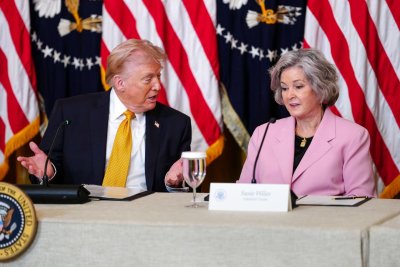
1 of 5 | President Donald Trump speaks with White House chief of staff Susie Wiles during a meeting with trustees of the John F. Kennedy Center for Performing Arts in the East Room of the White House in Washington, D.C., on Monday. Photo by Aaron Schwartz/UPI | License Photo
March 16 (UPI) — White House chief of staff Susie Wiles has been diagnosed with breast cancer and has an “excellent” prognosis, President Donald Trump announced Monday.
In a post on Truth Social, Trump said Wiles has “early stage breast cancer” and will be undergoing treatment “immediately.”
“She has a fantastic medical team, and her prognosis is excellent!” Trump wrote. “During the treatment period, she will be spending virtually full time at the White House, which makes me, as President, very happy!”
Wiles confirmed her diagnosis hours later in a statement on X.
“Nearly one in eight women in the United States will face this diagnosis. Every day, these women continue to raise their families, go to work and serve their communities with strength and determination,” she said.
“I now join their ranks.”
The diagnosis was made last week, she added, while expressing her gratitude to the doctors who “detected the cancer early.”
“I am encouraged by a very good prognosis,” she said.
“I am also deeply thankful for the support and encouragement of President Trump as I undergo treatment and continue serving in my role as White House chief of staff.”
The Hill reported that Wiles was seated next to Trump during Monday’s John F. Kennedy Center for the Performing Arts board meeting at the White House.
Vice President JD Vance also voiced his support for Wiles in a post on X.
“The Vance family is praying for our dear friend as she takes on her next fight!” he wrote.
Trump ally Elon Musksaid he was “hoping for the best,” while rapper Nicki Minajsaid, “God will get the glory for your testimony, my sister.”
WASHINGTON — White House chief of staff Susie Wiles has been diagnosed with early stage breast cancer but will continue working during her treatment, President Donald Trump said in a social media post on Monday.
Trump said Wiles’ prognosis is “excellent” and described her as “one of the strongest people I know.” He said Wiles plans to begin treatment immediately but made no suggestion she was pulling back on her work as one of his closest advisers.
“During the treatment period, she will be spending virtually full time at the White House, which makes me, as President, very happy!” Trump said on his Truth Social platform. “She will soon be better than ever!”
It comes as the Republican president confronts mounting challenges on global and national fronts, from the war in Iran and soaring oil prices to this fall’s midterm elections and American’s concerns over affordability.
Wiles, 68, is a longtime Trump ally who rose from his campaign co-chair to his closest adviser and counsel. The first woman to become White House chief of staff, Wiles spent decades as a lobbyist and political operative in Florida and led Trump’s 2016 effort in the state.
The Trump administration on Friday moved to roll back Biden-era limits on emissions of ethylene oxide, a cancer-causing chemical often used in the sterilization of medical devices.
The Environmental Protection Agency said repealing the rules, which fall under the National Emission Standards for Hazardous Air Pollutants, would “safeguard the supply of essential medical equipment” — saving approximately $630 million for companies over 20 years. California is home to about a dozen such facilities.
The government said the emissions are part and parcel of protecting people from “lethal or significantly debilitating infections that would result without properly sterilized medical equipment.”
“The Trump EPA is committed to ensuring life-saving medical devices remain available for the critical care of America’s children, elderly, and all patients without unnecessary exposure to communities,” EPA Administrator Lee Zeldin said in a statement.
An estimated 50% of sterile medical devices in the U.S. are treated with ethylene oxide, or EtO, particularly those that can’t be cleaned using steam or radiation. The colorless gas is also used to make chemicals found in products such as antifreeze, detergents, plastics and adhesives.
But EtO poses health risks. Short-term exposure by inhalation can cause headaches, dizziness, nausea, fatigue respiratory irritation and other adverse health effects, according to the federal Agency for Toxic Substances and Disease Registry.
Longer-term exposure increases the risk of cancers of the white blood cells, such as non-Hodgkin’s lymphoma, as well as breast cancer. A now-deleted page from the EPA’s website stated, “EtO is a human carcinogen. It causes cancer in humans.”
Friday’s proposal specifically targets updated rules for EtO emissions that were passed by the Biden administration in 2024 following pressure from environmental justice groups, particularly those in Louisiana’s heavily industrialized “Cancer Alley.” The change sought to reduce the amount of EtO released from commercial sterilizers by 90% and lessen the hazards for nearby communities.
The tighter rules were in part based on EPA’s own scientific study that found it to be 60 times more carcinogenic than previously thought, which the agency now says should be reassessed.
If finalized, the plan would give facilities the choice between installing continuous real-time monitoring systems for EtO emissions or complying with modified pollution control requirements at facilities that emit more than 10 tons a year, the EPA said.
The proposal follows other moves by the Trump administration to rescind regulations that it says are burdensome and costly for industries, such as those governing emissions from coal power plants. Last month, the EPA repealed the endangerment finding, which affirmed the dangers of greenhouse gas emissions and underpinned the agency’s ability to regulate those emissions from vehicles.
The action around ethylene oxide would affect about 90 commercial sterilization facilities owned and operated by approximately 50 companies. Three California companies applied for and received presidential exemptions for their EtO emissions in July.
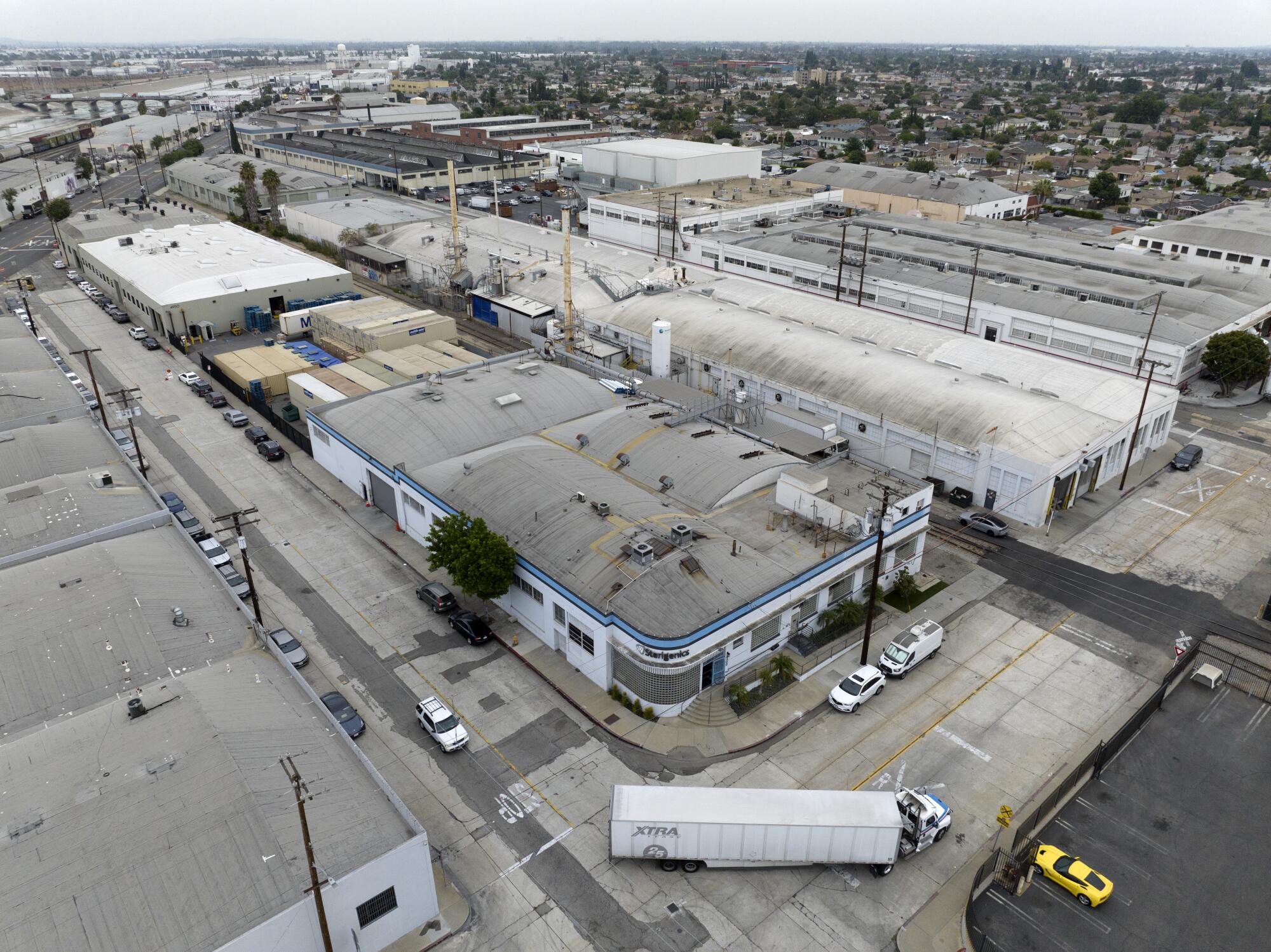
The Sterigenics facility, center, in Vernon is pictured in 2022.
(Myung J. Chun / Los Angeles Times)
They are located in Ontario and Vernon and operated by the company Sterigenics, which provides industrial sterilization technology for medical devices and other commercial products.
In January, a coalition of environmental and community groups challenged the EtO exemptions in federal court. The lawsuit from the Southern Environmental Law Center and the Natural Resources Defense Council argues that technology exists for facilities to comply with the tighter Biden-era standards without raising costs, and many facilities are already using it.
“EPA’s 2024 rule was an important and overdue step to reduce toxic ethylene oxide pollution and protect communities,” said Irena Como, senior attorney at the Southern Environmental Law Center, in a statement Friday. “Repealing this rule that is proven to significantly lower pollution exposure and cancer risks will subject even more people who work, live, and send their children to schools located near these facilities to harm that is entirely preventable.”
Sterilization and chemical industry groups support the plan.
“The EPA rule concerning ethylene oxide use in commercial sterilizers threatens to severely restrict access to vital medical products nationwide,” the American Chemistry Council said in a statement. “We commend the EPA for their commitment to reevaluating these policies.”
The EPA will hold a 45-day comment period about the proposal after it is published in the federal register. A final decision is expected sometime this year.
“I know from above she’s looking down on all of us with her beautiful smile. Rest in peace our Jenn.”
Erin Murphey wrote: “So sad to share that my friend Jennifer Runyon Corman has passed away after a brief battle with cancer.
“Some people you just know you’ll be friends with before you even meet. She was a special lady. I’ll miss you Jenn.
“My thoughts are with your family and beautiful children.”
Jennifer made her movie debut in the 1980 horrorfilm To All a Goodnight, taking on the lead role of Nancy.
She then took on a role as Sally Frame in the American soap Another World, acting in the series until 1982.
The beloved Ghostbusters film, which featured Bill Murray, Dan Aykroyd and Sigourney Weaver, Jennifer acted in the opening scene as a student involved in an ESP experiment.
Her television career included guest appearances in Murder, She Wrote as well as roles in Magnum PI and Beverly Hills.
Jennifer’s final role was in the 2017 comedy horror film Bloodsucka Jones vs. The Creeping Death.
During the 2019 documentary, Remembering Ghostbusters, Jennifer appeared to discuss her most notable role.
The actresses’ grieving family announced the heartbreaking news on social mediaCredit: Getty Images
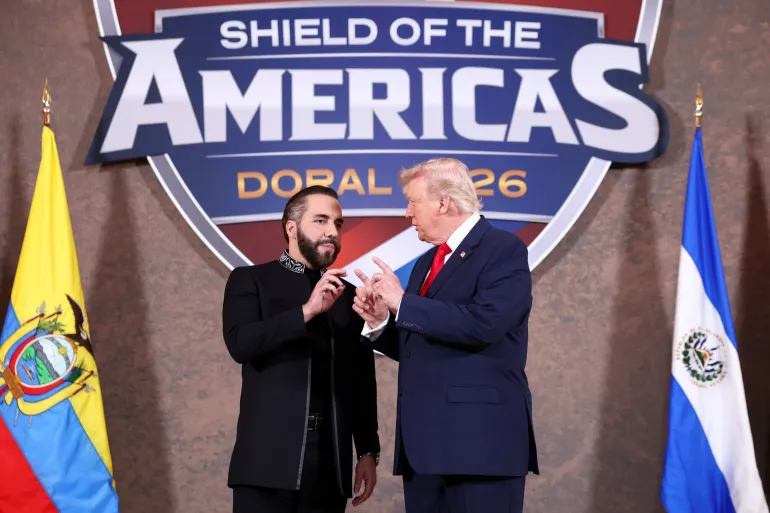
At the inaugural “Shield of the Americas” summit in South Florida, United States President Donald Trump announced the creation of what he calls the Americas Counter-Cartel Coalition: a group of a dozen politically aligned countries committed to fighting drug trafficking.
But as he signed a declaration to cement that commitment, Trump signalled that it came with the expectation that cartels would not be confronted with law enforcement action, but instead military might.
Recommended Stories
list of 3 itemsend of list
“ The only way to defeat these enemies is by unleashing the power of our military. So we have to use our military. You have to use your military,” Trump told the audience of Latin American leaders.
“You have some great police, but they threaten your police. They scare your police. You’re going to use your military.”
Saturday’s summit was the latest step in a larger foreign policy pivot under Trump.
Since taking office for a second term, Trump has distanced himself from some of the US’s traditional allies in Europe, instead forging tighter partnerships with right-wing governments around the world.
The attendance at the Shield of the Americas summit reflected that shift. Right-wing leaders, including Argentina’s Javier Milei, El Salvador’s Nayib Bukele and Ecuador’s Daniel Noboa, were among the guest list.
But notably absent was top-level leadership from Mexico, the US’s biggest trading partner, and Brazil, the largest country in the region by economy and population.
Both Mexico and Brazil are led by left-wing presidents who have resisted some of Trump’s more hardline policies.
The growing rift between the US and some of its longtime partners was a feature in the brief remarks delivered by US Secretary of State Marco Rubio, who praised attendees for their cooperation.
“They’re more than allies. They’re friends,” Rubio said of the leaders present.
“At a time when we have learned that oftentimes an ally, when you need them, maybe may not be there for you, these are countries that have been there for us.”
Secretary of Defense Pete Hegseth, meanwhile, reiterated his view that criminal networks and cartels pose an existential crisis for the entire Western Hemisphere, which he described as sharing the same cultural and religious roots.
“ We share a hemisphere and geography. We share cultures, Western Christian civilisation. We share these things together. We have to have the courage to defend it,” Hegseth said.
Donald Trump meets with El Salvador’s President Nayib Bukele as they attend the ‘Shield of the Americas’ summit on March 7 [Kevin Lamarque/Reuters]
A military-first approach
Latin America is one of several areas where Trump has launched military operations since returning to office in January 2025.
His rationale for authorising deadly operations in the region has centred primarily on the illicit drug trade.
Trump has repeatedly argued that Latin American criminal networks pose an imminent threat to national security, through the trafficking of people and drugs across US borders.
Experts in international law have pointed out that drug trafficking is considered a criminal offence — and it is not accepted as justification for acts of military aggression.
But the Trump administration has nevertheless launched lethal military strikes against alleged drug traffickers in Latin America.
Since September, for instance, the Trump administration has conducted at least 44 aerial strikes on maritime vessels in the Caribbean Sea and eastern Pacific Ocean, killing nearly 150 people.
The victims’ identities have never been publicly confirmed, nor has evidence been publicly released to justify the deadly strikes.
Some families in Colombia and Trinidad and Tobago have stepped forward to claim the dead as their loved ones, out on a fishing expedition or travelling between islands for informal work.
In Saturday’s remarks, Trump justified the attacks by arguing that cartels and other criminal networks had grown more powerful than local militaries — and therefore necessitated a lethal response.
“Many of the cartels have developed sophisticated military operations. Highly sophisticated, in some cases. They say they’re more powerful than the military in the country,” Trump said.
“Can’t have that. These brutal criminal organisations pose an unacceptable threat to national security. And they provide a dangerous gateway for foreign adversaries in our region.”
He then compared cartels to a disease: “They’re cancer, and we don’t want it spreading.”
US President Donald Trump signs a proclamation at the ‘Shield of the Americas’ summit in Doral, Florida [AFP]
A ‘nasty’ operation in Venezuela
In late December and early January, Trump also initiated attacks on Venezuelan soil, again defending his actions as necessary to stop drug traffickers.
The first attack targeted a port Trump linked to the gang Tren de Aragua. The second, on January 3, was a broader offensive that culminated in the abduction and imprisonment of Venezuela’s then-leader, President Nicolas Maduro.
On Saturday, Trump reflected on that military operation, which he characterised as an unmitigated success.
Maduro is currently awaiting trial on drug-trafficking charges in New York, though a declassified intelligence report last May cast doubt on Trump’s allegations that the Venezuelan leader directed drug-trafficking operations through groups like Tren de Aragua.
“America’s armed forces also ended the reign of one of the biggest cartel kingpins of all, with Operation Absolute Resolve to bring outlaw dictator Nicolas Maduro to justice in a precision raid,” Trump told Saturday’s summit.
He then described the military operation as “nasty”, though he underscored that no US lives were lost.
The early-morning raid, however, killed at least 80 people in Venezuela, including 32 Cuban military officers, dozens of Venezuelan security forces, and several civilians.
“We went right into the heart. We took them out, and it was nasty. It was about 18 minutes of pure violence, and we took them out,” Trump said of the operation.
Trump has since held up Venezuela as a model for regime change around the world, particularly as it leads a war with Israel against Iran.
Maduro’s successor, interim President Delcy Rodriguez, has so far complied with many of Trump’s demands, including for reforms to the country’s nationalised oil and mining sectors.
Just this week, the two countries re-established diplomatic relations for the first time since 2019, under Trump’s first term as president.
In Saturday’s remarks, however, Trump reiterated that his positive relationship with Rodriguez hinged on her cooperation with his priorities.
“She’s doing a great job because she’s working with us. If she wasn’t working with us, I would not say she’s doing a great job,” he said.
“In fact, if she wasn’t working with us, I’d say she’s doing a very poor job. Unacceptable.”
US Secretary of Defense Pete Hegseth speaks at the summit of Latin American leaders on March 7 [Kevin Lamarque/Reuters]
‘We’ll use missiles’
Trump did, however, express consternation with other presidents in the Latin American region, accusing them of allowing cartels to run amok.
“Leaders in this region have allowed large swaths of territory, the Western Hemisphere, to come under the direct control” of the cartels, Trump said.
“Transnational gangs have taken over, and they’ve run areas of your country. We’re not going to let that happen.”
He even delivered an ominous warning to the summit’s attendees: “Some of you are in danger. I mean, you’re actually in danger. It’s hard to believe.”
Many of the leaders in attendance, including El Salvador’s Bukele, have launched their own harsh crackdowns on gangs in their countries, employing “mano dura” or “iron fist” tactics.
Those campaigns, however, have elicited concerns from human rights groups, who have noted that presidents like Bukele used emergency declarations to suspend civil liberties and imprison hundreds of people, often without a fair trial.
Still, Trump dismissed alternative approaches in Saturday’s speech. Though he did not mention Colombia by name, he was critical of efforts to negotiate for the disarmament of cartels and rebel groups, as Colombian President Gustavo Petro has sought to do.
Instead, he offered to deploy military might throughout the region.
“We’ll use missiles. If you want us to use a missile, they’re extremely accurate — pew! — right into the living room, and that’s the end of that cartel person,” Trump said.
“A lot of countries don’t want to do that. They say, ‘Oh, sure. I’d rather not have that. I’d rather not have it. I believe they could be spoken to.’ I don’t think so.”
Leaders gather for a group photo at the ‘Shield of the Americas’ summit on March 7 [Kevin Lamarque/Reuters]
A call to ‘eradicate’ Mexico’s cartels
One country he did single out, though, was Mexico. Trump suggested that it had fallen behind other countries in the region in its efforts to combat crime.
“We must recognise the epicentre of cartel violence is Mexico,” he said.
“The Mexican cartels are fueling and orchestrating much of the bloodshed and chaos in this hemisphere, and the United States government will do whatever’s necessary to defend our national security.”
Since the start of his second term, Trump has pressured Mexico to step up its security efforts, threatening tariffs and even the possibility of military action if it does not comply.
Mexican President Claudia Sheinbaum has responded by increasing military deployments throughout the country.
In February 2025, for instance, she announced 10,000 soldiers would be sent to the US-Mexico border. For the upcoming FIFA World Cup, her officials have said nearly 100,000 security personnel will be patrolling the streets.
Just last month, her government also launched a military operation in Jalisco to capture and kill the cartel leader Nemesio Oseguera Cervantes, nicknamed “El Mencho”. She has also facilitated the transfer of cartel suspects to the US for trial.
But Trump reemphasised on Saturday his belief that Sheinbaum had not gone far enough, though he called her a “very good person” and a “beautiful woman” with a “beautiful voice”.
“I said, ‘Let me eradicate the cartels,’” Trump said, relaying one of his conversations with Sheinbaum.
“We have to eradicate them. We have to knock the hell out of them because they’re getting worse. They’re taking over their country. The cartels are running Mexico. We can’t have that. Too close to us, too close to you.”
Secretary of State Marco Rubio, centre, delivers remarks at a working lunch at Trump National Doral Miami in Florida [Rebecca Blackwell/AP Photo]
‘Last moments of life’ in Cuba
Trump also used his podium to continue his threats against Cuba’s communist government.
Since the January 3 attack on Venezuela, Trump has increased his “maximum pressure” campaign against the Caribbean island, which has been under a full US trade embargo since the 1960s.
His administration severed the flow of oil and funds from Venezuela to Cuba, and in late January, Trump announced he would impose steep economic penalties on any country that provides the island with oil, a critical resource for the country’s electrical grid.
Already, the country has been struck with widespread blackouts, and the United Nations has warned Cuba is inching closer to humanitarian “collapse”.
But Trump framed the circumstances as progress towards the ultimate goal of regime change in Cuba.
“As we achieve a historic transformation in Venezuela, we’re also looking forward to the great change that will soon be coming to Cuba,” he told Saturday’s summit.
“Cuba’s at the end of the line. They’re very much at the end of the line. They have no money, they have no oil. They have a bad philosophy. They have a bad regime that’s been bad for a long time.”
He added that he thinks changing Cuba’s government will be “easy” and that a deal could be struck for the transition of power.
“Cuba’s in its last moments of life as it was. It’ll have a great new life, but it’s in its last moments of life the way it is,” Trump said.
But while Trump’s remarks largely focused on governments not represented at the summit, he warned that there could be consequences even for the right-wing leaders in attendance.
Trump’s “Shield of the Americas” coalition comes as he seeks to bring the whole of Latin America in line with US priorities. It’s a policy he has dubbed the “Donroe Doctrine”, a riff on the 19th-century Monroe Doctrine, which claimed the Western Hemisphere as the US’s sphere of influence.
To Trump, that means ousting rival powers like China as they seek to forge relationships and economic ties with Latin America. Trump has even mused about retaking the Panama Canal, based on his allegation that the Chinese have too much control in the area.
“As these situations in Venezuela and Cuba should make clear, under our new doctrine — and this is a doctrine — we will not allow hostile foreign influence to gain a foothold in this hemisphere,” Trump said.
He then made a pointed remark to Panama’s president, Jose Raul Mulino, who was in the audience.
“That includes the Panama Canal, which we talked about. We’re not going to allow it.”