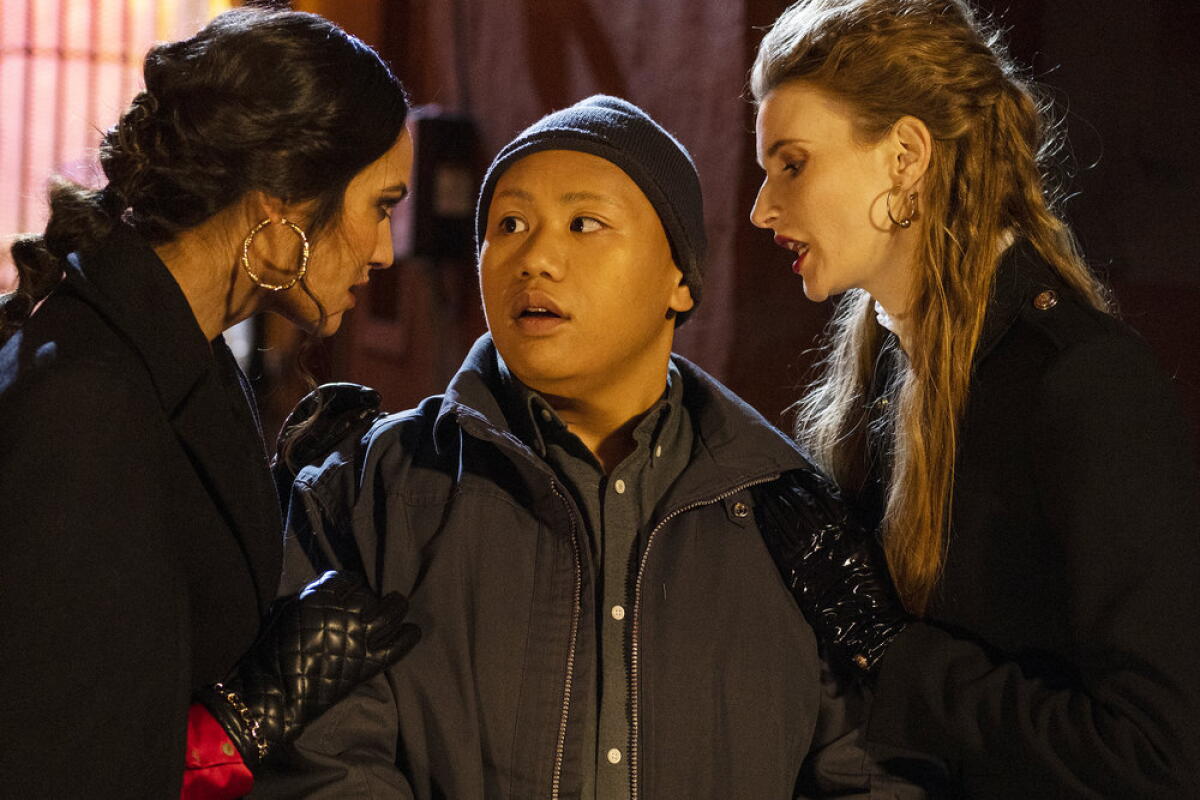
Rachelle Goulding, Jacob Batalon and Georgia Waters in “Reginald the Vampire.”
(James Dittiger / Syfy)
Based on Johnny B. Truant’s “Fat Vampire” book series, this Syfy series brings to light the (some would say preposterous) idea that a vampire could look like an average human. Created by “Twin Peaks” veteran Harley Peyton, it also hits on an important, body-affirming message: Reginald, who was played by Jacob Batalon, wasn’t super strong or super fast. But he was super smart.
In the same news conference, Jesus said he did not expect to start Ronaldo against Denmark.
“I don’t know what’s going to happen in the game,” Jesus said. “If we need him to play, he’ll play. If not, he won’t.”
This time, the player did make the decision for the coach.
“Following the national team coach’s news conference, and after a conversation with the president of the Portuguese football federation, I decided to leave the national team’s training camp,” Ronaldo posted on social media hours after Jesus spoke.
“In due time, I will tell all the Portuguese about the reasons that motivated my departure from the national team, which I always dedicated myself to. Now it’s time to wish good luck to Portugal and all my teammates, without exception.”
WASHINGTON — President Trump’s administration was set to issue a last-minute reprieve Tuesday over the planned closure of a camp in Qatar that houses more than 1,000 Afghans who assisted America’s war effort or are the relatives of U.S. service members.
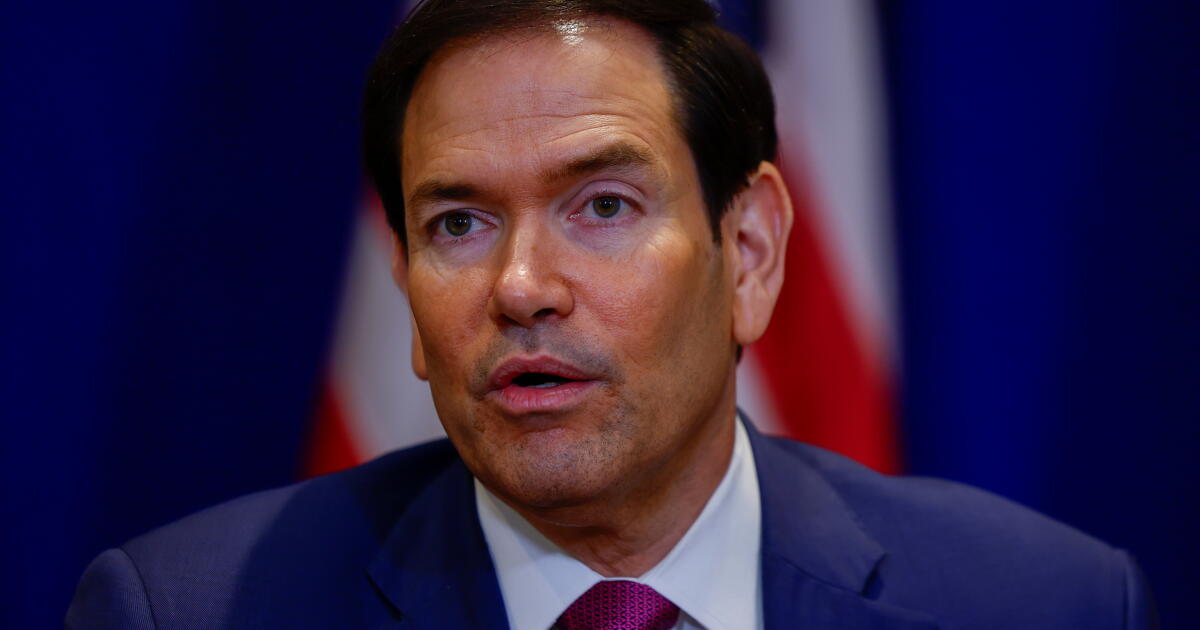
Secretary of State Marco Rubio is expected to sign off on a diplomatic note to Qatar extending for nine months the life of Camp As Sayliyah, which had been due to close Wednesday at the end of the U.S. budget year, according to two U.S. officials familiar with the matter. The officials spoke to the Associated Press on the condition of anonymity to offer details before the public announcement.
The decision comes months after Rubio told Congress that the U.S. was still in discussions with several third-party countries to take the 1,039 Afghans who worked as interpreters or in other roles helping the American war effort as well as relatives of U.S. service members who have been stranded in Qatar for more than a year.
Rubio’s testimony in June came after the AP and other outlets reported that war-torn Congo was among the countries where the Trump administration was considering resettlement.
The State Department would not immediately comment on Rubio’s extension for the camp but said it “continues to work toward a positive resolution that provides safety for these remaining people to start a new life outside of Afghanistan while upholding the safety and security of the American people.”
The department also repeated its claim that the camp is a legacy of an attempt by President Biden’s administration “to move as many Afghans to America as possible without properly vetting them” — an assertion that has been denied by former officials and refugee advocates.
The group of Afghans in Camp As Sayliyah includes those who fought or worked alongside the U.S. military between 2001 and 2021, with more than 70% of the camp’s residents being women and children, according to statistics from #AfghanEvac. The group has spent the last five years advocating for Washington to make good on its promise to resettle those whose service has put them at risk since the chaotic U.S. withdrawal from Afghanistan and the Taliban’s reassertion of control.
“This is a victory for those people, and they’re going to have some semblance of knowing that they’re safe there because they’ve been worried that at any moment somebody’s going to come and rip them out of there,” Shawn VanDiver, a Navy veteran who heads #AfghanEvac, told the AP.
But he added that there needs to be a permanent solution to this years-long crisis.
Despite the camp’s reprieve, which protects those housed there from possible forcible removal to Afghanistan, residents have little hope of being allowed to enter the United States.
Upon entering his second term, Trump, a Republican, paused his Democratic predecessor’s Afghan resettlement program as part of a series of executive orders cracking down on immigration, including dramatically altering refugee admissions to focus on white South Africans. Only five Afghans have been admitted to the U.S. since October 2025, #AfghanEvac says.
The refugee changes left thousands of people who fled war and persecution — and had gone through a sometimes years-long vetting process to start new lives in America — stranded at places worldwide, including the base in Qatar.
Advocates have warned that if there is no alternative, the only other option for the group of residents would be to go back to Afghanistan, where they face likely reprisal from the Taliban.
In the coming nine months, the State Department said it would “continue to work to identify options for voluntary resettlement of all Camp As-Sayliyah residents.” It gave no additional details.
Lee and Amiri write for the Associated Press. Amiri reported from New York.
When the shooting starts, Sara tells her children to lie flat on the ground; the bullets, she said, can go straight through her family’s tent.
Sara, who asked that her real name not be used, has been arbitrarily detained for nearly a decade in Roj camp in Syria’s far northeast, which holds more than 2,300 children and mothers, many of whom are held on the basis of alleged family or other associations with ISIL.
Recommended Stories
list of 4 itemsend of list
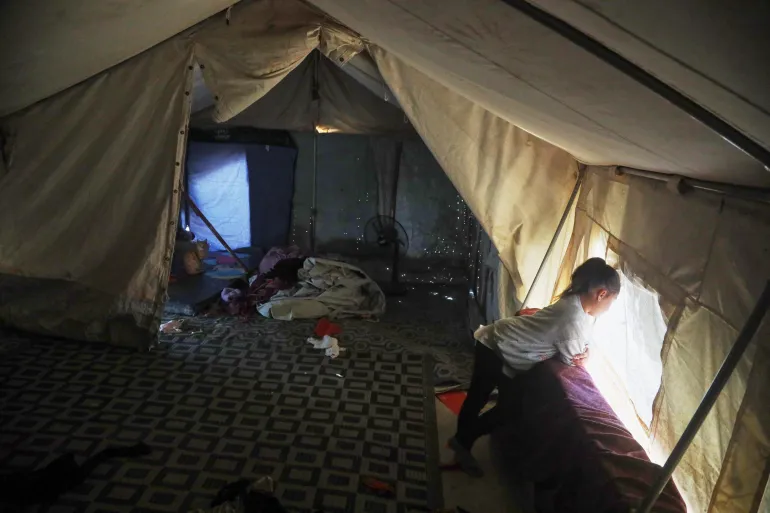
Her children have grown up behind guarded fences topped with barbed wire and tangled with rubbish that often blocks the view of the barren, windswept landscape beyond.
United Nations experts and human rights groups describe open-ended detention in camps such as Roj as a breach of international law.
In recent months, women in the camp told Al Jazeera that the situation has steadily escalated: gunfire at night, stones thrown by guards and a boy left with a serious head injury.
Complaints to the administration, they say, bring promises but little else. “Every cry for help results in another wave of aggression,” one mother said.
Al Jazeera cannot independently verify their accounts, but they match reports by UN investigators and NGOs.
On September 8, the UN Independent Commission of Inquiry on Syria told the body’s Human Rights Council that conditions in Roj had worsened over the past year, with regular night raids, extortion and violence by camp security.
It described the camp as the world’s largest site of mass arbitrary detention of women and children on security grounds.
A young girl looks out from a tent in a section of Roj Camp in eastern Syria [File: Baderkhan Ahmad/AP Photo]
Who really controls the camp?
The violence comes amid sweeping change in the region.
On August 25, the Kurdish-led Syrian Democratic Forces (SDF), once a key US ally in the fight against ISIL, announced it would dissolve as an independent military force under an agreement with Syria’s central government in Damascus.
After a government offensive in January, the SDF lost much of the territory under its control and agreed to merge with the national army.
Its commander, Mazloum Abdi, has since been appointed a presidential adviser.
Roj, which the SDF had controlled until last month, is now the Syrian state’s responsibility.
But inside the camp, detainees said the transition has been anything but smooth.
One woman described to Al Jazeera a divided security presence, with those who accepted integration with the government on one side and holdouts who refused or were rejected on the other, and tensions between them that play out over the heads of the women and children.
In an open letter published on Monday, 11 mothers in Roj wrote that many of the same guards remain.
“While individuals’ [affiliations] may have changed,” one woman told Al Jazeera, “the people themselves remain the same”.
A woman and a child stand in Roj camp [File: Baderkhan Ahmad/AP Photo]
No legal basis for detention
Children from more than 50 countries remain stranded in Syria.
None has been given an individual legal process to determine why they are held, or for how long.
Fionnuala Ni Aolain, who served as UN special rapporteur on counter-terrorism and human rights from 2017 to 2023 and now sits on its inquiry commission, visited the camp in 2023.
Upwards of 70,000 people were once detained in al-Hol, another larger camp in the northeast holding the families of alleged ISIL fighters. In 2023, more than 52,000 people – mostly Syrians and Iraqis – were held in al-Hol and Roj, including an estimated 12,000 foreign nationals.
She found that conditions met “the threshold for torture under international law”. The violence women and children face now, she told Al Jazeera, is worse.
“It is utterly unacceptable that women and children who have never been convicted of any crimes, who have never been subject to any legal process, are being detained in this way,” she said.
There is no legal basis for their arbitrary detention, she said, adding that the remedy is release.
In January, order at al-Hol collapsed in chaos. The fate of thousands who had been held there remains unknown.
An SDF patrol at the al-Hol camp in northeastern Syria in February 2025 [File: Nils Adler/Al Jazeera]
Beatrice Eriksson, a spokesperson for the Swedish branch of the rights organisation Repatriate the Children, which has been in contact with hundreds of mothers in the camps since 2019, told Al Jazeera that boys have been taken from their mothers as young as 12 or 13 and initially held in so-called rehabilitation centres.
Some have since been transferred to Iraq, she said, where they were detained in a makeshift prison for adult alleged ISIL fighters. The whereabouts of others remain unknown.
Eriksson argues that integrating former SDF-controlled forces and administrative structures into the Syrian government could provide an opportunity for change.
She said responsibility for the families has shifted from a non-state group to an internationally recognised government with which most of their home countries have diplomatic relations.
However, some detainees told Al Jazeera that they feel trapped. Governments tell them to reach out to an embassy, but their detention makes that impossible.
Ni Aolain said the responsibility does not just lie with the Syrian government, which is “doing its best to manage the massive post-conflict needs of the population as a whole”.
Instead, she said part of the blame clearly lies with foreign governments, “who have remained persistently stony-faced and unwilling to accept responsibility for their nationals”.
“It is not consistent with solidarity and support for a transitional state, and it’s an abdication of both their human rights and their security responsibilities to Syria”, she said.
For the women and children in Roj camp, the current situation is not sustainable.
“We want the next steps to begin where we’ll see an end to the suffering of our children,” one woman told Al Jazeera, “even if that means going to prison back home.”
At the time of publication, Syria’s Ministry of Foreign Affairs and Expatriates had not responded to Al Jazeera’s request for comment on the reports of violence at Roj as well as the government’s plans for the camp and its detainees.
The camp administration also did not respond to Al Jazeera’s request for comment.
Police in Ceuta used batons and fired shots into the air as they began moving migrants from beaches to a new camp. Nearly 10,000 remain in the Spanish territory weeks after a record influx saw more than 72,000 people cross from Morocco.
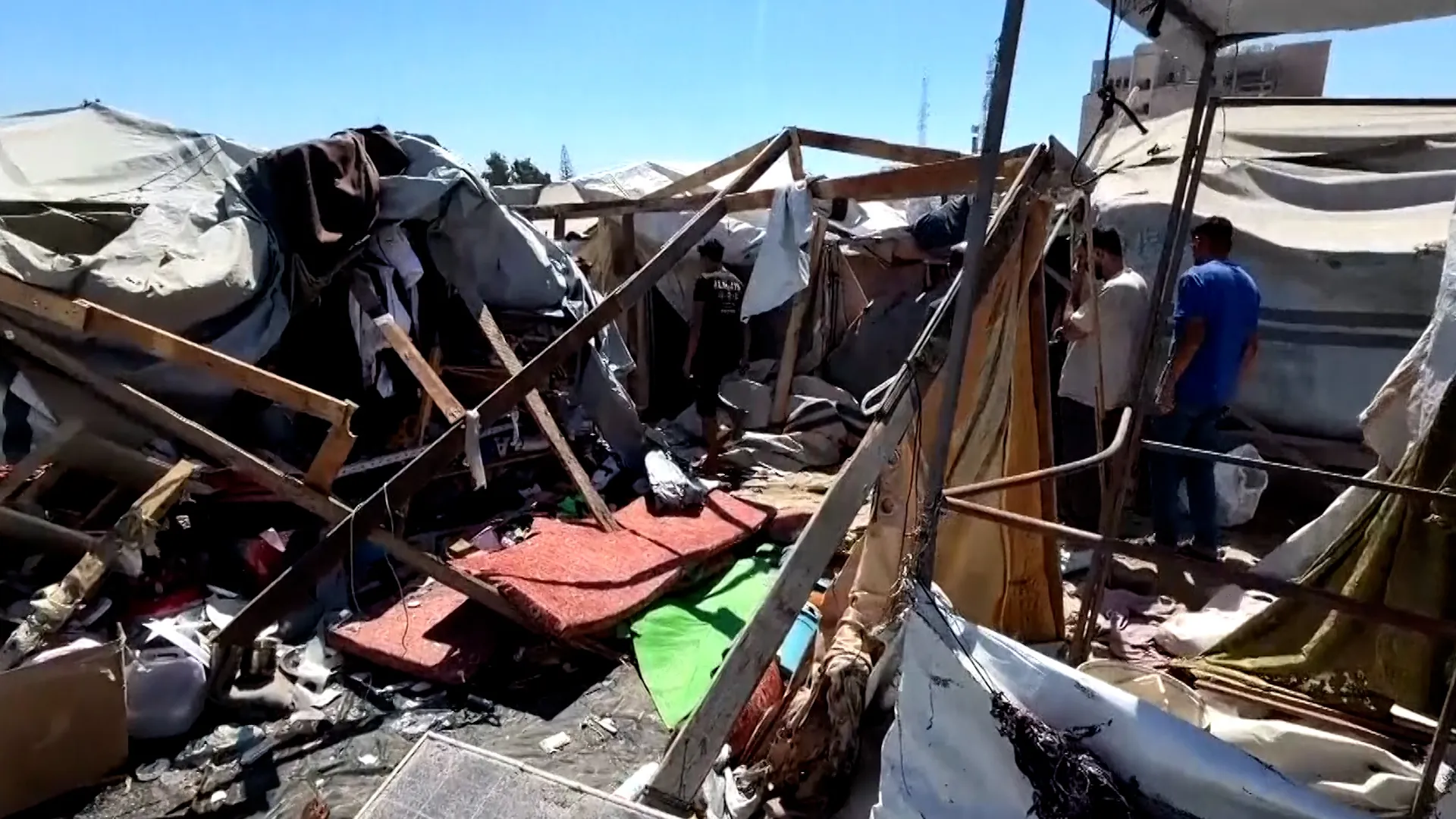
Israeli strikes across Gaza have killed at least one person and injured several. Residents say they were targeted outside tents in a Gaza City displacement camp.
I CAN’T say my weekends are usually spent dressed as a fox in the middle of a forest, springing about in an aerial bungee or learning Bollywood dance routines.
But I certainly wish more of them were.
A bit like an American summer camp but for grown-ups, Camp Wildfire incorporates outdoorsy activities like tree-climbing and paddleboarding with campfire singalongs – and, importantly, cocktailsCredit: SuppliedYou’ll fill your entire festival with your pick of 100 activities, from beekeeping to rifle shootingCredit: Supplied
I was at Camp Wildfire in Kent – a three-day festival that’s far from your average Reading or Glastonbury experience.
A bit like an American summer camp but for grown-ups, Camp Wildfire incorporates outdoorsy activities like tree-climbing and paddleboarding with campfire singalongs – and, importantly, cocktails.
Sign up for the Travel newsletter
Thank you!
Upon arrival, festivalgoers are asked to join one of four teams: Foxes, Badgers, Hawks or Squirrels.
One pair of fluffy ears and face-paint whiskers later, I had made myself part of the Fox patrol.
Forget scouring a lanyard for your favourite bands’ set times – a weekend here begins by charging into a games arena with your new animal teammates to take on a series of Sports Day-style games like tug-of-war that will earn your team “Patrol Points”.
You’ll fill your entire festival with your pick of 100 activities, from beekeeping to rifle shooting, all while collecting points for a grand finale at the end.
I chose to begin with quad biking – I truly can’t think of a better wake-up call than riding into the breeze through the Kentish countryside, taking in whiffs of wild mint.
Next came flower headdress-crafting, followed by a potion-making class that left me smelling of lavender and clutching some homemade skincare.
Jenna chose to begin with quad biking – riding into the breeze through the Kentish countryside,Credit: SuppliedThere was also a climbing wall on site to try outCredit: Supplied
By this point I was feeling like a total wilderness goddess, which gave me the confidence boost I needed to channel my inner acrobat for my final activity of the day: twirling on the aerial silks. All of this before 5pm left me in serious need of a drink.
Thankfully, there are regular cocktail masterclasses, where visitors can learn to pour favourites like the perfect Pornstar Martini ahead of the nighttime acts.
Evening entertainment at Camp Wildfire is some of the best I’ve experienced.
Yes, there’s great music, with everything from Disney singalongs to reggae and techno dance tents.
But there are also fabulous comedy acts, a board games bar and even an astronomy tent for stargazing.
The music continues well into the early hours but with laser clay shooting first thing in the morning, I made sure to rest up.
Precision was equally as important for pyrography, where I decorated a wooden coaster with a heated metal pen, although it was less critical for aerial bungee.
If you’ve never jumped around in a giant harness, pulling Superman shapes and Spider-Man jumps, I highly recommend it – you’ll split your sides laughing and become more flexible, too.
Jenna enjoys the fireworksCredit: Supplied
My final activity was a Burlesque class, where I managed to bag a Patrol Point, but sadly, it wasn’t enough for us Foxes to take the lead.
That didn’t stop me cheering on the winning Hawk team at the dramatic closing ceremony, though, where all visitors are invited to enjoy an impressive drone show.
We’ll get ’em next year, Foxes!
ULTRA-earlybird tickets for Camp Wildfire 2027 are live now and cost from £259pp for the weekend. Super-earlybird tickets go on sale from October 2 and start at £269pp.
All tickets include general camping. For details or to book, see campwildfire.co.uk.