‘Camp Miasma’ review: Horror becomes a doorway to liberation
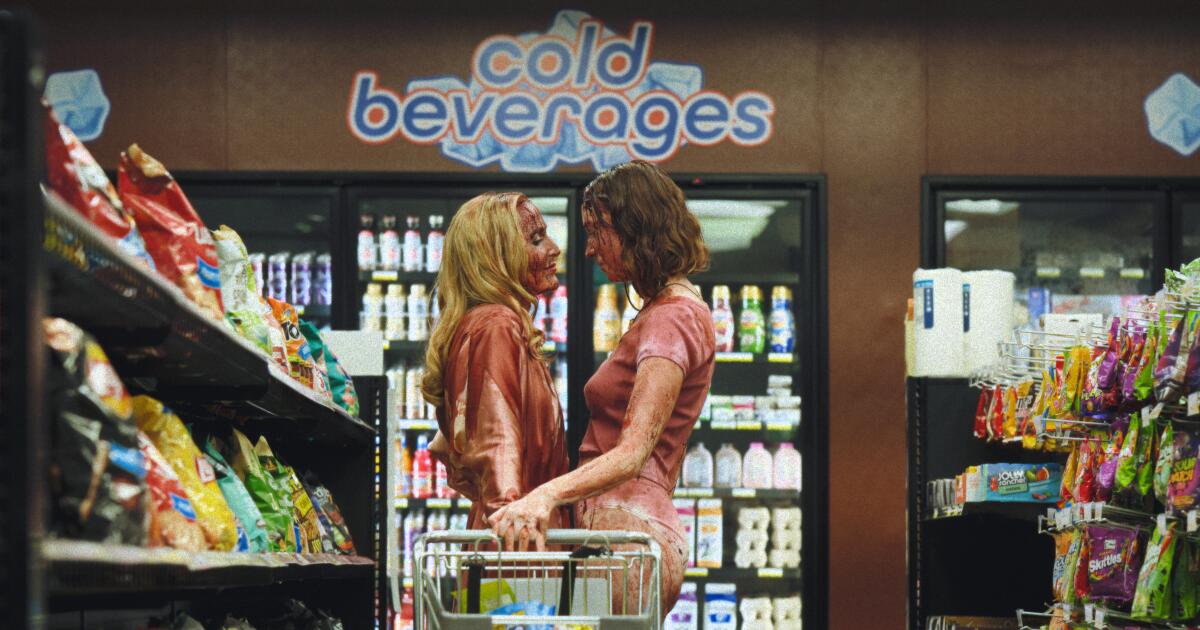
“Teenage Sex and Death at Camp Miasma” is a witty, gory slasher-romance that feels so personal to writer-director Jane Schoenbrun that they’ve essentially sliced out their soul and smeared it on the screen.
“Hacks’” Hannah Einbinder plays a rising director named Kris, a Sundance darling and Schoenbrun avatar of sorts who wants to convince a long-forgotten scream queen named Billy Presley (Gillian Anderson) to star in her next movie. It’s a resurrection of the fictitious “Camp Miasma” franchise, a hack-’em-up about hormonal camp counselors slaughtered by a gender-bending, spear-wielding killer called Little Death, who has an air-conditioning vent for a face. (The reason why sort of makes sense when you see his lair.) Billy played the final girl in the 1983 original film, then disappeared. And so Kris heads out to Billy’s snowbound hideaway — which just so happens to be where the movie was shot.
Young Billy (a riveting Amanda Fix) imprinted on Kris in a way she can’t articulate. Smoking weed with the real woman will hopefully help. Anderson’s Billy steps out of the shadows with a full face of femme fatale makeup and a syrupy Dolly Parton drawl, promptly serving Kris enough fried chicken to feed a bobsled team. Has Anderson ever had more fun onscreen? Her performance presents as camp, but her dynamic range of loud cackles and quiet glances is fabulous.
Acting in a film within a film, Fix’s version of teenage Billy is so nervous it seems impossible she’ll become Anderson’s diva. You can practically hear the girl’s heart beating so loud that it breaks your own. The two Billys almost snatch the movie from under its lead. But then toward the climax, Einbinder has a powerful close-up that puts the film back in her pocket. (Metaphorically, that is — by then, her character isn’t wearing any pants.)
Kris’ breakout movie was a high-concept inversion of “Psycho” told through the shower curtain’s POV. Yet she’s well aware that the studio hired her to rescue the “Camp Miasma” franchise not for her genius but because she’s queer and the internet has deemed Little Death “problematic.” The satirical scenes of Kris’ agent (Sarah Sherman) getting annoyed that her client can’t pitch a four-quadrant movie are hilarious while also ringing of truth.
Likewise, Schoenbrun specializes in zeitgeisty fables about 21st century isolation. Their own debut, the 2021 micro-budget internet thriller “We’re All Going to the World’s Fair,” was simultaneously mesmerizing and tedious, a mental breakdown that burrowed so deeply inside its own world that several COVID-era high schoolers I know felt like it had been made just for them.
A strange thing about Schoenbrun is that even when I haven’t liked their work, I’ve left the theater certain that I just watched what will be someone else’s favorite film of all time. (The affectless disassociation of 2024’s “I Saw the TV Glow” drove me bonkers.) Yet “Camp Miasma” finds Schoenbrun bravely opening up and getting vulnerable. It’s not just a lament about loneliness; it’s a challenge to change your perspective and maybe your life.
I suspect Schoenbrun could deliver a five-hour TED Talk on the pop cultural kitsch of “Friday the 13th’s” Jason Voorhees. They’re so fluent in how Hollywood squeezes the fun out of a franchise that they can convey “Camp Miasma’s” descent into schlock in a sprightly opening montage that sees Little Death become a trading card, a bobblehead, an 8-bit video game, an anti-drug spokesman and a novelty rapper. Over 13 sequels, the character’s trail of nubile corpses stretches from Manhattan to Mars to Quibi.
Kris pops in a disc of “Camp Miasma’s” tawdry 2008 reboot, which cinematographer Eric Yue makes look as flat as the discounted DVD. As that movie’s disposable bimbo strips off her top, the score cranks up a porno-chic song and Kris scribbles the word “desire” in her notebook in all caps. But the contrast between that sham seduction footage and a 35mm reel of the original “Camp Miasma” is like night and day — or rather, trash and art. Kris and Billy watch that one together in an intimate sleepover, sinking into the murky texture of a scene in which the virginal actor allowed a jerk to take off her clothes.
Schoenbrun loves the movie-ness of movies. You can see their devotion in outdoor backdrops that are deliriously false, in sight gags that reference Cronenberg and Carpenter or in production design that includes the perfect nostalgic ’90s video store carpet. Inside Billy’s private movie theater, the projector beams down on the back of Anderson’s head like that infamous Nicole Kidman AMC promo. Maybe I’m loopy, but I’d even swear the entrance to Billy’s screening room has a handmade mural of the Roku City screensaver. Watch for clues when the storyline we’re watching becomes its own nested narrative.
Horror fans waiting for jump scares will be thwarted. At least there are several sequences of macabre murder-comedy with blood geysers shooting up to the sky and a tracking shot through a killing spree that’s a riot. The soundtrack sets a more accurate tone right away with a gentle cover of R.E.M.’s “Nightswimming” that segues into Alex G’s dreamy synths. Yet Schoenbrun’s needle drops also seem to have been chosen to make the audience chuckle. A massacre set to the Counting Crows’ piano-and-accordion ballad “A Long December” is bizarre. (The only excuse I can think of is that Little Death hibernates at the bottom of a frozen lake?)
It feels like a magic trick when the film finally reveals where it’s going. “Teenage Sex and Death” is about climbing out of your head, admitting what you want and allowing yourself to enjoy it. Sexually, yes — that’s right in the title — and creatively, too, as Schoenbrun wants us to keep loving movies that make us squirm.
Lately, it’s been hard to talk about difficult art, with culture warriors deeming entire filmographies unworthy of enjoyment. People have gotten so used to preemptively apologizing for what they like that their mea culpas feel as reflexive as a sneeze. But Schoenbrun sticks up for the right to forgive a movie’s flaws. Here, when Kris anxiously whispers that a scene in the first “Camp Miasma” is transphobic, Billy gives her a shush.
We’ve all got our kinks, including ones for canceled flicks. (I still adore “Revenge of the Nerds” despite its god-awful rape joke.) Kris can intellectualize her “Camp Miasma” fandom all she wants. But Billy counters that the appeal of “Camp Miasma” is simple: “It’s flesh and fluids,” she says. And since she’s still living in it, we believe her.
‘Teenage Sex and Death at Camp Miasma’
Rated: R, for bloody violence, gore, sexual content, graphic nudity, drug use and some language
Running time: 1 hour, 52 minutes
Playing: Opening Friday, Aug. 7 in limited release