A name, a document, a future: Cameroon’s fight to register every child | News
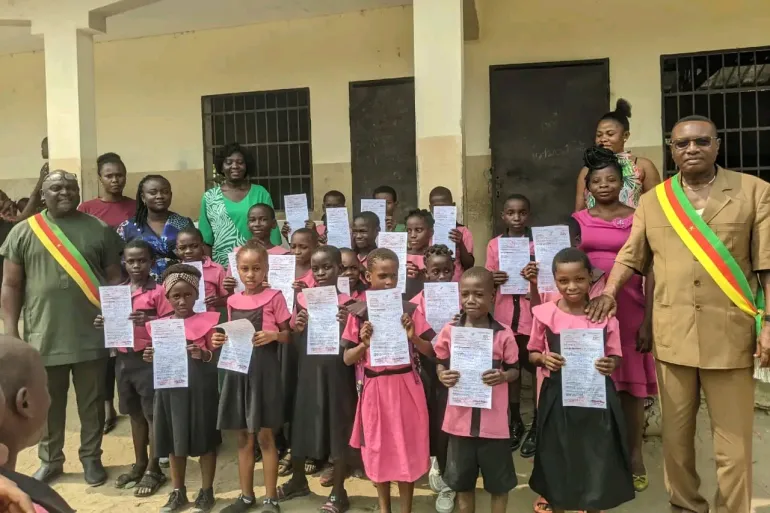
Garoua and Tiko, Cameroon – A year ago, Oumarou Sanda, mayor of Garoua 2 in northern Cameroon, raised a trophy above his head after his municipality was named Cameroon’s Citizenship Champion for its efforts to expand birth registration.
The recognition, awarded through UNICEF-supported initiatives in partnership with the Cameroonian government, marked months of work to address one of the country’s most persistent but often invisible child protection gaps: the absence of legal identity for thousands of children.
Under Cameroon’s civil status law, every child has the right to a birth certificate. Parents are expected to register births within 90 days at no cost. After that period, registration becomes more complex, and after one year, families must go through court procedures that are often costly, time-consuming, and difficult to navigate.
For many parents, that system remains out of reach.
“One of my eldest children was sent home years ago from school because we didn’t have his official papers,” says Aissatou Bouba, a mother of four living in Garoua 2.
That changed in 2024 when she brought her youngest child to a local health facility where staff registered the birth immediately after delivery, issuing the documents needed to establish his legal identity.
Her experience reflects a wider reality. According to Cameroon’s Ministry of Basic Education, more than 1.5 million children, about 30 percent of primary school pupils, are enrolled without birth certificates.
Without that documentation, the consequences often emerge later in life.

“If a child stays without a birth certificate, the child will not have admission into secondary school,” says Anna Enanga epse Itoe, head of the civil status bureau at the Tiko Council in Cameroon’s southwest region.
“It will be impossible to sit for public examinations. It will also be impossible to obtain a national identity card, which is needed to access many services,” she told Al Jazeera.
UNICEF estimates that, of the 560,000 births recorded in health facilities in 2023, only 43.77 percent were officially registered. The gap leaves many children exposed to risks that extend beyond education.
“Children without documentation are harder to trace, monitor, or protect,” says Alexis Mayang, a UNICEF child protection specialist based in Yaounde. “They can be moved across borders with fewer checks,” he told Al Jazeera.
He added that in conflict-affected areas, the lack of identification increases vulnerability to exploitation, including recruitment into armed groups.
A response to a protection gap
The push to address these gaps gained momentum after the first Mayors’ Forum on Birth Registration in April 2024, where local authorities signed a charter committing to strengthen civil registration systems in their municipalities.
Following the forum, UNICEF, working with the government and local partners, supported the rollout of the “My Name” campaign, aimed at identifying and registering children without legal documentation across Cameroon’s 360 councils and 14 cities.
![Members of the Tiko Council team conduct a community sensitization session for pregnant women at a local health center to highlight the importance of early birth registration [Lucrece Armande _ Social Voices]](https://i0.wp.com/www.aljazeera.com/wp-content/uploads/2026/06/Members-of-the-Tiko-Council-team-conduct-a-community-sensitization-session-for-pregnant-women-at-a-local-health-center-to-highlight-the-importance-of-early-birth-registration-Lucrece-Armande-_-Social-Voices-1782791789.jpg?w=640&ssl=1)
Since its launch, officials involved in the programme say more than 17,000 children have been registered.
Municipalities were assessed based on how effectively they improved registration systems, including setting up civil registration services within health facilities and identifying out-of-school children without documentation.
In Tiko, in the southwest, officials brought registration services closer to remote communities, working with traditional leaders to collect birth declarations from rural areas.
“In Tiko, people are coming every day to register their children and obtain birth certificates,” says Enanga. “We have issued documents to thousands of children.”
To manage demand, local chiefs played a central role in documenting births in hard-to-reach areas before forwarding records to council offices.
In Garoua 2, authorities took a different approach. Faced with delays caused by handwritten registers, the municipality shifted to digital civil status systems, allowing certificates to be issued within minutes.
Barriers that remain
Despite these gains, officials say significant challenges remain.
In many communities, birth registration is still not prioritised, with some parents only engaging with the system when children are denied access to schooling or barred from sitting national examinations.
![Mayors from Cameroon's top-performing municipalities, including Mayor Oumarou Sanda of Garoua 2 (center), are awarded for their exceptional efforts in deriving grassroots civil registration [Salomon Beguel _ UNICEF]](https://i0.wp.com/www.aljazeera.com/wp-content/uploads/2026/06/Mayors-from-Cameroons-top-performing-municipalities-including-Mayor-Oumarou-Sanda-of-Garoua-2-center-are-awarded-for-their-exceptional-efforts-in-deriving-grassroots-civil-registration-Salomon-Beguel-_-UNICEF-1782791781.jpg?w=640&ssl=1)
Schools often become the first point of enforcement, particularly at primary level, where pupils without documentation are turned away from key assessments.
Deeper social barriers also remain. Child protection workers say that in some rural communities, harmful norms persist, including beliefs that girls do not require formal documentation or education. These practices contribute to undocumented children and increase the risk of early or forced marriage.
Officials and community workers say traditional and religious leaders are increasingly being engaged in awareness campaigns aimed at changing these perceptions and encouraging earlier registration of births.
Globally, UNICEF estimates that 166 million children under the age of five remain unregistered. In Cameroon, officials say closing that gap will depend not only on administrative reform, but also on shifting how communities define a child’s legal existence.
“I was happy knowing that my son could get educated without any hindrance,” Bouba told Al Jazeera.