cam

Moment Justin Timberlake is cuffed after singer fails sobriety tests during drink driving arrest as body cam released

THIS is the moment Justin Timberlake is put in cuffs as the body cam footage of his arrest for drink driving is released.

The pop star, 45, was arrested in Sag Harbor, New York, in June 2024 after he failed to stop at a stop sign and could not stay in his lane.

This is the moment Justin Timberlake failed a sobriety test during a drink driving arrestCredit: Sag Harbour Police Department
The pop star was arrested in June 2024 for driving while intoxicatedCredit: Sag Harbour Police Department
Justin Timberlake’s mugshot following his arrestCredit: Getty

Shortly after leaving The American Hotel following a night out with friends, the singer was pulled over while traveling southbound on Madison Street, a public highway in the Hamptons village.

Cops, often stationed nearby, noticed Justin swerving on the road and blowing through a stop sign.

They later smelled alcohol on his breath and noted that he was unsteady on his feet and also had slowed speech and glassy eyes.

The body cam footage of his arrest was released on Friday after the star’s legal team reportedly tried to previously prevent its release.

GOING DOWN SWINGING

How Chuck Norris used loss to cement fame as Karate-kicking screen hero

In the video, an officer can be seen shining a flashlight in Timberlake’s face at the roadside before the star performs poorly on sobriety tests.

He is asked to walk in a straight line but has difficulty with the instructions, appearing confused.

Timberlake tells them: “Guys, I’m just following my friends back to my house. I’m not doing anything.”

While attempting the sobriety test, he stumbles before apologising and saying ” I’m a little nervous”.

When asked to do the next test, the officers are forced to explain multiple times before Timberlake says “sorry, my heart is racing” while clutching his chest.

Looking unsteady on his feet, the singer is then heard saying: “By the way, these are like, really hard tests.”

After failing the roadside tests, an officer is then seen asking Timberlake “turn around for me please”.

Saying nothing and looking resigned, he slowly turns before he’s put in handcuffs.

A friend appears and is shocked when police tell her Justin is going with them, saying: “You’re arresting Justin Timberlake? Stop it. What?”

She pleads with the officers to speak with him and give him his phone before she takes his car home.

Timberlake was eventually put in handcuffsCredit: Sag Harbor Police Department
The footage was released despite a challenge from his legal teamCredit: Sag Harbor Police Department

She begs: “Can you guys please do me a favour because you loved Bye Bye Bye or Sexy Back, do me one favour. This is insane.”

At the end of the footage, the 10-time Grammy winner can be seen in the back of a cop car behind bars.

He was taken into custody that night and arraigned in Sag Harbor Village Justice Court the following morning.

He was released without bail on his recognizance and was also charged with one count of DWI due to his refusal of the breathalyzer, according to Justin’s lawyer.

Timberlake’s lawyers previously sued the Village of Sag Harbor to prevent the release as it showed him “in an accutely vulnerable state”, reports CBS.

It was later agreed it would be released with redactions.

That September, Timberblake reached a plea deal to bring the case to an end.

The judge sentenced Justin to a $500 fine with a $260 surcharge, and 25 hours of community service at the nonprofit of his choosing.

After the sentencing, Justin said: “Even if you’ve had one drink, don’t get behind the wheel of a car.

“There are so many alternatives. You can call a friend [or] take an Uber.”

He added: “This is a mistake that I made, but I’m hoping that whoever is watching and listening right now can learn from this mistake. I know that I certainly have.”

During the proceedings the star remained standing throughout and gave a statement in which he expressed remorse for his actions.
He was unsteady on his feet when he was asked to walk in a straight lineCredit: Sag Harbor Police Department

Source link

‘Slow TV’, like Jackie and Shadow’s live cam, may be an antidote to turbulent times

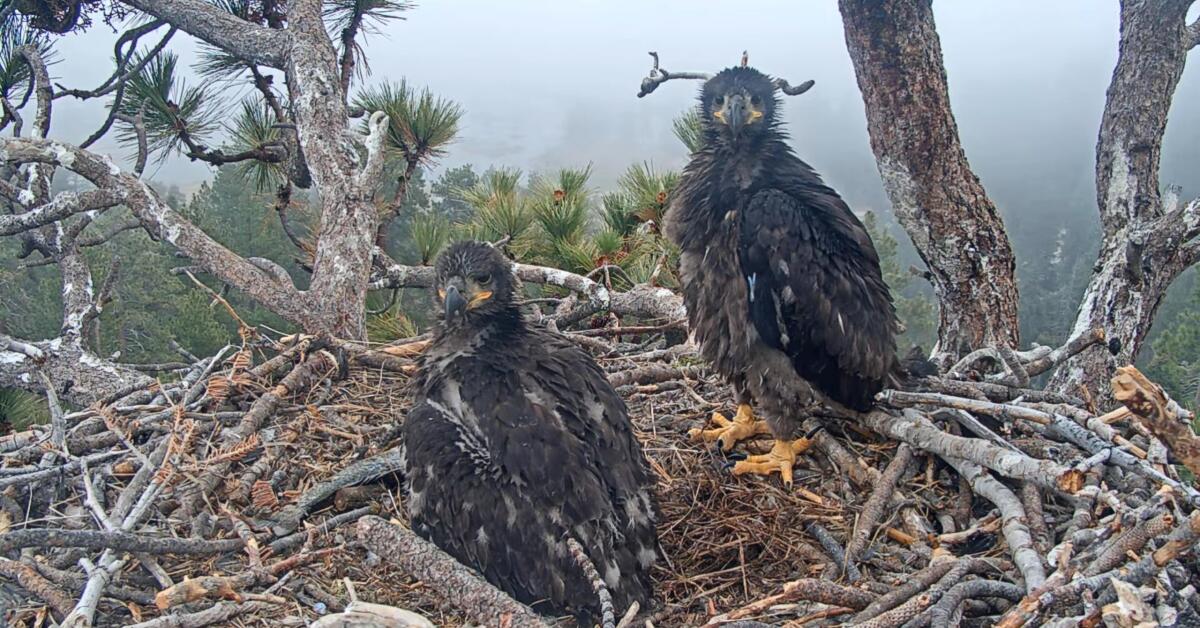
Erin Wagner lives in the Chicago suburbs but visits two bald eagles in Southern California’s Big Bear Valley nearly every day.

At work, the 41-year-old often plays a livestream featuring Jackie and Shadow on one of her monitors — a respite when she needs a break.

The avian power couple follows her home, keeping her company as she cooks dinner.

“We live in such a busy world, and things are always being thrown at our face, so sometimes it’s nice to just have a gentle reminder of nature and what else is out there in the world,” Wagner told me last week.

You’re reading Boiling Point

The L.A. Times climate team gets you up to speed on climate change, energy and the environment. Sign up to get it in your inbox every week.

By continuing, you agree to our Terms of Service and our Privacy Policy.

She is just one of many devoted fans; the eagles had the highest view count of any year-round nature livestream active on YouTube between last fall and this spring, said Rebecca Mauldin, an assistant professor at the University of Texas at Arlington who studies social connectedness.

While the eagles’ following is singular, it’s part of a broader trend: surging interest in webcams that broadcast nature, unadulterated, minute by minute, in all its messy glory.

The number of 24/7 livestreams created per year swelled by about 3,000% between 2019 and 2025, Mauldin’s data show.

Jackie and Shadow’s livestream exemplifies “Slow TV,” a genre that began with a 2009 Norwegian broadcast of a seven-hour train trip. It took off, with other marathon programs featuring chopping firewood and knitting.

Nature looms large in the format. Millions tune into Sweden’s live coverage of an annual moose migration, and the same goes for a seasonal broadcast of bears chowing down on salmon in Alaska.

The appeal makes intuitive sense. In a world of quick camera cuts, sound bites and troubling headlines, Mother Nature’s rhythms can be a salve. And with many of us wound up in concrete urbanity, the livestreams offer instant transportation to the wild.

Following Jackie and Shadow takes patience. If they’re not hanging out at the nest, it’s a waiting game until they come back. Even when they’re there, there may not be much going on.

Entertainment “can be very artificial, it can be very packaged, and it can be very short,” said Jenny Voisard, media manager for Friends of Big Bear Valley, the nonprofit that operates the cameras broadcasting the eagles. “This is long and slow and calm.”

Yet nature is unpredictable, another draw for viewers. This nesting season alone has brought plenty of drama, from the lovebirds losing their eggs to ravens to laying more not long after. Last week, I wrote about the couple’s shocking origin — it involves a love triangle! — and their rise to reality stardom.

Last year, Jackie and Shadow raised two chicks that fledged: Sunny and Gizmo

Last year, Jackie and Shadow raised two chicks that went on to fledge: Sunny and Gizmo

(Friends of Big Bear Valley)

Research backs the vibes. Those who watch nature livestreams — from platypi to osprey — report a host of benefits, from uplifted mood to relaxation, said Mauldin, citing a literature review she-coauthored.

Others get jazzed about learning about a particular species, she said.

There may be limitations, though.

In terms of connecting to nature, “I lean toward the effect is stronger if you’re actually outdoors, or, you know, you’ve got a little ant crawling on your finger and watching it,” Mauldin said.

She highlighted another dimension I didn’t think of: Many “talk about how they’re developing strong online relationships, and you can see it in the chats or in the comments.”

Someone might comment that they had a bad day and are glad to be watching their favorite birds again, and another viewer will rally to support them. Then there are people who watch on their own, but gab about it later with a friend.

Friends of Big Bear Valley, with 1.2 million followers on Facebook, offers more than just updates on the eagles. It’s a buzzing community center where fans can share their thoughts and engage with one another.

Animals may also get something out of being watched: protection.

The eagle cam, for example, “sort of stokes the public’s imagination and interest in conservation,” said Thomas Leeman, deputy chief of the U.S. Fish and Wildlife Service’s migratory bird program in the Pacific Southwest. “They start to really care about whichever particular birds that they’re watching.”

Wagner, of Chicago, said her husband and 14-year-old son sometimes give her a hard time about how invested she is in Jackie and Shadow.

But her cat, Oscar, shares her fascination.

She recently posted a photo of the feline on Jackie and Shadow’s Facebook — looking intently at a TV where an eagle hunkered down on the nest.

“My new cat is just as obsessed as all of us,” she wrote.

More recent wildlife news

Big Bear’s celeb eagles continue to keep us on our toes. Jackie recently vanished from the nest for nearly 24 hours, sending fans into a panic — but eventually reunited with her eggs and mate, reports USA Today’s Michelle Del Rey.

While we’re on the subject of avian kind: Last week, I wrote about a pair of condors that appear to be nesting in Northern California, something not seen for a century. The Yurok Tribe is leading the effort to bring the large, endangered vultures back to their historic homeland in Humboldt and Del Norte counties.

As conservationists celebrate that win, the story for birds nationwide is not so rosy. A recent study found that North America is rapidly losing birds, and the loss is accelerating, largely due to intensive agriculture and warming temperatures, writes the Associated Press’ Seth Borenstein.

A few last things in climate news

Trump’s war on Iran has disrupted global oil and gas supplies. The conflict has kept ships that carry millions of barrels of oil a day stranded in the Persian Gulf, and key Middle East facilities have sustained damage, reports the Associated Press.

Oil prices have spiked, and Californians are paying the highest price at the pump in the nation. As my colleague Iris Kwok explains, that’s due to the state’s higher taxes and stricter requirements for cleaner, more expensive gas that pollutes.

Sticker shock at gas stations is expected to spur more Americans to consider hybrid or electric vehicles, according to fellow Times staffers Caroline Petrow-Cohen and Blanca Begert.

Meanwhile, the U.S. Department of Justice has released a legal opinion that sets the stage to approve a controversial oil operation off the Santa Barbara County coast, The Times’ Grace Toohey reports.

This is the latest edition of Boiling Point, a newsletter about climate change and the environment in the American West. Sign up here to get it in your inbox. And listen to our Boiling Point podcast here.

For more wildlife and outdoors news, follow Lila Seidman at @lilaseidman.bsky.social on Bluesky and @lila_seidman on X.

Source link