californians

Becerra sees momentum, money and movement in the polls in governor’s race

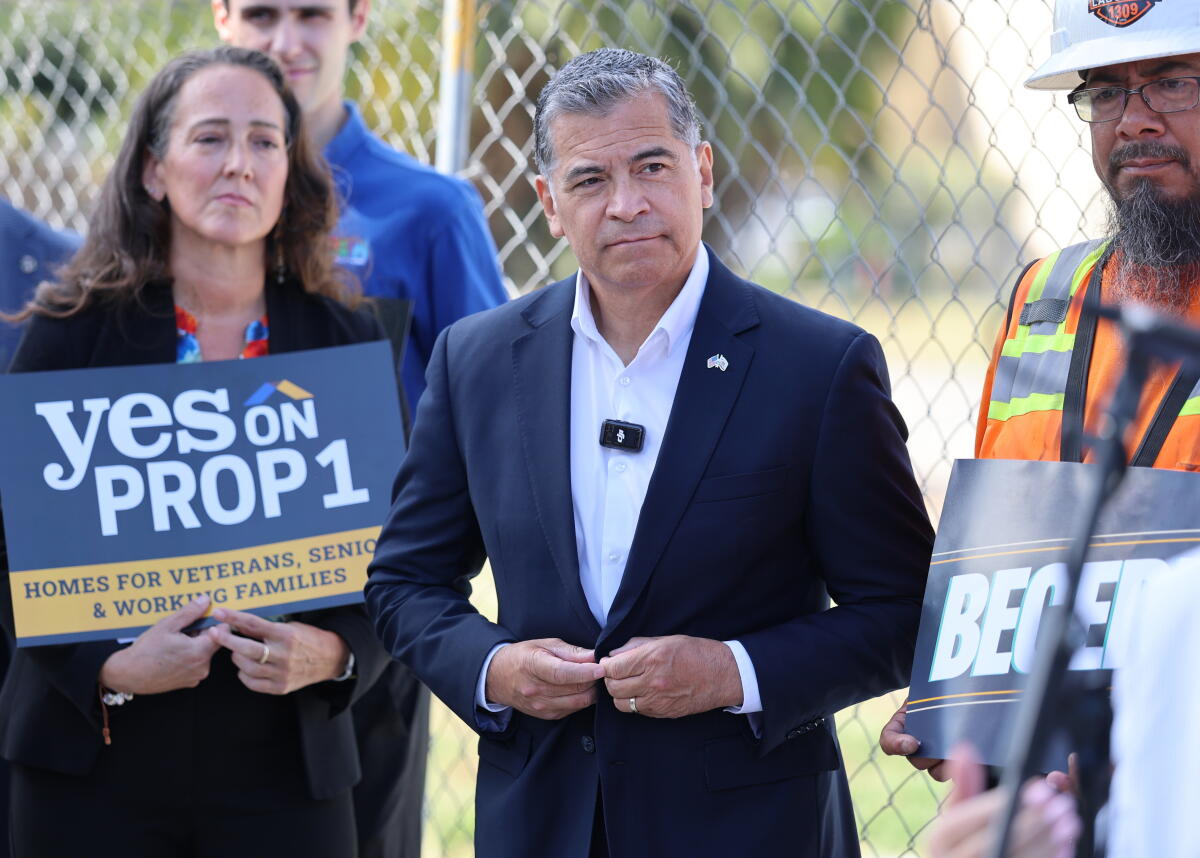
Xavier Becerra, a former cabinet secretary in President Biden’s administration, appears to be surging in the curiously unsettled California governor’s race.

Until recently, the former U.S. Health and Human Services secretary had been mired in the single digits in polling to replace termed-out Gov. Gavin Newsom and lead the nation’s most populous state.

But after former Rep. Eric Swalwell, (D-Dublin) dropped out of the race earlier this month amid accusations ofsexual assault and other misconduct Becerra has seen a boost in polls, fundraising and endorsements.

On Tuesday, Assembly Speaker Robert Rivas endorsed Becerra alongside 14 Democratic members of the legislative body.

Arguing that Californians are under constant threat from President Trump’s policies, Rivas cited Becerra’s decades-long record in public office, including defending Obamacare and young immigrants, or dreamers, to argue that Becerra is best positioned to lead the state.

“There’s no time to learn on the job — we need a governor who’s ready to fight back on day one,” Rivas said in a statement, noting that Becerra sued the Trump administration 122 times while he was California’s attorney general. “We have a strong Democratic field for governor. But right now, we need someone ready on day one. Xavier Becerra is that leader.”

Becerra said he was honored to receive the legislators’ backing.

“I look forward to working with the Speaker and legislators on Day One to tackle the problems Californians care about most — from the skyrocketing cost of groceries and housing to our unyielding fight against the Trump Administration’s disastrous policies,” he said in a prepared statement. “Californians need an experienced and trusted leader who doesn’t need on-the-job training.”

Despite Becerra’s long tenure in state and federal office, the unflashy politician is not well-known among California voters. He was among the underdogs in the 2026 gubernatorial race. Swalwell, by contrast, was among the leading Democratic candidates.

Amy Thoma, a former Republican strategist who is no longer affiliated with a political party, noted that Becerra’s surge comes at a critical moment in the election, shortly before ballots land in Californians’ mailboxes.

“Voters are starting to tune into the race. Yes, they want someone who will stand up to Trump, but it also seems they want someone with experience who can address the very real issues facing the state,” Thoma said.

She added that Becerra’s life story is “incredibly compelling.”

“The word authentic is overused, but every time he talks about his love for this state, for his family and wanting to make California work for everyone, it comes across incredibly sincere,” Thoma said. “Voters can see through candidates who fake it.”

Becerra was respected by colleagues across the aisle, including former GOP legislative leader and state Republican party chairman Jim Brulte. Both men were elected to the state Assembly in 1990 and though their politics often sharply differed. However, they had a warm relationship.

“He was progressive and I am a conservative,” Brulte said. “We never agreed much on policy, but he is a good man with a great heart.”

The 2026 governor’s race has been unlike any in recent memory, with no clear front-runner in a crowded field of candidates and voters just beginning to pay attention to the contest shortly before the June 2 primary.

There were two prominent Republicans and eight prominent Democrats in the race, leading to fears among Democratic leaders in the state that their party’s candidates could be shut out of the governor’s race in the general election because of California’s unique primary system. The two candidates who win the most votes in the June 2 primary will move onto the November general election, regardless of party affiliation.

Democratic leaders remain concerned that despite California’s sapphire-blue tilt, the number of their party’s candidates in the race could lead to a splintering of Democratic voters that results in two Republicans advancing to the November ballot.

Six prominent Democrats remain in the race, after Swalwell and former state Controller Betty Yee dropped out.

The race — lacking a global superstar such as Arnold Schwarzenegger or the scion of a storied political family and former governor like Jerry Brown — is ephemeral. Anything can happen before the June 2 primary.

But Becerra is having a moment. In addition to the new endorsements, he has seen notable movement in polls, most recently in a survey released Monday by the state Democratic party. Becerra jumped nine points from the party’s last poll, tying with billionaire Tom Steyer at 13%.

While Becerra will never be able to match Steyer’s deep pockets, he raised more than $1 million on ActBlue, the top Democratic fundraising platform, in the week ending on April 18, making him the biggest fundraiser on the site in the nation.

“Ninety-seven percent were first-time donors,” Becerra’s campaign said in a statement. “This is not a donor base being recycled. It is a movement being born.”

Source link

Governor’s race wildly unpredictable two weeks before Californians receive ballots

The most unpredictable California governor’s race in recent history took another set of dizzying turns on Monday, with former Health and Human Services Secretary Xavier Becerra surging after former Rep. Eric Swalwell dropped out in the face of sexual assault and misconduct allegations, and former state Controller Betty Yee ending her bid.

The race to replace termed-out Gov. Gavin Newsom is the first in a quarter of a century with no clear front-runner and a sprawling field of candidates who have been jockeying for the attention of Californians, who are just beginning to pay attention to the campaign two weeks before ballots arrive in their mailboxes.

“I certainly could not have imagined the twists and the disturbing turns that this race has taken,” Yee said as she announced she was dropping out. “But through it all, my values and my vision for California has never wavered.”

A poll released Monday by the state Democratic Party — its first since Swalwell (D-Dublin) dropped out — showed Becerra’s support jumped nine points to 13%, placing him in a tie with Tom Steyer, the billionaire hedge fund founder turned environmental warrior. Former Rep. Katie Porter of Orange County saw a slight bump to 10% from 7%, while the remaining Democrats in the contest were mired in the low single digits.

The party began the surveys out of concern that Democrats could be shut out of the governor’s race because of California’s unique primary system, where the top two vote-getters in the June 2 primary move on to the November general election regardless of political party.

“I continue to believe there are too many Democrats in the field,” California Democratic Party Chairman Rusty Hicks told reporters Monday. “My call for candidates to honestly assess the viability of their candidacy and campaigns still stands, especially if you are stalled in the single digits, seeing financial resources dry up and/or are failing to pick up additional support.”

Hicks and other party leaders and allies had unsuccessfully urged low-polling candidates to reconsider their candidacies before the filing deadline in an attempt to cull the field and avoid splintering the Democratic vote. Though most did not name candidates who they thought should think about their viability, Yee was widely believed to be among them.

Yee became emotional as she said on Monday that she decided to withdraw from the race because she wasn’t able to raise the resources necessary to compete in the state. She also said her message of competency and experience wasn’t resonating among voters who were seeking a fiery foil to President Trump, not “Boring Betty,” as she dubbed herself. Yee said she would assess the field before making an announcement on whether she would endorse one of her fellow Democrats.

Becerra was another candidate believed to be a target of party leaders’ efforts to shrink the field. But he held on and apparently benefited from Swalwell’s downfall.

“I’m not the richest candidate, I’m not the slickest candidate, but I am the guy that’s got you,” Becerra said, rallying supporters in Los Angeles on Saturday.

The audience was filled with members of labor groups backing the longtime politician, and Becerra told them he’d serve as a “union man” in the governor’s office.

Pro- and anti-Becerra forces tussled outside the town hall after two people, who declined to identify whom they were working for, passed out fliers highlighting critical media investigations of the U.S. Department of Health and Human Services during the migrant crisis when the agency was led by Becerra.

Pro-Becerra attendees grabbed the fliers and told the men to go away, prompting a security guard to intervene.

The question is whether Becerra, who also served as state attorney general, a member of Congress and a state Assembly member, can raise the funds necessary to compete in a state with some of the nation’s most expensive media markets. And he was tied in the state party poll with a billionaire who dumped an additional $12.1 million of his own money into his campaign last week.

Steyer’s total investment in his bid reached $133 million, according to the California secretary of state’s office. He also received the endorsement of Our Revolution, a progressive political organization founded by U.S. Sen. Bernie Sanders (I-Vt.).

“We’ve never endorsed a billionaire — but Tom Steyer is using his position to upset the system,” the group posted on X on Monday. “As Our Revolution executive director Joseph Geevarghese told @theintercept, ‘He’s been a partner in the movement. Most billionaires have used their wealth and privilege to lock in the status quo. Tom is doing the opposite.’”

San Jose Mayor Matt Mahan, who is also running for governor, accused Steyer of hypocrisy for the hedge fund he founded profiting from investments in private prisons being used to house ICE detainees, and Steyer calling for the abolishment of ICE.

Steyer got “rich investing off the ICE infrastructure he now wants to abolish,” Mahan posted on Instagram.

Steyer, who sold his stake in the hedge fund in 2012, has said he ordered the company to divest from the private prison company and has repeatedly expressed remorse about his former firm’s ties with the detention company.

Mahan also appeared Monday at a Hollywood production lot to announce his proposal for a special fund to lure sporting events, concerts and other productions to California as part of his plan to help the struggling film and television industry.

An independent effort supporting Mahan has also raised roughly $11 million since Swalwell left the race.

Mehta reported from Los Angeles and Nixon from Sacramento. Times staff writer Dakota Smith contributed to this report.

Source link

California Republicans rejoice over Swalwell scandal, but split on best GOP candidate for governor

While their spring convention was held beneath mostly sunny San Diego skies, delegates and leaders of the California Republican party basked in a different sort of glow over the weekend as the campaign for a leading Democratic candidate for governor imploded because of allegations of sexual assault and misconduct.

The party did not endorse a candidate for governor on Sunday because neither of the top Republicans — Riverside County Sheriff Chad Bianco and former Fox News host Steve Hilton — received the support of 60% of delegates. Bianco won 49% while Hilton had 44%; 7% of delegates voted not to endorse in the race.

“We’re very happy,” Bianco said after the vote. “We got the popular vote here, right? Ultimately, our goal is to win California, and you win California with the popular vote … Californians are looking for a leader. Californians are looking for integrity. Californians are looking for honesty. And they want someone that they know is going to be looking out for them, working for them, and that’s why I won this vote.”

Hilton also said he was pleased by his showing.

“Chad came into this convention thinking he had it in the bag,” Hilton said. “I think we made a lot of progress this week and I think the endorsement of President Trump is the one that’s gonna be decisive in the primary.”

The convention took place as a former staff member for Rep. Eric Swalwell (D-Dublin) accused him of forcing himself on her twice when she was too intoxicated to consent, according to reports published by the San Francisco Chronicle and CNN. Three other women also accused Swalwell of misconduct that included sending and soliciting explicit photos and messages.

Swalwell has not withdrawn from the race, but within hours of the allegations top supporters withdrew endorsements of the East Bay Area congressman, including Sen. Adam Schiff, campaign co-chairs Reps. Jimmy Gomez and Adam Gray, and prominent labor unions including the California Teachers Assn.

The collapse of Swalwell’s campaign brought a surge of energy to leaders and hundreds of die-hard members of a state Republican Party that holds a superminority in the state Legislature and no statewide elected offices. The news broke Friday, just as the party convention was getting underway at the bayside Sheraton San Diego Resort and hours before the Artemis II crew splashed down off the nearby coast.

Sean Spicer, a former press secretary during President Trump’s first term who is promoting a new book, joked during a Saturday brunch panel about landing in San Diego just in time to see “the fall.”

“Sorry, I was talking about Swalwell,” he said to laughter. “It was also cool to see Artemis come back down.”

Republicans have not won a statewide election since 2006 and some hoped Swalwell’s controversy would fuel voters already beleaguered by the cost of living to consider supporting GOP candidates this year.

“Quite frankly, Californians are, by and large, looking for viable alternatives. They’re looking towards the California Republican Party,” Chairwoman Corrin Rankin told reporters.

Republicans running to succeed Democratic Gov. Gavin Newsom shared similar visions during five-minute speeches at a Saturday afternoon candidate forum.

“We meet here today, full of energy and hope and optimism, with a spring in our step on this beautiful spring day. Why? Because every party has its season, and for the California Democrats, the leaves are cascading from the trees,” Hilton told delegates.

Hilton, who served as a top political advisor to U.K. Prime Minister David Cameron, argued that 16 years of Democratic rule has led to dysfunction, chaos and scandal that alarmed voters in the overwhelmingly blue state even before the Swalwell scandal.

“And now, it’s been a couple of hours, so I think we’re due for another Eric Swalwell intern eruption,” he said.

Hilton touted Trump’s endorsement, describing it as a “tremendous asset for us, the energy, the resources, the precious gift of having the boost that makes the biggest difference in a midterm year turnout.”

Bianco emphasized his decades serving in law enforcement in the state, one of his main selling points to Californians concerned about liberal criminal justice policies of past Democratic administrations.

“I have spent every day serving California residents, making our lives better and safer. I have fought for you, and I have bled for you,” Bianco said.

Bianco refuted Hilton’s allegations that he coddled undocumented immigrants, sympathized with Black Lives Matter protesters and threatened county residents with punishment if they did not abide by mask mandates during the pandemic. He said he was the first law-enforcement official in the nation to defy a lockdown order after the pandemic. Bianco said that while he prayed with protesters in the aftermath of George Floyd’s death, he also “forcefully” expelled “rioters and domestic terrorists” from his county.

Bianco also obliquely referred to attacks Hilton has lobbed against the sheriff on the campaign trail.

“This was never supposed to be about a dishonest smear campaign and bullseyes,” Bianco said, referring to a mailer Hilton’s campaign sent to voters that pictured Bianco’s head with circles around it that resemble a shooting target.

As Bianco walked through the bayfront convention hotel after the forum, he was swarmed by supporters chanting his name.

Saturday night, Bianco hosted a western-saloon themed party for delegates. Attendees wearing cowboy hats line danced, petted fluffy white calves and posed for pictures in front of an inflated cactus.

A Hilton-hosted party took on the feel of a candidate forum as he and Republican allies running for other statewide offices gave another round of speeches, often punctuated by shushing attendees who chattered in the back of the room.

Under California’s top-two primary system, the two leading candidates advance to the general election regardless of party affiliation. For weeks, Hilton and Bianco have led polls while eight prominent Democrats including Swalwell split the support of liberal voters, stoking anxiety among Democrats that the party could end up shut out of the November election.

The chances of that happening diminished with Swalwell’s fall from grace and Trump’s endorsement of Hilton, political experts said, but those in the conservative wing of California politics celebrated the apparent downfall of the once-powerful Democrat.

Swalwell is “in denial right now, but once he realizes he doesn’t have any friends left and his campaign team is leaving him, people are laughing at him in the restaurant, I think, and I hope for his sake, he has enough self-awareness that he’ll quietly drop out and go to the south coast of France and put on a wig,” said Republican National committeeman Shawn Steel.

One of the convention’s celebrated speakers, Sen. Ted Cruz (R-Texas) took shots at other California Democrats during a Saturday evening banquet, describing Los Angeles Mayor Karen Bass as “the Democrats’ national ambassador for disaster management” and Newsom as a contender for “Texas Realtor of the year, because no person in human history has sold more homes in the state of Texas.”

“Look, as a Texan, I gotta say, just isn’t fair. [You have] an economy that has been a monstrous engine driving America forward for decades, and yet you were cursed with idiot politicians,” Cruz said.

While Hilton‘s and Bianco’s campaigns have sparred about their respective records, the candidates largely avoided direct confrontation until a debate earlier this month in Rancho Mirage. The two GOP candidates tore into each other about issues such as immigration, their credentials and their honesty.

Delegates also sparred about Bianco and Hilton’s records in the halls of the convention.

Shiva Bagheri, a Bianco supporter from Beverly Hills, said that Hilton’s political positions are not constitutional.

“Steve said that anybody that makes under $100,000 shouldn’t pay [income] taxes,” said Bagheri, 52. “That’s against the 14th Amendment. I’m a constitutionalist.” She said she preferred Bianco’s plan to cut income taxes for everyone to avoid class warfare.

Celeste Greig, a Hilton supporter from Northridge, initially supported Bianco and donated to his campaign. But she grew troubled after hearing about Bianco’s comments about immigration, seeing images of the sheriff taking a knee alongside BLM protesters and learning of what she believes was an unlawful arrest of a person outside of President Trump’s 2024 rally in the Coachella Valley.

Some Republicans longed for a return to a bygone era when state lawmakers regularly worked across the aisle. State Sen. Tony Strickland (R-Huntington Beach) described teaming up with Democratic Sen. Alex Padilla when they served in the Legislature, adding that he still considers Padilla, now the state’s senior U.S. senator, a friend.

“We’re in a divided era right now,” Strickland said. “If we actually pick up a few more seats, I think it will give more comfort to some of those moderate Democrats to come over and work with us.”

Source link

Democracy at risk, California needs new voting protections, poll shows

Strong majorities of California voters believe American democracy is under attack and, in the wake of U.S. Supreme Court rulings narrowing federal protections, support enacting a new state Voting Rights Act to prohibit discrimination and efforts to suppress the ability to cast a ballot, a new poll showed.

The survey showed a sharp partisan divide over increasing voting rights protections, with Democrats and political independents overwhelmingly in favor and a majority of Republicans opposed. Fears that American democracy was either under attack, or at the very least being “tested,” were shared across political allegiances, according to a new poll released Thursday by the UC Berkeley Institute of Governmental Studies.

“I think that it suggests that the California voters, especially Democrats and independents, are very worried about some of what they’ve seen going on in Washington, both the court decisions and the Trump administration,” said Eric Schickler, the institute’s co-director. “They see it as threatening kind of core American values.”

That anxiety comes after years of baseless claims by President Trump that the 2020 election was stolen from him, as well as Republican-led efforts to restrict the use of mail-in ballots and impose new requirements for voters to show identification and proof of citizenship.

Trump earlier this week signed an executive order to place new federal controls on voting by mail in states such as California, an action that Democrats called unconstitutional and vowed to challenge in court.

Schickler said Republican concerns about the fate of American democracy may stem in large part from allegations about voter fraud hyped by Trump and his supporters, including unfounded claims that droves of undocumented immigrants are swaying elections.

The survey found that 67% of California voters believe American democracy is under attack, including 84% of Democrats, 40% of Republicans and 64% of voters registered as “no party preference” or with other political parties. An almost equal number of Republicans, 38%, believed democracy was being “tested” but not under attack, compared with 13% of Democrats and 26% of independents. The remainder of those surveyed said American democracy is in no danger.

The partisan divide was more pronounced when voters were asked if they wanted California to enact its own Voting Rights Act after decisions by the Supreme Court limited federal protections against discrimination and unequal access to ballots, the poll found.

Overall, 66% of California registered voters backed adopting new state voter protections, with 88% of Democrats supporting new laws compared with 25% of Republicans and 66% of voters who are political independents or belong to other parties. Support for new state laws was strongest among Black voters — 72% — who historically have been targeted with discriminatory voting policies, including Jim Crow-era laws such as literacy tests and poll taxes.

The federal Voting Rights Act of 1965 banned those policies, ensuring that the right to vote cannot be denied because of race. The law also ensured that Black Americans and other communities of color had the opportunity to participate in all parts of the political system and elect the leaders of their choosing, influencing how political districts are drawn. The act was reauthorized by Congress in 2006 by an overwhelming bipartisan majority.

“Now it has come to the point where the president has tried to convince people that somehow equal voting rights is bad, because, in his words, ‘The wrong people are voting right,’” said Matt Barreto, faculty director of the UCLA Voting Rights Project, referring to Trump. “You have super majorities, very large percentages of Californians, who want the state to do more to protect voting rights, I think, because of the very tenuous climate right now, with the president constantly going after states for vote by mail and trying to get their voter rolls and these other sorts of things.”

Recent rulings by the conservative-leaning Supreme Court also have rolled back federal protections under the Voting Rights Act. A pending case, Louisiana vs. Callais, which involves the drawing of congressional districts, may overturn some of the remaining protections, Barreto said.

“I think people should be extremely nervous this court has not shown a lot of support for voting rights, and that’s the reason why California has an opportunity to pass its own state laws,” he said.

Among the laws California legislators could adopt, Barreto said, would be protections for early voting, banning onerous requirements on voters to prove citizenship and provide identification, and ensuring that congressional and other political districts are created to allow minority groups to elect representatives of their choice.

The Berkeley poll also found widespread support among California voters for requiring that the top three financial backers supporting and opposing ballot measures be listed in official ballot voter guides. A majority of Californians also supported expanding access to translation and interpreter assistance for populations that make up at least 5% or 5,000 voters in a county.

The Berkeley IGS poll surveyed 5,109 California registered voters online in English and Spanish from March 9 to 15. The results are estimated to have a margin of error of 2.5 percentage points in either direction in the overall sample, and larger numbers for subgroups.

Funding for the poll was provided to IGS by the Evelyn and Walter Haas, Jr. Fund, a private foundation based in San Francisco that aims to increase civic participation and improve the state’s democratic processes.

Source link

Most Californians still disapprove of immigration crackdown, poll says

Two-thirds of California voters disapprove of President Trump’s immigration policies and a majority believe those policies are discriminating against Latinos, according to a new poll.

Nearly half of the voters said they were concerned that they, a family member or a close friend could be detained because of Trump’s immigration policies.

The findings of the UC Berkeley Institute of Governmental Studies poll, released Wednesday, show that most Californians haven’t budged on their thoughts about the president’s approach to immigration since he returned to office. A poll last August similarly showed strong disapproval of the Trump administration’s approach to immigration enforcement.

The poll, which was conducted for the Los Angeles Times, showed the usual division along party lines when voters were asked whether they trust the U.S. Border Patrol and Immigration and Customs Enforcement, whether agents should wear masks while on duty, and whether Latinos are being discriminated against.

“This suggests that a significant number of voters see ICE infringement on the individual rights of the undocumented as also potentially leading to broader infringements on citizens’ rights,” said G. Cristina Mora, co-director of the institute and a sociology professor at UC Berkeley who studies race and immigration.

“Latino voters also seem to particularly worry about the way that racism is motivating current immigration practices,” she said, which is likely tied to the Supreme Court’s approval of immigration agents detaining people on the basis of their perceived race, ethnicity, language or occupation.

The overall disapproval among voters of Trump’s immigration policies — 64% — was down a bit from the August poll, in which 69% of respondents said they disapproved of how immigration enforcement was being carried out in California.

Republicans appear to be more approving of immigration policies now, with 86% saying they approve of Trump’s immigration policies — up from 79% approval of enforcement in California last August.

Mora said the tilt among California Republicans toward the Trump administration could be due, in part, to the framing of the question, which asked about “President Trump’s immigration policies.”

Any time Trump’s name is included, Republicans are more likely to agree with him, she said. The same effect is seen when asking about other issues, such as the economy.

Another factor could be the timing, Mora said. Last summer, federal agents conducted widespread raids in Los Angeles before moving on to target other cities, such as Chicago and Minneapolis.

Now that the administration has shifted away from some tactics that resulted in escalations of violence, Republicans are “falling in line” again with the administration, she said.

“My hunch is it was shocking,” Mora said of the immigration raids last summer. “Things have normalized because the tension is somewhere else.”

Seeking to de-escalate after two protesters were shot and killed by federal agents in Minneapolis, the president tapped his border advisor Tom Homan to take control of the immigration enforcement operation there.

Republican strategist Ford O’Connell said that’s why voters are more supportive.

“Tom Homan being in charge and publicly taking a much lighter touch and appearing reasonable to the average voter is why you’re seeing this turnaround,” he said.

But Democratic strategist Maria Cardona said that that’s wishful thinking and that ICE’s approach hasn’t substantially changed.

“It only went down five points,” she said, referring to the disapproval of Trump’s policies. “That’s not the American people being on the side of the administration — it’s that they’re not seeing American citizens murdered on their screens every day.”

One question saw strong division among Republicans: Should immigration agents be allowed to enter the homes of suspected undocumented immigrants without a judge-approved search warrant?

Among California Republicans, 45% said no, 38% said yes, and 17% said they have no opinion.

O’Connell said that’s because Republicans strongly value civil liberties, especially around property.

Republicans were more strongly in favor of a different policy, allowing ICE agents to wear masks while on duty. While 91% of Democrats opposed the policy, 68% of Republicans favored it.

In the August poll, 45% of Republicans said federal agents should be required to show clear identification when carrying out their work. That desire for identification doesn’t appear to extend to being fully identifiable by face.

O’Connell said Republicans understand the concern over agents increasingly being doxxed.

“The administration wants to find a happy medium there, whether it’s a nameplate or a badge number,” he said. “There is wiggle room.”

Nearly 7 in 10 respondents said they want state and local authorities to intervene when they witness unlawful detentions or excessive use of force by federal immigration agents.

Voters were also asked about their level of concern that they, a family member or a close friend could be detained because of Trump’s immigration policies. While 85% of Republicans said they are not too concerned or not concerned at all, 63% of Democrats said they are somewhat or very concerned.

Overall, nearly half of the respondents, 45%, said they are somewhat or very concerned. Among racial and ethnic groups, 62% of Latino voters, 46% of Black voters and 43% of Asian or Pacific Islander voters said they are somewhat or very concerned.

“The Latino community has always wanted to think the best of this country and they still do,” Cardona said. “Our positivism, our optimism, our hope in a better future is second to none. I think that’s what you’re seeing in those numbers, even as our community feels totally attacked.”

Mora said the high concern among Black residents is notable because, while most Black Californians aren’t immigrants themselves, Los Angeles has one of the largest concentrations of Blaxicans — the children of one Black parent and one Latino parent.

Beyond intermarriages, Black residents in California are also likely to have immigrant friends or neighbors, she said.

O’Connell took a different view: “I don’t think we can glean anything from it other than how one party focuses more on identity politics than the other.”

The Institute of Governmental Studies poll was completed online in English and Spanish from March 9 to 15 by 5,109 registered voters in California.

Source link

Californians may need to mail ballots early as Supreme Court signals support for new election day deadline

Californians may be forced to put their ballots in the mail well before election day to be certain they will be counted.

That’s the likely outcome of a Republican challenge to mail ballots that came before the Supreme Court on Monday.

The court’s six conservatives sounded ready to rule that federal law requires that ballots must be received by election day if they are to be counted as legal.

In the 19th century, Congress set a national day for federal elections on a Tuesday in early November, but it did not say how or when states would count their ballots. The Constitution leaves it to states to decide the “times, places and manners for holding elections.”

California and 13 other states count mail ballots that were cast before or on election day but arrive a few days late. And most states accept late ballots from members of the military who are stationed overseas.

By law, California counts mail ballots that arrive within seven days of election day. In 2024, more than 406,000 of these late-arriving ballots were counted in California, about 2.5% of the total.

Other Western states — Washington, Oregon, Nevada and Alaska — also count late-arriving mail ballots.

But President Trump has repeatedly claimed that voting by mail leads to fraud, and the Republican National Committee has gone to court to challenge the state laws that allow for counting the legally cast ballots of citizens which are postmarked on time but arrive late.

GOP lawyers argued that the phrase “election day” has always meant ballots must be in the hands of election officials on that day. In their questions and comments, all six conservatives agreed.

Justice Samuel A. Alito Jr. saw a real prospect of fraud. There could be “a big stash of ballots” that arrive late and “flip the outcome,” he said.

Democrats and election law experts say that the proposed new rule conflicts with more than a century of practice, because most states allowed for some people to vote by mail if they were traveling on election day. They argued that election day is like the federal tax day of April 15. While tax returns must be postmarked then, the tax returns are legal even if they arrive at the Internal Revenue Service a few days later.

The GOP filed its challenge in Mississippi, which accepts ballots that arrive up to five days after election day. A district judge rejected the claim, but a 5th Circuit Court panel with three Trump appointees ruled that ballots are illegal if they are not received by election day.

The case before the court is Watson vs. Republican National Committee.

California has been criticized for taking weeks to count all the votes, but that issue was not raised in this case.

Source link

Newsom leads Harris for president among California Democrats, poll finds

Californians have never been forced to choose between Gavin Newsom and Kamala Harris, two homegrown political darlings, during any election.

But if the state’s registered Democrats picked now, Newsom would trounce Harris as their party’s next nominee for president and have the edge over other Democratic contenders, according to a poll released Friday by the UC Berkeley Institute of Governmental Studies and co-sponsored by The Times.

Twenty-eight percent of the California Democrats who were surveyed selected the governor as their top choice in the 2028 presidential election. U.S. Rep. Alexandria Ocasio-Cortez (D-New York) followed with 14% and former U.S. Transportation Secretary Pete Buttigieg received 11%. Harris came in fourth, with only 9% of voters in her own state naming her as their preferred Democratic nominee.

“It’s quite a positive result for Newsom,” said Mark DiCamillo, director of the Berkeley IGS Poll. “He’s separated himself from the rest of the pack, and especially when you compare him to the other major Californian in the considerations, he’s three times as much as Kamala. That’s quite impressive.”

The political careers of the governor and former vice president have orbited each other but never crossed since Newsom was sworn in as San Francisco’s mayor and Harris as the city’s district attorney on the same day in 2004. Now the two Bay Area natives are both flirting with the 2028 presidential contest as they travel the country promoting their life stories on respective book tours.

It’s early days and neither politician has said they will or won’t launch official campaigns for the Oval Office. The possibility remains that Californians might finally see a matchup that the two Democrats have long avoided.

Newsom set his sights on the governor’s office in 2010 before dropping out and running for lieutenant governor, a largely powerless post in which he served in the shadow of Gov. Jerry Brown for eight years. Harris won election that year as California attorney general.

Harris’ and Newsom’s paths diverged again when she chose to run for U.S. Senate in a 2016 contest to replace former Sen. Barbara Boxer and he announced his candidacy for governor in the 2018 election.

When Harris jumped into the 2020 and 2024 races for the White House, Newsom said he wouldn’t run against her. He’s discredited the idea that the two politicians have some kind of a sibling rivalry and noted that their trajectories ran adjacent and never collided.

Newsom was asked again last month whether he would vie against Harris in a presidential contest. The governor said he hasn’t “gotten in the way of her ambition ever,” and he doesn’t imagine that he would in the future. His answer changed when he was pressed to respond specifically to the potential for 2028.

“That’s fate. I don’t, I don’t know,” Newsom said to CNN’s Dana Bash, throwing up his hands. “You know, you can only control what you can control.”

Newsom and Harris had greater support from Black and Latino voters than white and Asian American Democrats in the new poll. She performed well among Democrats younger than 30 compared with other age groups, while Newsom fared better with older Democrats. More women selected Newsom as their first or second choice than they did Harris.

Neither California heavyweight performed particularly great among Democratic voters in the Bay Area, which DiCamillo called a curious finding for two politicians from the region. Support was higher for Harris and Newsom in almost every other region of the state.

DiCamillo believes the presence of Ocasio-Cortez on the list probably pulled some support from Harris. California voters in other recent polls were also sour on a third presidential run by Harris.

An Institute of Governmental Studies poll in August gauged interest in the potential candidacy of Newsom and Harris. About 45% of the state’s registered voters said they were enthusiastic about Newsom running, compared with 36% for Harris. Almost two-third of voters in that survey, and half of Democrats, said Harris should not run for president again.

Although Newsom clearly beat the field of candidates in the most recent poll, DiCamillo said receiving support from a little more than a quarter of those surveyed in his own backyard isn’t exactly wonderful. The governor’s approval rating is also down.

The poll found that 48% of California registered voters say they approve of the job Newsom is doing, with the same share disapproving of his performance. That marks a drop from 51% approval the last time DiCamillo asked in August. Disapproval also climbed, by 5 percentage points.

Voters held positive opinions about Newsom’s participation in international conferences, which was described in the poll as the governor “offering an alternative to the policies being promoted by President Trump on issues like climate change and the economy.” The poll found 59% of statewide registered voters approve and 37% disapprove.

Cristina G. Mora, co-director of the poll, said the results suggest Newsom’s more aggressive stance with Trump seems to resonate in his own state.

“Though Californians may hold mixed views on his gubernatorial tenure, they overwhelmingly see him as the strongest counter to Trump and MAGA candidates,” Mora said. “Harris’s earlier presidential defeat, compounded by persistent voter biases against women and candidates of color, may also be shaping these early numbers.”

The Berkeley IGS/Times poll surveyed 5,019 California registered voters online in English and Spanish from March 9 to 14. The results are estimated to have a margin of error of 2.5 percentage points in either direction in the overall sample, and larger numbers for subgroups.

Source link

Californians can now act to save dogs from hot cars

 (Kevin Chang / Daily Pilot)
(Kevin Chang / Daily Pilot)

Gov. Jerry Brown on Saturday signed into law a measure allowing Californians to break into vehicles to rescue animals if they appear to be in danger from excessive heat.

The bill by Assemblyman Marc Steinorth (R-Rancho Cucamonga), Miguel Santiago (D-Los Angeles) and others was introduced after a series of incidents in which dogs died after being left in closed cars on hot days.

“We’re very excited about the lives this new law will save,” Steinorth said in a statement Saturday on Facebook. “Thank you to everyone who helped us raise awareness of this serious issue and showed their support.”

Under AB 797, a citizen must first call law enforcement to report a situation in which he or she believes an animal to be in peril.

But if the animal is in imminent danger, the car is locked, and law enforcement is not arriving quickly enough to save the animal’s life, the bill provides immunity from civil and criminal liability to a person causing vehicle damage for the purpose of rescuing the animal. The measure was supported by the Humane Society of the United States and the Los Angeles district attorney’s office.

Latest updates


Source link