california governor

Standards have changed what we consider a political scandal

A few weeks ago, Katie Porter’s campaign for California governor was reeling. A day after an irritable TV interview went viral, an old video surfaced of the former Orange County congresswoman cursing and berating one of her aides.

Around the same time, the race for U.S. Senate in Maine was shaken by a number of disturbing online posts. In them, Democratic hopeful Graham Platner disparaged police and Black people, among other crude remarks. Soon after, it was revealed Platner had a chest tattoo resembling a Nazi symbol.

Meanwhile, in Virginia, several old text messages swallowed attorney general nominee Jay Jones in a cumulus of controversy. The Democrat had joked about shooting the Republican leader of the state House and blithely spoken of watching his children die in their mother’s arms.

Once — say, 20 or 30 years ago — those blow-ups might have been enough to chase each of those embattled candidates from their respective races, and maybe even end their political careers altogether.

But in California, Porter has pressed on and remains in the top tier of the crowded gubernatorial field. In Maine, Platner continues to draw large, enthusiastic crowds and leads polling in the Democratic primary. In Virginia, Jones was just elected attorney general, defeating his Republican opponent by a comfortable margin.

Clearly, things have changed.

Actions that once caused eyes to widen, such as the recreational puffs of marijuana that cost appeals court judge Douglas Ginsburg a Supreme Court seat under President Reagan, now seem quaint. Personal indiscretions once seen as disqualifying, such as the extramarital affair that chased Gary Hart from the 1988 presidential race, scarcely raise an eyebrow.

American politician Gary Hart sits on a dock with Donna Rice on his lap

Gary Hart quit the 1988 presidential race soon after reports surfaced of an extramarital affair. He later unsuccessfully jumped back into the contest.

(Getty Images)

And the old political playbook — confession, contrition, capitulation — is obviously no longer operative, as candidates find it not only possible but even advantageous to brazen their way through storms of uproar and opprobrium.

Look no further than the extravagantly checkered occupant of the White House. Donald Trump has seemingly survived more controversies — not to mention two impeachments, an $83.3-million judgment in a sexual abuse and defamation case and conviction on 34 felony counts — than there are stars winking in the nighttime sky.

Bill Carrick has spent decades strategizing for Democratic office-seekers. A generation or so ago, if faced with a serious scandal, he would have told his candidate, “This is not going to be sustainable and you just better get out.” But now, Carrick said, “I would be very reluctant to tell somebody that, unless there was evidence they had murdered or kidnapped somebody, or robbed a bank.”

Kevin Madden, a veteran Republican communications strategist, agreed. Surrender has become passe. Survival is the new fallback mode.

“The one thing that many politicians of both parties have learned is that there is an opportunity to grind it out, to ride the storm out,” Madden said. “If you think a news issue is going viral or becoming the topic everyone’s talking about, just wait. A new scandal … or a new shiny object will be along.”

One reason for the changing nature of political scandal, and its prognosis, is the way we now take in information, both selectively and in bulk.

With the chance to personally curate their news feed — and reinforce their attitude and outlook — people can select those things they wish to know about, and choose those they care to ignore. With such fragmentation, it’s much harder for a negative storyline to reach critical mass. That requires a mass audience.

“A lot of scandals may not have the impact that they once had because people are in these silos or echo chambers,” said Scott Basinger, a University of Houston political scientist who’s extensively studied the nature of political scandal. “They may not even hear about it, if they don’t want to hear about it.”

The sheer velocity of information — “not only delivered to you on your doorstep, or at 6:30 p.m. by the three networks, but also in your pocket, in your hand at all times, across multiple platforms,” as Madden put it — also makes events more fleeting. That makes it harder for any one to penetrate deeply or resonate widely.

“In a world where there’s a wealth of information,” he said, “there’s a poverty of attention.”

Seven months after abruptly dropping out of the 1988 presidential race, Hart jumped back into the contest. “Let’s let the people decide,” he said, after confessing his marital sins.

(He also said in the same interview, a few months before relaunching his candidacy, that he had no intention of doing so.)

Hart did not fare well. Once he’d been the overwhelming front-runner for the Democratic nomination. As a reincarnated candidate, he trudged on for a few months before dropping out for good, having failed to secure a single convention delegate or win double-digit support in any contest.

“The people have decided,” he said, “and now I should not go forward.”

That’s how it should be.

Porter in California and Platner in Maine both faced calls to drop out of their respective races, with critics questioning their conduct and whether they had the right temperament to serve, respectively, as California governor or a U.S. senator. Each has expressed contrition for their actions. (As did Jones, Virginia’s attorney general-elect.)

Voters can take all that into account when they pick their candidate.

If they want a governor who drops f-bombs and snaps at aides, a senator with a history of off-putting remarks or — gulp — an adulterous convicted felon in the White House, that’s their choice.

Let the people decide.

Source link

Swalwell suit alleges abuse of power in Trump official’s mortgage probes

In a fiery rebuttal to allegations he’d criminally misrepresented facts in his mortgage documents, Rep. Eric Swalwell (D-Dublin) sued Federal Housing Finance Agency Director Bill Pulte on Tuesday — accusing him of criminally misusing government databases to baselessly target President Trump’s political opponents.

“Pulte has abused his position by scouring databases at Fannie Mae and Freddie Mac — two government-sponsored enterprises — for the private mortgage records of several prominent Democrats,” attorneys for Swalwell wrote in a federal lawsuit filed in Washington, D.C. “He then used those records to concoct fanciful allegations of mortgage fraud, which he referred to the Department of Justice for prosecution.”

They said Pulte launched his attack on Swalwell at a particularly inopportune time, just as Swalwell was launching his campaign for California governor.

Pulte’s attack, Swalwell’s attorneys wrote, “was not only a gross mischaracterization of reality” but “a gross abuse of power that violated the law,” infringing on Swalwell’s free speech rights to criticize the president without fear of reprisal, and violating the Privacy Act of 1974, which they said bars federal officials from “leveraging their access to citizens’ private information as a tool for harming their political opponents.”

Pulte, the FHFA and the White House did not immediately respond to requests for comment Wednesday.

Pulte has previously defended his work probing mortgage documents of prominent Democrats, saying no one is above the law. His referrals have exclusively targeted Democrats, despite reporting on Republicans taking similar actions on their mortgages.

Swalwell’s lawsuit is the latest counterpunch to Pulte’s campaign, and part of mounting scrutiny over its unprecedented nature and unorthodox methods — not just from targets of his probes but from other investigators, too, according to one witness.

In addition to Swalwell, Pulte has referred mortgage fraud allegations to the Justice Department against Sen. Adam Schiff (D-Calif.), New York Atty. Gen. Letitia James and Federal Reserve Governor Lisa Cook, who have all denied wrongdoing and suggested the allegations amount to little more than political retribution.

James was criminally charged by an inexperienced, loyalist federal prosecutor specially appointed by Trump in Virginia, though a judge has since thrown out that case on the grounds that the prosecutor, Lindsey Halligan, was illegally appointed. The judge also threw out a case against former FBI Director James Comey, another Trump opponent.

Cook’s attorneys slammed Pulte in a letter to the Justice Department, writing that his “decision to use the FHFA to selectively — and publicly — investigate and target the President’s designated political enemies gives rise to the unmistakable impression that he has been improperly coordinating with the White House to manufacture flimsy predicates to launch these probes.”

Schiff also has lambasted Trump and Pulte for their targeting of him and other Democrats, and cheered the tossing of the cases against James and Comey, calling it “a triumph of the rule of law.”

In recent days, federal prosecutors in Maryland — where Schiff’s case is being investigated — have also started asking questions about the actions of Pulte and other Trump officials, according to Christine Bish, a Sacramento-area real estate agent and Republican congressional candidate who was summoned to Maryland to answer questions in the matter last week.

Pulte has alleged that Schiff broke the law by claiming primary residence for mortgages in both Maryland and California. Schiff has said he never broke any law and was always forthcoming with his mortgage lenders.

Bish has been investigating Schiff’s mortgage records since 2020, and had repeatedly submitted documents about Schiff to the federal government — first to the Office of Congressional Ethics, then earlier this year to an FHFA tip line and to the FBI, she told The Times.

When Trump subsequently posted one of Schiff’s mortgage documents to his Truth Social platform, Bish said she believed it was one she had submitted to the FHFA and FBI, because it was highlighted exactly as she had highlighted it. Then, she saw she had missed a call from Pulte, and was later asked by Pulte’s staff to email Pulte “the full file” she had worked up on Schiff.

“They wanted to make sure that I had sent the whole file,” Bish said.

Bish said she was subsequently interviewed via Google Meet on Oct. 22 by someone from the FHFA inspector general’s office and an FBI agent. She then got a subpoena in the mail that she interpreted as requiring her to be in Maryland last week. There, she was interviewed again, for about an hour, by the same official from the inspector general’s office and another FBI agent, she said — and was surprised their questions seemed more focused on her communications with people in the federal government than on Schiff.

“They wanted to know if I had been talking to anybody else,” she said. “You know, what did I communicate? Who did I communicate with?”

Schiff’s office declined to comment. However, Schiff’s attorney has previously told Justice Department officials that there was “ample basis” for them to launch an investigation into Pulte and his campaign targeting Trump’s opponents, calling it a “highly irregular” and “sordid” effort.

The acting FHFA inspector general at the time Bish was first contacted, Joe Allen, has since been fired, which has also raised questions.

On Nov. 19, Rep. Robert Garcia (D-Long Beach) — the ranking Democrat on the House Oversight and Government Reform Committee — wrote a letter to Pulte denouncing his probes as politically motivated, questioning Allen’s dismissal and demanding documentation from Pulte, including any communications he has had with the White House.

Swalwell’s attorneys wrote in Tuesday’s lawsuit that he never claimed primary residence in both California and Washington, D.C., as alleged, and had not broken any laws.

They accused Pulte of orchestrating a coordinated effort to spread the allegations against Swalwell via a vast network of conservative influencers, which they said had “harmed [Swalwell’s] reputation at a critical juncture in his career: the very moment when he had planned to announce his campaign for Governor of California.”

They said the “widespread publication of information about the home where his wife and young children reside” had also “exposed him to heightened security risks and caused him significant anguish and distress.”

Swalwell said in a statement that Pulte has “combed through private records of political opponents” to “silence them,” which shouldn’t be allowed.

“There’s a reason the First Amendment — the freedom of speech — comes before all others,” he said.

Source link

Newsom appears onstage at Texas rally to celebrate Prop. 50 victory, take swipes at Trump

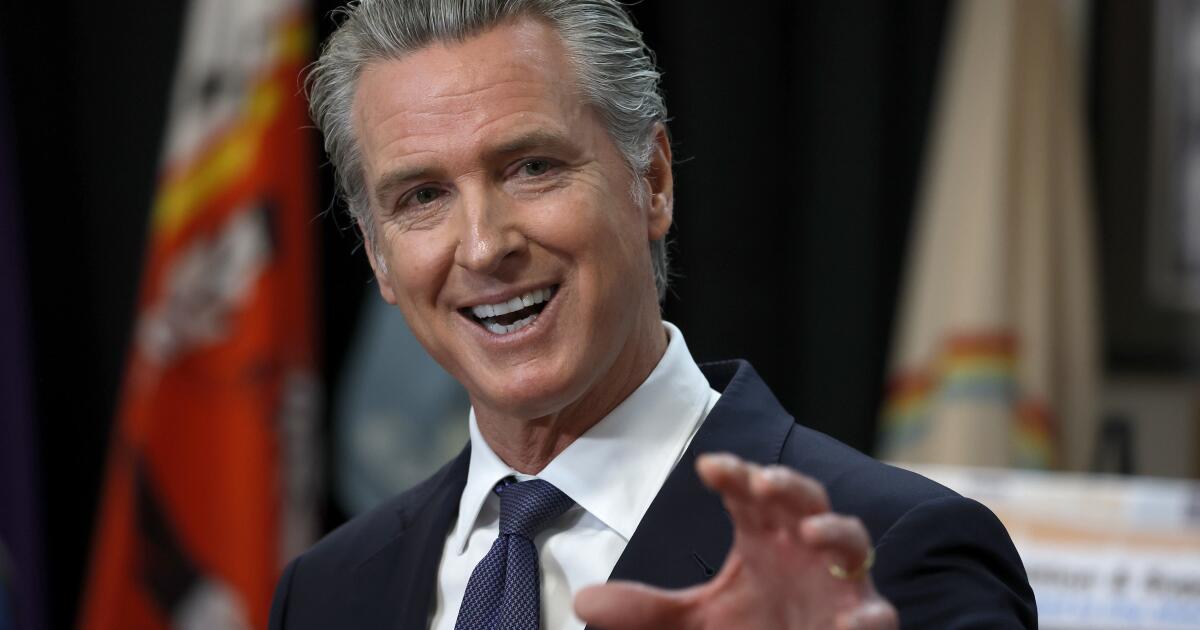
Gov. Gavin Newsom strode onstage in Houston on Saturday to a cheering crowd of Texas Democrats, saying Proposition 50’s victory in California on election day was a win for the nation and a firm repudiation of President Trump.

Newsom possessed the air of a politician running for president at the boisterous rally, a possibility the California governor says he is considering — and the location he chose was not happenstance.

Newsom accused Trump of pressuring Texas Gov. Greg Abbott to rejigger the state’s congressional districts with the goal of sending more Republicans to Congress, an action that triggered California’s Proposition 50. Newsom successfully pushed for a special election on the ballot measure to counter the efforts in Texas, which the governor said wasan attempt by Trump and the Republicans to “rig” the 2026 midterm election.

Cheers erupted from the friendly, union-hall crowd when Newsom belittled Trump as an “invasive species” and a “historically unpopular president.”

“On every issue, on the economy, on terrorists, on immigration, on healthcare, [he’s a] historically unpopular president, and he knows it, and he knows it,” Newsom said. “Why else did he make that call to your governor? Why else did he feel the need to rig the election before even one vote was cast? That’s just weakness, weakness masquerading as strength. That’s Donald Trump, and he had a very bad night on Tuesday.”

Newsom was the main political force behind Proposition 50, which California voters overwhelmingly approved in Tuesday’s special election. The statewide ballot measure was an attempt to counter Trump’s push to get Republican-led states, most notably Texas, to redraw their electoral maps to keep Democrats from gaining control of the U.S. House of Representatives in the 2026 midterms and upending his agenda. Newsom and California Democrats hope the change will net an additional five Democrats in California’s congressional delegation, canceling out any gains in Texas.

Newsom thanked Texas Democrats for putting up a fight against the redistricting effort in their state, saying it inspired an uprising.

“It’s dawning on people, all across the United States of America, what’s at stake,” Newsom told the crowd. “And you put a stake in the ground. People are showing up. I don’t believe in crowns, thrones. No kings.”

Newsom’s trip to Texas comes as the former San Francisco mayor has been openly flirting with a 2028 run for president. In a recent interview with “CBS News Sunday Morning,” Newsom was asked whether he would give “serious thought” after the 2026 midterms to a White House bid.

“Yeah, I’d be lying otherwise,” Newsom replied. “I’d just be lying. And I’m not — I can’t do that.”

In July, Newsom flew to South Carolina, a state that traditionally hosts the South’s first presidential primary. He said he wanted to help his party win back the U.S. House of Representatives in 2026. But South Carolina is a solidly conservative state and did not appear to have a single competitive race.

During that trip, South Carolina Rep. James Clyburn, the highest-ranking Black member of Congress and renowned Democratic kingmaker, told The Times that Newsom would be “a hell of a candidate.” Newsom received similar praise — and encouragement — when he was introduced at the “Take It Back” rally in Houston.

Newsom now heads to Belém, Brazil, where representatives from 200 nations are gathering to kick off the annual United Nations climate policy summit. For Newsom, it’s a golden opportunity to appear on a world stage and sell himself and California as the antidote to Trump and his attacks on climate change policy.

The Trump administration this year canceled funding for major clean energy projects such as California’s hydrogen hub and moved to revoke the state’s long-held authority to set stricter vehicle emissions standards than the federal government.

Source link

Opposition to single-payer healthcare separates Villaraigosa from others at candidate forum

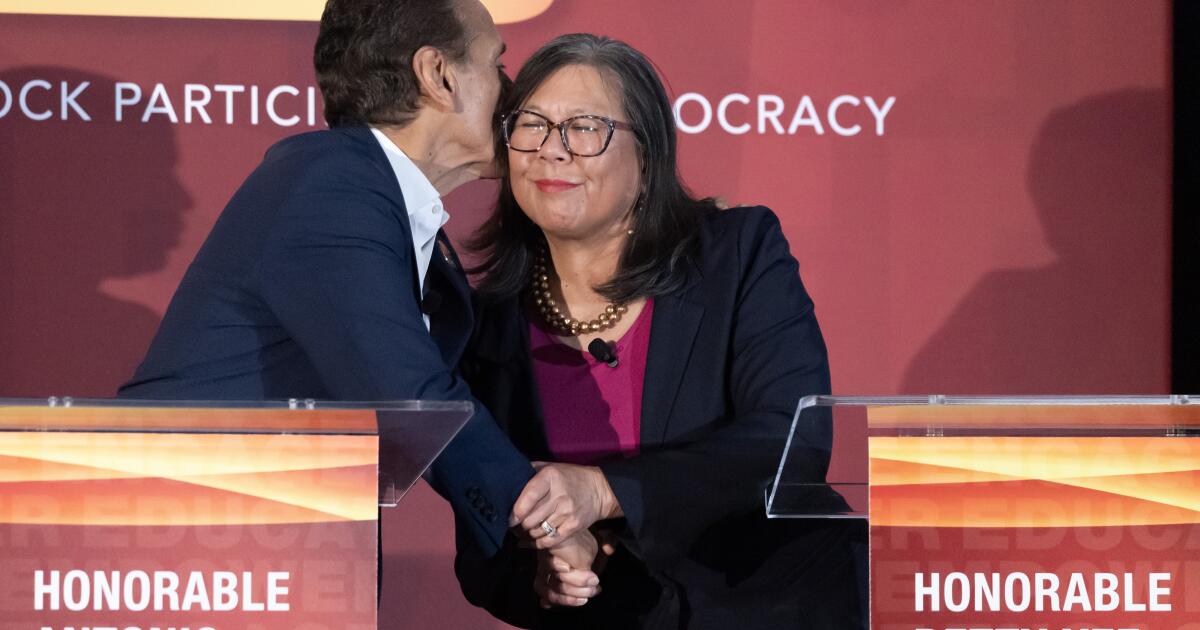
Antonio Villaraigosa, former Los Angeles mayor and current candidate for California governor, on Friday said he opposed the creation of a state-level single payer healthcare system.

Villaraigosa’s stance separated him from three rival Democrats who appeared on stage with him at a candidate forum at UC Riverside.

Candidates, who were asked about a single-payer healthcare system during a question-and-answer session that only involved raising their hands, did not provide explanations for their stances. But during earlier remarks, Villaraigosa had said he had no interest in selling “snake oil” solutions to voters on complex matters like healthcare.

The divide stood out because the four Democrats were otherwise closely aligned on prioritizing healthcare if elected in the 2026 race.

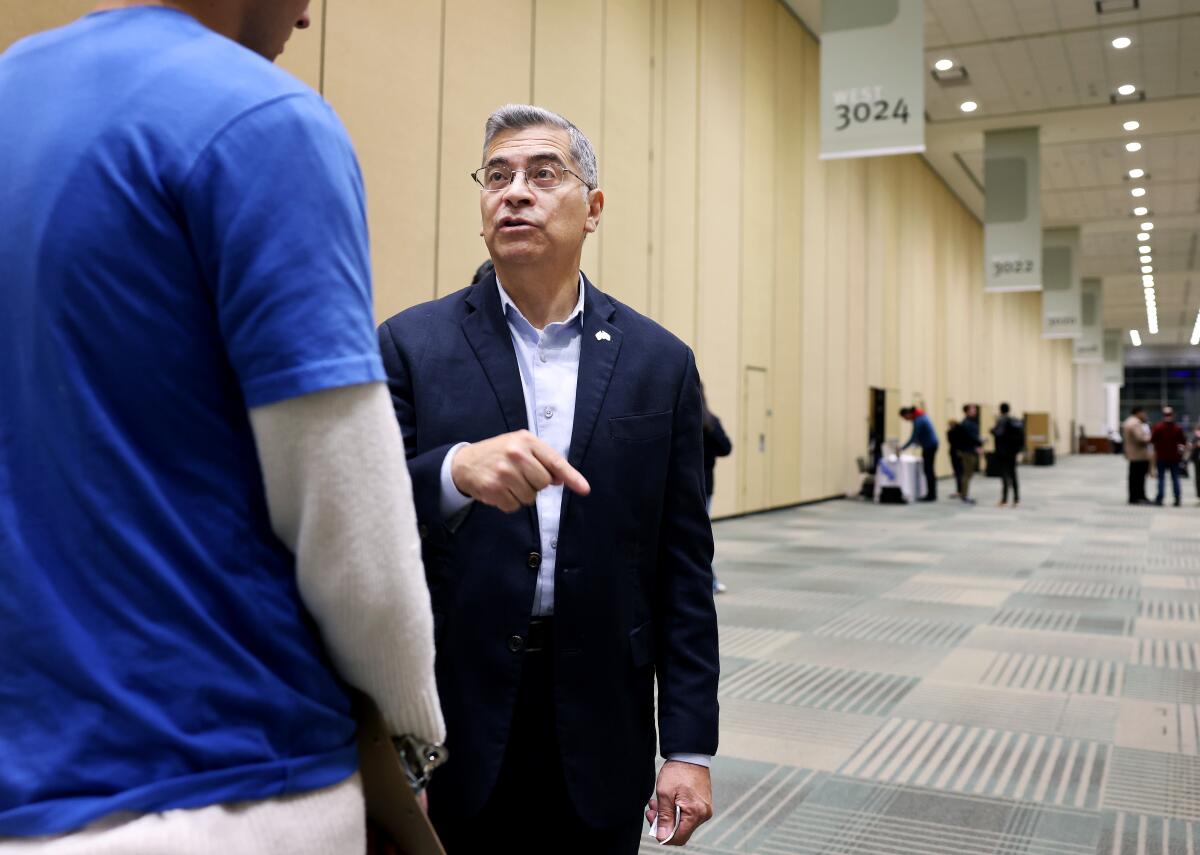
Aside from Villaraigosa, the candidates included: former state Controller Betty Yee, former U.S. Secretary of Health and Human Services Xavier Becerra and California Supt. of Public Instruction Tony Thurmond.

During the event, candidates were asked how they would approach a range of issues that impact an individual’s health, including aging, nutrition and mental illness.

The four contenders were largely on the same page, with all promising to work on removing barriers to care by expanding healthcare coverage and supporting programs that increase access to fresh food and mental health services. They all voiced support for creating pathways and incentives for students to study healthcare to help with industry staffing shortages.

Each also offered slightly different insights when asked a question about how to best support the “sandwich generation,” or those who are caring for both children and aging parents.

Becerra recalled how he and his siblings took turns caring for their aging father, which allowed him to spend his final years at home.

“There is nothing better because they are being cared for by those who love them,” Becerra said. “If I am governor, home care will be compensated.”

Yee said income tax credits could help and explained she would work with employers to improve employee leave options.

Thurmond said California should create a long-term care system for seniors similar to the system the state developed to help homeowners unable to access homeowners insurance.

The event was organized by Health Matters, a nonpartisan forum on health and equity that is organized by 11 health-focused foundations in California.

Source link

Support for gubernatorial hopeful Katie Porter slips after outburst

A new poll shows that former Orange County Rep. Katie Porter’s support in the 2026 governor’s race dropped after she tangled with a television reporter during a heated interview in October, an incident that rival candidates used to question her temperament.

Porter was the clear front-runner over the summer, but by late October she dropped behind Riverside County Sheriff Chad Bianco, a Republican, according to a poll released Friday by the UC Berkeley Institute of Governmental Studies and co-sponsored by The Times.

Still, nearly half of the registered voters surveyed remain undecided, evidence that few Californians are paying attention to a race that remains wide open and was eclipsed in recent months by the costly and successful congressional redistricting battle that became a referendum on President Trump. Porter remains the most favored Democratic candidate, which is significant in a state that has not elected a Republican governor since 2006.

“She’s the leading Democrat among the various ones that are in there right now,” said Mark DiCamillo, director of the poll. “But it’s because nobody really on the Democratic side has really jumped out of the pack. It’s kind of a political vacuum at the moment.”

The governor’s race was frozen in stasis for most of the year, first as Californians waited for former Vice President Kamala Harris to decide whether she was going to jump into the race. It wasn’t until late July that Harris announced, no, she was not running. Then, weeks later, Californians became captivated by a special election to reconfigure the state’s congressional districts — which set off a furious, expensive and high-stakes political battle that could help decide which party controls the U.S. House of Representatives.

Now that the special election is over, gubernatorial candidates can “rev up the public to pay attention,” DiCamillo said.

“It’s the time for someone to break through,” he said.

But it won’t be U.S. Sen. Alex Padilla. The senator would have been the top Democrat in the race, but not a heavy favorite, if he decided to jump in, the poll found. Voters gave him the highest favorability rating among all current and potential contenders in the governor’s race. After months of speculation, however, Padilla on Tuesday announced he would forgo a run for governor.

The new poll found that Bianco was supported by 13% of voters in the state, followed by Porter at 11%. The Berkeley poll in August showed that Porter led all candidates with 17% support, with Bianco in second place at 10%.

A Bianco representative said his lead in the polls was evidence that his campaign was resonating with voters.

“It is abundantly clear that Californians are demanding a new path forward,” campaign manager Erica Melendrez said. “Sheriff Bianco represents a safe California, an affordable California, an educated California and a leader with integrity and character that ALL Californians can be proud of.”

DiCamillo said Porter’s 6% drop over those three months was significant, given that the California governor’s race is so tight, but cautioned that it’s still early in the 2026 campaign season and a lot of shifting will happen before the June gubernatorial primary.

Porter’s campaign declined to comment on the drop in support and noted instead that she still led the Democratic field.

“Poll after poll continues to show Katie as the strongest Democrat in the race, driven by a growing coalition of grassroots supporters — not powerful special interests,” spokesperson Peter Opitz said. “Californians know her record of taking on Donald Trump and trust her to tackle our cost crisis, from skyrocketing rent and housing costs to rising healthcare premiums and unaffordable child care.”

Porter came under fire in October after an outburst during an interview with CBS reporter Julie Watts. When the Sacramento-based journalist asked Porter what she would say to Californians who voted for Trump, the UC Irvine law professor responded that she didn’t need their support.

After Watts asked follow-up questions, Porter accused the reporter of being “unnecessarily argumentative,” held up her hands and later said, “I don’t want this all on camera.”

The next day, a 2021 video emerged of Porter berating a staff member during a videoconference with a member of the Biden administration. “Get out of my f— shot!” Porter said to the young woman after she came into view in the background. Porter’s comments in the video were first reported by Politico.

Porter later acknowledged that she mishandled the television news interview, but explained that she felt the reporter’s questioning implied she should cater to Trump’s supporters. Porter also said she apologized to her staff member, saying her remarks were “inappropriate,” that she values her staff and could have handled that situation better.

Her Democratic gubernatorial rivals seized on the videos. Former state Controller Betty Yee called on Porter to drop out of the race, and businessman Stephen Cloobeck and former Los Angeles Mayor Antonio Villaraigosa attacked her in ads about the uproar.

While difficult to assess, the negative news coverage and publicity surrounding those incidents appear to have taken a toll on Porter’s reputation. No other candidate experienced a similar shift in support.

According to the new poll, 26% of California voters had a favorable opinion of Porter, compared with 33% who saw her unfavorably — with the remainder having no opinion. That’s a major drop from when she was running for the U.S. Senate last year, when 45% of voters had a favorable opinion in February 2024 and 27% were sour on her.

Political scientist Eric Schickler, co-director of the Berkeley institute that conducted the poll, said Porter looks vulnerable, and that makes the governor’s race a more attractive contest for current candidates and those who may be considering joining it.

Aside from Porter and Bianco, the poll found that 8% of voters favored former U.S. Health and Human Services Secretary Xavier Becerra, a Democrat; the same percentage backed conservative commentator Steve Hilton. Villaraigosa had support from 5% of voters, Yee 3%, and California Supt. of Public Instruction Tony Thurmond 1%. Cloobeck and former Democratic legislator Ian Calderon registered less than 1%.

Another potential candidate — billionaire developer Rick Caruso — was backed by 3% of voters, the poll found. Caruso said Monday night that he still was considering running for either governor or Los Angeles mayor and will decide in a few weeks.

Schickler said the results of Tuesday’s election may be a sign that moderate or business-friendly Democrats — including Caruso — may not fare so well in a state as Democratic as California. Voters across the nation delivered a sharp rebuke to Trump, electing Democrats in major races in New York City, New Jersey and Virginia and passing Proposition 50, the California ballot measure designed to help Democrats take control of the U.S. House of Representatives after the 2026 election.

“Somebody like Caruso, his narrative would probably look a lot stronger if Democrats still seemed on the defensive and in disarray,” Schickler said. “But after Prop. 50 passing, big Democratic wins in New Jersey and Virginia, I think the argument for a need to change what we’re doing dramatically, at least in a state like California, is less likely to resonate.”

The Berkeley IGS/Times poll surveyed 8,141 California registered voters online in English and Spanish from Oct. 20 to 27. The results are estimated to have a margin of error of 2 percentage points in either direction in the overall sample, and larger numbers for subgroups.

Source link

Sen. Alex Padilla says he won’t run for California governor

U.S. Sen. Alex Padilla announced Tuesday that he will not run for California governor next year, ending months of speculation about the possibility of the Democrat vying to succeed Gov. Gavin Newsom.

“It is with a full heart and even more commitment than ever that I am choosing to not run for governor of California next year,” Padilla told reporters outside his Senate office in Washington.

Padilla instead said he will focus on countering President Trump’s agenda in Congress, where Democrats are currently on the minority in both the House and Senate, but hope to regain some political clout after the 2026 midterm elections.

“I choose not just to stay in the Senate. I choose to stay in this fight because the constitution is worth fighting for. Our fundamental rights are worth fighting for. Our core values are worth fighting for. The American dream is worth fighting for,” he said.

Padilla said his decision was influenced by his belief that under President Trump, “these are not normal times.”

“We deserve better than this,” he said.

Many contenders, no clear favorite

Padilla’s decision to bow out of the 2026 governor’s race will leave a prominent name out of an already crowded contest with many contenders but not a clear favorite.

For much of the year, the field was essentially frozen in place as former Vice President Kamala Harris debated whether she would run, with many donors and major endorsers staying out of the game. Harris said at the end of July that she wouldn’t run. But another potential candidate — billionaire developer Rick Caruso — remains a question mark.

Caruso said Monday night that he was still considering running for either governor or Los Angeles mayor, and will decide in the next few weeks.

“It’s a really tough decision,” Caruso said. “Within a few weeks or so, or something like that, I’ll probably have a decision made. It’s a big topic of discussion in the house with my kids and my wife.”

Major Democratic candidates include former Orange County Rep. Katie Porter, former U.S. Health and Human Services Secretary Xavier Becerra, former Los Angeles Mayor Antonio Villaraigosa, current California Supt. of Public Instruction Tony Thurmond, former state Controller Betty Yee and wealthy businessman Stephen Cloobeck. Riverside County Sheriff Chad Bianco and conservative commentator Steve Hilton are the most prominent Republicans running.

Amid fire recovery aftermath, immigration raids and a high-octane redistricting battle, California voters have yet to turn their attention to next year’s gubernatorial matchup, despite the vast power Newsom’s successor will wield. California is now the world’s fourth-largest economy, and policy decisions in the Golden State often have global repercussions. Newsom is nearing the end of his second and final term.

Recent polling shows the contest as wide open, with nearly 4 in 10 voters surveyed saying they are undecided, though Porter had a slight edge as the top choice in the poll. She and Bianco were the only candidates whose support cracked the double digits.

Candidates still have months to file their paperwork before the June 2 primary to replace Newsom.

June incident brought attention

Known for soft-spoken confidence and a lack of bombast, Padilla’s public profile soared in June after he found himself cuffed by federal agents, at the center of a staggering viral moment during a news conference by Homeland Security Secretary Kristi Noem.

Despite identifying himself, Padilla was tackled after trying to interrupt Noem with a question. The manhandling of California’s senior senator was filmed by a staffer and broadcast around the world, provoking searing and widespread condemnation.

Days later, Vice President JD Vance joked about the incident and referred to Padilla — his former Senate colleague — as “Jose Padilla,” a misnaming that Padilla suggested was intentional and others characterized as racist.

The event put Padilla on the national spotlight and rumors of Padilla’s interest in the gubernatorial race ignited in late August.

Padilla told reporters on Tuesday that he received an “outpouring of encouragement and offers of support for the idea” of his candidacy and that he had “taken it to heart”

Alongside his wife, Angela, the senator said he also heard from many people urging him to keep his fight going in Washington.

“Countless Californians have urged me to do everything i could to protect California and the American Dream from a vindictive president who seems hell bent on raising costs for working families, rolling back environmental protections, cutting access to healthcare, jeopardizing reproductive rights and more,” he said.

Padilla said he had listened.

“I will continue to thank them and honor their support by continuing to work together for a better future,” he said.

Ceballos reported from Washington, Wick from Los Angeles. Times staff writer Noah Goldberg, in Los Angeles, contributed to this report.

Source link