california democrats

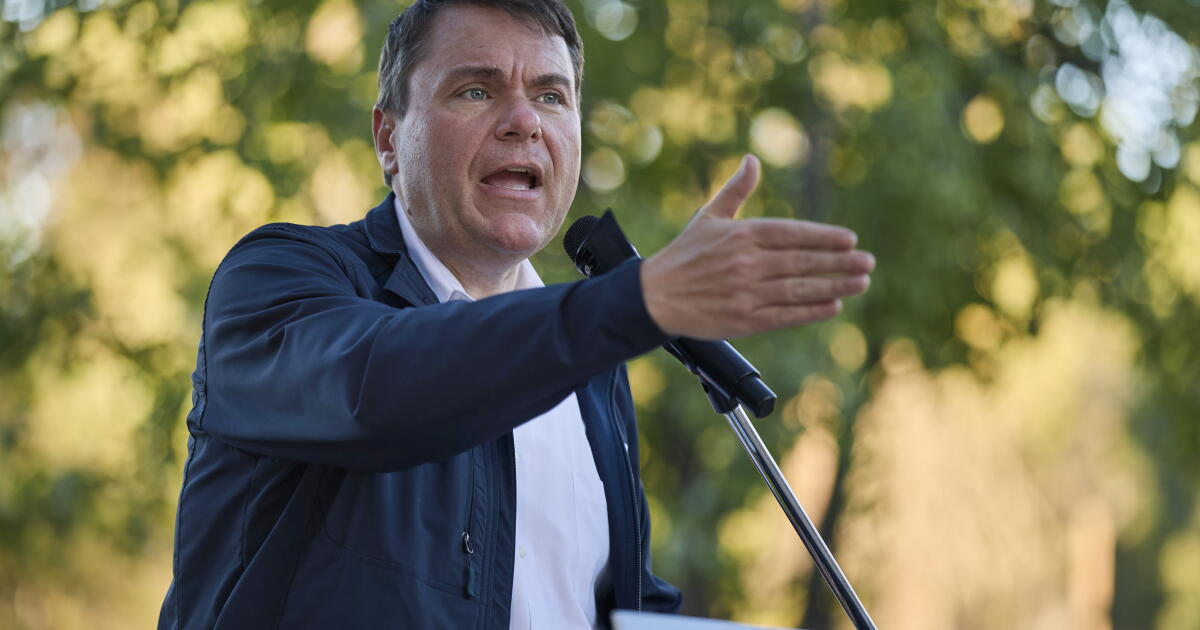
Newsom leads Harris for president among California Democrats, poll finds

Californians have never been forced to choose between Gavin Newsom and Kamala Harris, two homegrown political darlings, during any election.

But if the state’s registered Democrats picked now, Newsom would trounce Harris as their party’s next nominee for president and have the edge over other Democratic contenders, according to a poll released Friday by the UC Berkeley Institute of Governmental Studies and co-sponsored by The Times.

Twenty-eight percent of the California Democrats who were surveyed selected the governor as their top choice in the 2028 presidential election. U.S. Rep. Alexandria Ocasio-Cortez (D-New York) followed with 14% and former U.S. Transportation Secretary Pete Buttigieg received 11%. Harris came in fourth, with only 9% of voters in her own state naming her as their preferred Democratic nominee.

“It’s quite a positive result for Newsom,” said Mark DiCamillo, director of the Berkeley IGS Poll. “He’s separated himself from the rest of the pack, and especially when you compare him to the other major Californian in the considerations, he’s three times as much as Kamala. That’s quite impressive.”

The political careers of the governor and former vice president have orbited each other but never crossed since Newsom was sworn in as San Francisco’s mayor and Harris as the city’s district attorney on the same day in 2004. Now the two Bay Area natives are both flirting with the 2028 presidential contest as they travel the country promoting their life stories on respective book tours.

It’s early days and neither politician has said they will or won’t launch official campaigns for the Oval Office. The possibility remains that Californians might finally see a matchup that the two Democrats have long avoided.

Newsom set his sights on the governor’s office in 2010 before dropping out and running for lieutenant governor, a largely powerless post in which he served in the shadow of Gov. Jerry Brown for eight years. Harris won election that year as California attorney general.

Harris’ and Newsom’s paths diverged again when she chose to run for U.S. Senate in a 2016 contest to replace former Sen. Barbara Boxer and he announced his candidacy for governor in the 2018 election.

When Harris jumped into the 2020 and 2024 races for the White House, Newsom said he wouldn’t run against her. He’s discredited the idea that the two politicians have some kind of a sibling rivalry and noted that their trajectories ran adjacent and never collided.

Newsom was asked again last month whether he would vie against Harris in a presidential contest. The governor said he hasn’t “gotten in the way of her ambition ever,” and he doesn’t imagine that he would in the future. His answer changed when he was pressed to respond specifically to the potential for 2028.

“That’s fate. I don’t, I don’t know,” Newsom said to CNN’s Dana Bash, throwing up his hands. “You know, you can only control what you can control.”

Newsom and Harris had greater support from Black and Latino voters than white and Asian American Democrats in the new poll. She performed well among Democrats younger than 30 compared with other age groups, while Newsom fared better with older Democrats. More women selected Newsom as their first or second choice than they did Harris.

Neither California heavyweight performed particularly great among Democratic voters in the Bay Area, which DiCamillo called a curious finding for two politicians from the region. Support was higher for Harris and Newsom in almost every other region of the state.

DiCamillo believes the presence of Ocasio-Cortez on the list probably pulled some support from Harris. California voters in other recent polls were also sour on a third presidential run by Harris.

An Institute of Governmental Studies poll in August gauged interest in the potential candidacy of Newsom and Harris. About 45% of the state’s registered voters said they were enthusiastic about Newsom running, compared with 36% for Harris. Almost two-third of voters in that survey, and half of Democrats, said Harris should not run for president again.

Although Newsom clearly beat the field of candidates in the most recent poll, DiCamillo said receiving support from a little more than a quarter of those surveyed in his own backyard isn’t exactly wonderful. The governor’s approval rating is also down.

The poll found that 48% of California registered voters say they approve of the job Newsom is doing, with the same share disapproving of his performance. That marks a drop from 51% approval the last time DiCamillo asked in August. Disapproval also climbed, by 5 percentage points.

Voters held positive opinions about Newsom’s participation in international conferences, which was described in the poll as the governor “offering an alternative to the policies being promoted by President Trump on issues like climate change and the economy.” The poll found 59% of statewide registered voters approve and 37% disapprove.

Cristina G. Mora, co-director of the poll, said the results suggest Newsom’s more aggressive stance with Trump seems to resonate in his own state.

“Though Californians may hold mixed views on his gubernatorial tenure, they overwhelmingly see him as the strongest counter to Trump and MAGA candidates,” Mora said. “Harris’s earlier presidential defeat, compounded by persistent voter biases against women and candidates of color, may also be shaping these early numbers.”

The Berkeley IGS/Times poll surveyed 5,019 California registered voters online in English and Spanish from March 9 to 14. The results are estimated to have a margin of error of 2.5 percentage points in either direction in the overall sample, and larger numbers for subgroups.

Source link

California Dems launch polling effort to winnow gubernatorial field

As anxiety mounts among California Democrats about the potential of a Republican being elected governor, the state party will spend hundreds of thousands of dollars on polling to assess the viability of the sprawling field of candidates hoping to replace termed-out Gov. Gavin Newsom, according to plans released Tuesday.

The move comes after nearly every Democratic candidate refused party leaders’ call last week to withdraw from the race to avoid splitting the vote in the June primary — an outcome that could lead to a Republican being elected to statewide office for the first time in two decades.

“Candidates have filed, and now they’ve got the opportunity to showcase their viability, their path to win. I want to simply ensure that everybody has information to fully understand the current state of the race,” said Rusty Hicks, the leader of the California Democratic Party.

As campaign season ramps up, the series of six polls will allow “candidates, supporters, the media, voters, anyone and everyone to have a clear understanding of what is or is not happening in this particular race,” he said.

The filing deadline to appear on the June 2 ballot was Friday. Three days earlier, Hicks released an open letter urging candidates who did not have a path to victory to withdraw from the race. Of the nine prominent Democrats who had announced runs for governor, only one heeded his call: former state Assembly Majority Leader Ian Calderon.

That means the eight other candidates’ names will appear on the ballot, regardless of whether they decide to later drop out. And that creates the possibility of a Republican winning the race because of how California elections are decided.

The state has a voter-approved top-two primary system, under which the two candidates who receive the most votes in the June primary advance to the November general election, regardless of party.

Two prominent Republicans will appear on the ballot: former conservative commentator Steve Hilton and Riverside County Sheriff Chad Bianco. Even though Democratic voters outnumber Republicans nearly 2 to 1, and the state’s electorate last elevated Republicans to statewide office in 2006, it is mathematically possible for Democrats to splinter the vote, allowing the two GOP candidates to advance.

Under such a scenario, not only would Republicans be guaranteed the leadership of the nation’s most-populous state, but Democratic voter turnout also would probably be depressed in November, potentially affecting down-ballot races such as those that could determine control of Congress.

Hicks’ call last week prompted concerns among candidates of color, including former U.S. Health and Human Services Secretary Xavier Becerra and state Supt. of Public Instruction Tony Thurmond, that the effort was aimed at every nonwhite candidate in the race.

The state party chairman responded that his letter was not aimed at any specific candidate.

“It’s not something I lose sleep over,” Hicks said when asked about the racial claims. But he added that the voter surveys will be conducted by Los Angeles-based Evitarus, the state’s only Black- and Latino-led full-service polling firm, and will oversample historically underrepresented communities: Latino, Black and Asian American voters.

Hicks said the polling will cost “multiple six figures” but did not specify the exact amount.

The first poll will be released on March 24, and then five additional surveys will come out every seven to 10 days until voters start receiving mail ballots in early May.

“We’re putting this forward to ensure everyone is armed with the information they need to clearly have an eyes-wide-open assessment of where the state of the race currently is between now and when ballots land in the mailboxes of voters,” Hicks said.

Source link

Anxiety grows among California Democrats as gubernatorial candidates rebuff calls to drop out

Despite a plea from the head of the California Democratic Party for underperforming candidates to drop out of the governor’s race, all but one of the party’s top hopefuls spurned the request.

Party leaders fear the growing possibility that the crowded field will split the Democratic electorate in the state’s June top-two primary election and result in two Republicans advancing to the November ballot, ensuring a Republican governor being elected for the first time since 2006.

His advice largely unheeded, state party Chairman Rusty Hicks on Thursday said the fate of a Democratic victory now rests squarely on the gubernatorial candidates who flouted him.

“The candidates for Governor now have a chance to showcase a viable path to win,” Hicks said in a statement Thursday.

Eight top Democratic candidates filed the official paperwork to appear on the June ballot after Hicks released a letter on Tuesday urging those “who cannot show meaningful progress towards winning” to drop out. Friday is the deadline to file to appear on the primary election ballot. On March 21, the secretary of state’s office will formally announce who will appear on the June ballot.

“It sounded like someone who has his head in the sand,” former Los Angeles Mayor Antonio Villaraigosa said of Hicks’ open letter. “[Most] of us filed within 24 hours of getting that letter. It created some press but not much else. It didn’t impact [most] of the candidates and it certainly didn’t impact my candidacy.”

Democratic strategist Elizabeth Ashford said it was appropriate for Hicks and other Democratic leaders to make a public plea as opposed to keeping such discussions solely behind closed doors.

But the response showed the limited power of the modern-day party bosses.

“It’s definitely not Tammany Hall,” said Ashford, referring to the storied Democratic political machine that had a grip on New York City politics for nearly a century. “The party and Rusty are influential and they are helpful and that is their role. I don’t think anyone would be comfortable with outright public strong-arming of specific candidates.”

Ashford, who worked for former Govs. Jerry Brown and Arnold Schwarzenegger, along with former Vice President Kamala Harris when she served as state attorney general, added that the minimal power of the state GOP is likely a factor in the dynamics of Democrats’ decision to stay in the race. Democratic registered voters outnumber Republicans by almost a 2-to-1 margin in the state, and Democrats control every statewide elected office and hold supermajorities in both chambers of the California Legislature.

“If there were a strong viable opposition that existed, if the Republican Party was actually relevant in California, I think that would sort of force greater unity amongst Democrats,” she said.

Just one of the nine major Democrats did heed the party chair’s message. Ian Calderon, a former Los Angeles-area Assemblyman who consistently polled near the bottom of the field, withdrew from the race and endorsed Rep. Eric Swalwell (D-Dublin) on Thursday.

Candidates cannot withdraw their name from the ballot once they officially file to run for office, leading to some fears that even if other candidates drop out of the race, a crowded primary ballot could still split California’s liberal votes.

“I’m disappointed most of them will be on the ballot,” said Lorena Gonzalez, the head of the California Federation of Labor Unions, which will announce whether it endorses in the governor’s race on March 16. But “I do still think you can have people drop out of the race or become viable. I think that there are candidates who know viability is a real thing they have to show in coming weeks” before ballots start being mailed to voters.

Jodi Hicks, chief executive and president of Planned Parenthood Affiliates of California, said she is “still worried” about the prospect of two Republicans winning the top two spots in the June primary, shutting Democrats out of any chance of winning the governor’s office in November.

“I didn’t have any specifics of who I wanted to do what,” she said. “I’m just very, very concerned and the stakes are really high right now and seem to be getting worse by the day.”

Republican candidate Steve Hilton, a former Fox News host, said he is “confident that I’ll be in the top two” along with a Democratic candidate. “I find it very difficult to believe that the Democratic Party will just surrender California and allow two Republicans to be in the top two.”

Hilton made the comments Thursday after a gubernatorial forum in Sacramento hosted by the California Assn. of Realtors focused on housing and homeownership. Villaraigosa, former Health and Human Services Secretary Xavier Becerra, San Jose Mayor Matt Mahan and former Rep. Katie Porter also attended. Swalwell, who is currently in Washington, joined the panel virtually.

During the panel, candidates were in broad agreement about the need to reduce barriers and costs in order to build more housing in California, where the median single-family home costs more than $820,000. Many also endorsed proposals to disincentivize private investment firms from buying up homes as well as a $25-billion bond proposed by former Sen. Bob Hertzberg to help first-time homebuyers afford a down payment.

“This really isn’t a debate because we’re agreeing so much with each other,” Hilton said at one point during the event.

That political alignment on one of the most pressing issues facing California may explain why voters are having such a difficult time deciding who to support.

A recent poll of the Public Policy Institute of California found that the five candidates topping the crowded field were within 4 percentage points of one another: Porter, Swalwell, Hilton, Democratic hedge fund founder Tom Steyer and Republican Riverside County Sheriff Chad Bianco. Earlier polls had Hilton and Bianco leading the field, though many voters remained undecided.

Some candidates took issue with Hicks’ push to cull the field, noting that most of the lower-polling candidates he asked to drop out are people of color.

“Our political system is rigged, corrupted by the political elites, the wealthy and well connected,” state Supt. of Public Instruction Tony Thurmond, who is Black and Latino, said in a video posted on social media in response to the open letter. “The California Democratic Party is essentially telling every person of color in the race for Governor to drop out.”

Villaraigosa argued that enough voters remain undecided that it was too early for quality candidates to call it quits.

“Most people don’t even know who’s in the race,” said Villaraigosa. “It’s premature to be thinking about getting out of the race. I certainly am not considering it and I feel no pressure.”

Aside from the opinion polls, other indicators on who may emerge from the pack a candidates are slowly emerging.

Though it wasn’t enough to win the party’s endorsement, Swalwell won support from 24% of delegates at the state Democratic convention last month, the most of any party candidate.

While spending is no guarantee of success, Steyer has donated $47.4 million of his own wealth to his campaign. Mahan, who recently entered the race and is supported by Silicon Valley leaders, has quickly raised millions of dollars, as have two independent expenditures committees backing his bid.

Ashford said part of candidates’ decisions to remain in the race could have been driven by their lengthy political careers, as well as Democrats’ crushing November redistricting victory.

“In several cases, these are people who have won statewide office,” she said. “It’s tough to feel like there may not be a sequel to that.”

Nixon reported from Sacramento and Mehta from Los Angeles.

Source link

California Democrats unite against Trump, differ on vision for state’s future

While united against a common political enemy in the White House, the California Democratic Party remains deeply divided over how to address the state’s affordability crisis and who is best suited to lead the state in this turbulent era of President Trump.

Those fractures revealed themselves during the party’s annual convention in California’s liberal epicenter, San Francisco, where a slate of Democrats running to succeed Gov. Gavin Newsom pitched very different visions for the state.

Former Orange County Rep. Katie Porter and wealthy financier Tom Steyer were among the top candidates who swung left, with Porter vowing to enact free childcare and tuition-free college and Steyer backing a proposed new tax on billionaires. Both candidates also support universal healthcare.

San Jose Mayor Matt Mahan, the newest major candidate to enter the race, hewed toward partisan middle ground, chastising leaders in Sacramento for allowing the state budget to balloon without tangible improvements to housing affordability, homelessness and public schools.

Rep. Eric Swalwell (D-Dublin), a vociferous critic and constant target of the Trump administration, emerged from the convention with the greatest momentum after receiving the most votes for the California Democratic Party’s endorsement, with 24% of delegates backing him.

“The next governor has two jobs: one, to keep Donald Trump and ICE out of our streets and out of our lives, and two, to lower your costs on healthcare, on housing, on utilities,” Swalwell said. “Californians need a fighter and protector, and for the last 10 years, I’ve gone on offense against the worst president ever.”

Still, none of the top Democrats running for governor received the 60% vote needed to capture the endorsement, indicating just how uncertain the race remains just months away from the June primary.

Betty Yee, a former state controller and party vice chair, placed second in the endorsement vote with 17%; former U.S. Health and Human Services Sec. Xavier Becerra had 14%; and Steyer had 13%. The remaining candidates had single-digit levels of support from among the more than 2,300 delegates who cast endorsement votes.

Speaker Emerita Nancy Pelosi (D-CA) takes a selfie with supporters.

Speaker Emerita Nancy Pelosi (D-San Francisco) takes a selfie with supporters during the California Democratic Party’s annual convention at the Moscone Center in San Francisco on Saturday.

(Christina House / Los Angeles Times)

Despite anxiety and infighting over the governor’s race, many in the party agreed that the most effective way to fight Trump is to win back control of the House in November’s midterm elections.

“We’re going to win the House. There’s absolutely no question we will win the House,” said former House Speaker Nancy Pelosi (D-San Francisco) at a Young Dems event on Friday evening. “We’re going to protect the election, we’re going to win the election, and we’re going to tell people the difference that we will make.”

Thousands of delegates, party allies and guests attended the weekend California Democratic Party convention at Moscone Center in the South of Market neighborhood. The gathering included a tribute to Pelosi as she serves her final term.

Party leaders did coalesce behind one of the Democrats running to replace Pelosi, Scott Wiener, a liberal state senator who is vying be the first openly gay person to represent San Francisco in Congress.

The convention comes as party members and leaders continue to soul search after Trump’s second election. California remains a stronghold of opposition to the president, but its next governor will also have to face a growing cost-of-living crisis in a state where utility costs keep climbing and the median single-family home price is more than double what it is nationally.

Under growing pressure, the candidates for governor went on the offensive at the party gathering. Candidates sniped at each other — though rarely by name — for being too rich, too beholden to special interests or for voting in the past in support of ICE and border wall funding.

While largely panned by delegates who tend to lean further left than the typical California Democratic voter, Mahan has jolted the race by quickly raising millions from tech industry leaders and targeting moderate voters with a message of getting the state “back to basics.”

“We are at risk of losing the trust of the people of California if we don’t hold ourselves accountable for delivering better results on public education, home building, public safety,” Mahan said. “We’re not getting the outcomes we need for the dollars we’re spending.”

Mahan has raised more than $7.3 million since entering the contest in late January, according to campaign finance disclosures of large contributions. Many of the donors are tied to the tech industry, such as Y Combinator, Doordash, Amazon and Thumbtack. Billionaire Los Angeles developer Rick Caruso has also contributed the maximum allowed to Mahan’s campaign.

Technology businessman Dennis Bress, from Newport Beach, wears a pin supporting Planned Parenthood

Technology businessman Dennis Bress, from Newport Beach, wears a pin supporting Planned Parenthood and a Yes on Proposition 50 shirt at the California Democratic Party convention at the Moscone Center on Friday in San Francisco.

(Christina House / Los Angeles Times)

Other candidates have raised concerns about the cash infusion, particularly Steyer, who has already dropped more than $37 million into his self-funded campaign and is pitching himself as a “billionaire who will take on the billionaires.”

“Here’s the thing about big donors: If you take their money, you have to take their calls,” Steyer said during his floor speech.

Delegates and party leaders said California’s next governor will have to continue leading the state’s aggressive opposition to Trump while dealing with the issues at home.

“I think people want a fighter,” said Rep. Dave Min (D-Irvine), who represents Porter’s former congressional district and has endorsed her in the governor’s race. “They want someone who’s going to stand up to Donald Trump but also fight to help average people who feel like they’re getting a raw deal in today’s America.”

Several of the candidates made the case that they could do both.

During her speech, Porter held up a whiteboard — her signature prop when grilling CEOs and Trump administration officials while she served in Congress — with “F— Trump” written on it.

“I’ll stand up to Trump and his cronies just like I did in Congress,” she said. “But this election for governor is about far more than defeating Trump.”

Porter, a law professor at UC Irvine, called on Democrats to “send a message about democracy by rejecting billionaires and corporate-backed candidates.” She also rolled out a long list of “true affordability measures” including free child care, free tuition at public universities, and single-payer healthcare, though she did not specify how she would pay for them.

Fighting back against Trump is “the floor,” said 29-year-old Gregory Hutchins, an academic labor researcher from Riverside. “We need to go higher than the floor — what can you do for the people of California? We all recognize that this is a beautiful and wonderful state, but it is very difficult to afford living here.”

Even some delegates — often the most politically active members of a party — have yet to make up their minds in the governor’s race. Nearly 9% opted not to endorse a particular candidate at the convention.

“You want that perfect candidate. You want that like, yes, this is the person,” said Sean Frame, a school labor organizer from Sacramento who is running for state Senate. “And I don’t feel like there is one candidate for me that fits all that.”

For all the focus on affordability, there were undertones of growing frustration from even reliable Democratic allies over a lack of tangible results in a state where the median home price is more than $823,000. SEIU California president David Huerta said workers have “been deferring our power to elected leadership” for too long.

“I think we need to be the ones who set the agenda and hold them accountable to that agenda,” Huerta said. “And they need to be leading from the direction of working people.”

It’s a constant battle with Democrats at state and local levels to get fair pay, said Mary Grace Barrios, who left a career in insurance to take care of her disabled adult daughter.

Barrios makes $19 an hour as an in-home caregiver to other clients in Los Angeles County. When Newsom signed a law to raise wages for most healthcare workers to $25 an hour by 2030, in-home support staff like Barrios were not included.

“It’s so important that we be given the respect and pay we need to live because we can’t live on that amount,” she said, adding that it feels like a “constant attack by people in our own party that we supported, that forgot us.”

“As citizens, you get what you vote for, right? So we have to do it. We have to make the change.”

Source link