‘East of Eden’ review: Steinbeck’s classic led by impressive Florence Pugh
John Steinbeck’s 1952 novel “East of Eden,” an Oprah’s Book Club Selection in 2003, is a retelling, or actually two retellings, of the Cain and Abel story, first in Connecticut with half-brothers Charles and Adam Trask, and then in the author’s native Salinas Valley with Adam’s fraternal twin sons, Cal and Aron, in each case competing with one another for their father’s love. Not wanting you to miss his meaning, if you haven’t already guessed by the title, Steinbeck has a character read the entire passage from Genesis.
The stories, which together run from the late 19th century through World War I, are connected by a woman named Cathy Ames, whom Adam marries and who gives birth to Cal and Aron — which I suppose makes her the Eve in this household, though that’s not a theological road Steinbeck chose to really explore.
In 1955, Elia Kazan directed a film version, a color-mad Cinemascope melodrama that told only the Cal and Aron part of the story; significantly, it was the film debut of James Dean and so will live forever. Writing in The Times in 2005, Kenneth Turan called it “not only one of Kazan’s richest films and Dean’s first significant role” but “arguably the actor’s best performance.”
Kazan’s granddaughter Zoe Kazan has written the screenplay and worked with Jeb Stuart as co-showrunners for a new “East of Eden” adaptation, a seven-episode miniseries debuting Thursday on Netflix. Though it omits a sizable chunk of what is after all a very long book, it takes its chronology whole, putting Cathy front and center in the publicity and in the show, owing largely to Florence Pugh‘s performance as its most dynamic character.
Kazan begins her telling with a badly beaten woman dragging herself through the night as a female voice delivers an edited, elaborated version of the author’s thoughts on difference. (It is a book brimming with thoughts.) “I believe there are monsters born in this world to human parents … A child may be born perfect of body but without kindness or the potential of conscience. Still, you must not forget, everyone is normal to himself. And to a monster, the norm must seem monstrous.” Given that the novel’s narrator is Steinbeck, it’s hard to say just who the “I” is here, but I assume the gender swap has something to do with wanting to literally give this version a female voice.
The monster is Cathy, crawling to the porch of the farmhouse occupied by Charles (Mike Faist), who thinks they should call the sheriff, and Adam (Christopher Abbott), who is compelled to care for her. Close your eyes if you don’t want to know anything more about this 73-year-old bestseller, but Cathy has already possibly driven a man to suicide and definitely burned down her house with her parents locked inside. She was beaten up by her former pimp, whose mistress she’d become and from whom she was stealing. You may be thinking “sociopath.”
The series backs up 25 years to a Connecticut farm where father Cyrus Trask (Tracy Letts), a peg-legged Civil War veteran, rejects Charles’ gift of a new knife in favor of Adam’s present of a stray puppy, creating a long trail of jealousy. He’ll later pack pacifistic Adam off to the army (because, he says, he loves him better), with Charles unhappily constrained to stay and work the farm (though he proves good at it). After years in service and living in hobo jungles, Adam returns home.

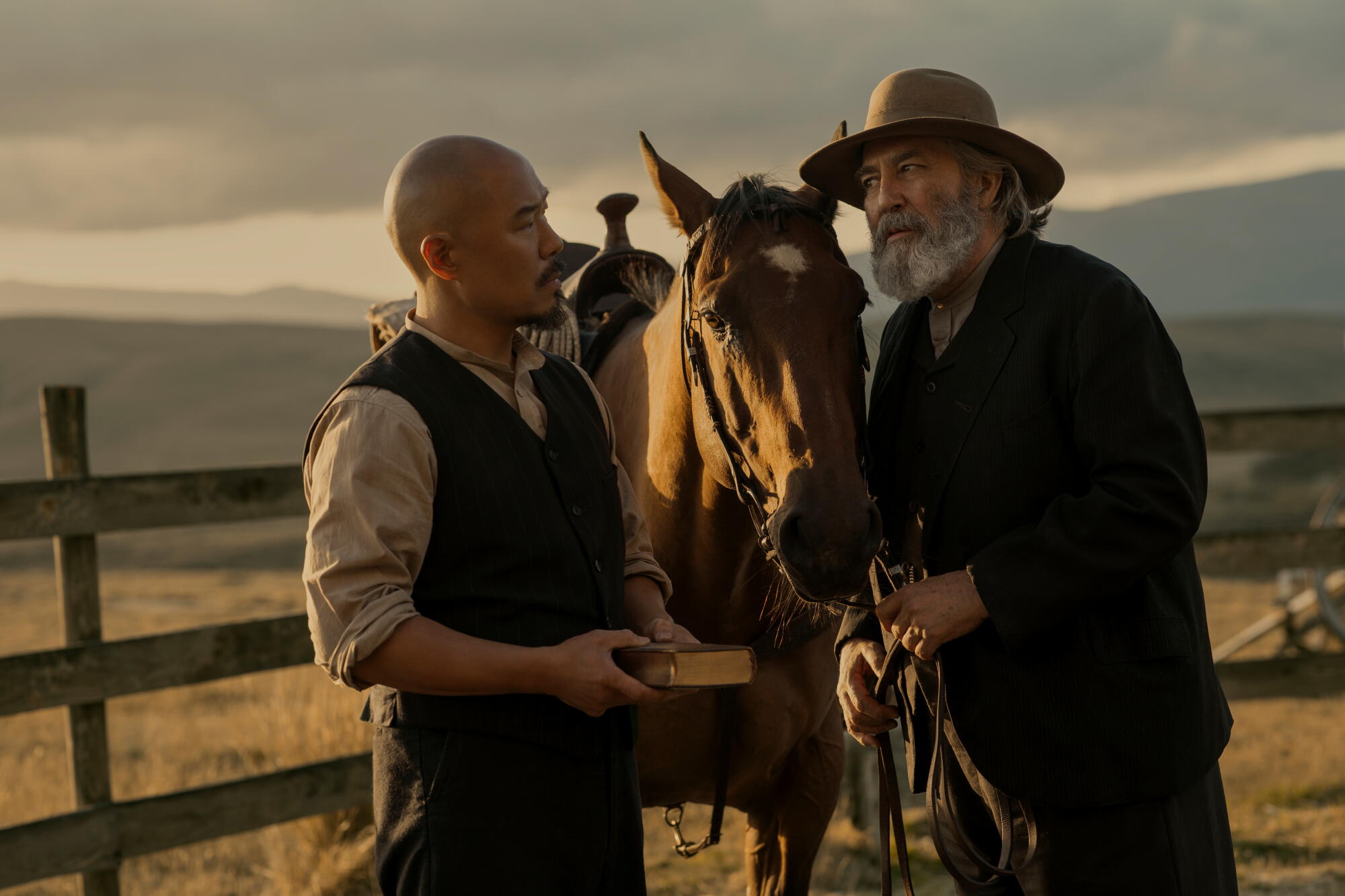
Standout performers include Hoon Lee as Lee, left, and Ciarán Hinds as Samuel Hamilton.
(Kirsty Griffin / Netflix)
Cathy crawls to their doorstep; Charles sees through her, which will earn him her respect, but Adam falls for her, marries her and drags her west to California, where she doesn’t want to go and doesn’t plan to stay. (She’s quite upfront about this, but Adam is a poor listener.) She gives birth to Cal (younger, Bodhi Aisher; older, Joseph Zada), who will grow up to wonder if he’s bad, and Aron (younger, Jonah Wren Phillips; older, Joe Anders), whom everyone thinks is good, and returns to the life of a prostitute, which suits her fine. And that is probably enough plot for me to relate.
Pugh impressively represents Cathy’s outward self through successive stages; she’s not a character born to develop, though she will have various crises to navigate, and the actor imbues her with as much nuance as the part allows. She’s the main reason to watch, though there are standout performances from Hoon Lee as Lee, a philosophical, intellectual, American-born Chinese man who works for Adam and becomes a kind of surrogate mother to Cal and Aron; and from Ciarán Hinds as Samuel Hamilton, a jovial Irishman, virtually the only remnant of the novel’s Hamiltons, who stand in for Steinbeck’s own family. Faist does a lot with the taciturn, perceptive Charles. Martha Plimpton, never not great, plays Faye, a madam for whom Cathy works; and Zoe Phillips makes an impression in her scattered scenes as Abra Bacon, who’ll date Aron but feels connected to Cal.
Kazan and Stuart do cover all the main plot points and themes — good and evil, love and jealousy, inherited character and (the big one) the possibility of change. Unavoidably the text has been chopped and channeled, with some swapping of parts, bits of narration screwed into dialogue and events described in a paragraph blown out into scenes. Certain thoughts inside Cathy’s head have been made concrete.
The adapters don’t add too much material of their own, Steinbeck having provided a wealth of character descriptions, backstory, philosophical rumination and social criticism for every occasion, but here and there they’ll stress a point or provide something new in order to make sense of Cathy. But they don’t overdo it. (Steinbeck, declaring her unknowable, cuts her a lot of slack, walking back his earlier “monster” comments: “Who knows but that she tried to tell someone or everyone what she was like and could not, for lack of a common language. It is easy to say she was bad, but there is little meaning unless we know why.”) Oddly, the Cain and Abel elements in the Cal and Aron story, which launched Dean’s career, don’t really register.
If nothing else, the miniseries reminds us that adaptation is a difficult job that grows harder the more complex and celebrated the original text, and the more necessary it is to honor it. (This is why pulp fiction has produced so many memorable movies.) Things will always be lost in translation, not least from the pictures in your head to the pictures on the screen. If you’re going to film a literary monument, and a period piece to boot, you’re going to have to spend some money.
But the production here betrays its economy, and the direction, by Garth Davis and Laure de Clermont-Tonnerre, remains earthbound, held down by mournful strings and devoid of color. The New Zealand landscape does echo the rolling hills of Central California, in a dry season, but it’s a dreary vision, hardly the paradise of Steinbeck’s memory, book or metaphor.