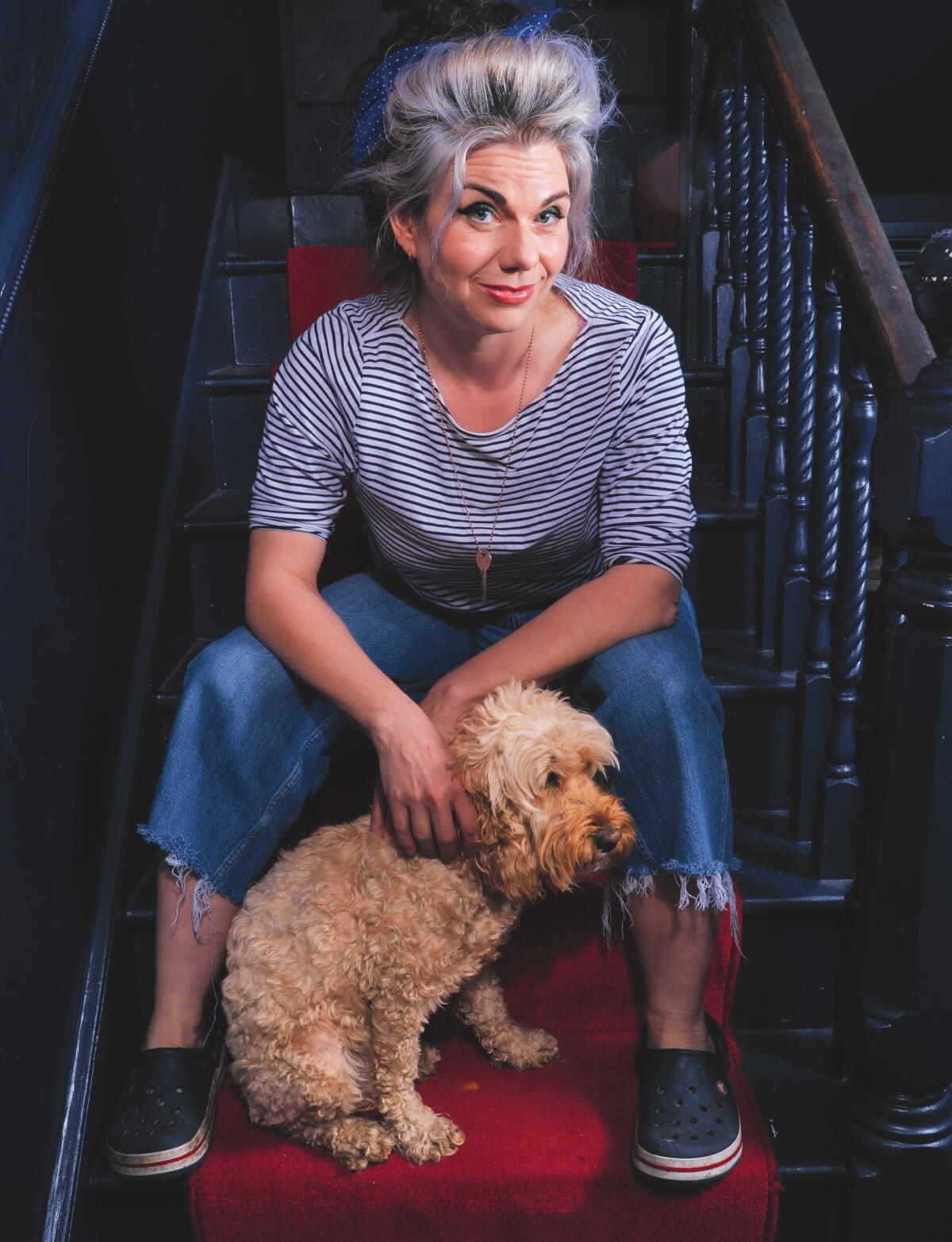
Why Caitlin Moran never wants ‘to take advice from someone who isn’t making jokes’
For years, stress followed Caitlin Moran around like bad weather. She liked it that way, as anxiety became a spur to productivity in her career as an author and columnist. While it’s hard to find fault with the results — nine bestselling books, household name status in her native England, a passel of awards for her sharply amusing take on modern life and its discontents — Moran was starting to fall into the deep end of her bruised and battered psyche.
Her new book “How to Be Hopeful” details how Moran threw herself a lifeline and pulled out of her self-made abyss. I recently chatted with Moran about health, happiness and the benefits of having a pet.
✍️ Author Chat
How is your anxiety these days?
For the last 10 years, it felt like my life could be over at any minute because I never felt safe. I didn’t realize how abnormal that was. Now that I’m talking to readers at events about this book, I realize how common it is. A good half of the people that approach me at readings tell me that I have described their anxiety exactly as it is. But they have never talked about it or shared it with anyone. I have had a few people tell me they were planning on killing themselves. There’s a lot of crying, a lot of hugging. It’s quite intense.
I feel like your fan base wouldn’t be inclined to buy self-help books.
Self-help books are often quite dry and humorless. Those books seem to have all the answers, which they then drill into their readers. You know, “You must do this one thing in order to feel better.” My book is a memoir, and I’m not exactly someone who has it all sorted out. So it’s not impersonal and I hope it’s funny. I don’t ever want to take advice from someone who isn’t making jokes.

Caitlin Moran talks about her new memoir, telling The Times that she is “not exactly someone who has it all sorted out.”
(Dora Paphides)
You write about how your anxiety was a great source of productivity, that it allowed you to generate pages. How is that working out now that you’ve quelled your stress somewhat?
Anxiety was a good friend to me and it fueled my writing, but it wound up being the sort of friend you have to say goodbye to. Panic and anxiety turn up when your brain thinks you need it to save yourself, and it releases these powerful neurotransmitters like cortisol into your brain. But I never just stepped back and asked myself, do I need to be anxious right now? Or have I in fact gotten out of the trouble that caused the anxiety to begin with? When I figured out how to turn off the anxiety, and turn off the drug tap that was feeding me these chemicals, I thought I would never be able to write. But it turned out I didn’t need it. I’m writing more than ever before, because I’m not spending all my time battling these voices in my head.
You target social media, specifically Twitter/X, as a driver of anxiety. But you are a public figure, so I’m assuming you have some obligation to have a social media presence.
I had over a million followers on Twitter at one point, but then it started to get dark. You’re always going to offend or upset someone, no matter how hard you try not to. No one on social media has ever said, “You know what? I agree with you and I’ve changed my mind.” If you want to change things in the world, social media is not the way to do it. If you are fighting the good fight on Twitter, the anxiety attrition rate is horrible, whereas if you are contributing to a local charity, the attrition rate is much healthier.
In the book you talk about getting a dog, and how that has helped you.
Yes, she’s sleeping here on the couch as we speak. When we first brought her home as a puppy, I just kept praising her, and I realized I’ve been nicer to this dog than I’ve ever been to myself. Dogs are the best. They don’t care about Trump, or Zelensky, or interest rates. They will just remind you, we need to play. We need to go for a walk. We need to feel excited about the fact it’s raining. Simple things.
This Q&A was edited for length and clarity.
📰 The Week(s) in Books

Book jacket for “Look at Me” by Dustin Hoffman
(Los Angeles Times illustration; book jacket from Simon Six)
Dustin Hoffman’s memoir “Look at Me” is a “gossipy, entertaining compendium of stories” that doesn’t leave out some of the uglier episodes of the film icon’s career, including his #MeToo moment in 2017, writes Julia M. Klein.
Klein also reviews Sam Wasson’s exhaustive biography of film director Frank Capra, which is “fond and admiring, even gushing at times” without papering over Capra’s missteps, including his “weak-kneed response to the anti-Communist crusade that roiled 20th century Hollywood.”
Novelist Alexander Maksik has written a father-daughter story called “Passengers” that takes place in LAX, of all places. “When my daughter was born, like many new parents, I found I could only think in clichés, and I didn’t try to resist them,” he tells Bethany Patrick. “But as time went by, I started to toy with the idea of writing a novel about a father and daughter in which the battle against cliché would become central, would take on huge, even life-saving, importance.”
Malcolm Gladwell has written a book called “The American Way of Killing,” about gun violence in America, and in typically Gladwellian fashion, he upends our expectations about the subject. “Gun violence isn’t just about gun violence,’ he tells Shelby Hartman. “It encompasses so many aspects of the human experience. Every time someone dies, somebody grieves, a mother, a partner is bereft. It involves violence which is a source of great horror and fascination.”
📖 Bookstore Faves

Zibby’s Bookshop is on Montana Avenue in Santa Monica.
(Photo from Zibby Media)
In the three years since Zibby Owens opened Zibby’s Bookshop on Santa Monica’s Montana Avenue, the inviting, carefully curated space has become a vital gathering place for bookish Westsiders. Owens, who has written three books and hosts the podcast “Totally Booked,” is committed to creating an intuitive space that functions as a curiosity incubator for committed bibliophiles and casual readers alike. I recently asked Owens what’s flying off her shelves.
How did you come to open the store?
I had essentially been testing out the concept of a bookstore in my apartment. I was having frequent events and I had book fairs twice a year. I would invite over everybody I knew, and people would leave with books. So I was testing out curation and events and book sales without even knowing it. And it had always been my dream to own a brick-and-mortar store.
You organize your inventory according to how people tend to shop for books, which is according to mood, or perhaps a genre they are interested in.
We have curation by emotion and topic. It’s designed for discoverability. So we have individual shelves of 20 books or so, which will focus on different topics. Perhaps you feel like being outdoors, or you saw a film but you want to read the book that it was adapted from, or you want a book to make you cry, or to cope while you’re reeling from divorce. We make it easy for you to find what you need.
You also feature books that might otherwise slip between the cracks.
I wanted to put better known books alongside undiscovered gems. Because having been on the other side of the equation, I know how hard it is to get discovered if the big publishing machine is not pushing you.
What’s selling right now?
“Hollywood, Ending” by John Green, “A Court of Splintered Harmony” by Sarah J. Maas, “Peck and Peck” by Bonnie Garmus and Gloria Steinem’s memoir “An Unexpected Life.”
Zibby’s Bookshop is located at 1113 Montana Ave. in Santa Monica.