C17

C-17 Cargo Jets Flowing To Caribbean For Venezuela Earthquake Relief Effort

U.S. Air Force C-17 Globemaster III cargo jets have arrived in Venezuela, packed with personnel and equipment for the ongoing earthquake relief efforts. The aircraft are joining U.S. forces already in the country as well as on the amphibious transport ship USS Fort Lauderdale, the littoral combat ship USS Billings and at American bases around the region.

The flights are part of a growing U.S. military presence being run by U.S. Southern Command (SOUTHCOM) in support of the U.S. State Department. The movements are in response to 7.2- and 7.5-magnitude earthquakes Wednesday night that Venezuelan authorities say devastated much of the northern part of the country and have killed more than 900

The first C-17 arrived in Venezuela this morning. Online flight trackers show that at least four of the cargo jets have left the U.S.

“The first air shipment of equipment has arrived to support the two specialized U.S. search and rescue teams, which are arriving in Venezuela to join ground operations as soon as possible,” the U.S. Embassy in Caracas said in a post on X. “With nearly 80 experts per team—firefighters, doctors, structural engineers—12 canines trained for detection in rubble, these groups bring advanced capabilities to locate survivors and assist in complex emergencies. Their personnel and specialized equipment are being positioned to head to the hardest-hit areas and begin operations when conditions allow.”

A second one reportedly landed in the stricken nation as well.

“A C-17 Globemaster III was loaded overnight at Dover AFB with Urban Search and Rescue personnel and equipment for transport to Venezuela in support of State Department-led humanitarian response efforts,” SOUTHCOM said in a post on X Friday morning. “America’s military is delivering the people and capabilities needed to save lives.”

A C-17 Globemaster loaded specialized U.S. search and rescue teams overnight bound for Venezuela. (SOUTHCOM)

Another C-17 landed in Curaçao. The island is serving as one staging area for international efforts to search for survivors and victims and bring in much-needed humanitarian aid.

U.S. Marine Corps Maj. Gen. Kevin J. Jarrard arrived in Caracas on Thursday to oversee the Pentagon’s Venezuela earthquake relief efforts, SOUTHCOM stated. 

“Jarrard is serving as the senior U.S. Southern Command (SOUTHCOM) official on the ground and is working closely with partners to plan, coordinate, and direct the U.S. military’s unparalleled logistical and operational capabilities to support the rapid, life-saving movement of response personnel, equipment, and humanitarian assistance into affected areas,” the command said in a media release.

In another post on X, SOUTHCOM included a photograph of a USMC MV-22B Osprey tiltrotor aircraft. The Osprey is part of an array of fixed- and rotary-wing assets deployed for the relief effort around the region.

A U.S. Marine Corps MV-22 Osprey tiltrotor aircraft landed in Venezuela Thursday as part of U.S. humanitarian relief efforts. (SOUTHCOM)

Jarrard is leading SOUTHCOM Commander Gen. Francis L. Donovan’s deployment of “significant forces to the effort,” according to the command. This includes the aforementioned cargo jets and Navy vessels, as well as C-130 Hercules transports, unspecified reconnaissance platforms and rotary-wing aircraft.

“These forces will provide specialized mobility services and support to U.S. government personnel, search and rescue teams, and U.S. interagency partners as they assess damage, locate the injured, and deliver critical, life-saving assistance,” SOUTHCOM said in a statement.

The Pentagon released images of a U.S. Army CH-47 Chinook transport helicopter loading up personnel and supplies in Honduras for potential participation in this mission.

A 1st Battalion 228th Aviation Regiment CH-47 Chinook is prepped for potential support for Venezuela's disaster relief response at Soto Cano Air Base, Honduras, June 25, 2026. At the direction of U.S. Southern Command, assigned U.S. military forces are supporting Department of State-led U.S. disaster assistance to the people of Venezuela in the aftermath of the June 24, 2026, earthquakes. (U.S. Air Force photo by Staff Sgt. Ethan Sherwood)
A 1st Battalion 228th Aviation Regiment CH-47 Chinook is prepped for potential support for Venezuela’s disaster relief response at Soto Cano Air Base, Honduras, June 25, 2026. (U.S. Air Force photo by Staff Sgt. Ethan Sherwood) Staff Sgt. Ethan Sherwood
Members of Joint Task Force-Bravo load equipment into a CH-47 Chinook in preparation for potential support to Venezuela's disaster relief response at Soto Cano Air Base, Honduras, June 25, 2026. At the direction of U.S. Southern Command, assigned U.S. military forces are supporting Department of State-led U.S. disaster assistance to the people of Venezuela in the aftermath of the June 24, 2026, earthquakes. (U.S. Air Force photo by Staff Sgt. Ethan Sherwood)
Members of Joint Task Force-Bravo load equipment into a CH-47 Chinook in preparation for potential support to Venezuela’s disaster relief response at Soto Cano Air Base, Honduras, June 25, 2026. (U.S. Air Force photo by Staff Sgt. Ethan Sherwood) Staff Sgt. Ethan Sherwood

All this is being anchored by the two Navy vessels, which have been in the region for months.

Of the two, Fort Lauderdale has been in the Caribbean the longest and took part in the counternarcotics operation that led to the capture of former Venezuelan dictator Nicolás Maduro, now in custody in the U.S. The rest of the ships assigned to that mission left the region months ago.

Fort Lauderdale can embark multiple types of rotary wing aircraft, including Marine MV-22B Ospreys and UH-1Y Venoms. Other helicopters can use their large deck area for resupply and refueling, as well. The vessel could be used as a staging area to deliver aid and extract wounded from a nearby port or off the coast of Venezuela. Hundreds of sailors and Marines aboard could assist with humanitarian efforts, from the ship or on the ground. 

ATLANTIC OCEAN (June 29, 2025) The San Antonio-class amphibious transport dock USS Fort Lauderdale (LPD 28) sails during a strait transit exercise. The Iwo Jima Amphibious Ready Group (ARG) and embarked 22nd are underway executing Composite Training Unit Exercise (COMPTUEX), which tests the amphibious ready group’s ability to deliver combat power wherever the nation’s leadership requires, and is informed by U.S. Navy Fleet Commander requirements and assessment of ongoing operations around the globe. COMPTUEX is the Department of the Navy’s commitment to deliver highly capable, integrated naval forces to promote our nation’s prosperity and security, deter aggression and provide tailorable options to our nation’s leaders. COMPTUEX also allows the Navy to assess all aspects of prior readiness generation activities, which provides leaders information needed for process and resource allocation decisions for future warfighting development. (U.S. Navy photo by Mass Communication Specialist 2nd Class Savannah L. Hardesty)
The San Antonio class amphibious transport dock USS Fort Lauderdale (LPD 28) is taking part in the U.S. military’s humanitarian aid response to the Venezuelan earthquakes. (U.S. Navy photo by Mass Communication Specialist 2nd Class Savannah L. Hardesty) Petty Officer 2nd Class Savannah Hardesty

The flight deck of Billings, which arrived in the Caribbean in March, is much smaller and supports the ship’s MH-60 Seahawk helicopter and drones. It can also be used by other helicopters.

If needed, there are additional Navy assets operating off the East Coast that could be re-tasked to SOUTHCOM. 

The amphibious assault ship USS Iwo Jima recently returned to Norfolk from a 10-month deployment in the Caribbean. If it has not yet entered its planned maintenance availability, the vessel could be redeployed if called upon. 

ATLANTIC OCEAN (Aug. 17, 2025) The Wasp-class amphibious assault ship USS Iwo Jima (LHD 7) conducts an anchoring evolution. Sailors and Marines of the Iwo Jima Amphibious Ready Group (IWO ARG) – 22nd MEU(SOC) departed Norfolk and Camp Lejeune, North Carolina after completing a comprehensive, nine-month training program. (U.S. Navy photo by Mass Communication Specialist Seaman Logan Goins)
The Wasp class amphibious assault ship USS Iwo Jima (LHD 7). (U.S. Navy photo by Mass Communication Specialist Seaman Logan Goins) Seaman Logan Goins

Much less likely is moving the aircraft carrier USS Nimitz. The fleet’s oldest carrier left Mayport, FL, on Wednesday and is now participating in large-scale FLEETEX before a planned transit to New York for America 250 events. 

Meanwhile, America’s unique array of ISR assets can be critical to Venezuela’s relief efforts.

Platforms like MQ-9 Reaper and MQ-4C Triton drones and piloted aircraft like P-8 Poseidon maritime patrol craft and even U-2 Dragon Lady spy planes could bring a lot of sensor power to bear to help with search and rescue, mapping and provide other geospatial intelligence benefits to develop a clearer picture of the situation.

U.S. Navy P-8 Posiedon martime patrol jet. (USN)

This relief effort is still unfolding and the full extent of the damage is still coming to light. As we previously noted, the disaster offers an opportunity for the U.S. military to foster improving relations with Venezuela almost half a year after Maduro was snatched out of Caracas.

U.S. President Donald Trump appears to have seized on this chance, at least to some degree, announcing America would play a key role in helping Venezuela in a post on his Truth Social site.

“The two major earthquakes that just hit the great people of Venezuela are both massive in scale and have left a devastating number of deaths,” Trump proclaimed. “The U.S.A. stands ready, willing, and able to help! I have instructed all agencies of our government to get ready to move quickly. We will be there for our new and great friends. Early reports are not good!!!”

It is unclear how much larger the U.S. military presence will grow for this mission. Several other countries are taking part as well and China has pledged to. Trump has made keeping the Caribbean under the control of the U.S. a major part of his administration’s plans and a top reason for removing Maduro was to stem the influence of China and Russia there.

We will continue to monitor the situation and provide updates when warranted.

UPDATE: 3:28 PM EDT –

SOUTHCOM provided an update on the assets being deployed:

  • Two U.S. Air Force C-17 Globemaster aircraft are transporting U.S. Urban Search and Rescue teams based in Los Angeles and Fairfax, Virginia, and one U.S. Air Force C-17 will deliver load-movement equipment to Caracas.
  • U.S. Marine Corps MV-22 Ospreys will transport an airfield assessment team to Venezuela to support airport operations that were impacted near the earthquake epicenter.
  • The U.S. Navy’s San Antonio-class amphibious transport dock USS Fort Lauderdale (LPD 28) and Freedom-variant littoral combat ship USS Billings (LCS 15) have arrived in waters near Venezuela and will begin supporting relief and live-saving efforts.
  • Three U.S. Army CH-47 Chinooks and crews from Joint Task Force-Bravo will depart Soto Cano Air Base in Honduras en route to support the transport of key personnel and supplies aiding impacted Venezuelan communities.
  • The command’s U.S. Space Force component is providing satellite imagery of devastated areas to disaster relief planners in Venezuela to aid them in assessing where immediate live-saving and aid efforts are needed most and identifying what capability requests to prioritize.

Contact the author: howard@twz.com

Howard is a Senior Staff Writer for TWZ. He writes frequently about conflict, focusing heavily on the Middle East and Ukraine, and interviews with military and intelligence officials and industry leaders from around the globe. He lives near Tampa, Florida, home of U.S. Central Command, U.S. Special Operations Command.


Ian executes TWZ’s full-spectrum social media strategy, brings his interpretive graphics skills to our editorial team as an OSINT analyst and researcher, and maintains the weekly carrier tracker and newsletter.


Source link

Boeing “Encouraged” By C-17 Production Restart Discussions

Operators of the C-17 Globemaster III have been reaching out to Boeing about possibly restarting the product line, and the company has been “encouraged” by these engagements. Separately, Congress recently directed the U.S. Air Force to prepare a formal briefing on the feasibility of acquiring new Globemaster IIIs. The Air Force’s C-17 fleet is critical for U.S. power projection globally. At the same time, a succession of crises in recent years has put serious strain on these aircraft, and questions have already been raised about the viability of the current plan to keep them flying through 2075.

The House Committee on Armed Services added the requirement for the C-17 production restart briefing to a report accompanying the latest draft of the annual defense policy bill, or National Defense Authorization Act (NDAA), last week. The Air Force took delivery of its last Globemaster III in 2013, and has some 222 of these airlifters in service today. The air arms of Australia, Canada, India, Kuwait, Qatar, the United Arab Emirates, and the United Kingdom also have smaller fleets of these airlifters. Three more of these aircraft are operated under the Strategic Airlift Capability (SAC) initiative, a multi-national arrangement with several European members, as well as the United States. Boeing shuttered the C-17 line entirely in 2015.

Boeing Pieces Together the Last C-17 on the Line thumbnail

Boeing Pieces Together the Last C-17 on the Line


“The committee recognizes that the existing C-17 fleet continues to bear significant operational demands supporting combatant commander requirements, humanitarian assistance missions, and global mobility operations,” the provision in the House Committee on Armed Services’ report notes. “The committee is concerned that future operational demands may place additional strain on the existing C-17 fleet.”

“Therefore, the committee directs the Secretary of the Air Force to provide a briefing to the House Committee on Armed Services not later than March 1, 2027, assessing the feasibility of restarting the production line for the C-17 aircraft,” it adds.

The committee wants the Air Force’s briefing to at least include the following:

  • “An assessment of the technical and industrial feasibility of restarting the C-17 production line, including the status of tooling, supplier base viability, workforce availability, and potential reconstitution costs.”
  • “An estimate of the timeline required to reestablish production and deliver the first newly produced aircraft.”
  • “A cost estimate for restarting the production line and procuring additional aircraft, including options for limited procurement and multi-year procurement.”
  • “An evaluation of alternative approaches to increasing strategic airlift capacity, including service life extension programs, modernization of existing aircraft, procurement of commercial derivative cargo aircraft, and expansion of the Civil Reserve Air Fleet.”
  • “An assessment of potential international partner interest in participating in or contributing to a restarted production line.”
A row of US Air Force C-17s. USAF

TWZ subsequently reached out to Boeing to ask about the company’s current position on rebooting C-17 production.

“Our goal is to help our customers be successful, and we work with them to develop innovative solutions to meet their mission needs, including development and production partnerships,” a Boeing spokesperson told us this week. “We are proud of our continued support for the unique, mission-proven capabilities that the C-17 Globemaster III delivers to the U.S. Air Force and eight allied nation partners.”

At the Paris Air Show last year, Turbo Sjogren, Vice President and General Manager of Boeing Global Services-Government Services, had told Shephard Defense that talks with an unnamed country about a possible C-17 production restart were in their “early infancy.”

“It is a very extraordinary effort to do” and is “reflective of the utility of the aircraft,” he also said at the time, according to Shephard.

Boeing has also now said that it is always willing to work to better understand the requirements and needs of its customers. Any talk about the prospect of restarting C-17 production would also have to be viewed in the broader context of the Air Force’s still-evolving requirements for the Next Generation Air Lift (NGAL) program. The service’s current NGAL plans envision a single aircraft replacing the very different C-17 and C-5 Galaxy fleets, as you can read more about here.

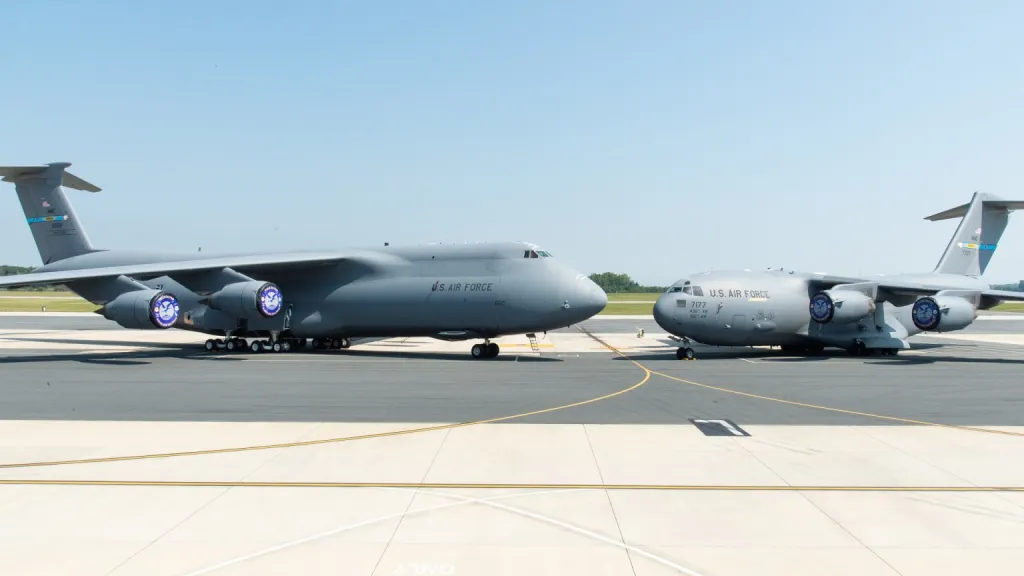
A C-5 Galaxy, at left, and a C-17, right. USAF

TWZ also reached out to the US Air Force about the recently requested briefing.

It is unclear what it might cost to get the C-17 line restarted and what the unit price of these new-production aircraft would be in the end. There are various factors at play, including whether Boeing retains any relevant tooling, the knowledge base of its current workforce, the state of third-party supply chains, and the availability of physical space to build the airplanes. Back in 2019, the company sold off the facilities in Long Beach, California, where it built the original run of Globemaster IIIs.

More than a decade ago, the RAND Corporation did conduct a detailed, independent analysis that explored options for resuming production of the baseline C-17A, a new C-17B, and a significantly revised “fuel efficient” C-17FE derivative.

The C-17B was “a variant Boeing has proposed that adds centerline landing gear, a tire deflation/inflation system, higher-thrust engines, advanced flaps, and an advanced situational awareness and countermeasures system,” according to RAND’s report. The C-17FE derivative “would have a narrower fuselage, up-rated engines, a double-element flap system, winglets, a longer loading ramp, a shorter cargo door, and a modified horizontal tail.”

A graphic offering a very general comparison between the C-17A and the proposed C-17FE. Boeing

RAND said that it could cost between $2.1 and $2.7 billion in 2011 dollars to begin making C-17A models again after a pause, depending on how much tooling Boeing retained. Those costs would rise to $4.6 to $6.4 billion for new production of the improved C-17B version, and $6.2 billion to $7 billion to start building the C-17FE derivative. Billions more would be required to actually procure the aircraft, with unit prices being highly dependent on the total size of the production, as outlined in the table below. If nothing else has changed, these cost projections would still be significantly higher today just due to inflation.

RAND

As an aside here, RAND published a similar assessment of the options for restarting production of the F-22 Raptor in 2011. That report factored heavily into a study the Air Force subsequently delivered to Congress on that topic back in 2017, which you can read more about here.

Foreign participation in new production of C-17s could help defray costs, and is one of the points the House Armed Services Committee specifically wants the Air Force to address in its briefing. As TWZ noted last year after Turbo Sjogren made comments at the Paris Air Show, Boeing’s discussions at that point might not have been with the U.S. government. Earlier in 2025, then-Japanese Prime Minister Shigeru Ishiba had expressed interest in buying Globemaster IIIs, raising immediate questions about where those aircraft might come from.

It should be noted here that the U.S. Air Force’s C-17s have received various upgrades over the years, and the service continues to move ahead with other plans to improve their performance and expand their capabilities. This includes the installation of 3D-printed microvanes on the fuselage, which offer a very minor reduction in drag (approximately one percent), but that translates into real reductions in fuel consumption. All Air Force C-17s are expected to have this feature by the end of next year. Communications and data-sharing upgrades have also been a major focus area across all of the Air Force’s airlift and tanker fleets.

Boeing is now under contract for a more extensive upgrade of the flight decks on Air Force C-17s. The company says this will aid in “resolving avionics obsolescence” and integrate new open systems architectures to make it easier to add new and improved capabilities and functionality in the future.

A look inside the cockpit of a US Air Force C-17. USAF

The prospect of a re-engining effort for the Globemaster III fleet has also been raised in the past, but the Air Force downplayed the value of doing so earlier this year.

When it comes to discussions about restarting C-17 production, another key factor is the lack of immediate alternative options. There is really no other aircraft in this class in production now in the United States or anywhere else in the West. Airbus has long positioned its turboprop-powered A400M as sitting in a capability space between Lockheed Martin’s C-130 family and the C-17. Embraer’s KC-390 Millennium design, which is also offered as an aerial refueling tanker, has generally been pitched as a jet-powered competitor to the C-130. China’s Y-20 and Russia’s Il-76 are really the only in-production analogs on any level to the C-17 globally.

The House Armed Services Committee has now also asked the Air Force to speak to the possibility of buying “commercial derivative cargo aircraft” and/or an “expansion of the Civil Reserve Air Fleet,” or CRAF, to help bolster airlift capacity. The CRAF is an arrangement by which the U.S. military can call upon commercial airlines and charter companies to help move cargo and personnel, which you can learn more about here.

A key issue here is that the C-17 is specifically designed for tactical operations right at the tactical edge. This includes the ability to bring combat-ready forces to far-flung locations without the need for an established airfield. Additional commercial alternatives could still be utilized in rear areas to help free up C-17s for more demanding missions and otherwise relieve stress on the Globemaster III fleet.

A C-17 at Delamar Dry Lake in Nevada during training. USAF

Questions have been increasingly raised about the survivability of the C-17 itself, especially in the context of a future high-end fight, as the threat ecosystem continues to expand and evolve. The Air Force has made clear that it is working to find new ways to bolster the defensive capabilities of all of its existing airlifters, as well as its tanker fleets, and that this is a key consideration in the evolving NGAL requirements.

TWZ has long been sounding the alarm on the need for more survivable cargo planes and tankers. The Air Force already has decades’ worth of experimental work and studies on concepts for stealthy cargo aircraft and tankers, as well as non-stealthy ones with blended-wing-body (BWB) planforms, under its belt. Over the years, several companies have publicly put forward prospective designs that could be relevant for NGAL, as well.

A wind tunnel model of a design concept for an advanced tanker and/or cargo aircraft that the Air Force explored as part of a project called Speed Agile in the late 2000s and early 2010s. USAF
A rendering of the blended-wing-body demonstrator aircraft now in development for the Air Force. USAF

When any new platform developed under NGAL actually enters service remains to be seen. The stated plan the Air Force has put forward to date would see those new aircraft replacing its C-5s first, with C-17s flying through 2075. By that point, the Globemaster III, as a type, will have been in service for 80 years.

“The C-17 is the most amazing airplane ever made. I have a lot of time in it, so I can say that. We have asked it to do a lot of things, and it’s done more than we ever planned for when we bought that airplane,” Air Force Lt. Gen. Rebecca Sonkiss told TWZ and other outlets at a roundtable on the sidelines of the Air & Space Forces Association’s (AFA) annual Warfare Symposium in February. “It has performed flawlessly, but it’s getting old too.”

Sonkiss is Deputy Commander of Air Mobility Command (AMC). She has been serving as the interim head of the command since her predecessor, Gen. John Lamontagne, became Vice Chief of Staff of the Air Force in January.

“I cannot have a gap in my strategic airlift forces, and we’re working forward on the NGAL to combine the view of the C-5 and the C-17 fleet and figure out what the next strategic airlifter needs to be. That conversation, in my book, can’t happen enough, or can’t happen fast enough,” she added at the roundtable in February. “We have to get after what next looks like, and we can’t wait until we’re shoveling it into the boneyard before we get to that discussion.”

Whether the Air Force’s future airlift plans also include buying new-production C-17s remains to be seen. For its part, Boeing does not appear to have ruled out the possibility just yet.

Contact the author: joe@twz.com

Joseph has been a member of The War Zone team since early 2017. Prior to that, he was an Associate Editor at War Is Boring, and his byline has appeared in other publications, including Small Arms Review, Small Arms Defense Journal, Reuters, We Are the Mighty, and Task & Purpose.


Source link