Best Buy (BBY) announced the launch of its Best Buy Gamers hub in beta. The free online hub was highlighted as putting gaming content, gear, special offers, sweepstakes, and events all in one place, with the goal to save gamers from checking several sites for
MILWAUKEE — The Dodgers spent $163 million on the back end of their bullpen the past two years. The Milwaukee Brewers did not.
So two games into the National League Championship Series, guess which team’s relief corps has been lights out and which one has been lit up? (Spoiler alert: it’s not the team with all the money.)
Milwaukee sent a parade of four relievers to the mound for a second straight game Monday, and for a second straight game they didn’t give up a run, retiring the last 15 Dodgers in order in a 7-4 win that gives Milwaukee a commanding 2-0 lead in the best-of-seven series, which moves to Dodger Stadium for Game 3 on Wednesday.
The Brewers’ bullpen has pitched 9 2/3 innings in the series, yielding just two hits — both off Abner Uribe — and three walks. That’s it. Both wins have gone to relievers, DL Hall in the opener and JoJo Romero in Game 2.
Dodger relievers, meanwhile, have pitched 9 1/3 innings in the two games, giving up four runs on nine hits. Reliever Brock Stewart took the loss Monday.
In a series that’s rapidly shaping up as a battle of the bullpens, the Dodgers clearly aren’t getting what they paid for.
“I don’t have an answer,” Dodgers manager Dave Roberts shrugged when asked why the Dodgers relievers have struggled while the Brewers have shined. “I know that they’ve got good arms; so do we. I think they’re just finding ways to win pitches better than we are.”
Slugger Max Muncy has a theory on the same question.
“They’re really good,” he said.
The Brewers’ 48 bullpen wins was the most in baseball during the regular season and its 3.40 ERA was best in the National League. And it has been even better in the postseason, giving up just one earned run in 28 2/3 innings against the Dodgers and San Diego Padres. In the divisional era (since 1969), only the 1991 Minnesota Twins have a lower bullpen ERA through six playoff games and with a reliever earning the victory in all five of Milwaukee’s postseason wins, the Brewers have done something only the 2014 Kansas City Royals had done previously.
“There’s a reason they’re where they’re at right now and the bullpen’s a big piece of that,” Muncy said. “If there is a positive, you can say that a lot of our guys are starting to get looks at their back-end guys. But when they’re as good as they are, I don’t know how much that helps.
“They’re all throwing 100 [mph] plus and they all have really nasty stuff.”
Especially Aaron Ashby, who has pitched in both games, holding the Dodgers to a walk in 3 2/3 innings, striking out three. He’s the Brewers’ best-paid reliever, earning $5.5 million this season.
The Dodgers have three relievers making at least twice that — and one of them, Blake Treinen, didn’t even make the postseason roster. One of the others, Tanner Scott, gave up twice as many runs in his first postseason appearance as the Brewers’ bullpen has given up this month.
Milwaukee Brewers pitcher Abner Uribe celebrates after completing the seventh inning of Game 2 of the NLCS.
(Robert Gauthier / Los Angeles Times)
“They attack the hitters,” Dodgers outfielder Teoscar Hernández said of Milwaukee’s relievers. “They throw strikes. They got good stuff. They throw hard. We’ve just got to do a better job.”
Hernández then echoed Muncy in pointing out the Dodgers have now seen six of Milwaukee’s nine relievers, with Ashby and Uribe throwing in both games. And while the Dodgers haven’t done anything against them yet, that familiarity could help going forward.
“We know what we’re going to get,” Hernández said.
Brewers manager Pat Murphy conceded the point — sort of.
“Familiarity, as the numbers tell us, does provide an edge,” he said. “So what we try to do is make sure they don’t face the same guys the next time they pitch if they’re one-inning guys.
“Can’t always do that.”
Sometimes you can, though. Uribe, who has appeared in all six Brewers games this postseason, has already faced eight Dodger hitters in the series, but only one of them, Andy Pages, twice. And when he does face someone a second time, Murphy said with a smile, who’s to say he’ll him pitch the same way?
“Uribe might have something up his sleeve based on how those other times went,” he said. “Like, well, I never gave him this.’”
That would count as a surprise. However the dominant performance of the Brewers’ bargain-basement bullpen would not. Because even in baseball, the Dodgers are finding out, there are some things money can’t buy.
Nimesh Patel’s stock in comedy has been on an upswing lately. From sold-out shows to a skyrocketing social media following and the release of his first Netflix special, “Buy the Dip,” last month, it’s been amazing the difference a year makes. The new hour filmed in Washington, D.C., delivers surgically precise, dryly delivered jokes and personal stories about America falling apart from the heart of our nation’s capital.
Despite the dire circumstances, it’s in our country’s DNA to believe in the power of the rebound. So does Patel, who’s seen one play out with his own career after taking an unexpected hit. Last fall, the comedian faced public backlash for his decision to accept — and then reject — a spot on the controversial Riyadh Comedy Festival, for which he’d been offered $125,000 to perform along with major names like Dave Chappelle, Bill Burr, Sebastian Maniscalco, Whitney Cummings and many more. The rollout of a comedy festival in Saudi Arabia, a nation whose government has been accused of human rights abuses and, according to U.S. intelligence, the brutal murder of journalist Jamal Khashoggi at its consulate in Turkey, lead to a war of words on the internet aimed at the comedians on the lineup. Hearing the scrutiny loud and clear and ultimately deciding the money wasn’t worth it, Patel decided to pull out and tell the world via Instagram that he wasn’t going, opting instead (and somewhat grudgingly) to make up for the lost bag with 40 extra shows added to his nationwide theater tour. The response to his video announcement drew even more ire from comedy fans. Looking back on it now, he admits his delivery at the time, looking tired and somewhat annoyed by his own decision, wasn’t the greatest.
“People read that as sarcasm and like woe is me,” Patel said in a recent conversation with The Times over Zoom. “I can see why they thought that I was a poor actor in the video that I posted. But everyone acts better than the person they see on the screen until it becomes their life and then they’re like, ‘Oh s—, yeah, I probably would have done the same thing.’ So, f— them!”
Despite the roasting he received, Patel stuck to his word and did the shows. Stepping on stage night after night to earn the money he had planned on making last year from one canceled gig in Saudi Arabia gave him the reps he says he needed to perfect the new hour of material. The title “Buy the Dip” is a nod to the remnants of his former career in finance — it’s stock market terminology about buying a failing asset with the hope that it will go up in value again. But it also describes the optimism from which he now makes his decisions as a parent and as someone who still believes that things can get better, even at their lowest.
“I have to be an optimist, I have to believe the world is getting better, because otherwise, what the f— did I do by having a kid?” he said.
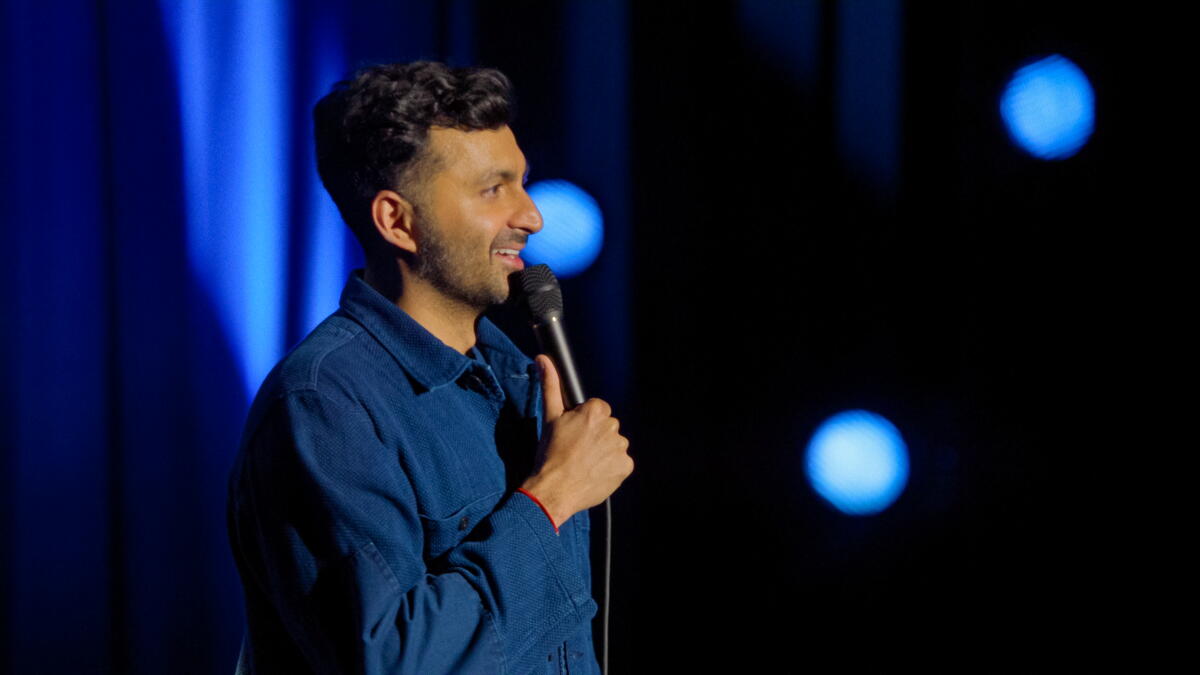
In his Netflix debut special, “Buy the Dip,” comedian Nimesh Patel turns personal setbacks and a troubled America into sharply observed jokes grounded in unexpected optimism.
(Courtesy of Netflix)
His belief in positivity followed him to D.C. to record the special, the town where he says he got his first big breaks as a comedian opening for major acts like Maz Jobrani at the Warner Theatre, headlining the Bier Baron and the DC Improv and even the Kennedy Center — “or the now-defunct Trump whatever you’re supposed to call it,” he joked. When it comes to his comedy trajectory, taking the long view is essential to realizing that Patel’s path to this special started over a decade ago when Chris Rock discovered him while on stage in Brooklyn and helped him get writing gigs on “Saturday Night Live” and the 2016 Oscars ceremony, two opportunities that solidified his resolve to go into comedy full-time after he lost his job in finance.
As an Indian American comedian, he knows there is a spotlight of cultural representation on him, which he notes in the special and even makes fun of. That kind of attention isn’t on just him but also on Indian Americans in even higher-profile jobs, such as, say, the first Indian American director of the FBI, the chronically embattled Kash Patel.
“Let me be clear, it’s really difficult to both be proud of Kash and despise him at the same time,” Patel says. On the one hand, there’s the astonishing feat of going from being one of the few Indian kids in Virginia amid post-9/11 racism to becoming head of the nation’s domestic intelligence agency. On the other there’s a career riddled with gaffes and allegedly immoral conduct that makes him an easy punching bag for the writers at “SNL” with the help of his late-night TV doppelganger Aziz Ansari.
“For him to go from that to then be serving the country at this level, that is an incredible achievement, and it’s just so sad that that is who our representative is at the moment,” Patel said. “Just like when an Uber driver says to me, ‘Your last name is Patel? Like Kash?’ I’m like, ‘Yeah, just like that, but not like that at all, you know?’”
Patel revisits the backlash he faced after accepting, then withdrawing from, Saudi Arabia’s Riyadh Comedy Festival, and how dozens of extra tour dates helped shape his new material.
(Courtesy of Netflix)
While trying to distance himself from one person who shares his family name, when it comes to his actual family, Patel has plenty of jokes of being too close to them. Like many millennials, he’s squeezed tight between caring for aging parents and raising a child. At 40, he says in the special that people in his age bracket have become the “Sandwich Generation.” Though, to be fair to his toddler, keeping track of his parents is a much harder task at times.
“They won’t take help. They’re very independent, and I imagine I was the same way when I was growing up,” Patel said. “So it’s that in itself is just like the Progressive commercial that we’re all becoming our parents, but in real life and not driven by a corporate marketing team. It’s just funny to see that play out.”
Whether the obstacles he faces in life are laugh-out-loud funny or career hurdles that threaten to topple him into the abyss, the idea that he can always bounce back is the key to staying unfazed during the highs and the lows of life. And to the extent that anyone can take a lesson from Patel in the art of staying even-keeled, he hopes the special will make people feel a little less bad about the country being on the brink of destruction.
“Everyone knows that we’re not in a good spot right now,” he said. “The dip is here now. I fully believe that we can recover, I hope that we can. It’s going to be a lot of pain. I don’t know if we’re at the bottom just yet, but I’m optimistic, and I have to be. Otherwise, I don’t know what I’m doing.”
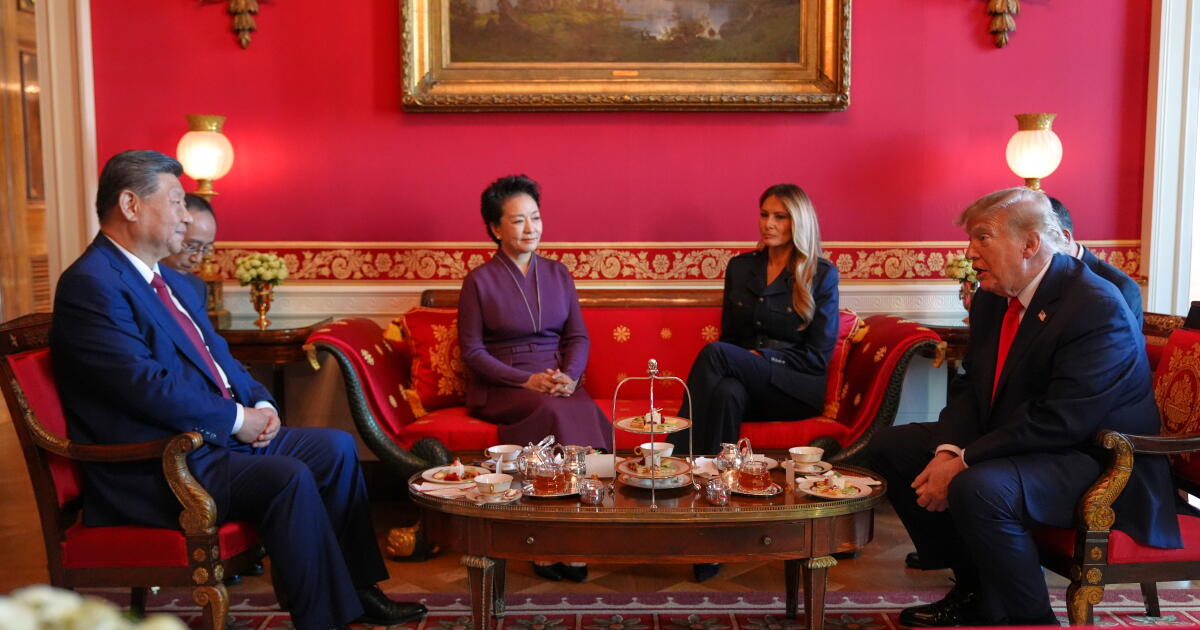
WASHINGTON — President Trump asked Chinese President Xi Jinping if he wanted to buy weapons from the United States, the U.S. ambassador to China said.
David Perdue said Trump raised the prospect of the arms sales from the U.S. to its ascendant geopolitical rival, an unlikely offer that if consummated would upend generations of U.S. policy toward China and Taiwan and expose U.S. technology to a potential foe. Perdue, speaking to Shannon Bream on Fox News Channel’s “Fox News Sunday” days after Trump hosted Xi for a state visit in Washington, didn’t specify when the offer was made.
Perdue said Sunday that Trump, a Republican, was downplaying longstanding U.S. arms sales to Taiwan — which have drawn protest from Beijing for years — by couching it as just one of many sales Washington makes around the world — and even asking Xi if he’d be in the market for U.S. weaponry.
Bream had cited concerns from Republican and Democratic lawmakers over delayed aid packages and weapons orders to Taiwan, the self-ruled democracy that seeks to defend itself from China’s threat to invade the island. Bream asked if the U.S. is denying arms to Taiwan to appease the Chinese president, who visited Trump last week.
Perdue pushed back on the suggestion, stating that Trump “is as strong on Taiwan as I’ve ever seen anybody” and has sold it plenty of weapons. Perdue also said Trump and Xi continue to talk about future U.S. weapons sales to Taiwan.
“But President Trump continues to say, ‘Hey, we sell arms to other people around the world,’” Perdue said. “He actually asked President Xi, would he like to buy some, at one point.”
The U.S. is bound by its own laws to provide Taiwan with the means to defend itself. While not recognizing Taiwan as a country, the U.S. is the island’s strongest informal backer and arms provider. But multiple U.S. leaders have left ambiguous whether they would commit military force to defend the U.S. ally should China invade.
China has pressed Washington to halt the arms sales, most prominently during a previous summit in May between Trump and Xi in Beijing. After that meeting, the United States paused the sale of a record-breaking $14 billion package — and Trump described arms sales to Taiwan as a “very good negotiating chip” with China.
In their private talks at the White House last week, Xi pressed Trump to oppose Taiwan independence, according to Chinese state media.
In Beijing, China’s foreign ministry spokesperson Guo Jiakun did not confirm Perdue’s remarks when asked about the matter on Monday. But he told reporters that China has always strengthened its national defense capabilities based on its needs and is committed to maintaining world peace and stability.