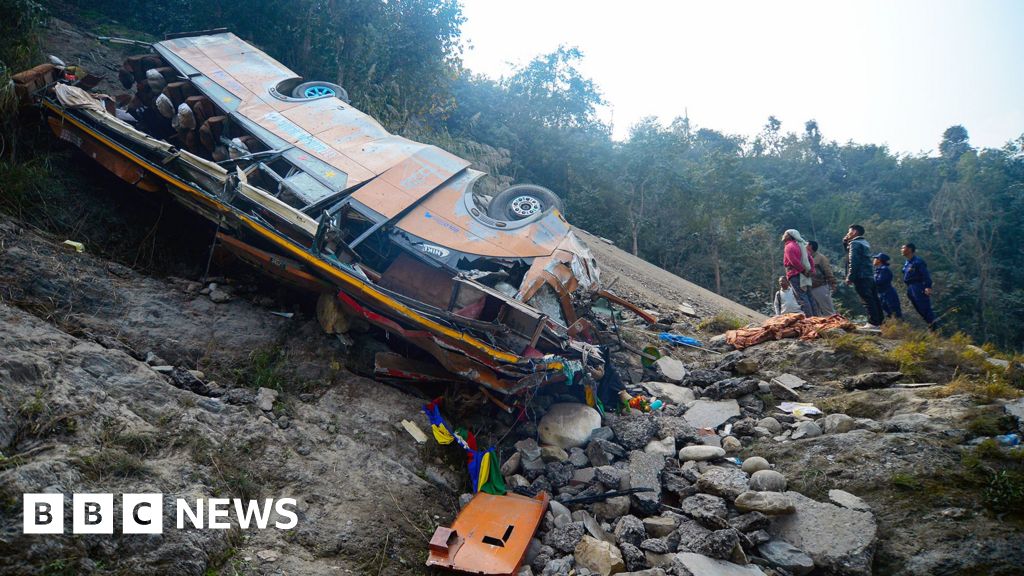
The bus, which was travelling between Guatemala City and San Marcos, crashed for unknown reasons, authorities say.
Published On 27 Dec 202527 Dec 2025
Share
At least 15 people have been killed and 19 injured after a passenger bus plunged into a ravine on the Inter-American Highway in western Guatemala, local authorities say.
The deaths included 11 men, three women and a minor, according to Leandro Amado, a spokesperson for local firefighters.
Recommended Stories
list of 4 itemsend of list
Amado told reporters on Saturday that some 19 injured people were taken to hospitals near the scene of the accident.
The crash occurred in the Solola Department between kilometres 172 and 174, in an area nicknamed “Alaska Peak” because of its rugged terrain, in the department of Totonicapan (western Guatemala).
The dense fog in that area also often reduces visibility for drivers taking the route in question.
‘Reason unknown’
The bus, which was travelling between Guatemala City and the department of San Marcos, on the border with Mexico, fell into a ravine almost 75 metres (250ft) deep for unknown reasons, Amado added.
Images shared by the fire department on social media early on Saturday showed the wrecked bus in the ravine as firefighters worked at the scene of the incident to rescue the wounded and recover the bodies of the victims.
Relatives of the passengers have arrived at the scene of the accident as well as the hospitals around the area searching for their loved ones, local media reports said.
Early in 2025, more than 50 people died and many others were injured in another major bus crash in the country, when the vehicle plunged into a polluted ravine outside Guatemala City.
The top of the tower had disappeared in the mist, but its bells rang clear and true, tolling beyond the abbey gates, over the slopes of frost-fringed trees, down to the town in the valley below. Final call for morning mass. I took a seat at the back of the modern church, built when the Abbey of Saint Maurice and Saint Maurus relocated to this hill in Clervaux, north Luxembourg, in 1910. Then the monks swept in – and swept away 1,000 years. Sung in Latin, their Gregorian chants filled the nave: simple, calming, timeless. I’m not religious and didn’t understand a word, but also, in a way, understood it completely.
Although mass is held here at 10am daily, year-round, the monks’ ethereal incantations seemed to perfectly suit the season. I left the church, picked up a waymarked hiking trail and walked deeper into the forest – and the mood remained. There was no one else around, no wind to dislodge the last, clinging beech leaves or sway the soaring spruce. A jay screeched, and plumes of hair ice feathered fallen logs. As in the church, all was stillness, a little magic.
I’d come to Luxembourg by train, with the notion of finding a frozen fairytale. This tiny grand duchy, about the size of Dorset, has a ridiculous number of castles – as many as 130 (depending on your definition). It’s the legacy of being sited at the heart of western Europe, suffering centuries of incursions. Some of these castles have been restored for visitors; some are places you can stay at (with lower rates off-season). Add in rimy forests, chanting monks and the fact all public transport is free – maybe the most magical thing of all – and my hopes Luxembourg would make an atmospheric winter break were being fulfilled.
My walk ended at Clervaux Castle. It dates from the 12th century, but was destroyed during the second world war’s desperate Battle of the Bulge, which played out in these cold forests in December 1944. The castle has since been rebuilt and now houses the 1950s Unesco-listed photo exhibition The Family of Man. It was almost empty as I moved between the 503 images, taken by the most prestigious photographers of the age, depicting normal people in all life stages, the ordinary rendered extraordinary. There are no captions or locations; each photograph is its own whole story, containing multitudes. It was incredibly uplifting.
Clervaux Castle perched on a rocky promontory above the city, was destroyed during the Battle of the Bulge in the second world war and then rebuilt. Photograph: Pixelbiss/Alamy
You can’t spend the night at Clervaux Castle, but 10 minutes away by (free!) bus is Chateau d’Urspelt, where you can stay. When I arrived, this castle looked Disney-cute, fairy lights dripping from its white-washed turrets. Eighty years ago, it was quite different. The US 1st Battalion 110th Infantry had its HQ here in December 1944, before being overwhelmed by German forces. After the war, Urspelt fell further into ruin, until 2005, when a local entrepreneur decided to restore it and turn it into a smart hotel. I skipped the snazzy spa, and the ice rink sparkling in the courtyard, but relished a fruity Luxembourgish pinot noir in the low-lit bar, which hides like a speakeasy in the castle’s historic cellars.
One of the country’s most impressive castles is Vianden (less than an hour from Clervaux via a free bus), a beast of a bastion, lording over the River Our, on the German border. It was constructed between the 11th and 14th centuries on Roman foundations, altered multiple times, left to rot, then, from the 1970s, painstakingly restored to its medieval pomp. On a pallid winter’s day, it was crowd-free. I rattled around its vast state rooms and marvelled at the layered history visible in the visitor centre, which is built around past excavations.
It’s not just the castle that gives Vianden its fairytale feel. There’s the winding river, the tight-pressed wooded hills and the village itself, with its remnants of 13th-century walls and pretty, cobbled main street. I opted to escape reality entirely in the Ancien Cinéma cafe, a former movie theatre where you can grab a coffee, sit on a couch and watch whatever’s on the big screen, surrounded by film paraphernalia.
The Sherlock room at Château de Clémency. Photograph: Sarah Baxter
My final stop was a castle unlike any other. Chateau de Clémency, close to the Belgian border, is a five-room guesthouse and the 2025 winner of Luxembourg Tourism’s Best Host award. Dating back to 1635, it was only ever a small residential retreat, with no military function. When Pascal Zimmer – former judoka, self-taught tailor and architect, and restorer of historic buildings – bought it 20 years ago, it was a proper mess, in need of either demolition or renovation. He saw the property’s true value and he liked the staircase – “You could say I spent €400,000 on some stairs …” he confessed, pointing out the stone pleasingly worn by 400 years of footfall.
“When you think about castles, you think of Windsor or Versailles. But this is a Luxembourgish castle, not so expansive, not so well done; you can’t restore it in the same way.”
So, to that end, Clémency is Pascal’s own artistic vision. Each room has a different theme, from belle époque “Peggy’s” to the “Roaring 20s”. “Tribute” pays homage to the local steel industry on which Luxembourg’s wealth is built. “My father was a miner,” Pascal said. “He was a humble guy; he’d say all he wanted was a small, clean room. This is a small, clean room.” A patchwork blanket covers the bed, while the bathroom is black polished concrete, a nod to life underground. I stayed in “Sherlock”, a Holmesian fantasy suite; the lounge was a steam-punkish curiosity shop of moody portraits, scientific implements and stuffed cats.
There isn’t much to do in the town of Clémency itself, although that hardly mattered. It was only 40 minutes by public transport (did I mention: all free!) into Luxembourg City, a capital perched on a precipitous rock, like something from a storybook. It was a shorter hop to Bascharage, where I got cosy in D’Braustuff, a gemütlich brewery-brassiere serving Luxembourgish classics – I tucked into a hearty wäinzoossiss (traditional sausage). But when darkness fell, I was also content to stay in my castle with a book – the shelves were full of Agatha Christie and Conan Doyle – and enjoy an alternative winter’s tale.
Cornwall might be best known for its show-stopping beaches and natural beauty – but there’s a whole host of family-friendly attractions, from theme parks and soft plays to historic jails and kid-friendly museums.
It’s a good idea to have some wet weather ideas up your sleeve, or if you simply want an alternative to exploring Cornwall’s golden sands and picturesque fishing villages.
St Michael’s Mount is a great day out with kids, with visitors walking across to the island when the tide is outCredit: GettyCamel Creek is a great adventure park for all ages, with a large indoor soft play for when it rainsCredit: Tripadvisor
We’ve asked Cornwall experts, holiday park staff and Sun readers who have holidayed here for their recommendations of the best family attractions in the county, located near your next £9.50 Holiday park. Here’s what they said…
Hop on a bus
Carol Harris, 72, from Clacton-on-Sea, Essex, stayed at Parkdean Resorts Lizard Point and her top tip is to take the double decker bus, which stops right outside the holiday park.
She said: “Taking the bus was an unexpected highlight. We took a double decker to Penzance for just £4 for an all-day ticket. The sea views from the top deck were brilliant – and, as passengers instead of driving, we both got to enjoy them.
“We jumped off at Marazion for St Michael’s Mount, which is beautiful. In Penzance we walked along the quay and got unlimited refills of coffee in Wetherspoons for £1.56.”
Cornwall expert and Sun travel writer Ellie Ross also recommends the Atlantic Coaster.
She said: “On a sunny day, children will also love the thrill of riding this open-top bus.
“It links Hendra Holiday Park in Newquay with Padstow, offering amazing views out to sea, and you can hop on and off as you please. It’s also a bargain – with single fares from £2.”
Take a boat
A short ferry ride can add a dose of excitement to a day out, especially for little ones.
You can hop on board the St Mawes Ferry from Falmouth, like Laraine Wells, 73, from Taunton in Somerset, did during her £9.50 Holiday to St Ives.
She said: “Falmouth is a great place to mooch about – there are loads of small, independent shops selling interesting things.
“You can also catch the ferry to St Mawes – it’s a nice boat trip over and St Mawes is a pretty fishing harbour that you can explore or just have a cup of tea in one of the cafes.”
Family tickets cost from £7.56 return for five people; under-threes travel free. You can take a (foldable) buggy on the ferry.
On a sunny day, children will also love the thrill of riding on the open-top Atlantic Coaster busCredit: AlamyLappa Valley Steam Railway is a train-themed attraction set in beautiful countryside, on the outskirts of NewquayCredit: Alamy
Toddler-friendly attractions
If you’ve got tots in tow, rainy day activities can be a challenge.
In which case, take a trip to Lappa Valley, a train-themed attraction set in beautiful countryside on the outskirts of Newquay.
As well as the steam engine that chugs you into the park from the car park, it features mini golf, outdoor play areas and indoor soft play (tip: check the train timetable before you arrive – they only run every 40 minutes in low season).
It was recommended by Dani Fillery, Owner and Guest Experience Manager at White Acres Holiday Park.
Dani also recommended Newquay Trampoline and Play Park, which has an under-twos area as well as huge soft play for older children (tip: rainy days are especially busy, so book online to avoid disappointment).
Meanwhile, Camel Creek is an adventure park that’s great for kids of all ages. Dani said: “There’s a huge indoor soft play where you can hide away if it rains. It’s reasonably priced, we’ve been going for years with my son who is now six.”
For older kids
Cornwall expert Ellie Ross said: “Located just off the A30, Bodmin Jail is a great option en route to or from Cornwall – or if you’re happy to head half an hour inland from your holiday park.
“The 18th-century prison has recently been redeveloped into an attraction and hotel, and is a great option for families with older children, offering educational tours for children up to the age of 16 (Key Stage 4).
“Highlights include an interactive walk back in time, offering a glimpse into life inside the historic jail.
“Or pop over to Falmouth, where the National Maritime Museum has loads of interactive exhibitions that will engage youngsters while teaching them about Cornwall’s seafaring past, from pirates to packet ships.
“Tickets – which last a year – cost £18 for adults and £9 for under-18s. Under-fives get in free.”
Bodmin Jail has recently been redeveloped into an attraction and hotel, and is a great option for families with older childrenCredit: Alamy