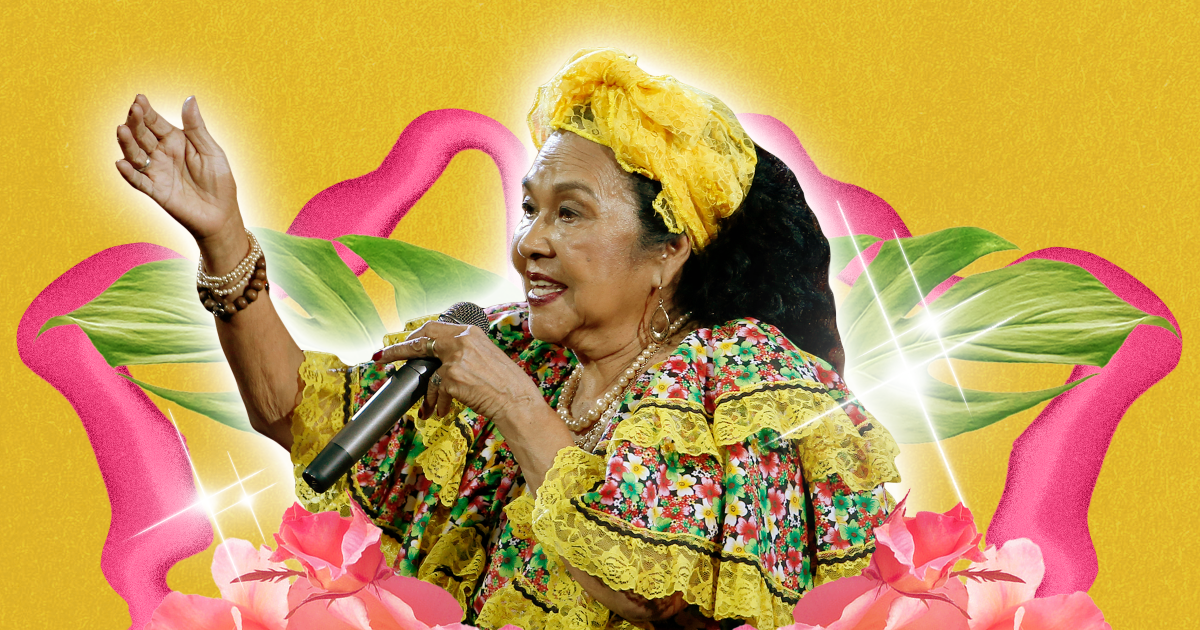
Legendary Colombian folk singer Totó La Momposina dies at 85
Colombian folk music icon Totó La Momposina, known as the “Queen of Cumbia,” has died. She was 85.
The Colombian Ministry of Culture announced the lauded vocalist’s death Tuesday morning.
“Today we bid farewell to the eternal Totó. (1940-2026) To the eternal teacher who traveled the entire world to the rhythm of cumbias, porros, mapalés, and bullerengues born in the heart of our land,” the ministry wrote in an X post. “To the eternal Momposina who spoke of the traditional music of the Caribbean, empowered it, and enriched it for decades to write an entire chapter in the cultural history of our country.”
In an Instagram post from the artist’s official account, her children provided a cause of death.
“With profound sorrow, we, her children Marco Vinicio, Angelica Maria, and Euridice Salome Oyaga Bazanta, announce the passing of our mother, Sonia Bazanta Vides, better known as Totó la Momposina, surrounded by her family in Celaya, Mexico, on Sunday, May 17. Cause of death: myocardial infarction,” the post read.
The children also touched on the enduring legacy that their mother left behind.
“Totó was a woman who, with her voice and extraordinary dedication, carried the culture and memory of the Colombian people to the far corners of the world. Her joy, light, wisdom, talent, generosity, and many other virtues touched the lives of countless people,” they continued in the post. “She shared with the world the music, culture, dances, and essence of Colombia’s Caribbean coast. Her name will forever remain in the memory of those who admired her, accompanied her and loved her.”
Born Sonia Bazanta Vides in 1940 in the Colombian town of Talaigua Nuevo, Totó la Momposina was born to a family with Afro-Colombian and Indigenous roots. Her music was renowned for incorporating the percussive and melodic instruments unique to her cultural identity. Both of her parents were amateur musicians and she began performing on stage at the age of six.
Her musical taste and sound was informed by the Afro-Indigenous rhythms of the traditional mapalé, chalupa, porro, bullerengue and cumbia genres that originated in Columbia and which she studied by visiting musicians in neighboring villages throughout her youth.
After moving to the Colombian capital of Bogotá in the 1960s, she immersed herself in the city’s music scene and began performing as part of a group. Totó la Momposina moved to Paris in the 1980s to study music at the Sorbonne University.
When Colombian author Gabriel García Márquez received the Nobel Prize in literature in 1982, she accompanied him to Stockholm and was among several Colombian artists to perform at the ceremony.
Hot on the heels of some international recognition, Totó la Momposina released her debut solo album “La Verdolaga” in 1983. She would later catapult to greater worldwide fame after she formed an artistic relationship with English musician Peter Gabriel. Under Gabriel’s Real World Records label, Totó la Momposina released her 1993 album “La Candela Viva,” which received international acclaim and a formative text in the cumbia and bullerengue genres.
In 2011, she was award record of the year at the 12th annual Latin Grammy Awards, alongside Calle 13, Susana Baca and Maria Rita for the track “Latinoamérica.” The singer also received a Latin Grammy lifetime achievement award in 2013.