budget proposal

Disability rights advocates protest proposed cuts to in-home support services

Disability rights advocates on Monday gathered outside the state Capitol to push back on Gov. Gavin Newsom’s proposed cuts to in-home supportive services.

“These aren’t just numbers in a budget; these are real people,” said Assemblymember Jeff Gonzalez (R-Indio). “These are children, seniors, veterans and individuals with disabilities whose independence and quality of life depend on these services every single day.”

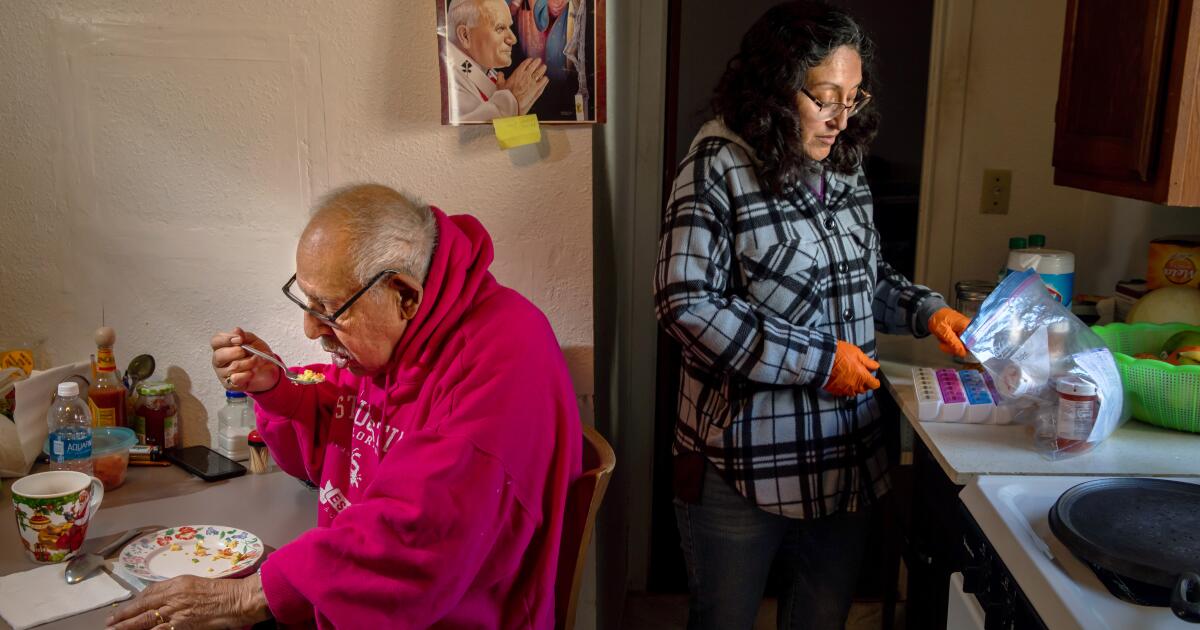
The In-Home Supportive Services program helps disabled and elderly people remain in their houses by providing in-home care. It pays assistants to help with tasks such as showering, cooking or attending doctor appointments. Newsom’s revised budget proposal, which was unveiled last month, would cut $367.7 million from the program and shift some of that financial burden onto counties.

Gonzalez explained that the issue hits close to home for his family. He said his son has cerebral palsy and a seizure disorder, and relies on assistance to live with dignity.

“Families should not have to wonder every budget season whether the support they rely on will be taken away,” Gonzalez said. “These services should not be treated as bargaining chips in budget negotiations.”

Assemblymember Laurie Davies (R-Laguna Niguel) questioned why a successful state like California would need to enact such cuts.

“It’s hard to go a day without hearing the governor or the administration brag about how we are the fourth-largest economy in the world and yet we can’t fully fund [this program for] the most vulnerable?” Davies said.

The governor has previously explained that difficult decisions must be made as the state could soon face an economic downturn. The budget proposal relies on a tax windfall, largely attributed to the stock market success of artificial intelligence companies, to erase California’s deficit — but some analysts have warned that the AI bubble could burst.

H.D. Palmer, deputy director for external affairs for the California Department of Finance, on Monday said some of the proposed cuts are a byproduct of the federal government’s changes in funding and eligibility for health and human services programs.

The so-called “Big, Beautiful Bill” signed by President Trump last year shifted federal funding away from safety-net programs, he said.

Palmer stressed that state budget negotiations are ongoing.

“Until we land on an agreement, speculation regarding the resolution of any specific differences between the Governor’s budget plan or the Legislature’s respective budget proposals would be premature,” he stated by email.

Monday’s event drew some bipartisan support. Brody Fernandez, communications director for Assemblymember Esmeralda Z. Soria (D-Fresno), said the legislator had been fighting for In-Home Supportive Services funding since she was elected.

Fernandez said his daughter has special needs and her mother had to give up her career to become a full-time caregiver. “This is personal for us and for many of the incredible individuals standing behind me,” he said.

Graham Knaus, chief executive of the California State Assn. of Counties, told The Times that he appreciated efforts to raise awareness about the burden these changes would place on counties.

“We applaud the Senate and Assembly for recognizing counties’ concerns and rejecting this proposal,” he said. “We ask them to hold the line in final negotiations.”

Elizabette Guecamburu, a bookkeeper who has a rare neuromuscular disorder, spoke at Monday’s rally and implored the governor to remember the teachings of their shared alma mater Santa Clara University, a Jesuit-led private school.

“I want him to remember where he came from,” she said, adding that students were taught to value compassion and community. “Don’t forget your Jesuit roots.”

Source link

Immigrant rights advocates rally for more state healthcare funding, criticize Newsom

Human rights advocates on Tuesday rallied outside the state Capitol to push back on Gov. Gavin Newsom’s proposed budget plan to reduce state-sponsored healthcare coverage for undocumented immigrants.

“We are here to demand a budget that protects California’s values,” said Kiran Savage-Sangwan, executive director of California Pan-Ethnic Health Network. “We are fighting for a budget that rejects Medi-Cal cuts, seeks new revenues and strengthens our safety net reserve to keep families whole.”

Newsom last week unveiled his revised budget proposal, which would further move away from his previous policy to provide free healthcare coverage to all low-income undocumented immigrants.

His proposal would require monthly premiums for undocumented immigrants receiving coverage from Medi-Cal, the state’s version of the federal Medicaid program. It would also continue to block new adult applications, a cutback imposed last year.

The governor has explained that his original policy was more costly than expected and that difficult decisions must be made as the state could soon face an economic downturn.

Speakers at Tuesday’s rally argued this was unacceptable.

The cuts would force many immigrants to choose between putting food on the table or visiting a doctor, said Savage-Sangwan. She said certain groups, including refugees, older adults and those with disabilities, would be left especially vulnerable.

“These are the kinds of actions we would expect from a federal government that scapegoats immigrants and sends violent ICE forces to terrorize our community,” she said. “Instead, these proposals were made by our own governor in a state that claims to value immigrant communities. We know California is better than this.”

The governor’s office did not respond to a request for comment about the rally.

The event drew about 100 attendees, including Anahi Araiza, a policy researcher with Imperial Valley Equity and Justice. She told The Times that many immigrants in their community struggle to afford medical care and subsequently put off doctor visits.

“They wait until it’s an absolute emergency,” she said. “We’ve heard stories where people delay care and then get diagnosed with Stage 4 cancer.”

The event was supported by several organizations, including California Pan-Ethnic Health Network, Survivors of Torture International, Communities Organized for Relational Power in Action, Health4All Coalition, and Organizing Rooted in Abolition, Liberation and Empowerment.

One man carried a large sign with an image of the Virgin Mary that read “Safety Net For All.” Other marchers donned flowing monarch butterfly wings. The orange-and-black insect became a symbol for the pro-migrant movement years ago because it travels long distances between Mexico and the United States.

Meanwhile, another group gathered outside the Capitol for a news conference to raise awareness about the instability caused by federal healthcare cuts.

Assemblymembers Patrick Ahrens (D-Sunnyvale), Robert Garcia (D-Rancho Cucamonga) and Tina S. McKinnor (D-Hawthorne) joined several doctors and nurses to call for a $500-million state investment into public hospitals.

“Public hospitals are the backbone of our healthcare system,” Ahrens said. “It is estimated that federal cuts will strip over $3 billion a year from the California public hospital system — we cannot balance our budget on the backs of the most vulnerable Californians.”

The Republican-backed “Big Beautiful Bill” signed by President Trump last year shifted federal funding away from safety-net programs and toward tax cuts and immigration enforcement. During a legislative hearing this year, healthcare professionals warned state lawmakers the cuts would harm all patients, including those with private insurance.

Source link

Newsom offers early peek at rosy budget projections

Hours before Gov. Gavin Newsom is expected to present his budget plan on Thursday, his office released new projections of a $16.5-billion state revenue windfall over three years and offered a rosy outlook on California’s fiscal position during his final year in office and the year after.

Newsom’s office provided few details about his plan to reduce spending or other adjustments that he would need to propose in combination with the increase in revenue to eliminate projected deficits from 2026-27 through 2027-28.

The unusual early look at his budget proposal comes as Newsom begins to wind down his time at the state Capitol and considers a run for president in 2028.

Two weeks ago, the Legislative Analyst’s Office issued an analysis of state spending that said California could not, in the long term, afford to pay for existing services and the new programs that Newsom and Democratic lawmakers have enacted since he took office in 2019. State spending has outpaced California’s strong revenue growth by about 10%, creating a perennial budget shortfall, defined as a structural deficit.

California’s spending problem threatens to define Newsom’s fiscal legacy and could provide ripe fodder for his critics. If projections of the unexpected tax windfall, which analysts attribute to stock market interest in artificial intelligence companies, bear out, the upswing could mark a lucky break for Newsom.

The governor has largely resisted adopting new across-the-board tax increases or sharply curtailing his expensive policy proposals in order to align state spending with revenue.

His budget proposal includes a call to increase taxes on corporations by limiting state tax credits to no more than $5 million, or 50% of a company’s tax liability, beginning in the tax year 2027. No estimates were offered to explain how much revenue the new cap would bring in to support the state budget.

The preview of his budget has several new spending proposals, including providing $300 million to help low-income Californians keep $0 monthly premiums on healthcare coverage through the Affordable Care Act in response to cuts by the federal government, as well as $100 million to help wildfire victims afford construction loans to rebuild their homes. Two days before Mother’s Day, Newsom also introduced a plan to provide 400 free diapers for every California newborn at select hospitals beginning this summer.

Newsom is expected to present his budget in more detail late Thursday morning in Sacramento.

Source link