Don’t forget why Harry and Meghan left the U.K. in the first place
Prince Harry and Meghan Markle are reportedly moving back across the pond, six years after their dramatic exit from the Royal family stunned Americans and Britons and exposed scandal in Buckingham Palace.
The Duke and Duchess of Sussex will return to British soil along with their two young children, Prince Archie and Princess Lilibet, for an extended period starting this month, People reported last week. While the pair’s decision may be unsurprising to some, Prince Harry and Meghan made clear in 2020 that their personal Brexit was because of several factors, ranging from severe scrutiny by the British media to alleged racism and bullying from the royal family.
Meghan, during the couple’s memorable tell-all interview with Oprah Winfrey in 2021, spoke plainly of her experience among the royals: “I just didn’t want to be alive anymore. And that was very clear and real and frightening.”
King Charles III is aware of the plans for his son and Meghan‘s U.K. return and “welcomes the opportunity to see more of the Sussex family in a private and personal capacity,” People reported. The spouses are also said to retain their property in the affluent Santa Barbara enclave of Montecito, and vacation home in Portugal while also making a “private, non-royal” home in Britain. This retrospective tracks the early years of the highly scrutinized pair’s relationship, the fallout from their royal exit, their media ventures and more.
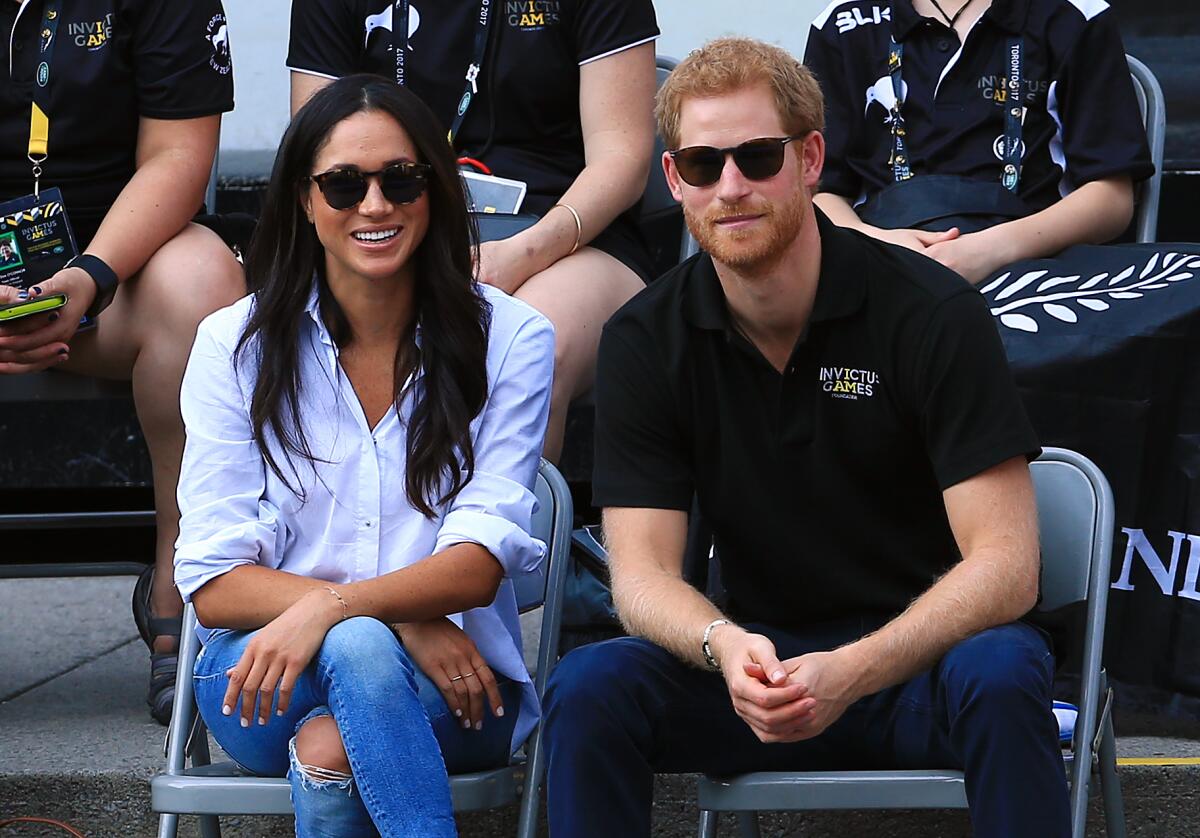
When Harry met Meghan

Meghan Markle and Prince Harry attend a Wheelchair Tennis match during the Invictus Games 2017 at Nathan Philips Square in Toronto, Canada.
(Vaughn Ridley / Getty Images)
“Personally, I love a great love story.”
That’s what Meghan Markle, formerly of “Suits” fame, told Vanity Fair in October 2017. By then, more than a year of media speculation and rumors surrounded the L.A.-raised actor and activist’s romance with Britain’s Prince Harry, younger brother to Prince William and the second son of Charles and the late Princess Diana, who was killed at age 36 in 1997 after the car she was in crashed while fleeing paparazzi in Paris.
Meghan and Prince Harry kindled a romance in 2016 at that year’s edition of his veteran-centered Invictus Games, held in Orlando. Markle quickly found herself in the beloved “bad boy” Royal’s orbit — including the tireless swarm of tabloids and paparazzi who have captured almost his every move from childhood. The pair was already subject to media frenzy early in their relationship, prompting Harry via Buckingham Palace to plead with reporters to respect his then-girlfriend’s privacy and to condemn the “outright sexism and racism” in online comments. Markle had also remarked early on that she was disheartened that so much coverage of her romance focused on her ethnicity.
News of their engagement in 2017 further raised eyebrows among the public and even more so with established British tabloids, including the Daily Mail, which had once described the pair’s relationship as a “VERY unlikely romance.” In the context of the longstanding (and almost exclusively white) British monarchy, Meghan was an outsider: American, mixed-race (she is half white and half Black), an outspoken public figure and a divorcée (she was previously married to film producer Trevor Engelson).
Prince Harry and Meghan married in May 2018 and were named Duke and Duchess of Sussex. At the time, Prince Harry was sixth in line to the British throne. During the wedding ceremony, the Rev. Michael Bruce Curry heralded the pair’s union with calls for justice and equality — amid the country’s early steps into leaving the European Union — and made references to the Rev. Martin Luther King Jr.
“When love is the way, there’s plenty of room for all of God’s children,” Curry said during the ceremony. “When love is the way, we actually treat each other — well, like we are actually family.”
Between the newlyweds and the British royals, family ties proved only so strong.
Buckingham Palace faces a new era of controversy

As new parents, the Duchess and Duke of Sussex pose with their newborn son, Archie Harrison Mountbatten-Windsor, at Windsor Castle on May 8, 2019 in England.
(WPA pool / Getty Images)
Marrying into British royalty did not shield Meghan from criticism, speculation and attacks by the press — it appeared to have the opposite effect. Sound familiar?
British tabloids and several media personalities continued taking aim at Meghan, portraying her as a rude “trailer trash” personality amid a rumored riff with Princess Kate and using racist imagery to mock the arrival of her firstborn son, Archie, in 2019. The public ridicule remained ceaseless, but alleged tension was also brewing behind palace walls.
Less than a year after their first heir’s arrival, the Duke and Duchess announced in a shocking personal statement in 2020 that they would step down as senior members of the royal family and would work to become financially independent. They also announced at the time that they would split their time between the U.K. and North America. A year later, the spouses announced they would not return to royal duties. Shortly after, they memorably shed light on their decision in a bombshell CBS interview with Oprah Winfrey, unleashing a disturbing look into their life as members of the royal family.
Meghan claimed that while pregnant with Archie, she and her husband were informed their son would not have the title of prince or princess, which she said deviated from longtime protocol, and would not be entitled to security. The actor also implied that during discussions about her son’s title, there were “also concerns and conversations about how dark his skin might be when he’s born.”
“They were concerned that if he were too brown, that that would be a problem?” Winfrey asked.
“If that’s the assumption you’re making,” Meghan replied, “I think that’s a pretty safe one.” She did not identify the person who made the remarks: “I think that would be very damaging to them.”
Winfrey later clarified that Harry said neither his grandmother Queen Elizabeth II or his grandfather Prince Philip “were a part of those conversations.”
Meghan also spoke about her struggles with her mental health while part of the royal family. She revealed that she was suicidal while pregnant with Archie, citing isolation and helplessness amid ceaseless attacks by the press.
“I just didn’t want to be alive anymore. And that was a very clear and real and frightening constant thought,” she said, adding that she went to the palace’s corporate institution for help. “I was told that I couldn’t, that it wouldn’t be good for the institution.” At the time of the interview, Harry and Meghan revealed they were expecting a baby girl. Lilibet was born June 2021.
“The whole family is saddened to learn the full extent of how challenging the last few years have been for Harry and Meghan,” Buckingham Palace said in a statement responding to the spouses’ interview. “The issues raised, particularly that of race, are concerning. While some recollections may vary, they are taken very seriously and will be addressed by the family privately.”
Royal fallout

Prince Harry with Meghan, standing behind Prince William and Kate, during the funeral service for Queen Elizabeth II in September 2022.
(WPA pool / Getty Images)
In addition to Harry and Meghan’s self-demotion, Buckingham Palace faced tragedy and additional criticism in the following years. Prince Philip died in April 2021 and long-reigning Queen Elizabeth II died in September 2022 at age 96. Prince Harry and Meghan both attended the queen’s funeral, but under close watch by the British media.
Charles ascended to the throne after Queen Elizabeth’s death, marginally moving up Harry and his children with Meghan — the children later received their royal titles of prince and princess. — in the line of succession to the British throne.
When 2023 arrived, so did a fresh batch of revelations about the Windsors. Prince Harry published his memoir, “Spare,” providing readers an unflinching look at his family but an even more unforgiving description of the paparazzi. In the book he recalled needing to ask his grandmother’s permission to propose to Meghan, wrote that older brother Prince William had “been pretty discouraging about my even dating Meg” and accused queen consort Camilla of making shady deals with the press.
Months after the memoir’s publication, Prince Harry and Meghan were asked to vacate their British home of Frogmore Cottage on the grounds of Windsor Castle. Reportedly, King Charles began the eviction process the day after his son published the memoir.

Meghan, left, and Chrissy Teigen in an episode of Netflix’s “With Love, Meghan.”
(Jake Rosenberg / Netflix)
As Meghan and Harry moved to separate themselves from the royal family and from life in the U.K., they settled down in California in the affluent neighborhood of Montecito and into new business ventures. Among their earliest post-palace endeavors was the creation of multimedia company Archewell Productions, which in September 2020 inked a multiyear deal with Netflix to produce series, docuseries, documentaries and other programming.
For Netflix, the spouses have put forward numerous projects, including documentary series and reality shows “Harry & Meghan,” “Heart of Invictus” and cooking show “With Love, Meghan.” The pair opted last year to maintain its relationship with the streaming giant, signing another multiyear, first-look deal.
Additionally the ex-royals’ Archewell Audio inked a multiyear deal with Spotify to produce podcasts and shows for the platform in a deal that was reportedly worth $20 million. Archewell Audio released a 30-minute holiday special in 2020 and one audio series — “Archetypes” — hosted by Meghan in August 2022. The Duke and Duchess of Sussex‘s podcasting endeavor at Spotify ended in 2023.
Unsurprisingly, Prince Harry and Meghan, who have also busied themselves with various philanthropic causes, faced backlash for their Spotify departure. Meghan was also accused of faking some “Archetypes” interviews.
In addition to big-swing media ventures, Meghan launched a lifestyle and food business that had undergone multiple name changes. She initially launched her brand under the moniker American Riviera Orchard, specializing in artisan jams she notably gifted to celebs, including Kris Jenner, Chrissy Teigen and Mindy Kaling. She later rebranded the line to As Ever, following a minor roadblock with the U.S. Patent and Trademark Office.
“I was figuring it out in real time,” she told People of the naming debacle in 2025. She also said she now sees herself “as an entrepreneur and a female founder.”
According to recent reporting, Meghan can add “actor” back into that description. She is reportedly in talks to join the third season of Guy Ritchie’s Netflix series “The Gentleman.” That would be her first acting gig since the end of “Suits” and marrying into the royal family.